
Judge, 1912-07-06 · page 6 of 24
Judge — July 6, 1912 — page 6: what you’re looking at
What you’re looking at
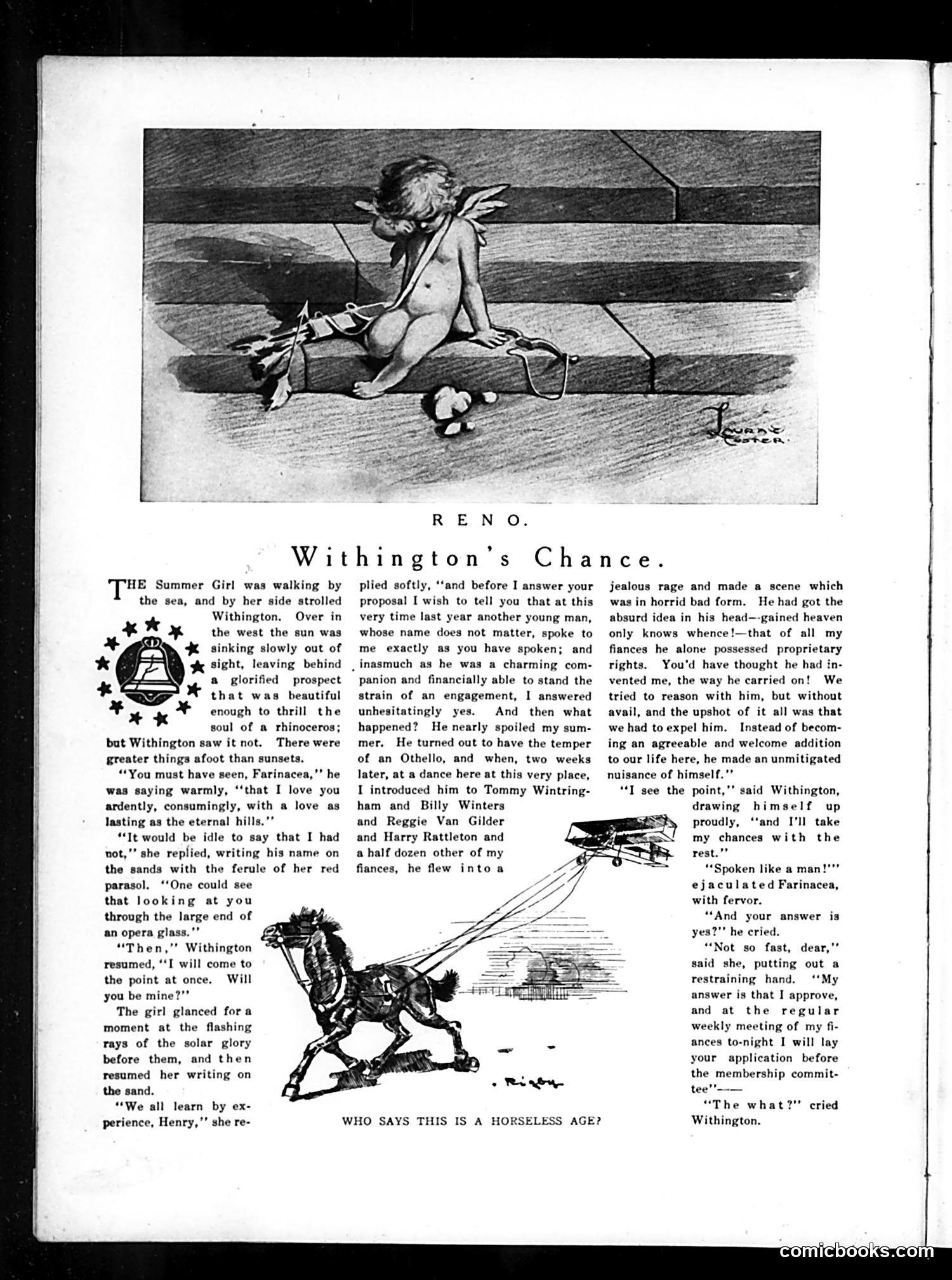
This page satirizes the "modern woman" and changing courtship customs of the early 20th century. The story mocks a young woman named Farinacea who maintains multiple simultaneous engagements like a business portfolio. The joke targets two things: first, the absurdity of a woman casually juggling multiple fiancés and holding formal "membership meetings" to evaluate them; second, the implicit criticism of men (like Withington) who naively accept such arrangements. The woman's casual mention of expelling a previous fiancé for jealous behavior—treating romantic exclusivity as an "absurd idea"—satirizes emerging attitudes about romantic freedom. The illustration above shows a cherub on a log, likely representing naive romance or youth, contrasting with the cynical matrimonial marketplace depicted in the text. The final punchline—Withington's shock at learning about the formal committee process—suggests that even progressive attitudes have limits. Judge presents this as ridiculous social excess.
📄 Transcribed text from this page (OCR, searchable)
Machine-transcribed from the original scan — historical spelling and the odd misread are preserved.
Withington’s TH Summer Girl was walking by the sea, and by her side strolled «x y Withington. Over in the west the sun was HK sinking slowly out of $ sight, leaving behind « * a glorified prospect that was beautiful ar enough to thrill the soul of a rhinoceros; but Withington saw it not. There were greater things afoot than sunsets. “You must have seen, Farinacea,’* he was saying warmly, ‘‘that I love you ardently, consumingly, with a love as lasting as the eternal hills.’ “It would be idle to say that I had not,’ she replied, writing his name on the sands with the ferule of her red parasol. ‘‘One could see that looking at you through the large end of an opera glass."” “Then Withington resumed, ‘‘I will come to the point at once, Will you be mine?” The girl glanced fora moment at the flashing rays of the solar glory before them, and then resumed her writing on the sand. “We all learn by ex- perience, Henry,’’ she re- 4 * WHO SAYS Cha plied softly, ‘‘and before I answer your proposal I wish to tell you that at this very time last year another young man, whose name does not matter, spoke to me exactly as you have spoken; and _ inasmuch as he was a charming com- panion and financially able to stand the strain of an engagement, I answered unhesitatingly yes. And then what happened? He nearly spoiled my sum- mer. He turned out to have the temper of an Othello, and when, two weeks later, at a dance here at this very place, I introduced him to Tommy Wintring- ham and Billy Winters and Reggie Van Gilder and Harry Rattleton and a half dozen other of my fiances, he flew into a > Rie IS A HORSELESS AGE? nce. jealous rage and made a scene which was in horrid bad form. He had got the absurd idea in his head—-gained heaven only knows whence!—that of all my fiances he alone possessed proprietary rights. You'd have thought he had in- vented me, the way he carried on! We tried to reason with him, but without avail, and the upshot of it all was that we had to expel him. Instead of becom- ing an agreeable and welcome addition to our life here, he made an unmitigated nuisance of himself.’’ “T see the point,’’ said Withington, drawing himself up proudly, ‘‘and I'll take my chances with the rest.’" “Spoken like a man!'"” ejaculated Farinacea, with fervor. “And your answer is 2" he cried. Not so fast, dear,’’ said she, putting out a restraining hand. ‘*My answer is that I approve, and at the regular weekly meeting of my fi- ances to-night I will lay your application before the membership commit- tee’’—— “The what?" cried Withington.