
Judge, 1912-07-06 · page 21 of 24
Judge — July 6, 1912 — page 21: what you’re looking at
What you’re looking at
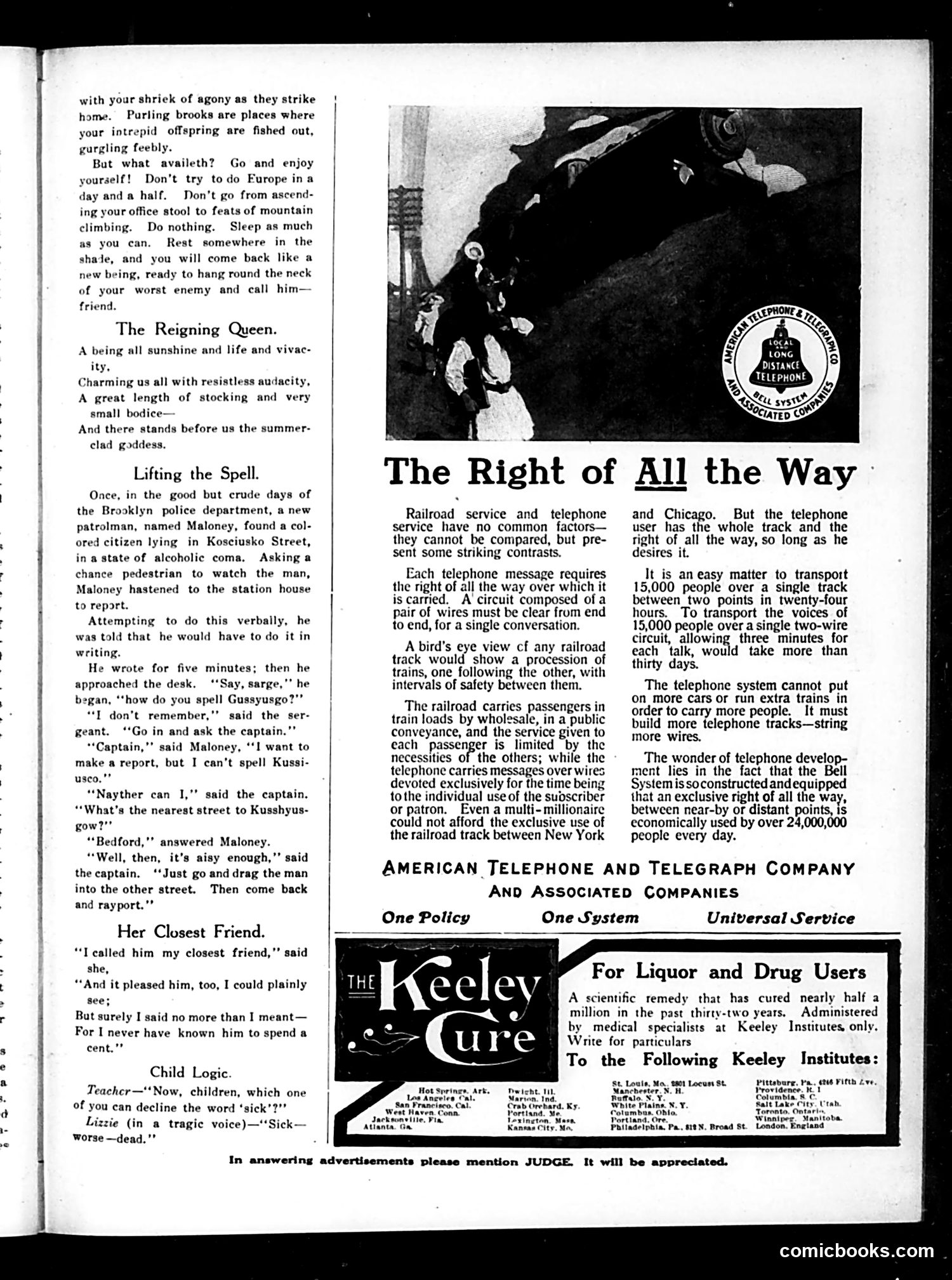
This page is primarily a corporate advertisement for AT&T, explaining the telephone system's superiority to railroads. The central argument compares infrastructure: railroads must share tracks among many trains sequentially, but telephone wires serve individual users exclusively during each call. The ad emphasizes that telephone service is more efficient and personalized than rail transport—a single caller gets "the right of all the way" over their circuit, whereas railroad passengers share conveyances with others. The text suggests this exclusive access is a marvel of modern engineering. The surrounding content—short humorous pieces like "Lifting the Spell" (a Brooklyn police anecdote) and "Child Logic"—appears to be typical Judge magazine filler material unrelated to the advertisement. This represents early-20th-century corporate messaging celebrating telephone infrastructure as a technological marvel worthy of public admiration.
📄 Transcribed text from this page (OCR, searchable)
Machine-transcribed from the original scan — historical spelling and the odd misread are preserved.
6 SEAR Ct a with your shriek of agony as they strike home. Purling brooks are places where your intrepid offspring are fished out, gurgling feebly. But what availeth? Go and enjoy yourself! Don't try todo Europe ina day anda half. Don't go from ascend- ing your office stool to feats of mountain Do nothing. Sleep as much Rest somewhere in the climbing. as you can. shade, and you will come back like a new being, ready to hang round the neck of your worst enemy and call him— frie The Reigning Queen. A being all sunshine and life and vivac- ity, Charming us all with resistless audacity, A great length of stocking and very small bodice— And there stands before us the summer- clad goddess. Lifting the Spell. Once, in the good but crude days of the Brooklyn police department, a new patrolman, named Maloney, found a col- ored citizen lying in Kosciusko Street, in a state of alcoholic coma, Asking a chance pedestrian to watch the man, Maloney hastened to the station house to report. Attempting to do this verbally, he was told that he would have to do it in writing. He wrote for five minutes; then he approached the desk. ‘‘Say, sarge,"’ he began, ‘thow do you spell Gussyusgo?”’ “I don’t remember,’’ said the ser- geant. ‘‘Go in and ask the captain."’ “Captain,” said Maloney, ‘‘1 want to make a report, but I can’t spell Kussi- usco,"” “‘Nayther can I,’’ said the captain. “‘What’s the nearest street to Kusshyus- gow?” “*Bedford,’’ answered Maloney. “Well, then, it’s aisy enough,” said the captain. ‘‘Just go and drag the man into the other street. Then come back and rayport.’” Her Closest Friend. “Tecalled him my closest friend,’’ said she, ‘And it pleased him, too, I could plainly see; But surely I said no more than I meant— For I never have known him to spend a cent.”” Child Logic. Teacher—‘Now, children, which one of you can decline the word ‘sick’?”" Lizzie (in a tragic voice)—‘*Sick— Worse —dead.’" | The Right of All the Way Railroad service and telephone service have no common factors— they cannot be compared, but pre- sent some striking contrasts. Each telephone message requires the right of all the way over which it is carried. A’ circuit composed of a pair of wires must be clear from end to end, for a single conversation. A bird's eye view cf any railroad track would show a procession of trains, one following the other, with intervals of safety between them. The railroad carries passengers in train loads by wholesale, in a public conveyance, and the service given to each passenger is limited by the necessities of the others; while the telephone carries messages over wires devoted exclusively for the time being to the individual use of the suoscriber or patron. Even a multi- millionaire could not afford the exclusive use of the railroad track between New York and Chicago. But the telephone user has the whole track and the right of all the way, so long as he desires it. It_is an easy matter to transport 15,000 people over a single track between two points in twenty-four hours. To transport the voices of 15,000 people over a single two-wire circuit, allowing three minutes for each talk, would take more than thirty days. The telephone system cannot put On more cars or run extra trains in order to carry more people. It must build more telephone tracks—string more wires. The wonder of telephone develop- ment lies in the fact that the Bell System is soconstructed and equipped that an exclusive right of all the way, between near-by or distant points, is economically used by over 24,000,000 people every day. AMERICAN TELEPHONE AND TELEGRAPH COMPANY AND ASSOCIATED COMPANIES One Policy One System Universal Service For Liquor and Drug Users A scientific remedy that has cured nearly half a million in the past thirty-two years, Administered by medical specialists at Keeley Institutes only. Write for particulars To the St. Louie, Mo, 2801 Locust St. Manchester. N. H. u na TN. J ‘Orebard. Ky. Haven. C Portiand Jacksonelite. Pia. Atlanta. Gm In answering advertisements please mention JUDGE. It will be appreciated. Following Keeley Institutes: Pittebure, Pa. «246 Fifth £ve. Providence. Kt 0. N.Y Columbia. & © Plains. N.Y. Salt Lake City. Utah, bas, Oba. Taranto. Ontari-. Winnipeg. Manitoba. ‘Ore. ladeIpbia, Pa, 818N. Broad St. London, England comicbooks.com