
Judge, 1912-07-06 · page 12 of 24
Judge — July 6, 1912 — page 12: what you’re looking at
What you’re looking at
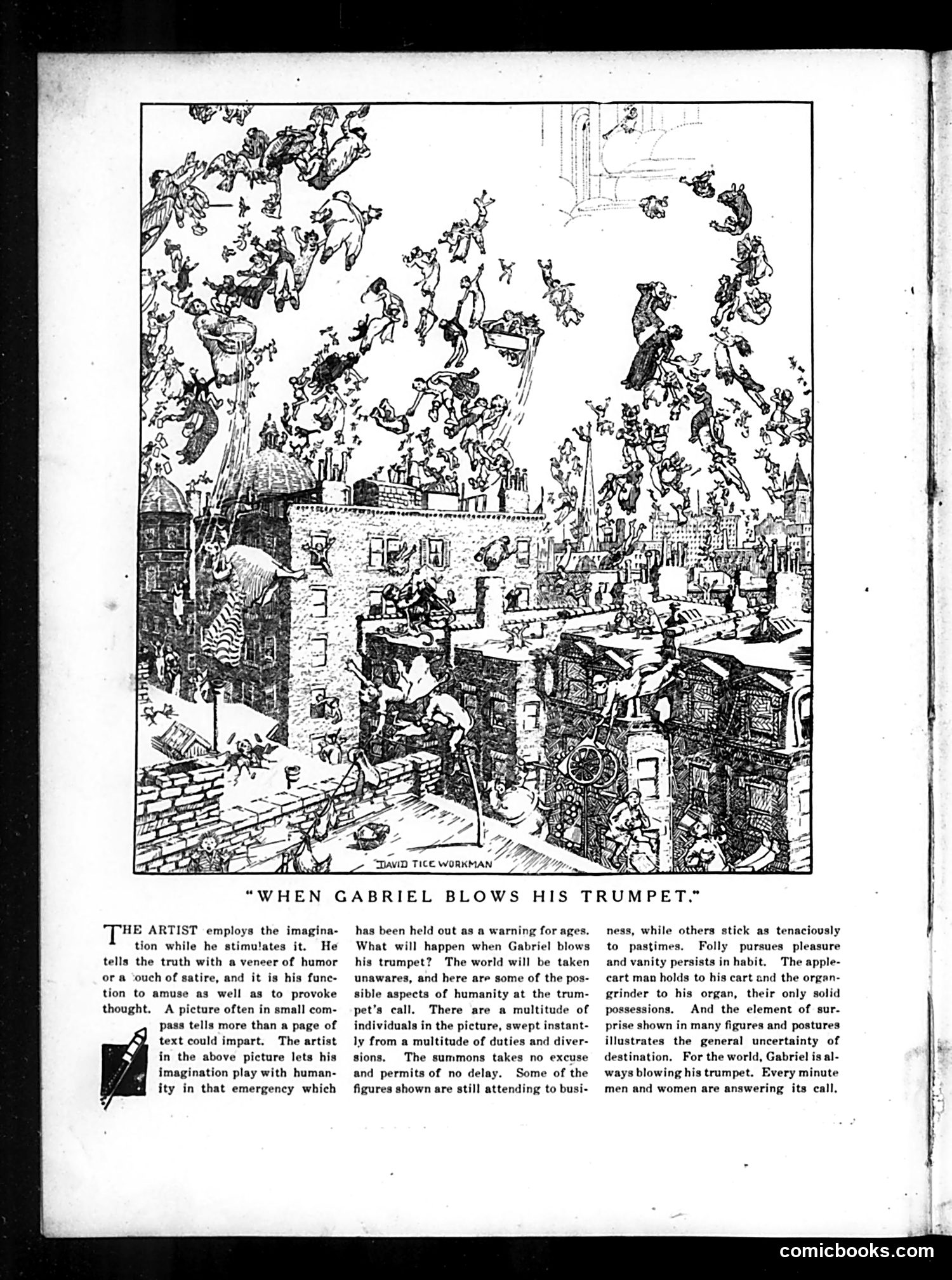
This satirical illustration by David T. Workman depicts the Christian apocalyptic moment when the Archangel Gabriel's trumpet signals the end times. The cartoon shows a crowded city scene with dozens of figures engaged in various activities—business, leisure, vanity—who are suddenly caught by the trumpet's call. The satire critiques human nature: people cling desperately to worldly possessions and habits (an apple-cart vendor, an organ-grinder) rather than spiritual preparation. The accompanying text explains the artist's point: that while most view Gabriel's trumpet as a distant warning, in reality death (life's "trumpet") calls people constantly, every minute. The cartoon mocks humanity's complacency and materialism in the face of mortality, suggesting people should prioritize spiritual concerns over earthly pursuits and possessions.
📄 Transcribed text from this page (OCR, searchable)
Machine-transcribed from the original scan — historical spelling and the odd misread are preserved.
“WHEN GABRIEL BLOWS HIS TRUMPET.” HE ARTIST employs the imagina- tion while he stimulates it. He tells the truth with a veneer of humor or a ‘ouch of satire, and it is his func- tion to amuse as well as to provoke thought. A picture often in small com- pass tells more than a page of text could impart. The artist in the above picture lets his imagination play with human- ity in that emergency which has been held out as a warning for ages. What will happen when Gabriel blows his trumpet? The world will be taken unawares, and here are some of the pos- sible aspects of humanity at the trum- pet’s call. There are a multitude of individuals in the picture, swept instant- ly from a multitude of duties and diver- sions, The summons takes no excuse and permits of no delay. Some of the figures shown are still attending to busi- ness, while others stick as tenaciously to pastimes. Folly pursues pleasure and vanity persists in habit. The apple- cart man holds to his cart and the organ- grinder to his organ, their only solid possessions, And the element of sur- prise shown in many figures and postures illustrates the general uncertainty of destination. For the world, Gabriel is al- ways blowing his trumpet. Every minute men and women are answering its call. comicbooks.com