
A complete issue · 25 pages · 1912
Judge — June 29, 1912
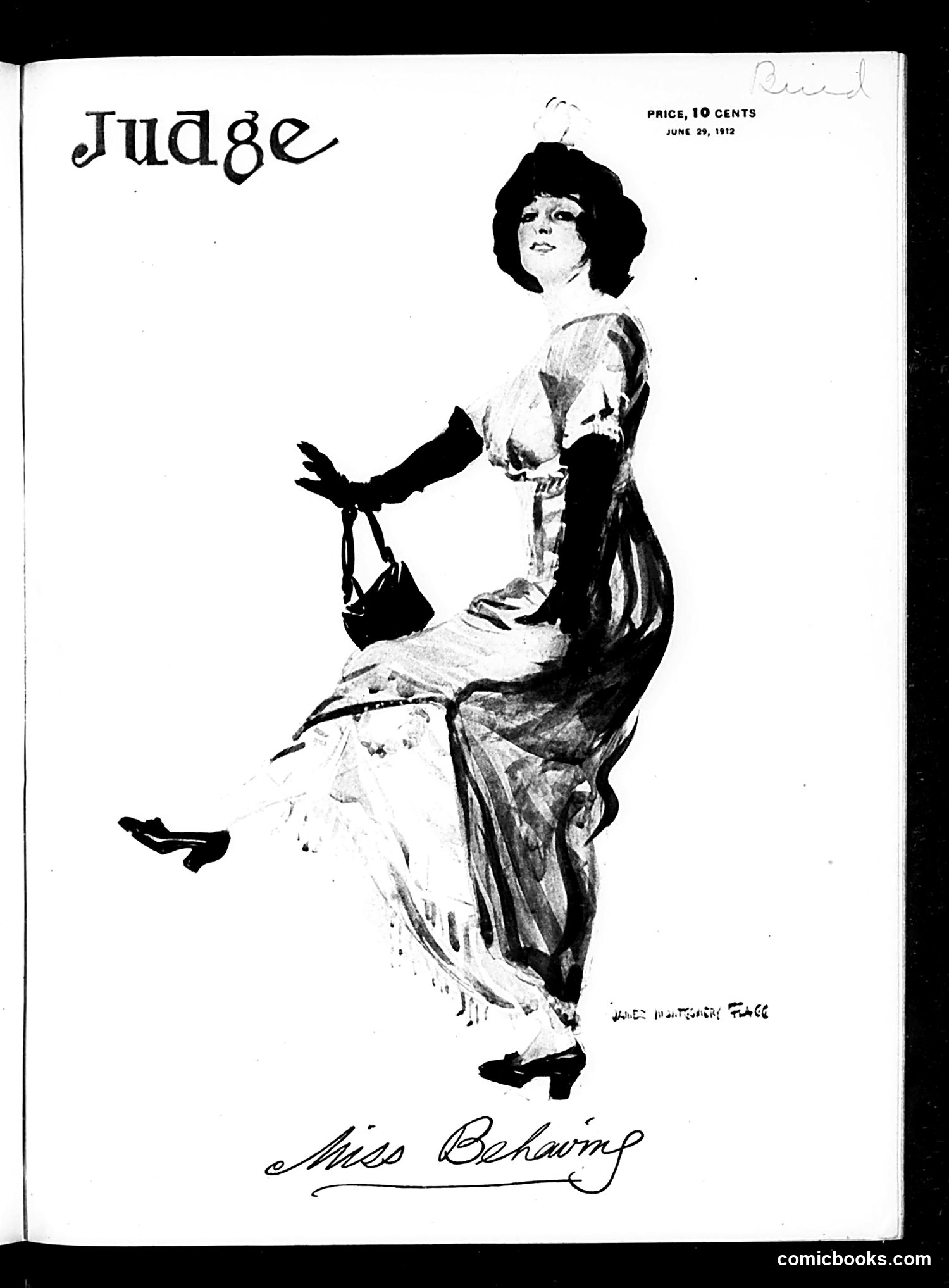
This is a cover illustration by James Montgomery Flagg titled "Miss Behaving." It depicts a fashionable woman in an elegant dress and wide-brimmed hat, posed in an exaggerated, playful manner with one leg extended and a small purse held aloft. The illustration likely satirizes contemporary debates about women's behavior and social propriety during the Progressive Era. The title "Miss Behaving" is a pun—she's misbehaving while appearing refined. This reflects Judge magazine's tendency to mock evolving gender roles and the "New Woman" of the early 1900s who was becoming more independent and less bound by Victorian conventions. The artwork exemplifies the magazine's satirical approach to modern social changes through elegant caricature.
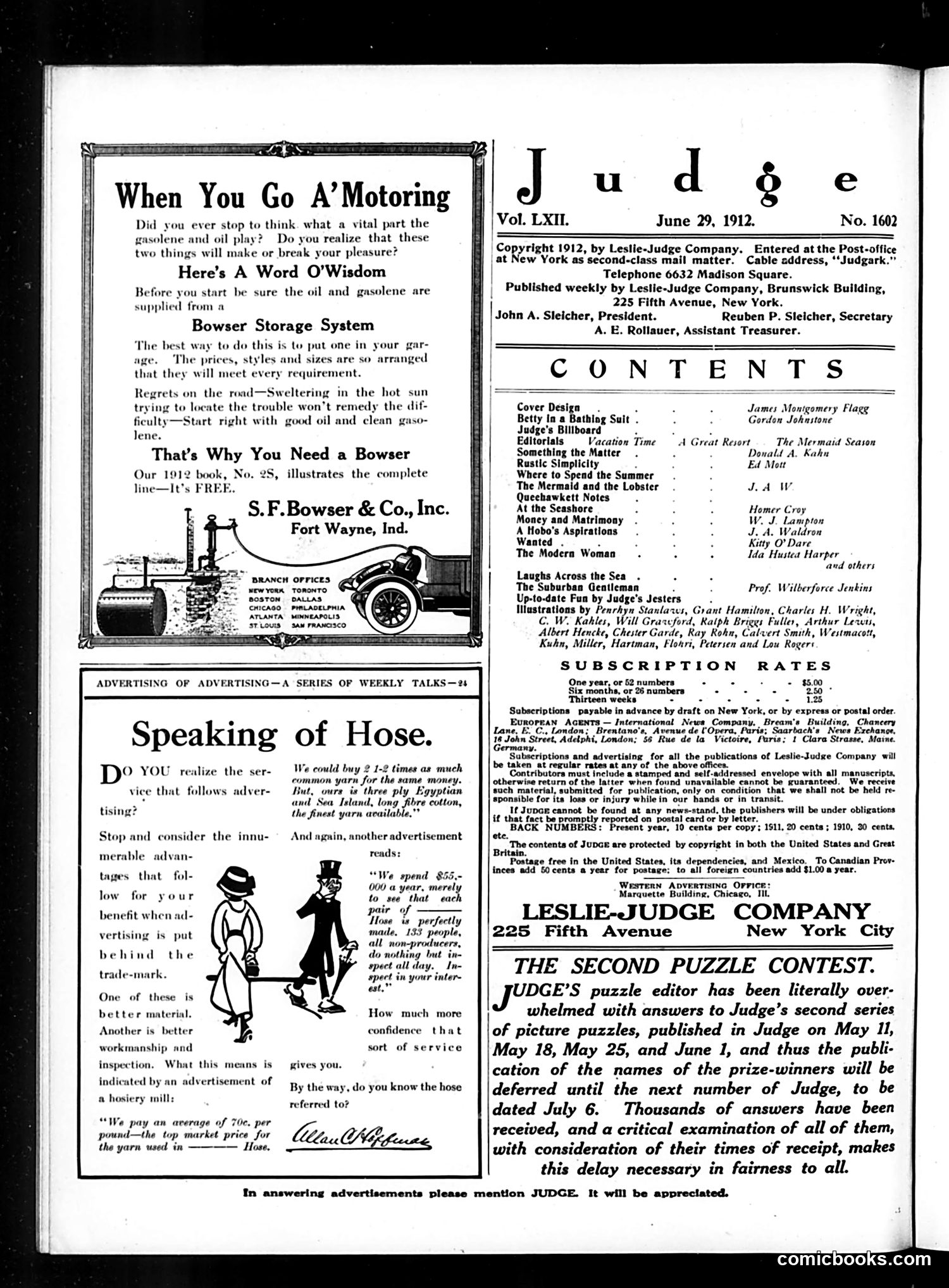
This page is primarily **advertising and editorial content** rather than political satire. The main cartoon, "Speaking of Hose," uses two illustrated figures (a woman and a man in formal dress) to promote a hose product. The joke appears to be a pun playing on the word "hose"—the dialogue references spending money "to see that each bit of goods is correctly made," suggesting quality assurance in manufacturing, likely by S.F. Bowser & Co.'s hose products. The S.F. Bowser advertisement itself promotes automotive storage systems for 1912 automobiles, with branch offices listed across major American cities. The "Second Puzzle Contest" announcement indicates Judge was running contests to engage readers. The page reflects **turn-of-the-century commercial advertising** integrated with light humor rather than sharp political commentary typical of satirical magazines.
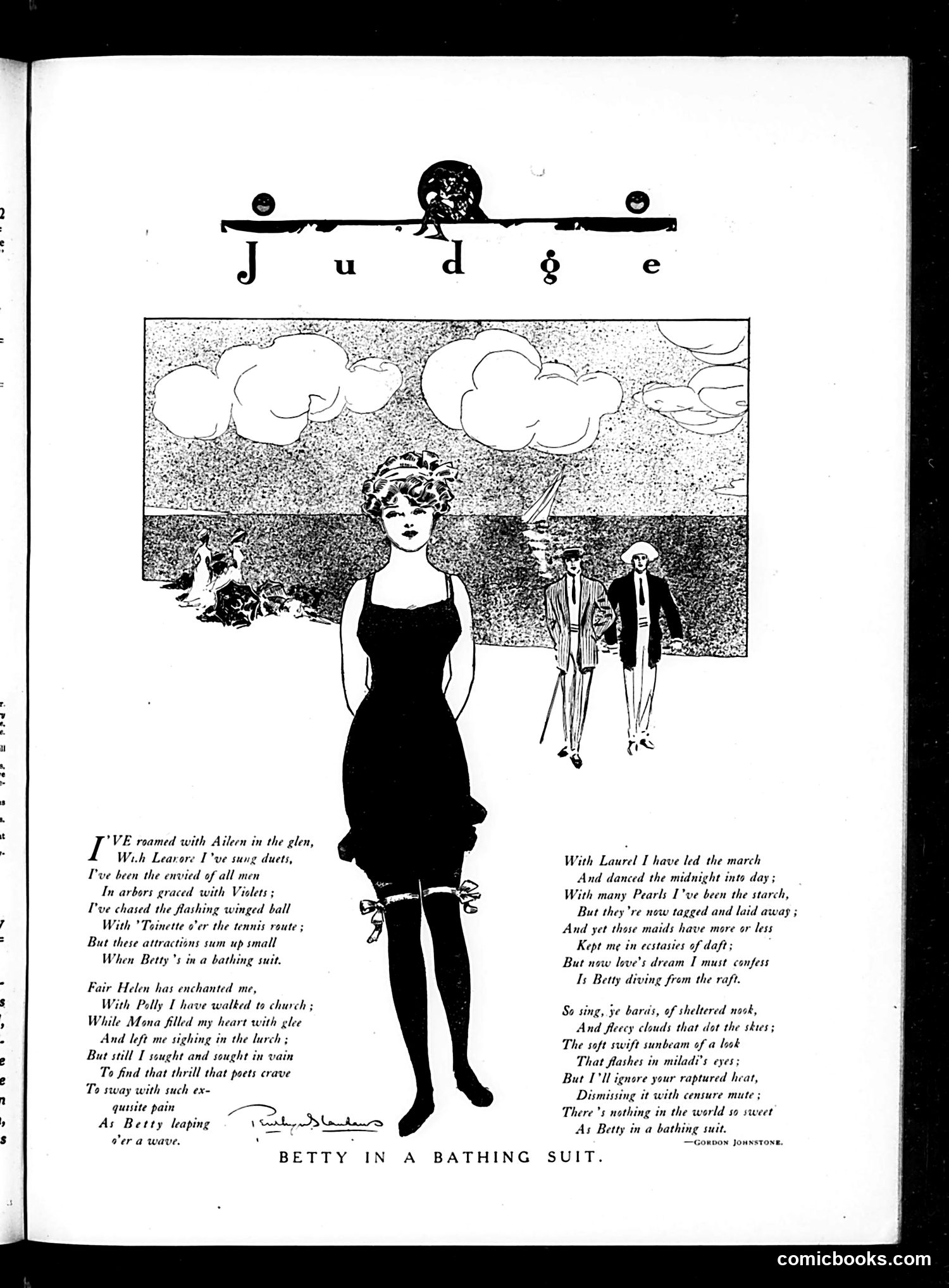
This is a poem by Gordon Johnstone satirizing a young woman named Betty and her social conquests. The illustration shows Betty in a bathing suit, referenced in the poem's title and closing line: "There's nothing in the world is sweet / At Betty in a bathing suit." The verses humorously catalog Betty's romantic and social achievements—enchanting men like Aiken and various named acquaintances (Helen, Polly, Mona), participating in fashionable activities (bathing, dancing, church-going), and generally captivating suitors. The poem's tone is lighthearted mockery of 1920s flapper culture and female social mobility during this era, when young women gained unprecedented freedom in fashion, dating, and public life. The judge illustration style confirms this as social commentary on contemporary youth behavior.
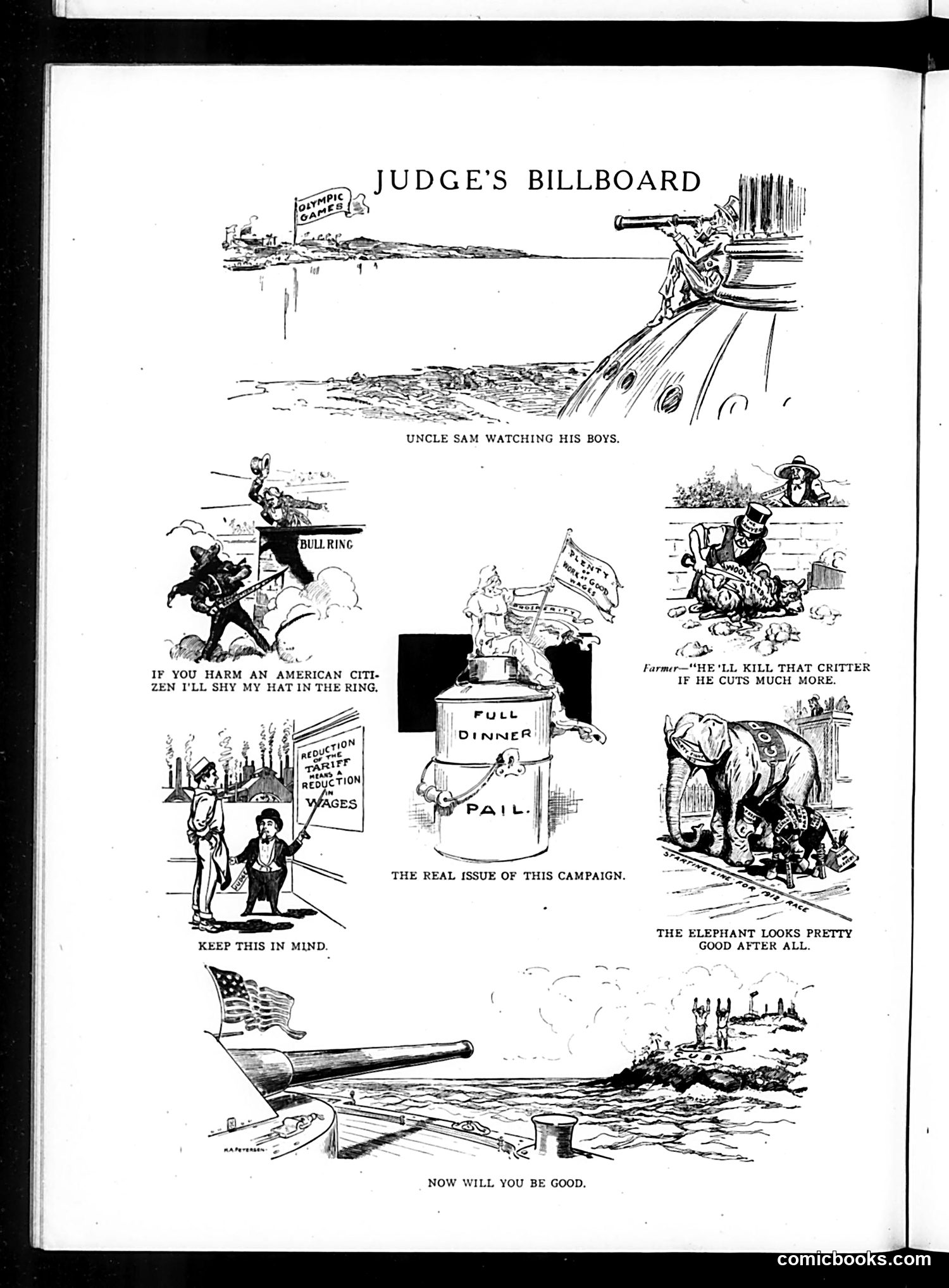
This is a multi-panel satirical commentary on American economic and foreign policy, likely from the late 19th or early 20th century. The central image—"Full Dinner Pail"—references a famous Republican campaign slogan promising prosperity. The surrounding vignettes mock various consequences of protectionist trade policies: - "If you harm an American citizen I'll shy my hat in the ring" references aggressive American foreign policy - Tariff and wage discussions show labor concerns - "The elephant looks pretty good after all" appears to reference the Republican Party symbol - "Uncle Sam watching his boys" and "Now will you be good" suggest paternalistic imperialism The satire argues that aggressive trade protectionism and imperial policies ultimately harm American workers and citizens despite promises of prosperity.
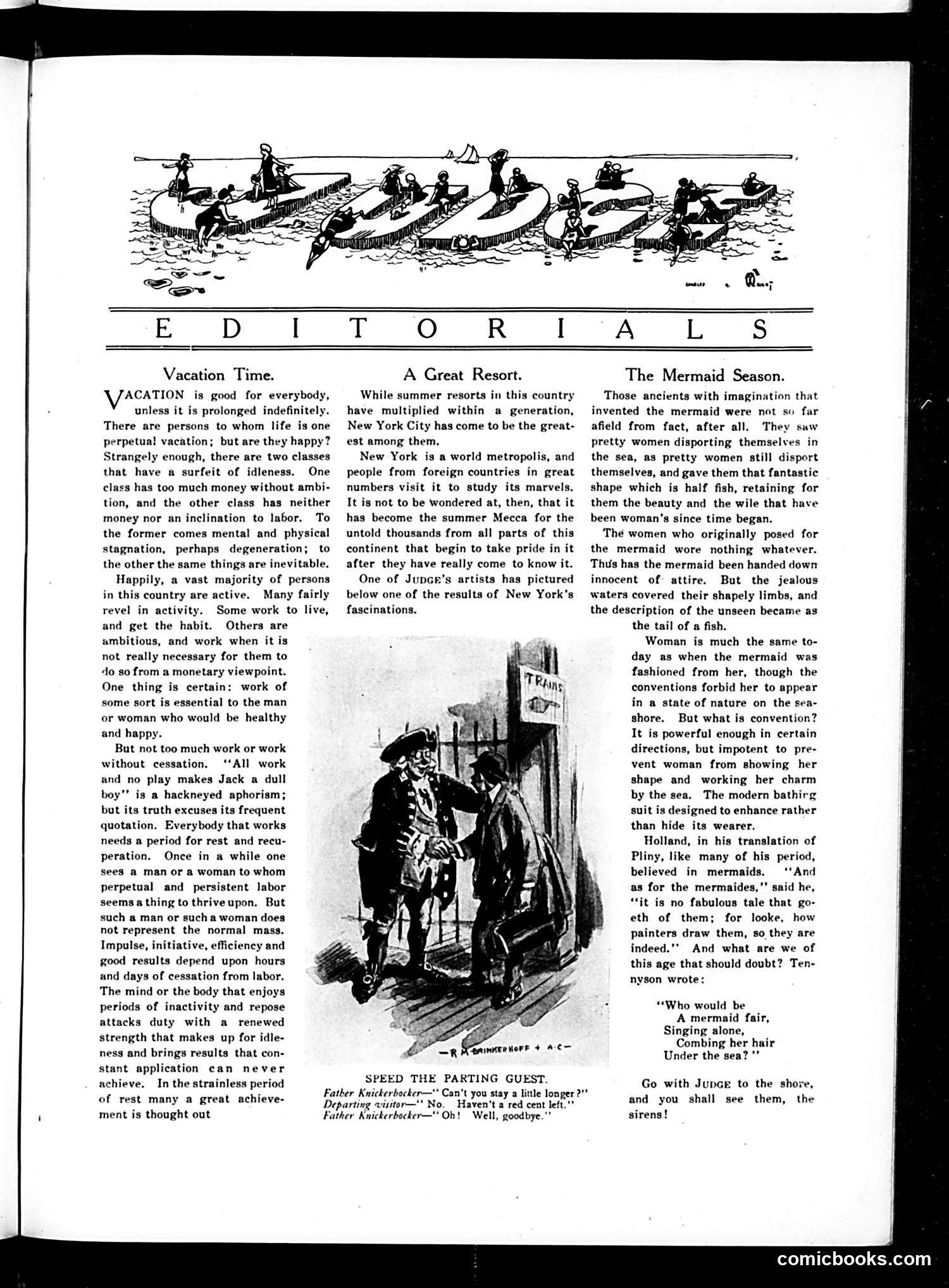
This cartoon depicts a farewell scene at what appears to be a dock or pier. The caption references a father figure trying to speed along departing visitors—likely summer guests returning home after vacation season. The humor plays on the social awkwardness of overstaying guests. The father says "Can't you stay a little longer?" while the departing visitor responds "Haven't a red cent left," and the father cheerfully replies "O! Well, goodbye!"—revealing his actual relief at the guest's departure despite polite pretenses. This satirizes the common social tension between hosts obligated to extend hospitality and their desire to see expensive guests leave. The irony is that the visitor's financial depletion aligns perfectly with the host's unstated wishes.
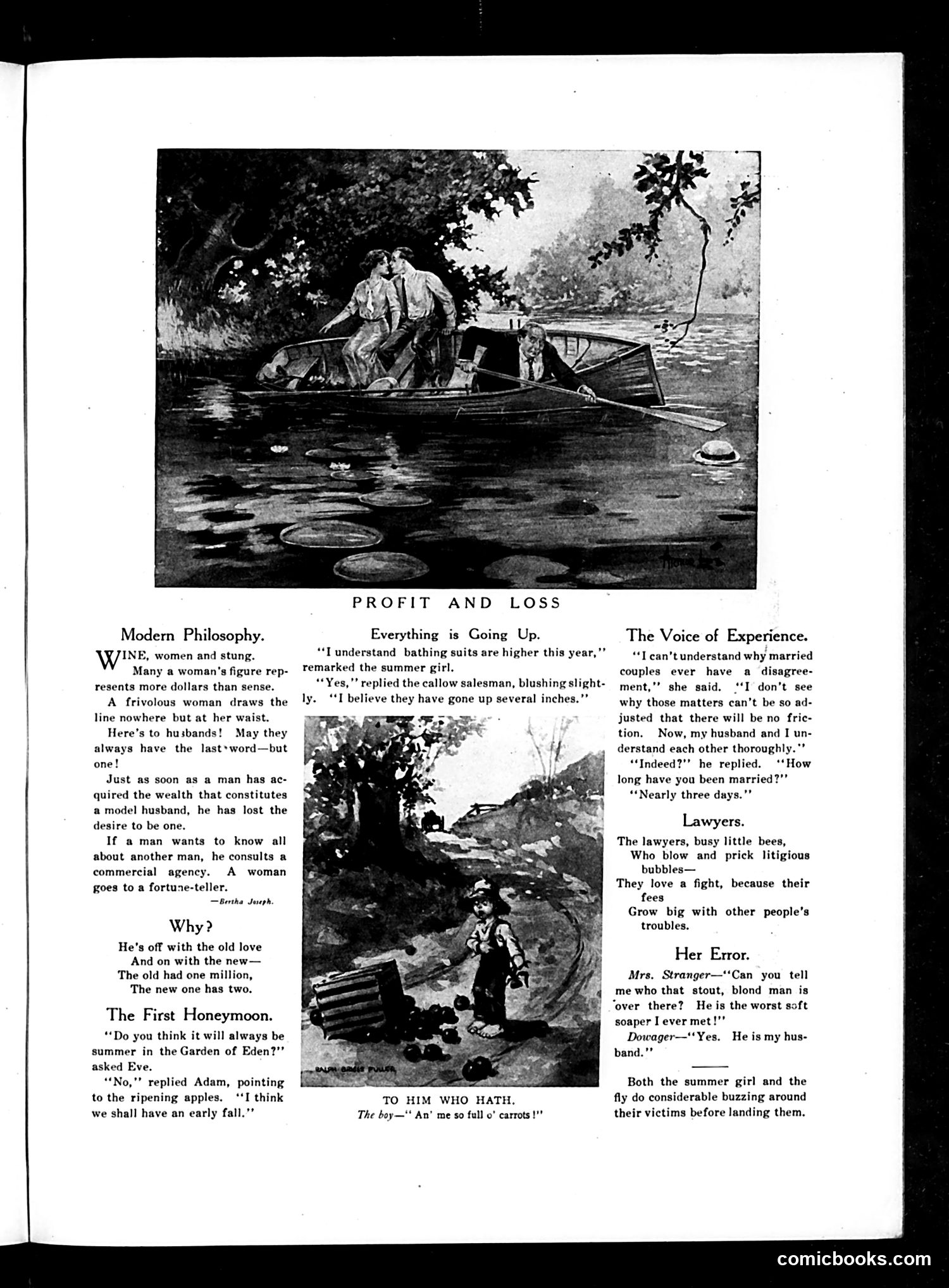
This page collects brief satirical quips and jokes typical of early 20th-century Judge magazine. The content targets several social anxieties: **"Modern Philosophy"** mocks women as frivolous spenders and men as fortune-hunters who lose ambition once wealthy. **"Everything is Going Up"** contains a double-entendre joke: a salesman suggestively comments that bathing suits are "higher" and have "gone up several inches"—playing on both fashion prices and hemlines (a scandalous topic of the era). **"The First Honeymoon"** jokes darkly about marriage's brevity of happiness. **"Lawyers"** presents a standard complaint: lawyers profit from others' disputes. **"Her Error"** and "The Voice of Experience"** mock married couples—the first suggesting a woman married to a flatterer, the second ridiculing newlyweds' naïve belief they understand each other. The river-scene photographs illustrate leisure activities, contrasting with the cynical commentary. Overall, the page reflects era-typical misogyny and marital skepticism.
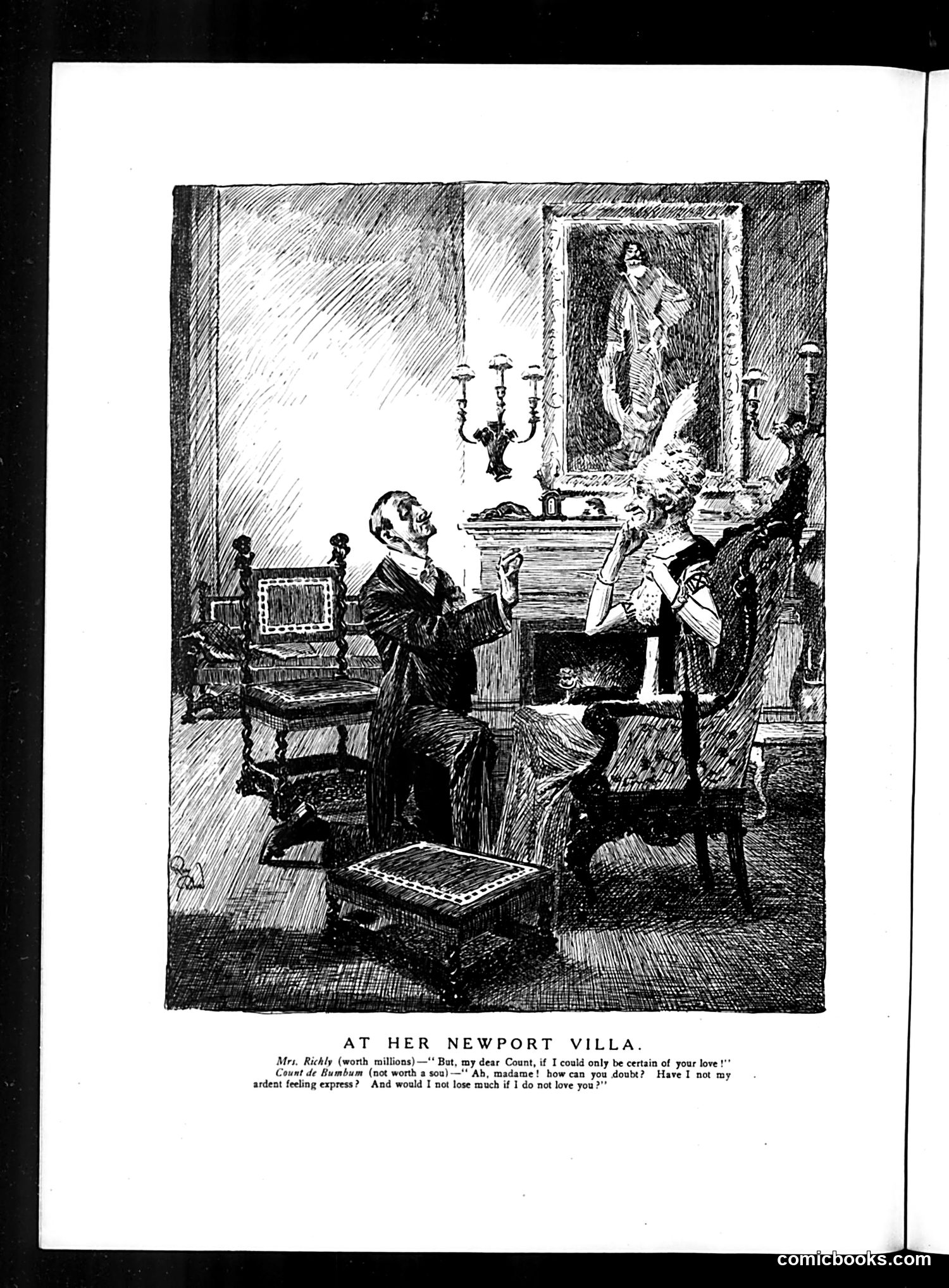
This cartoon satirizes wealthy American women's vulnerability to fortune-hunting European aristocrats. Mrs. Richly, a millionaire, expresses doubt about the Count's love despite his protestations. The joke's bitter edge lies in his final line: he wouldn't "lose much" by not loving her—implying his only motivation is her money, not genuine affection. The "Count de Bumbum" name itself mocks European nobility as ridiculous and worthless ("not worth a sou"). The Newport villa setting references the exclusive Rhode Island resort where wealthy Americans displayed their fortunes. Judge uses this scene to critique both the gullibility of rich American women and the predatory nature of impoverished European title-holders seeking wealthy American wives—a common Gilded Age phenomenon.
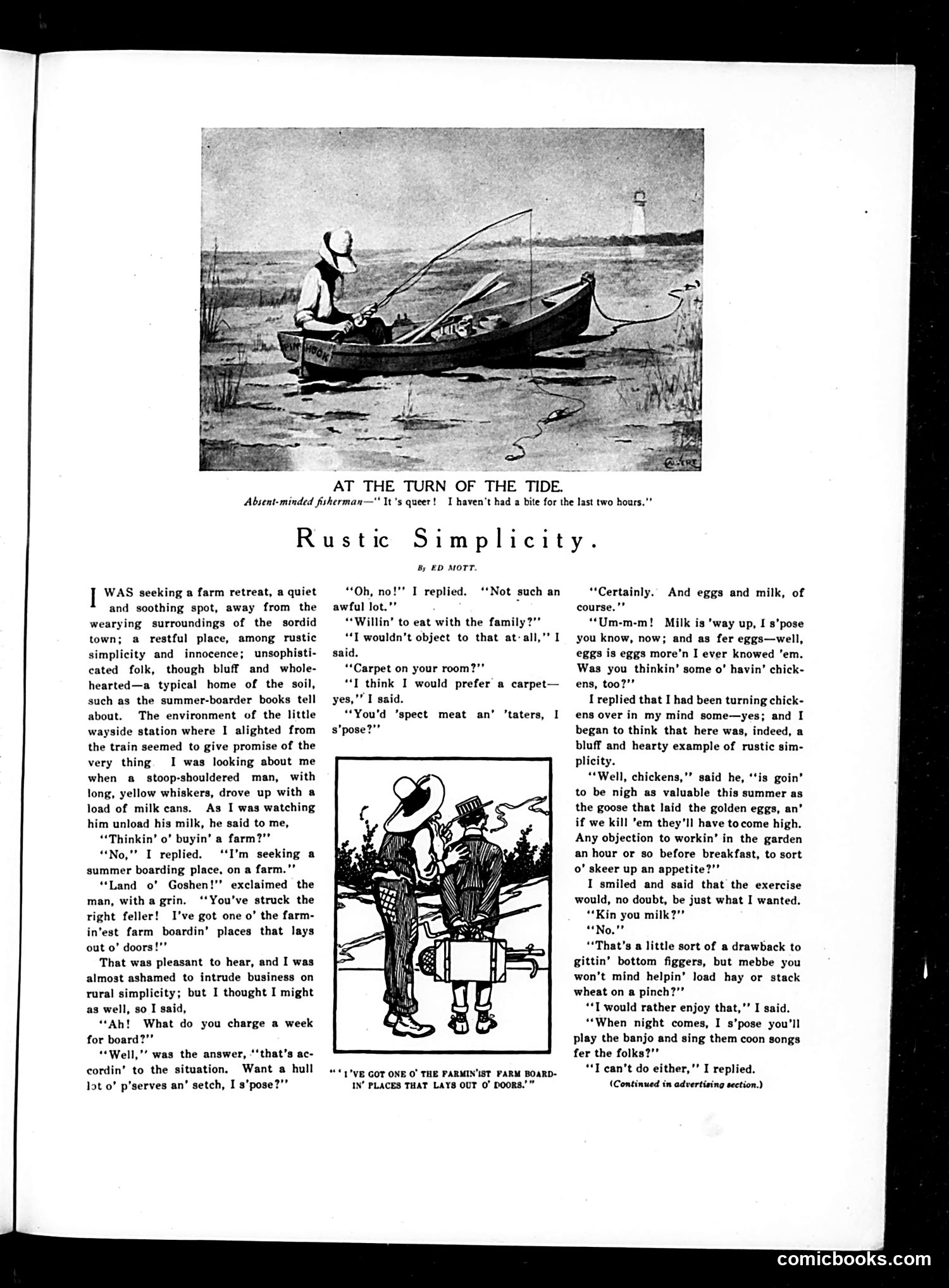
This satirical story mocks the romantic urban fantasy of "rustic simplicity." A city dweller seeking a peaceful farm retreat encounters a shrewd farmer advertising an "outdoor" boarding house. Through a negotiation scene, the farmer systematically reveals that his supposedly simple, affordable country retreat comes with hidden costs and labor expectations. The joke: the farmer extracts payment through inflated food prices (milk and eggs are "way up"), charges extra for basic amenities (carpet, meat), and demands free labor (garden work, hay-stacking, entertainment). The "bluff and wholehearted" rustic proves to be a cunning businessman exploiting the city visitor's romanticized expectations. The satire targets both the naïve urban fantasy of country life and the actual exploitation of summer boarders by rural entrepreneurs. The accompanying fishing cartoon ("At the Turn of the Tide") offers a simpler joke about an impatient fisherman.
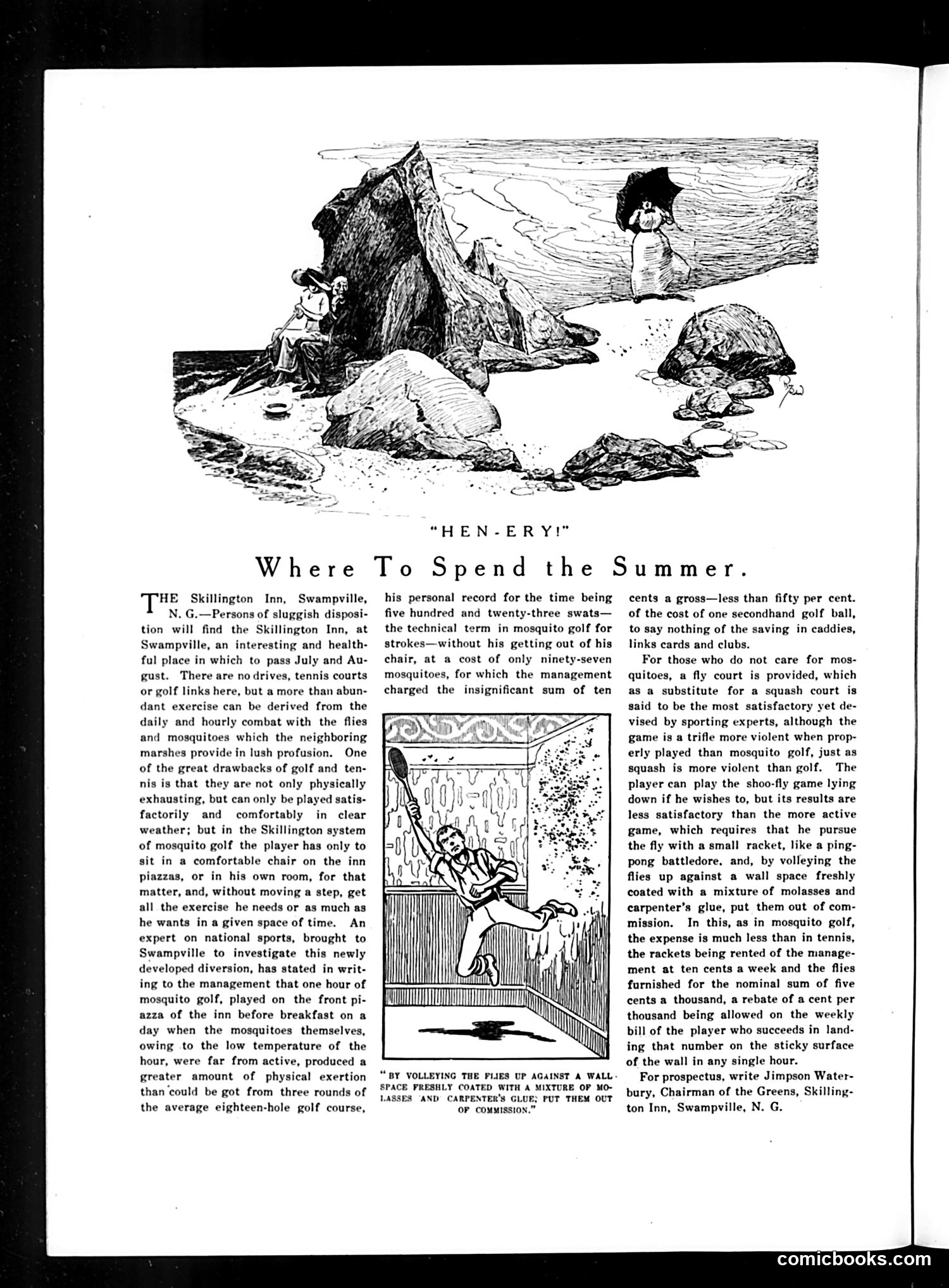
This is a satirical advertisement for the fictional "Skillington Inn" in Swampville, N.C., mocking both rustic vacation destinations and the era's golf obsession. The joke targets wealthy leisure travelers seeking "healthful" summer retreats. The satire invents "mosquito golf" and "fly court" as substitute sports—claiming that swatting insects in a chair provides equal exercise to actual golf, at fraction of the cost. The accompanying illustration shows a guest violently swatting flies indoors using wall-space coated with molasses and glue to immobilize them. The piece ridicules Americans' willingness to accept uncomfortable, absurd conditions if rebranded as fashionable sport. It also mocks the promotional language of resort advertising—presenting a bug-infested swamp as "interesting and healthful" through jargon and false equivalencies. The elaborate pricing scheme for mosquitoes and flies parodies golf's expensive infrastructure (caddies, clubs, course fees).
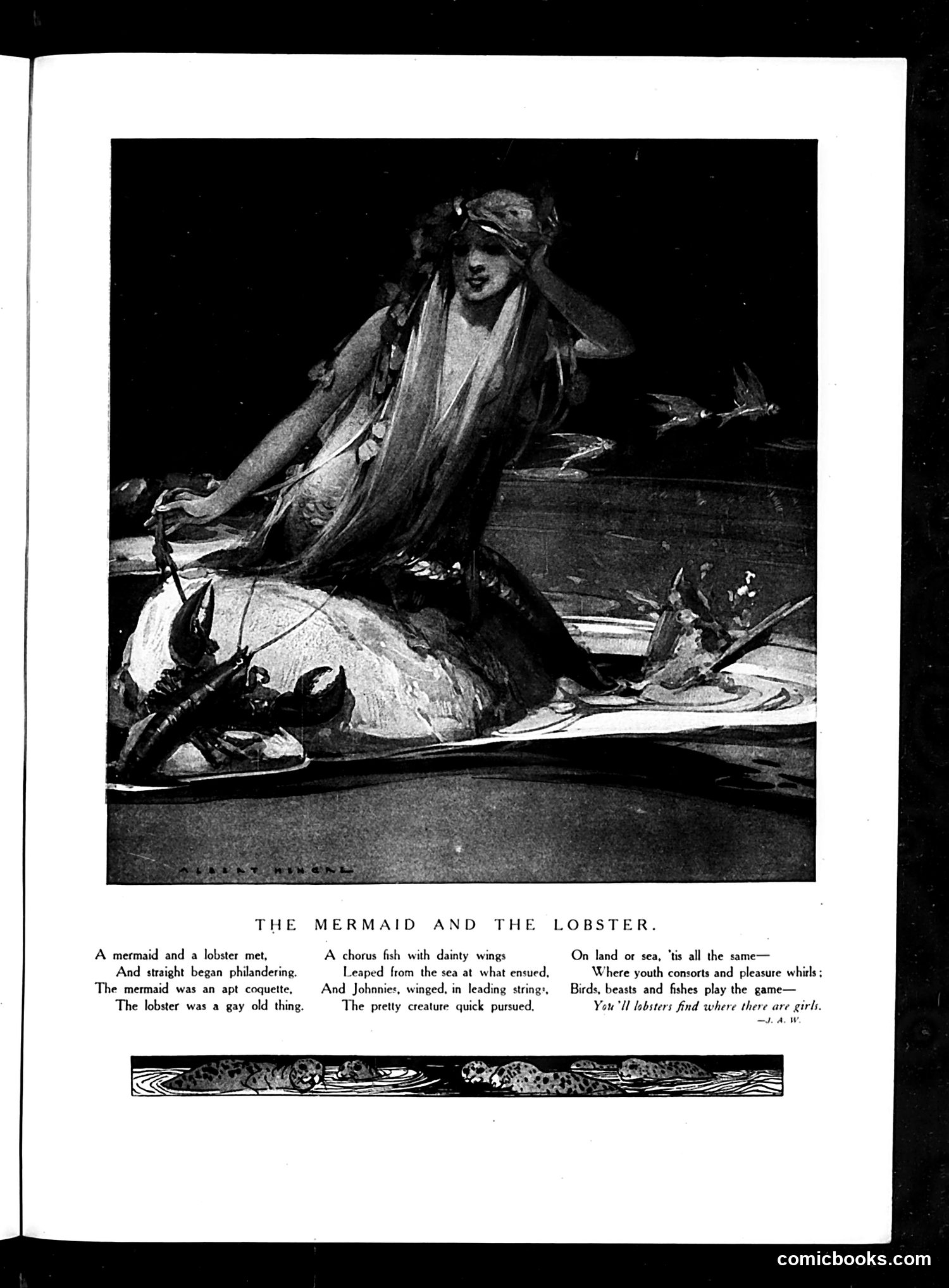
This is a humorous illustrated poem rather than political satire. The image shows a mermaid in classical dress interacting with a lobster in a seaside setting. The poem is a playful moral tale: a flirtatious mermaid ("apt coquette") encounters an amorous lobster ("gay old thing"). The narrative warns that whether on land or sea, youth and pleasure attract suitors—and just as fish pursue the pretty creature in the ocean, so too will "lobsters" (slang for foolish or lecherous men) pursue women wherever they congregate. The concluding line is deliberately cut off in the OCR, but appears to deliver a satirical punchline about where such men congregate. This is mild Victorian-era humor playing on the double meaning of "lobster" as both the crustacean and a derogatory term for males who pursue women.
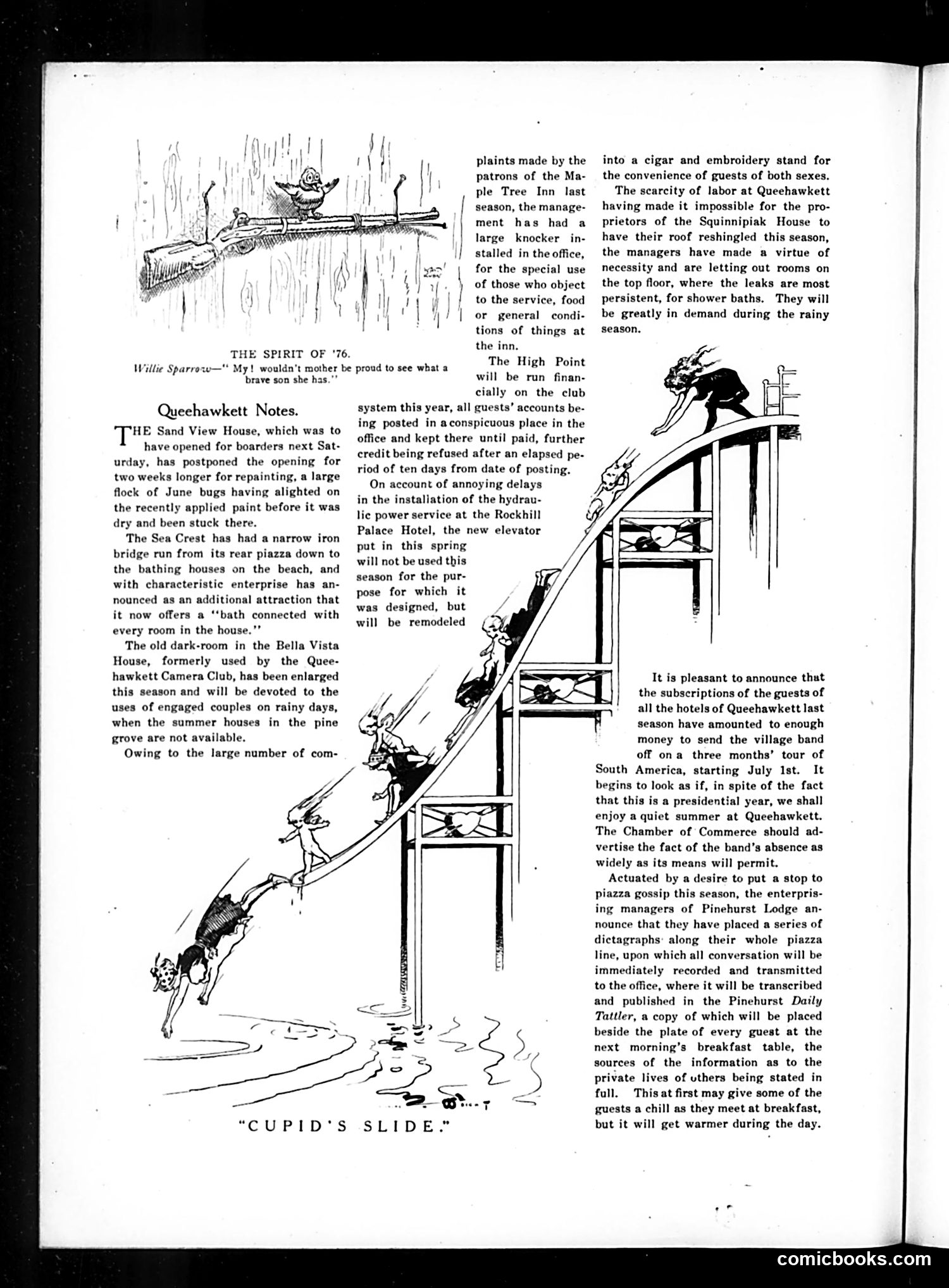
This page contains satirical notes about a fictional resort town called "Queehawkett" and its hotels during summer season. **The cartoons** depict: - "The Spirit of '76": A bird perched on a rifle, captioned with a mother's pride—likely mocking patriotic fervor or military posturing - "Cupid's Slide": Cherubs sliding down a tall structure, probably referencing amorous activities at the resort **The satire targets** resort hotel management's absurd responses to problems: - June bugs stuck in fresh paint (left unpainted) - An "elevator" repurposed as a cigar stand due to installation delays - Rooms rented despite persistent roof leaks as "shower baths" - A "dictagraph" (recording device) installed on the piazza to capture and publish guest gossip in a daily "Tattler" **The joke**: These incompetent or opportunistic hotel managers spin failures into "features," turning bugs, broken equipment, and leaks into selling points—while one manager literally monetizes guest privacy invasion. It's satire about American business corner-cutting and hucksterism at vacation destinations.
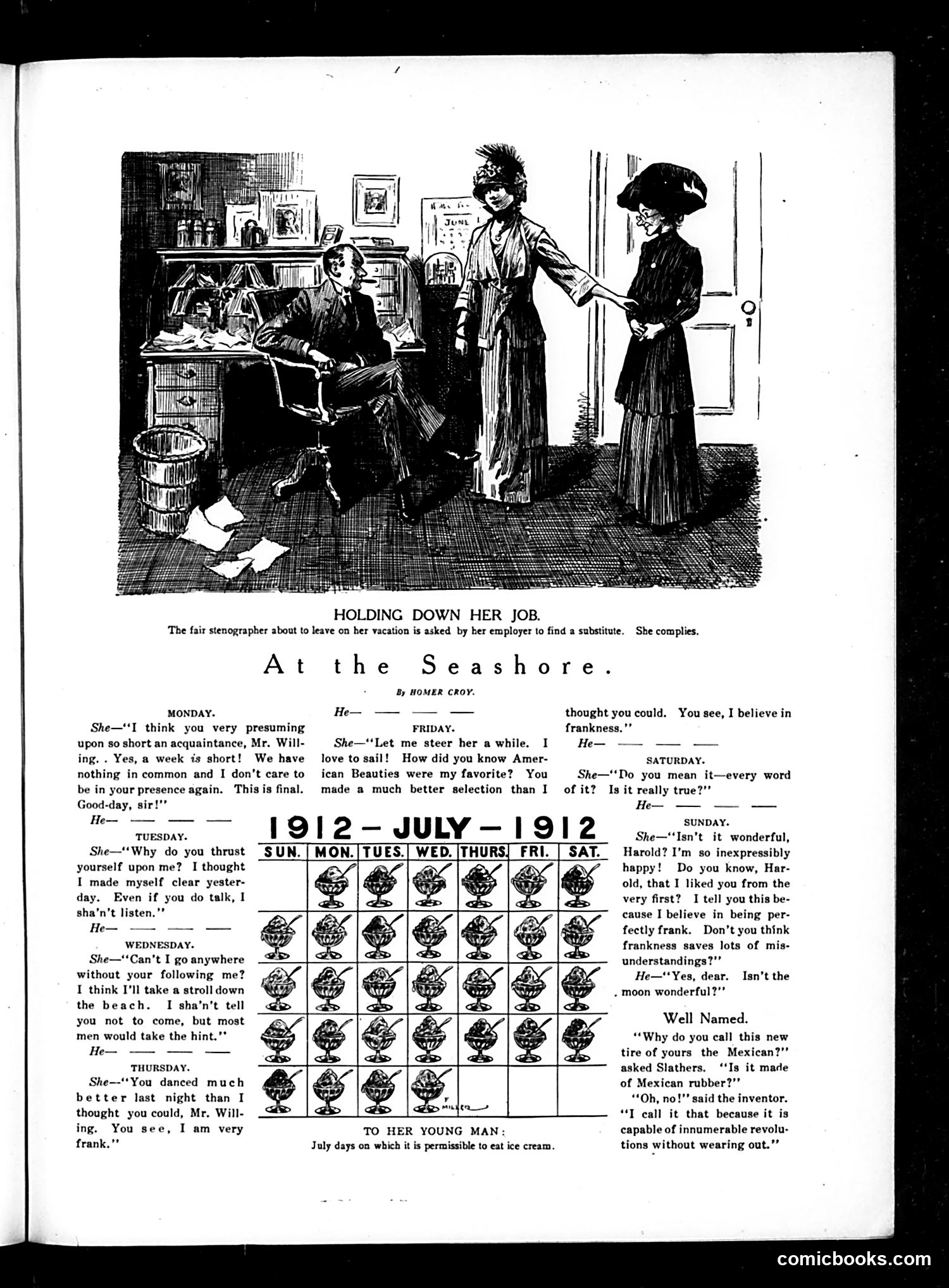
This comic strip satirizes the predictable arc of workplace romance. A stenographer asks her male coworker (Mr. Willing) to help find a vacation substitute, but he uses this as an excuse to pursue her romantically. Over the week, the woman's resistance crumbles: Monday she's coldly dismissive; by Thursday she's complimenting his dancing; by Sunday she's professing love and claiming she liked him "from the very first." The calendar showing ice cream days (permissible indulgences for July) illustrates their growing intimacy. The satire targets women's inconsistency and transparent romantic game-playing—her claims of "frankness" mask obvious manipulation. The title "Holding Down Her Job" ironically suggests she's actually focused on maintaining her employment position, when the narrative proves the opposite: she quickly abandons her professional boundaries for romance. The humor relies on period attitudes viewing women as emotionally unpredictable and inherently duplicitous in romantic matters.
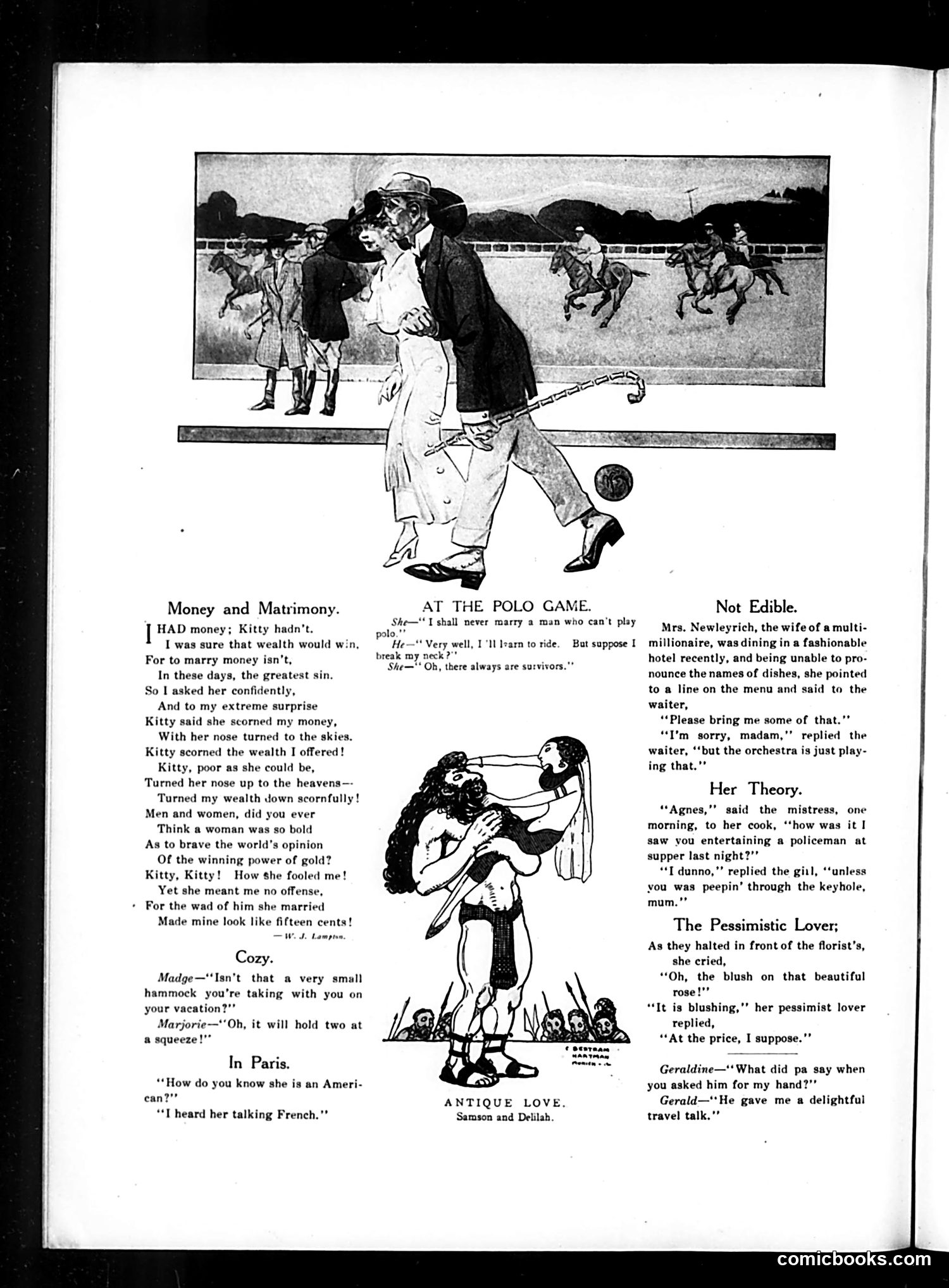
This page contains multiple brief satirical jokes typical of early 20th-century American humor magazines. The content mocks social conventions and contemporary types: **"Money and Matrimony"** satirizes a woman who rejects wealth but marries someone richer, exposing hypocrisy about mercenary marriage motives. **"At the Polo Game"** jokes about class signifiers—polo as an exclusive sport—and the woman's contradictory demands. **"Not Edible"** mocks newly wealthy people (Mrs. "Newleyrich" is transparently named) who lack cultural refinement, unable to read a menu and mistaking orchestra music for food. **"Her Theory"** plays on servant-class dialect and suggests a maid's deflection about entertaining a policeman. **"The Pessimistic Lover"** uses a flower's "blushing" for a cynical joke about high prices—common satire about commercial excess. The small illustration labeled "Antique Love" depicts Samson and Delilah in classical/biblical reference. Overall, these jokes target wealth disparities, social climbing, cultural pretension, and romance—standard Judge magazine fare.
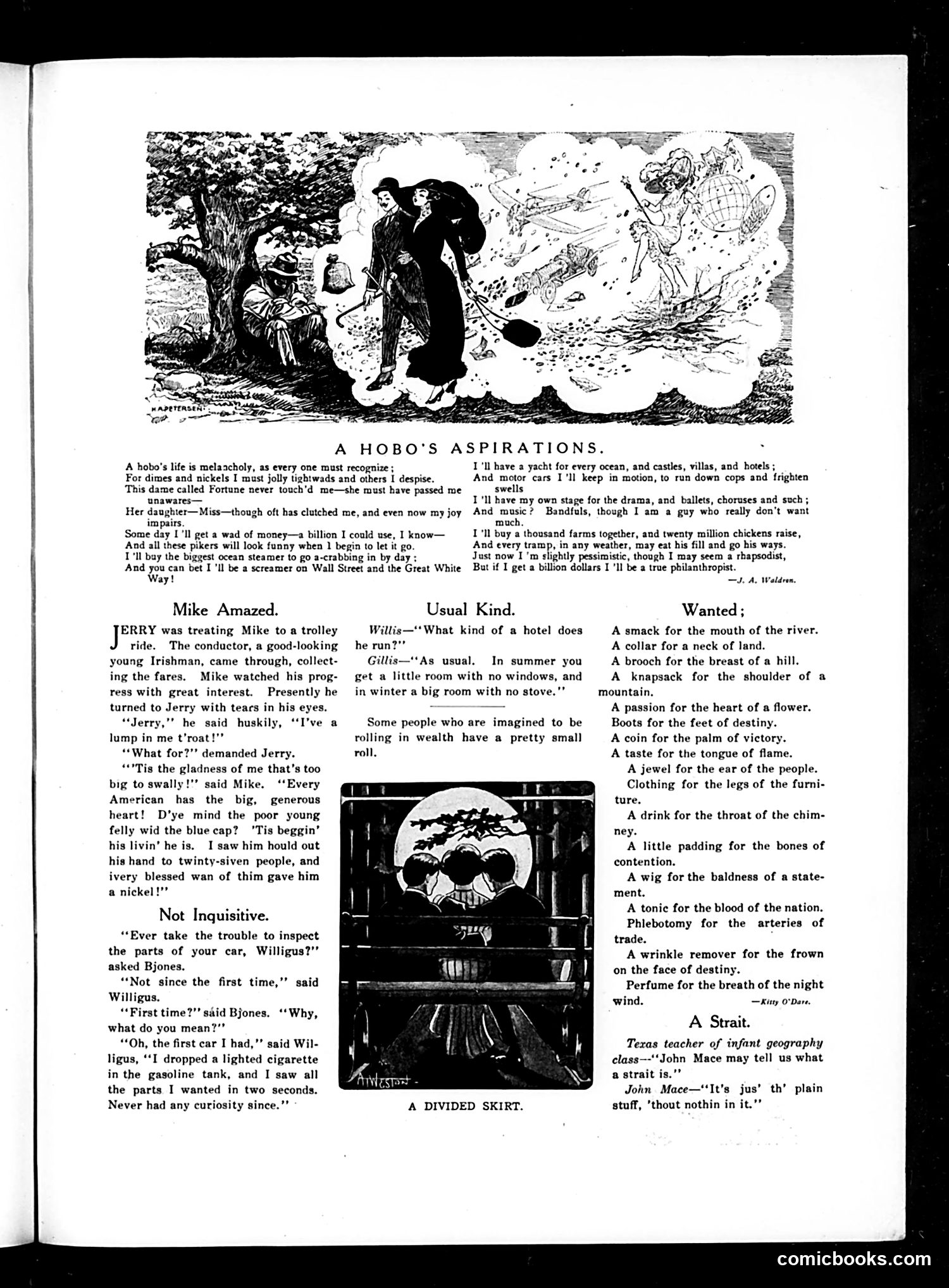
This page contains several satirical pieces typical of early 20th-century humor: **"A Hobo's Aspirations"** mocks the fantasy wealth-dreams of homeless men. The hobo imagines buying yachts, estates, and theatrical productions—yet ironically still plans to "run down cops and frighten swells," revealing that money wouldn't change his fundamental character or antagonism toward society. **"Mike Amazed"** plays on Irish-immigrant stereotypes. Mike is moved to tears watching a trolley conductor, mistaking his job (collecting fares from 27 people who each gave a nickel) as charity, because he assumes Americans are naturally generous. The joke relies on the Irish immigrant character's misunderstanding of American commerce. **"Not Inquisitive"** is a brief joke about a man so incurious he never inspected his car after it caught fire—he literally saw all its parts explode. **"Wanted"** is wordplay using geographical and abstract terms as if they were objects (a "collar for a neck of land," "boots for the feet of destiny"). **"A Strait"** jokes on a student's ignorant definition—a strait as "plain stuff, 'thout nothin in it.'" The page emphasizes class differences, immigrant characters, and pun-based humor typical of the era.
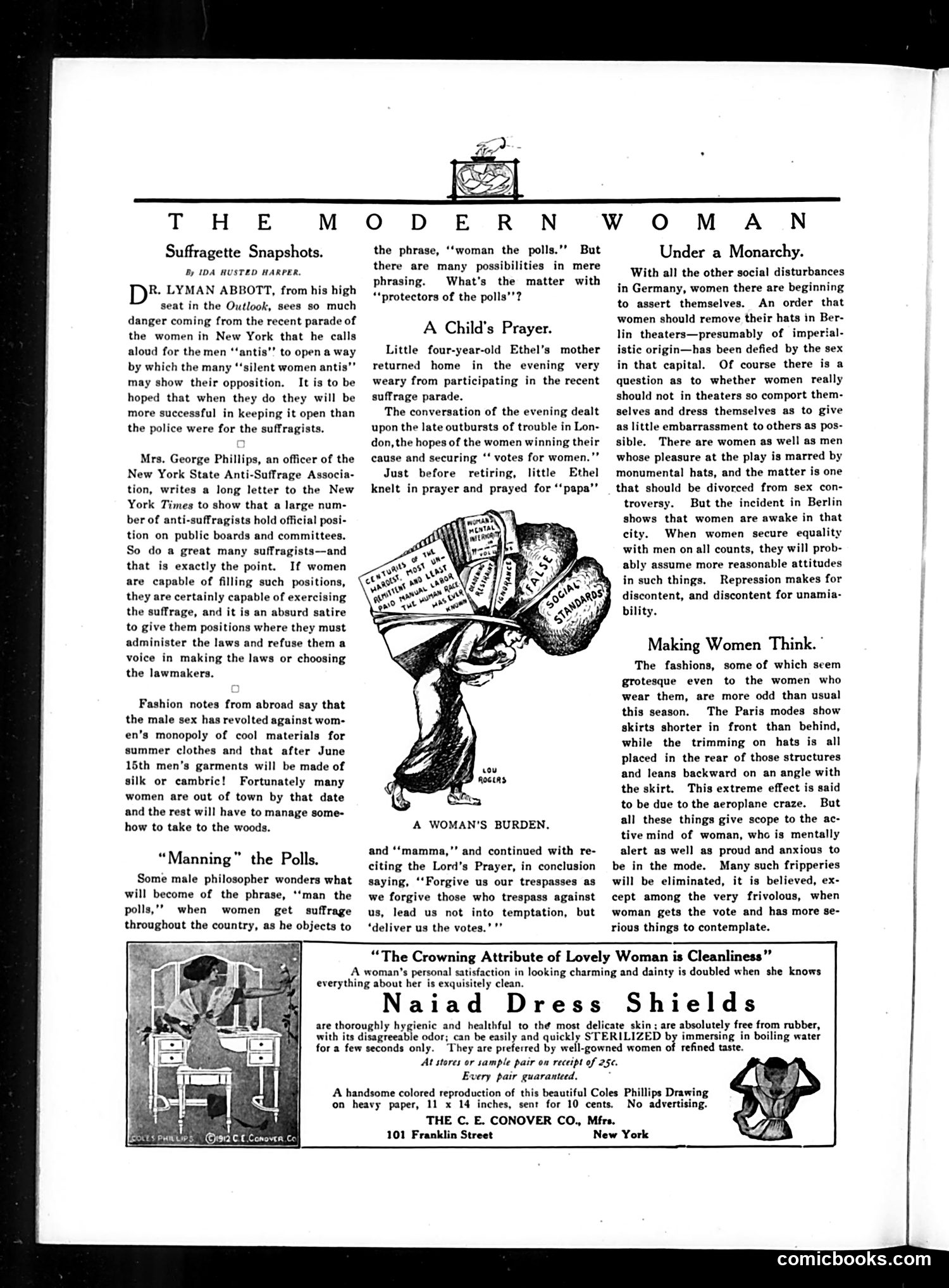
This satirical page from Judge addresses **women's suffrage** during the Progressive Era (early 1900s), when women's voting rights were a heated American political debate. ## Key Content: **"Manning the Polls"** mocks male anti-suffragists who object to the phrase "man the polls" becoming obsolete if women gain voting rights—treating linguistic concerns as absurd when women already hold public office. **"A Child's Prayer"** satirizes the suffrage movement's pervasiveness by depicting a tired parade participant's daughter innocently conflating political demands with religious supplication, ending prayers with "deliver us the votes." **"A Woman's Burden"** (the cartoon) depicts a woman literally crushed under weight labeled with domestic duties and social obligations—visual commentary on women's disproportionate burdens. **"Under a Monarchy"** contrasts German women defying theater hat-removal orders with American suffragists' activism, suggesting women everywhere increasingly resist restrictions. The page uses humor to both mock anti-suffragists' weak arguments and sympathetically portray women's frustrations with legal disempowerment despite holding responsible positions.
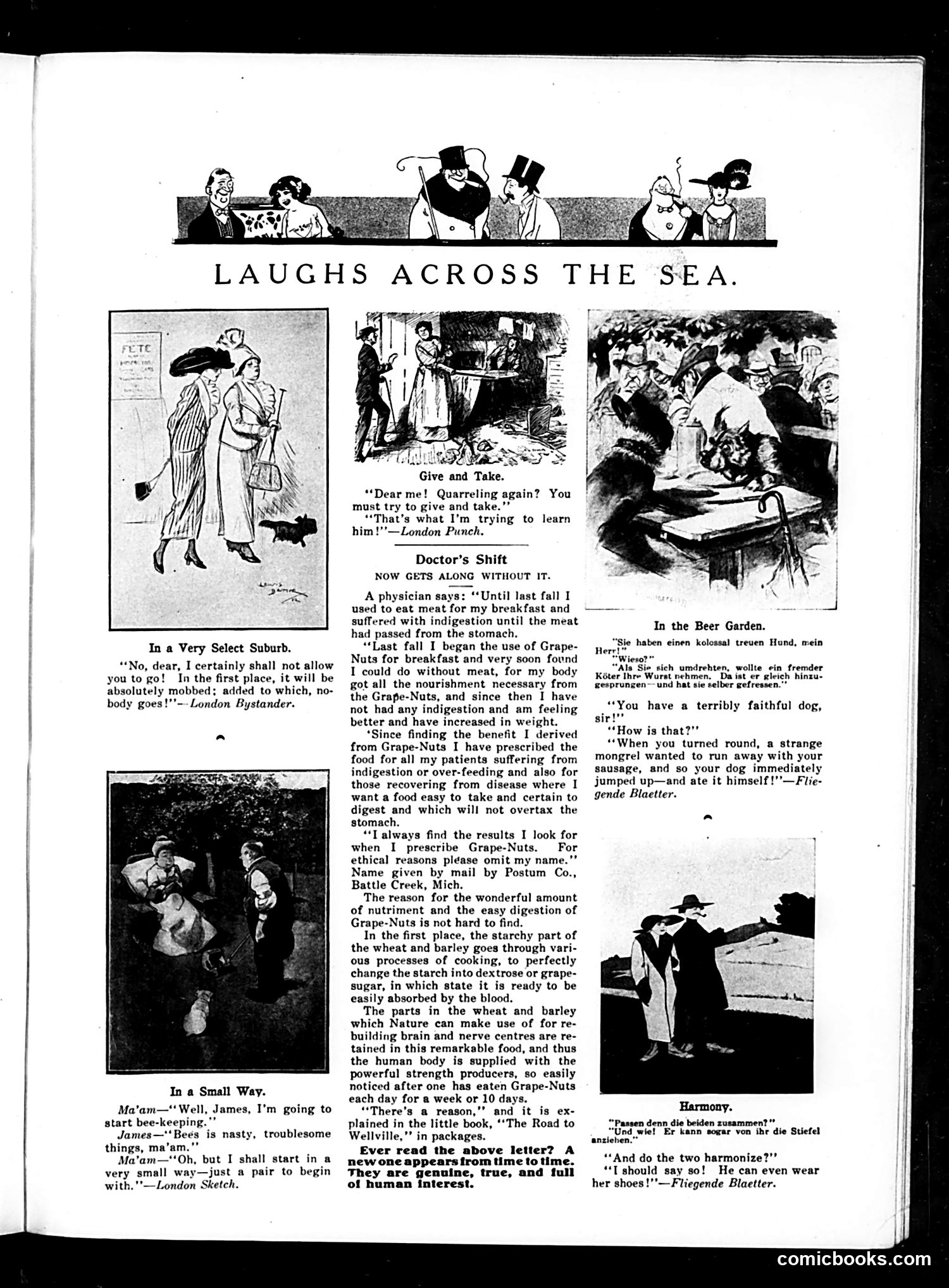
This page collects brief humorous anecdotes from British and German satirical magazines, presenting them as comparative international humor. The cartoons mock social pretension and domestic absurdity: a snobbish suburbanite refuses to attend an event because "nobody goes"; a woman naively plans to start bee-keeping with "just a pair"; a husband claims he's teaching his wife "give and take" while actually learning it from her. The page's centerpiece is a **Grape-Nuts cereal advertisement** disguised as a doctor's testimonial—a common advertising format of the era. The physician endorses the product for digestive health, claiming it cured his indigestion and now he prescribes it to patients. The remaining items—"In the Beer Garden" and "Harmony"—are German anecdotes about a faithful dog (who eats the sausage meant for a stranger) and a harmonious couple (who share clothing), both playing on unexpected interpretations of the setup. The page demonstrates how Judge republished European humor to entertain American readers.
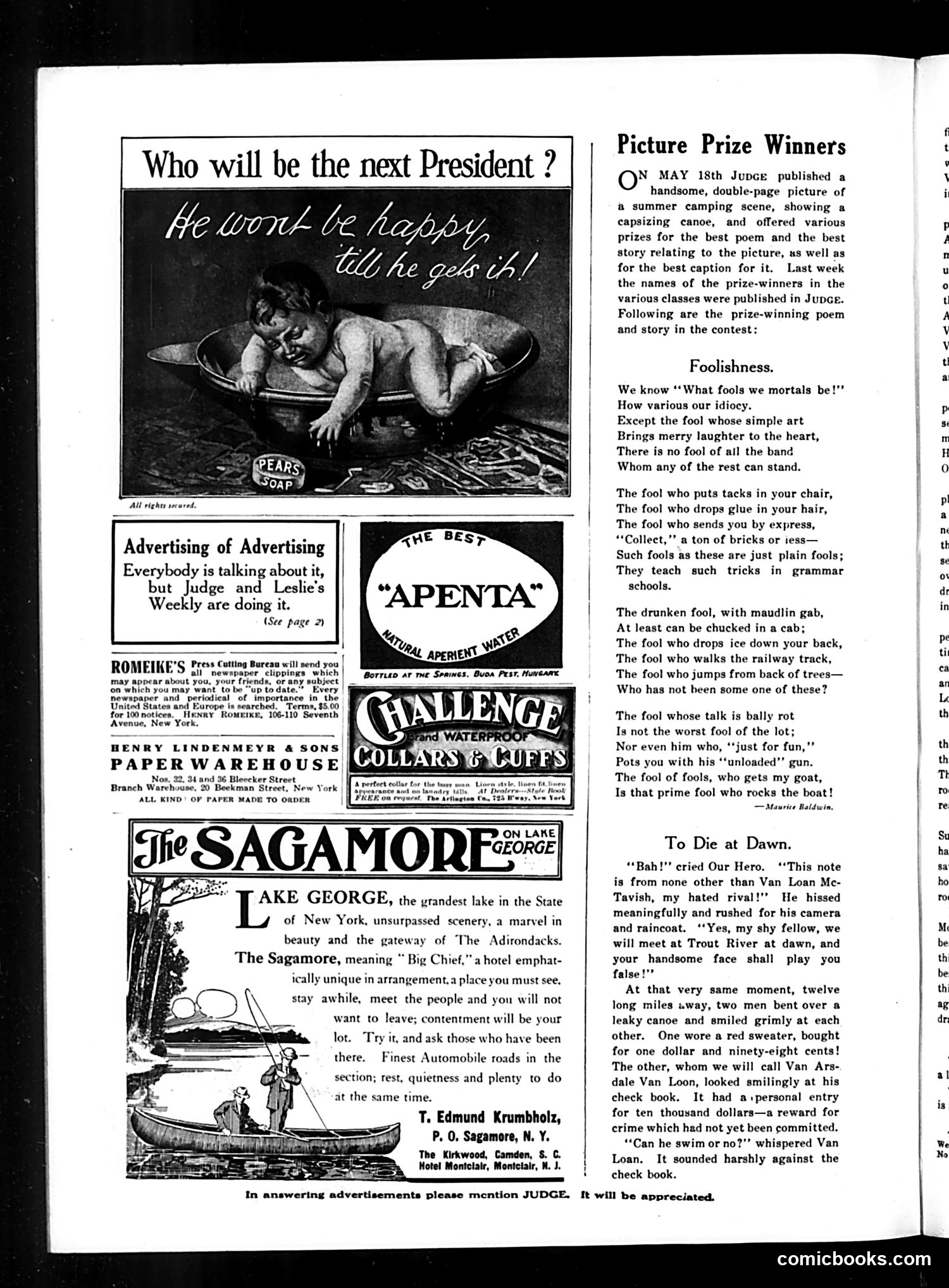
The top cartoon satirizes the 1908 U.S. presidential election with the caption "Who will be the next President? He won't be happy till he gets it!" depicting a cherub-like figure on a bar of Pears Soap. This mocks presidential ambition as childish greed—the soap brand placement suggests vanity and self-interest drive candidates. The page is primarily **advertising and content filler** rather than political satire. It includes ads for Romeike's press clipping service, paper warehouses, and The Sagamore hotel at Lake George, New York. The substantial right-side content features prize-winning submissions from Judge's picture contest: a poem called "Foolishness" cataloging various fool archetypes (pranksters, drunks, practical jokers), and a short story fragment "To Die at Dawn" about a dramatic rival confrontation involving a canoe—presumably connecting to the original contest picture of a capsizing canoe that readers submitted entries about.
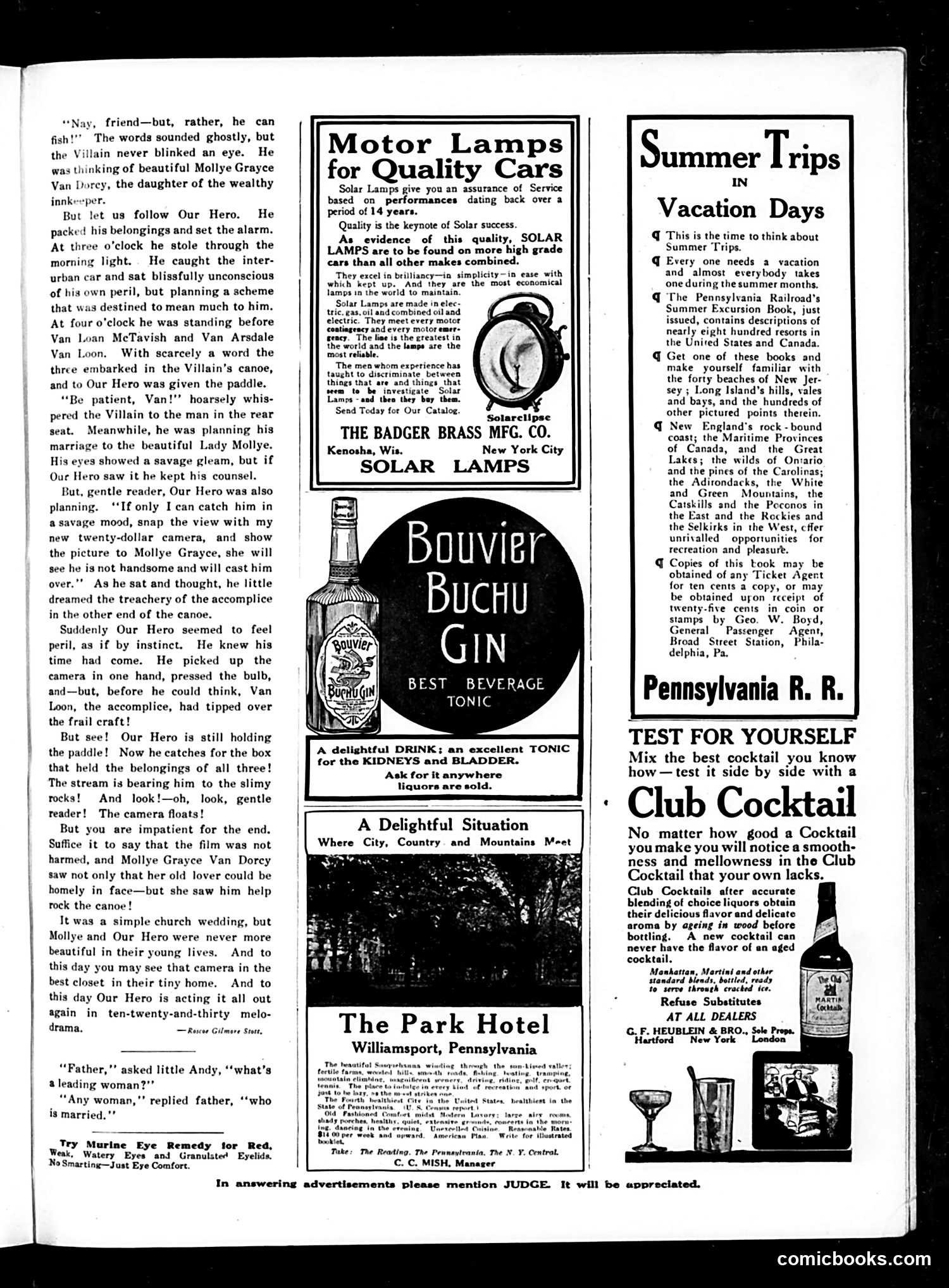
This page is primarily **advertising with a serialized story**. The main narrative (left column) appears to be a melodramatic ten-twenty-thirty theater serialization titled "Our Hero," featuring stock characters: a virtuous hero, a villain pursuing the beautiful "Mollye Grayce Van Dorcy," and a climactic canoe-tipping scene. The hero proves his worth by heroically rescuing belongings after being deliberately capsized by accomplices. The story ends with him winning the heroine through demonstrated character rather than appearance—a sentimental moral typical of early 20th-century popular entertainment. The page is dominated by period advertisements for **motor lamps, gin, cocktails, and a Pennsylvania hotel**—reflecting 1920s luxury goods marketing. A brief joke at bottom plays on the term "leading woman" (theatrical jargon for the female lead role), with the father's punchline suggesting any married woman leads her household. This is representative Judge content: serialized sentiment mixed with modern consumer advertising and light humor.
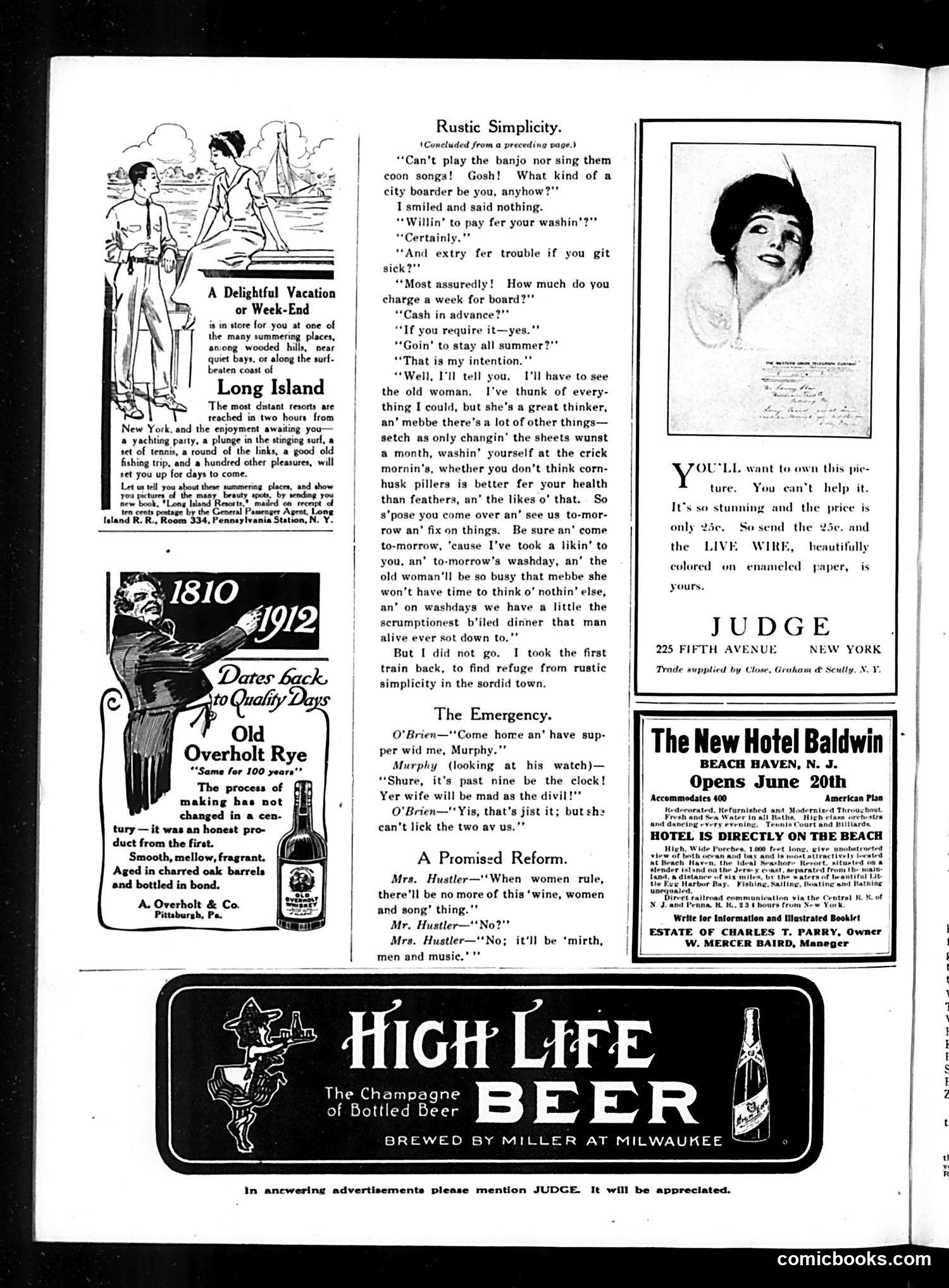
This page contains three brief humorous sketches typical of Judge's satirical humor: **"Rustic Simplicity"** mocks the clash between a sophisticated city visitor and rural landlords. A cosmopolitan boarder seeking summer lodging encounters a crass farmer and his wife who speak in exaggerated dialect, make crude demands (cash advance, extra fees for illness), and boast of their "scrumptionest b'iled dinner." The city dweller ultimately flees back to town, finding rural life unbearably provincial. **"The Emergency"** presents Irish characters (O'Brien and Murphy) using ethnic humor: Murphy fears his wife's anger at his late arrival, but O'Brien assures him they're safe together—"she can't lick the two av us." **"A Promised Reform"** satirizes women's suffrage through a domestic argument. The wife claims women's rule will eliminate "wine, women and song," but her husband cheerfully notes it'll merely become "mirth, men and music"—essentially the same thing with different names. All three rely on class and ethnic stereotypes typical of early 1910s American humor.
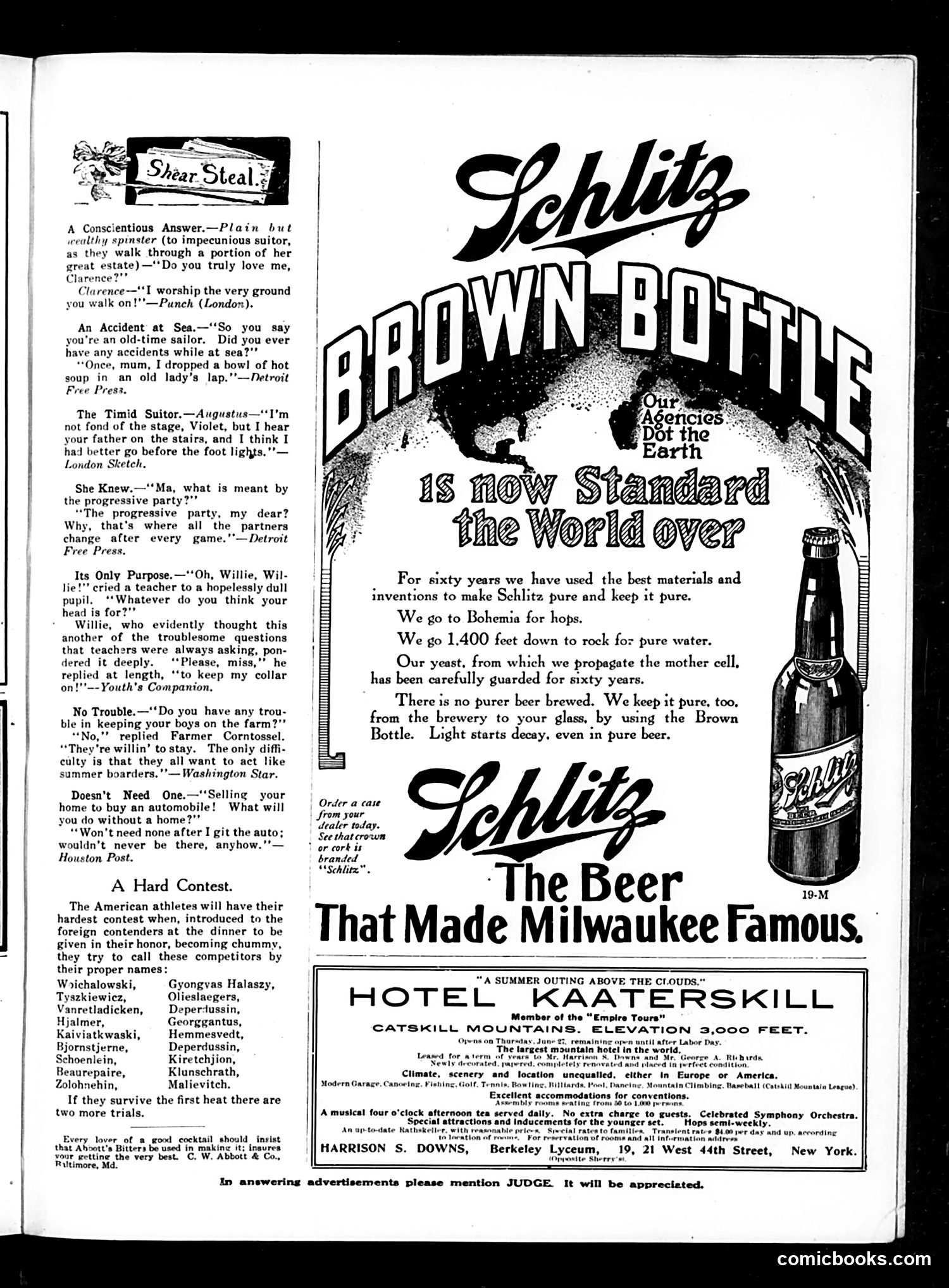
This page combines **humor content with advertisements**, typical of early 20th-century magazines. The left side features brief jokes on familiar themes: courtship, romantic mishaps, and family dynamics. The humor relies on wordplay and irony—a suitor proves his devotion by "worshiping the ground" his wealthy fiancée walks on; a schoolboy thinks his head's only purpose is "to keep my collar on." These appeal to middle-class readers through gentle mockery of romance, social climbing, and generational tensions. The dominant advertising (two-thirds of the page) promotes **Schlitz beer** and the Hotel Kaaterskill. The Schlitz ad emphasizes purity through industrial processes—Bohemian hops, deep well water, controlled yeast strains, brown bottles preventing light decay. This marketing reflects early 20th-century anxieties about food safety and "scientific" manufacturing credibility. The Hotel Kaaterskill ad touts luxury mountain resort amenities for wealthy tourists seeking leisure. The page shows no political satire—it's primarily commercial content wrapped in light entertainment for affluent readers.
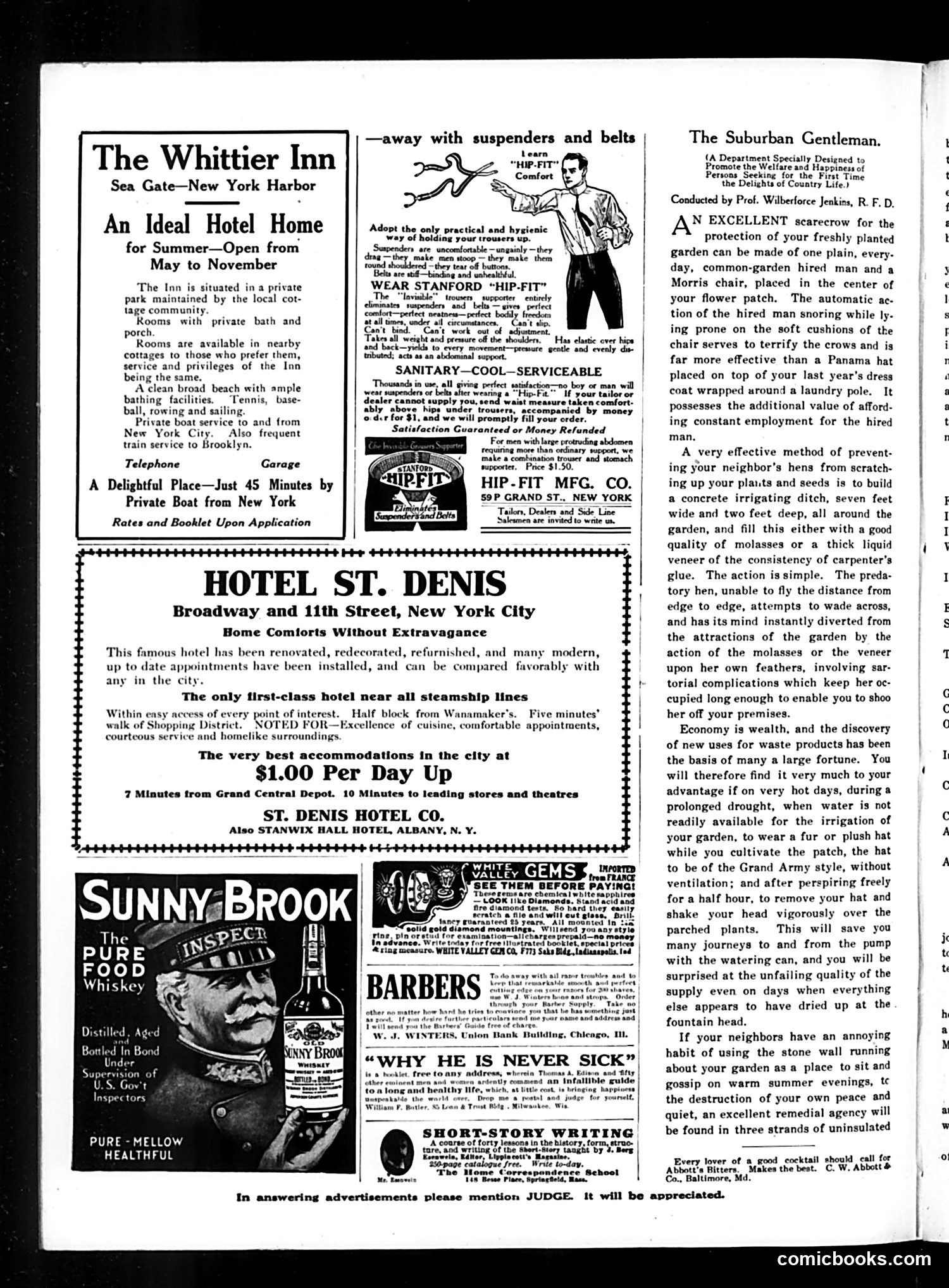
This is primarily an **advertising page** with one satirical column. The advertisements promote hotels, whiskey, and the "Hip-Fit" trouser support system—typical early 20th-century commerce. The sole satirical content is **"The Suburban Gentleman"** column (top right), conducted by "Prof. Wilberforce Jenkins, R.F.D." It mocks affluent urban professionals attempting country living. The humor lies in the impractical "scarecrow" suggestion: placing a sleeping hired farmworker in a Morris chair (an expensive, comfortable piece of indoor furniture) in the garden. The joke is that the worker's snoring will frighten crows—treating a human laborer as garden equipment, while also satirizing the gentleman's ignorance of actual farming. It's a class-conscious jab at wealthy dilettantes playing at rural life with comical incompetence, presenting absurd "advice" with mock seriousness.
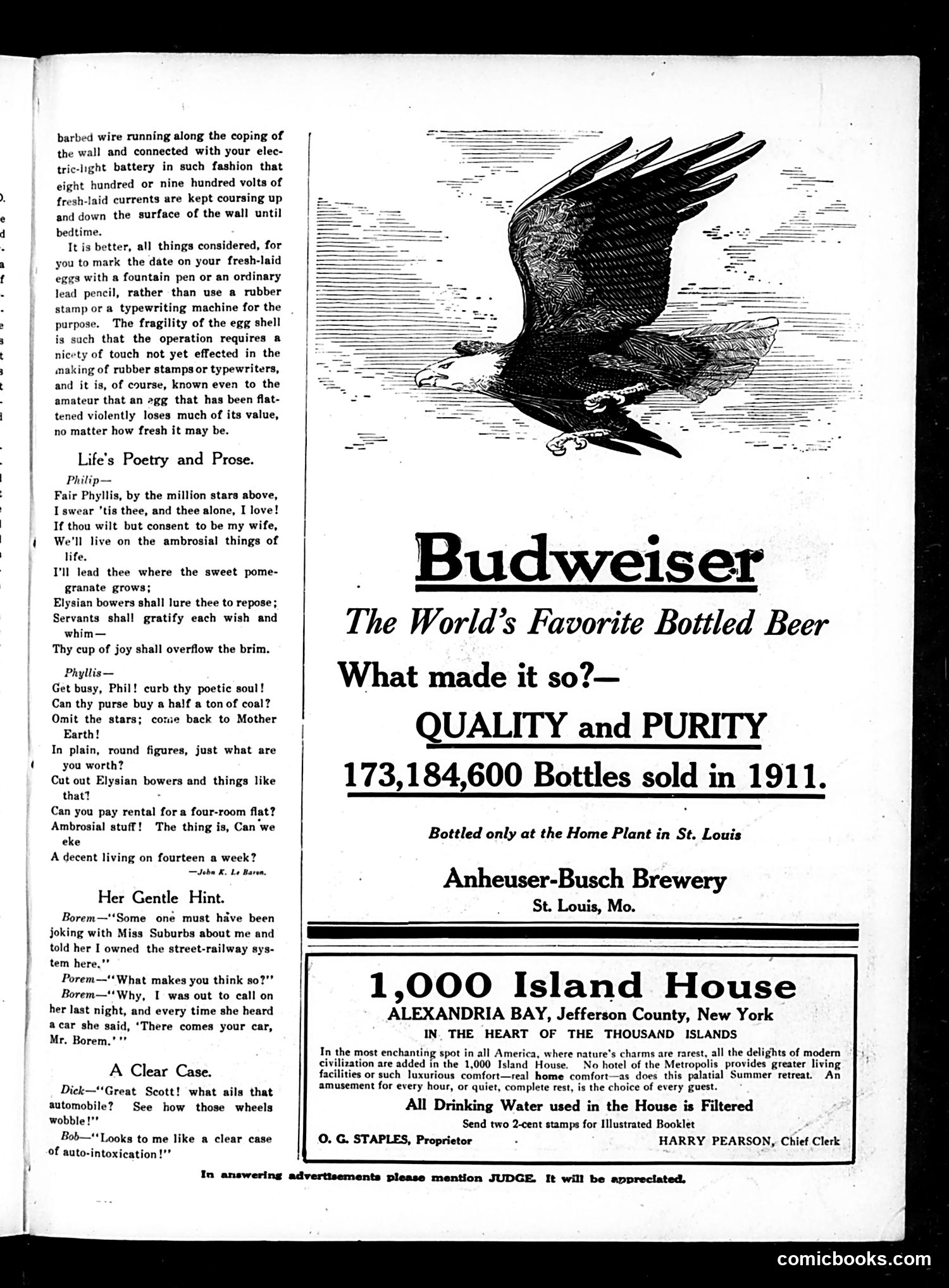
This page from the satirical magazine *Judge* contains several humor pieces and advertisements typical of 1912. **"Life's Poetry and Prose"** satirizes romantic idealism versus harsh economic reality. Philip recites flowery poetry about love and Elysian bowers, but Phyllis cuts through it with practical questions: Can you afford coal? Pay rent on a four-room apartment? Support us on fourteen dollars weekly? The joke mocks the disconnect between romantic fantasy and working-class financial struggle. **"Her Gentle Hint"** and **"A Clear Case"** are brief, punchy jokes relying on misunderstandings and wordplay—typical of the era's humor magazines. The page is dominated by **period advertisements**: a Budweiser beer ad boasting 173 million bottles sold in 1911, and a resort hotel advertisement for the "1,000 Island House" in upstate New York. The opening text discusses marking fresh eggs and protecting property with electrified barbed wire—likely practical advice or satirical suggestions from an earlier article.
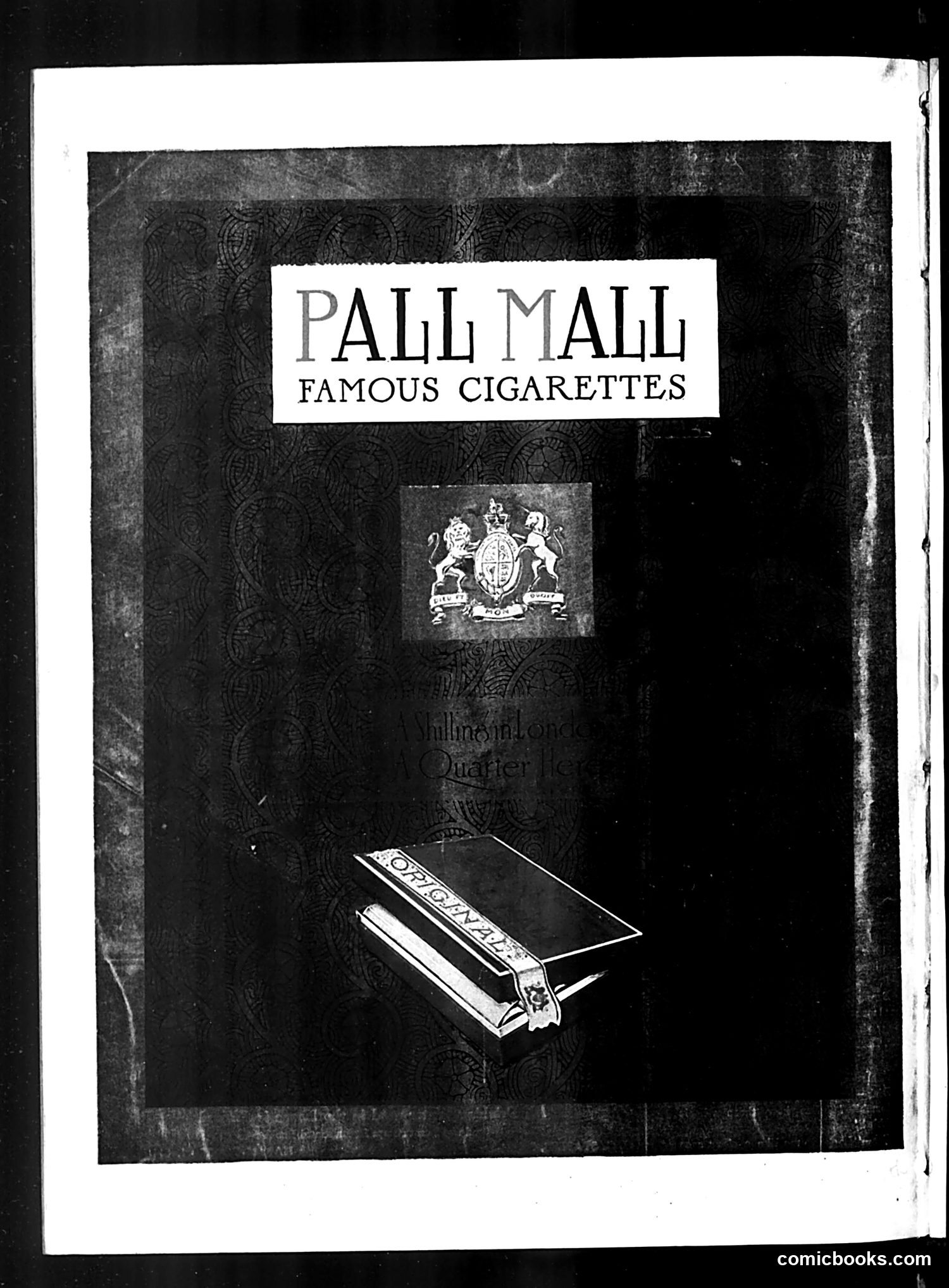
This appears to be a **cigarette advertisement rather than political satire or cartoon**. The page showcases Pall Mall Famous Cigarettes branding, featuring: - The product name prominently displayed at top - A royal coat of arms (with lion and unicorn supporters), suggesting British prestige and quality - An illustration of the cigarette package itself The design emphasizes luxury and sophistication through heraldic imagery—a common advertising strategy of the era to associate cigarettes with refinement and status. There is no apparent political commentary, caricature, or satirical content visible. This is a straightforward commercial advertisement, likely from Judge magazine's advertising section rather than its editorial content.
I can see this is a page from *Judge* magazine, but the image is almost entirely black with only a white binding/spine visible on the left edge. The OCR text contains only "comicbooks.com," which appears to be a watermark rather than actual magazine content. Without visible cartoon illustrations, article text, or identifying details in the image itself, I cannot determine what specific political or social satire this page contains, who any figures might represent, or what the intended joke or commentary was. To provide accurate historical context about this *Judge* page's meaning for a modern reader, I would need a clearer, more legible scan of the actual content.