
Judge, 1912-06-29 · page 5 of 25
Judge — June 29, 1912 — page 5: what you’re looking at
What you’re looking at
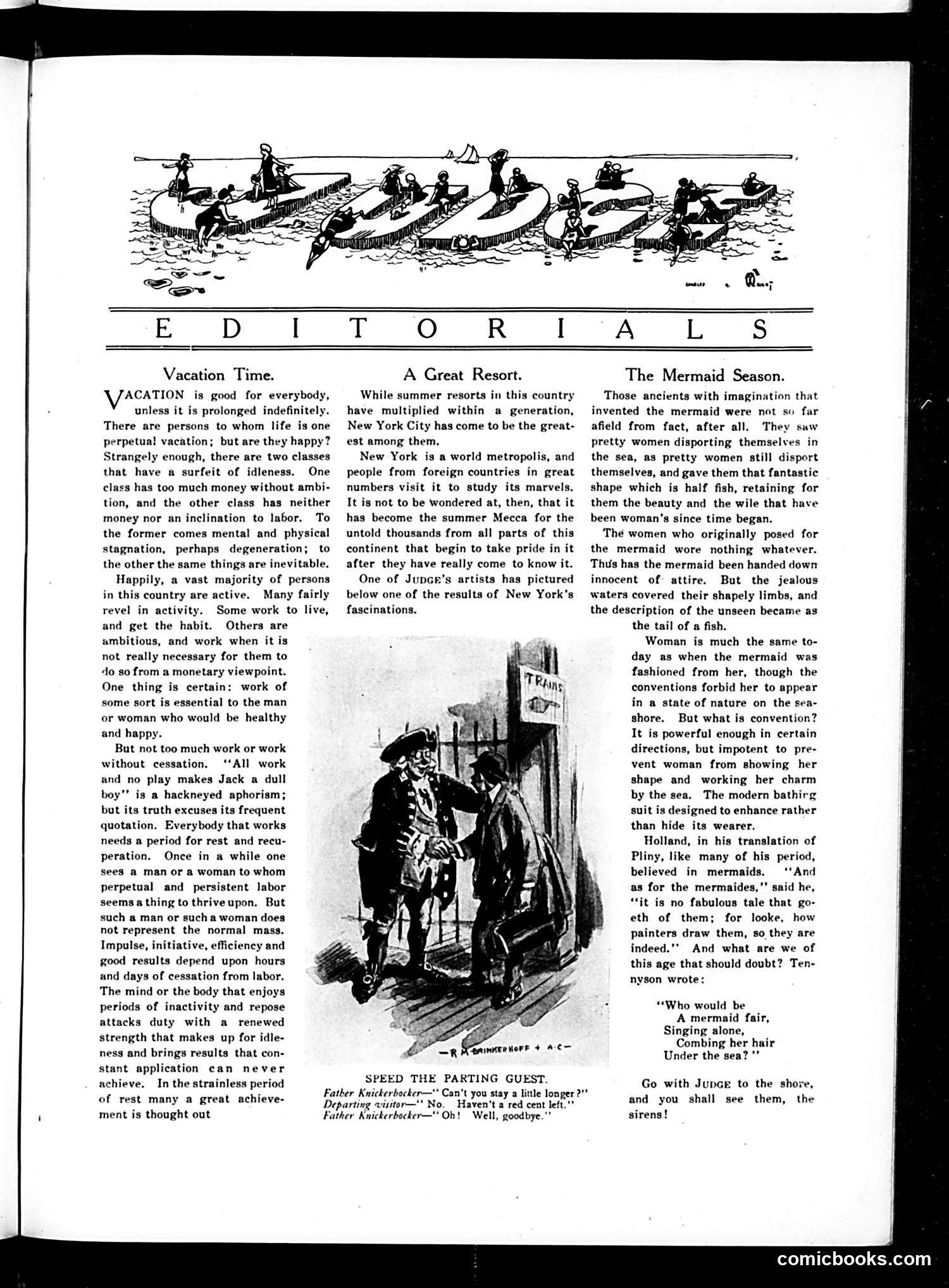
This cartoon depicts a farewell scene at what appears to be a dock or pier. The caption references a father figure trying to speed along departing visitors—likely summer guests returning home after vacation season. The humor plays on the social awkwardness of overstaying guests. The father says "Can't you stay a little longer?" while the departing visitor responds "Haven't a red cent left," and the father cheerfully replies "O! Well, goodbye!"—revealing his actual relief at the guest's departure despite polite pretenses. This satirizes the common social tension between hosts obligated to extend hospitality and their desire to see expensive guests leave. The irony is that the visitor's financial depletion aligns perfectly with the host's unstated wishes.
📄 Transcribed text from this page (OCR, searchable)
Machine-transcribed from the original scan — historical spelling and the odd misread are preserved.
Vacation Time. ACATION is good for everybody, unless it is prolonged indefinitely. There are persons to whom life is one perpetual vacation; but are they happy? Strangely enough, there are two classes that have a surfeit of idleness. One class has too much money without ambi- tion, and the other class has neither money nor an inclination to labor. To the former comes mental and physical stagnation, perhaps degeneration; to the other the same things are inevitable. Happily, a vast majority of persons in this country are active. Many fairly revel in activity. Some work to live, and get the habit. Others are ambitious, and work when it is not really necessary for them to do so from a monetary viewpoint. One thing is certain: work of some sort is essential to the man or woman who would be healthy and happy. But not too much work or work without cessation. ‘‘All work and no play makes Jack a dull boy’’ is a hackneyed aphorism; but its truth excuses its frequent quotation. Everybody that works needs a period for rest and recu- peration. Once in a while one sees a man or a woman to whom perpetual and persistent labor seems a thing to thriveupon. But such a man or such a woman does not represent the normal mass. Impulse, initiative, efficiency and good results depend upon hours and days of cessation from labor. The mind or the body that enjoys periods of inactivity and repose attacks duty with a renewed strength that makes up for idle- ness and brings results that con- stant application can never achieve. In the strainless period of rest many a great achieve- ment is thought out A Great Resort. While summer resorts in this country have multiplied within a generation, New York City has come to be the great- est among them. New York is a world metropolis, and people from foreign countries in great numbers visit it to study its marvels. It is not to be wondered at, then, that it has become the summer Mecca for the untold thousands from all parts of this continent that begin to take pride in it after they have really come to know it. One of JupnGe’s artists has pictured below one of the results of New York's fascinations. is RABANNE NORE + AC SPEED THE PARTING GUEST. Father Knickerbocker—"* Can't you stay a little longer?” Departing visitor—" No. Father Knickerbocker—" Ob! Well, goodbye.”* Haven't a red cent left."" The Mermaid Season. Those ancients with imagination that invented the mermaid were not so far afield from fact, after all. They saw pretty women disporting themselves in the sea, as pretty women still disport themselves, and gave them that fantastic shape which is half fish, retaining for them the beauty and the wile that have been woman’s since time began. The women who originally posed for the mermaid wore nothing whatever. Thus has the mermaid been handed down innocent of: attire. But the jealous waters covered their shapely limbs, and the description of the unseen became as the tail of a fish. Woman is much the same to- day as when the mermaid was fashioned from her, though the conventions forbid her to appear in a state of nature on the sea- shore. But what is convention? It is powerful enough in certain directions, but impotent to pre- vent woman from showing her shape and working her charm by the sea. The modern bathirg suit is designed to enhance rather than hide its wearer. Holland, in his translation of Pliny, like many of his period, believed in mermaids. ‘‘And as for the mermaides,”’ said he, “it is no fabulous tale that go- eth of them; for looke, how painters draw them, so they are indeed.”” And what are we of this age that should doubt? Ten- nyson wrote: “Who would be A mermaid fair, Singing alone, Combing her hair Under the sea? ’’ Go with Jupce to the shore, and you shall see them, the sirens! comicbooks.com