
A complete issue · 24 pages · 1912
Judge — June 8, 1912
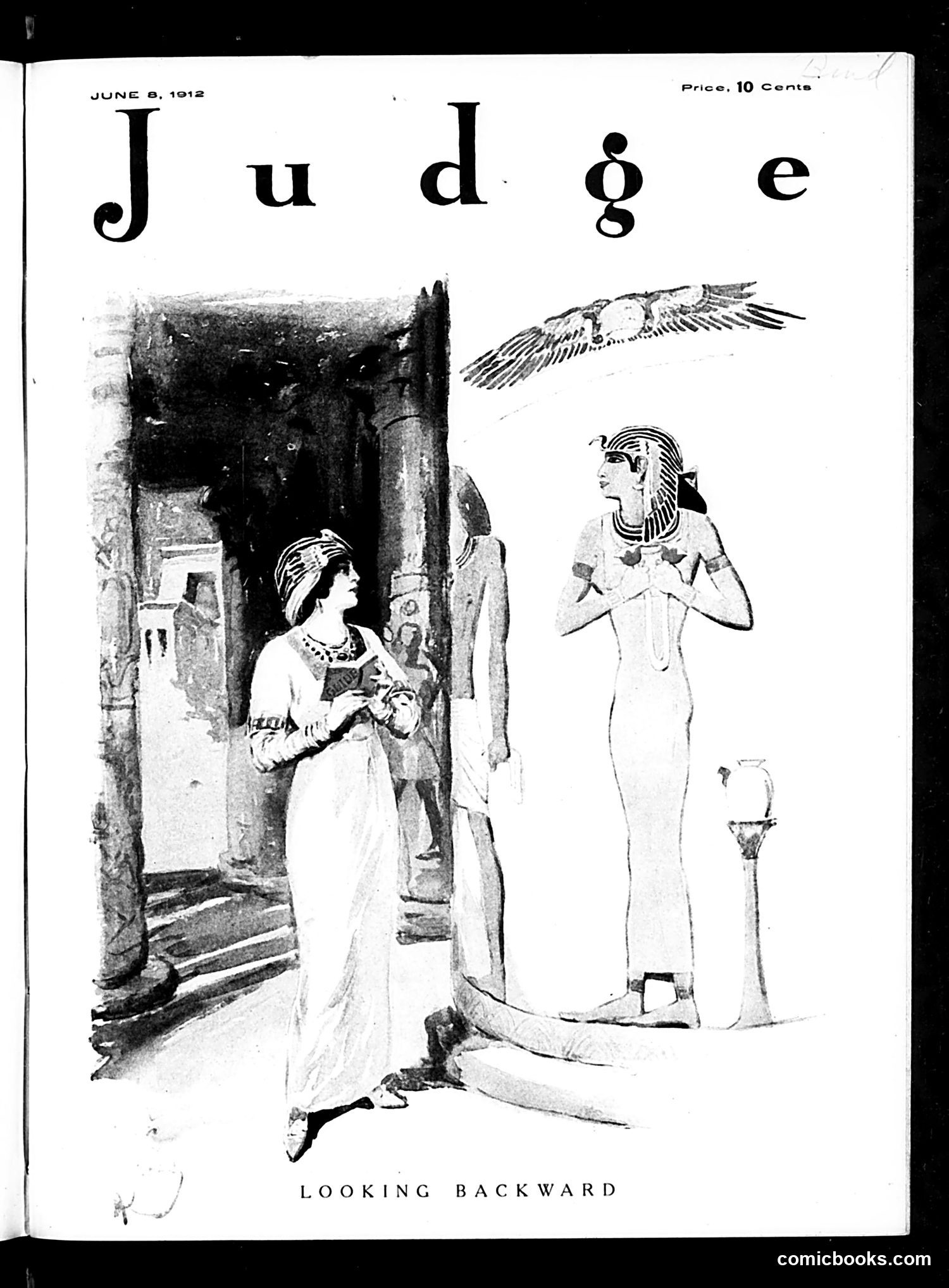
This cartoon illustrates the title "Looking Backward," likely referencing Edward Bellamy's famous 1888 utopian novel of that name. The image depicts an ancient Egyptian scene with two figures in traditional Egyptian dress. A winged deity or spirit hovers above, while below, a woman in Egyptian garb stands in a temple doorway observing another elaborately dressed Egyptian figure. The satire appears to comment on comparing ancient civilizations to contemporary American society—a common trope in Judge's satirical commentary. The specific political or social message is unclear without additional context, but it likely critiques either nostalgia for "simpler times" or contemporary American pretensions by contrasting them with ancient Egypt's grandeur. The precise satirical target remains uncertain from the image alone.
This page is primarily **advertising and table of contents**, not satirical political content. The advertisements promote practical consumer goods: Bowser Storage Systems for automobiles, Solars Motor Lamps, and Badger Brass Manufacturing lamps. The main editorial content announces an upcoming illustrated series titled "The Excitements of Camping," featuring paintings depicting camp scenes like "A Cold and Foggy Morning in Camp" and "An Unexpected Thunderstorm." The editors note these will appeal to readers' appreciation for outdoor life. The page reflects early 20th-century American interests in emerging automobile technology and recreational camping—leisure activities becoming accessible to middle-class readers during this era.
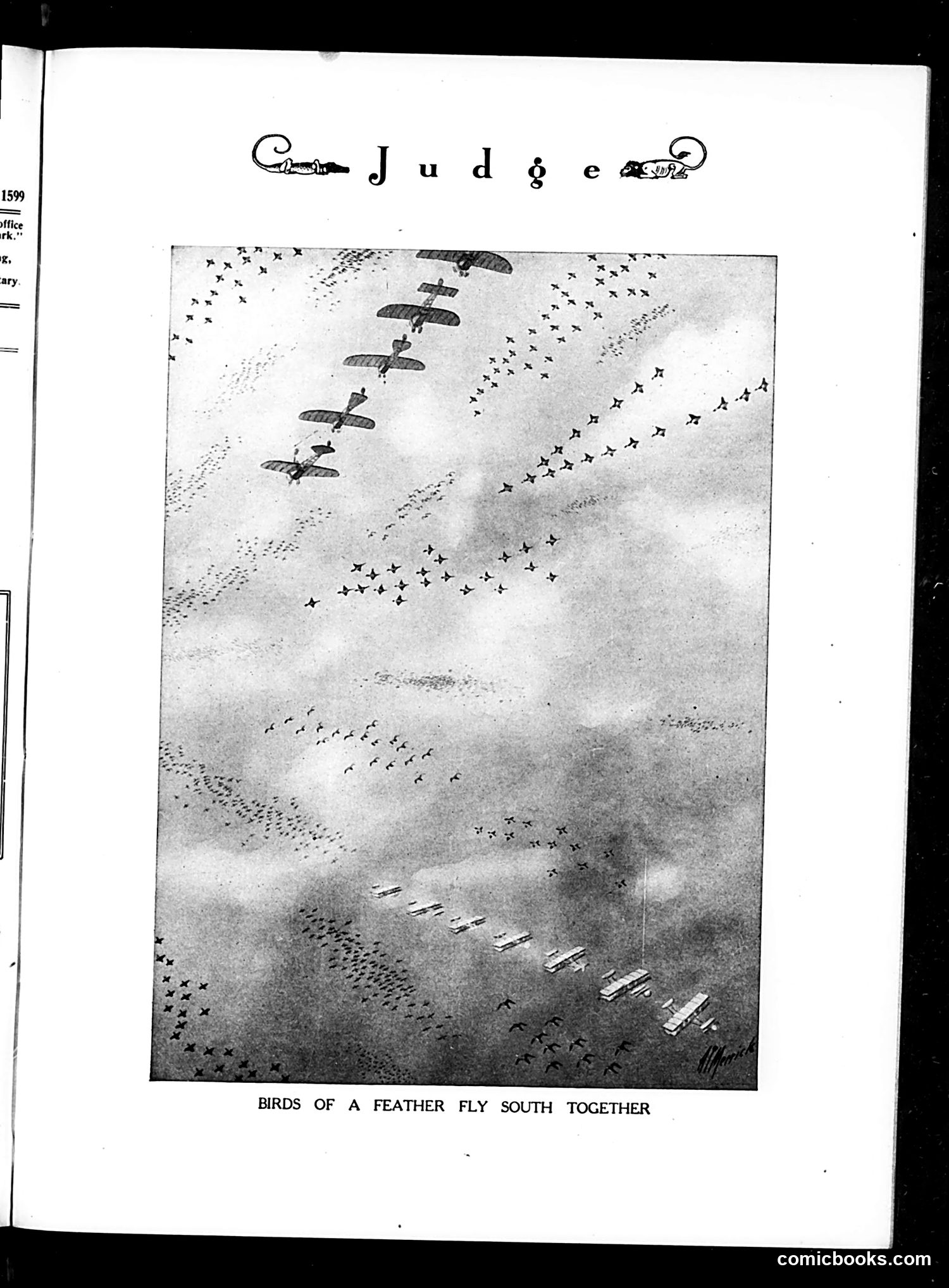
This Judge magazine illustration uses avian metaphor to satirize military or political figures traveling together. The image shows multiple formations of aircraft and birds in flight heading southward. The caption "Birds of a Feather Fly South Together" is a play on the proverb about similar individuals associating. The composition—mixing stylized bird formations with what appear to be military aircraft—suggests commentary on political allies or military leaders moving in coordinated direction, likely during a period of international tension or coalition-building. Without clearer dating or additional context, the specific historical event and figures referenced remain unclear, though the satire appears to mock conformity or coordinated action among the depicted group.
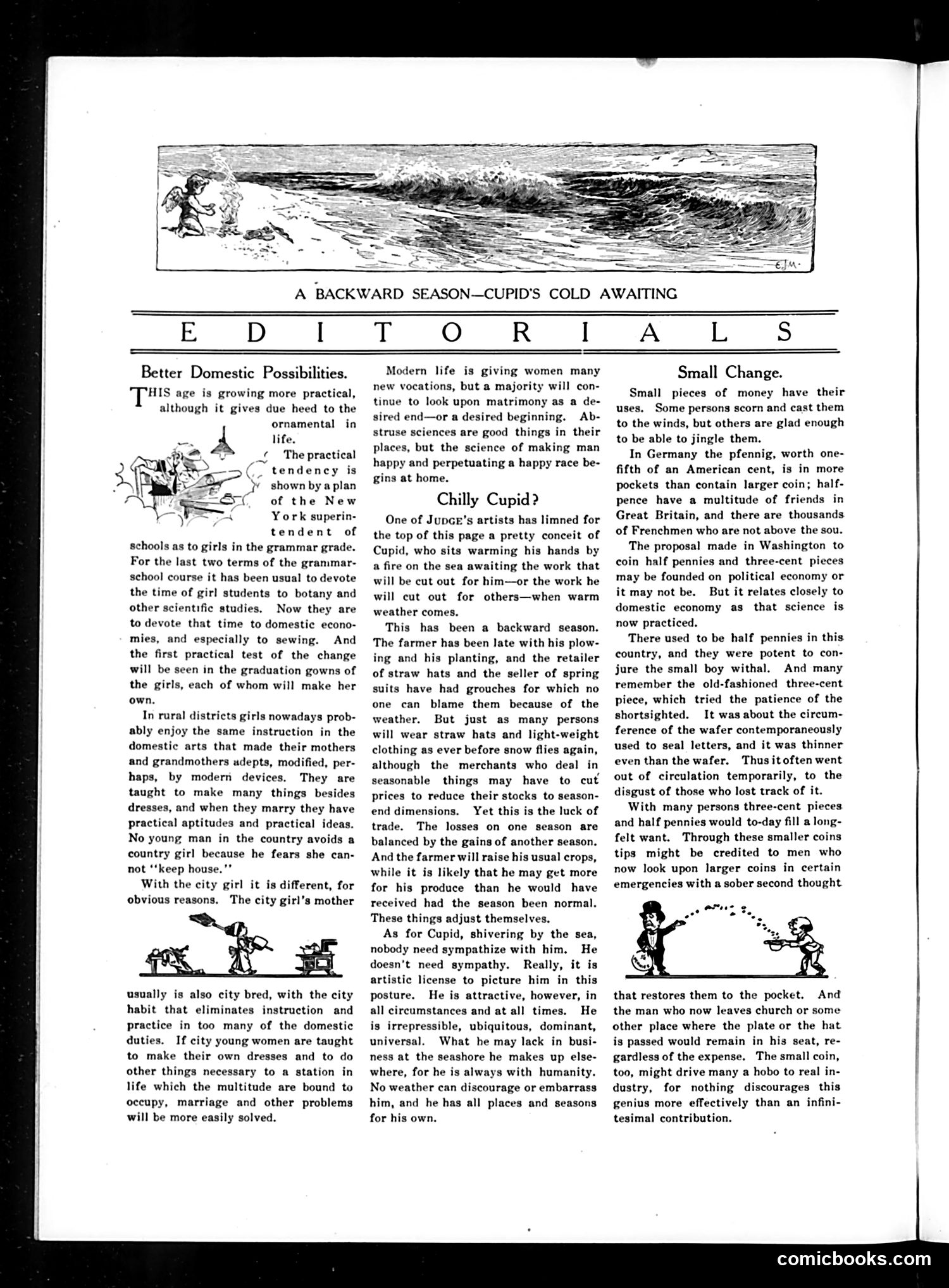
This editorial page satirizes the economic hardships affecting courtship and marriage during what appears to be a recession or depression. The main cartoon depicts Cupid shivering by the sea, symbolizing romance suffering from poor economic conditions. The text argues that practical domestic skills matter more than romance during hard times. It contrasts rural and city life, noting that rural girls learn homemaking while city girls don't—yet paradoxically, city girls' mothers were also city-bred. The satire targets merchants and farmers who blame external circumstances (bad weather, "backward season") for their losses, when market forces actually dictate outcomes. The piece ultimately suggests that small coins and practical economics, not romantic idealism, now govern courtship and marriage among ordinary people.
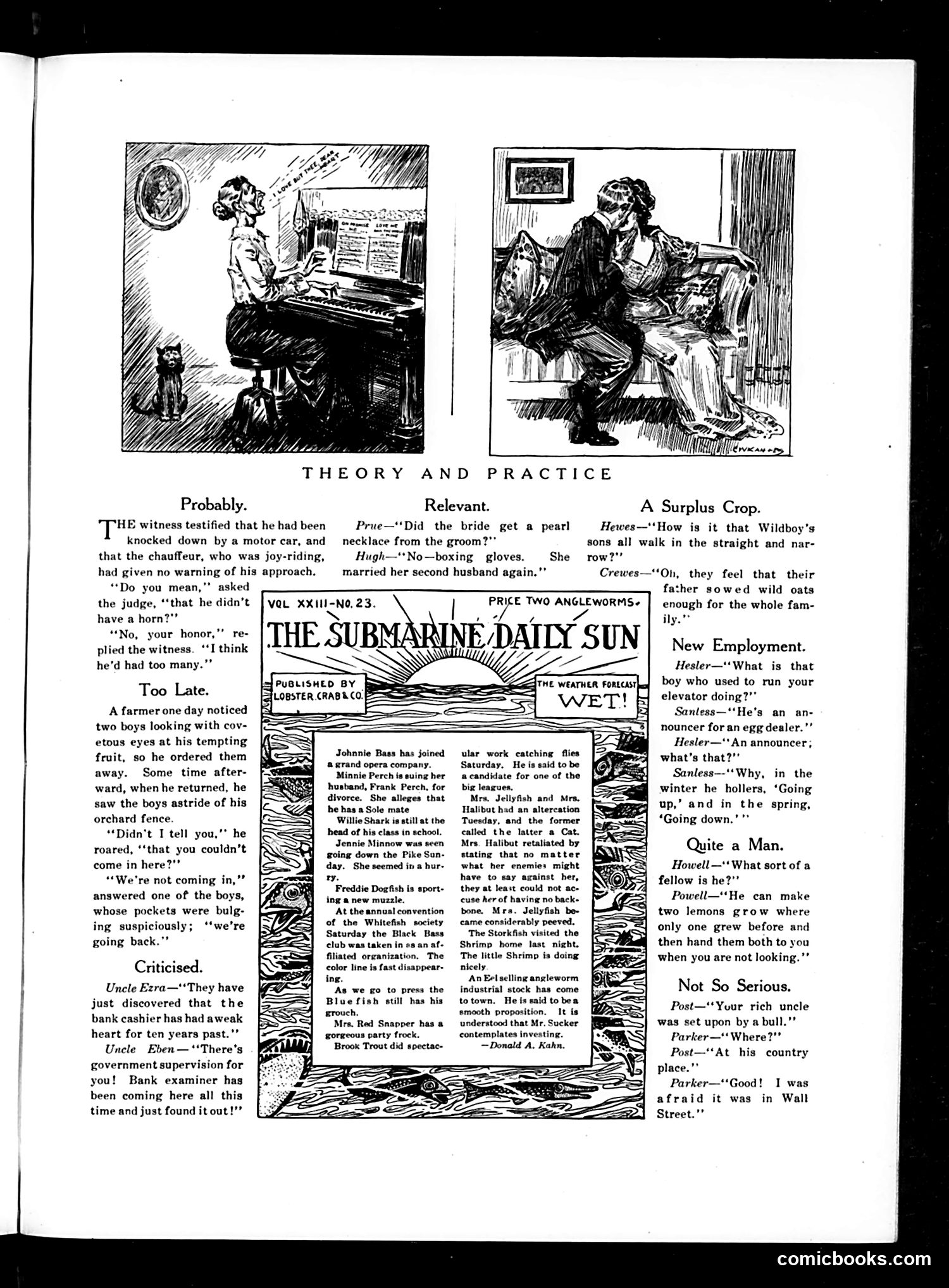
This page from Judge magazine (Vol. XXIII, No. 23) contains **"The Submarine Daily Sun,"** a mock newspaper parody, alongside several brief humorous anecdotes and two sketch illustrations labeled "Theory and Practice." The central cartoon satirizes sensational journalism through fake headlines about social gossip (opera singers, marriage rumors) and mundane events. The "Theory and Practice" sketches contrast idealized versus realistic scenarios—likely depicting romantic or social situations that disappoint in reality. The surrounding jokes address early 20th-century concerns: motor-car accidents, farming mishaps, employment struggles, and wealth disparities. These represent typical Judge magazine fare: gentle satire of middle-class American life, urban hazards, and social pretensions rather than overtly political commentary. The page represents Judge's characteristic blend of visual humor and witty social observation.
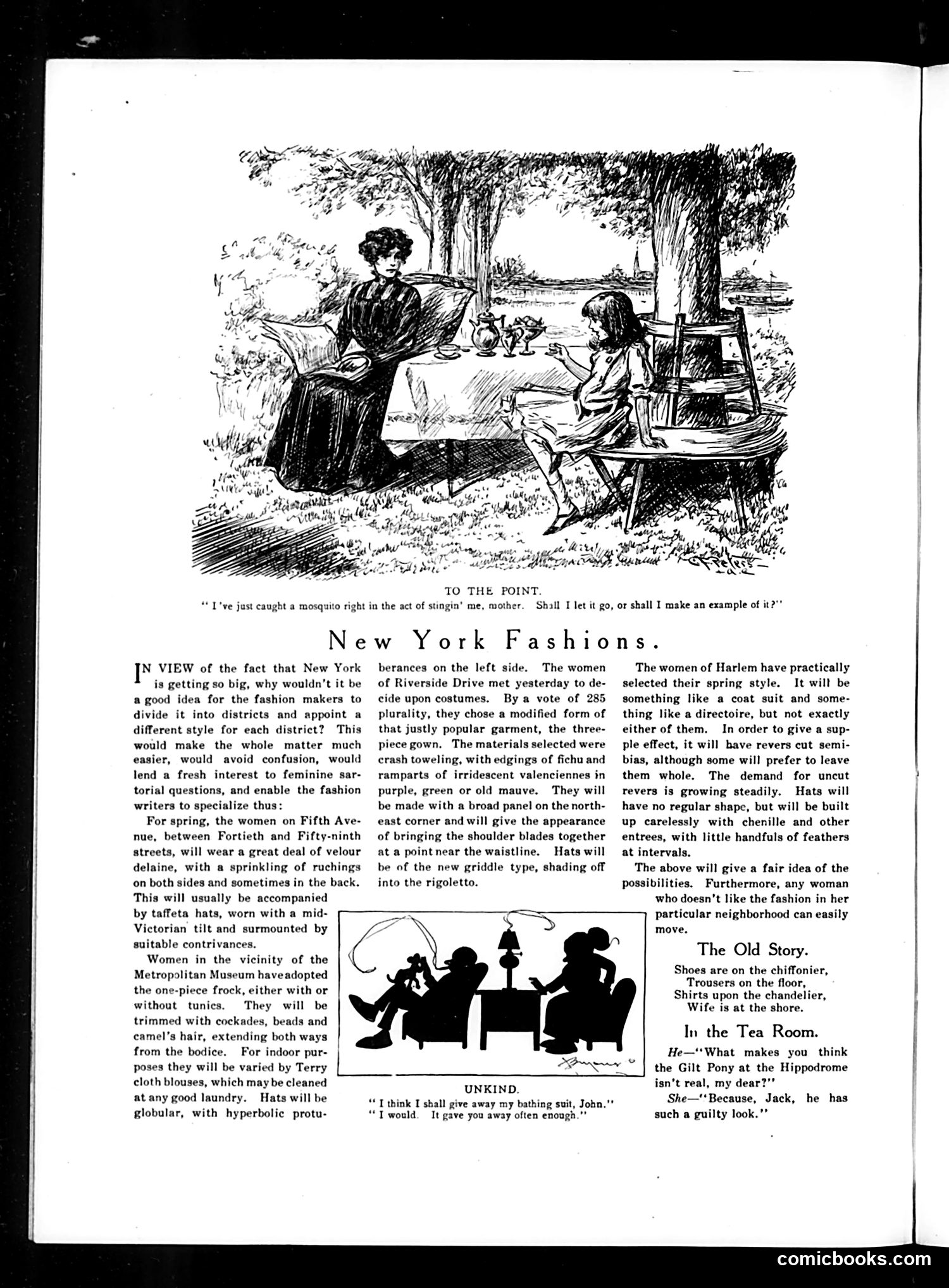
**Top Cartoon ("To the Point"):** A mother and child discuss catching a mosquito mid-bite. The joke plays on the child's literal interpretation of justice—asking whether to "make an example" of the insect. This satirizes adult legal/moral rhetoric by applying it absurdly to pest control, mocking pompous language about punishment and deterrence. **"New York Fashions":** This satirizes the fragmentation and pretension of New York high society by proposing that different wealthy neighborhoods (Fifth Avenue, Metropolitan Museum area, Riverside Drive, Harlem) each adopt distinct spring fashions. The piece mocks both fashion writers' tendency to over-complicate garment descriptions and the social stratification implied by geographic divisions within the city. **Bottom Items:** Two brief humor pieces: "Unkind" jokes about a bathing suit revealing the wearer's figure, and "In the Tea Room" plays on the question of whether a theatrical horse prop is real—typical early-1900s social comedy targeting urban leisure activities.
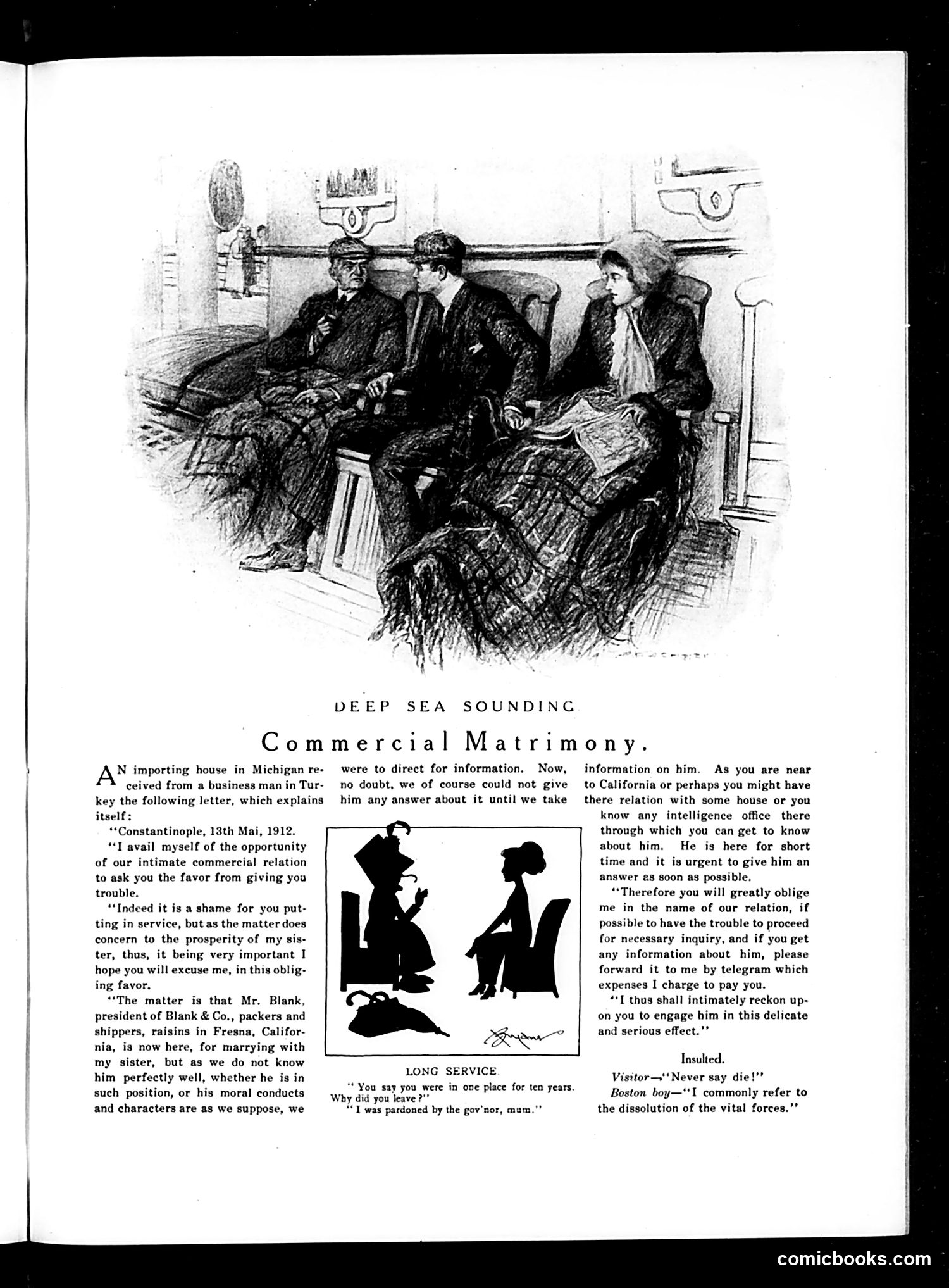
This page satirizes cross-cultural business communication and arranged marriages. The main article presents a genuine letter from a Turkish merchant requesting that an American importing company investigate a prospective brother-in-law (Mr. Blank, a California raisin shipper) before the marriage proceeds. The humor lies in the letter's awkward English phrasing and the absurdity of conducting due diligence on a marriage partner through business connections—treating matrimony as a commercial transaction requiring background checks and telegrams. The cartoon (top) illustrates the scene: three men in a business setting discussing this unusual request. Secondary jokes on the page include "Long Service" (a man explains leaving his job because he was "pardoned by the gov'nor") and "Insulted" (wordplay about "dissolution of vital forces" as a euphemism for death).
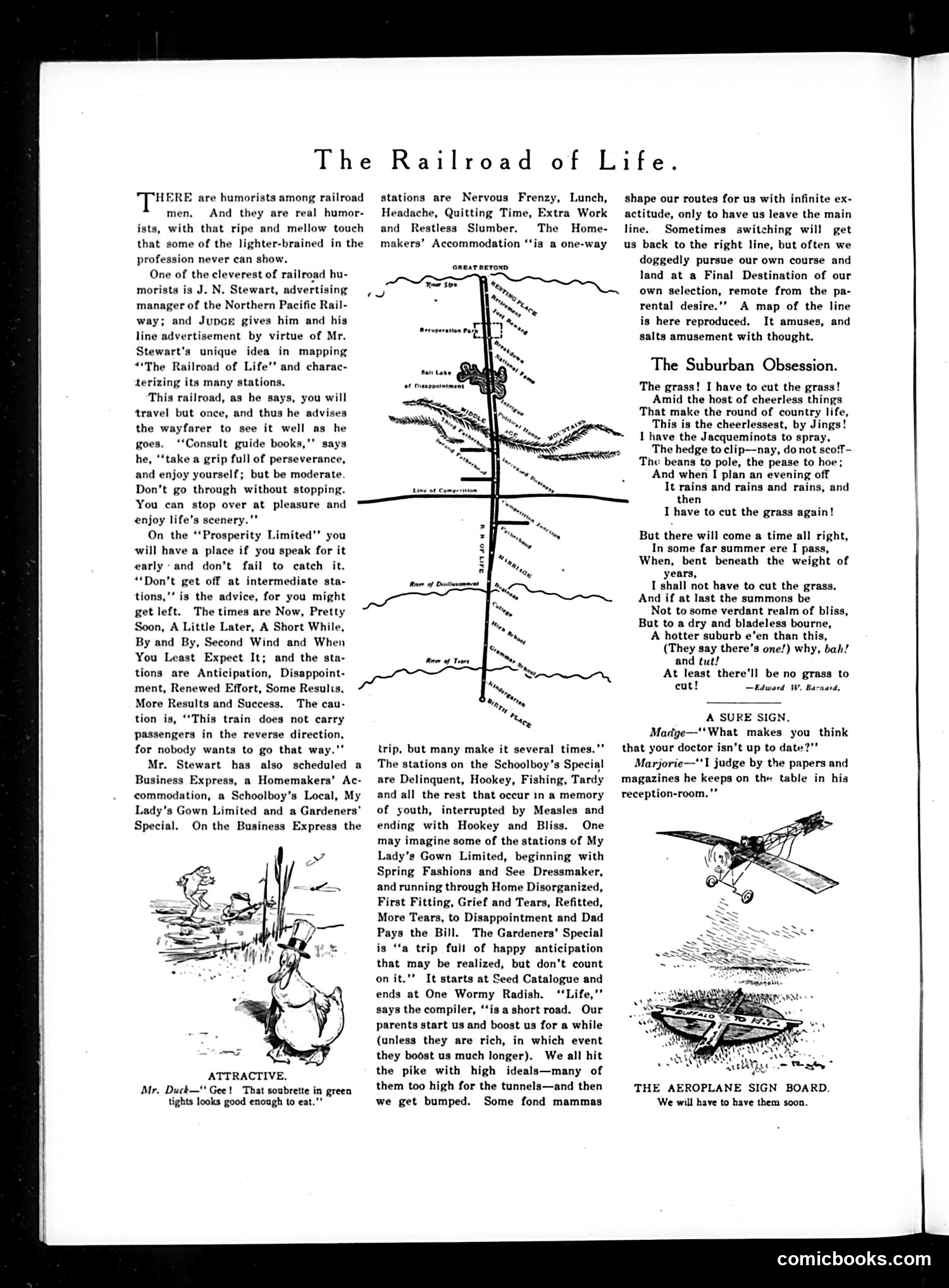
This page presents J.N. Stewart's (Northern Pacific Railway advertising manager) clever metaphor: life as a train journey with symbolic stations. The "Prosperity Limited" train stops at stations like Anticipation, Disappointment, Renewed Effort, and Success—tracking a typical life trajectory. Other trains serve specific demographics: the Schoolboy's Local stops at Hookey and Measles; My Lady's Gown Limited progresses through Spring Fashions to "Dad Pays the Bill"; the Gardeners' Special optimistically begins at Seed Catalogue but ends at "One Wormy Radish." The satire gently mocks human ambition and life's inevitable disappointments. The message: life is a one-way journey—plan carefully, don't get sidetracked, enjoy the scenery, and accept you can't reverse course. The secondary cartoon mocks suburban middle-class obsession with lawn maintenance ("The grass! I have to cut the grass!"), treating grass-cutting as life's most tedious burden.
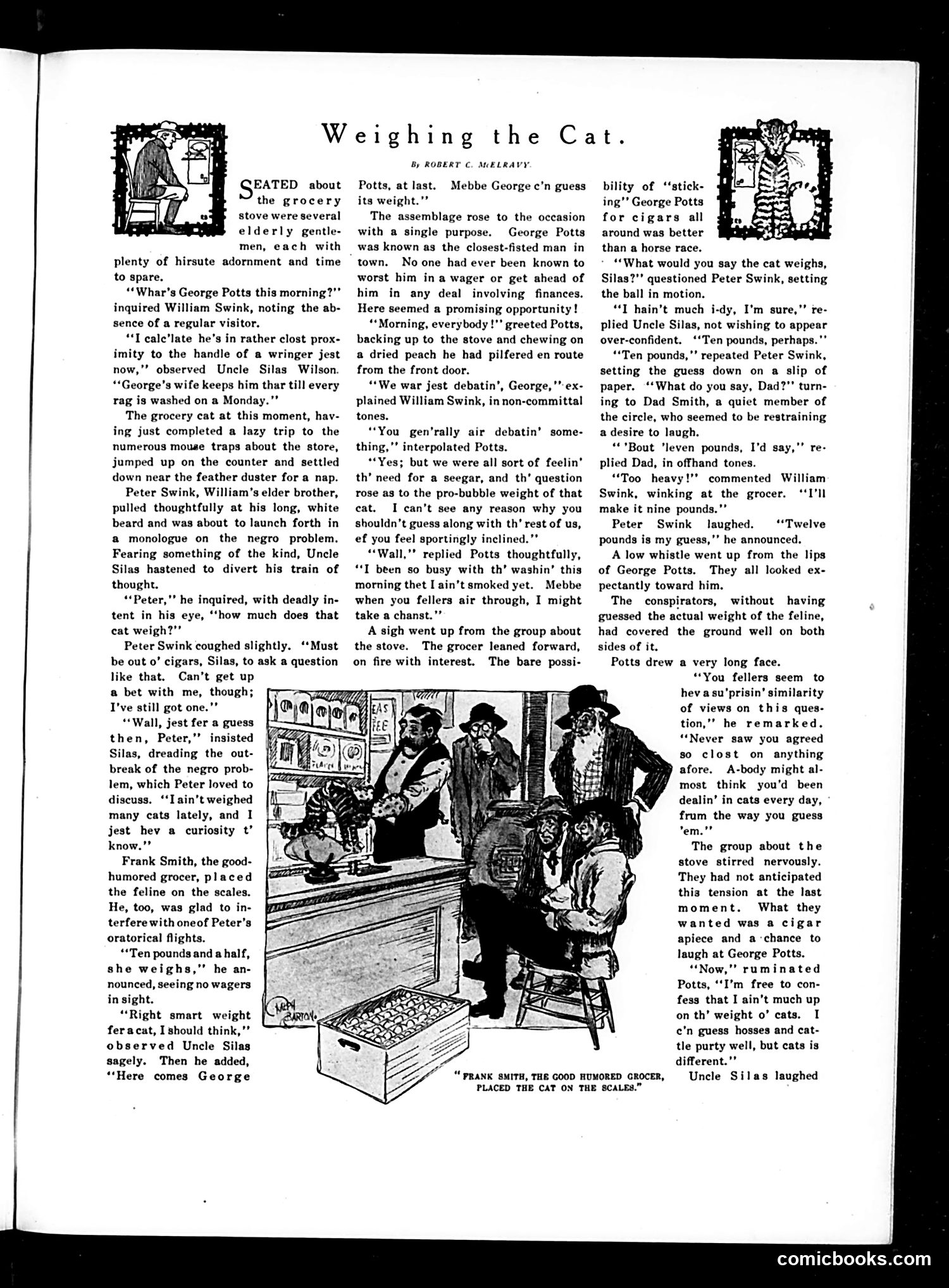
This is a humorous story about small-town gossip and a bet. A group of elderly men at a grocery store debate the weight of the store cat as a casual wager—a common form of entertainment and stakes for cigars in rural communities. The setup targets **George Potts**, a famously stingy, shrewd businessman known for never losing financial deals. The men see an opportunity to finally "stick" him—trick him into losing cigars through a bet he can't win. The joke's tension derives from Potts being too busy with laundry (henpecked by his wife) to participate immediately, frustrating the group. The satire mocks both rural gambling culture and Potts' miserliness: even a simple cat-weighing becomes an occasion for working-class men to scheme against their tightest peer. The grocer's eager participation shows how universal the impulse is to best Potts financially.
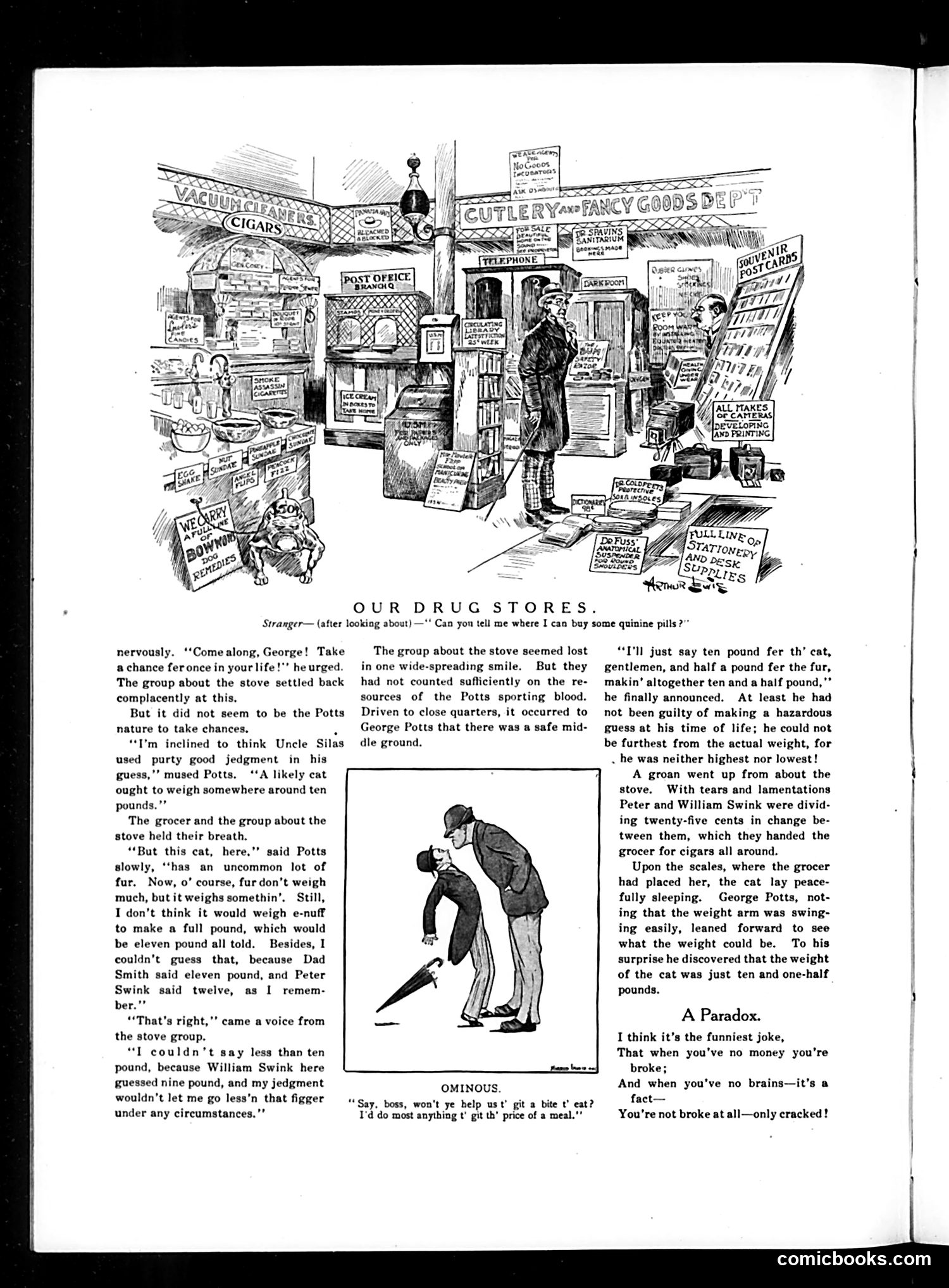
This satirical story depicts a small-town betting game at a rural drug store where customers guess a cat's weight. George Potts, apparently known for caution, faces pressure to wager but employs clever logic: he splits the difference between other guesses (nine and twelve pounds), wagering "ten and a half pounds"—counting the cat's body at ten pounds plus half a pound for its fur. The joke satirizes small-town gambling culture and male vanity. Potts's meticulous reasoning—avoiding both extremes to hedge his bets—accidentally wins by landing precisely on the actual weight. His conservative, overthinking approach triumphs over confident guessing, mocking both the foolishness of gambling and the irony that excessive caution sometimes succeeds. The secondary cartoon mocks urban poverty, while a poem comments on financial ruin.
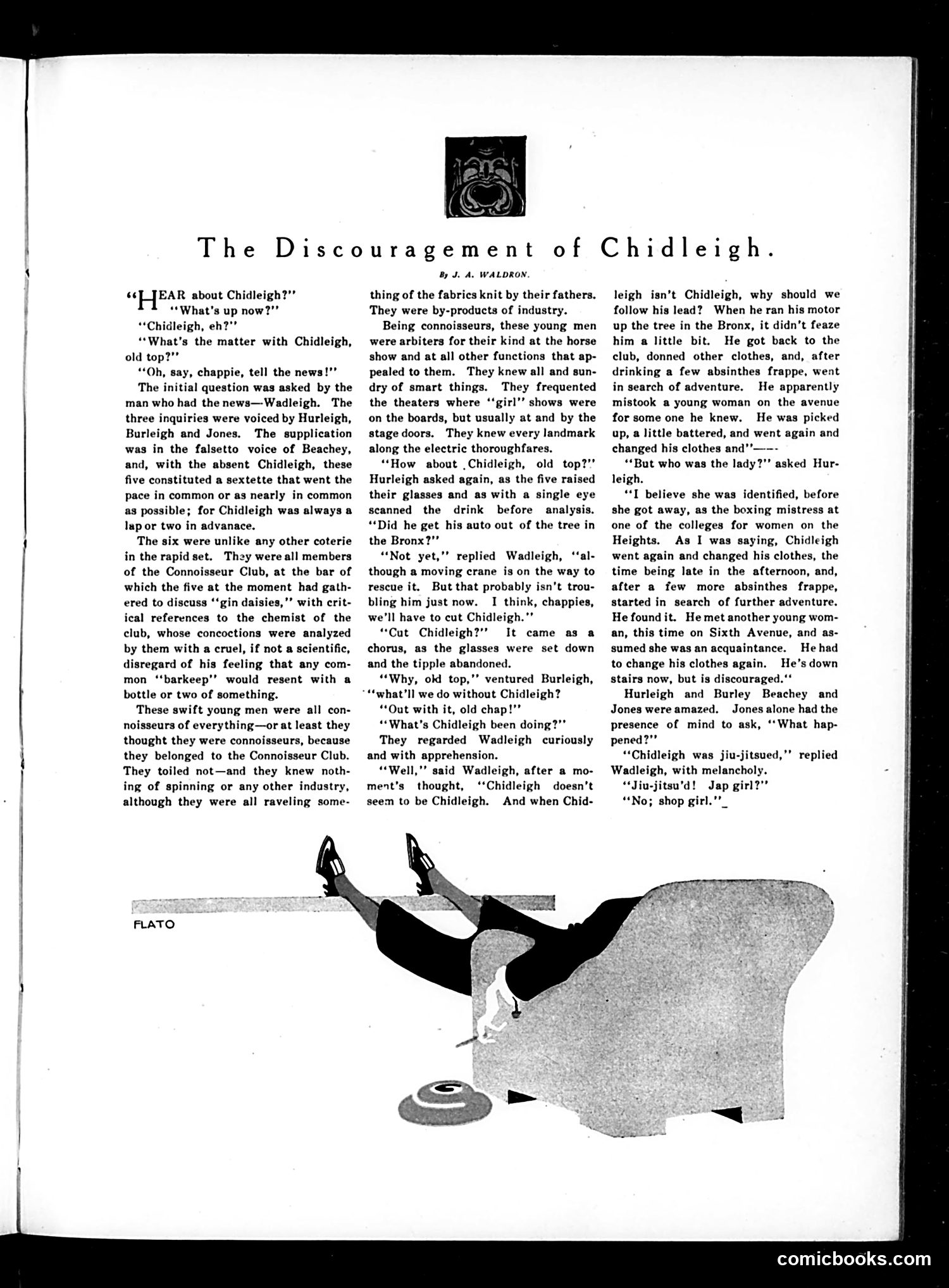
This is a satirical short story mocking the idle wealthy class of early 20th-century Manhattan. Chidleigh and his social set—Wadleigh, Hurleigh, Burleigh, Jones, and Beachey—are members of the Connoisseur Club, wealthy young men who "toiled not" and were "by-products of industry" (inherited wealth). The satire: these self-proclaimed arbiters of taste and fashion know nothing practical; they merely frequent theaters, horse shows, and nightlife while claiming refined expertise. The joke: Chidleigh's "discouragement" stems from repeated romantic misadventures. He mistook two different women for acquaintances he knew, resulting in physical confrontations (implied boxing matches) that forced him to repeatedly change clothes. His companions are shocked not by his behavior, but that the usually unflappable Chidleigh seems "discouraged." The illustration (credited "PLATO") shows a lounging figure in relaxed pose, likely representing the idle leisure these men embody. The satire targets upper-class frivolity and disconnect from reality.
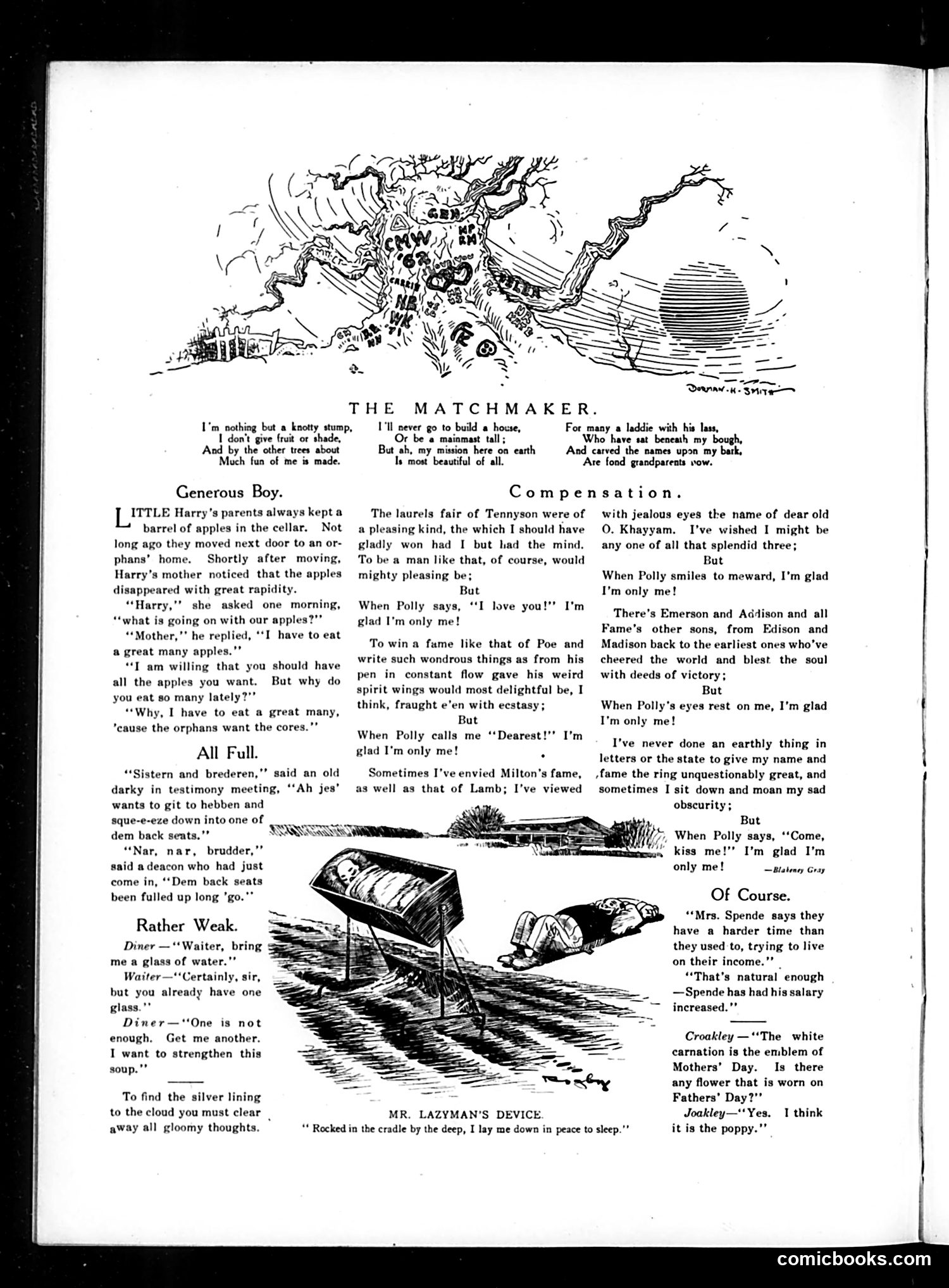
This page contains several short humorous pieces typical of early 20th-century American satirical magazines: **"Generous Boy"** and **"All Full"** are dialect jokes playing on racial stereotypes common to the era—depicting Black speakers with exaggerated speech patterns for comic effect. **"Rather Weak"** is a simple pun about watering down soup. **"The Matchmaker"** is sentimental verse about a tree witnessing lovers' declarations, contrasted with **"Compensation,"** a longer poem where an ordinary man finds contentment in being loved by "Polly" rather than achieving literary fame like Tennyson, Poe, or Milton. **"Mr. Lazyman's Device"** shows an illustration of someone in a rocking cradle, playing on the concept of effortless comfort. **"Of Course"** presents a gentle joke about Fathers' Day flowers—the "poppy" puns on opium use, suggesting fathers need sedation. The page reflects Judge's mix of mild social satire, sentimental poetry, and puns, with racial humor that would be considered offensive today.
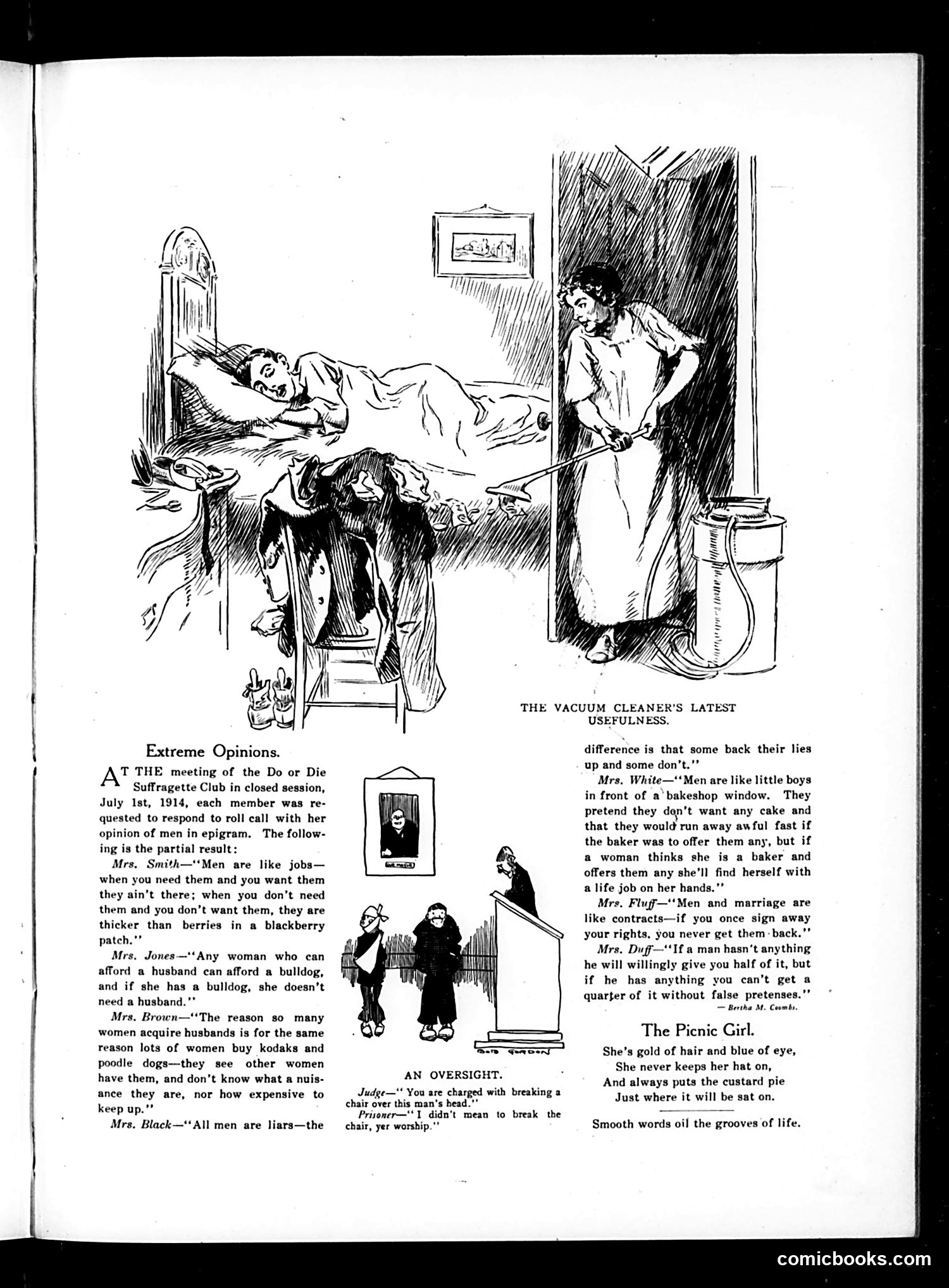
This page contains satirical commentary on early 20th-century gender relations, centered around a 1914 suffragette club meeting. The "Extreme Opinions" section presents women members offering cynical epigrams about men—comparing them to unreliable jobs, unnecessary expenses, and liars. The satire mocks both the suffragettes' anti-male rhetoric and, implicitly, traditional marriage dynamics. The three cartoons illustrate domestic scenes: a woman cleaning with a vacuum cleaner (presented as her "latest usefulness"), a court scene where a prisoner worries more about breaking a chair than assaulting a man, and a poem about a careless "picnic girl." The overall thrust appears to mock the women's suffrage movement by exaggerating women's grievances against men while simultaneously depicting women as frivolous or destructive. The magazine presents this as humor attacking feminist rhetoric rather than supporting women's equality.
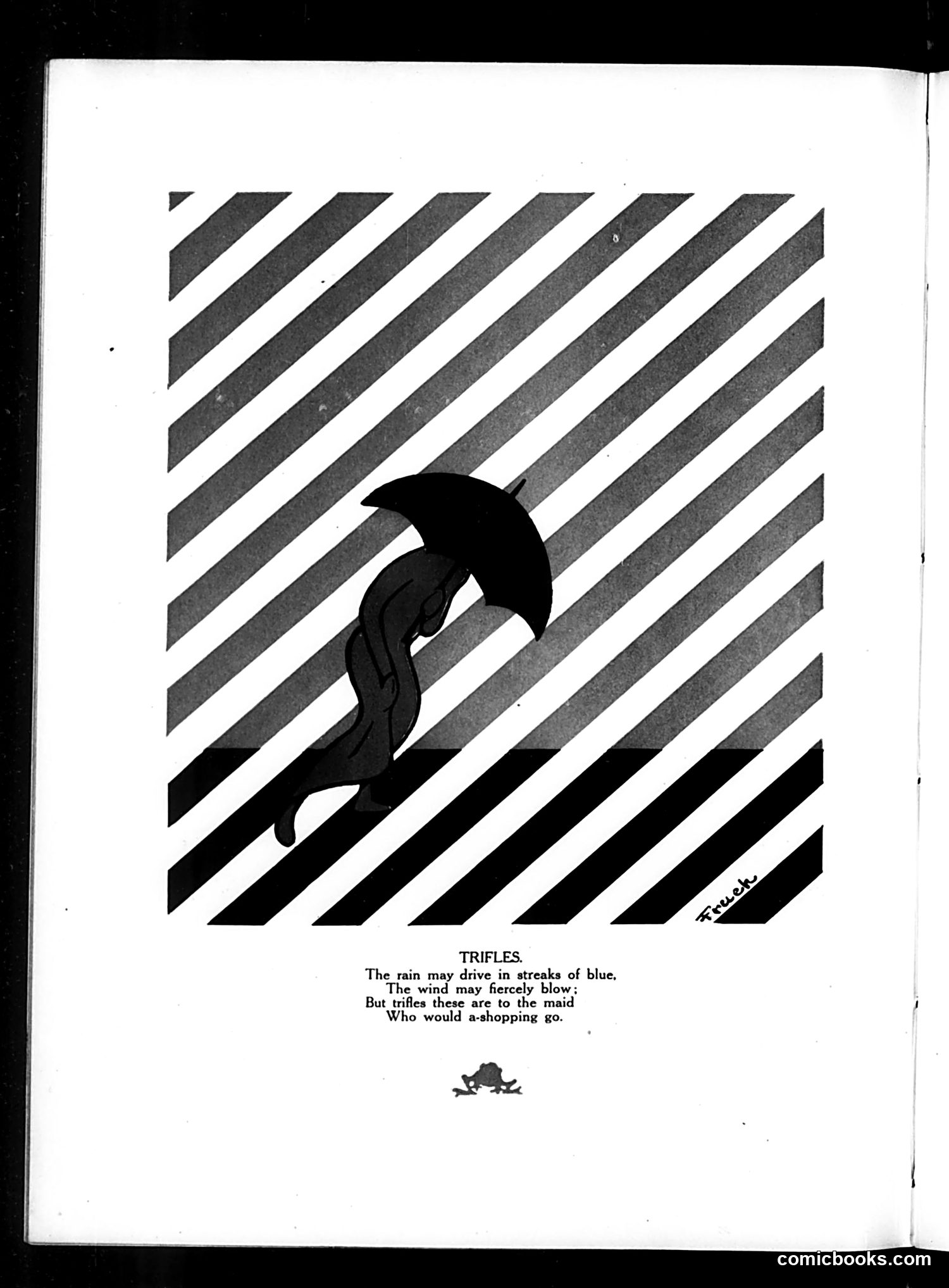
This illustrated verse celebrates female shopping as an irresistible pursuit. The artwork shows a woman with an umbrella trudging through diagonal rain and wind, depicted through bold striped patterns. The accompanying poem suggests that despite harsh weather—rain and fierce winds—a woman determined to go shopping considers these conditions mere "trifles" (trivial obstacles). The satire gently mocks both female shopping enthusiasm and the societal stereotype of women as inveterate consumers willing to brave any inconvenience for retail. The humor lies in depicting shopping not as a necessity but as such a compelling compulsion that dangerous weather cannot deter it. This reflects early-20th-century attitudes about women's consumer behavior and leisure activities.
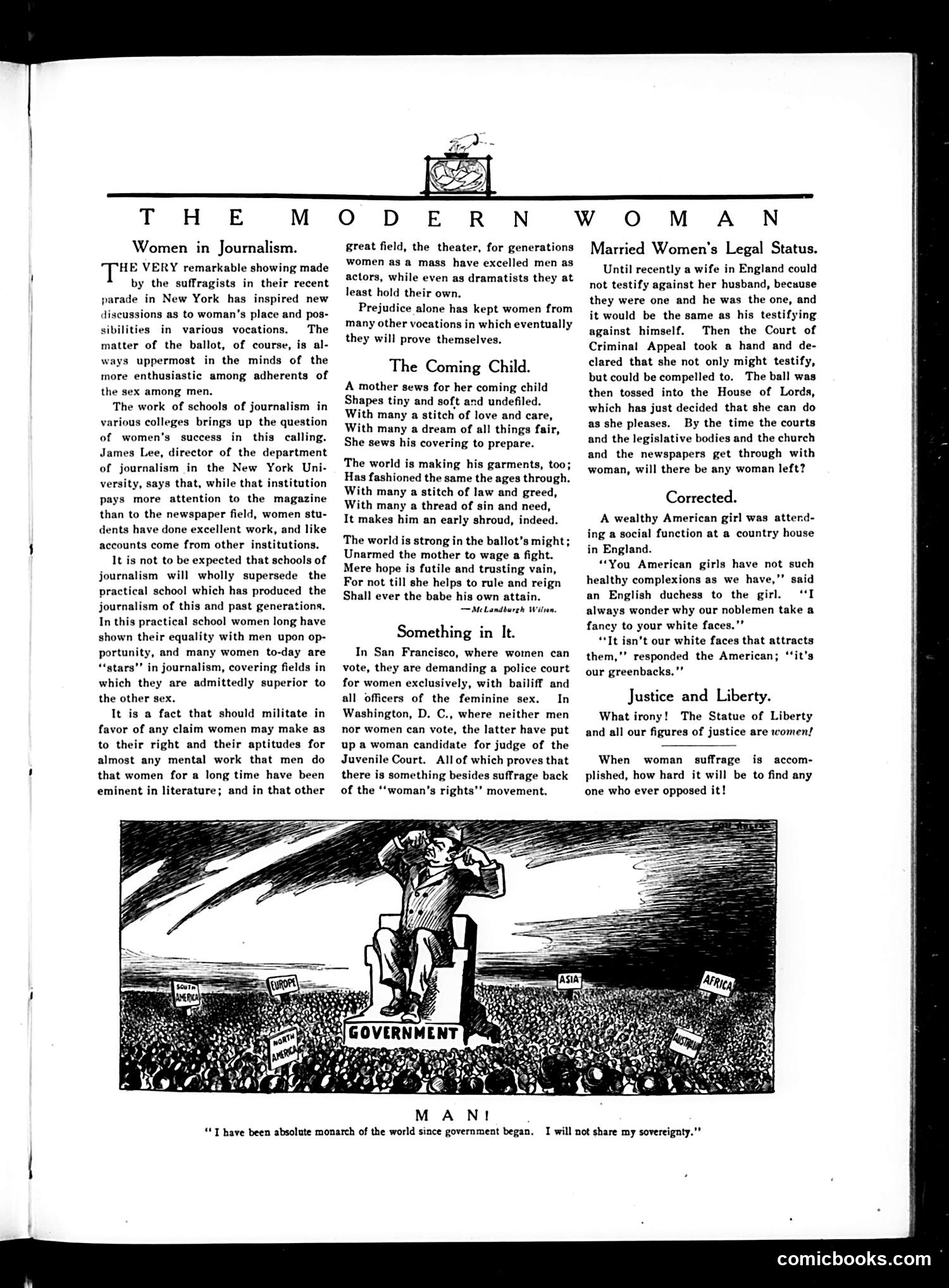
This page addresses women's expanding roles in early 20th-century America, primarily through advocacy rather than satire. The main cartoon depicts **"Man"**—a figure standing atop "Government," claiming absolute monarchy since government began—contrasted with **"Woman"** demanding equality and a voice in governance. This illustrates the suffrage debate: men's historical political monopoly versus women's growing demands for voting rights and participation. The accompanying articles support women's capabilities in journalism, law, and civic participation. A poem, "The Coming Child," uses metaphor to argue that mothers cannot adequately prepare children for society without political power—suggesting women need voting rights to influence the world their children inherit. The "Something in It" section cites San Francisco (where women could vote) and Washington, D.C. (where they couldn't) as evidence that women's activism extends beyond suffrage alone—they seek broader legal and professional equality. Overall, this page advocates for women's suffrage and expanded opportunities rather than mocking them.
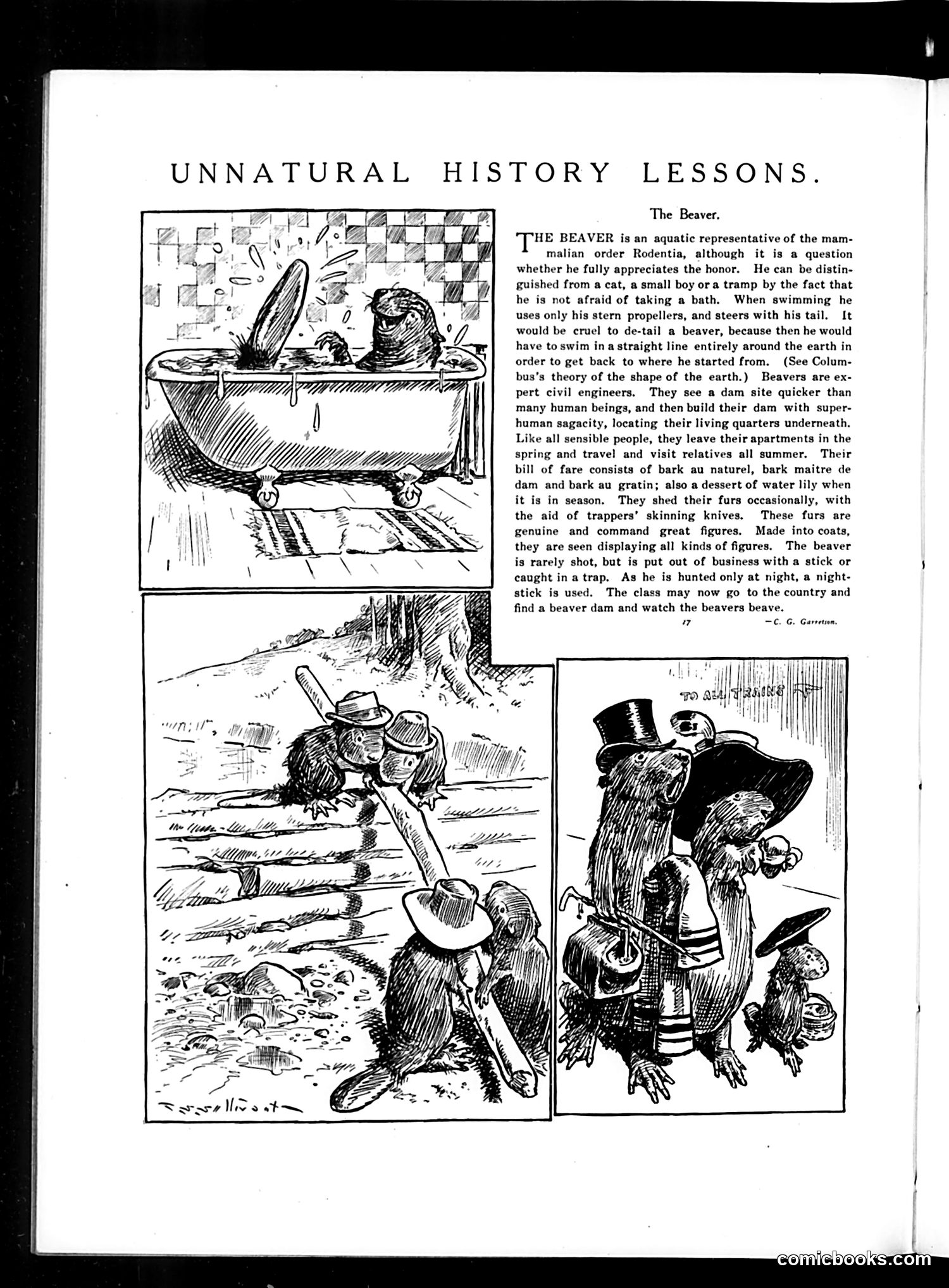
This is a humorous "nature lesson" mocking both animal facts and Victorian manners. The text presents deliberately absurd descriptions: beavers preferring baths (unlike the dirty "cat, small boy or tramp"), puns about tails and "detail," and jokes about Columbus and the Earth's shape. The embedded caricatures appear to show well-dressed gentlemen (possibly Gilded Age capitalists or politicians, identifiable by top hats) anthropomorphized as beavers engaged in dam-building—a likely metaphor for corporate monopolies or industrial manipulation of natural resources. The satire suggests wealthy men exploit nature (and labor) with calculated "sagacity" while the common man (the "small boy or tramp") lives uncouth and dirty. The author mocks overly serious "natural history" while critiquing class pretensions and rapacious industrialization disguised as civilized engineering.
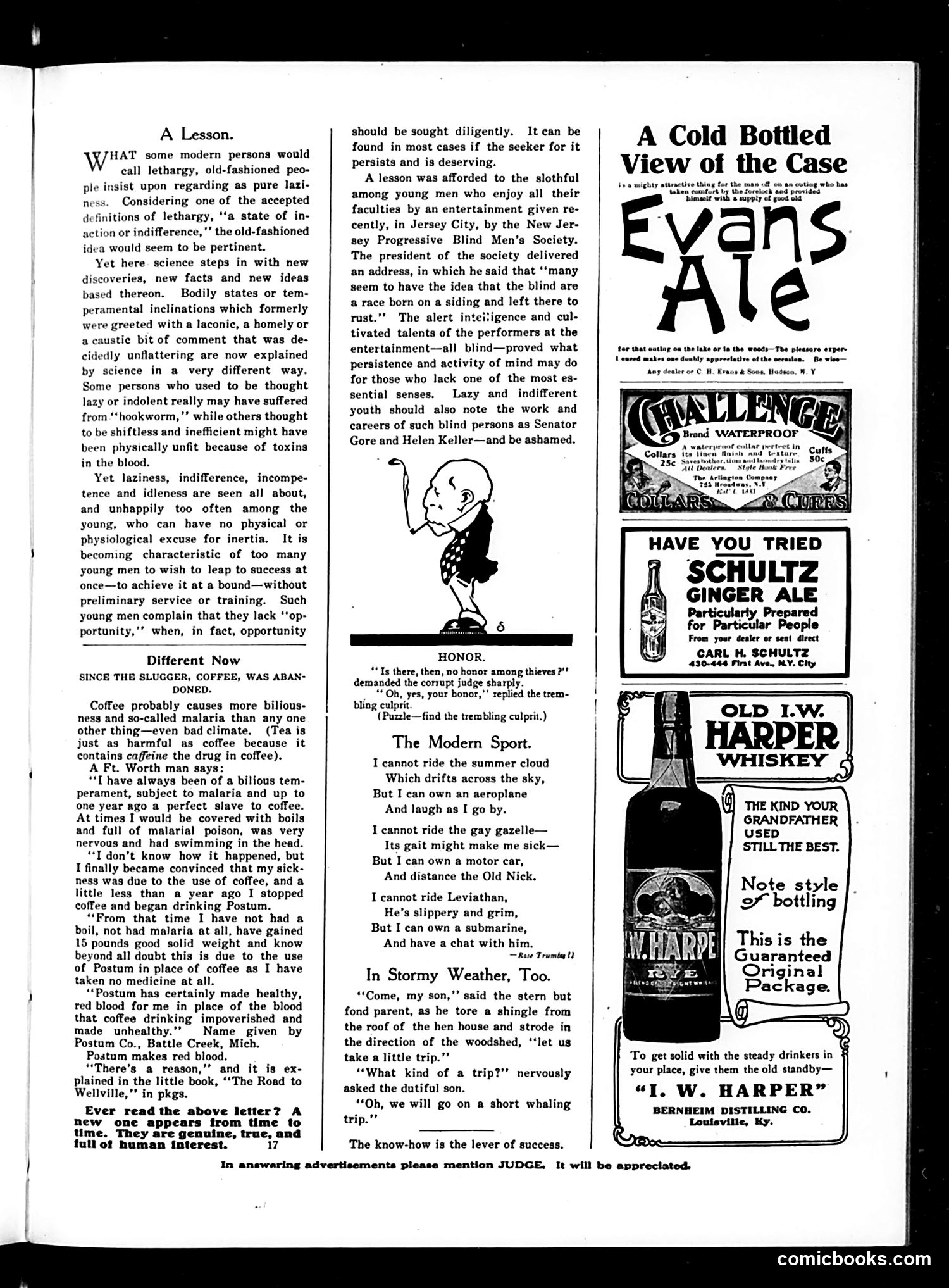
This page combines editorial content with period advertising. The main article "A Lesson" contrasts modern scientific explanations for laziness (hookworm, toxins) with old-fashioned moral judgment. It argues young people lack ambition and expect success without training, then praises blind performers—likely including Senator Gore and Helen Keller—as examples of perseverance overcoming disability. The small cartoon labeled "HONOR" presents a judge asking a thief if there's honor among criminals. It's a cynical joke about corrupt judiciary: the judge himself is corrupt ("the corrupt judge sharply"), so his ironic question about criminal honor satirizes judicial hypocrisy. The page is heavily dominated by **period advertisements** for Evans Ale, Challenge Waterproof Collars, Schultz Ginger Ale, and I.W. Harper Whiskey—typical early-20th-century product promotions.
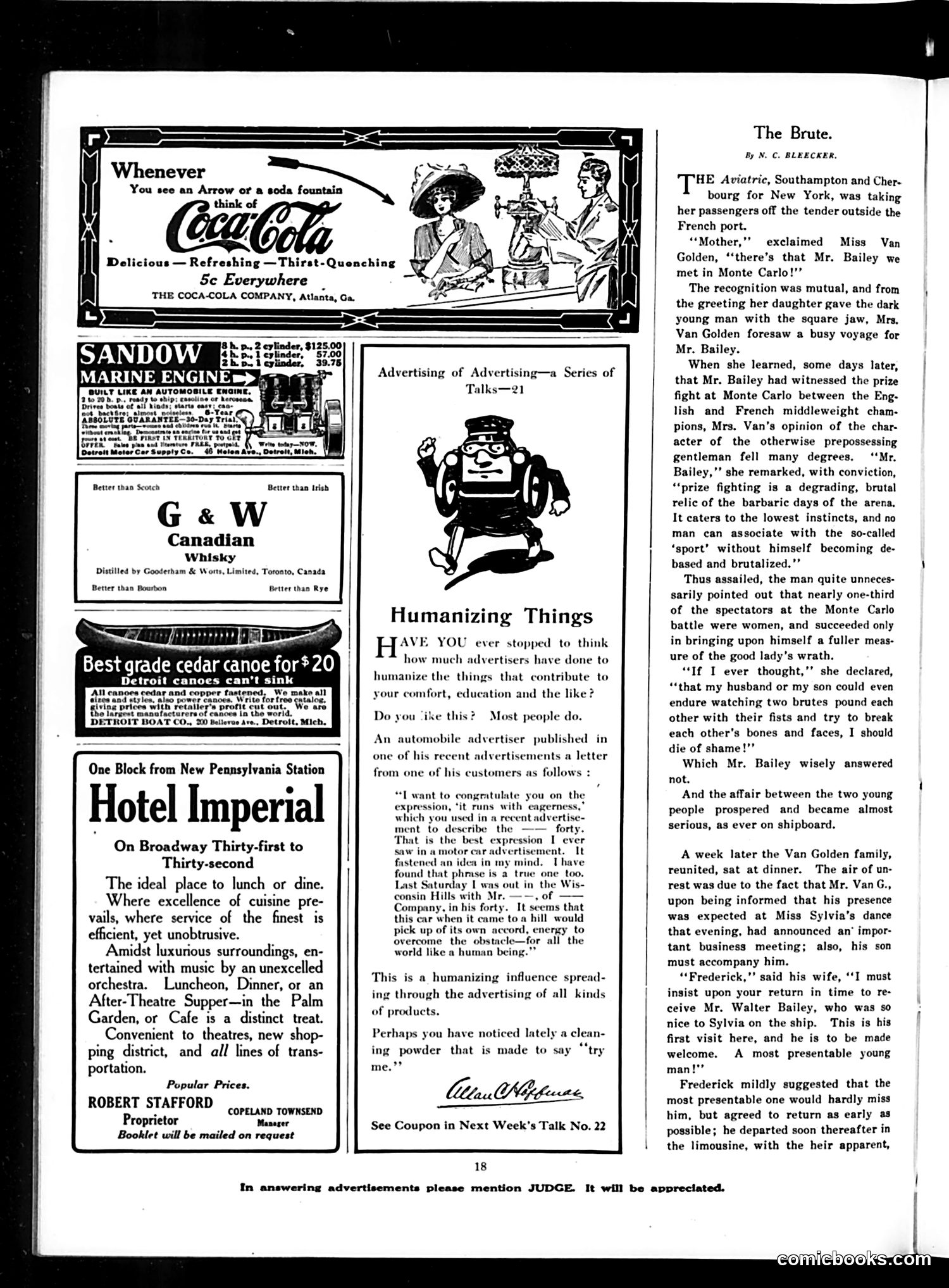
This short story satirizes upper-class moral hypocrisy. Mrs. Van Golden, a wealthy society matron traveling on a luxury liner, initially approves of Mr. Bailey—a socially acceptable young man—until learning he attended a prize fight at Monte Carlo. She then condemns him as "debased and brutalized," viewing boxing as barbaric and incompatible with genteel society. The satire deepens when Bailey points out that nearly one-third of spectators were women—implying the moral disapproval is performative rather than principled. Mrs. Van Golden's indignation only intensifies, revealing her concern is less about the sport's brutality than about maintaining class respectability and social appearances. The story mocks how the wealthy police morality selectively while their own members participate in the very activities they publicly denounce.
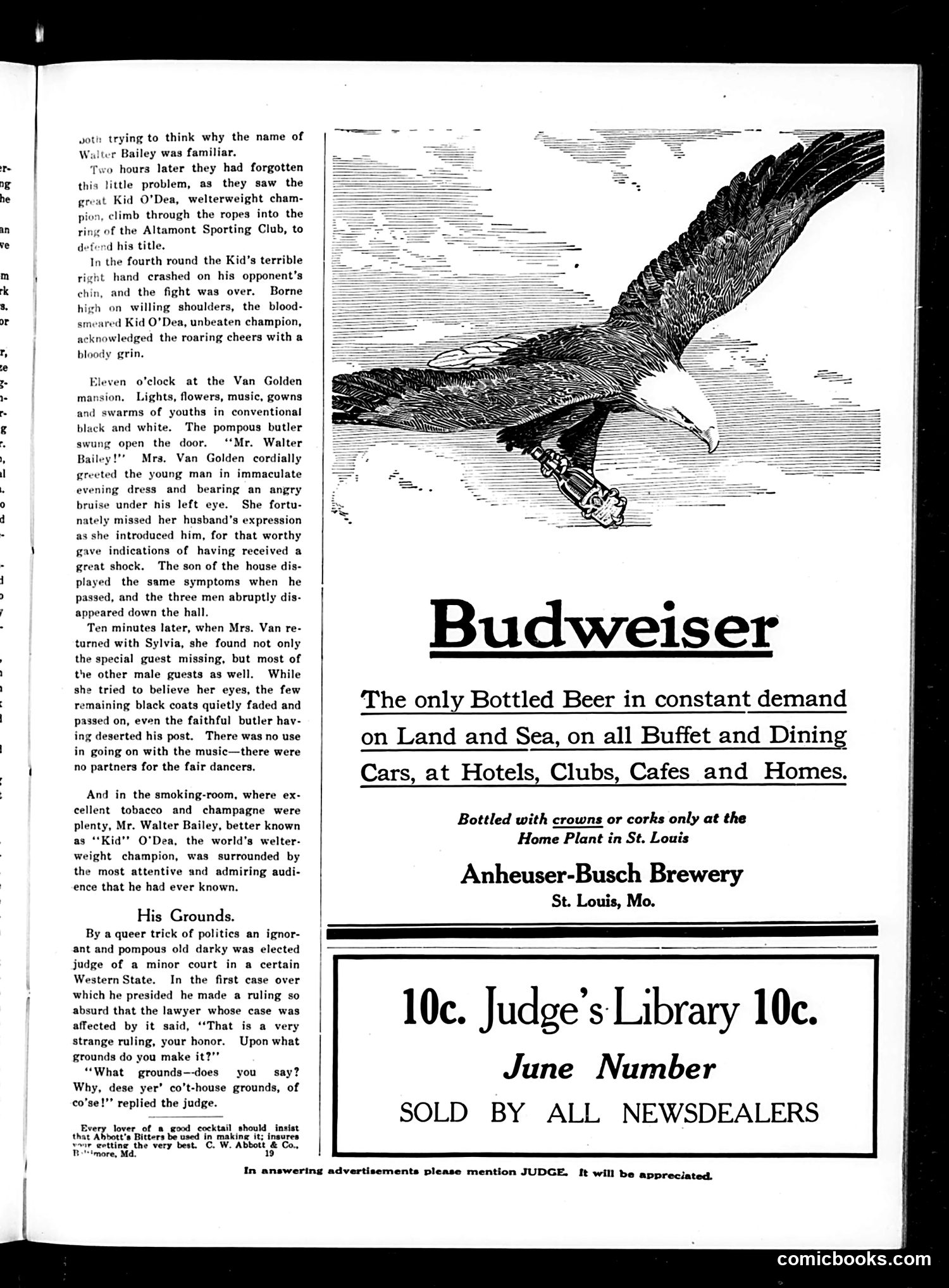
This page contains two distinct pieces of content: **Main Story:** A social comedy about mistaken identity. A young boxer known as "Kid O'Dea" fights at a sporting club, then appears at an elite Van Golden mansion party as "Walter Bailey." The guests discover his true identity and abandon the hostess to surround the famous fighter instead—a satirical jab at American class pretension and celebrity worship overriding social hierarchy. **Secondary Joke:** A racist caricature depicting a Black judge making an absurd ruling based on a pun about "courthouse grounds" (the physical location vs. legal reasoning). This reflects the magazine's casual bigotry typical of early 20th-century publications. **Advertising:** The Budweiser and Abbott's Bitters ads are period marketing, while the "Judge's Library" box promotes the magazine itself. The page exemplifies Judge's satirical focus on social foibles and pretension among the wealthy and respectable classes.
This is primarily a **advertising page** from Judge magazine, not a political cartoon. The page contains: **Main Content:** - Whiskey advertisement (Hunter Baltimore Rye) - Hotel advertisements (Grenoble, Park Hotel, St. Denis) - A notice about Judge's contest being postponed due to overwhelming entries - A humorous poem titled "Dictionary Discoveries" **The Poem's Joke:** Edmund Moberly's poem is light satire about obscure animal and scientific terms most people don't know exist. Each stanza builds a pattern: he was ignorant of these odd creatures/concepts "until I saw it in the dictionary." The humor comes from the unexpected revelation of bizarre, real-but-unfamiliar words (capybara, thylacine, scyphozoans, etc.). It's gentle intellectual humor typical of Judge's audience—educated readers amused by their own gaps in knowledge. **Historical Context:** This appears to be early 20th century. The ads emphasize "refined" travel and "ladies travelling alone," reflecting period concerns about respectability and gender.
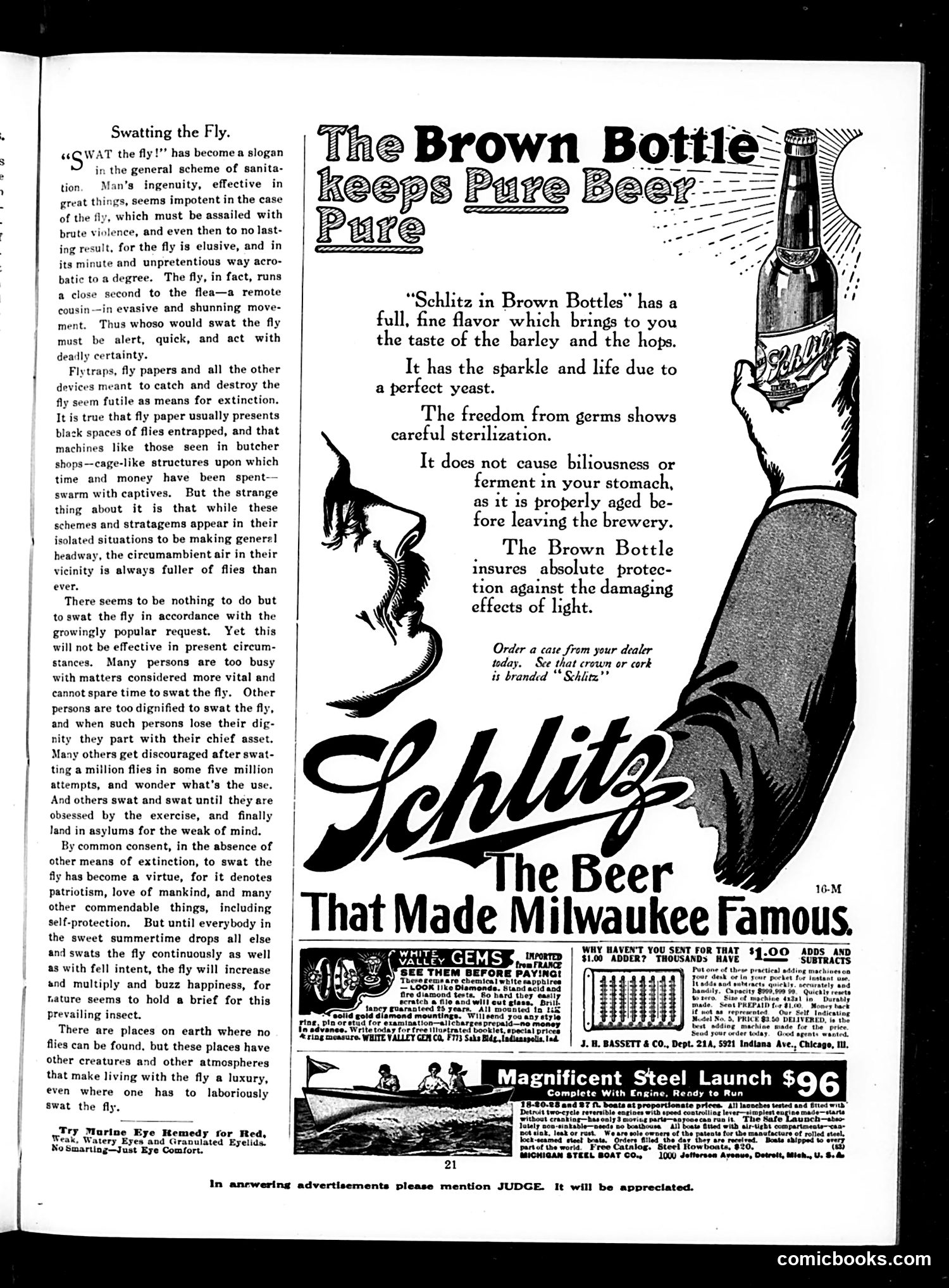
This page is primarily **advertising**, not satire or political commentary. The left column contains an essay titled "Swatting the Fly"—a humorous commentary on the popular public health campaign encouraging citizens to kill flies as a sanitation measure. The essay satirizes the futility and impracticality of the "swat the fly" movement, noting that despite widespread efforts, flies remain abundant. It gently mocks both those too busy to participate and those who become obsessed with fly-swatting. The bulk of the page features commercial advertisements: Schlitz beer (emphasizing the brown bottle's protection against light damage), Valley Gems jewelry (promoting imported gems), and a steel boat launch. A small eye remedy advertisement appears at bottom left. The content reflects early 20th-century American concerns with hygiene and disease prevention alongside consumer product promotion typical of Judge magazine's format.
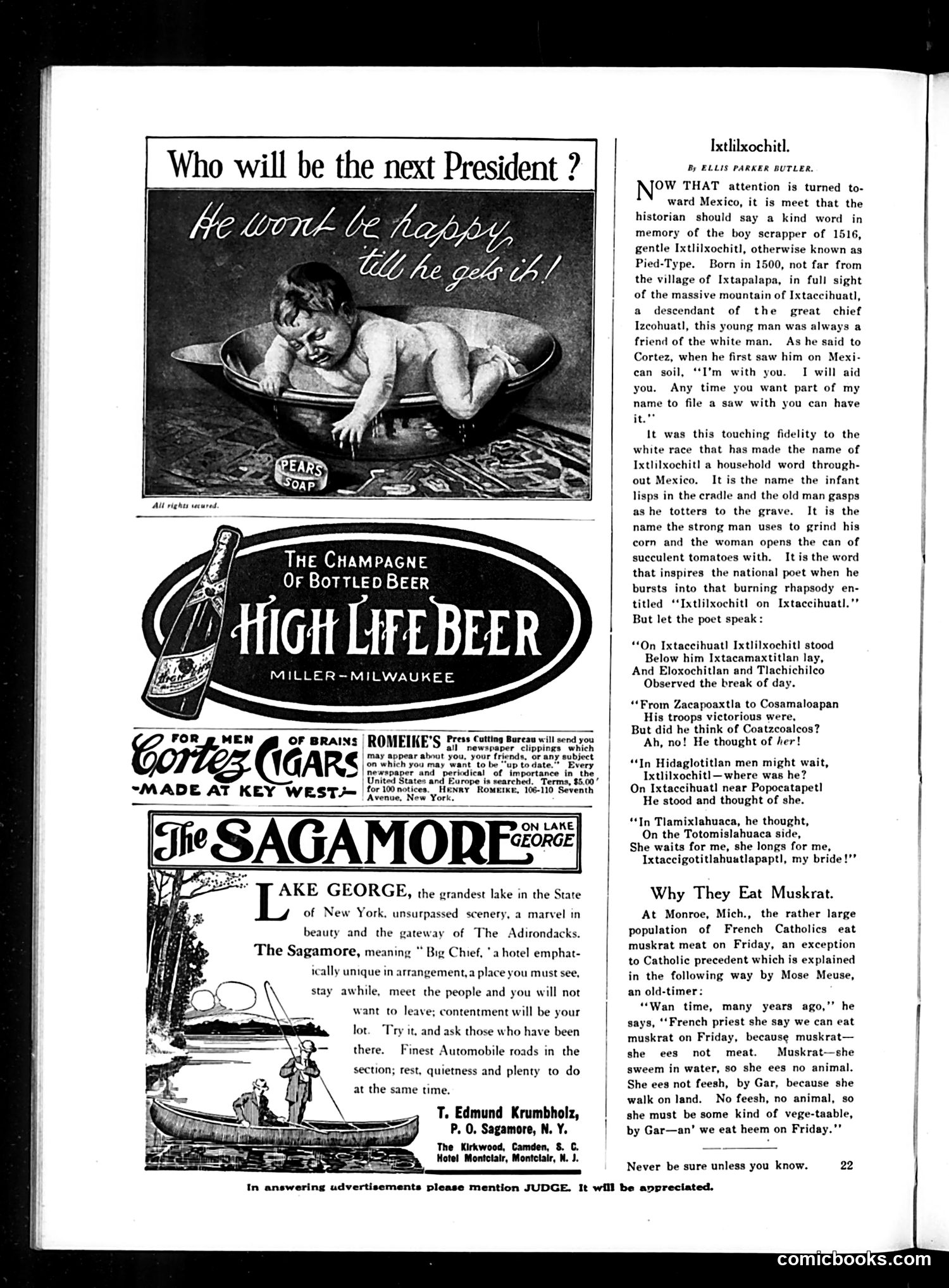
The top cartoon satirizes the 1912 presidential election with the caption "Who will be the next President? He won't be happy, till he gets it!" A baby in a bathtub clutches a Pears Soap box, appearing to represent a political candidate obsessed with winning office. The image mocks the undignified scrambling and desperation of presidential aspirants—reducing them to infants demanding gratification. The rest of the page consists of advertisements (High Life Beer, Cortes Cigars, The Sagamore hotel) and two humorous prose pieces: "Ixtlilxochitl" by Ellis Parker Butler satirizes flowery pseudo-historical Mexican poetry with deliberately unpronounceable Aztec names and absurd romantic verse; "Why They Eat Muskrat" jokes about French-Canadian Catholic logic reclassifying muskrat as "vegetable" to circumvent Friday meat restrictions. The satire targets both political vanity and ethnic/religious cultural practices.
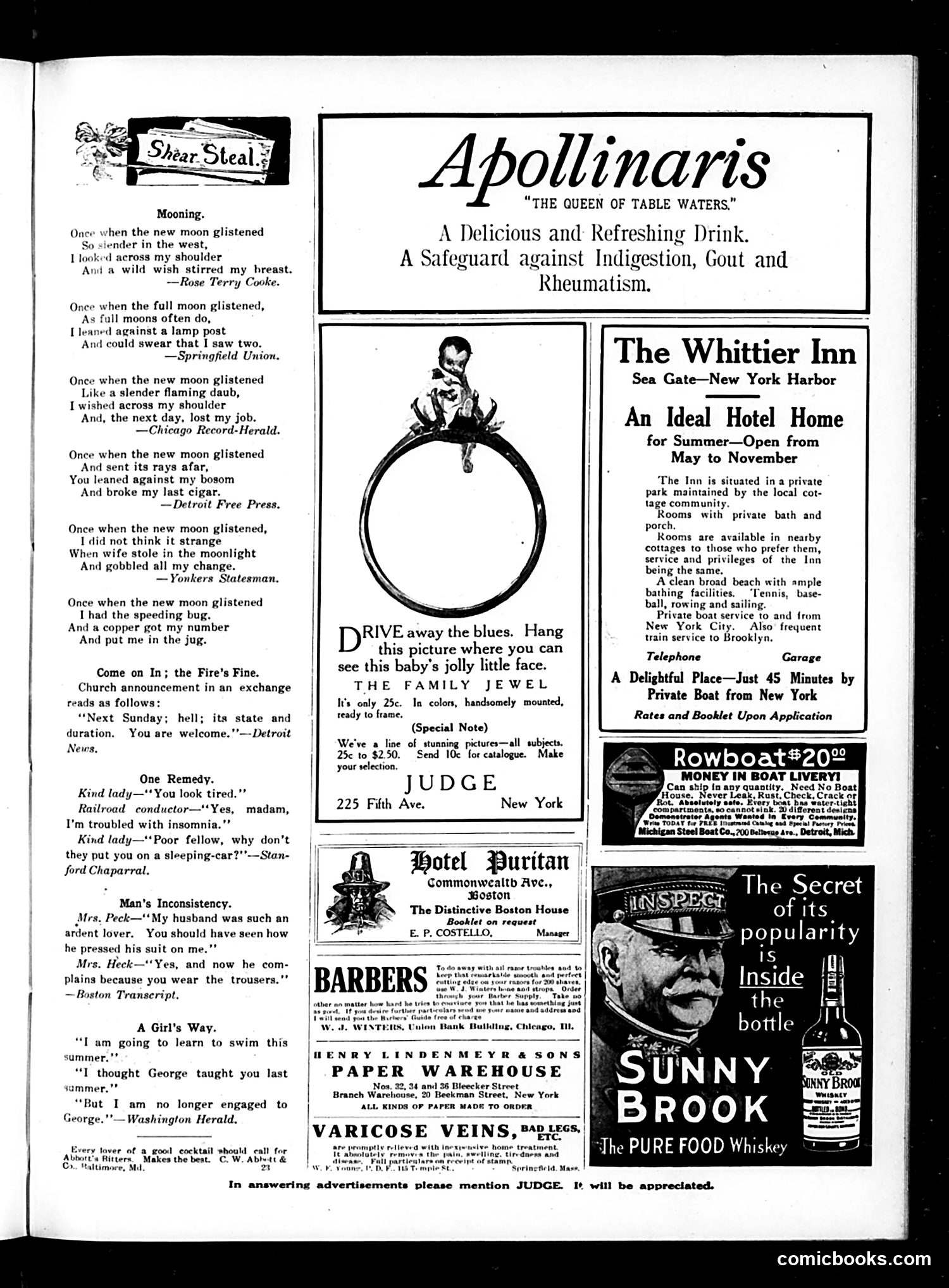
This page is primarily **advertisements and humorous short pieces**, not political satire. The content includes: **"Mooning" Section**: A series of brief comic poems playing on the phrase "when the new moon glistened," each from different newspapers. They're punchlines about romantic mishaps, drunkenness, job loss, and marital disputes—simple, everyday humor. **Other Humor Snippets**: Short jokes about a church service announcement about hell, railroad insomnia, marital role-reversal, and a girl breaking her engagement. These are gentle domestic comedy with no political edge. **Advertisements**: The page is dominated by product ads (Apollinaris water, The Whittier Inn, Hotel Puritan, barber supplies, paper warehouse, whiskey). These are standard period advertising with no satirical intent. **No Notable Political Cartooning**: Despite being from *Judge*, a satirical magazine, this particular page contains no identifiable political cartoons or social commentary requiring historical context beyond general early-20th-century domestic humor.
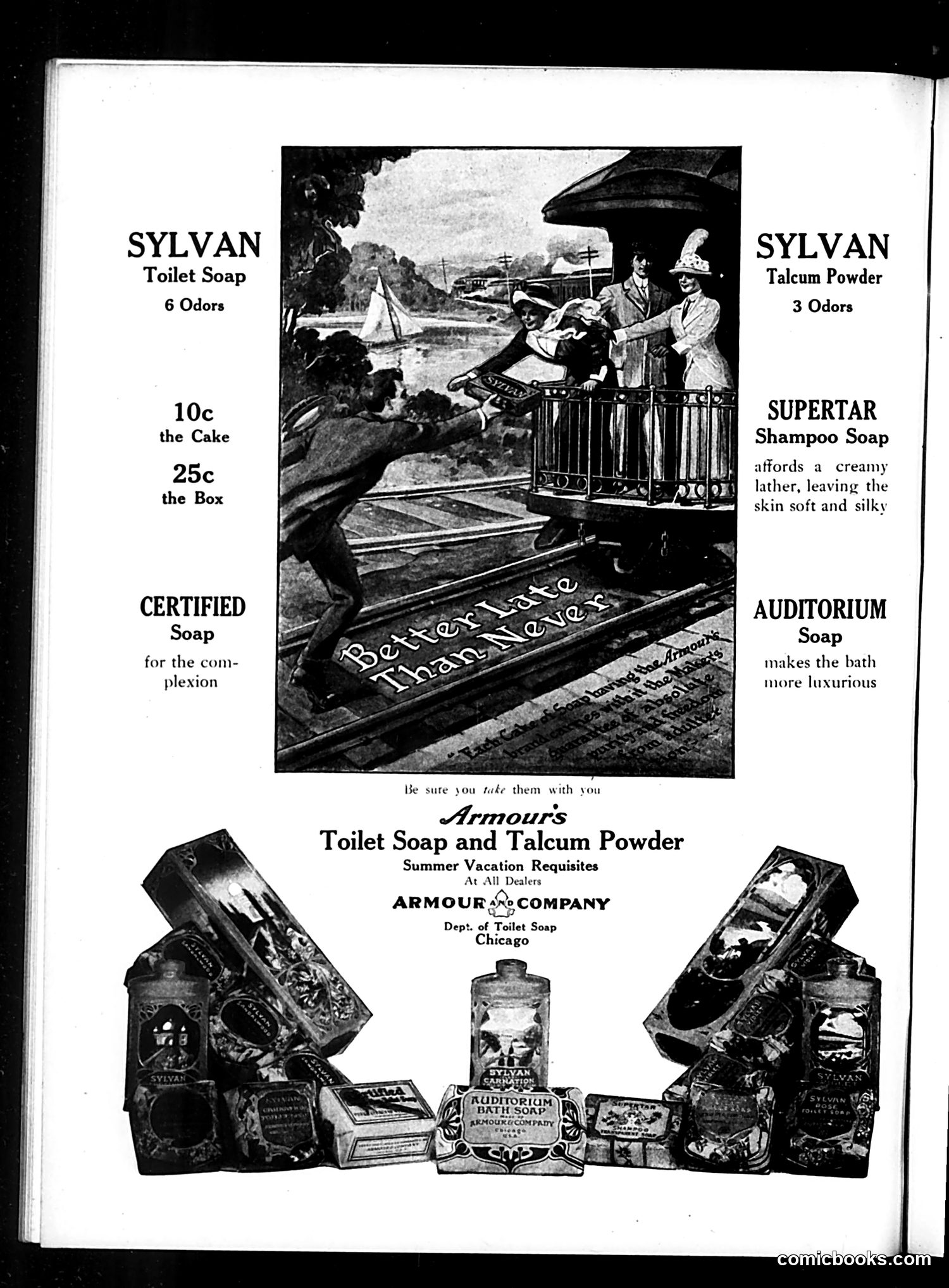
This page is primarily a **vintage advertisement**, not political satire. It advertises Armour Company's toiletry products (Sylvan soap, talcum powder, and related items) marketed as "Summer Vacation Requisites." The central image depicts an idealized leisure scene: well-dressed people enjoying a pleasant waterside outing with a boat, suggesting vacation and relaxation. This imagery was common in early 20th-century advertising to create aspirational lifestyle associations with consumer goods. The specific product claims—"certified soap for the complexion," creamy lather, luxurious bathing—reflect period marketing conventions emphasizing cleanliness, refinement, and beauty. The pricing (10¢-25¢) indicates this was mass-market consumer advertising. While the page appears in *Judge* magazine, it functions as straightforward commercial promotion rather than editorial satire or political commentary.