
Judge, 1912-06-08 · page 15 of 24
Judge — June 8, 1912 — page 15: what you’re looking at
What you’re looking at
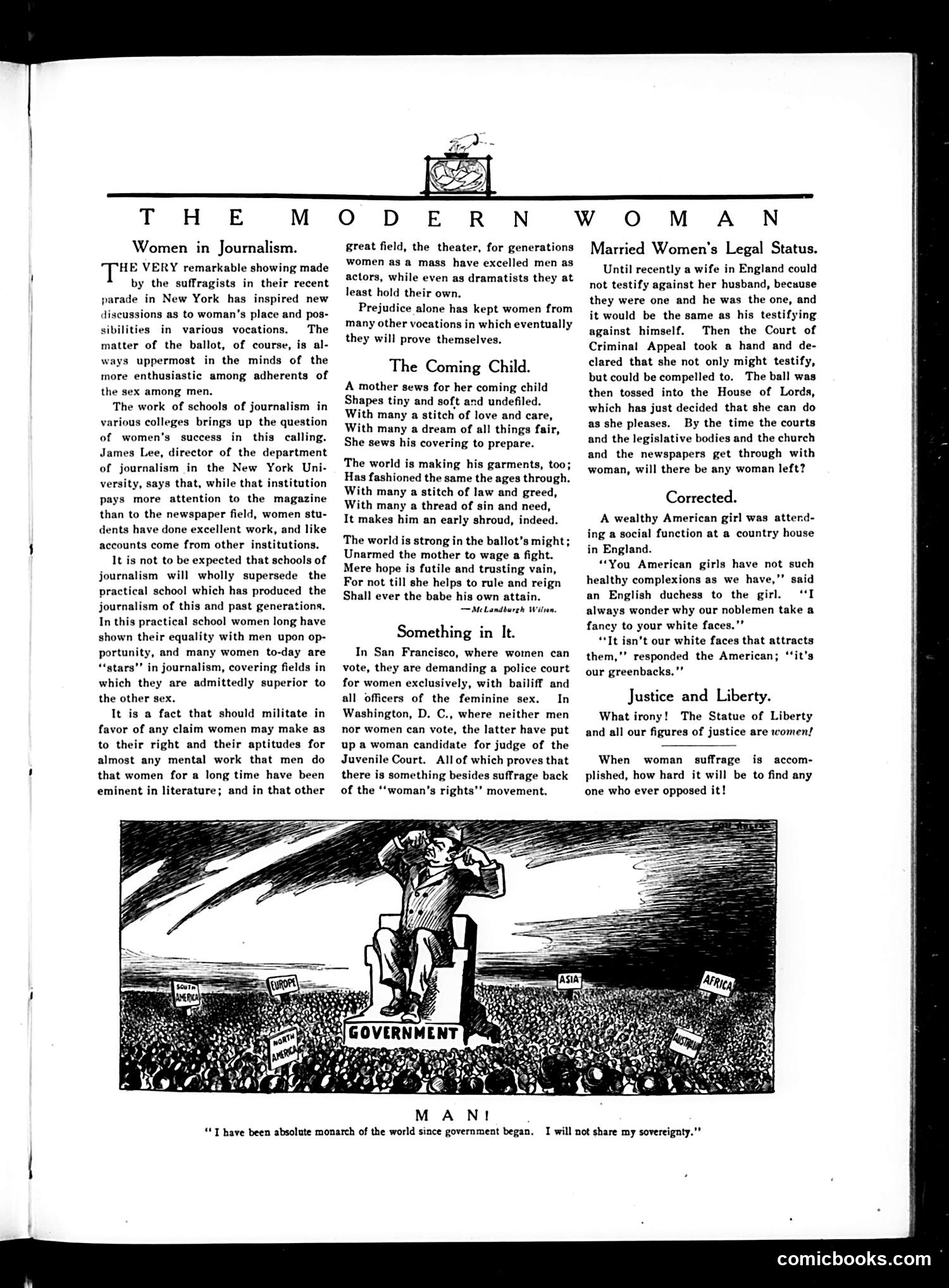
This page addresses women's expanding roles in early 20th-century America, primarily through advocacy rather than satire. The main cartoon depicts **"Man"**—a figure standing atop "Government," claiming absolute monarchy since government began—contrasted with **"Woman"** demanding equality and a voice in governance. This illustrates the suffrage debate: men's historical political monopoly versus women's growing demands for voting rights and participation. The accompanying articles support women's capabilities in journalism, law, and civic participation. A poem, "The Coming Child," uses metaphor to argue that mothers cannot adequately prepare children for society without political power—suggesting women need voting rights to influence the world their children inherit. The "Something in It" section cites San Francisco (where women could vote) and Washington, D.C. (where they couldn't) as evidence that women's activism extends beyond suffrage alone—they seek broader legal and professional equality. Overall, this page advocates for women's suffrage and expanded opportunities rather than mocking them.
📄 Transcribed text from this page (OCR, searchable)
Machine-transcribed from the original scan — historical spelling and the odd misread are preserved.
T H E Women in Journalism. HE VERY remarkable showing made by the suffragists in their recent parade in New York has inspired new discussions as to woman’s place and pos- sibilities in various vocations. The matter of the ballot, of course, is al- ways uppermost in the minds of the more enthusiastic among adherents of the sex among men, The work of schools of journalism in various colleges brings up the question of women’s success in this calling. James Lee, director of the department of journalism in the New York Uni- versity, says that, while that institution pays more attention to the magazine than to the newspaper field, women stu- dents have done excellent work, and like accounts come from other institutions. It is not to be expected that schools of journalism will wholly supersede the practical school which has produced the journalism of this and past generations. In this practical school women long have shown their equality with men upon op- portunity, and many women to-day are ‘‘stars’’ in journalism, covering fields in which they are admittedly superior to the other sex. It is a fact that should militate in favor of any claim women may make as to their right and their aptitudes for almost any mental work that men do that women for a long time have been eminent in literature; and in that other MO D E RN Great field, the theater, for generations women as a mass have excelled men as actors, while even as dramatists they at least hold their own. Prejudice alone has kept women from many other vocations in which eventually they will prove themselves. The Coming Child. A mother sews for her coming child Shapes tiny and soft and undefiled, With many a stitch of love and care, With many a dream of all things fair, She sews his covering to prepare. The world is making his garments, too; Has fashioned the same the ages through. With many a stitch of law and greed, With many a thread of sin and need, It makes him an early shroud, indeed. The world is strong in the ballot’s might; Unarmed the mother to wage a fight. Mere hope is futile and trusting vain, For not till she helps to rule and reign Shall ever the babe his own attain. —McLandburgh Wilsen. Something in It. In San Francisco, where women can vote, they are demanding a police court for women exclusively, with bailiff and all officers of the feminine sex. In Washington, D. C., where neither men nor women can vote, the latter have put up a woman candidate for judge of the Juvenile Court. Allof which proves that there is something besides suffrage back of the ‘‘woman’s rights’? movement. MAN! “T have been absolute monarch of the world since government began. Ww oM A N Married Women's Legal Status. Until recently a wife in England could not testify against her husband, because they were one and he was the one, and it would be the same as his testifying against himself. Then the Court of Criminal Appeal took a hand and de- clared that she not only might testify, but could be compelled to. The ball was then tossed into the House of Lords, which has just decided that she can do as she pleases. By the time the courts and the legislative bodies and the church and the newspapers get through with woman, will there be any woman left? Corrected. A wealthy American girl was attend- ing a social function at a country house in England. “You American girls have not such healthy complexions as we have,’’ said an English duchess to the girl. ‘I always wonder why our noblemen take a fancy to your white faces.”” “It isn’t our white faces that attracts them,”’ responded the American; ‘‘it’s our greenbacks.”’ Justice and Liberty. What irony! The Statue of Liberty and all our figures of justice are women! When woman suffrage is accom- plished, how hard it will be to find any one who ever opposed it! I will not share my sovereignty.”* comicbooks.com