
Judge, 1912-06-08 · page 12 of 24
Judge — June 8, 1912 — page 12: what you’re looking at
What you’re looking at
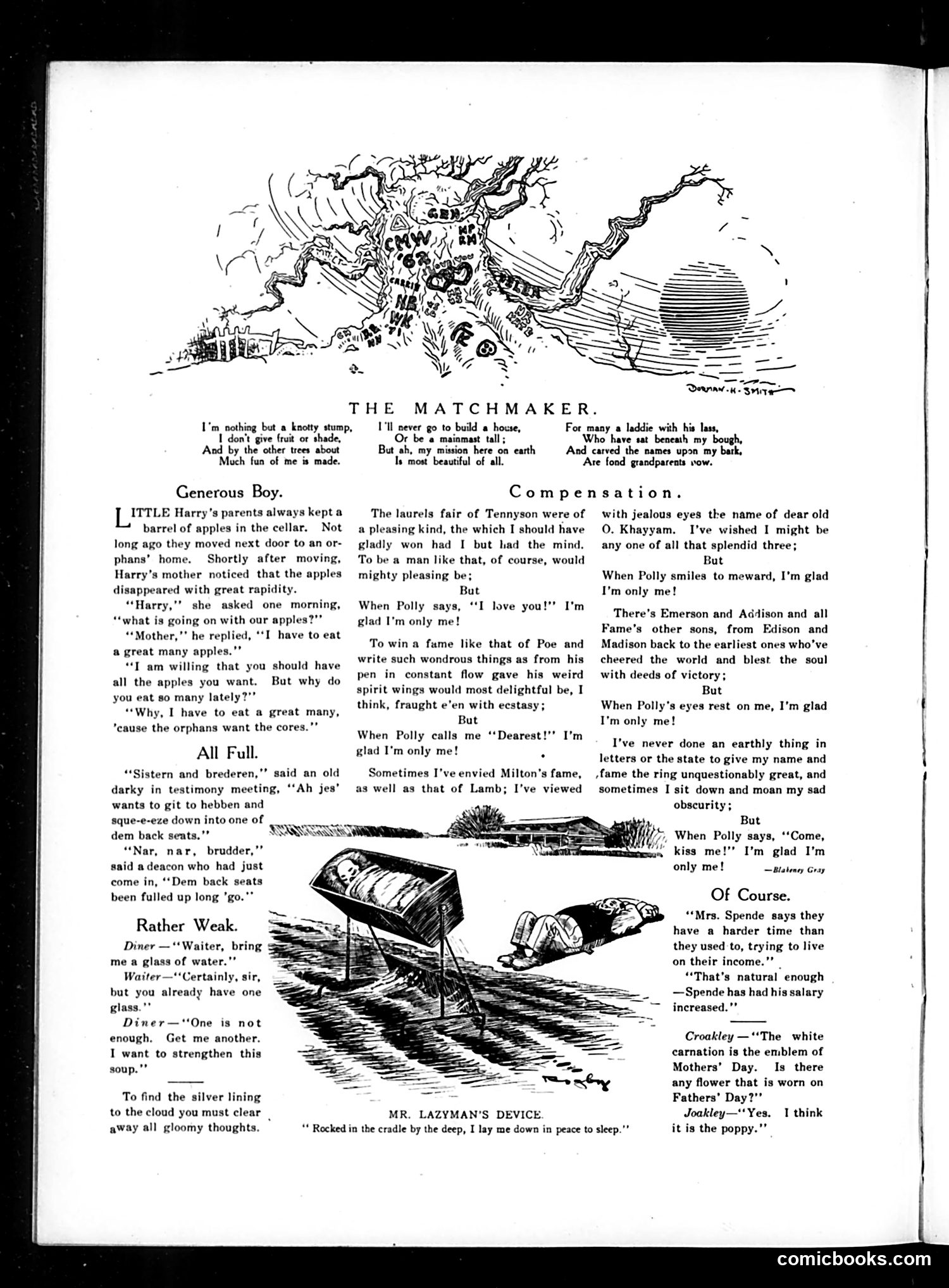
This page contains several short humorous pieces typical of early 20th-century American satirical magazines: **"Generous Boy"** and **"All Full"** are dialect jokes playing on racial stereotypes common to the era—depicting Black speakers with exaggerated speech patterns for comic effect. **"Rather Weak"** is a simple pun about watering down soup. **"The Matchmaker"** is sentimental verse about a tree witnessing lovers' declarations, contrasted with **"Compensation,"** a longer poem where an ordinary man finds contentment in being loved by "Polly" rather than achieving literary fame like Tennyson, Poe, or Milton. **"Mr. Lazyman's Device"** shows an illustration of someone in a rocking cradle, playing on the concept of effortless comfort. **"Of Course"** presents a gentle joke about Fathers' Day flowers—the "poppy" puns on opium use, suggesting fathers need sedation. The page reflects Judge's mix of mild social satire, sentimental poetry, and puns, with racial humor that would be considered offensive today.
📄 Transcribed text from this page (OCR, searchable)
Machine-transcribed from the original scan — historical spelling and the odd misread are preserved.
I'm nothing but a knotty stump, 1 ‘don't give (ru or shade,” And by the other trees about Much fun of me is made. Generous Boy. ITTLE Harry's parents always kept a barrel of apples in the cellar. Not long ago they moved next door to an or- phans’ home. Shortly after moving, Harry’s mother noticed that the apples disappeared with great rapidity. “Harry,"’ she asked one morning, “what is going on with our apples?"” ‘Mother,’ he replied, ‘‘I have to eat @ great many apples.’’ “T am willing that you should have all the apples you want. But why do you eat so many lately?"’ “Why, I have to eat a great many, "cause the orphans want the cores.”’ All Full. “‘Sistern and brederen,”’ said an old darky in testimony meeting, ‘‘Ah jes’ wants to git to hebben and sque-e-eze down into one of dem back seats.’’ “Nar, nar, brudder,’’ said adeacon who had just come in, ‘‘Dem back seats been fulled up long ’go."* Rather Weak. Diner —‘‘Waiter, bring me a glass of water."* Waiter—‘‘Certainly, sir, but you already have one glass."* Diner—‘‘One is not enough. Get me another. I want to strengthen this soup."” IAN To find the silver lining to the cloud you must clear _ away all gloomy thoughts. I'll never go to build a house, Or be a mainmast tall ; But ah, my mission here on earth Is most beautiful of all. —-—-— Dewaw-k- Smite THE MATCHMAKER. For many a laddie with his lass, Who have sat beneath my bough, And carved the names upon my batk, Are fond grandparents ow. Compen The laurels fair of Tennyson were of a pleasing kind, the which I should have gladly won had I but had the mind. To be a man like that, of course, would mighty pleasing be; But When Polly says, ‘I love you!’’ I'm glad I'm only me! To win a fume like that of Poe and write such wondrous things as from his pen in constant flow gave his weird spirit wings would most delightful be, I think, fraught e’en with ecstasy; But When Polly calls me ‘‘Dearest!'’ I’m glad I'm only me! Sometimes I've envied Milton's fame, as well as that of Lamb; I’ve viewed MR. LAZYMAN’S DEVICE “* Rocked in the cradle by the deep, I lay me down in peace to sleep."* sation. with jealous eyes the name of dear old 0. Khayyam. I’ve wished I might be any one of all that splendid three; But When Polly smiles to meward, I'm glad I'm only me! There’s Emerson and Addison and all Fame’s other sons, from Edison and Madison back to the earliest ones who've cheered the world and blest the soul with deeds of victory; But When Polly's eyes rest on me, I'm glad I'm only me! I've never done an earthly thing in letters or the state to give my name and fame the ring unquestionably great, and sometimes I sit down and moan my sad obscurity; But ;, When Polly says, ‘‘Come, kiss me!’’ I’m glad I'm only me! —Blateny Gray Of Course. “Mrs. Spende says they have a harder time than they used to, trying to live on their income.” “That's natural enough —Spende has had his salary increased.’” Croakley —‘‘The white carnation is the emblem of Mothers’ Day. Is there any flower that is worn on Fathers’ Day?" Joakley—*Yes, 1 think it is the poppy.’’ comicbooks.com