
Judge, 1912-06-08 · page 4 of 24
Judge — June 8, 1912 — page 4: what you’re looking at
What you’re looking at
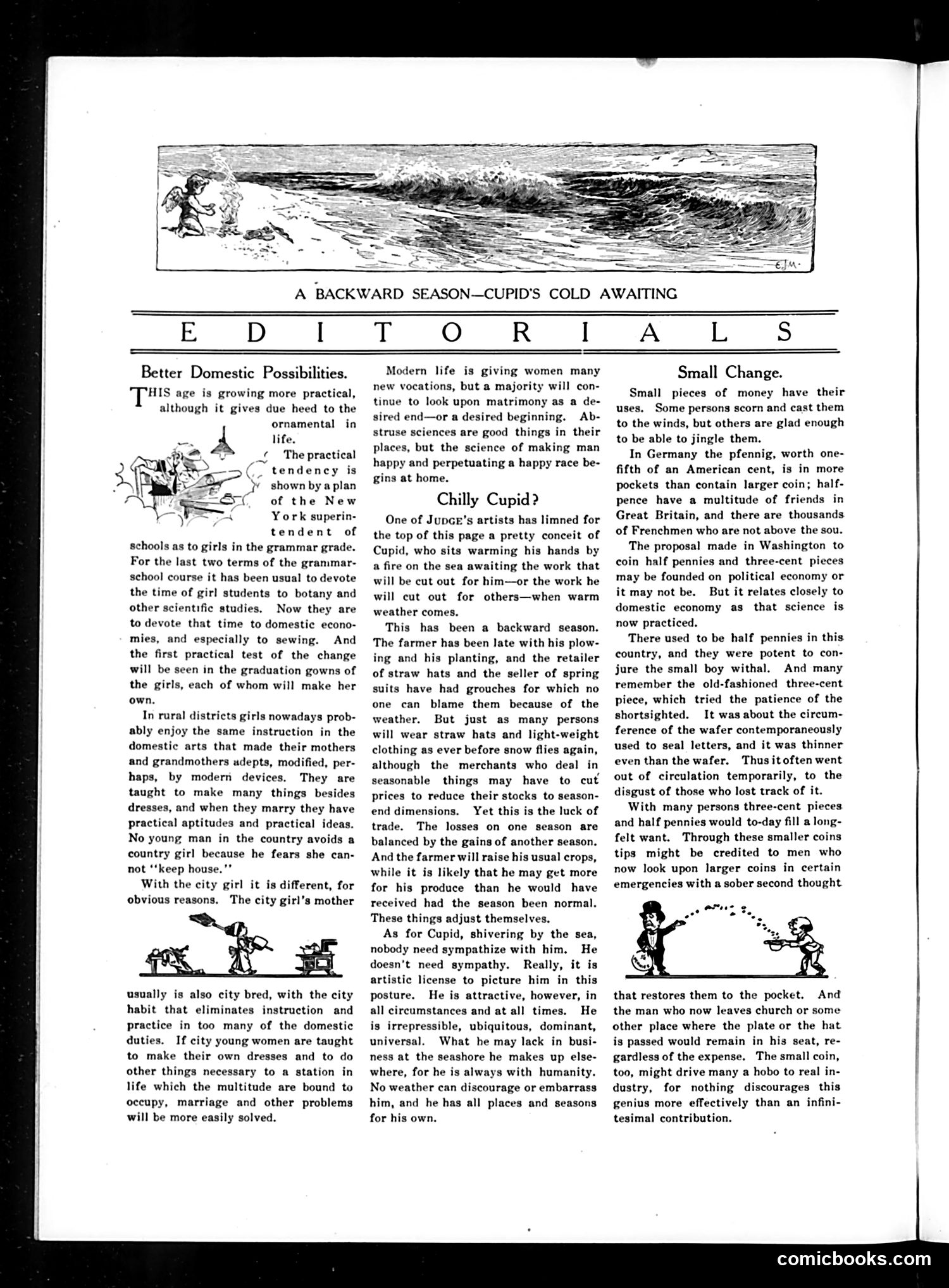
This editorial page satirizes the economic hardships affecting courtship and marriage during what appears to be a recession or depression. The main cartoon depicts Cupid shivering by the sea, symbolizing romance suffering from poor economic conditions. The text argues that practical domestic skills matter more than romance during hard times. It contrasts rural and city life, noting that rural girls learn homemaking while city girls don't—yet paradoxically, city girls' mothers were also city-bred. The satire targets merchants and farmers who blame external circumstances (bad weather, "backward season") for their losses, when market forces actually dictate outcomes. The piece ultimately suggests that small coins and practical economics, not romantic idealism, now govern courtship and marriage among ordinary people.
📄 Transcribed text from this page (OCR, searchable)
Machine-transcribed from the original scan — historical spelling and the odd misread are preserved.
A BACKWARD SEASON—CUPID'S COLD AWAITING D Better Domestic Possibilities. Tills ae is growing more practical, although it gives due heed to the ornamental in life. ‘The practical tendency is shown by a plan of the New York superin- tendent of schools as to girls in the grammar grade. For the last two terms of the grammar- school course it has been usual to devote the time of girl students to botany and other scientific studies. Now they are to devote that time to domestic econo- mies, and especially to sewing. And the first practical test of the change will be seen in the graduation gowns of the girls, each of whom will make her own. In rural districts girls nowadays prob- ably enjoy the same instruction in the domestic arts that made their mothers and grandmothers adepts, modified, per- haps, by modern devices. They are taught to make many things besides dresses, and when they marry they have practical aptitudes and practical ideas. No young man in the country avoids a country girl because he fears she can- not ‘keep house.” With the city girl it is different, for obvious reasons. The city girl’s mother usually is also city bred, with the city habit that eliminates instruction and Practice in too many of the domestic duties. If city young women are taught to make their own dresses and to do other things necessary to a station in life which the multitude are bound to occupy, marriage and other problems will be more easily solved. T O R Modern life is giving women many new vocations, but a majority will con- tinue to look upon matrimony as a de- sired end—or a desired beginning. Ab- struse sciences are good things in their places, but the science of making man happy and perpetuating a happy race be- gins at home. Chilly Cupid? One of Jupce's artists has limned for the top of this page a pretty conceit of Cupid, who sits warming his hands by a fire on the sea awaiting the work that will be cut out for him—or the work he will cut out for others—when warm weather comes. This has been a backward season. The farmer has been late with his plow- ing and his planting, and the retailer of straw hats and the seller of spring suits have had grouches for which no one can blame them because of the weather. But just as many persons will wear straw hats and light-weight clothing as ever before snow flies again, although the merchants who deal in seasonable things may have to cut prices to reduce their stocks to season- end dimensions. Yet this is the luck of trade. The losses on one season are balanced by the gains of another season. And the farmer will raise his usual crops, while it is likely that he may get more for his produce than he would have received had the season been normal. These things adjust themselves. As for Cupid, shivering by the sea, nobody need sympathize with him. He doesn’t need sympathy. Really, it is artistic license to picture him in this posture. He is attractive, however, in all circumstances and at all times. He is irrepressible, ubiquitous, dominant, universal. What he may lack in busi- ness at the seashore he makes up else- where, for he is always with humanity. No weather can discourage or embarrass him, and he has all places and seasons for his own, A L Small Change. Small pieces of money have their uses. Some persons scorn and cast them to the winds, but others are glad enough to be able to jingle them. In Germany the pfennig, worth one- fifth of an American cent, is in more pockets than contain larger coin; half- pence have a multitude of friends in Great Britain, and there are thousands of Frenchmen who are not above the sou. The proposal made in Washington to coin half pennies and three-cent pieces may be founded on political economy or it may not be. But it relates closely to domestic economy as that science is now practiced. There used to be half pennies in this country, and they were potent to con- jure the small boy withal. And many remember the old-fashioned three-cent piece, which tried the patience of the shortsighted. It was about the circum- ference of the wafer contemporaneously used to seal letters, and it was thinner even than the wafer. Thusitoften went out of circulation temporarily, to the disgust of those who lost track of it. With many persons three-cent pieces and half pennies would to-day fill a long- felt want. Through these smaller coins tips might be credited to men who now look upon larger coins in certain emergencies with a sober second thought that restores them to the pocket. And the man who now leaves church or some other place where the plate or the hat is passed would remain in his seat, re- gardless of the expense. The small coin, too, might drive many a hobo to real in- dustry, for nothing discourages this genius more effectively than an infini- tesimal contribution. comicbooks.com