
Judge, 1912-06-08 · page 11 of 24
Judge — June 8, 1912 — page 11: what you’re looking at
What you’re looking at
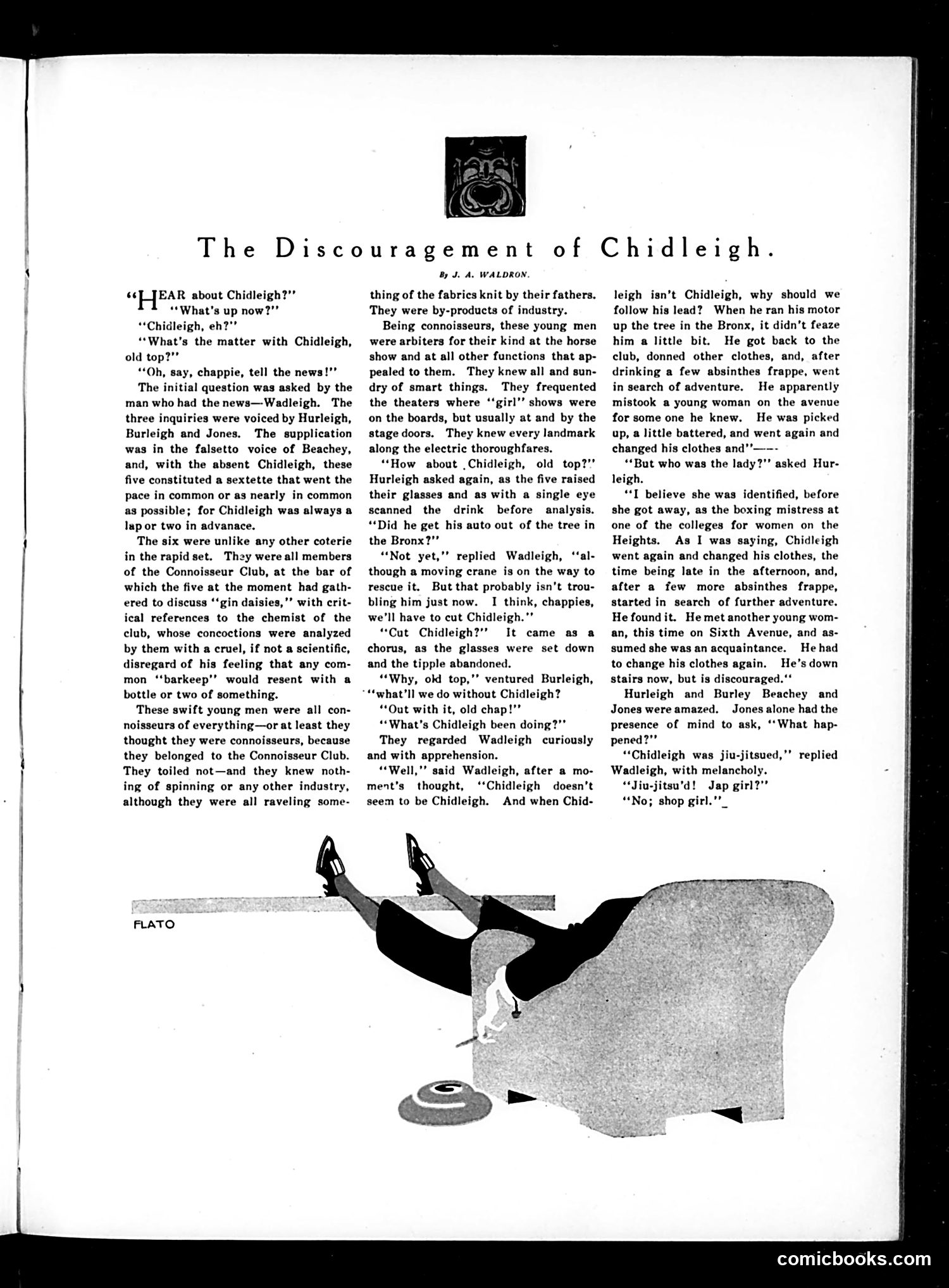
This is a satirical short story mocking the idle wealthy class of early 20th-century Manhattan. Chidleigh and his social set—Wadleigh, Hurleigh, Burleigh, Jones, and Beachey—are members of the Connoisseur Club, wealthy young men who "toiled not" and were "by-products of industry" (inherited wealth). The satire: these self-proclaimed arbiters of taste and fashion know nothing practical; they merely frequent theaters, horse shows, and nightlife while claiming refined expertise. The joke: Chidleigh's "discouragement" stems from repeated romantic misadventures. He mistook two different women for acquaintances he knew, resulting in physical confrontations (implied boxing matches) that forced him to repeatedly change clothes. His companions are shocked not by his behavior, but that the usually unflappable Chidleigh seems "discouraged." The illustration (credited "PLATO") shows a lounging figure in relaxed pose, likely representing the idle leisure these men embody. The satire targets upper-class frivolity and disconnect from reality.
📄 Transcribed text from this page (OCR, searchable)
Machine-transcribed from the original scan — historical spelling and the odd misread are preserved.
6sL_JEAR about Chidleigh?”’ “*What’s up now?’”” “Chidleigh, eh?’ ‘‘What’s the matter with Chidleigh, old top?” “Oh, say, chappie, tell the news!’’ The initial question was asked by the man who had the news—Wadleigh. The three inquiries were voiced by Hurleigh, Burleigh and Jones, The supplication was in the falsetto voice of Beachey, and, with the absent Chidleigh, these five constituted a sextette that went the pace in common or as nearly in common as possible; for Chidleigh was always a lap or two in advanace. The six were unlike any other coterie in the rapid set. They were all members of the Connoisseur Club, at the bar of which the five at the moment had gath- ered to discuss ‘‘gin daisies,’’ with crit- ical references to the chemist of the club, whose concoctions were analyzed by them with a cruel, if not a scientific, disregard of his feeling that any com- mon ‘‘barkeep’’ would resent with a bottle or two of something. These swift young men were all con- noisseurs of everything—or at least they thought they were connoisseurs, because they belonged to the Connoisseur Club. They toiled not—and they knew noth- ing of spinning or any other industry, although they were all raveling some- The Discouragement of Chidleigh. By J. A, WALDRON. thing of the fabrics knit by their fathers. They were by-products of industry. Being connoisseurs, these young men were arbiters for their kind at the horse show and at all other functions that ap- pealed to them. They knew all and sun- dry of smart things. They frequented the theaters where ‘‘girl’’ shows were on the boards, but usually at and by the stage doors. They knew every landmark along the electric thoroughfares. “How about ,Chidleigh, old top?’’ Hurleigh asked again, as the five raised their glasses and as with a single eye scanned the drink before analysis. “Did he get his auto out of the tree in the Bronx?” “Not yet,”’ replied Wadleigh, ‘‘al- though a moving crane is on the way to rescue it. But that probably isn’t trou- bling him just now. I think, chappies, we'll have to cut Chidleigh."’ “Cut Chidleigh?’’ It came as a chorus, as the glasses were set down and the tipple abandoned. “Why, old top,’’ ventured Burleigh, *“*what’ll we do without Chidleigh? “Out with it, old chap!’” “What's Chidleigh been doing?”” They regarded Wadleigh curiously and with apprehension. “‘Well,”’ said Wadleigh, after a mo- ment’s thought, ‘‘Chidleigh doesn’t seem to be Chidleigh. And when Chid- leigh isn’t Chidleigh, why should we follow his lead? When he ran his motor up the tree in the Bronx, it didn’t feaze him a little bit. He got back to the club, donned other clothes, and, after drinking a few absinthes frappe, went in search of adventure. He apparently mistook a young woman on the avenue for some one he knew. He was picked up, a little battered, and went again and changed his clothes and’’—-- “But who was the lady?’’ asked Hur- leigh. “I believe she was identified, before she got away, as the boxing mistress at one of the colleges for women on the Heights. As I was saying, Chidleigh went again and changed his clothes, the time being late in the afternoon, and, after a few more absinthes frappe, started in search of further adventure. He found it. He met another young wom- an, this time on Sixth Avenue, and as- sumed she was an acquaintance. He had to change his clothes again. He’s down stairs now, but is discouraged.‘* Hurleigh and Burley Beachey and Jones were amazed. Jones alone had the presence of mind to ask, ‘‘What hap- pened?”” “Chidleigh was jiu-jitsued,’’ replied Wadleigh, with melancholy. “‘Jiu-jitsu’d! Jap girl?”’ “No; shop girl.””_ comicbooks.com