
A complete issue · 24 pages · 1912
Judge — May 18, 1912
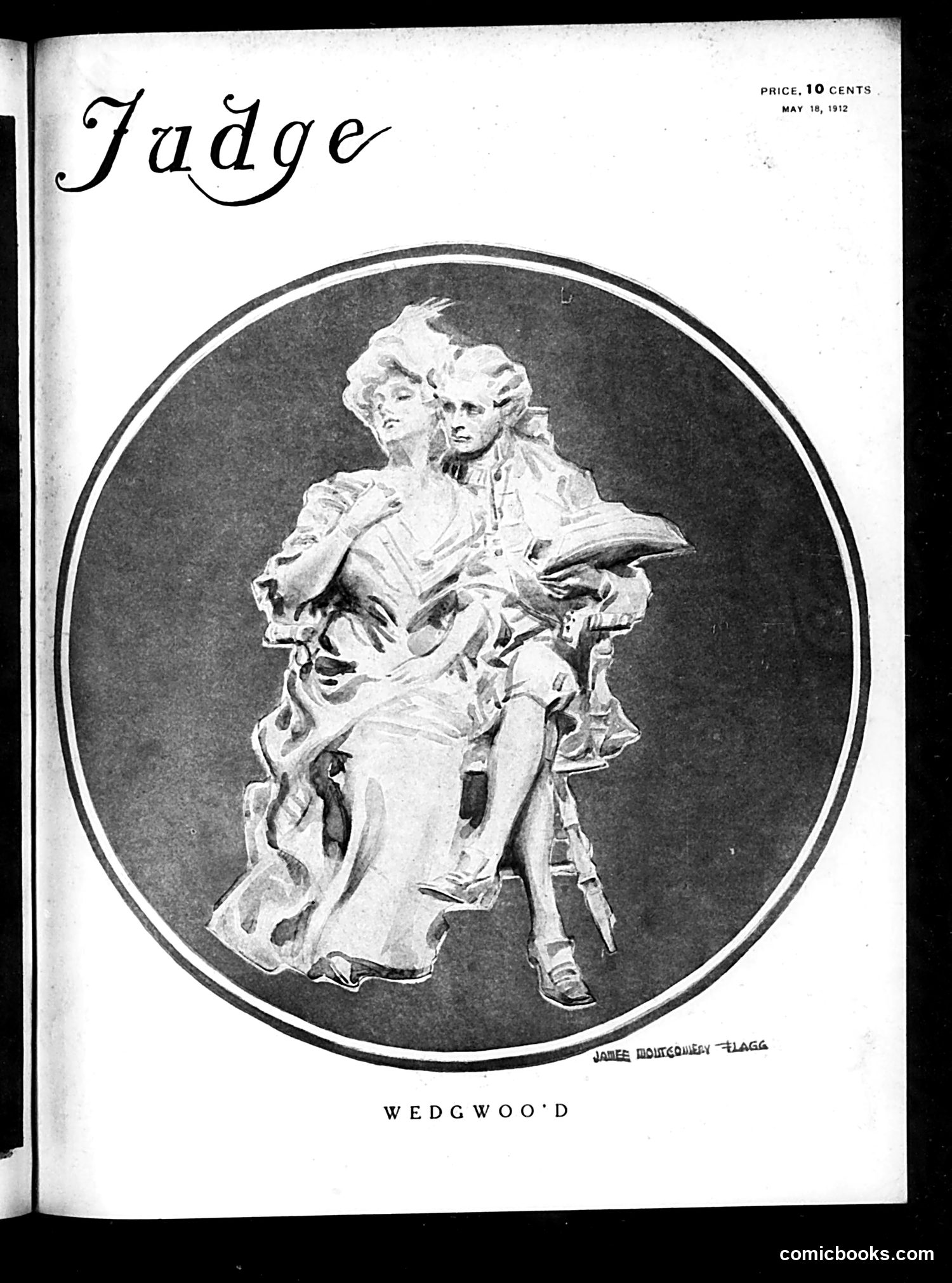
This illustration by James Montgomery Flagg depicts two elegantly dressed figures in an oval frame, captioned "Wedgwood." The image likely references a high-society wedding or engagement from 1912, given the formal attire and romantic positioning of the couple. The satirical point appears to target the superficiality or artificiality of wealthy society marriages—the classical, almost sculptural quality of the drawing (evoking Wedgwood pottery's neoclassical aesthetic) suggests Judge is mocking the "artificial" or "manufactured" nature of fashionable society unions. The couple's posed, statuesque quality reinforces this critique of elite society's performative nature rather than genuine emotion. Without additional context about the specific individuals depicted, the precise satirical target remains unclear.
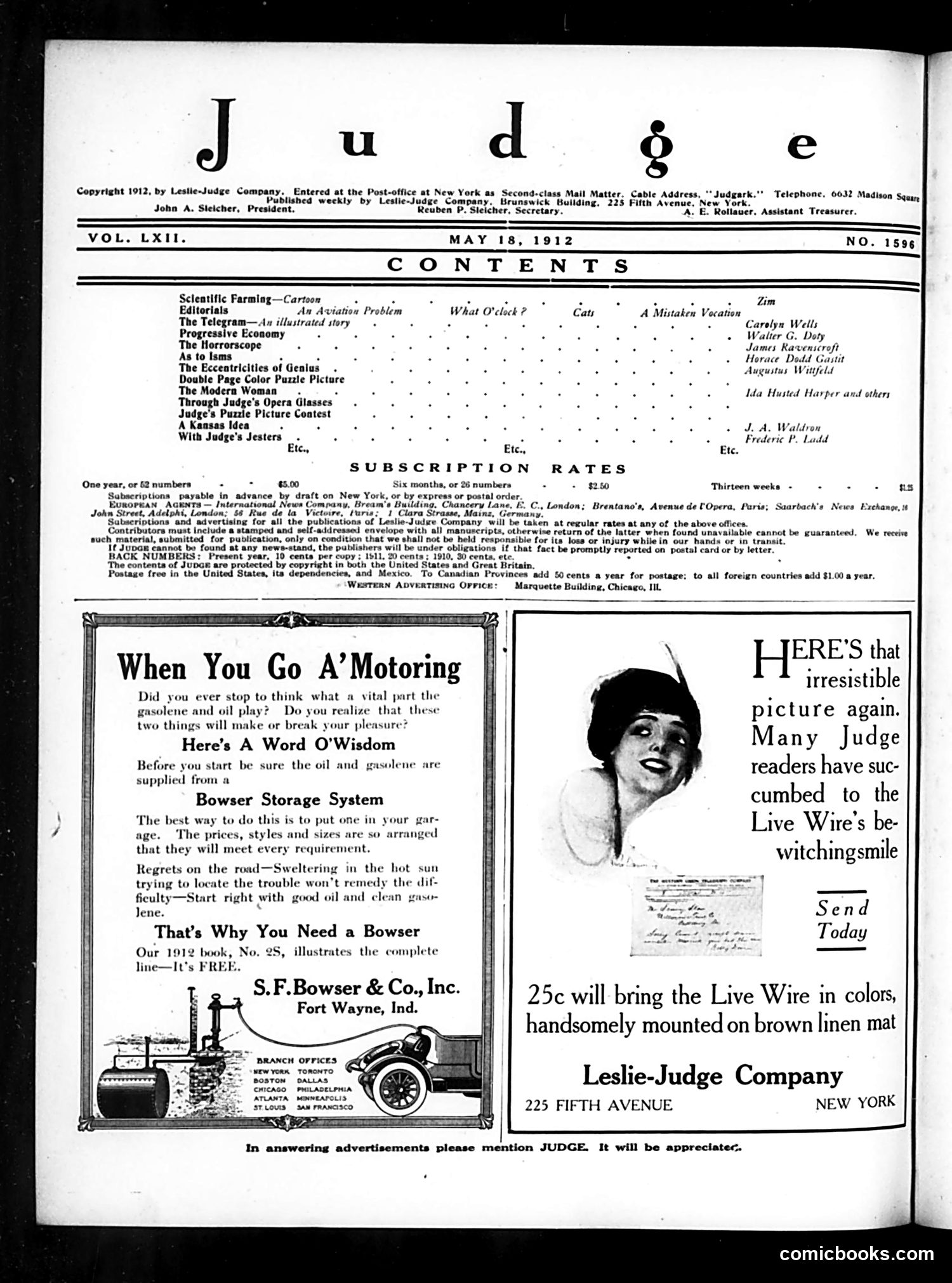
This page is primarily **advertising**, not political satire. The two main advertisements are: 1. **S.F. Bowser & Co., Inc.** (Fort Wayne, Indiana): Promotes automobile gasoline and oil storage systems, addressing early motorists' practical concerns about fuel supply and road reliability. 2. **Leslie-Judge Company**: Advertises the "Live Wire" picture—a photograph with an accompanying handwritten note, available for 25 cents mounted on linen. The accompanying illustration shows a woman's face with a "bewitching smile," suggesting this was a popular portrait or celebrity photograph of the era. The content reflects 1912 consumer culture: automobile adoption was still novel, and picture postcards/celebrity photographs were common collectibles.
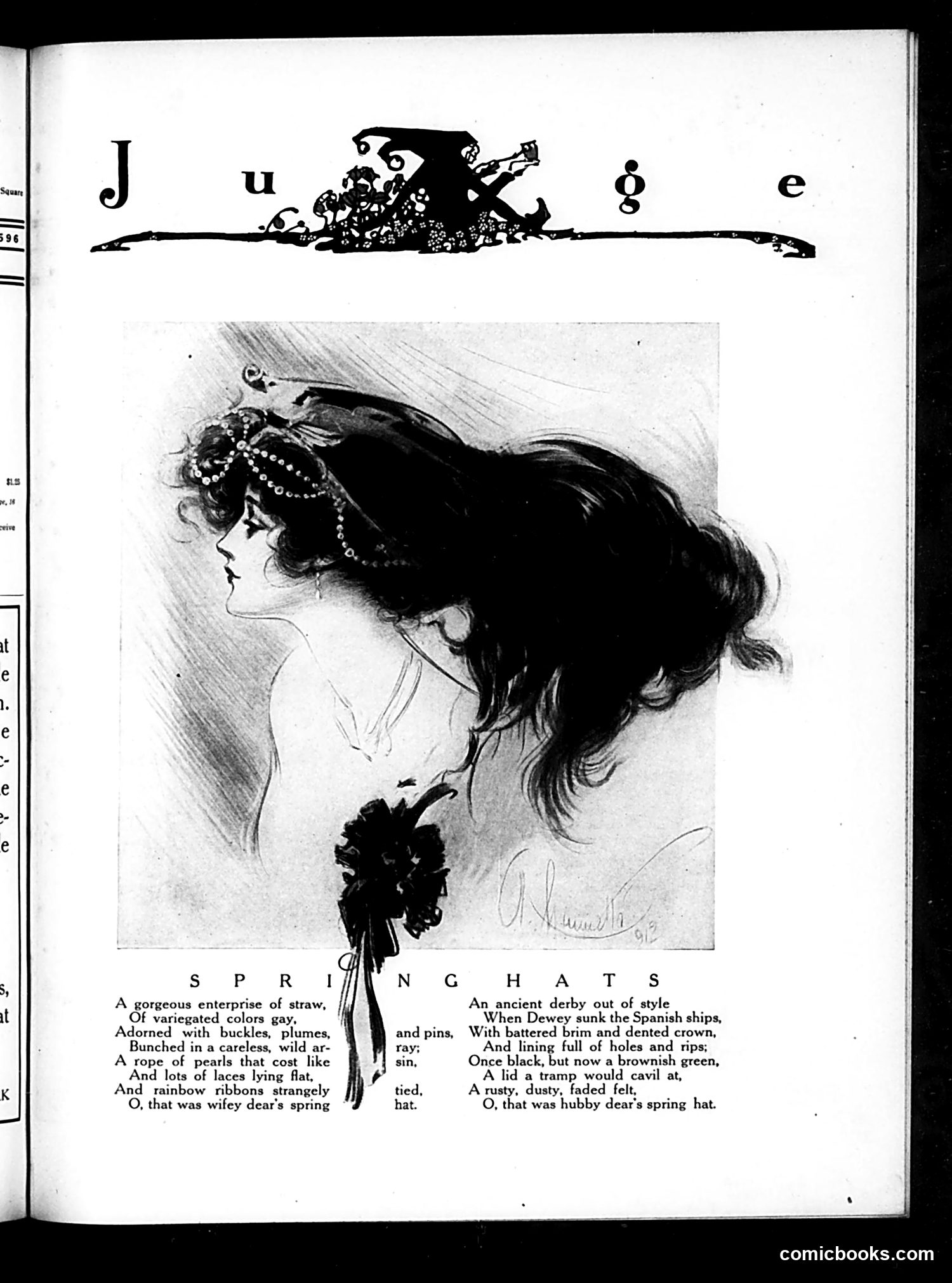
This page satirizes women's elaborate spring hats through a portrait and accompanying verse. The illustration shows a woman in profile wearing an ornate hat decorated with pearls, plumes, buckles, and ribbons—typical of early 20th-century millinery excess. The poem mocks these extravagant creations, describing a hat that once belonged to a Spanish naval ship ("When Dewey sunk the Spanish ships"), now repurposed as women's fashion. The joke equates women's hats to salvaged military debris—absurdly oversized, ragged, and patched with lace and ribbons. This reflects contemporary satirical criticism of women's fashion, particularly the impractical, wasteful nature of elaborate hat decoration that dominated the era. The reference to Dewey suggests this is from around the Spanish-American War period (1898).
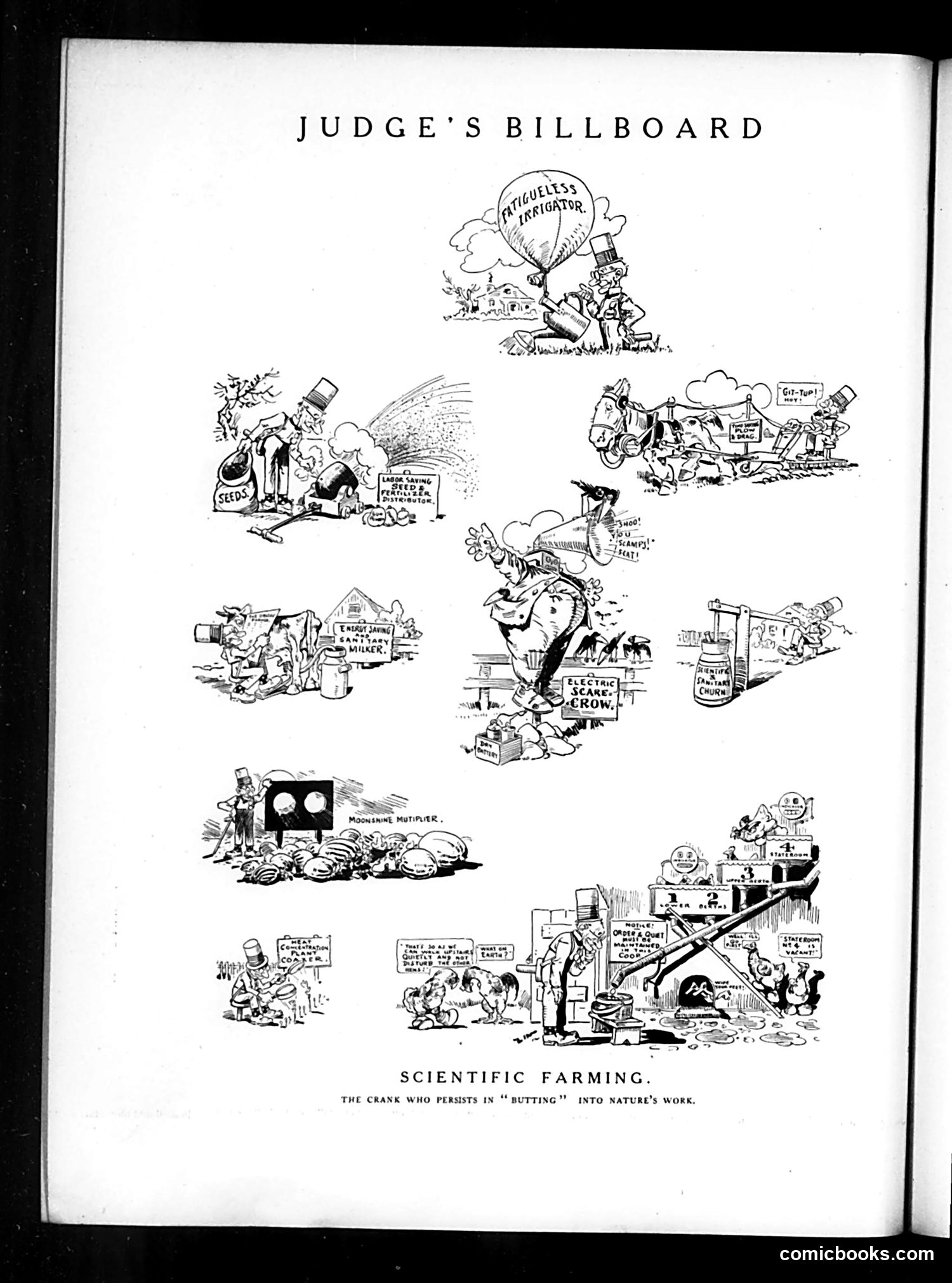
This satirical page mocks agricultural innovation and mechanization trends of its era. The subtitle—"The Crank Who Persists in 'Butting' Into Nature's Work"—indicates the cartoons ridicule farmers attempting overly complex, dubious modern methods. The various panels depict absurd contraptions and schemes: an "incubator" balloon, a "seed distributor," a mechanical mixer, an "electric scarecrow," a "moonshine mattifier," and elaborate automated systems. Each suggests well-meaning but misguided attempts to "improve" farming through technology. The satire targets both farmer-experimenters and the era's optimistic belief that machinery could solve agricultural problems. The phrase "butting in" suggests these innovations interfere with natural processes rather than enhance them—a common critique during industrialization's expansion into rural life.
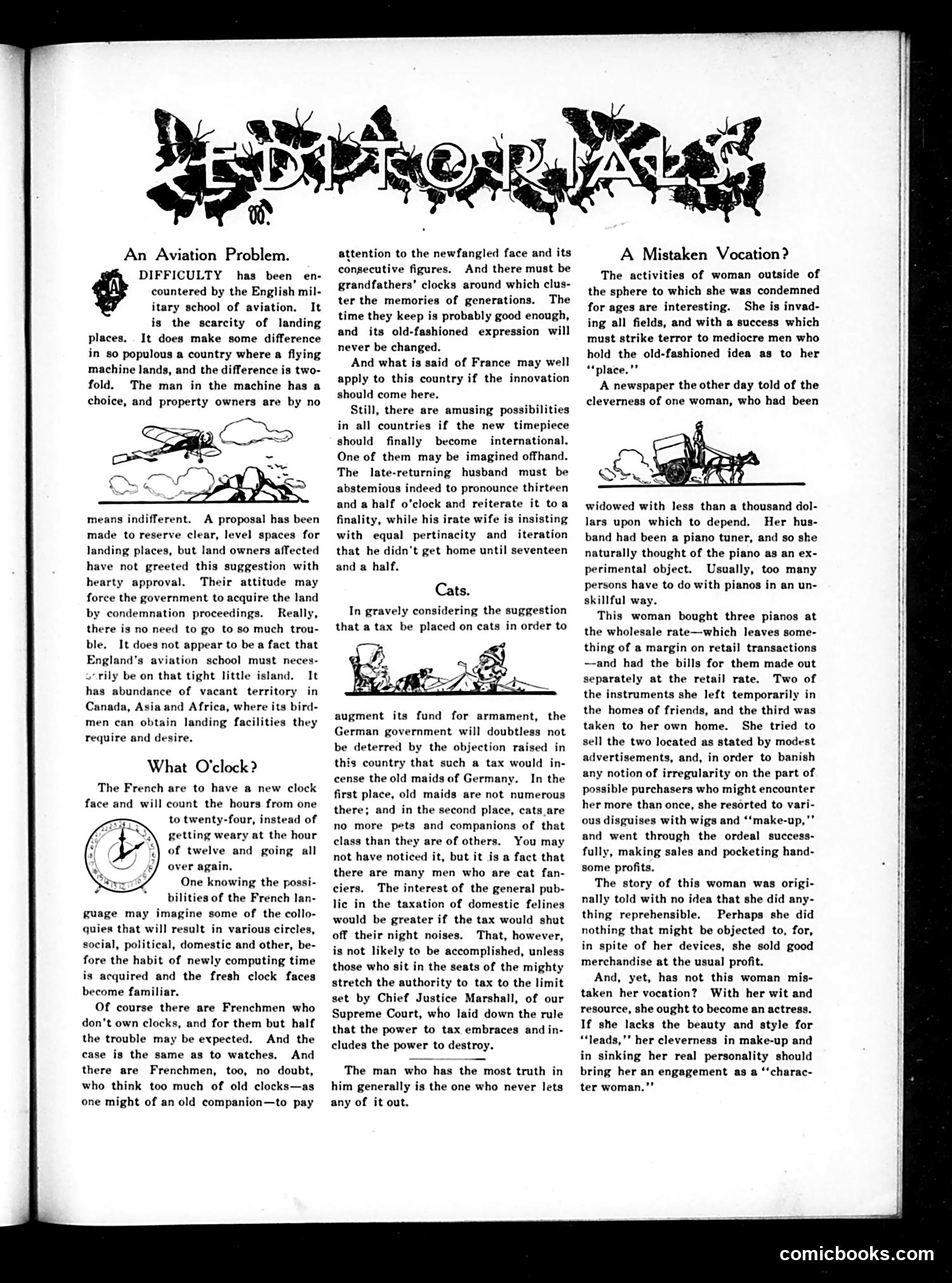
This Judge magazine page contains three satirical pieces about contemporary issues: **"An Aviation Problem"**: Mocks English aviation regulations that restrict where planes can land. The satire suggests this overly cautious approach hobbles aviation development compared to other nations, noting that property owners' concerns shouldn't outweigh progress. **"What O'clock?"**: France is adopting a 24-hour clock face. The piece humorously imagines the adjustment difficulties and pokes fun at the French for constantly inventing new systems, while suggesting Frenchmen are oddly nostalgic about old customs. **"Cats"**: Proposes taxing cats to fund German military armament. The satire mocks this idea as absurd while joking about old maids' attachment to cats and questioning government authority to tax personal possessions. All three pieces use absurdist humor to critique regulatory overreach and national stereotypes.
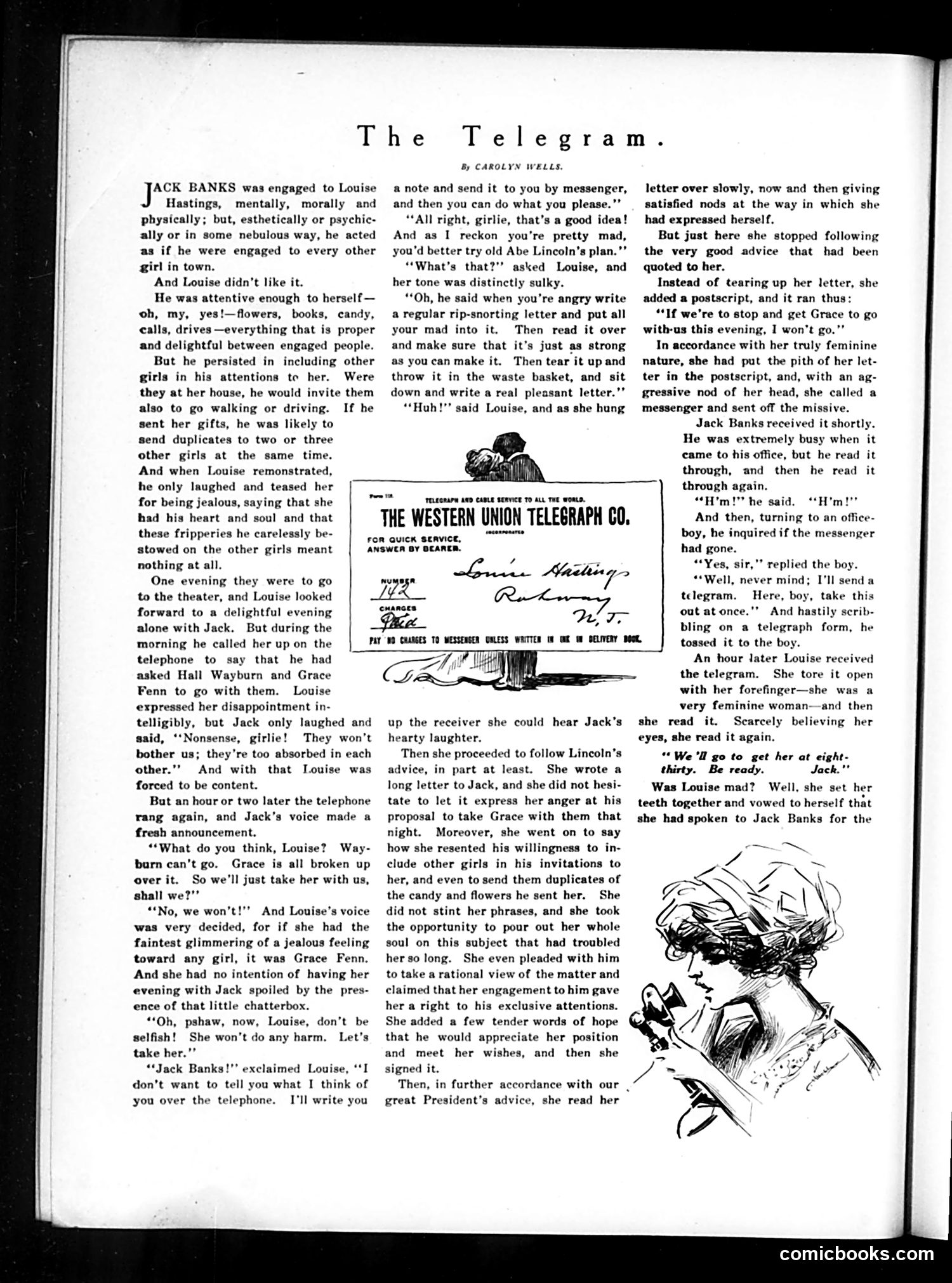
This is a romantic comedy story about relationship jealousy and modern communication. Jack Banks, engaged to Louise Hastings, carelessly includes other girls in their social activities. Louise protests repeatedly, but Jack dismisses her concerns. When Jack invites another girl (Grace) to their theater evening, Louise writes an angry letter. Following Abraham Lincoln's famous advice (referenced humorously), she's supposed to write angry letters then discard them—but instead, she adds a petulant postscript and sends it via Western Union telegram. Jack receives the message and, rather than apologize or argue over the telephone, responds with his own telegram. The satire targets both romantic miscommunication and the era's fascination with instantaneous telegraph technology as a solution to personal disputes. The joke is that modern technology enables escalating relationship drama rather than resolving it—a timeless observation about how communication devices amplify rather than improve human conflict.
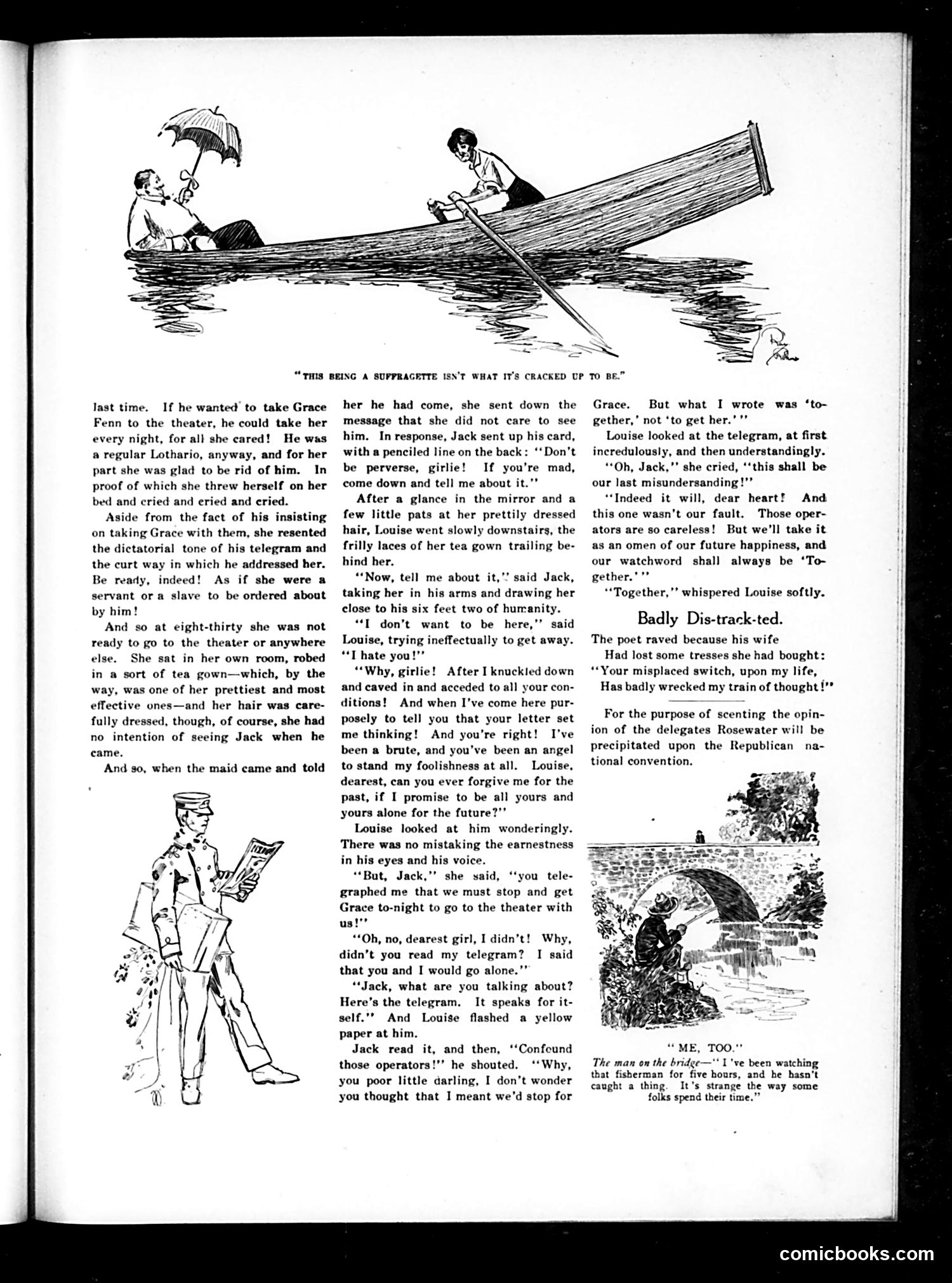
The main cartoon at top satirizes the women's suffrage movement. The caption "THIS BEING A SUFFRAGETTE ISN'T WHAT IT'S CRACKED UP TO BE" accompanies an illustration of two men in a rickety boat—one rowing while the other holds an umbrella, appearing distressed. The cartoon mocks suffragettes by suggesting their activism is impractical or creates chaos, using the sinking boat as metaphor for their cause's instability. The accompanying story about Jack and Louise appears designed to reinforce traditional gender roles: Louise initially resists Jack's authority, but ultimately submits when he explains a misunderstanding. The narrative suggests women are better served by romantic reconciliation than independence. The lower cartoon about the fisherman and observer appears unrelated social humor. Judge magazine consistently opposed women's suffrage during this era, using satire to delegitimize the movement as foolish or destabilizing to proper social order.
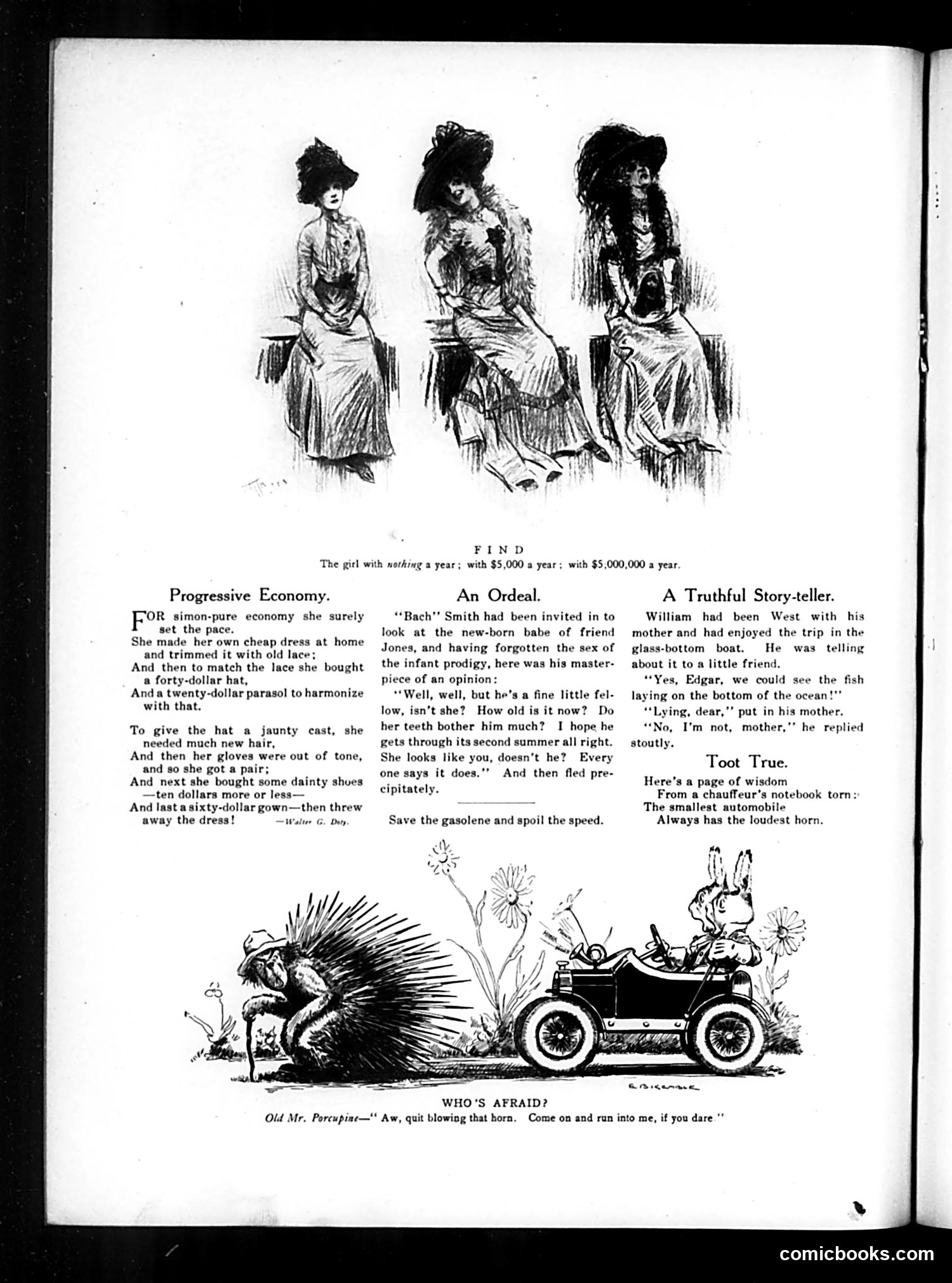
This page contains four separate humorous pieces satirizing early 20th-century American society: **"Progressive Economy"** mocks wealthy women's illogical spending: a woman economizes by making her own dress, then immediately spends extravagantly on a $40 hat, $20 parasol, gloves, and $60 gown to "match" her homemade outfit—defeating the purpose of economizing. **"An Ordeal"** humorously depicts "Bach" Smith's social awkwardness when visiting a newborn, repeatedly confusing the baby's gender and getting pronouns wrong. **"A Truthful Story-teller"** shows a child insisting he saw fish "laying" on the ocean floor during a glass-bottom boat trip; his mother corrects the grammar ("lying"), and he stubbornly maintains his factual claim was correct. **"Who's Afraid?"** features a porcupine challenging an automobile driver, playing on contemporary anxiety about the new automobile technology and reckless drivers. The page reflects early 1900s concerns: conspicuous consumption, social etiquette confusion, children's honesty, and emerging automobile culture.
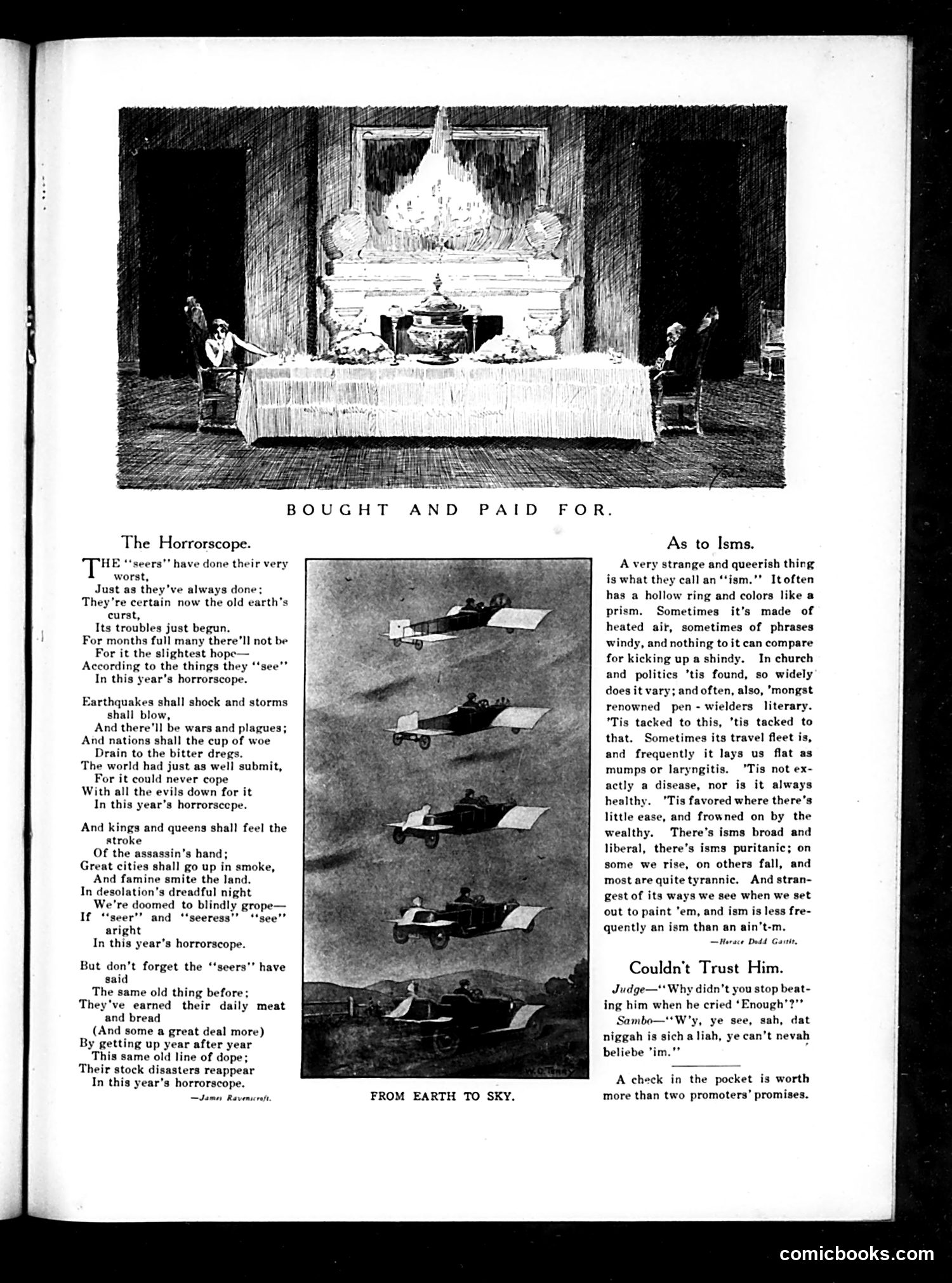
This page contains satirical commentary on two topics: **"The Horrorscope"** (left): A poem mocking fortune-tellers and "seers" who annually predict catastrophe—earthquakes, wars, plagues, assassinations, famine. The satire's point: these predictors recycle identical doom-laden forecasts year after year simply to earn income through sensationalism. They profit from fear while their predictions never materialize. **"From Earth to Sky"** (center): Appears to be an aviation-related photo series, though context is unclear without full caption. **"As to Isms"** (right): A humorous poem defining "-isms" (ideologies, philosophies) as hollow constructs—"heated air" and "phrases windy"—that vary wildly in church and politics. The joke: an "-ism" is often merely "an ain't-m" (negation dressed up). **"Couldn't Trust Him"** (bottom right): A racist joke using a dehumanizing slur, depicting an African American character as inherently dishonest. This reflects deeply offensive period stereotyping. The page overall satirizes false prophets, empty ideologies, and contains period-typical racist content.
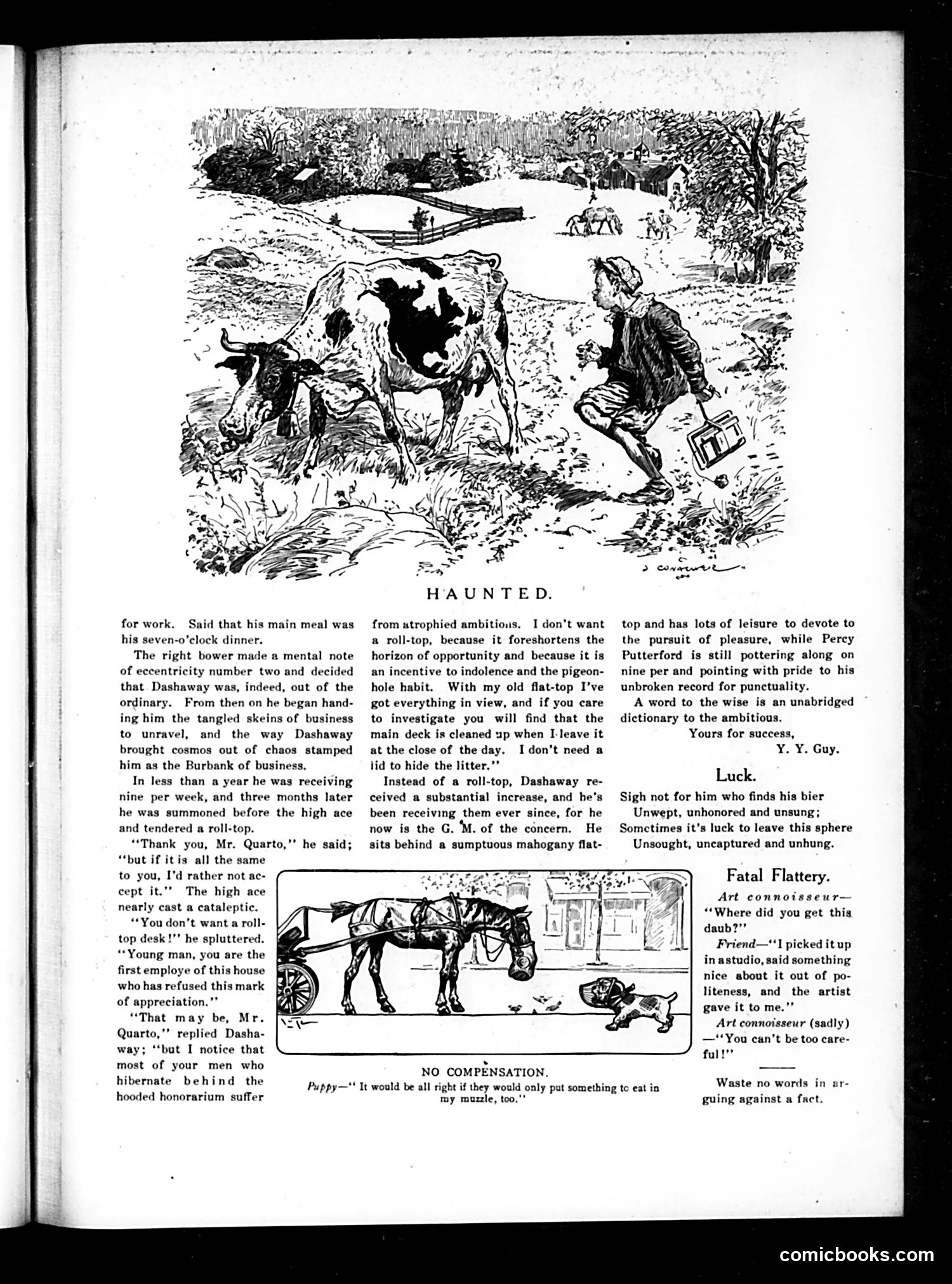
**"HAUNTED"** (main story): A cautionary tale about ambition and success. Dashaway, a young employee, refuses a prestigious roll-top desk promotion, arguing it encourages laziness and limits opportunity. His honesty impresses his boss (Mr. Quarto), earning him raises and eventual advancement to General Manager. The moral: maintaining integrity and hunger for work outpaces those content with visible status symbols. Percy Putterford represents the cautionary opposite—clinging to punctuality records while stagnating. **"NO COMPENSATION"** (small cartoon): A muzzled dog complains it receives no food compensation for wearing the muzzle—a workplace joke about employees forced into restrictive conditions without benefits. **"FATAL FLATTERY"** (sidebar): An artist connoisseur warns against insincere compliments; flattery led him to accept a mediocre painting ("daub") from a grateful artist, which he now regrets. **Context**: This reflects early 20th-century American business culture valuing hustle, ambition, and meritocracy over class signifiers.
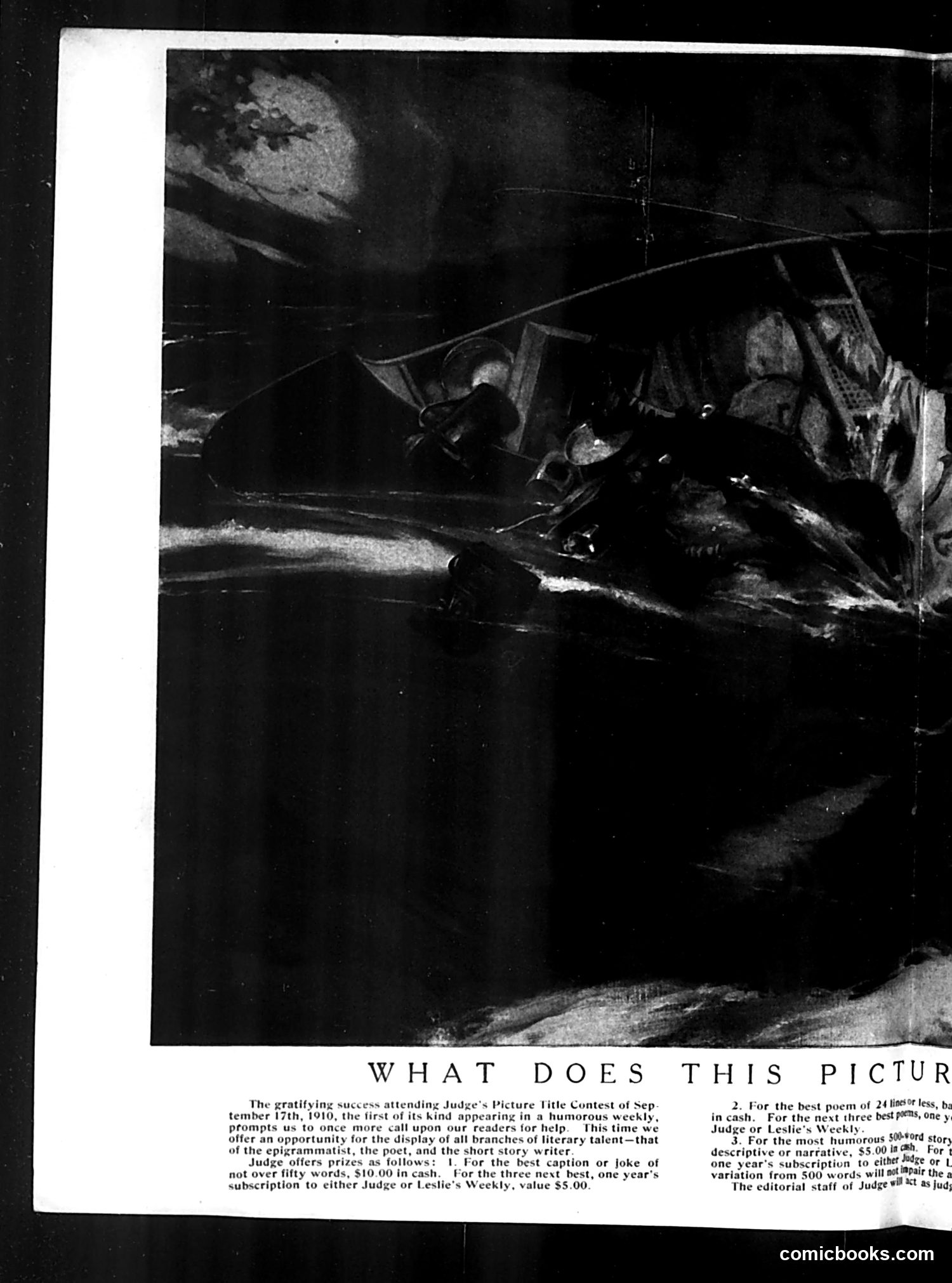
This appears to be a **contest announcement page** from Judge magazine (dated around September 1910), not a political cartoon. The page announces a "Picture Title Contest" soliciting reader submissions across multiple categories. Judge is offering cash prizes and magazine subscriptions for: 1. Best captions/jokes (under 50 words) — $10 cash 2. Best humorous poems (24 lines or less) — $5 cash 3. Best humorous short story (500 words) — $5 subscription The visible image above shows what appears to be an illustration or cartoon that readers would be captioning, though the image itself is quite dark and difficult to discern clearly in this reproduction. This is a **participatory engagement strategy** — Judge was inviting its readership to contribute creative content, leveraging amateur talent to fill pages while building reader investment in the magazine. This was common practice for humor magazines of the era.
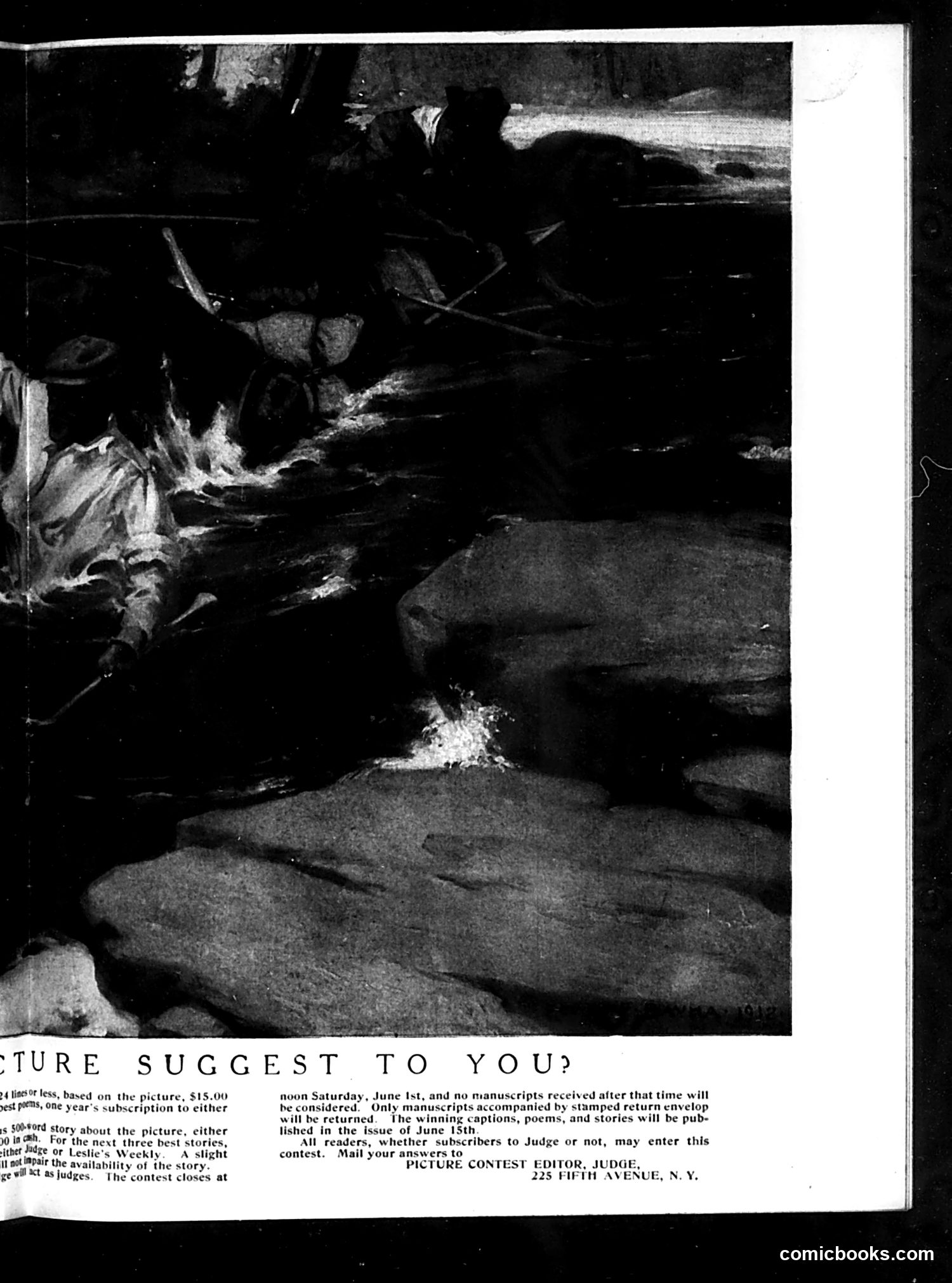
This page is primarily a **contest announcement** rather than a cartoon. Judge magazine is soliciting readers' creative interpretations of a photograph showing what appears to be a nighttime camping or outdoor scene with figures around a campfire and rocks. The contest offers prizes ($15 for first place, subscriptions to Judge or Leslie's Weekly for runner-up stories) and invites readers to submit stories, poems, or captions inspired by the image. The deadline is noon Saturday, June 1st, with winners published in the June 15th issue. The image itself is quite dark and atmospheric—difficult to parse precisely—showing silhouetted figures and what may be a dramatic moment outdoors. Without clearer visibility, the specific narrative the photograph suggests remains unclear to modern viewers, though it likely depicted something dramatic or humorous that would have been more immediately recognizable to 1910s-era Judge readers.
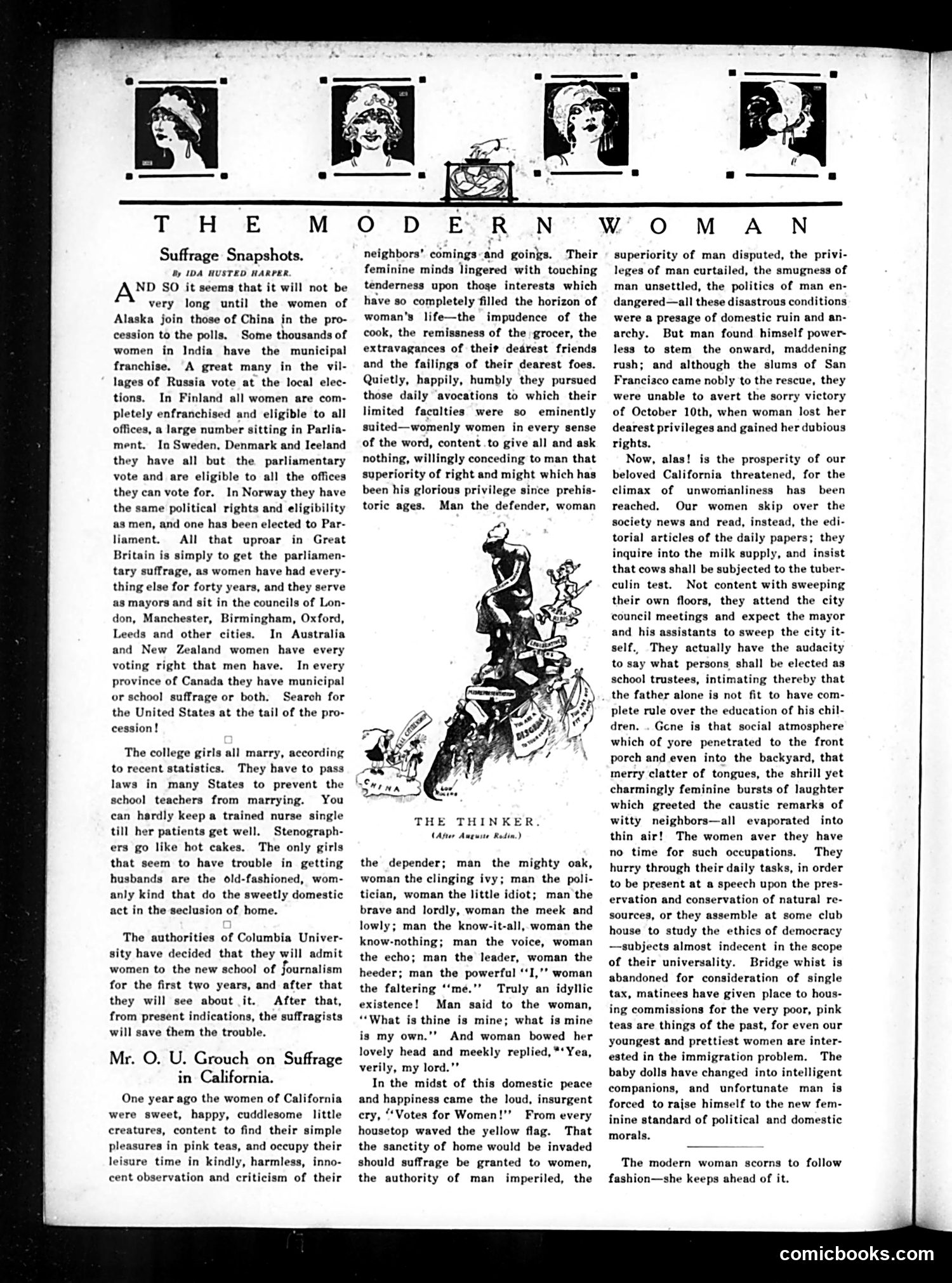
This page presents pro-suffrage arguments by Ida Husted Harper, contrasting women's voting rights globally with America's lagging position. The text catalogs how women vote in Finland, Norway, Australia, New Zealand, and Canada—placing the United States "at the tail of the procession." The central cartoon ("The Thinker," after Rodin) depicts a woman in the philosopher's famous pose, replacing the male original. This visual argument suggests women possess intellectual capacity equal to men's. The secondary article satirizes anti-suffrage California men through "Mr. O. U. Grouch," who laments women's pre-suffrage docility—portraying them as decorative, intellectually limited ("little idiot"), and submissive. The sarcasm mocks this vision of feminine inferiority, implying such stereotypes are absurd justifications for denying voting rights. The piece argues women's education and civic competence make disenfranchisement untenable.
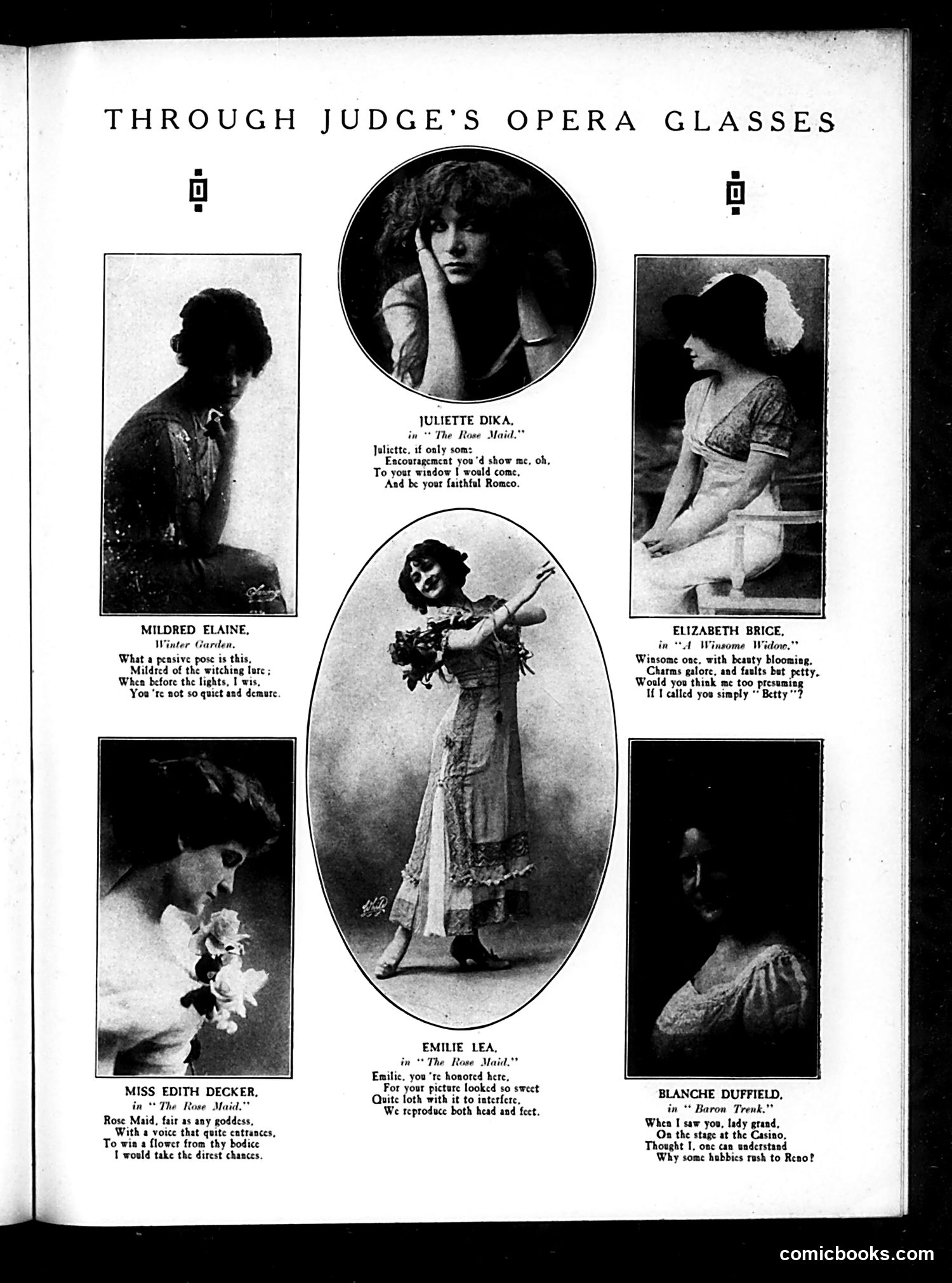
This page features celebrity portraits of Broadway actresses from early 1910s theatrical productions, presented as flirtatious admiration through "opera glasses"—a metaphor for the male theatergoer's perspective. Each photograph is paired with a playful, romantic verse addressing the actress by her stage character. The actresses pictured—Mildred Elaine, Edith Decker, Juliette Dika, Elizabeth Brice, Emilie Lea, and Blanche Duffield—are from shows like "The Rose Maid" and "A Winsome Widow." The satire mocks theatrical culture and male audience behavior: the verses range from gentle compliments to implicit propositions, with one joke about "Reno" (divorce) suggesting infidelity. Judge presents this as lighthearted entertainment while gently ribbing both the actresses' vanity and male theatergoers' predictable romantic fantasies.
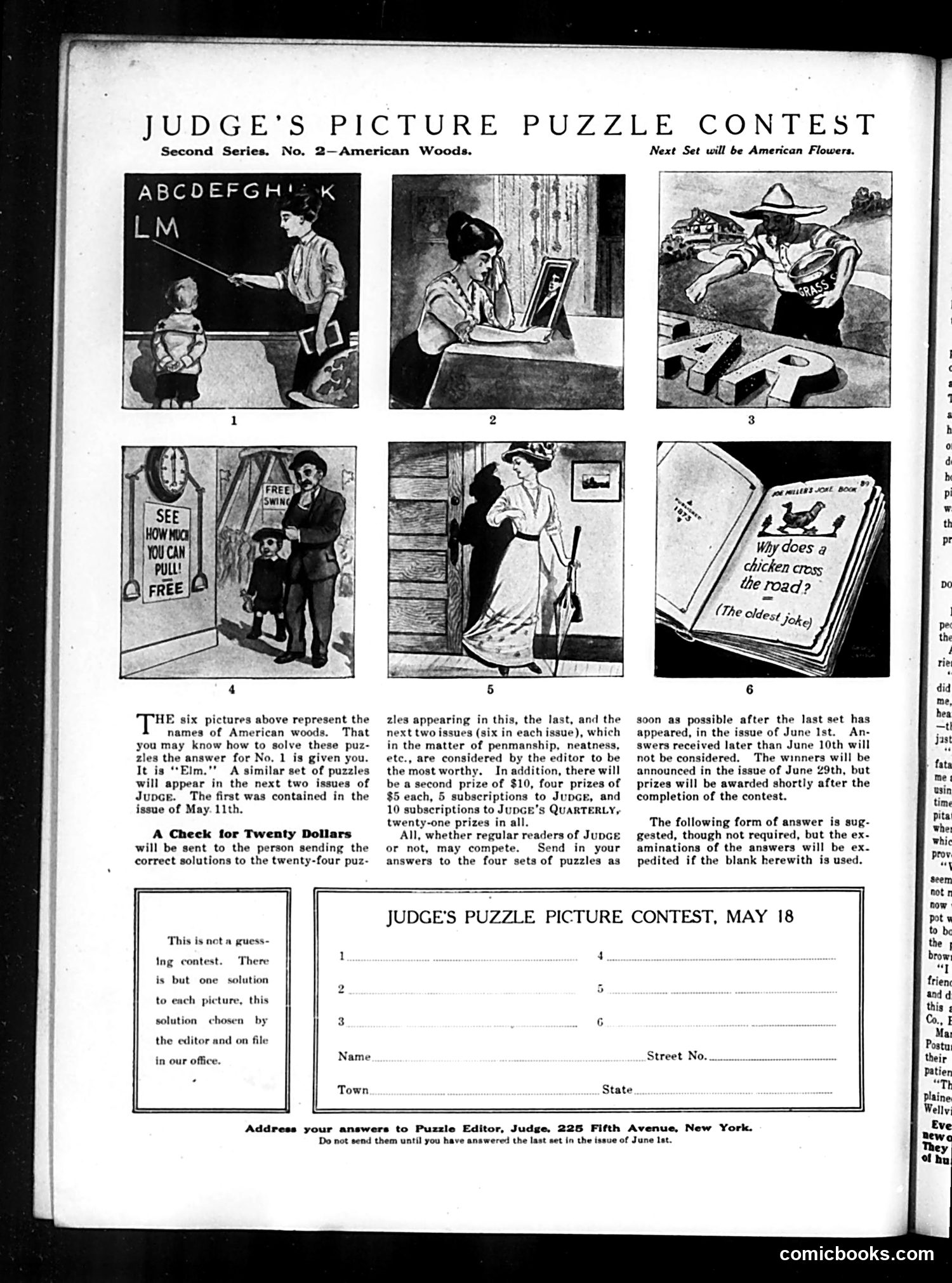
This page presents a competition from *Judge*, a satirical magazine, featuring a visual puzzle contest. Readers must identify six American wood types from illustrated rebuses (visual puns). Picture 1, solved as "Elm," shows a man pointing at the letter "L" and "M" on a blackboard—a phonetic play on the tree name. The contest offered $20 to the winner, plus cash prizes and magazine subscriptions totaling twenty-one awards. Entries were judged on correctness (there was one official answer), penmanship, and neatness. The contest ran across multiple issues of *Judge* through June 1st, with winners announced June 29th. This reflects early-20th-century magazine culture, where reader participation contests were popular entertainment and circulation-boosting devices. The puzzle format—visual wordplay identifying natural resources—suggests light intellectual amusement for middle-class audiences.
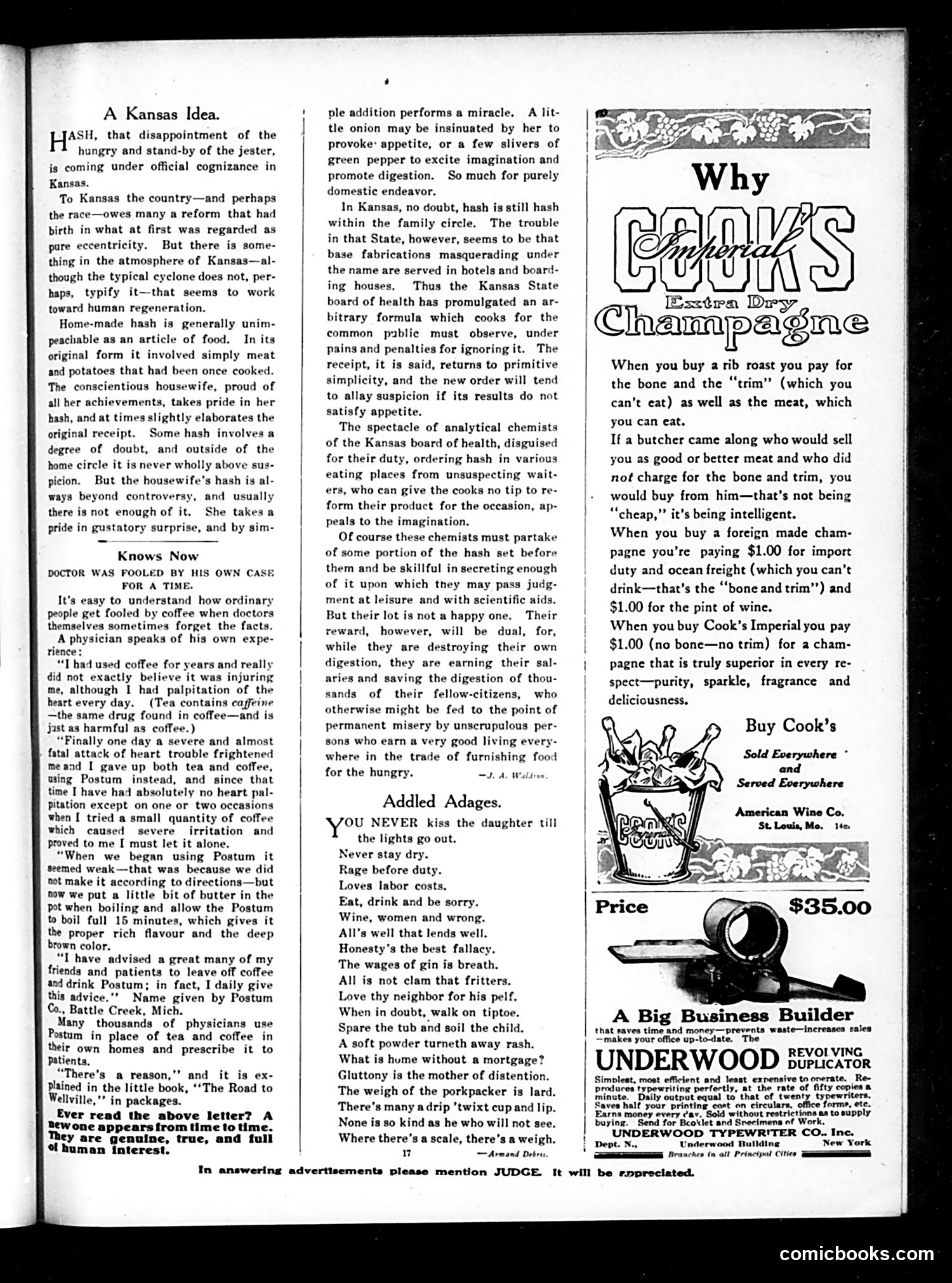
This article satirizes Kansas's regulatory overreach by mocking the state's health board for imposing strict standardized recipes on restaurants—specifically for hash. The humor lies in the absurdity: Kansas, historically known for progressive reforms, is now micromanaging something as humble and variable as hash through "arbitrary formulas" and enforcement. The satire targets bureaucratic solution-seeking. Judge ridicules the image of state chemists disguising themselves as ordinary diners to inspect restaurant hash for compliance—treating a simple dish with comical seriousness. The piece acknowledges homemade hash's natural variability and family pride, then contrasts this with government attempting to legislate culinary standardization for commercial establishments. The broader joke: Kansas, a state born from reform impulses, now exemplifies intrusive government regulation over minor matters. It's both affectionate mockery of Kansas progressivism and critique of bureaucratic overreach into everyday life.
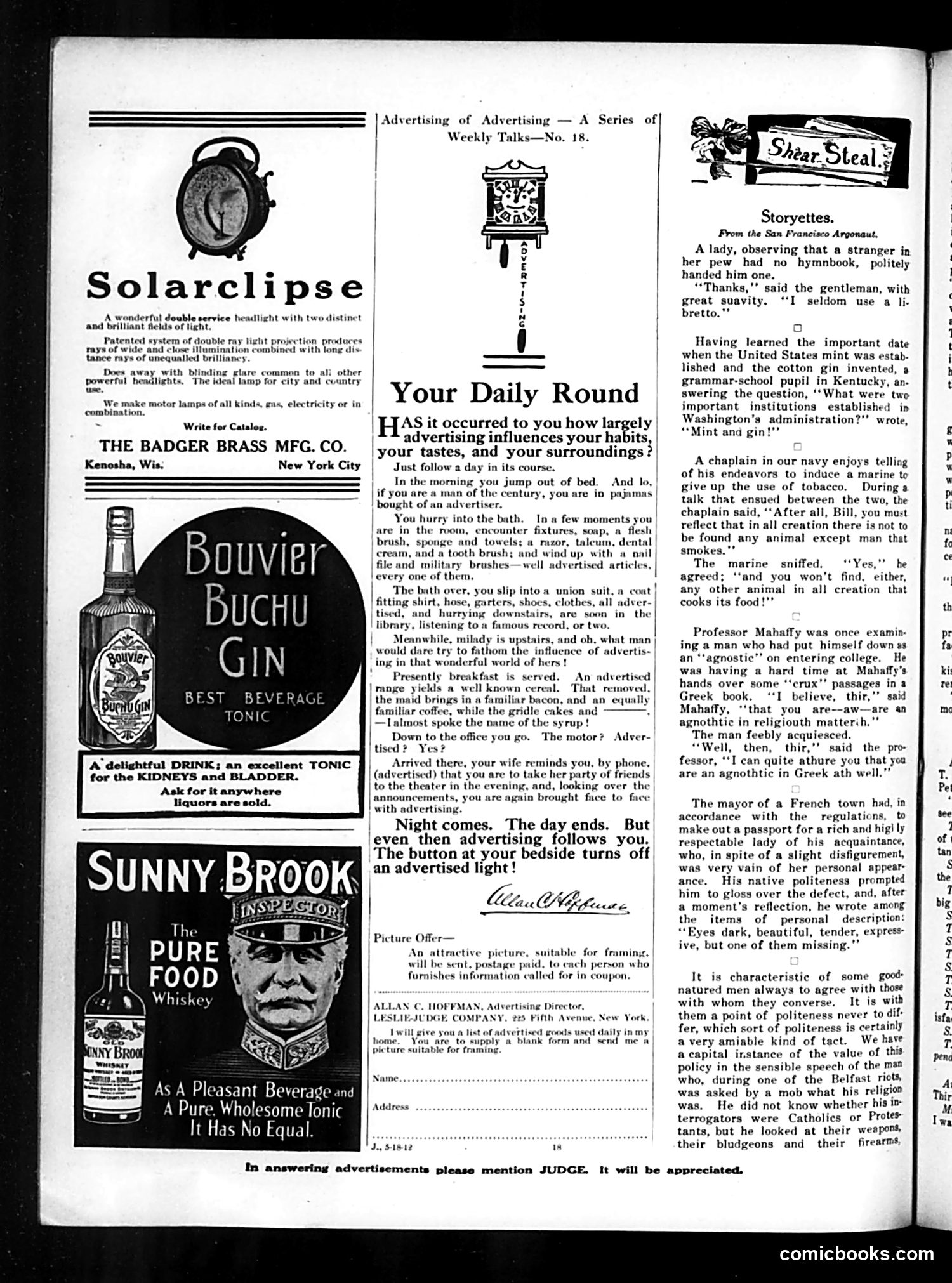
This page is primarily **advertising**, not political satire. It features commercial ads for products like the Solarclipse headlight, Bouvier Buchu Gin, and Sunny Brook Whiskey—typical for Judge magazine, which relied on advertising revenue. The editorial content is a meta-commentary on advertising itself titled "Your Daily Round," which traces how advertising influences daily life from morning (pajamas, toiletries) through evening. It's satirizing not politics but **consumer culture and advertising's pervasive influence**—a contemporary concern about how ads shape behavior and purchases throughout one's day. The "Storyettes" section contains light humor anecdotes unrelated to politics: a church visitor's use of "libretto" instead of "hymnbook," a schoolchild's confusion of "mint and gin," and a marine's witty comeback about animals cooking food. These are gentle, non-political humor pieces typical of the era's magazines.
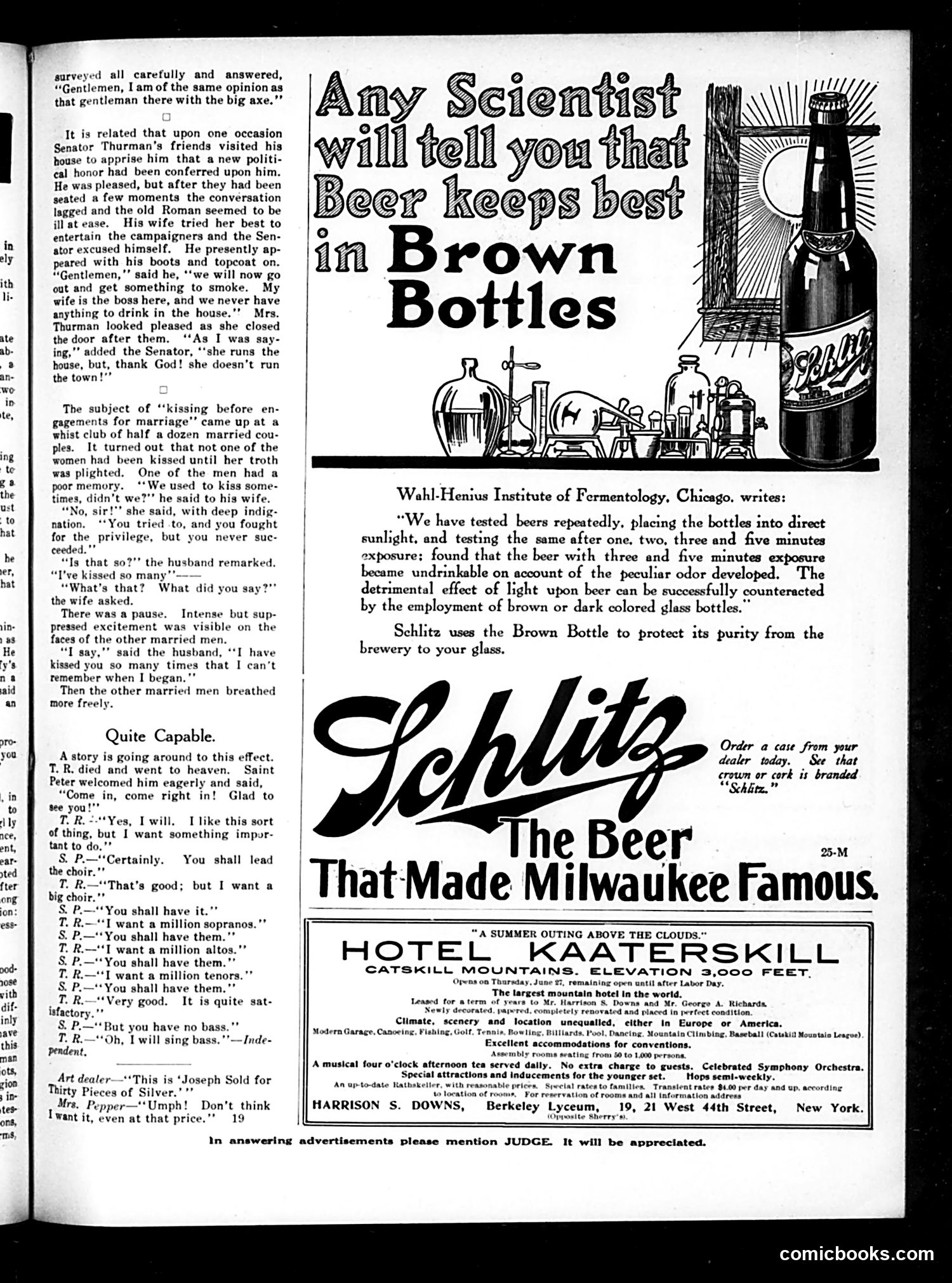
This page contains **multiple unrelated items** typical of Judge's satirical format: **Main Content:** - Humorous anecdotes about Senator Thurman (likely William Allen Thurman, 19th-century politician) emphasizing his wife's household dominance - A joke about married couples and pre-engagement kissing customs - **Satire on Theodore Roosevelt**: After dying, T.R. demands an enormous choir ("million sopranos," "million altos," "million tenors") to lead, then insists on singing bass solo—mocking Roosevelt's well-known bombastic personality and need to dominate any situation **Advertisements:** - Large Schlitz beer ad citing scientific evidence that brown bottles protect beer from light damage - Hotel Kaaterskill resort advertisement The Roosevelt piece is the clearest satire: it captures contemporary public perception of T.R. as an unstoppable egotist who must control everything and be the center of attention, even in heaven.
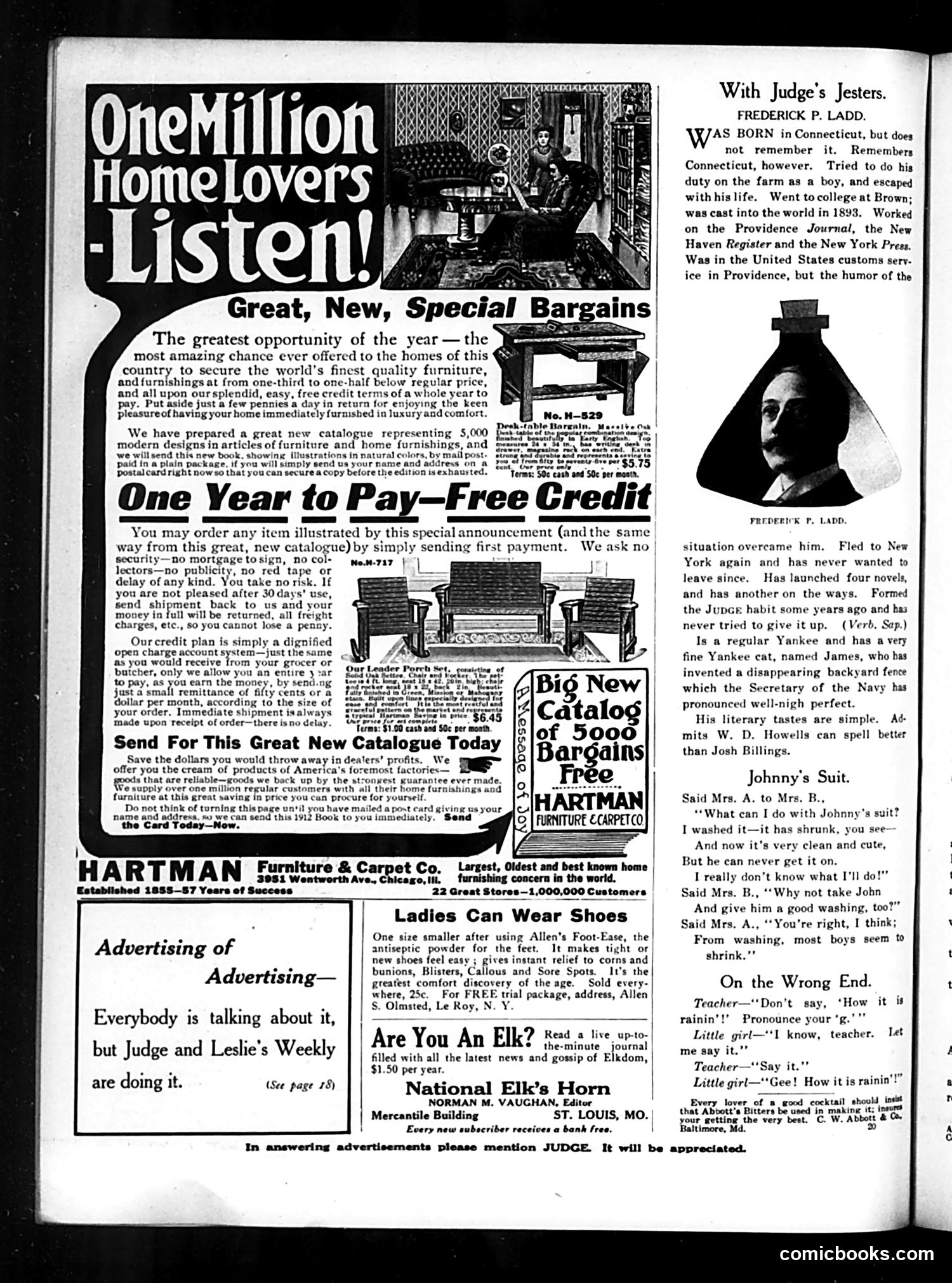
This page is primarily **advertising** for Hartman Furniture & Carpet Company, with the main content being a catalog sales pitch offering "One Year to Pay—Free Credit" terms on home furnishings. **"Judge's Jesters"** at top-right is a biographical section featuring Frederick P. Ladd, a Connecticut-born writer who worked for Providence and New York newspapers. His biography includes humorous asides (like "escaped with his life" from farm work) typical of Judge magazine's comedic tone. The remaining content consists of unrelated **advertisements**: Allen's Foot-Ease powder, The National Elk's Horn journal, and other consumer products—standard advertising filler for the era. There is **no political cartoon** visible on this page. The satirical content is limited to the biographical humor in Ladd's entry. This appears to be a typical mixed editorial-advertising page from an early 1910s magazine.
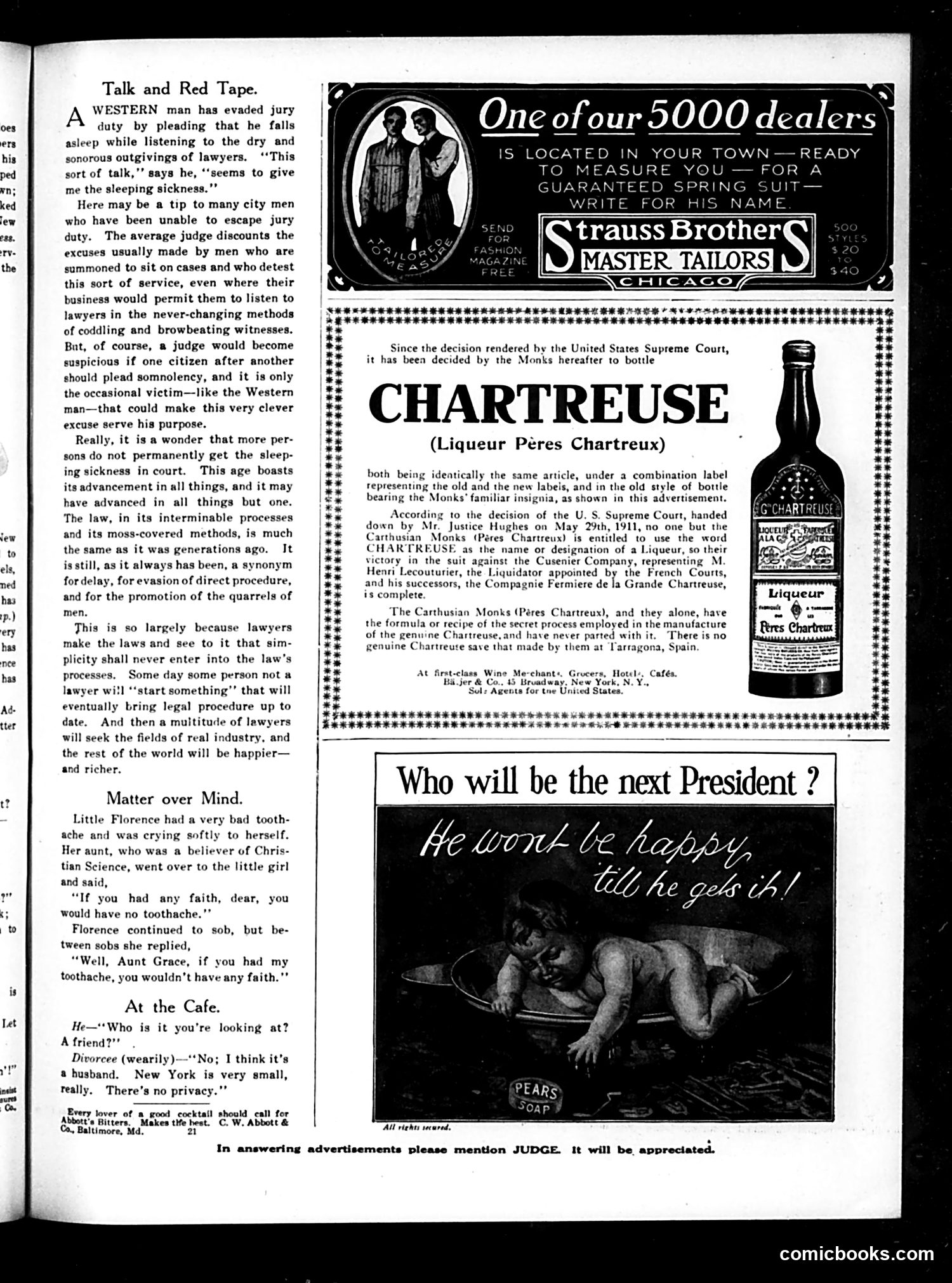
This page contains editorial commentary and advertisements rather than political cartoons. **"Talk and Red Tape"** critiques the American legal system's inefficiency. The author notes a Western man escaped jury duty by claiming lawyers' speeches induce sleep—a humorous but pointed observation about law's tedious, archaic procedures. The piece sarcastically suggests the legal system hasn't modernized despite societal progress, blaming lawyers for deliberately maintaining complexity to perpetuate their profession and litigation. **"Matter over Mind"** is a brief joke mocking Christian Science: a girl with a toothache tells her Christian Science aunt that if the aunt had the same toothache, *she* wouldn't have faith—matter (physical pain) overwhelms mind-over-matter philosophy. **The advertisements** include Strauss Brothers tailors and Chartreuse liqueur, the latter referencing a 1911 Supreme Court decision regarding trademark rights. The page reflects early 20th-century skepticism toward both legal establishment and religious movements claiming mind controls physical reality.
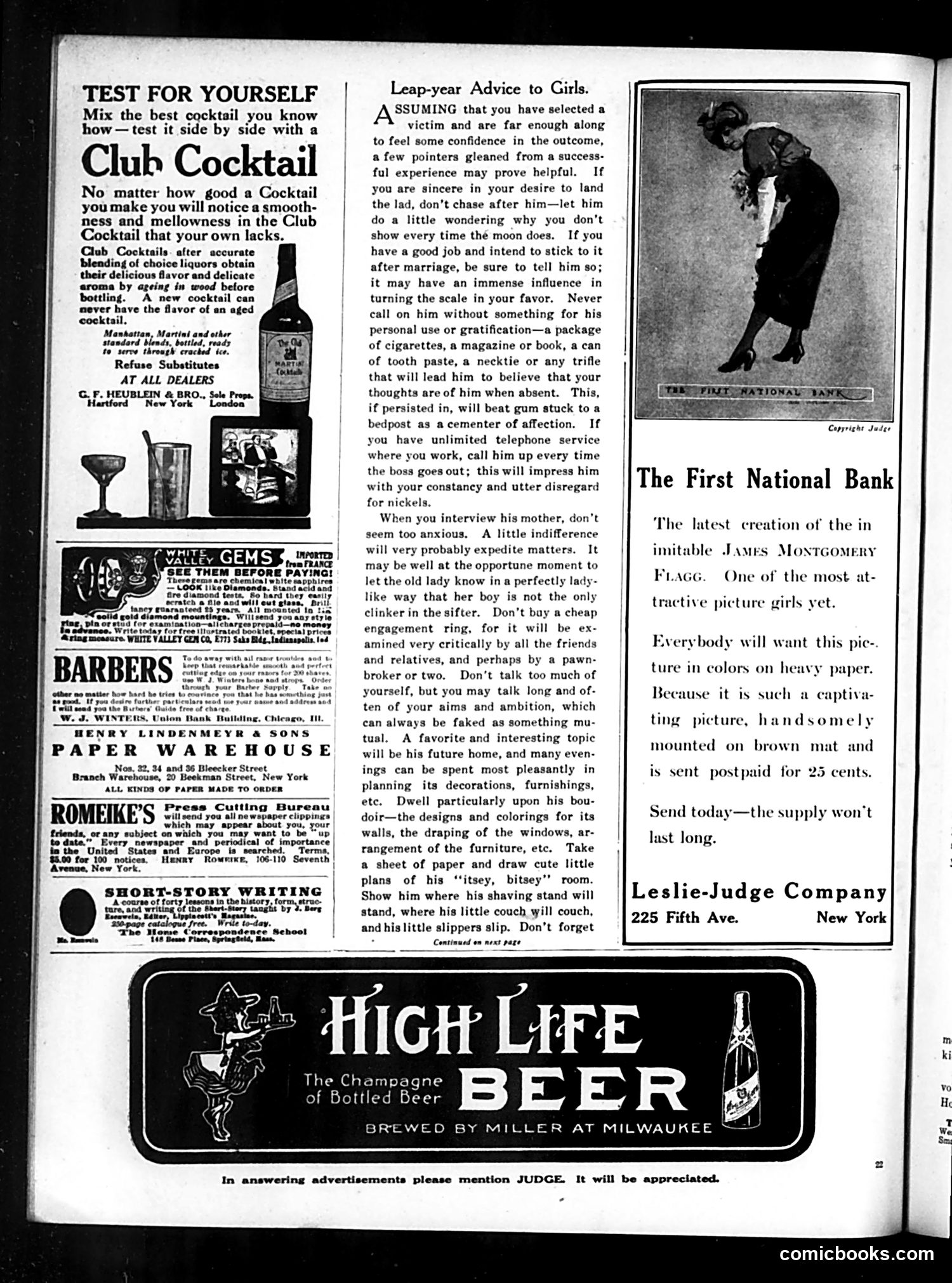
This satirical article mocks early-20th-century courtship conventions by offering tongue-in-cheek advice for women pursuing men during leap year (when tradition supposedly allowed women to propose). The humor lies in its exaggerated, contradictory guidance: women should appear *indifferent* while constantly calling and visiting; bring small gifts to seem thoughtful; avoid discussing themselves while obsessively planning his future home's décor down to "itsey, bitsey" details. The satire targets both gender dynamics of the era—women's limited agency in courtship—and the absurdity of "feminine wiles" advice literature. By having women strategically manipulate men through feigned constancy, gift-giving, and elaborate domestic fantasizing, Judge ridicules both the courtship playbook and the notion that women needed such elaborate schemes to secure husbands. The piece reflects early-1900s anxieties about changing gender roles while poking fun at prescriptive advice culture.
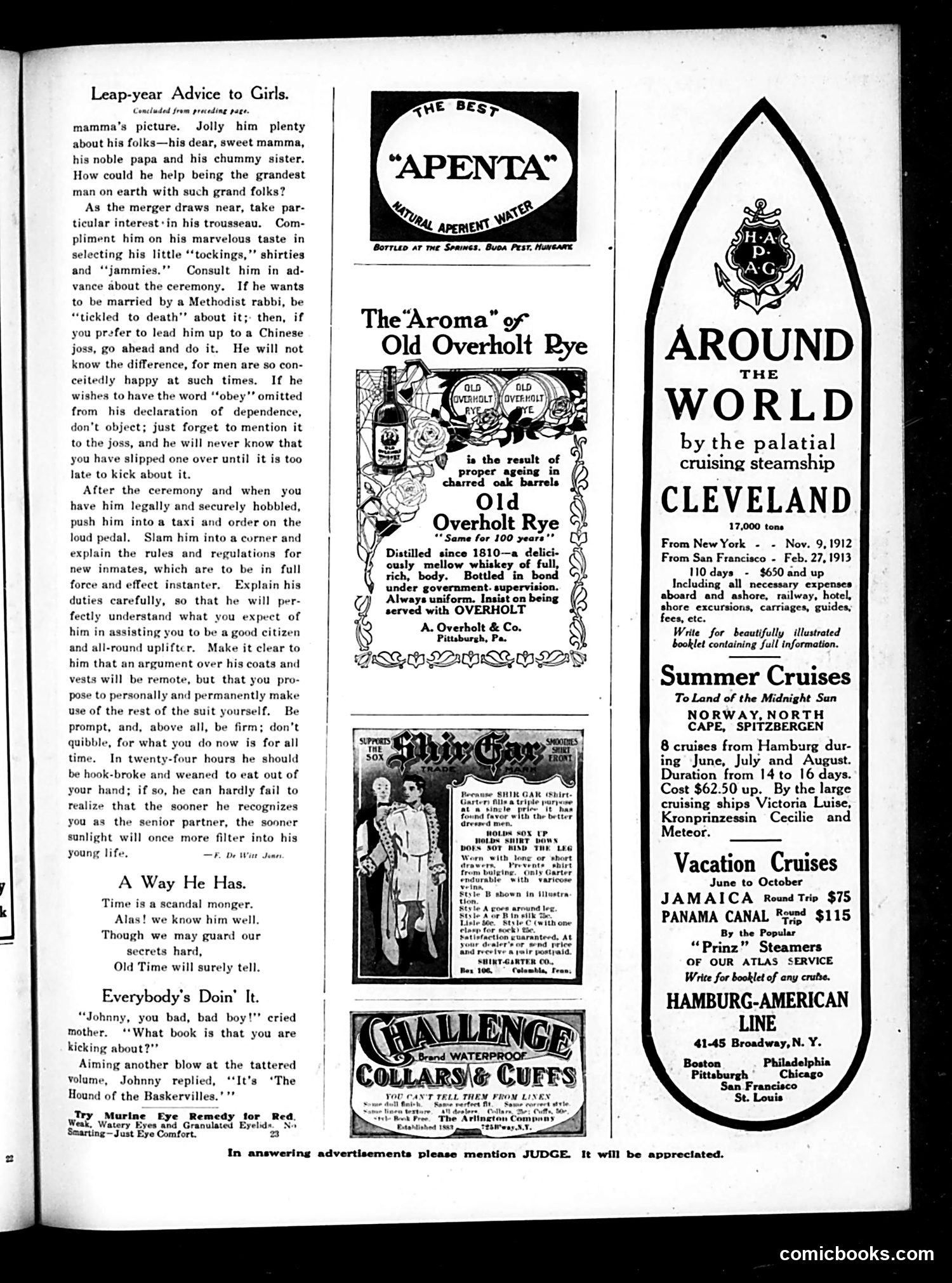
This page from *Judge* magazine contains satirical advice and period advertising. The main editorial content is "Leap-year Advice to Girls" (continued from a previous page), which satirizes early 1910s gender dynamics by offering tongue-in-cheek guidance to women on how to manipulate men into marriage during leap year—when tradition supposedly allowed women to propose. The satire mocks both female scheming and male gullibility, advising women to flatter their suitors, control the wedding details, and then dominate them as the "senior partner" afterward. The page also includes advertisements for Old Overholt Rye whiskey, a world cruise on the steamship *Cleveland*, and other consumer products typical of 1912. The other brief items—"A Way He Has," "Everybody's Doin' It"—appear to be short humorous anecdotes, likely typical of *Judge*'s satirical format, though their specific references are unclear from the OCR text provided.
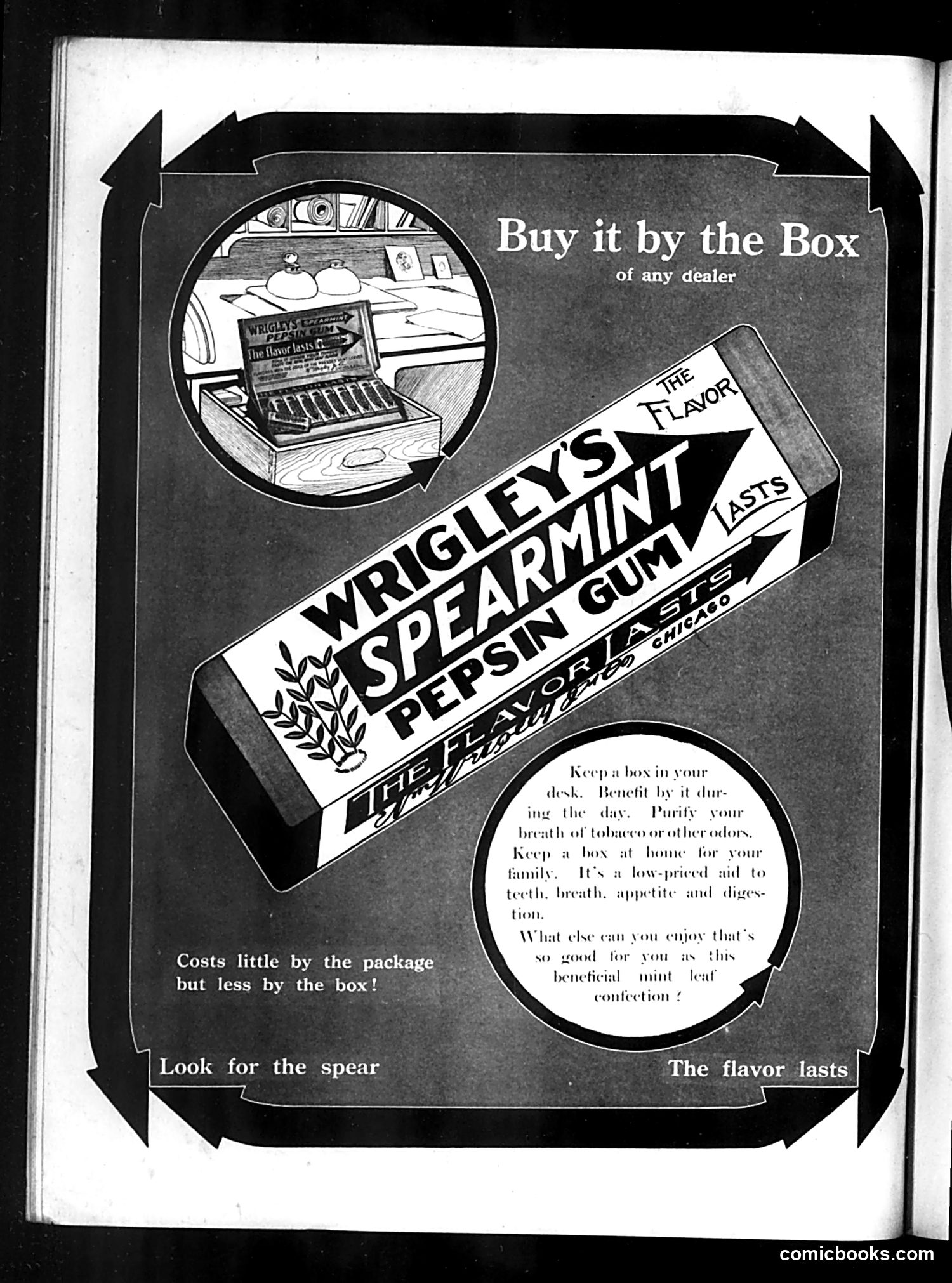
This is primarily a **product advertisement**, not a political cartoon. It promotes **Wrigley's Spearmint Peppsin Gum**, a chewing gum product manufactured in Chicago. The ad uses period marketing language to encourage bulk purchasing ("buy it by the box"), emphasizing cost savings. It makes health claims typical of early 20th-century advertising—that chewing gum benefits teeth, breath, appetite, and digestion. The circular text suggests keeping gum at your desk and home for family use. The circular illustration shows an office setting, and the packaging displays a spear motif (Wrigley's trademark branding element). The tagline "The flavor lasts" promotes product longevity. This reflects early advertising's bold health claims now considered dubious or misleading by modern standards.