
Judge, 1912-05-18 · page 6 of 24
Judge — May 18, 1912 — page 6: what you’re looking at
What you’re looking at
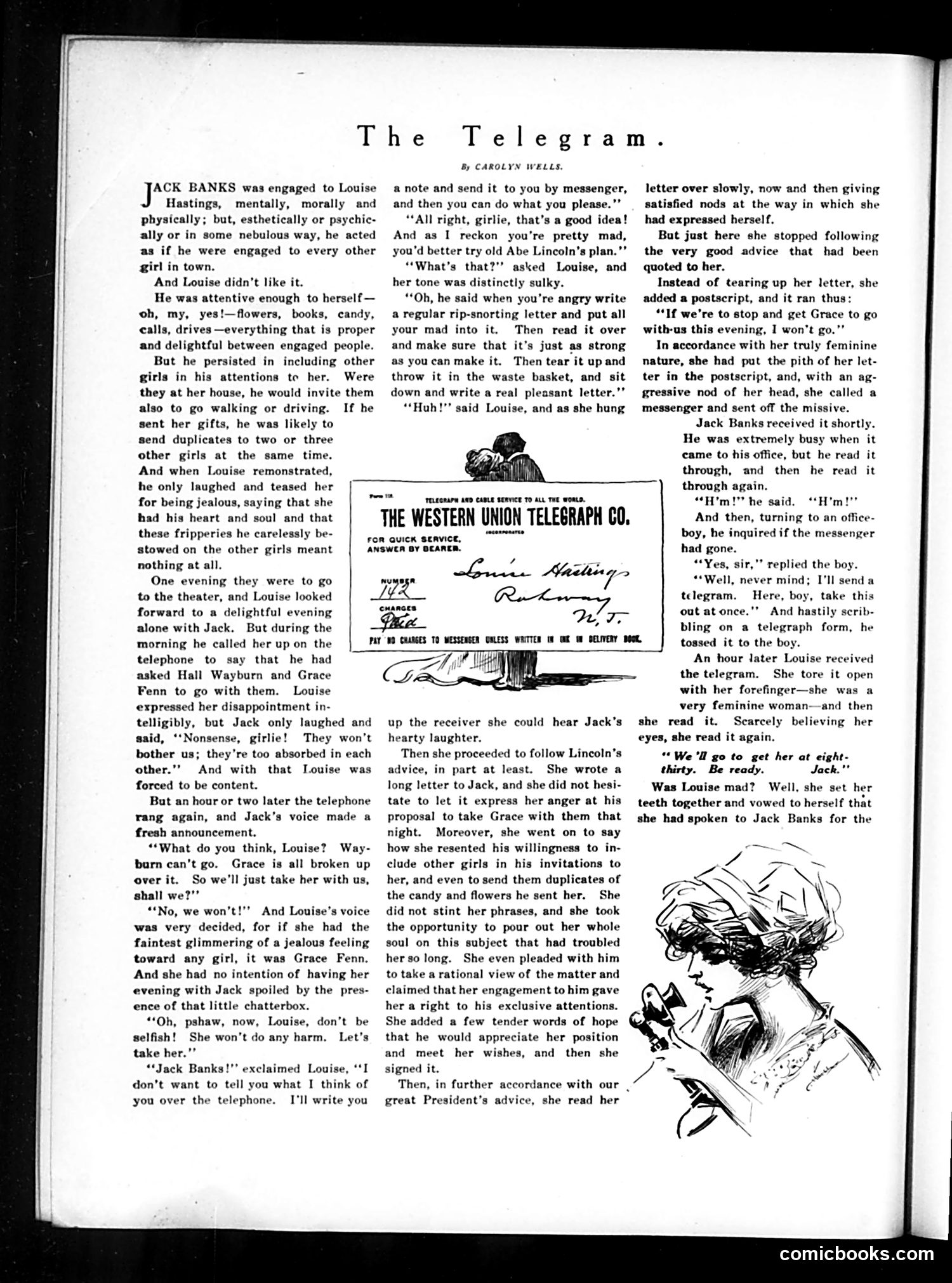
This is a romantic comedy story about relationship jealousy and modern communication. Jack Banks, engaged to Louise Hastings, carelessly includes other girls in their social activities. Louise protests repeatedly, but Jack dismisses her concerns. When Jack invites another girl (Grace) to their theater evening, Louise writes an angry letter. Following Abraham Lincoln's famous advice (referenced humorously), she's supposed to write angry letters then discard them—but instead, she adds a petulant postscript and sends it via Western Union telegram. Jack receives the message and, rather than apologize or argue over the telephone, responds with his own telegram. The satire targets both romantic miscommunication and the era's fascination with instantaneous telegraph technology as a solution to personal disputes. The joke is that modern technology enables escalating relationship drama rather than resolving it—a timeless observation about how communication devices amplify rather than improve human conflict.
📄 Transcribed text from this page (OCR, searchable)
Machine-transcribed from the original scan — historical spelling and the odd misread are preserved.
At ACK BANKS was engaged to Louise Hastings, mentally, morally and physically; but, esthetically or psychic- ally or in some nebulous way, he acted as if he were engaged to every other girl in town. And Louise didn’t like it. He was attentive enough to herself — oh, my, yes!—flowers, books, candy, calls, drives —everything that is proper and delightful between engaged people. But he persisted in including other girls in his attentions te her. Were they at her house, he would invite them also to go walking or driving. If he sent her gifts, he was likely to send duplicates to two or three other girls at the same time. And when Louise remonstrated, he only laughed and teased her for being jealous, saying that she had his heart and soul and that these fripperies he carelessly be- stowed on the other girls meant nothing at all. One evening they were to go to the theater, and Louise looked forward to a delightful evening alone with Jack. But during the he By CAROLYN WELLS. a note and send it to you by messenger, and then you can do what you please.’’ “Allright, girlie, that’s a good idea! And as I reckon you're pretty mad, you'd better try old Abe Lincoln’s pla “What's that?’’ asked Louise, and her tone was distinctly sulky. “Oh, he said when you're angry write a regular rip-snorting letter and put all your mad into it. Then read it over and make sure that it’s just as strong as you can make it. Then tear it up and throw it in the waste basket, and sit down and write a real pleasant letter.’’ “Huh!” said Louise, and as she hung TELEGRAPH AND CABLE SERVICE TO ALL THE WORLD. THE WESTERN UNION TELEGRAPH CO FOR QUICK SERVICE, ANSWER BY DCARER. Ry chances PAY WO CRARGES TO MESSENGER ONLESS WRITTEN I GE W@ DELIVERY BOOK. Telegram. letter over slowly, now and then giving satisfied nods at the way in which she had expressed herself. But just here she stopped following the very good advice that had been quoted to her. Instead of tearing up her letter, she added a postscript, and it ran thus: “If we're to stop and get Grace to go with-us this evening, I won't go.”’ In accordance with her truly feminine nature, she had put the pith of her let- ter in the postscript, and, with an ag- gressive nod of her head, she called a messenger and sent off the missive. Jack Banks received it shortly. He was extremely busy when it came to his office, but he read it through, and then he read it through again. “H'm!" he said. ‘‘H'm!"’ And then, turning to an office- boy, he inquired if the messenger had gone. “Yes, sir,”’ replied the boy. **Well, never mind; I'll send a telegram. Here, boy, take this out atonce.'’ And hastily scrib- bling on a telegraph form, he tossed it to the boy. morning he called her up on the telephone to say that he had asked Hall Wayburn and Grace Fenn to go with them. Louise expressed her disappointment in- telligibly, but Jack only laughed and said, ‘‘Nonsense, girlie! They won't bother us; they’re too absorbed in each other.’’ And with that Louise was forced to be content. But an hour or two later the telephone rang again, and Jack’s voice made a fresh announcement. “*What do you think, Louise? Way- burn can’t go. Grace is all broken up over it. So we'll just take her with us, shall we?"’ **No, we won’t!’’ And Louise’s voice was very decided, for if she had the faintest glimmering of a jealous feeling toward any girl, it was Grace Fenn. And she had no intention of having her evening with Jack spoiled by the pres- ence of that little chatterbox. “Oh, pshaw, now, Louise, don’t be selfish! She won't do any harm. Let’s take her.”’ “Jack Banks!"’ exclaimed Louise, ‘I don’t want to tell you what I think of I'll write you you over the telephone. up the receiver she could hear Jack’s hearty laughter. Then she proceeded to follow Lincoln's advice, in part at least. She wrote a long letter to Jack, and she did not hesi- tate to let it express her anger at his proposal to take Grace with them that night. Moreover, she went on to say how she resented his willingness to in- clude other girls in his invitations to her, and even to send them duplicates of the candy and flowers he sent her. She did not stint her phrases, and she took the opportunity to pour out her whole soul on this subject that had troubled her so long. She even pleaded with him to take a rational view of the matter and claimed that her engagement to him gave her a right to his exclusive attentions. She added a few tender words of hope that he would appreciate her position and meet her wishes, and then she signed it. Then, in further accordance with our . , she read her great President's ad An hour later Louise received the telegram. She tore it open with her forefinger—she was a very feminine woman—and then she read it. Scarcely believing her eyes, she read it again. ‘* We'll go to get her at eight- thirty. Be ready. Jack."" Was Louise mad? Well, she set her teeth together and vowed to herself that she had spoken to Jack Banks for the comicbooks.com