
Judge, 1912-05-18 · page 5 of 24
Judge — May 18, 1912 — page 5: what you’re looking at
What you’re looking at
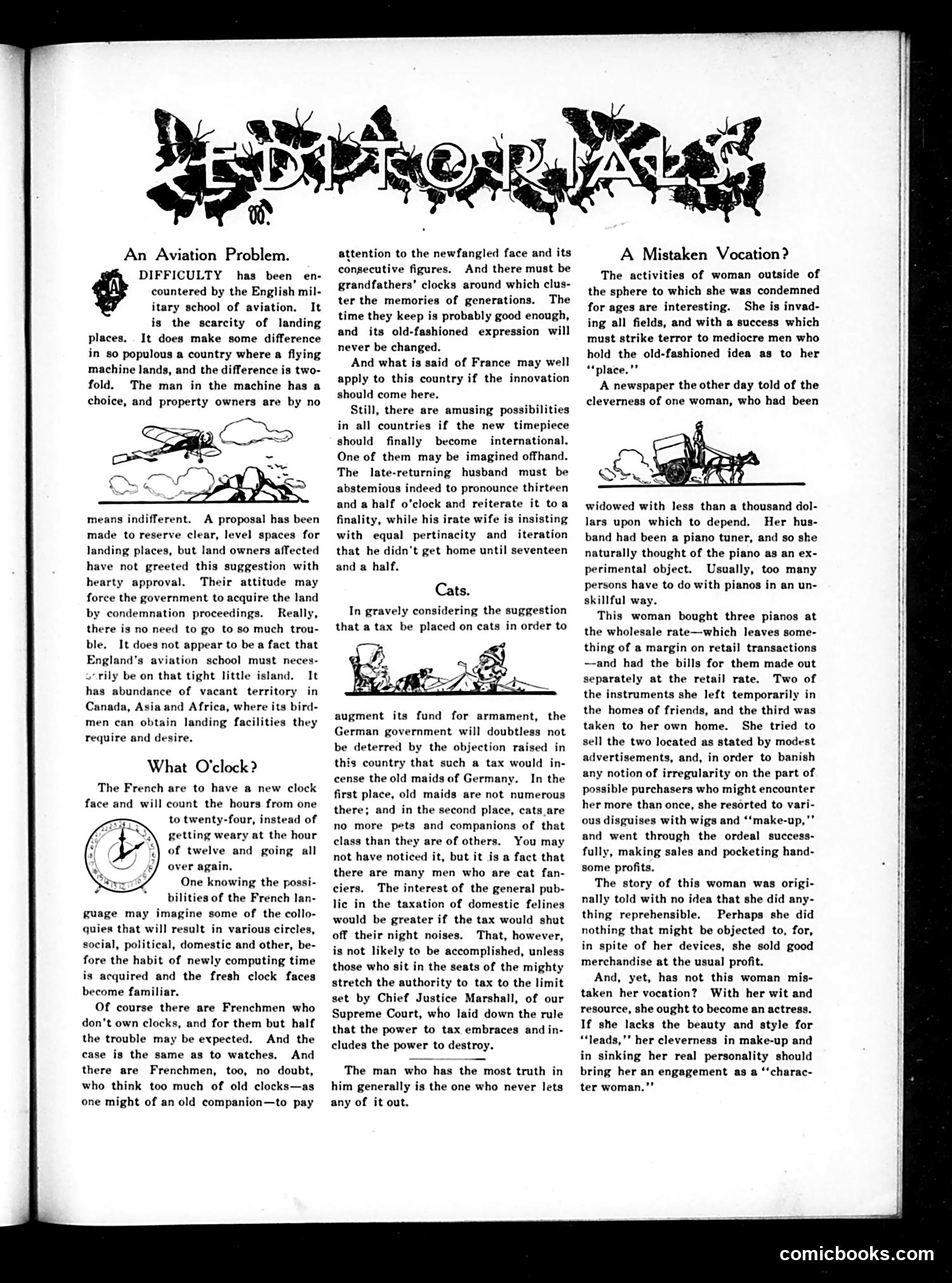
This Judge magazine page contains three satirical pieces about contemporary issues: **"An Aviation Problem"**: Mocks English aviation regulations that restrict where planes can land. The satire suggests this overly cautious approach hobbles aviation development compared to other nations, noting that property owners' concerns shouldn't outweigh progress. **"What O'clock?"**: France is adopting a 24-hour clock face. The piece humorously imagines the adjustment difficulties and pokes fun at the French for constantly inventing new systems, while suggesting Frenchmen are oddly nostalgic about old customs. **"Cats"**: Proposes taxing cats to fund German military armament. The satire mocks this idea as absurd while joking about old maids' attachment to cats and questioning government authority to tax personal possessions. All three pieces use absurdist humor to critique regulatory overreach and national stereotypes.
📄 Transcribed text from this page (OCR, searchable)
Machine-transcribed from the original scan — historical spelling and the odd misread are preserved.
An Aviation Problem. DIFFICULTY has been en- countered by the English mil- itary school of aviation. It is the scarcity of landing places. It does make some difference in so populous a country where a flying machine lands, and the difference is two- fold. The man in the machine has a choice, and property owners are by no means indifferent. A proposal has been made to reserve clear, level spaces for landing places, but land owners affected have not greeted this suggestion with hearty approval. Their attitude may force the government to acquire the land by condemnation proceedings. Really, there is no need to go to so much trou- ble. It does not appear to be a fact that England's aviation school must neces- orily be on that tight little island. It has abundance of vacant territory in Canada, Asia and Africa, where its bird- men can obtain landing facilities they require and desire. What O'clock? The French are to have a new clock face and will count the hours from one to twenty-four, instead of getting weary at the hour of twelve and going all over again. One knowing the possi- bilities of the French lan- guage may imagine some of the collo- quies that will result in various circles, social, political, domestic and other, be- fore the habit of newly computing time is acquired and the fresh clock faces become familiar. Of course there are Frenchmen who don't own clocks, and for them but half the trouble may be expected, And the case is the same as to watches. And there are Frenchmen, too, no doubt, who think too much of old clocks—as one might of an old companion—to pay attention to the newfangled face and its congecutive figures. And there must be grandfathers’ clocks around which clus- ter the memories of generations. The time they keep is probably good enough, and its old-fashioned expression will never be changed. And what is said of France may well apply to this country if the innovation should come here. Still, there are amusing possibilities in all countries if the new timepiece should finally become international. One of them may be imagined offhand. The late-returning husband must be abstemious indeed to pronounce thirteen and a half o’clock and reiterate it toa finality, while his irate wife is insisting with equal pertinacity and iteration that he didn't get home until seventeen and a half. Cats. In gravely considering the suggestion that a tax be placed on cats in order to augment its fund for armament, the German government will doubtless not be deterred by the objection raised in this country that such a tax would in- cense the old maids of Germany. In the first place, old maids are not numerous there; and in the second place, cats are no more pets and companions of that class than they are of others. You may not have noticed it, but it is a fact that there are many men who are cat fan- ciers. The interest of the general pub- lic in the taxation of domestic felines would be greater if the tax would shut off their night noises. That, however, is not likely to be accomplished, unless those who sit in the seats of the mighty stretch the authority to tax to the limit set by Chief Justice Marshall, of our Supreme Court, who laid down the rule that the power to tax embraces and in- cludes the power to destroy. The man who has the most truth in him generally is the one who never lets any of it out. A Mistaken Vocation? The activities of woman outside of the sphere to which she was condemned for ages are interesting. She is invad- ing all fields, and with a success which must strike terror to mediocre men who hold the old-fashioned idea as to her “‘place.’” A newspaper the other day told of the cleverness of one woman, who had been widowed with less than a thousand dol- lars upon which to depend. Her hus- band had been a piano tuner, and so she naturally thought of the piano as an ex- perimental object. Usually, too many persons have to do with pianos in an un- skillful way. This woman bought three pianos at the wholesale rate—which leaves some- thing of a margin on retail transactions ~and had the bills for them made out separately at the retail rate. Two of the instruments she left temporarily in the homes of friends, and the third was taken to her own home. She tried to sell the two located as stated by modest advertisements, and, in order to banish any notion of irregularity on the part of possible purchasers who might encounter her more than once, she resorted to vari- ous disguises with wigs and ‘‘make-up,"’ and went through the ordeal success- fully, making sales and pocketing hand- some profits. The story of this woman was origi- nally told with no idea that she did any- thing reprehensible. Perhaps she did nothing that might be objected to, for, in spite of her devices, she sold good merchandise at the usual profit. And, yet, has not this woman mis- taken her vocation? With her wit and resource, she ought to become an actress. If she lacks the beauty and style for “‘leads,’’ her cleverness in make-up and in sinking her real personality should bring her an engagement as a ‘‘charac- ter woman.”” comicbooks.com