
Judge, 1912-05-18 · page 14 of 24
Judge — May 18, 1912 — page 14: what you’re looking at
What you’re looking at
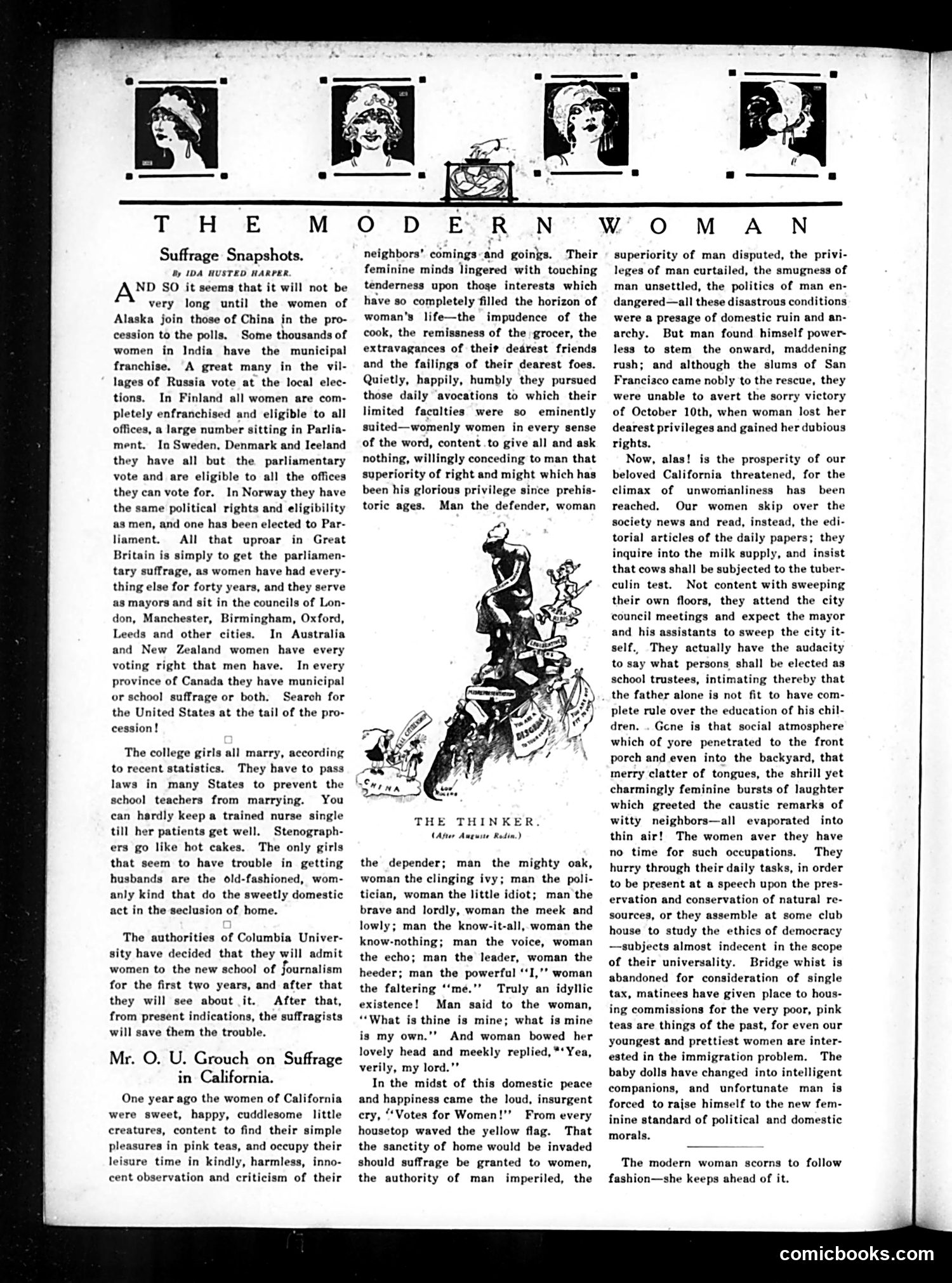
This page presents pro-suffrage arguments by Ida Husted Harper, contrasting women's voting rights globally with America's lagging position. The text catalogs how women vote in Finland, Norway, Australia, New Zealand, and Canada—placing the United States "at the tail of the procession." The central cartoon ("The Thinker," after Rodin) depicts a woman in the philosopher's famous pose, replacing the male original. This visual argument suggests women possess intellectual capacity equal to men's. The secondary article satirizes anti-suffrage California men through "Mr. O. U. Grouch," who laments women's pre-suffrage docility—portraying them as decorative, intellectually limited ("little idiot"), and submissive. The sarcasm mocks this vision of feminine inferiority, implying such stereotypes are absurd justifications for denying voting rights. The piece argues women's education and civic competence make disenfranchisement untenable.
📄 Transcribed text from this page (OCR, searchable)
Machine-transcribed from the original scan — historical spelling and the odd misread are preserved.
T HE Suffrage Snapshots. By IDA HUSTED HARPER. ND SO it seems that it will not be very long until the women of Alaska join those of China in the pro- cession to the polls. Some thousands of women in India have the municipal franchise. A great many in the vil- lages of Russia vote at the local elec- tions. In Finland all women are com- pletely enfranchised and eligible to all offices, a large number sitting in Parlia- ment. In Sweden, Denmark and Ieeland they have all but the parliamentary vote and are eligible to all the offices they can vote for. In Norway they have the same political rights and eligibility as men, and one has been elected to Par- liament. All that uproar in Great Britain is simply to get the parliamen- tary suffrage, as women have had every- thing else for forty years, and they serve as mayors and sit in the councils of Lon- don, Manchester, Birmingham, Oxford, Leeds and other cities. In Australia and New Zealand women have every voting right that men have. In every province of Canada they have municipal or school suffrage or both, Search for the United States at the tail of the pro- cession! The college girls all marry, according to recent statistics. They have to pass laws in many States to prevent the school teachers from marrying. You can hardly keep a trained nurse single till her patients get well. Stenograph- ers go like hot cakes. The only girls that seem to have trouble in getting husbands are the old-fashioned, wom- anly kind that do the sweetly domestic act in the seclusion of home. The authorities of Columbia Univer- sity have decided that they will admit women to the new school of fournalism for the first two years, and after that they will see about it. After that, from present indications, the suffragists will save them the trouble. Mr. O. U. Grouch on Suffrage in California. One year ago the women of California were sweet, happy, cuddlesome little creatures, content to find their simple pleasures in pink teas, and occupy their leisure time in kindly, harmless, inno- cent observation and criticism of their M OD ER N neighbors’ comings-and goings. Their feminine minds lingered with touching tenderness upon thoge interests which have so completely filled the horizon of woman's life—the impudence of the cook, the remissness of the grocer, the extravagances of thei? dearest friends and the failings of their dearest foes. Quietly, happily, humbly they pursued those daily ‘avocations to which their limited faculties were so eminently suited—womenly women in every sense of the word, content .to give all and ask nothing, willingly conceding to man that superiority of right and might which has been his glorious privilege since prehis- toric ages. Man the defender, woman Pa THE THINKER. (After Auguste Rodin.) the depender; man the mighty oak, woman the clinging ivy; man the poli- tician, woman the little idiot; man the brave and lordly, woman the meek and lowly; man the know-it-all, woman the know-nothing; man the voice, woman the echo; man the leader, woman the heeder; man the powerful ‘‘I,’’ woman the faltering ‘‘me.’’ Truly an idyllic existence! Man said to the woman, “What is thine is mine; what is mine is my own.’’ And woman bowed her lovely head and meekly replied, **Yea, verily, my lord.’” In the midst of this domestic peace and happiness came the loud, insurgent cry, ‘‘Votes for Women!"’ From every housetop waved the yellow flag. That the sanctity of home would be invaded should suffrage be granted to women, the authority of man imperiled, the Ww OM A N superiority of man disputed, the privi- leges of man curtailed, the smugness of man unsettled, the politics of man en- dangered—all these disastrous conditions were a presage of domestic ruin and an- archy. But man found himself power- less to stem the onward, maddening rush; and although the slums of San Franciaco came nobly to the rescue, they were unable to avert the sorry victory of October 10th, when woman lost her dearest privileges and gained her dubious rights. Now, alas! is the prosperity of our beloved California threatened, for the climax of unwomanliness has been reached. Our women skip over the society news and read, instead, the edi- torial articles of the daily papers; they inquire into the milk supply, and insist that cows shall be subjected to the tuber- culin test. Not content with sweeping their own floors, they attend the city council meetings and expect the mayor and his assistants to sweep the city it- self. They actually have the audacity to say what persons shall be elected as school trustees, intimating thereby that the father alone is not fit to have com- plete rule over the education of his chil- dren. . Gene is that social atmosphere which of yore penetrated to the front porch and even into the backyard, that merry clatter of tongues, the shrill yet charmingly feminine bursts of laughter which greeted the caustic remarks of witty neighbors—all evaporated into thin air! The women aver they have no time for such occupations. They hurry through their daily tasks, in order to be present at a speech upon the pres- ervation and conservation of natural re- sources, or they assemble at some club house to study the ethics of democracy —subjects almost indecent in the scope of their universality. Bridge whist is abandoned for consideration of single tax, matinees have given place to hous- ing commissions for the very poor, pink teas are things of the past, for even our youngest and prettiest women are inter- ested in the immigration problem. The baby dolls have changed into intelligent companions, and unfortunate man is forced to raise himself to the new fem- inine standard of political and domestic morals. The modern woman scorns to follow fashion—she keeps ahead of it. comicbooks.com