
A complete issue · 26 pages · 1912
Judge — May 11, 1912
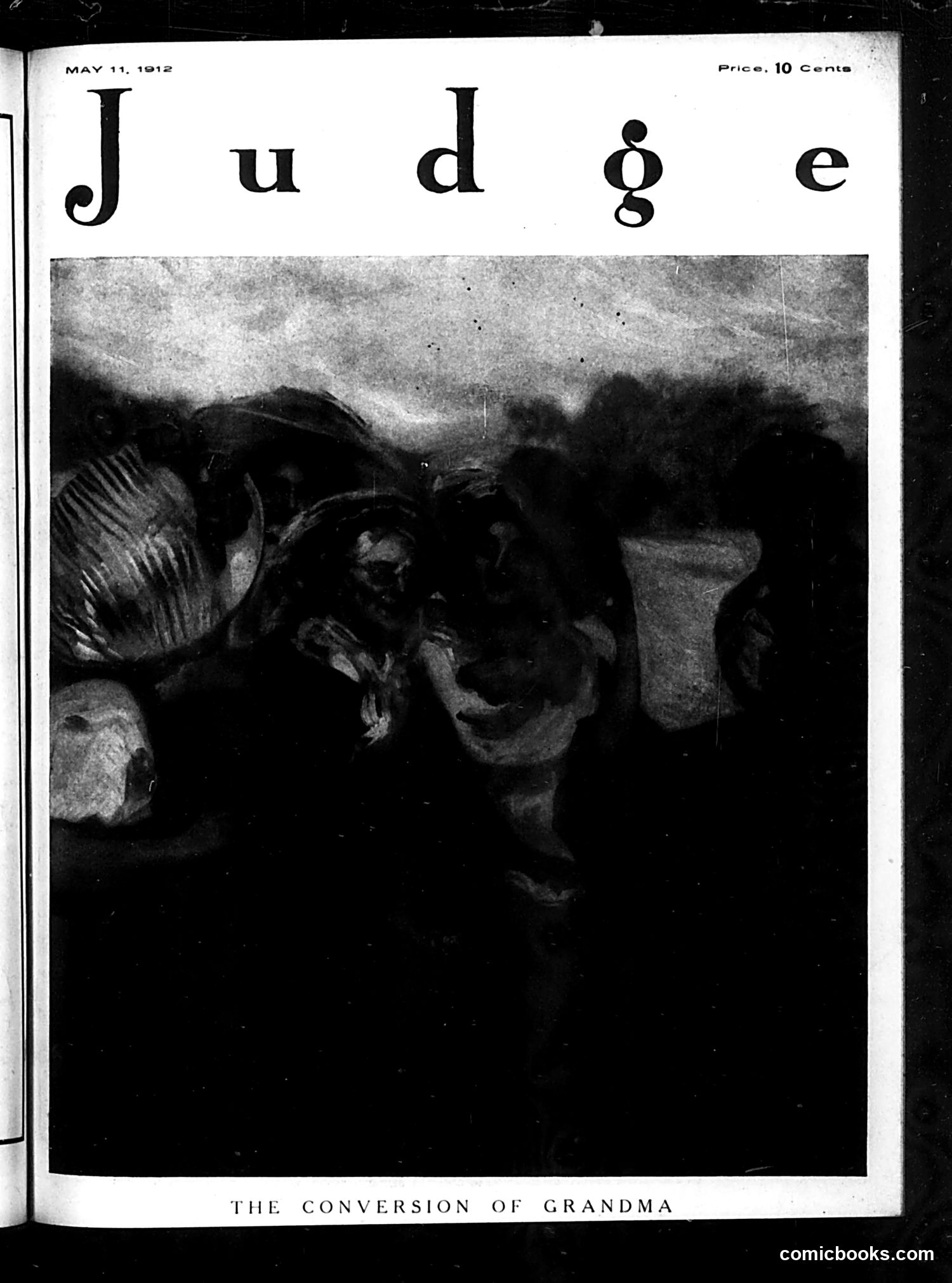
This Judge magazine cover from May 11, 1912 appears to depict a darkened scene titled "The Conversion of Grandma," though the image quality makes specific details difficult to discern. The composition shows multiple figures gathered together in what seems to be an interior setting, with dramatic lighting creating silhouettes. Without clearer visibility of facial features or identifying details, I cannot definitively state who the figures represent or what specific "conversion" is being satirized. The title suggests commentary on an elderly woman's change of belief or opinion, possibly religious or political in nature. The 1912 date places this during Theodore Roosevelt's presidential campaign and Progressive Party emergence, when many conversion narratives circulated in American politics and society, but I cannot confirm the cartoon's specific target without additional clarity.
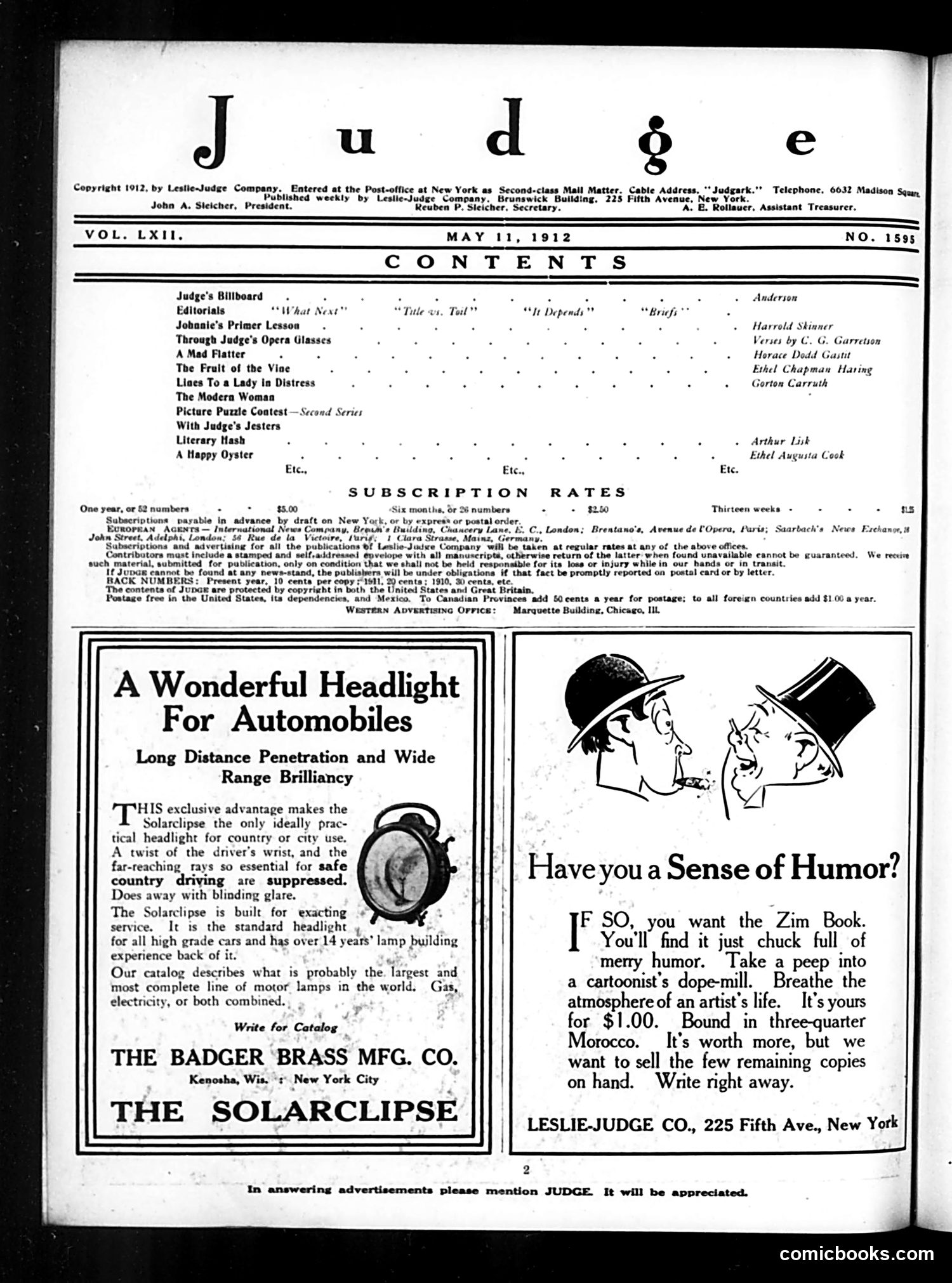
This page is primarily **advertising and subscription information** rather than political satire. The two main advertisements shown are: 1. **"A Wonderful Headlight For Automobiles"** by the Badger Brass Manufacturing Company—promoting the "Solarclipse" headlight with claims of superior long-distance visibility and safety. 2. **"Have you a Sense of Humor?"**—advertising the "Zim Book," a humor collection bound in Moroccan leather, priced at $1.00, sold by Leslie-Judge Company. The cartoon illustration accompanying the humor ad shows two men in profile—one wearing a bowler hat tipping his top hat to another—a generic visual gag about comedic social situations rather than political commentary.
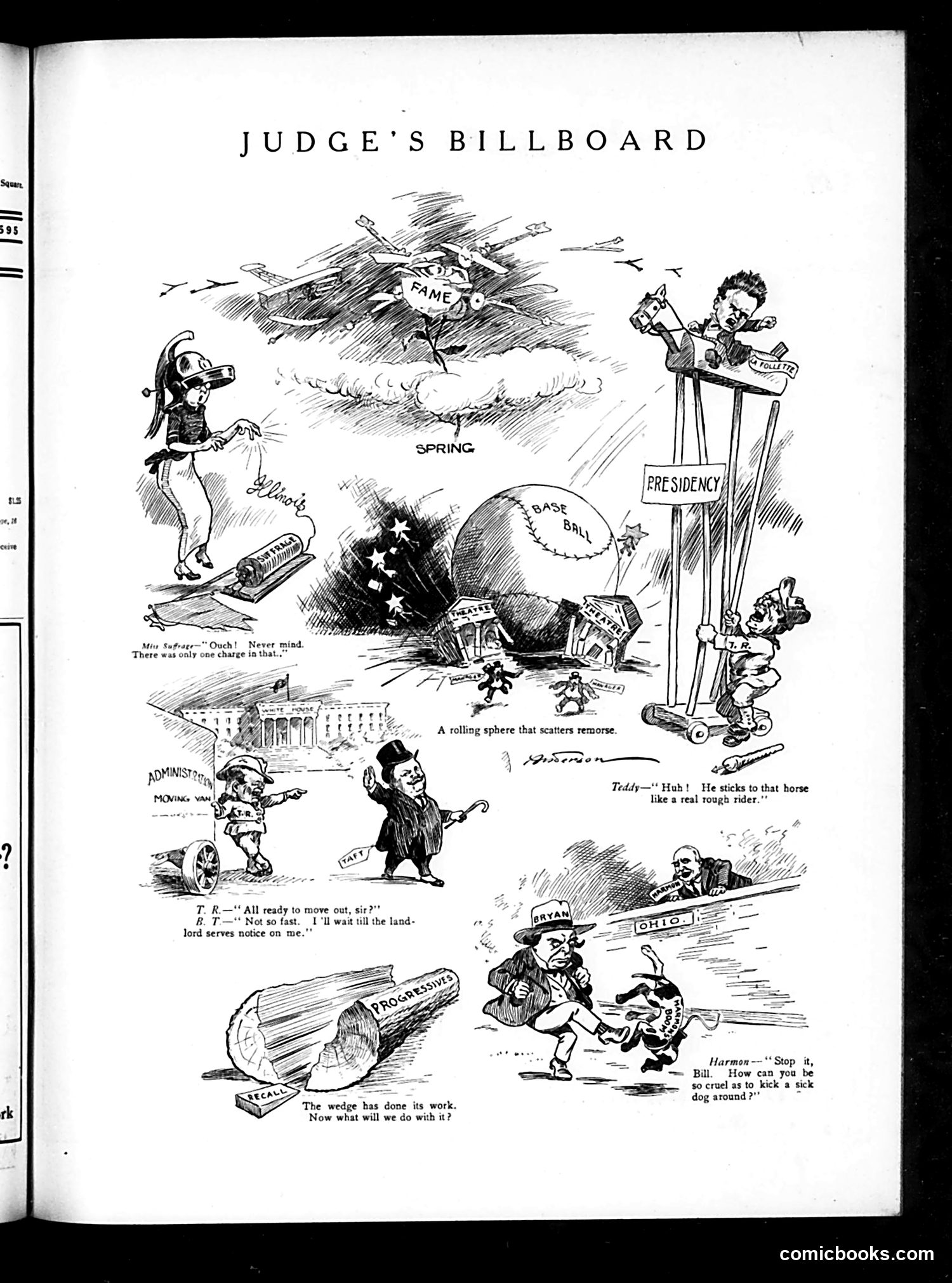
This satirical page depicts early 20th-century American politics as chaotic. The central imagery—a baseball ("Base Ball"), rolling sphere, and scattered debris labeled "Administration" and "Presidency"—suggests political instability during a presidential transition or scandal. Key figures appear to include caricatured politicians managing various crises. References to "Spring," "Fame," and "Presidency" indicate seasonal political renewal or campaign season. The "wedge" metaphor ("The wedge has done its work") likely refers to factional splits within a political party or administration. Dialogue snippets mock political incompetence: characters question how to handle situations, suggesting leadership failure. The overall composition uses baseball/sports metaphors to critique government dysfunction—a common Judge technique for making political commentary accessible and satirical to readers.
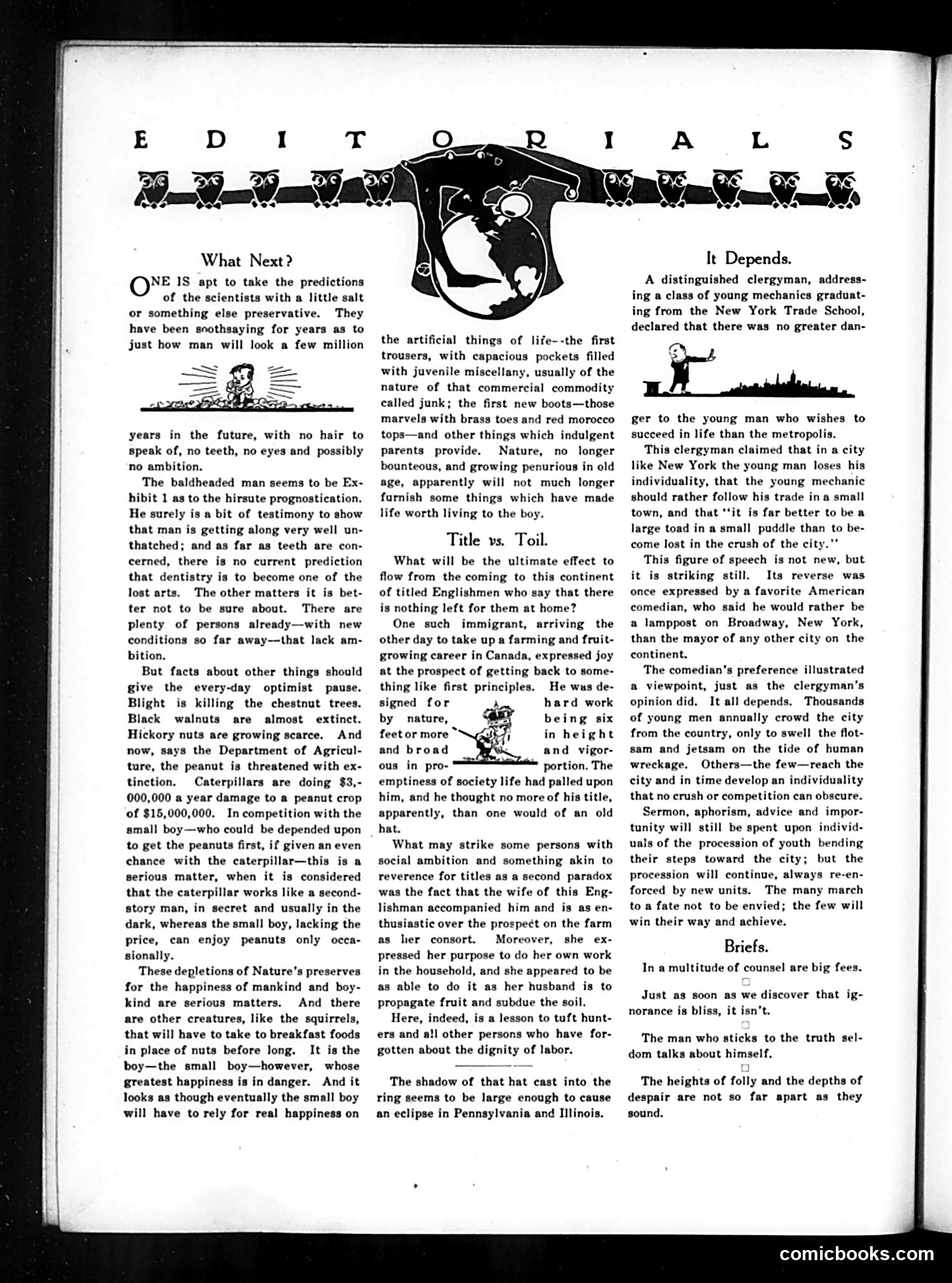
This page from *Judge* magazine presents editorial commentary on American futures and social mobility. The left column, "What Next?," satirizes predictions about future humanity—mocking anxieties about physical degeneration (baldness, toothlessness) while celebrating American progress through consumerism and technology. The right column, "It Depends," addresses immigration and class mobility through a clergyman's anecdote about a young mechanic from the New York Trade School. The piece debates whether ambitious immigrants should stay in cities or seek opportunities in smaller towns or Canada—reflecting early 20th-century tensions over urbanization and immigration policy. The central section, "Title vs. Toil," presents a humorous vignette about an English immigrant woman who rejects farm work, preferring city life despite its hardships—satirizing genteel pretensions versus practical labor.
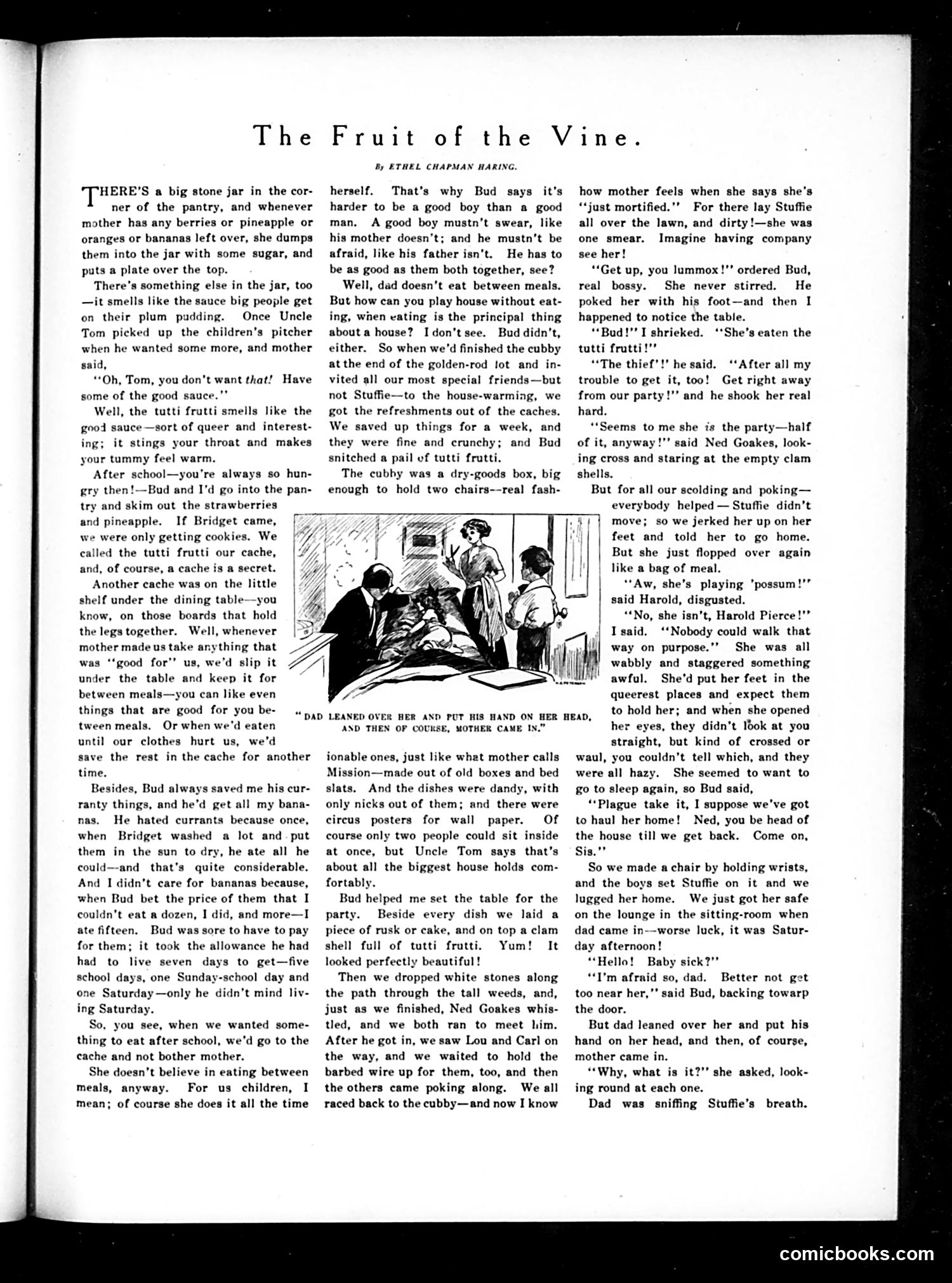
This page contains a short story by Ethel Chapman Haring about a family's experience with homemade wine during Prohibition. The accompanying illustration shows a father leaning over his sick daughter's bed while the mother enters—a dramatic moment when the family discovers their child has secretly drunk the homemade wine they were producing. The story satirizes Prohibition-era domestic life: families made illegal "homemade" wine, stored it in kitchen caches, and faced the ironic consequence of children accessing it. The narrative tone is humorous, treating the accidental poisoning as comedic rather than tragic, reflecting how common such incidents were during this period of alcohol illegality.
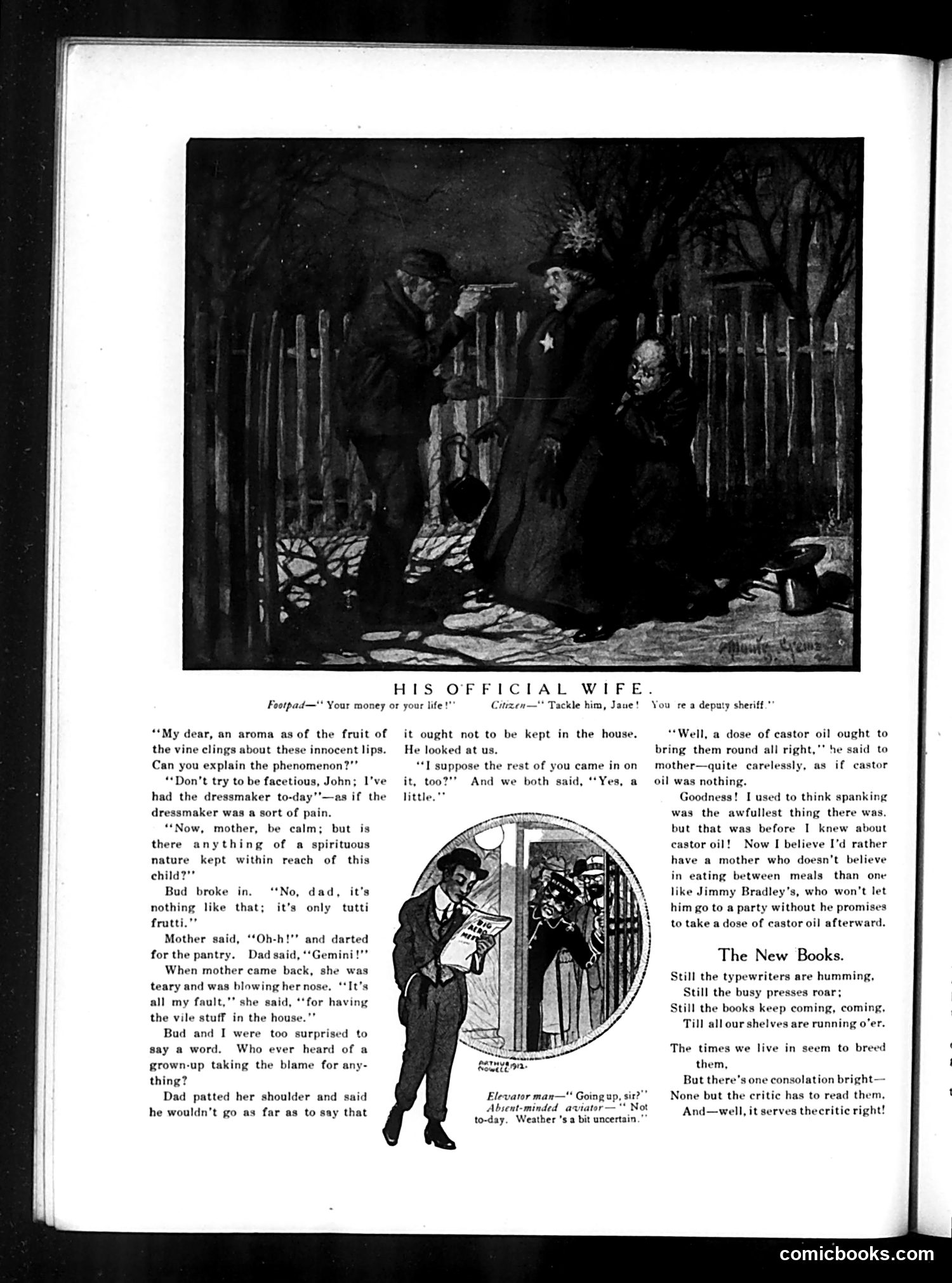
This page satirizes domestic life and parental discipline in early 20th-century America. The main cartoon depicts a family discovery of alcohol in the home, with a father figure confronting the situation. The humor centers on the mother taking unexpected responsibility for keeping liquor in the house—unusual because typically fathers would be blamed for such "vices." The accompanying text story describes a child character ("Bud") and how the family discusses castor oil as punishment, contrasting it with spanking. The satire mocks how parents administered harsh remedies and the child's growing preference for permissiveness over traditional discipline. The lower section, "The New Books," satirizes the publishing industry's output, joking that only professional critics must endure reading the flood of new publications—a humorous jab at both prolific authors and literary gatekeepers of the era.
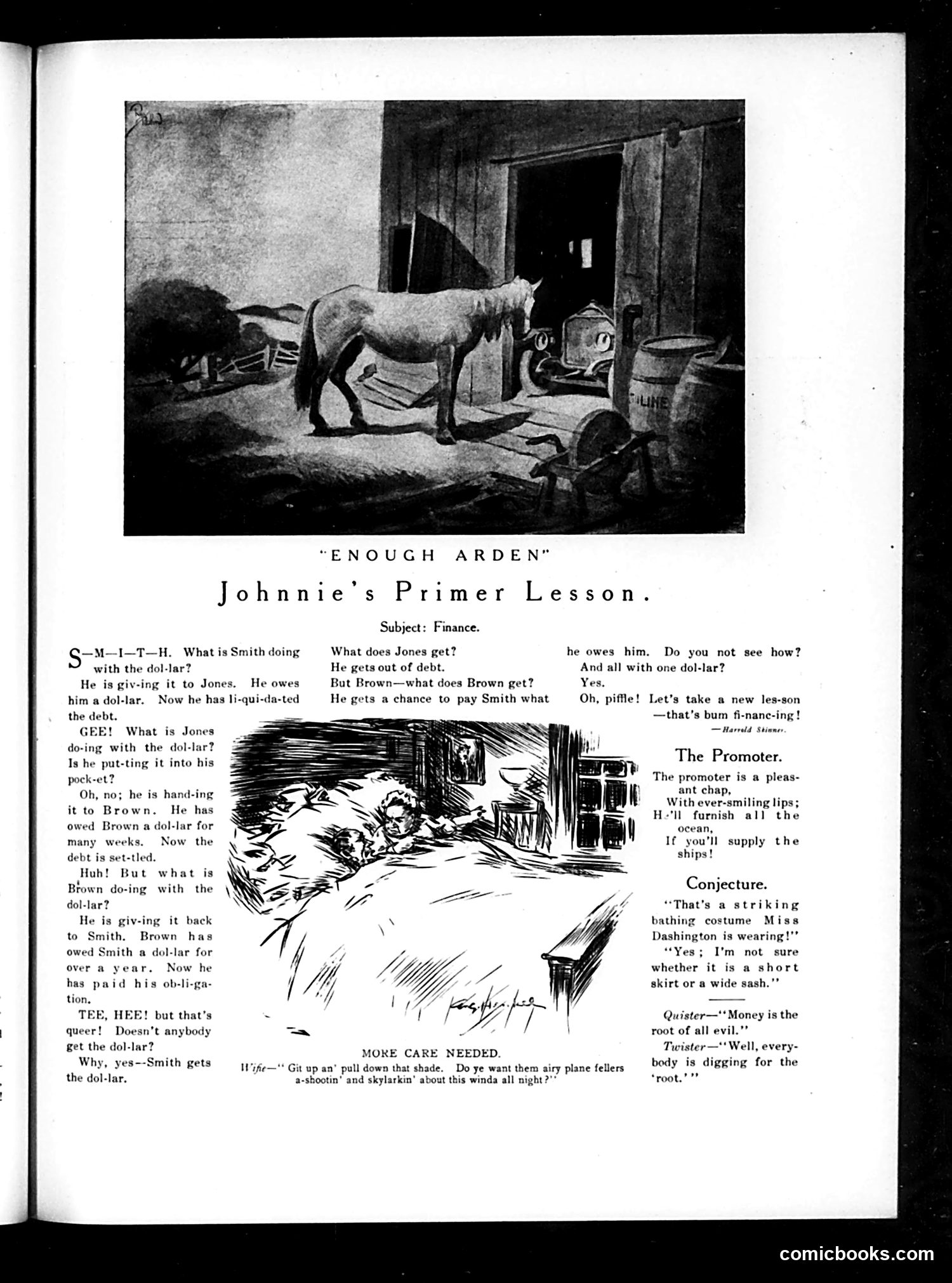
This page satirizes financial mismanagement and circular debt through a children's primer format. Smith lends a dollar to Jones, who pays Brown, who repays Smith—the dollar circulates without actually resolving debt or creating real value. The joke: "Doesn't anybody get the dollar?" highlights how money can move repeatedly without anyone actually gaining. The satire critiques inefficient financial practices, possibly referencing post-WWI economic confusion or general financial irresponsibility. Supporting vignettes mock questionable ventures ("The Promoter" offering dubious ocean schemes) and trivial concerns (debating women's fashion). The bottom illustration, "More Care Needed," shows a horse eating from a window—likely commenting on wasteful or careless behavior during resource scarcity. The overall message: financial sophistication requires more than shuffling money around without tangible results.
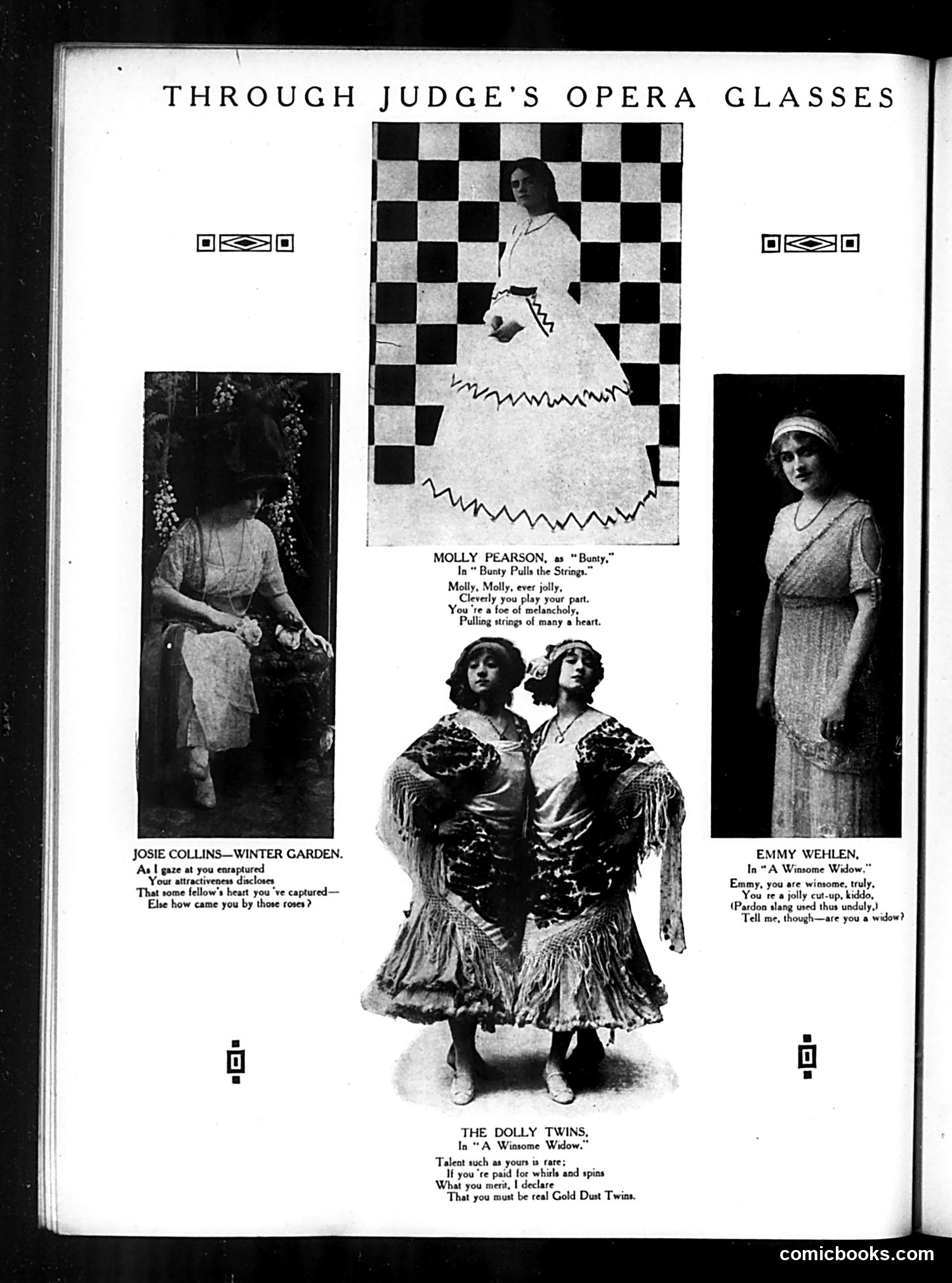
This page showcases theatrical performers of the era through a feature called "Opera Glasses"—a humorous review of stage talent. Four performers are spotlighted with their stage roles and accompanying witty verses: **Molly Pearson** in "Bunty Pulls the Strings" is praised for her cheerful performance and romantic appeal. **Josie Collins** at the Winter Garden is teased about the roses she's received, implying male admirers. **The Dolly Twins** in "A Winsome Widow" are complimented on their rare talent, with a pun comparing them to Gold Dust cleaning product twins (a popular advertising campaign). **Emmy Wehlen**, also in "A Winsome Widow," receives similar praise while the critic playfully questions whether she's genuinely a widow as her character suggests. The satire is gentle—playful observation of stage performers' attractiveness and talent rather than harsh criticism. This reflects Judge magazine's focus on entertainment-world gossip and light social commentary.
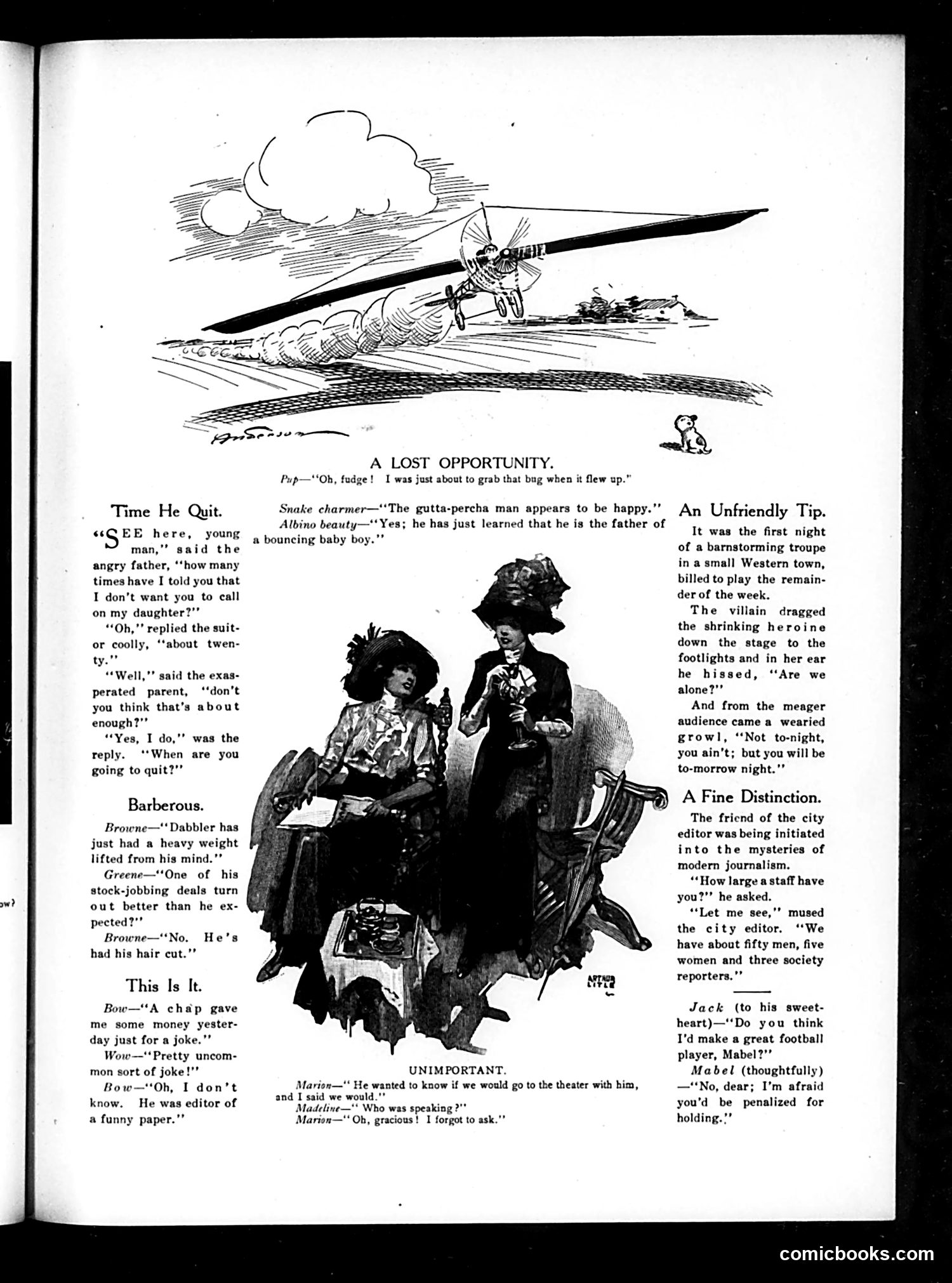
This page contains multiple brief satirical jokes typical of early 20th-century humor magazines: **Top cartoon**: A dog watches an airplane pass overhead, lamenting a missed opportunity to catch a bug. The joke plays on the dog's inability to compete with modern aviation technology. **Other jokes mock**: - An overeager suitor repeatedly calling on his girlfriend despite the father's warnings - A barber's services as mental relief from stock-market anxieties - A newspaper editor's casual money-giving as a "joke" befitting his profession - A theatrical company's poor attendance in a small Western town - A newspaper's distinction between "staff" and "society reporters" (implying society reporters weren't serious journalists) - A football joke about "holding" penalties, playing on double meaning (romantic holding vs. sports violation) The humor reflects period attitudes: class consciousness, skepticism toward journalism, rural/urban divides, and gender stereotypes. Most jokes rely on wordplay or social observation rather than visual comedy.
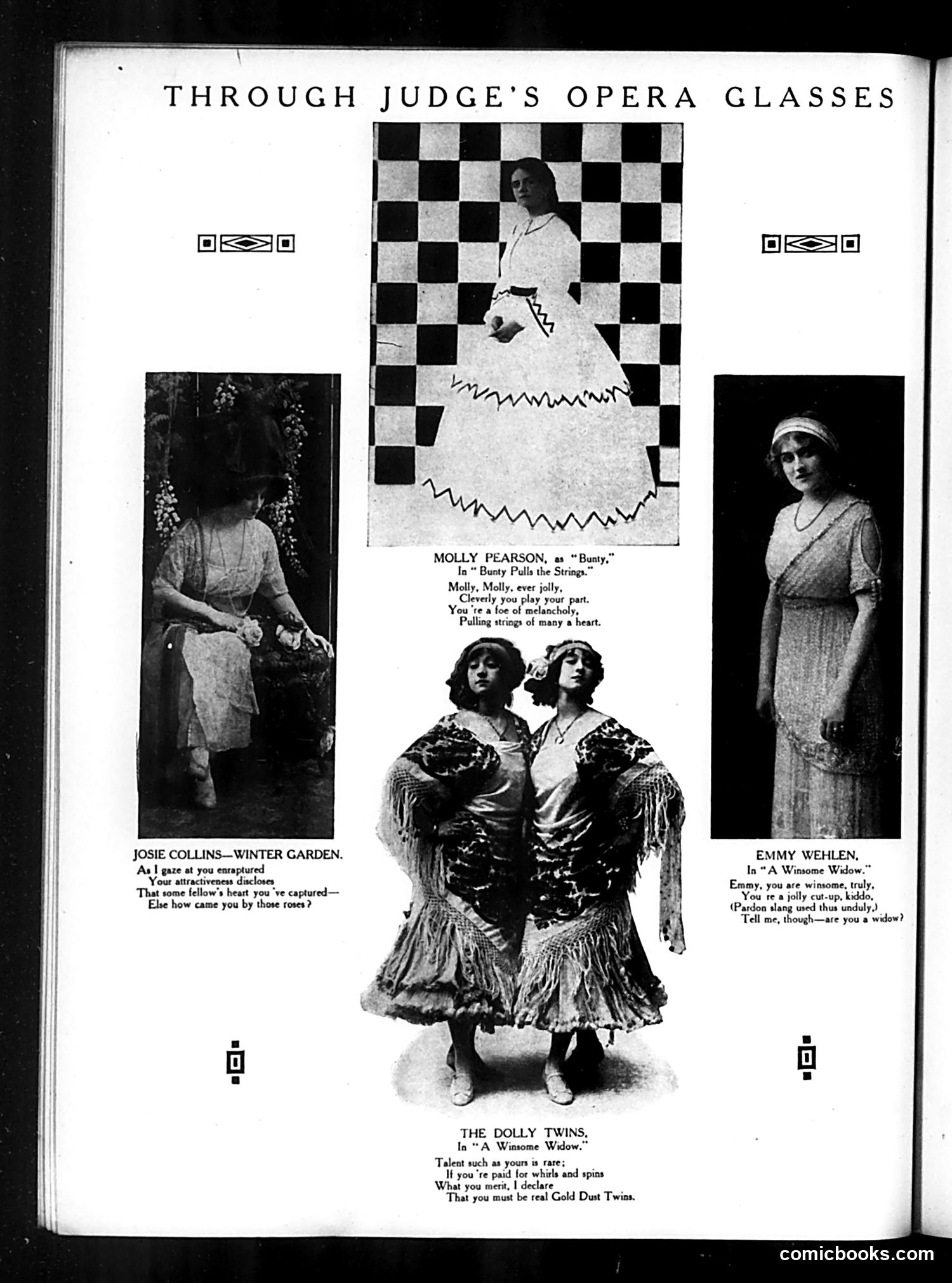
This page features theatrical reviews written as lighthearted verse about Broadway performers and productions. The title references opera glasses—binoculars used by theater patrons—a metaphor for critical examination. The page reviews four actresses: Molly Pearson (in "Bunty Pulls the Strings"), Josie Collins ("Winter Garden"), Emmy Wehlen (in "A Winsome Widow"), and the Dolly Twins (also in "A Winsome Widow"). Each review is a brief poem offering compliments wrapped in theatrical wit. The jokes are gentle: admiring Pearson's cheerfulness, romanticizing Collins's beauty, playfully asking Wehlen if she's actually a widow, and comparing the Dolly Twins to "Gold Dust Twins" (likely a contemporary advertising mascot) based on their energetic dancing. This appears to be typical Judge magazine content—gossipy, affectionate coverage of New York theater rather than hard political satire.
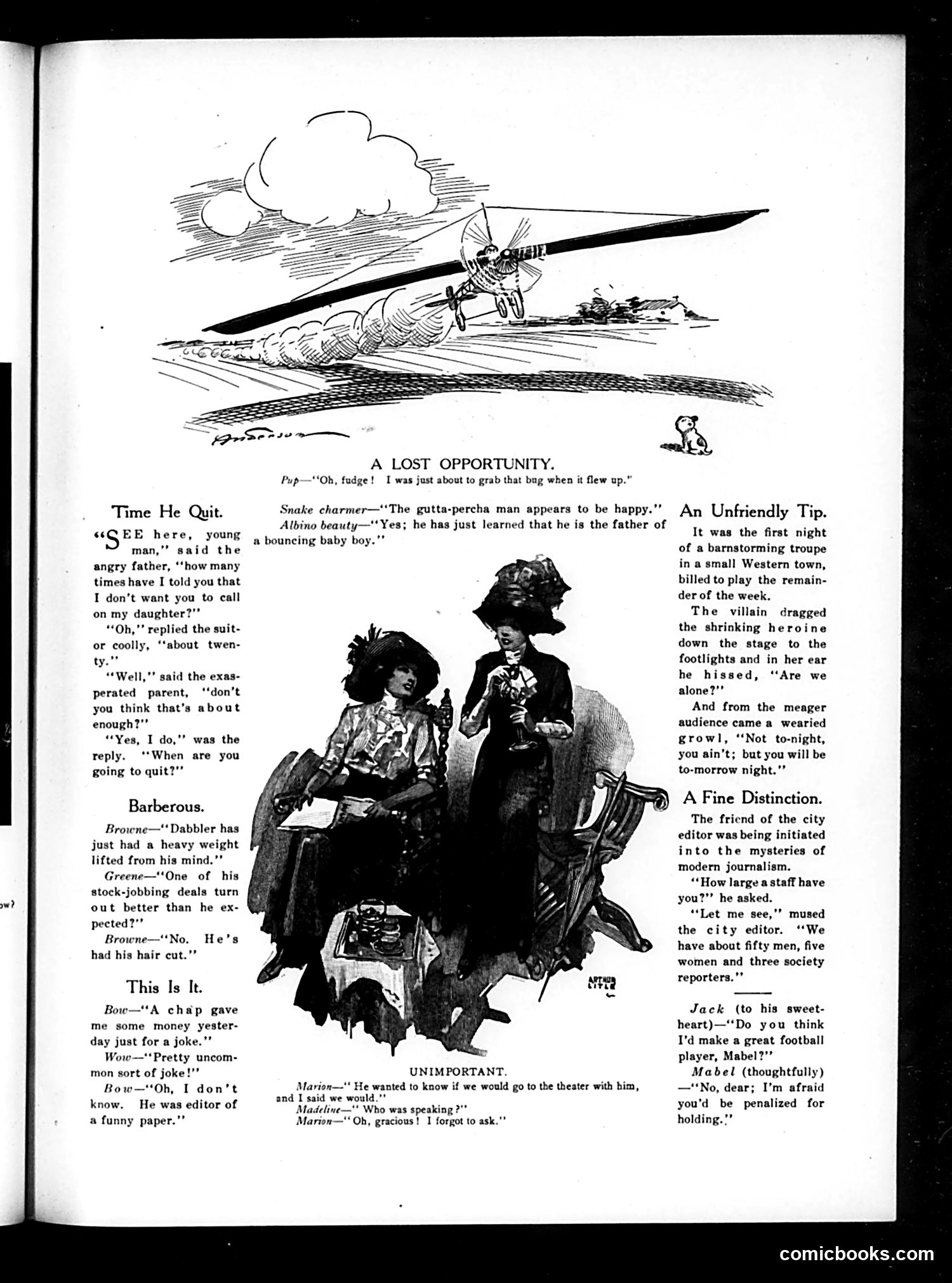
This page contains six separate humor pieces typical of early 20th-century American satirical magazines: **"Time He Quit"** mocks persistent courtship—a young man has called on a girl despite her father's repeated objections, treating parental disapproval as merely a running joke. **"Barberous"** is a pun: a man feels relieved after a haircut, with his friend misinterpreting the relief as financial (from a successful stock deal). **"This Is It"** jokes about editors of humor magazines being stingy—someone giving money "as a joke" is unusual because editors don't typically give anything away. **"A Lost Opportunity"** (top cartoon) shows a dog missing a chance to catch a flying bag, with wordplay about a "gutta-percha man" (rubber man) celebrating fatherhood. **"An Unfriendly Tip"** satirizes small-town theater: a melodramatic villain's seduction scene is interrupted by an audience member heckling that the show will have better attendance tomorrow night. **"A Fine Distinction"** is editorial satire—a newspaper employs many male reporters but categorizes female staff separately as "society reporters," treating them as a distinct, lesser category.
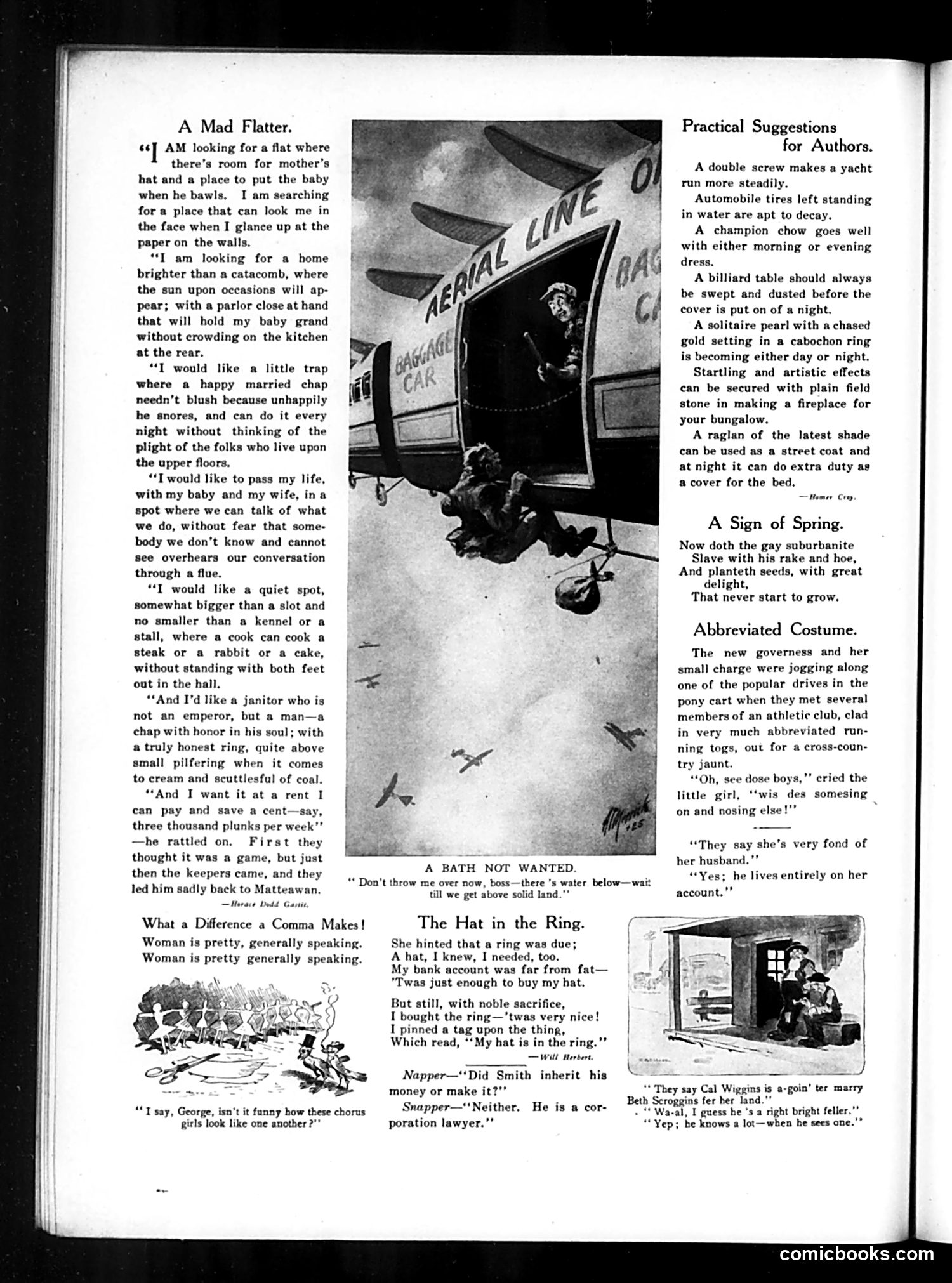
This page from the satirical magazine **Judge** contains several humor pieces mocking early 20th-century urban and social anxieties: **"A Mad Flatter"** (top left): A man rants absurdly about apartment hunting, demanding impossible luxuries—space for a baby grand piano without crowding the kitchen, soundproofing so neighbors can't hear him snore, an honest janitor—all for an absurdly low rent. He's eventually taken to "Matteawan" (a mental institution), suggesting his demands are unrealistic fantasies. The satire targets both unrealistic renters and cramped urban apartment living. **"The Hat in the Ring"** (center): A man buys an engagement ring but can't afford a hat, so he gives the ring with a tag saying "My hat is in the ring"—a crude joke playing on the phrase meaning "to enter a competition." **"A Bath Not Wanted"** (bottom): A cartoon showing a man clinging to a boat, refusing to jump into water below. The remaining items are brief humorous anecdotes and puns about grammar, social observations, and romantic/financial misadventures typical of Judge's light satirical tone.
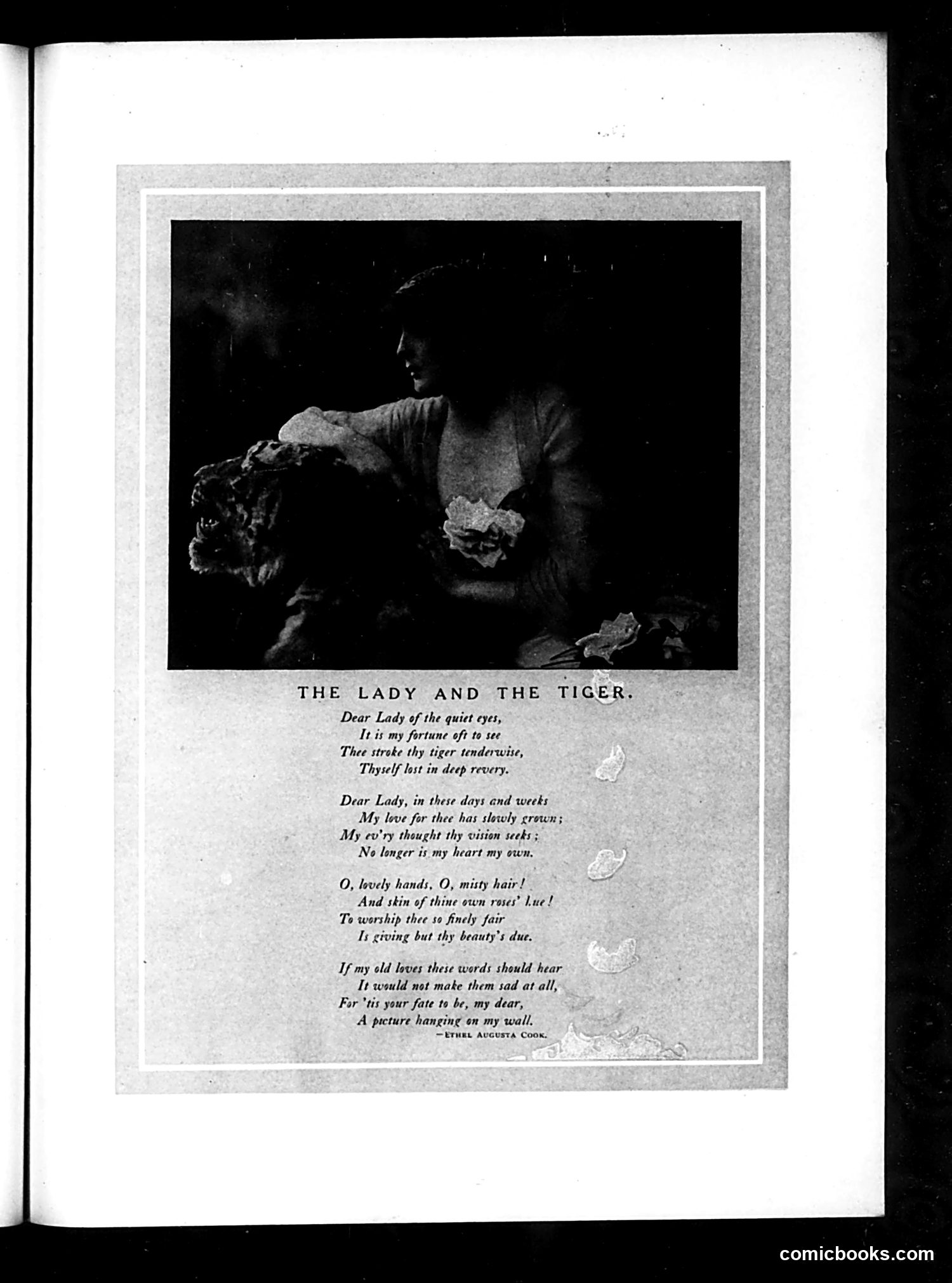
This is a romantic poem by Ethel Augusta Cook accompanying a photograph or illustration of a woman posing with a tiger. The image appears to be a theatrical or artistic photograph—likely from a stage production or artistic composition popular in the late 19th/early 20th century. The poem's satire lies in its final stanza: the speaker confesses that despite his romantic declarations, the "lady" is merely "a picture hanging on my wall"—she exists only as an artwork or photograph, not a real person. The earlier lovers need not worry because the current "love" is literally inanimate. This mocks sentimental Victorian romance poetry and male sentimentality toward unattainable women, while also commenting on how such exotic theatrical imagery (woman with tiger) was consumed as decorative art rather than representing genuine human connection. The joke is the speaker's eventual admission that his "love" is literally two-dimensional.
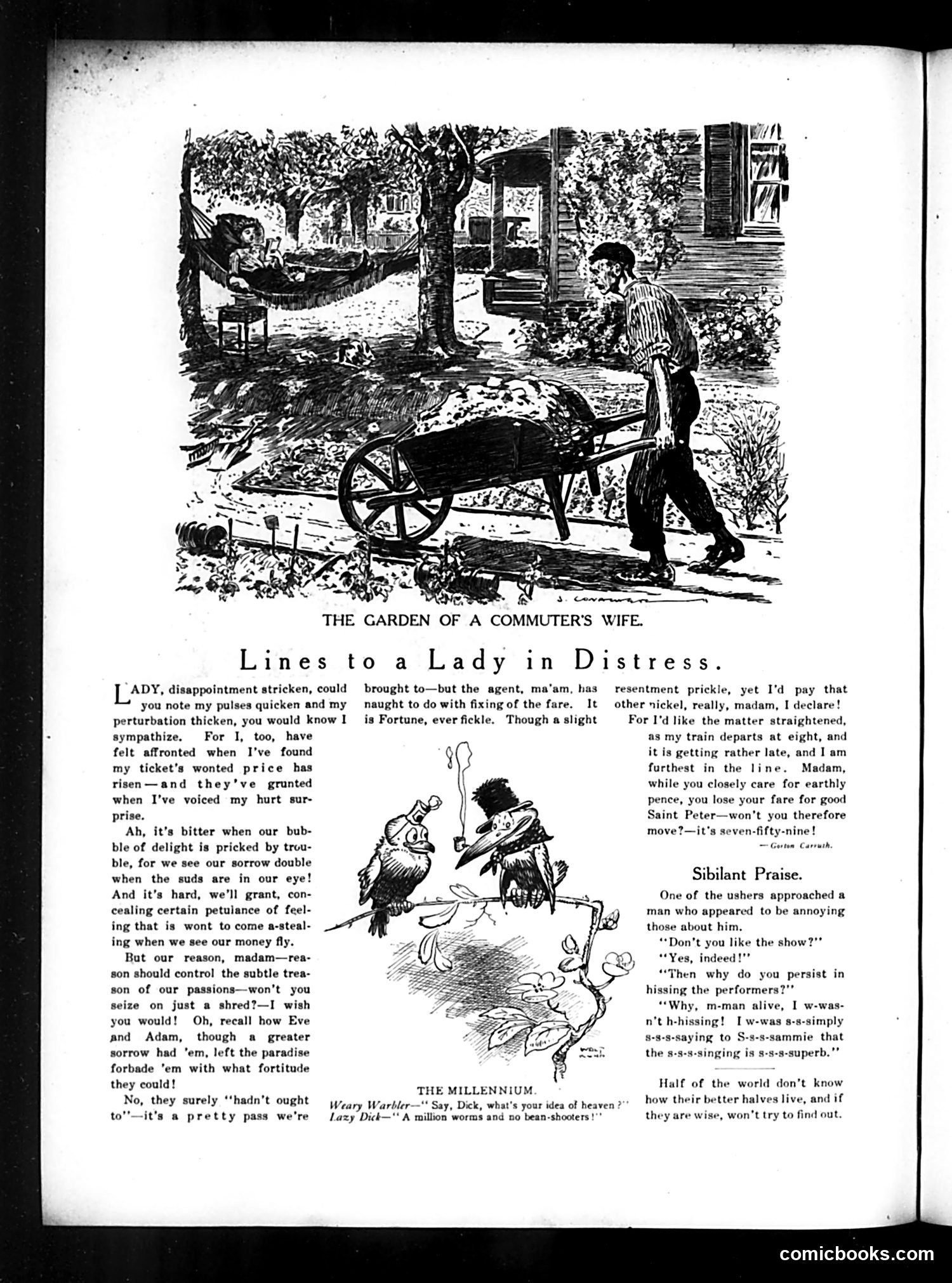
This page satirizes the frustrations of commuter rail travel in early 20th-century America. A woman complains to a conductor that a fare increase has disrupted her day—the joke being her disproportionate emotional distress over a minor cost. The male responder (likely the conductor) sympathizes but urges her to maintain composure, invoking Adam and Eve's acceptance of hardship as moral example. The satirical point: the absurdity of a middle-class commuter's wife being emotionally devastated by a small fare hike, elevated to biblical proportions. The illustration shows her abandoning her gardening duties (hence "The Garden of a Commuter's Wife") in distress. Below are two unrelated humorous anecdotes—one about an enthusiastic theater-goer whose hissing is actually praise (verbal stammering making "s-s-singing" sound like hissing), and one about worms preferring heaven without bean-shooters. These are typical magazine filler jokes.
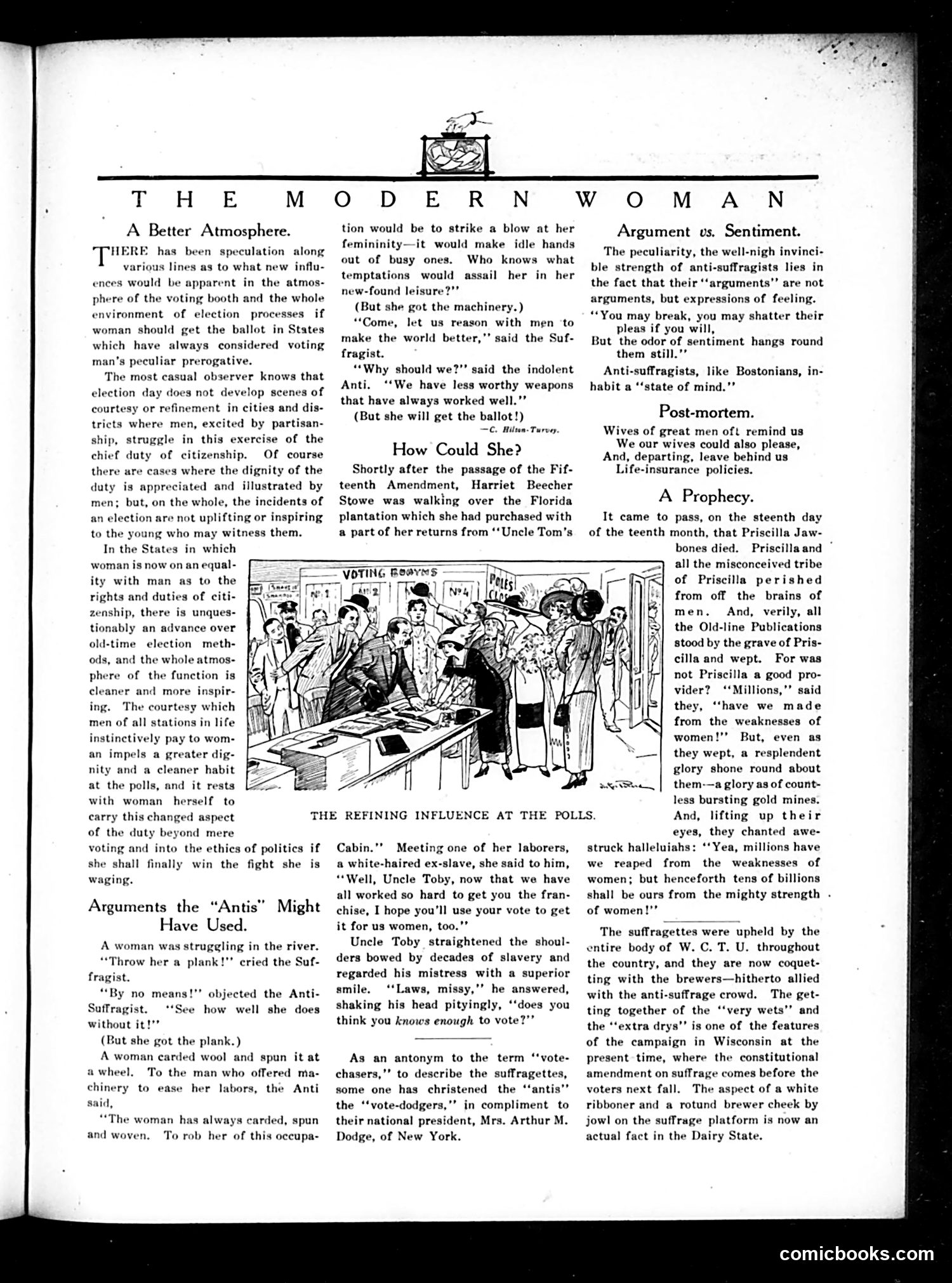
This page argues FOR women's suffrage through satirical rebuttals of anti-suffrage arguments. The central cartoon depicts a polling place where women's presence has "refined" the atmosphere—men behave with courtesy and dignity around female voters, contrasting sharply with the rowdy, partisan behavior typical of all-male elections. The text presents three "arguments the 'Antis' might have used" (anti-suffragists)—each following a formula where opponents object to women gaining something (a plank, machinery, the ballot), claiming it would harm femininity or traditional roles, yet women get it anyway. The "How Could She?" anecdote presents the ironic scenario where Harriet Beecher Stowe—author of *Uncle Tom's Cabin*, instrumental in abolishing slavery—asks a freedman to support women's suffrage, only to be told by him that women lack the knowledge to vote. The satire highlights the hypocrisy: if formerly enslaved men deserve voting rights, why not women? The final sections mock anti-suffragists as "vote-dodgers" relying on sentiment rather than logic, unable to construct genuine arguments.
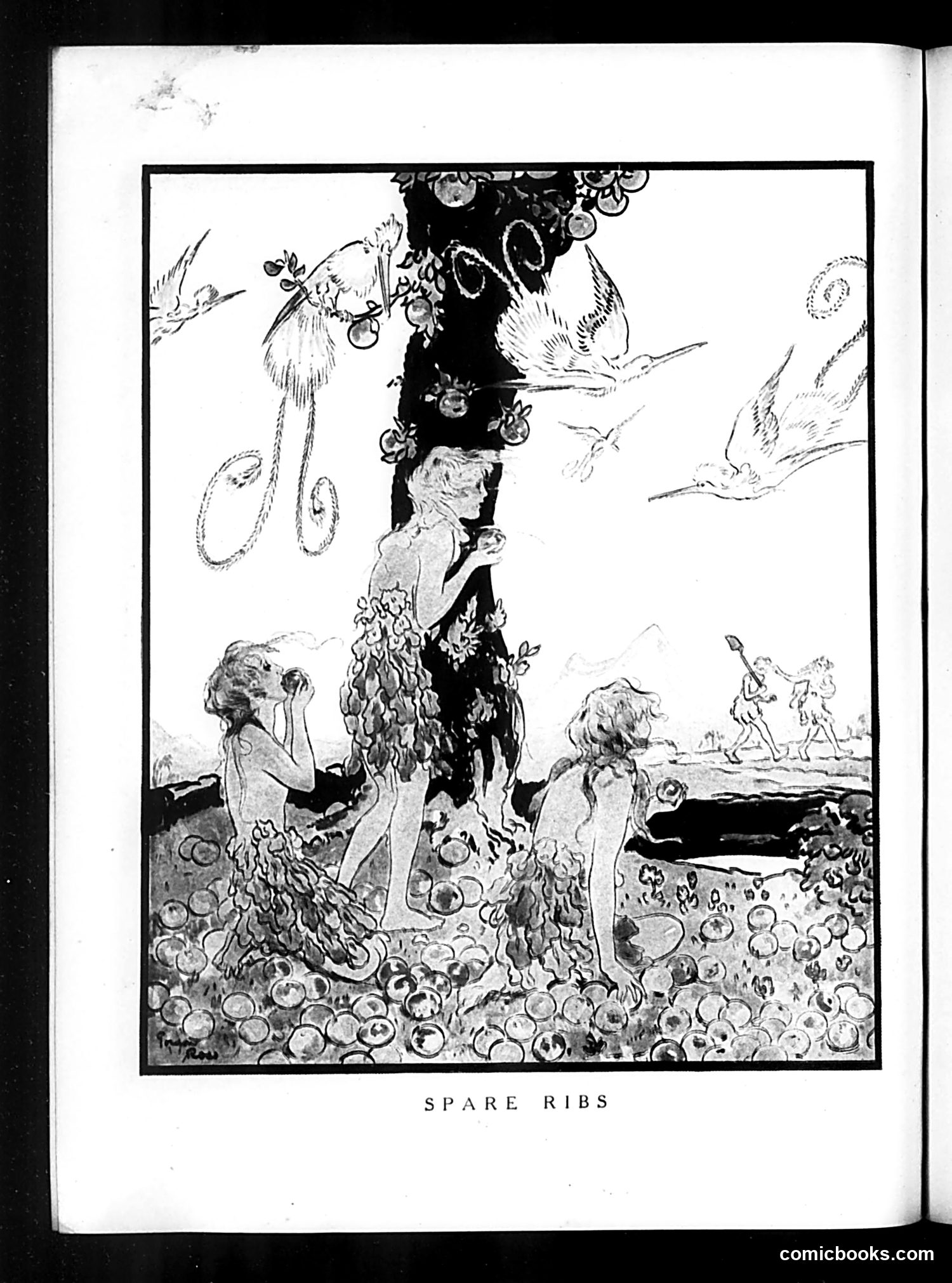
This illustration depicts a biblical allegory—likely referencing the creation of Eve from Adam's rib (Genesis 2:21-22). The image shows three female figures among abundant spherical objects (the "ribs" of the title) in a fantastical landscape, with cherubs and decorative foliage above. The satirical point appears to target either the commodification of women or their artificial creation/manufacture as objects. The title "Spare Ribs" puns on both the biblical narrative and the butcher's term, suggesting women are interchangeable products. The abundance of identical spheres reinforces mass-production imagery. Without additional context about the specific Judge issue date, the precise political target remains unclear, though it likely critiques contemporary attitudes toward women, marriage, or femininity popular in the magazine's era.
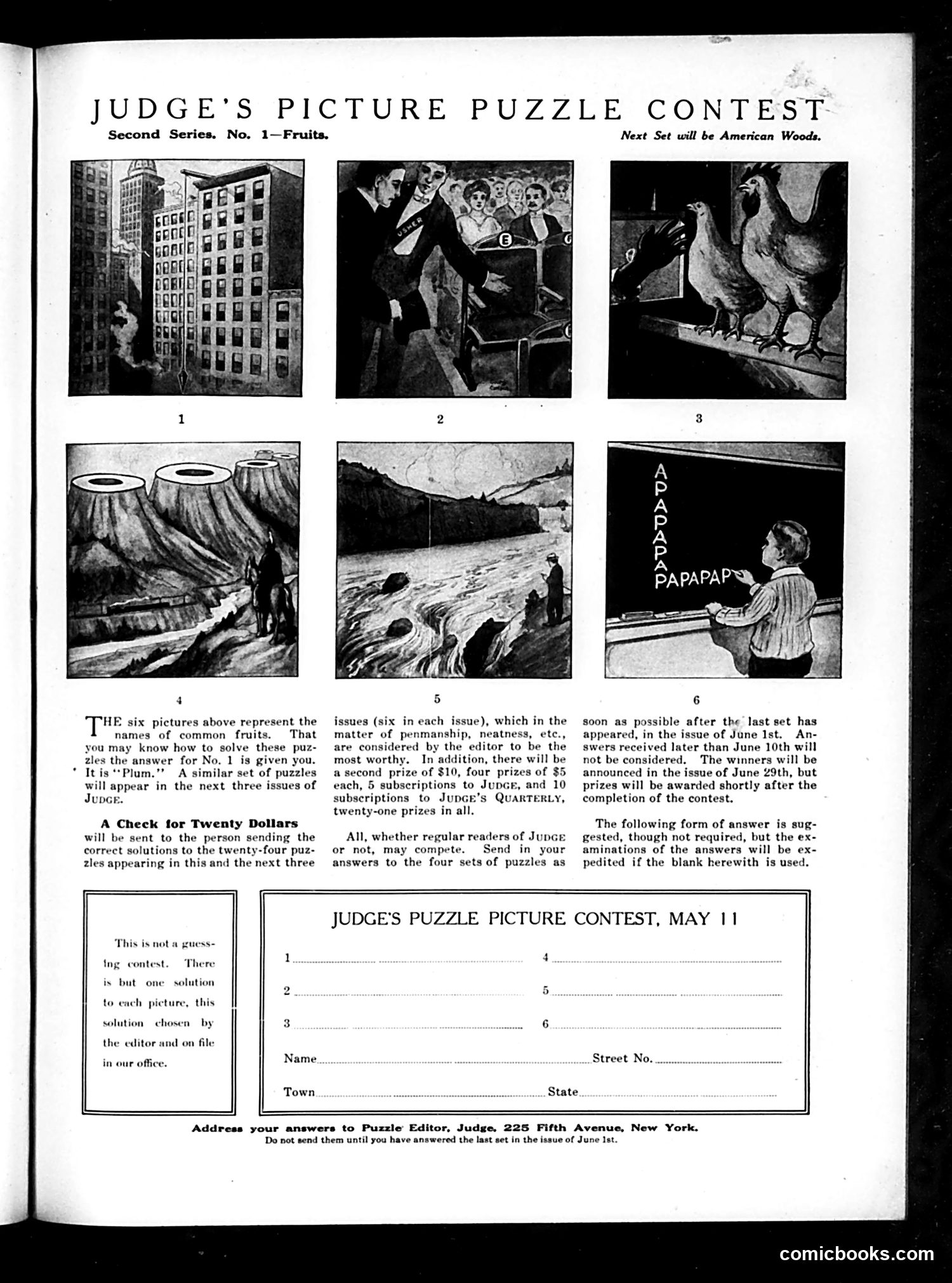
This page announces a four-part puzzle competition in Judge magazine (May 1911). Readers must identify six fruits depicted in cryptic illustrations—picture 1, for example, shows a tall building with a small figure, representing "Plum" (pun: "plumb" = vertical). The contest offers a $20 grand prize for the most neatly-submitted complete solutions across all four sets (24 puzzles total), plus additional monetary prizes and magazine subscriptions. Notably, the contest emphasizes this is "not a guessing contest"—there is one official answer per image, established by the editor beforehand. This reflects early 20th-century magazine culture: puzzles were popular reader engagement tools, and Judge (a satirical weekly) used contests to build subscriber loyalty and encourage careful reading across multiple issues. The emphasis on penmanship and neatness reveals contemporary values about proper presentation.
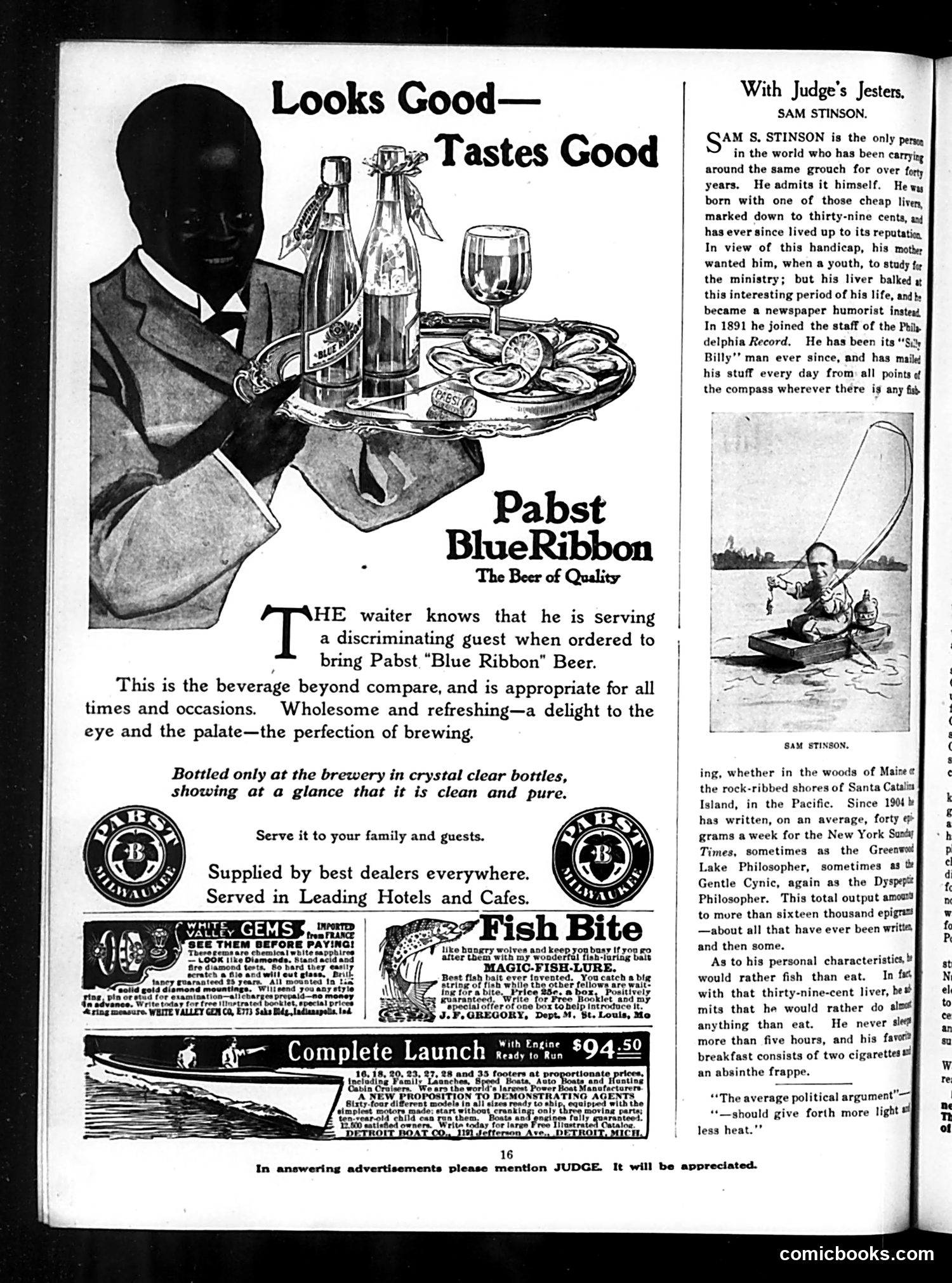
This page is primarily **advertising**, not political satire. The dominant content is a Pabst Blue Ribbon beer advertisement featuring a waiter serving drinks and oysters, with accompanying promotional text about beer quality. The page's satirical content appears in the right column: a profile of **Sam Stinson**, a newspaper humorist who has written a humor column for forty years. The humor derives from his established persona—a perpetually grouchy man with a "cheap liver" (weak constitution) who prefers fishing and cigarettes to eating, and drinks absinthe. His humorous observations on politics and life are presented as typical of his contrarian worldview. The remaining advertisements include fishing lures, jewelry, and boat launches—typical Judge magazine content mixing commercial promotion with light humor. No specific political figures or events are referenced; this represents Judge's standard format of advertising interspersed with personality profiles and product humor.
This piece satirizes the **Populist Party** (the "Pops") through a story set during Kansas's contentious early politics. Former sheriff Rufe Cone, summoned before a Populist convention, storms in defiant, announcing he's abandoned politics for the laundry business—then insults the Populists by saying he doesn't expect them to send him washing since "you don't have none done!" The joke mocks Populists as poor, lazy, or incompetent—implying they lack the resources or respectability to patronize a laundry. The phrase "Bleeding Kansas" references the violent 1850s territorial conflict over slavery, suggesting Judge views contemporary Populism as similarly chaotic or disruptive to Kansas society. The accompanying sections—"Destiny's Grim Humor" (about Major Butt and the Titanic) and various advertisements—fill the remainder of the page.
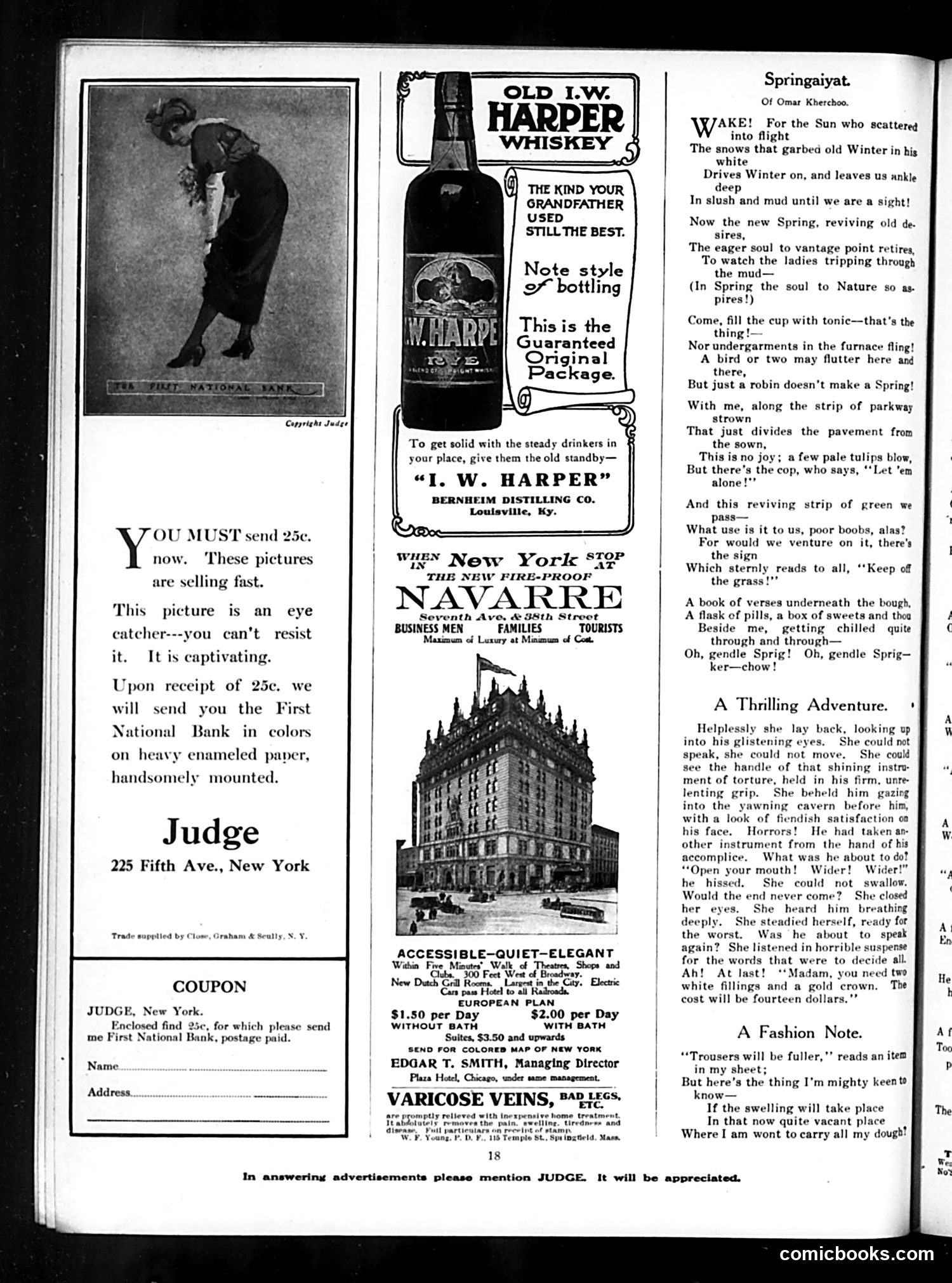
This page is primarily **advertisements and filler content** rather than political satire. The left side features a mail-order promotion for "First National Bank" pictures (25 cents), showing what appears to be a photograph of a person in formal dress—typical of Judge's revenue-generating schemes. The poetry piece "Springaiyat" (a parody of Omar Khayyam's "Rubaiyat") satirizes **spring in urban America**: the season brings mud, overcrowded parks with "Keep off the grass" signs, and commercialized romance (pills, sweets, dentist visits). The cop keeping people off grass is a mild jab at **urban restrictions on public enjoyment**. The remaining content consists entirely of period advertisements: I.W. Harper Whiskey, the Navarre Hotel, and varicose vein treatments. One brief story, "A Thrilling Adventure," offers pulp-fiction parody—the "torture" and "fiendish grip" turn out to be a dentist's visit, mocking melodramatic magazine fiction. Overall: a typical Judge issue mixing light humor with commercials.
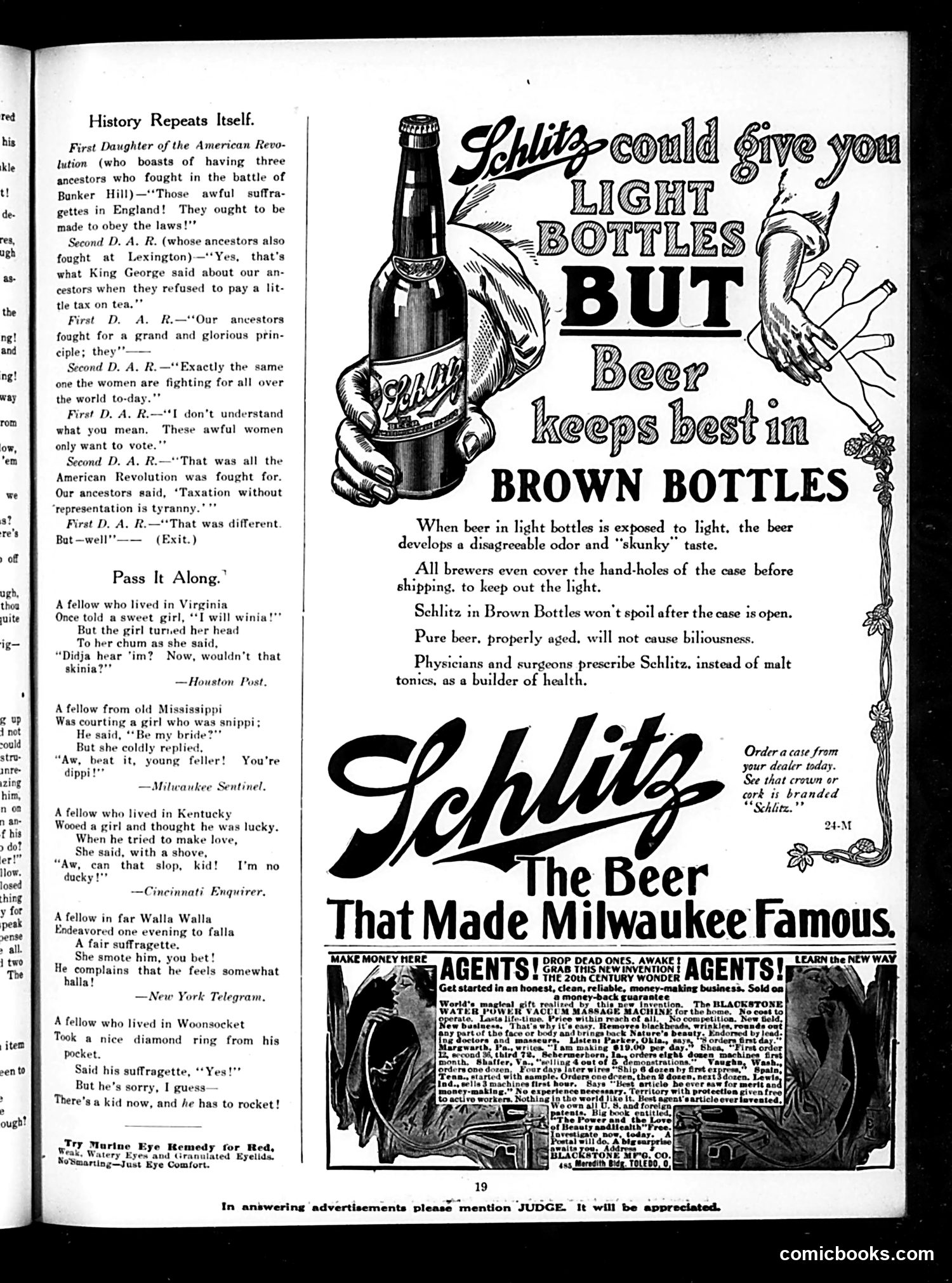
This page contains a **political cartoon satirizing women's suffrage** alongside a **beer advertisement**. The cartoon "History Repeats Itself" features two Daughters of the American Revolution (D.A.R.) debating. The first D.A.R. condemns English suffragettes as lawbreakers, while the second points out the historical irony: American Revolutionary ancestors also defied laws (refusing taxes) for representation. The punchline equates women's fight for voting rights to the original American Revolution's core principle—"taxation without representation is tyranny." The satire mocks anti-suffrage women who proudly claim Revolutionary ancestry while opposing the same democratic principles their ancestors fought for. The remainder of the page features **humorous anecdotes** about courtship rejections and a **Schlitz beer advertisement** emphasizing that brown bottles protect beer from light exposure, which causes unpleasant flavor.
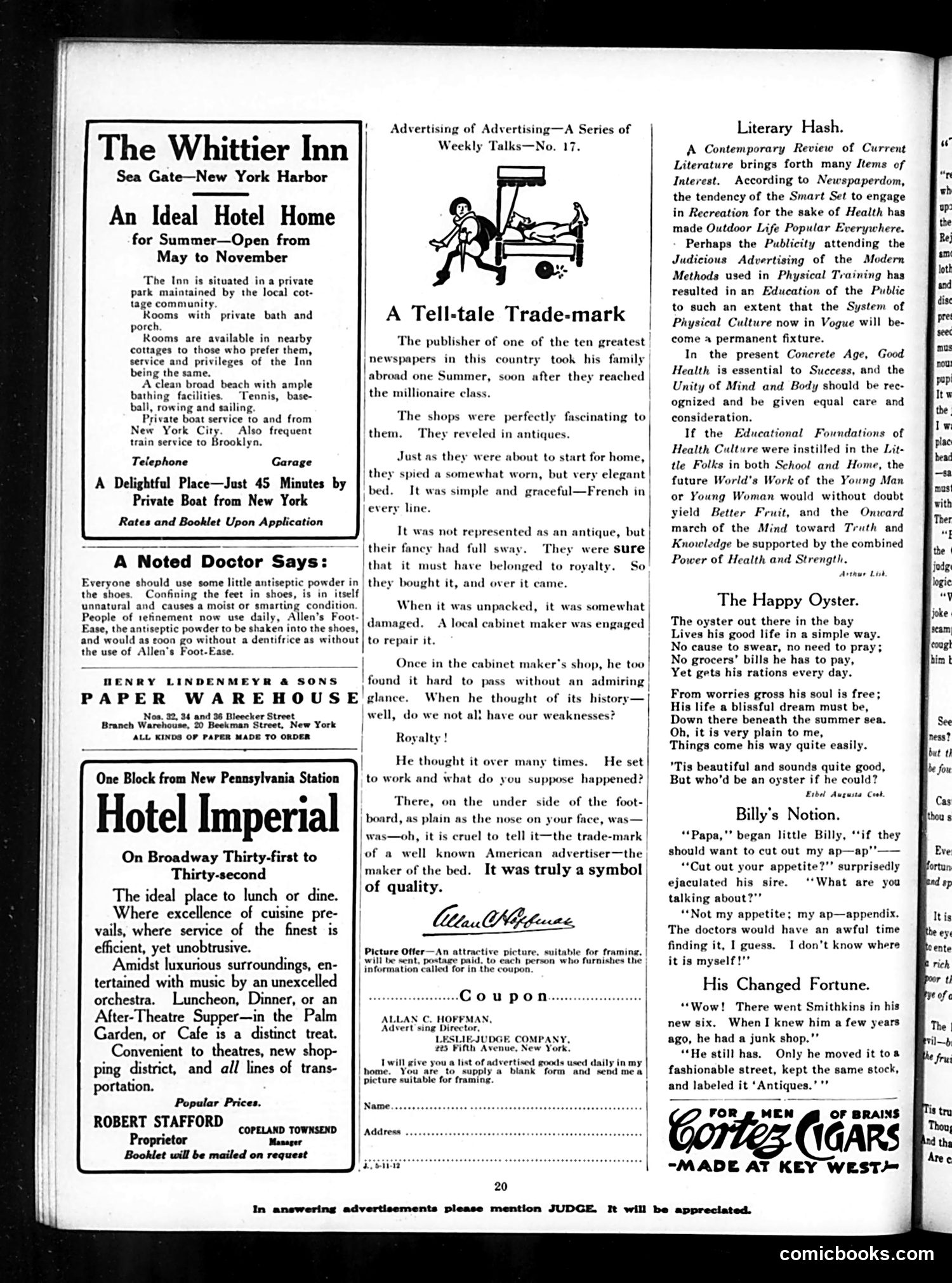
This satirical piece mocks American advertising's omnipresence and aggressive marketing tactics. A wealthy newspaper publisher's family purchases what they believe is a royal French antique bed while vacationing abroad. Upon unpacking, a furniture maker discovers a manufacturer's trade-mark stamped on the underside—revealing it's actually a mass-produced American bed, not a European luxury item. The satire targets two things: (1) consumers' snobbish desire for imported "prestige" goods and (2) American advertisers' relentless branding of products, even on hidden surfaces. The irony is that superior American manufacturing—represented by "a well known American advertiser"—undercuts the very European pretension the buyers sought. It's commentary on how advertising has become inescapable and how brand-consciousness shapes consumer desires, even when purchasing supposedly authentic antiques.
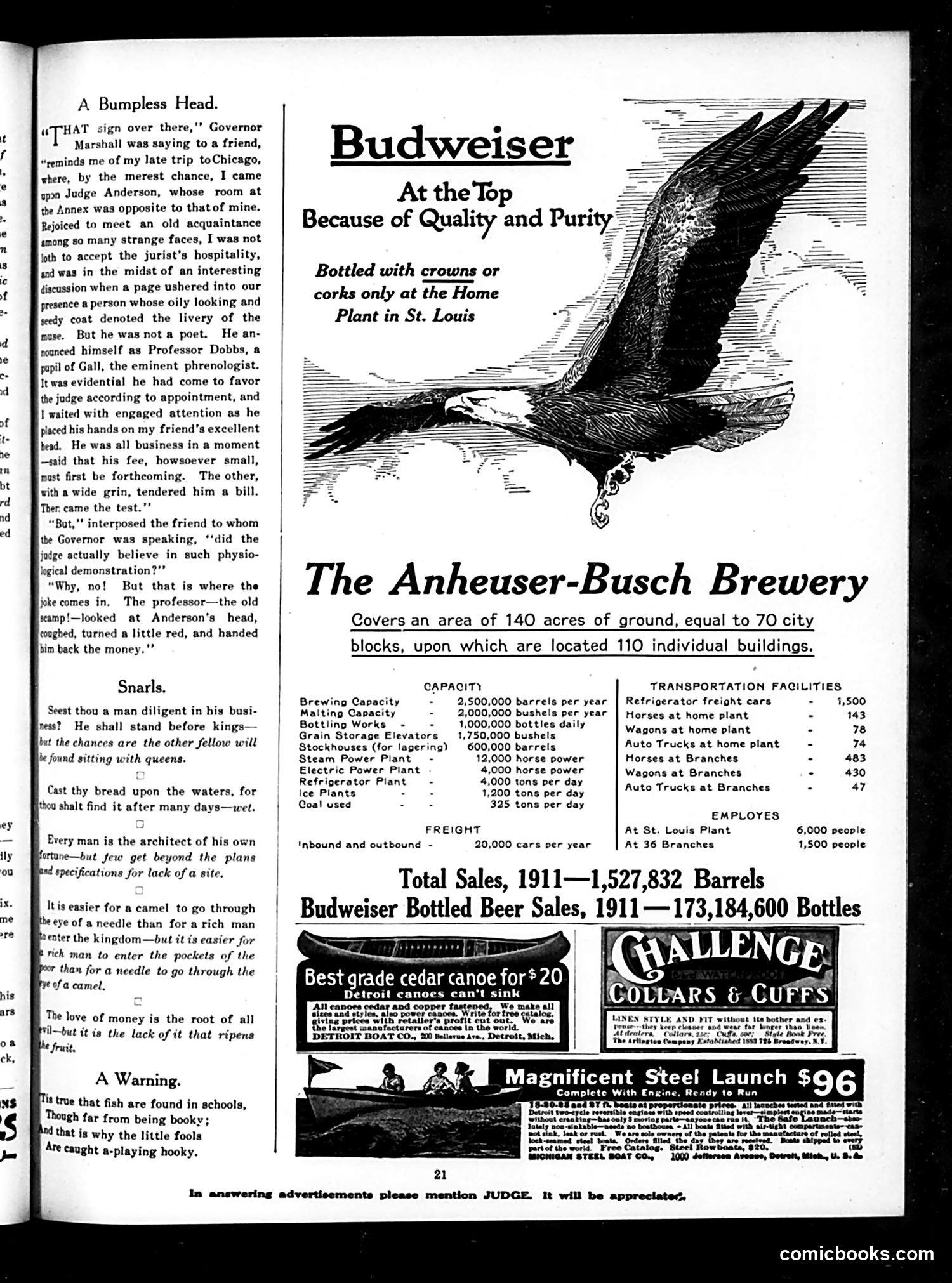
This page is primarily **advertising** for Budweiser and other products, but opens with a short satirical story titled "A Bumpless Head." The story mocks **phrenology**—a pseudoscience claiming skull shape revealed character and intelligence. Governor Marshall recounts meeting Judge Anderson in Chicago, who hired Professor Dobbs (a phrenologist and student of Gall, the "eminent" phrenologist) to read his head. The phrenologist examined the judge's skull, then awkwardly refused to speak, returning the payment instead. **The joke**: The phrenologist found nothing worth commenting on—implying the judge's skull/intellect was unremarkable or "bumpless" (lacking the supposedly meaningful protrusions phrenology claimed to read). It's gentle ridicule of both phrenology's absurdity and the judge's wit in exposing the fraud by paying upfront, forcing the charlatan to either admit his method failed or admit he was a con artist. The remainder consists of **full-page Budweiser advertising** showcasing brewery capacity and employment statistics.
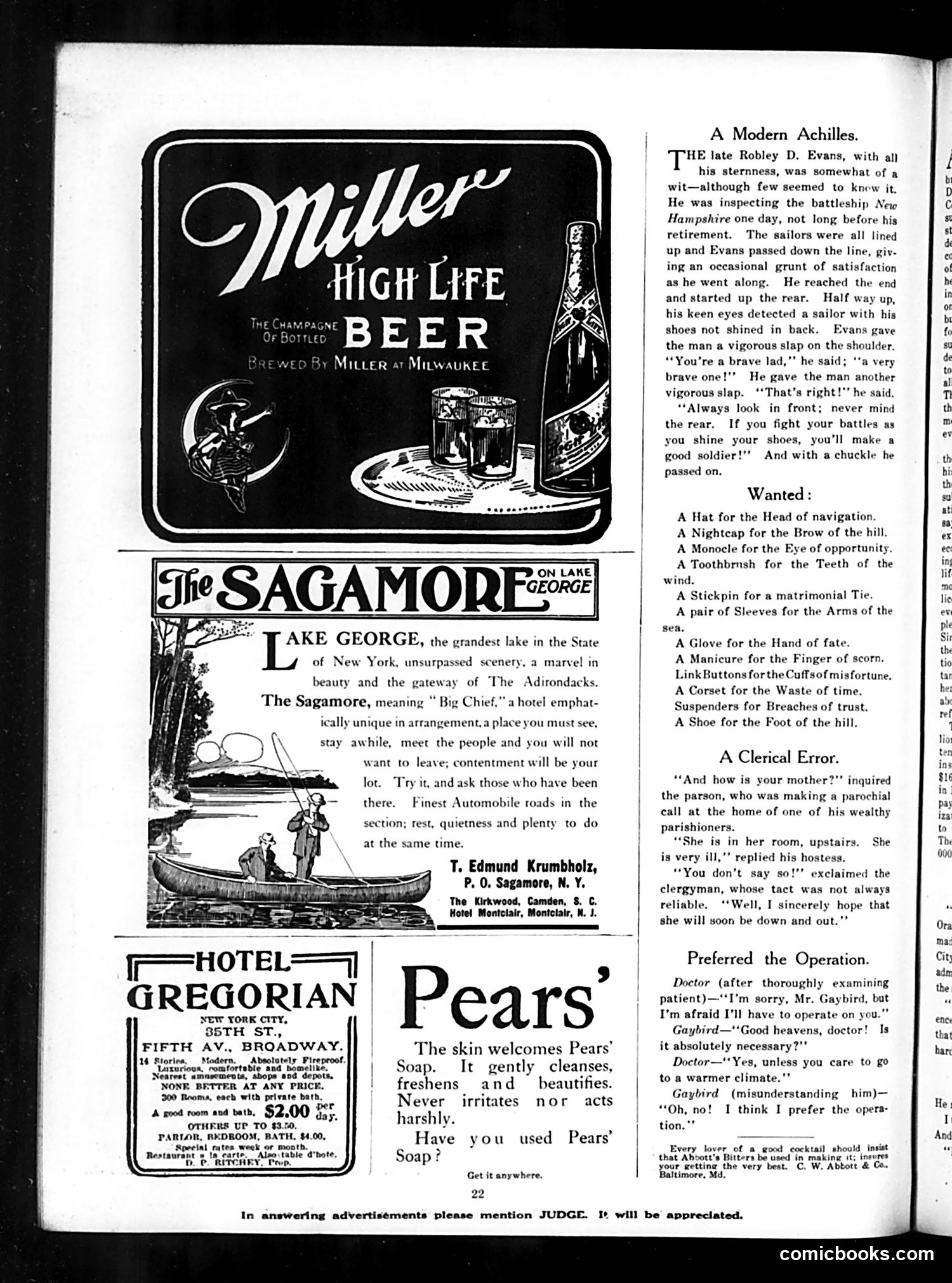
This page is primarily **advertisements and humor pieces** rather than political satire. The main content includes: **Advertisements:** Miller High Life beer, The Sagamore hotel on Lake George, Hotel Gregorian in New York, and Pears' Soap dominate the layout. **Humor pieces:** - "A Modern Achilles" describes Admiral Robley D. Evans (a real historical naval officer) inspecting a battleship and praising a sailor with unshined shoes for his "bravery"—a joke about Evans's dry wit and the sailor's confused obedience. - "Wanted" is a surrealist word-play list (a "Hat for the Head of navigation," etc.)—contemporary absurdist humor. - "A Clerical Error" is a pun: a clergyman hoping a sick woman gets "down and out" (meaning better), misunderstood literally. - "Preferred the Operation" relies on a double entendre about "warmer climate." The page reflects early 20th-century Judge magazine's mix of light advertising and genteel wordplay humor rather than sharp political commentary.
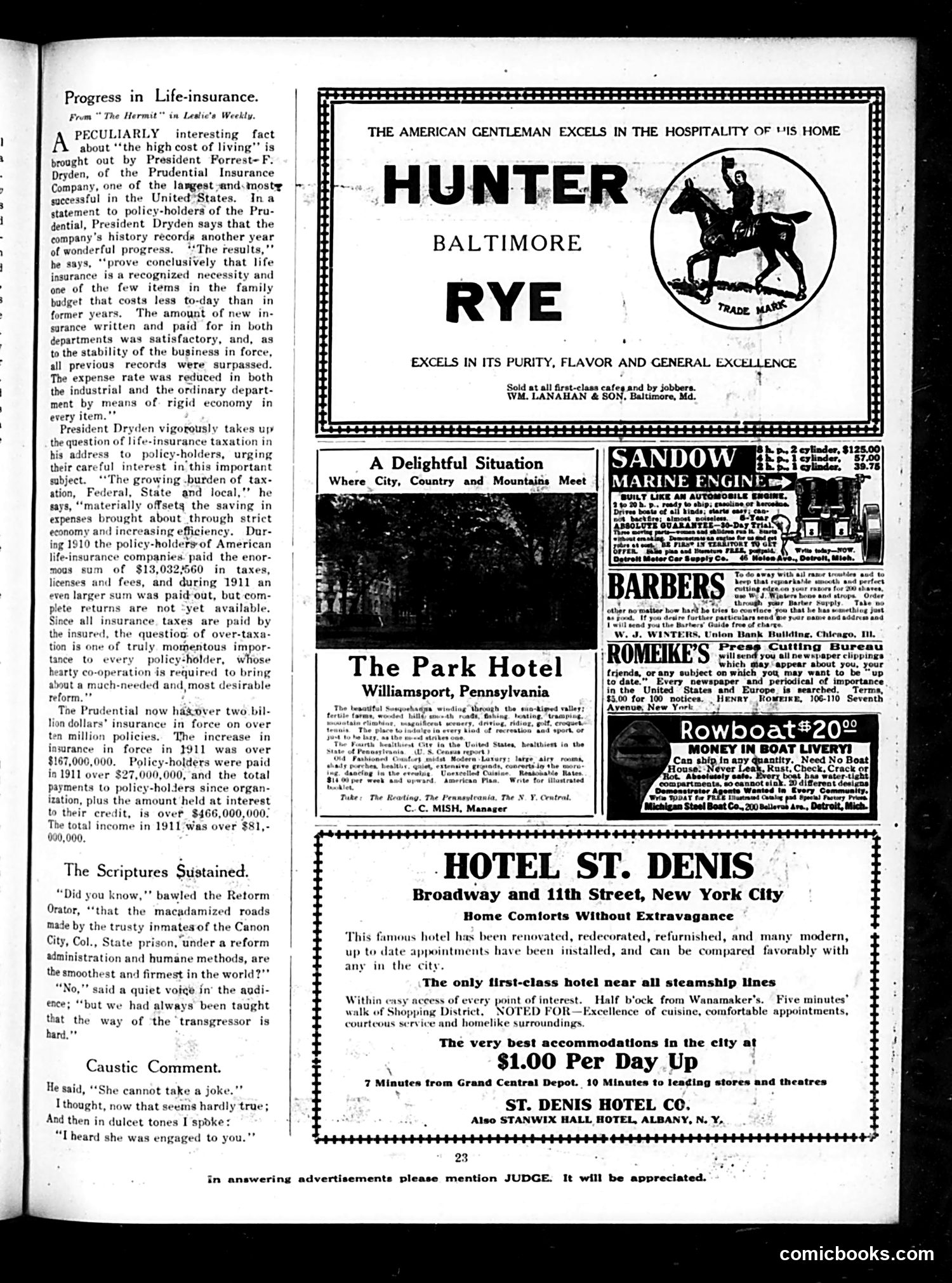
This page is primarily **advertisements and filler content** rather than political satire. The main article discusses life insurance progress at the Prudential Insurance Company under President Forrest F. Dryden, noting that insurance costs less than before despite rising taxes—a counterintuitive point about the "high cost of living." The page includes several hotel and product advertisements (Hunter Rye whiskey, Park Hotel, Hotel St. Denis, Sandow Marine Engine, etc.) typical of early 1910s magazines. At bottom left are brief humorous items: "The Scriptures Sustained" (a joke about prison reform) and "Caustic Comment" (a short joke about someone unable to take criticism). These are minor filler jokes, not political cartoons. **No significant political or social satire is present.** The insurance article is straightforward business reporting praising Prudential's efficiency and cost-effectiveness, framed as consumer-friendly news rather than critique.
This appears to be a **title page or advertisement** for Pall Mall cigarettes, rather than a political cartoon or satirical content. The page features the Pall Mall branding at top, an ornate coat of arms (likely representing the brand's prestigious positioning), and an illustration of an open cigarette package at bottom left. The design emphasizes luxury and formality through heraldic imagery, which was typical early 20th-century marketing strategy—associating consumer products with aristocratic legitimacy and refinement. The "Famous Cigarettes" descriptor suggests brand reputation-building. This is essentially **commercial content**, not satirical editorial material, though it appears within Judge magazine's pages. It represents how magazines subsidized themselves through such advertising.