
Judge, 1912-05-11 · page 4 of 26
Judge — May 11, 1912 — page 4: what you’re looking at
What you’re looking at
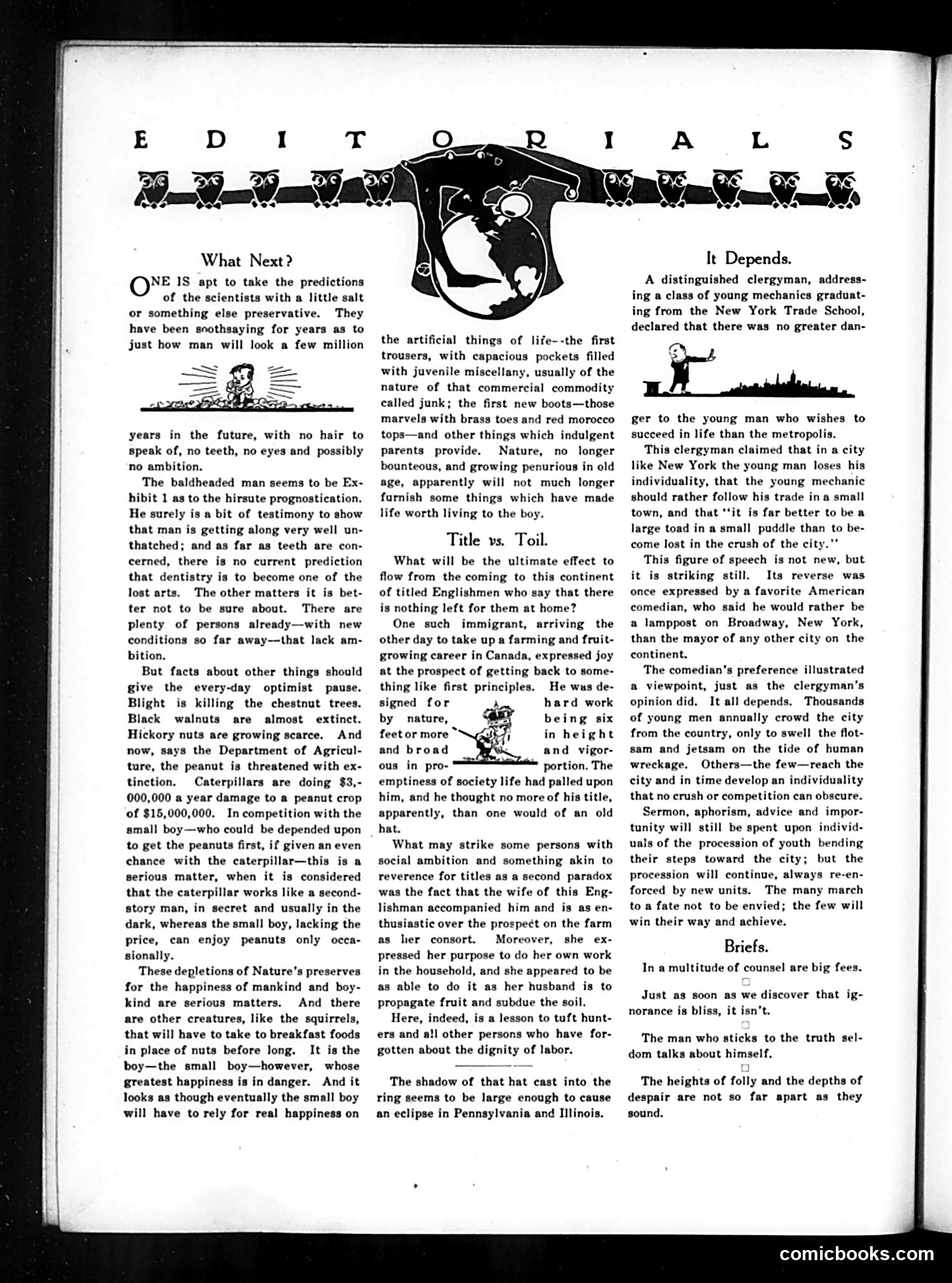
This page from *Judge* magazine presents editorial commentary on American futures and social mobility. The left column, "What Next?," satirizes predictions about future humanity—mocking anxieties about physical degeneration (baldness, toothlessness) while celebrating American progress through consumerism and technology. The right column, "It Depends," addresses immigration and class mobility through a clergyman's anecdote about a young mechanic from the New York Trade School. The piece debates whether ambitious immigrants should stay in cities or seek opportunities in smaller towns or Canada—reflecting early 20th-century tensions over urbanization and immigration policy. The central section, "Title vs. Toil," presents a humorous vignette about an English immigrant woman who rejects farm work, preferring city life despite its hardships—satirizing genteel pretensions versus practical labor.
📄 Transcribed text from this page (OCR, searchable)
Machine-transcribed from the original scan — historical spelling and the odd misread are preserved.
D I T Ee a What Next? ONE 1S apt to take the predictions of the scientists with a little salt or something else preservative. They have been soothsaying for years as to just how man will look a few million years in the future, with no hair to speak of, no teeth, no eyes and possibly no ambition. The baldheaded man seems to be Ex- hibit 1 as to the hirsute prognostication. He surely is a bit of testimony to show that man is getting along very well un- thatched; and as far as teeth are con- cerned, there is no current prediction that dentistry is to become one of the lost arts. The other matters it is bet- ter not to be sure about. There are plenty of persons already—with new conditions so far away—that lack am- bition. But facts about other things should give the every-day optimist pause. Blight is killing the chestnut trees. Black walnuts are almost extinct. Hickory nuts are growing scarce. And now, says the Department of Agricul- ture, the peanut is threatened with ex- tinction. Caterpillars are doing $3,- 000,000 a year damage to a peanut crop of $15,000,000. In competition with the small boy—who could be depended upon to get the peanuts first, if given an even chance with the caterpillar—this is a serious matter, when it is considered that the caterpillar works like a second- story man, in secret and usually in the dark, whereas the small boy, lacking the price, can enjoy peanuts only occa- sionally. These depletions of Nature’s preserves for the happiness of mankind and boy- kind are serious matters. And there are other creatures, like the squirrels, that will have to take to breakfast foods in place of nuts before long. It is the boy—the small boy—however, whose greatest happiness is in danger. And it looks as though eventually the small boy will have to rely for real happiness on I the artificial things of life--the first trousers, with capacious pockets filled with juvenile miscellany, usually of the nature of that commercial commodity called junk; the first new boots—those marvels with brass toes and red morocco tops—and other things which indulgent parents provide. Nature, no longer bounteous, and growing penurious in old age, apparently will not much longer furnish some things which have made life worth living to the boy. Title vs. Toil. What will be the ultimate effect to flow from the coming to this continent of titled Englishmen who say that there is nothing left for them at home? One such immigrant, arriving the other day to take up a farming and fruit- growing career in Canada, expressed joy at the prospect of getting back to some- thing like first principles. He wus de- signed for hard work by nature, being six feet or more ~ in height and broad and vigor- ous in pro- portion. The emptiness of society life had palled upon him, and he thought no more of his title, apparently, than one would of an old hat. What may strike some persons with social ambition and something akin to reverence for titles as a second paradox was the fact that the wife of this Eng- lishman accompanied him and is as en- thusiastic over the prospect on the farm as her consort. Moreover, she ex- pressed her purpose to do her own work in the household, and she appeared to be as able to do it as her husband is to propagate fruit and subdue the soil. Here, indeed, is a lesson to tuft hunt- ers and all other persons who have for- gotten about the dignity of labor. The shadow of that hat cast into the ring seems to be large enough to cause an eclipse in Pennsylvania and Illinois. A L S It Depends. A distinguished clergyman, address- ing a class of young mechanics graduat- ing from the New York Trade School, declared that there was no greater dan- ger to the young man who wishes to succeed in life than the metropolis. This clergyman claimed that in a city like New York the young man loses his individuality, that the young mechanic should rather follow his trade ina small town, and that ‘‘it is far better to be a large toad in a small puddle than to be- come lost in the crush of the city."” This figure of speech is not new, but it is striking still. Its reverse was once expressed by a favorite American comedian, who said he would rather be a lamppost on Broadway, New York, than the mayor of any other city on the continent. The comedian’s preference illustrated a viewpoint, just as the clergyman’s opinion did. It all depends. Thousands of young men annually crowd the city from the country, only to swell the flot- sam and jetsam on the tide of human wreckage. Others—the few—reach the city and in time develop an individuality that no crush or competition can obscure. Sermon, aphorism, advice and impor- tunity will still be spent upon individ- uals of the procession of youth bending their steps toward the city; but the procession will continue, always re-en- forced by new units. The many march to a fate not to be envied; the few will win their way and achieve. Briefs. In a multitude of counsel are big fees. Just as soon as we discover that ig- norance is bliss, it isn’t. The man who sticks to the truth sel- dom talks about himself. The heights of folly and the depths of despair are not so far apart as they sound. comicbooks.com