
Judge, 1912-05-11 · page 15 of 26
Judge — May 11, 1912 — page 15: what you’re looking at
What you’re looking at
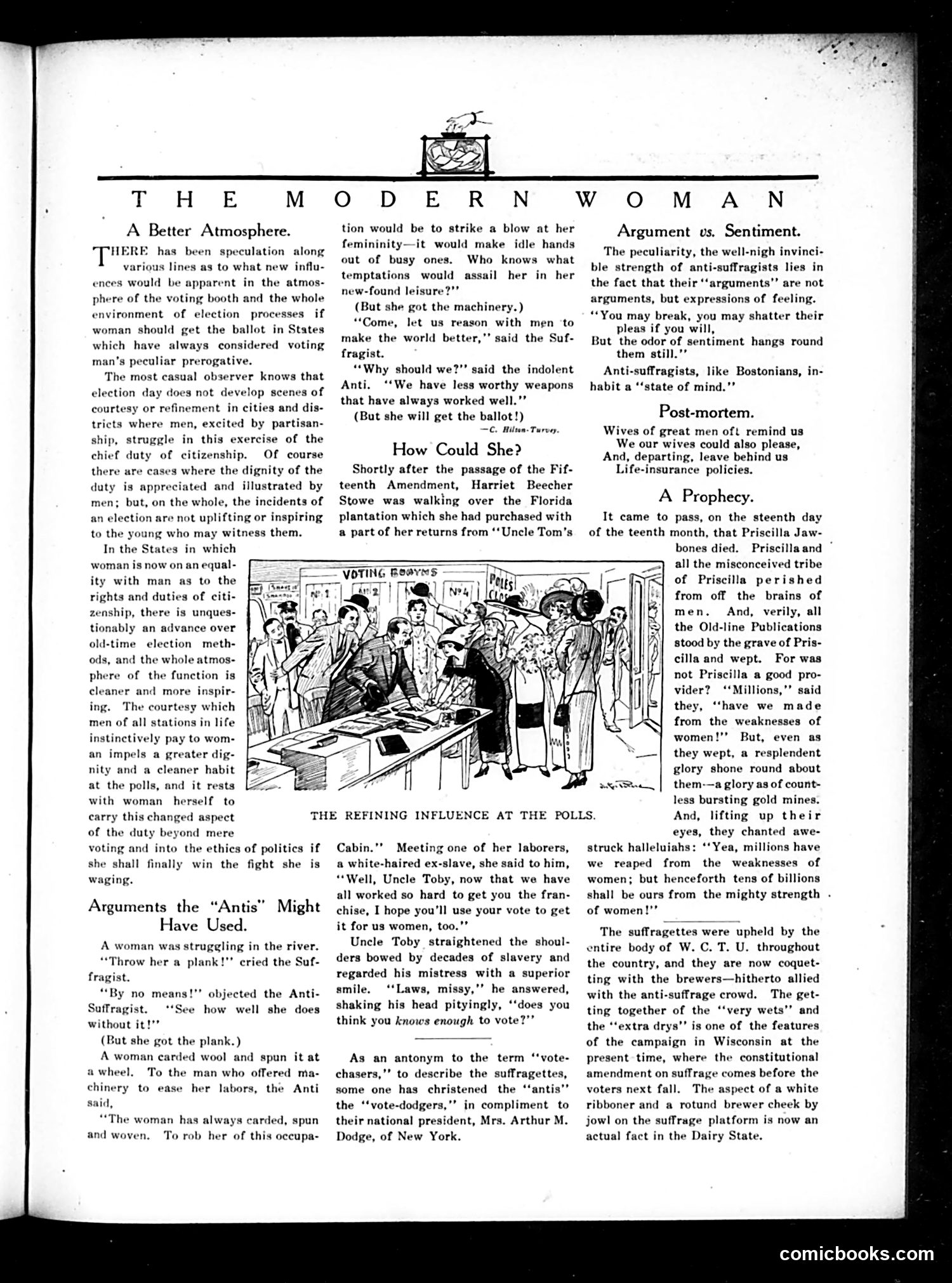
This page argues FOR women's suffrage through satirical rebuttals of anti-suffrage arguments. The central cartoon depicts a polling place where women's presence has "refined" the atmosphere—men behave with courtesy and dignity around female voters, contrasting sharply with the rowdy, partisan behavior typical of all-male elections. The text presents three "arguments the 'Antis' might have used" (anti-suffragists)—each following a formula where opponents object to women gaining something (a plank, machinery, the ballot), claiming it would harm femininity or traditional roles, yet women get it anyway. The "How Could She?" anecdote presents the ironic scenario where Harriet Beecher Stowe—author of *Uncle Tom's Cabin*, instrumental in abolishing slavery—asks a freedman to support women's suffrage, only to be told by him that women lack the knowledge to vote. The satire highlights the hypocrisy: if formerly enslaved men deserve voting rights, why not women? The final sections mock anti-suffragists as "vote-dodgers" relying on sentiment rather than logic, unable to construct genuine arguments.
📄 Transcribed text from this page (OCR, searchable)
Machine-transcribed from the original scan — historical spelling and the odd misread are preserved.
T H E A Better Atmosphere. HERE has been speculation along various lines as to what new influ- ences would be apparent in the atmos- phere of the voting booth and the whole of election processes if woman should get the ballot in States which have always considered voting man’s peculiar prerogative. The most casual observer knows that election day does not develop scenes of courtesy or refinement in cities and dis- tricts where men, excited by partisan- ship, struggle in this exercise of the chief duty of citizenship. Of course cases where the dignity of the environment there a duty is appreciated and illustrated by men; but, on the whole, the incidents of an election are not uplifting or inspiring to the young who may witness them. In the States in which woman is now on an equal- ity with man as to the rights and duties of citi zenship, there is unques- tionably an advance over old-time election meth- ods, and the whole atmos- phere of the function is cleaner and more inspir- ing. The courtesy which men of all stations in life instinctively pay to wom- an impels a greater di nity and a cleaner habit at the polls, and it rests with woman herself to carry this changed aspect of the duty beyond mere voting and into the ethics of politics if she shall finally win the fight she is waging. Arguments the “Antis” Might Have Used. A woman was struggling in the river. “Throw her a plank!"’ cried the Suf- fragist. “By no means!" objected the Anti- Suffragist. ‘‘See how well she does without it!” (But she got the plank.) A woman carded wool and spun it at To the man who offered ma- chinery to ease her labors, the Anti a wheel, said, “The woman has always carded, spun and woven, To rob her of this occupa- M O D E RN tion would be to strike a blow at her femininity—it would make idle hands Who knows what assail her in her out of busy ones. temptations would new-found leisure ?’" (But she got the machinery.) “Come, let us reason with men ‘to make the world better,’’ said the Suf- fragist. “Why should we?” said the indolent Anti. ‘We have less worthy weapons that have always worked well.’” (But she will get the ballot!) —C. Hiln How Could She? Shortly after the passage of the Fif- teenth Amendment, Harriet Beecher Stowe was walking over the Florida plantation which she had purchased with a part of her returns from ‘‘Uncle Tom's THE REFINING INFLUENCE AT THE POLLS. Cabin."’ Meeting one of her laborers, a white-haired ex-slave, she said to him, “Well, Uncle Toby, now that we have all worked so hard to get you the fran- chise, I hope you'll use your vote to get it for us women, too.’” Uncle Toby straightened the shoul- ders bowed by decades of slavery and regarded his mistress with a superior smile. ‘‘Laws, missy,"’ he answered, shaking his head pityingly, ‘‘does you think you knows enough to vote?’’ As an antonym to the term ‘‘vote- chasers,’ to describe the suffragettes, some one has christened the ‘‘antis’’ the ‘‘vote-dodgers,’’ in compliment to their national president, Mrs. Arthur M. Dodge, of New York. WwW OM A N Argument vs. Sentiment. The peculiarity, the well-nigh invinci- ble strength of anti-suffragists lies in the fact that their ‘‘arguments’’ are not arguments, but expressions of feeling. “You may break, you may shatter their pleas if you will, But the odor of sentiment hangs round them still."” Anti-suffragists, like Bostonians, in- habit a ‘‘state of mind.’’ Post-mortem. Wives of great men oft remind us We our wives could also please, And, departing, leave behind us Life-insurance policies. A Prophecy. It came to pass, on the steenth day of the teenth month, that Priscilla Jaw- bones died. Priscillaand © all the misconceived tribe of Priscilla perished from off the brains of men. And, verily, all the Old-line Publications stood by the grave of Pris- cilla and wept. For was not Priscilla a good pro- vider? ‘‘Millions,’’ said they, ‘have we made from the weaknesses of women!’ But, even as they wept, a resplendent glory shone round about them-—a glory as of count- less bursting gold mines. And, lifting up their eyes, they chanted awe- struck halleluiahs: ‘Yea, millions have we reaped from the weaknesses of women; but henceforth tens of billions shall be ours from the mighty strength . of women!" The suffragettes were upheld by the entire body of W. C. T. U. throughout the country, and they are now coquet- ting with the brewers—hitherto allied with the anti-suffrage crowd. The get- ting together of the ‘‘very wets’’ and the ‘‘extra drys’’ is one of the features of the campaign in Wisconsin at the present time, where the constitutional amendment on suffrage comes before the voters next fall. The aspect of a white ribboner and a rotund brewer cheek by jowl on the suffrage platform is now an actual fact in the Dairy State. comicbooks.com