
A complete issue · 23 pages · 1912
Judge — May 4, 1912
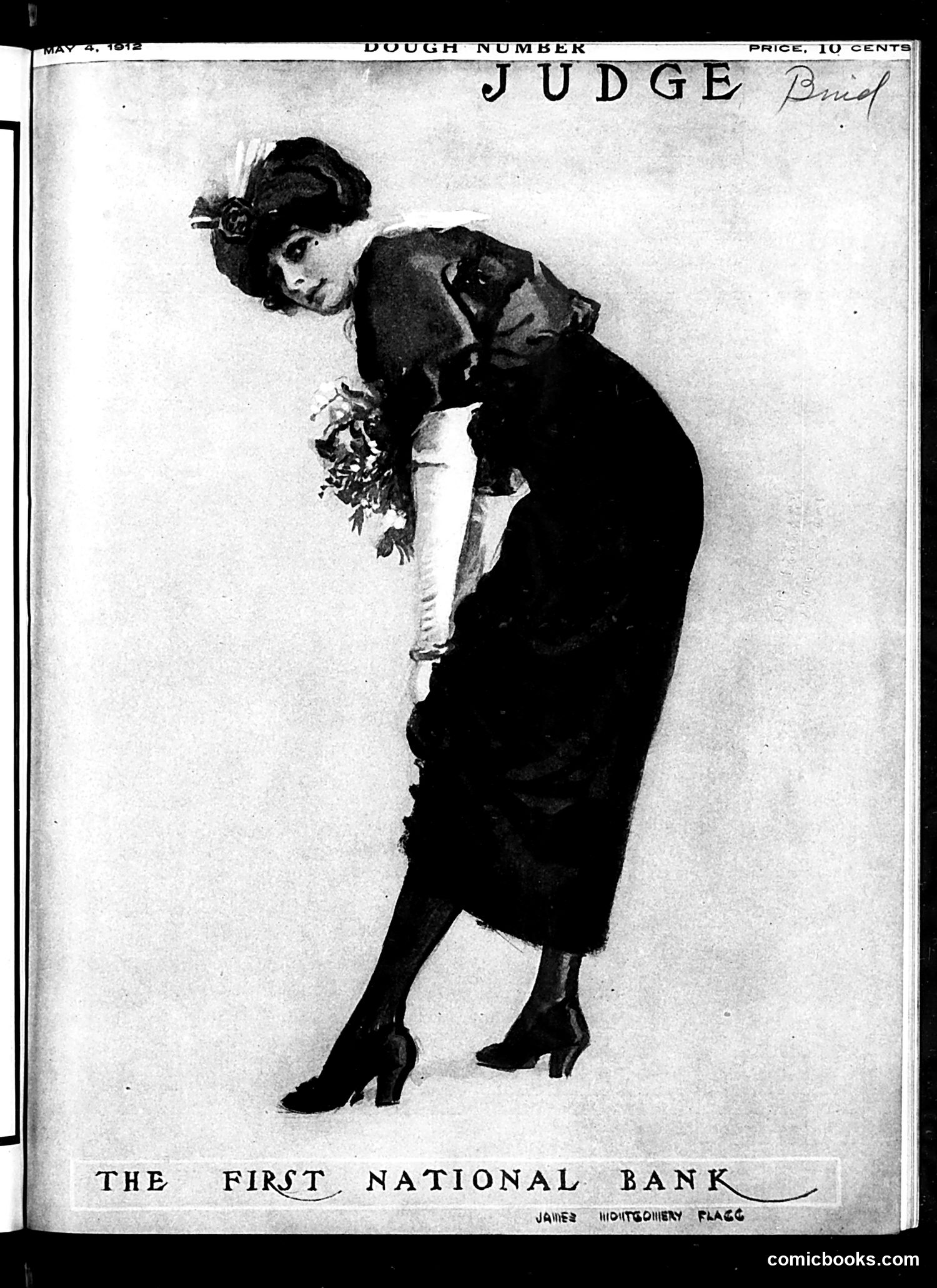
This is a cover from Judge magazine dated May 4, 1912. The illustration shows a woman in elegant dark clothing holding flowers, depicted in a graceful, elongated pose characteristic of early 20th-century fashion illustration. The caption reads "THE FIRST NATIONAL BANK," suggesting this is likely an advertisement rather than political satire. The image appears to promote banking services using an attractive female figure—a common advertising approach of the era. The woman's fashionable attire, including her decorated hat and high heels, reflects 1912 style conventions. Without additional contextual text on this page, the specific satirical or commercial message isn't entirely clear, though the elegance and refinement of the composition suggest it's marketing financial services to affluent audiences.
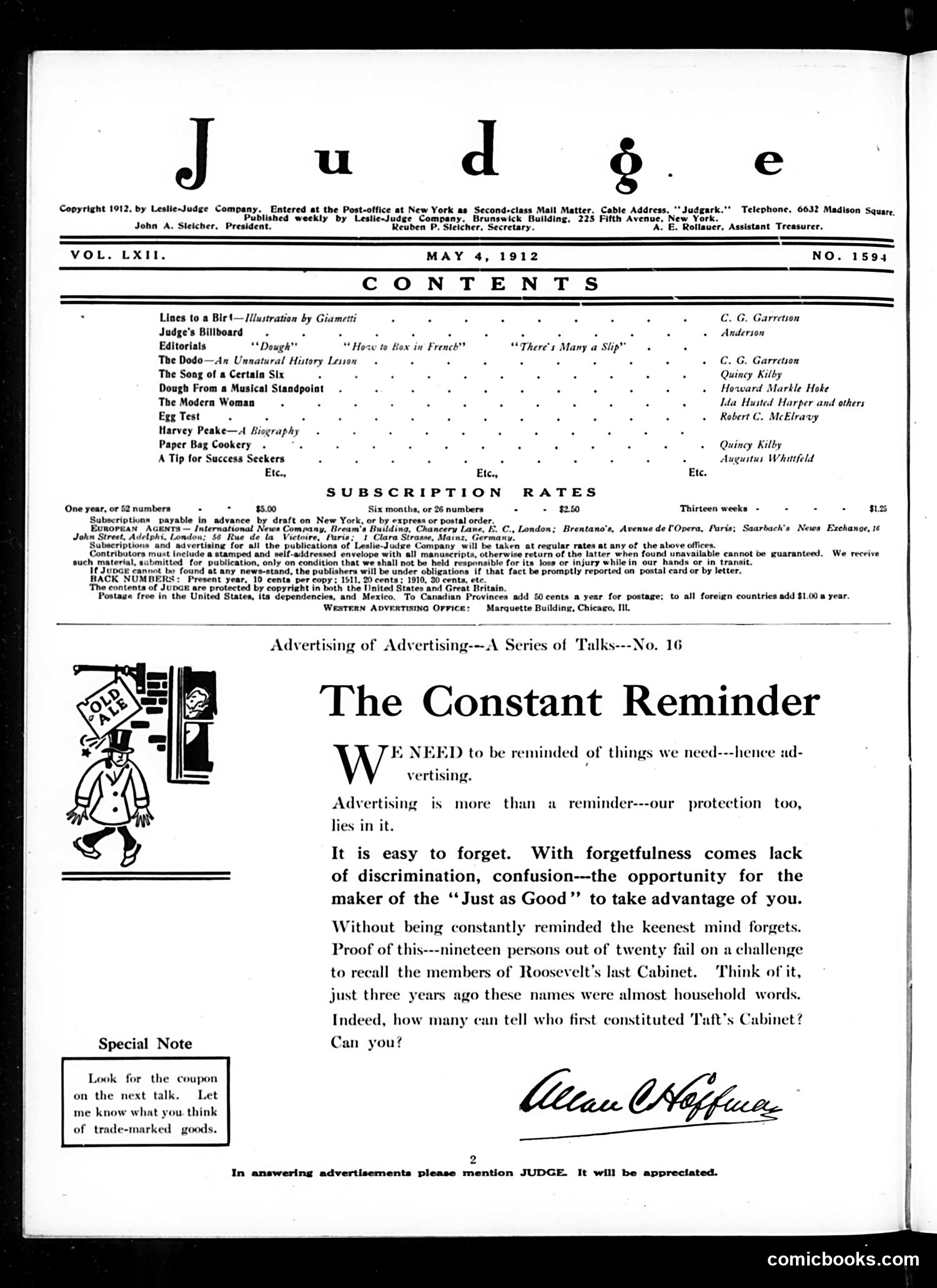
This page is primarily an **advertising article** rather than political satire. It's the 16th installment in a series titled "Advertising of Advertising—A Series of Talks." The piece, titled "The Constant Reminder," argues that **advertising serves as essential protection against forgetfulness and consumer confusion**. The cartoonist illustrates a figure surrounded by advertising placards, suggesting ads are everywhere and necessary. The text uses examples—like how nineteen of twenty people fail to recall President Taft's Cabinet members, despite their former fame—to demonstrate that **without constant reminders through advertising, people forget important information**. This allows inferior "just as good" products to gain unfair advantage. The article concludes advertising protects consumers from such deception through repeated exposure. The tone is promotional rather than satirical.
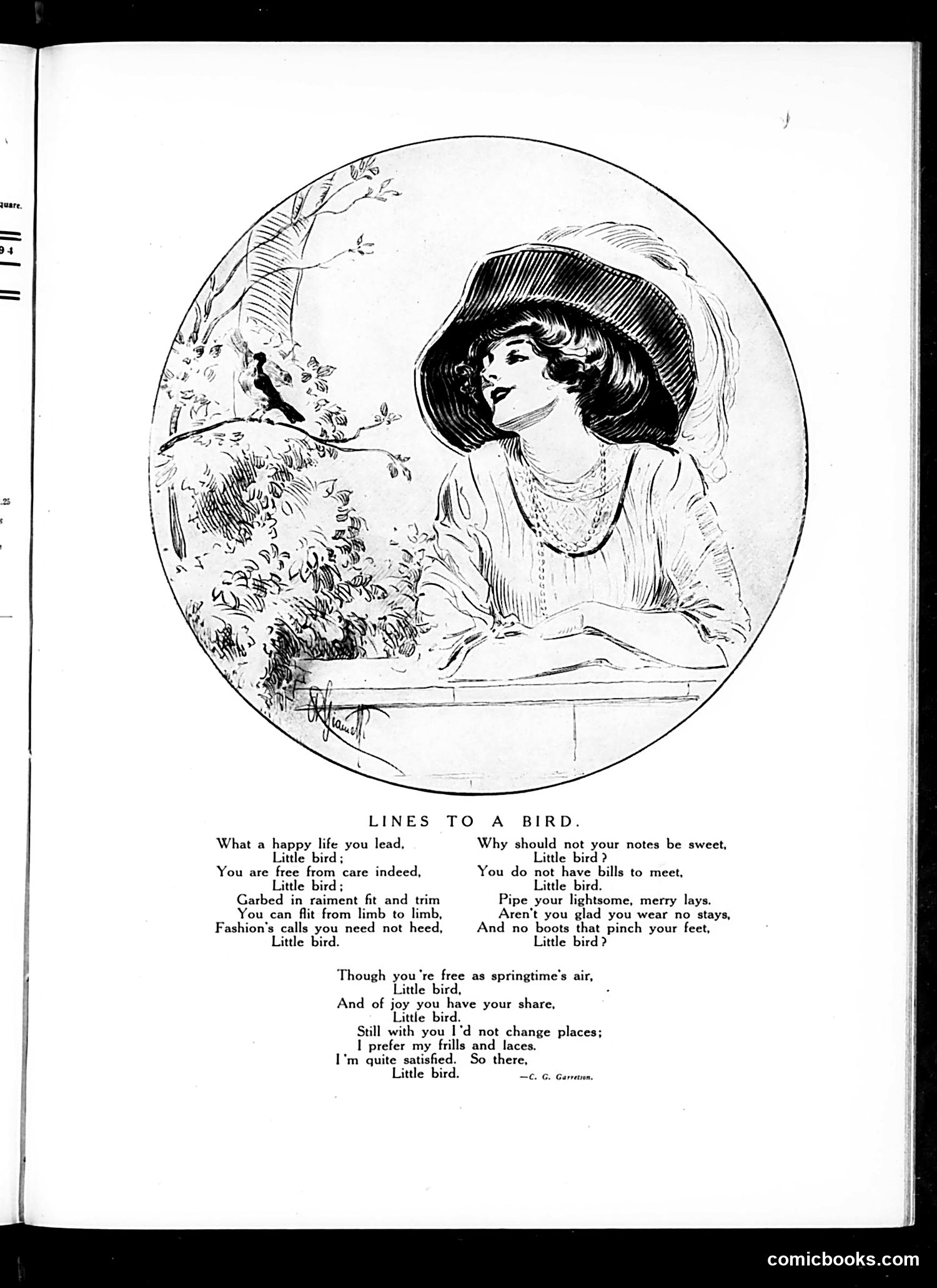
This page features a poem by C. G. Garrison addressed to a "Little bird," accompanied by an illustration of a fashionable woman in a hat gazing at a bird perched on a branch. The satire contrasts the bird's carefree existence with the constraints of human—specifically women's—fashion and social convention. The poem envies the bird's freedom from worry, expense, and restrictive clothing ("Fashion's calls you need not heed," "no boots that pinch your feet"). The final stanza reveals the speaker's irony: despite admiring the bird's liberty, she chooses her "frills and laces" over genuine freedom, declaring satisfaction with her constrained life. This reflects early-20th-century anxieties about women's restrictive fashion and social roles, using gentle humor to comment on the disconnect between aspiring to freedom and accepting social conformity.
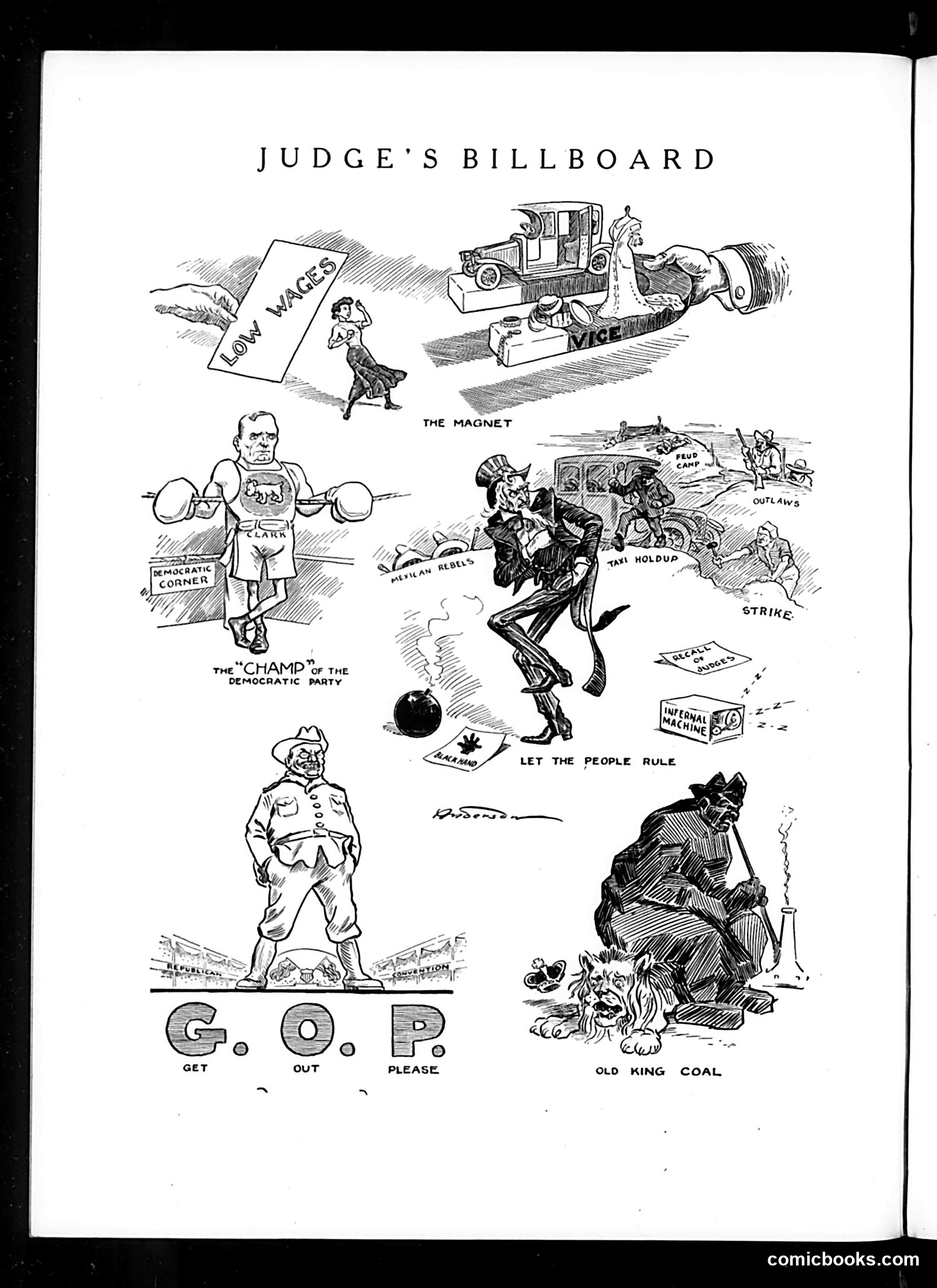
This page presents six political cartoons critiquing early 20th-century American politics and social issues: 1. **"Low Wages"** - A figure is knocked down by low wages, suggesting economic hardship. 2. **"The Magnet"** - Depicts political/labor "rebels" being attracted to various causes (camps, strikes, machines), satirizing unstable political movements. 3. **"The Champ of the Democratic Party"** - Shows a boxer labeled "Clark" holding dumbbells, likely mocking a Democratic political figure's strength or competence. 4. **"Let the People Rule"** - A devil-like figure juggles various societal problems, suggesting chaotic democracy or demagoguery. 5. **"G.O.P."** - A Republican figure stands triumphantly, with "Get Out Please" as commentary. 6. **"Old King Coal"** - Shows coal industry dominance, with a figure sitting atop coal and a dog, likely critiquing coal monopolies or labor exploitation. The overall theme addresses labor disputes, political corruption, and industrial power during the Progressive Era.
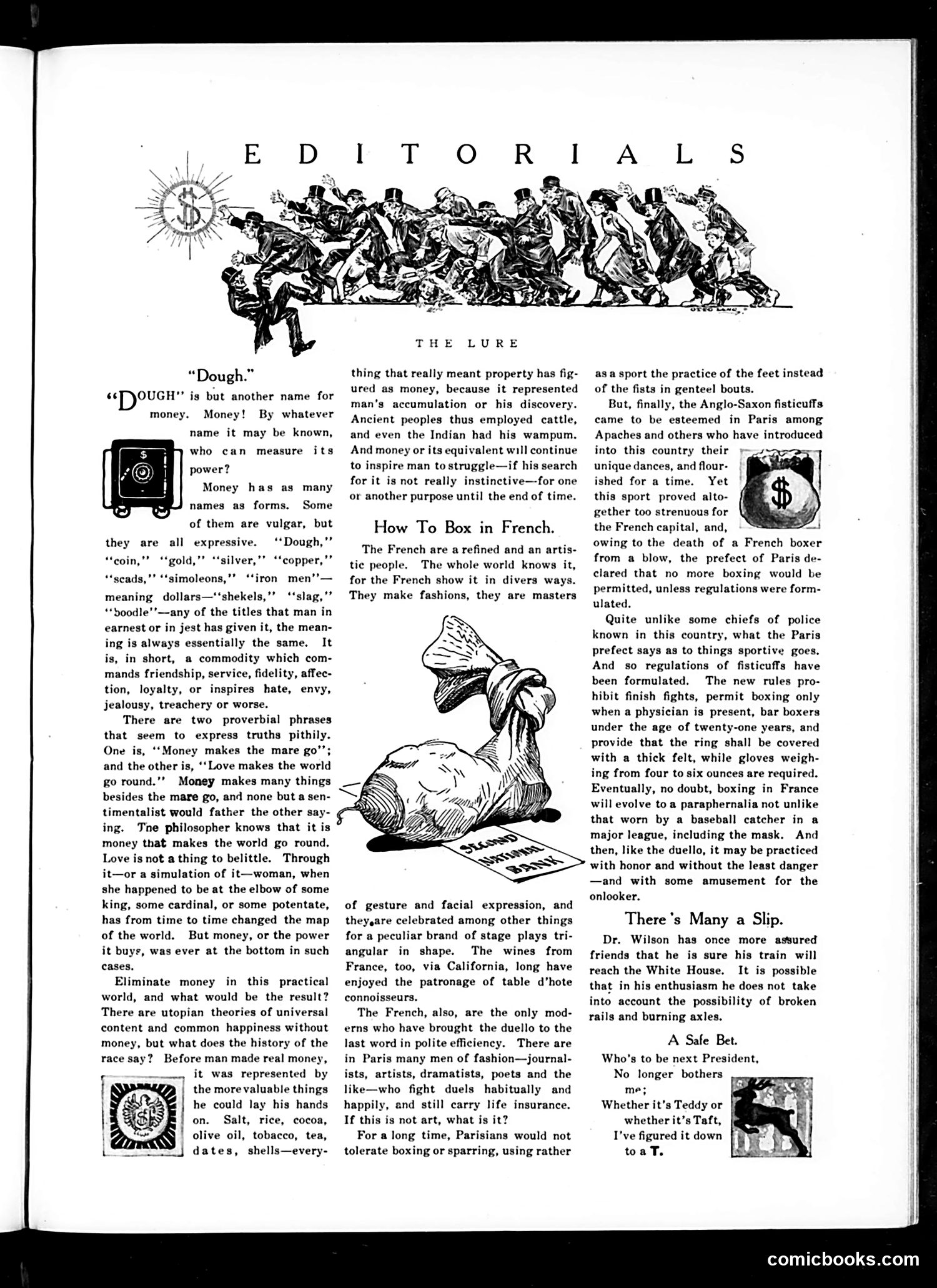
This page presents three editorial pieces with light satirical commentary: **"Dough"** discusses money's various names ("coin," "gold," "silver," etc.) across cultures, arguing that regardless of terminology, money fundamentally represents the same concept—a medium enabling human survival and commerce. **"How To Box in French"** satirizes French cultural refinement, noting the French prohibition on boxing. The piece suggests this reflects French artistic sensibilities but predicts boxing will eventually be accepted in France, possibly evolving into a more formal, regulated sport similar to dueling. **"There's Many a Slip"** and **"A Safe Bet"** appear to be brief humor columns about everyday mishaps and betting on presidential candidates—likely referring to an upcoming election, though the specific year is unclear from visible text. The overall tone is genteel, middle-class satire rather than hard political commentary.
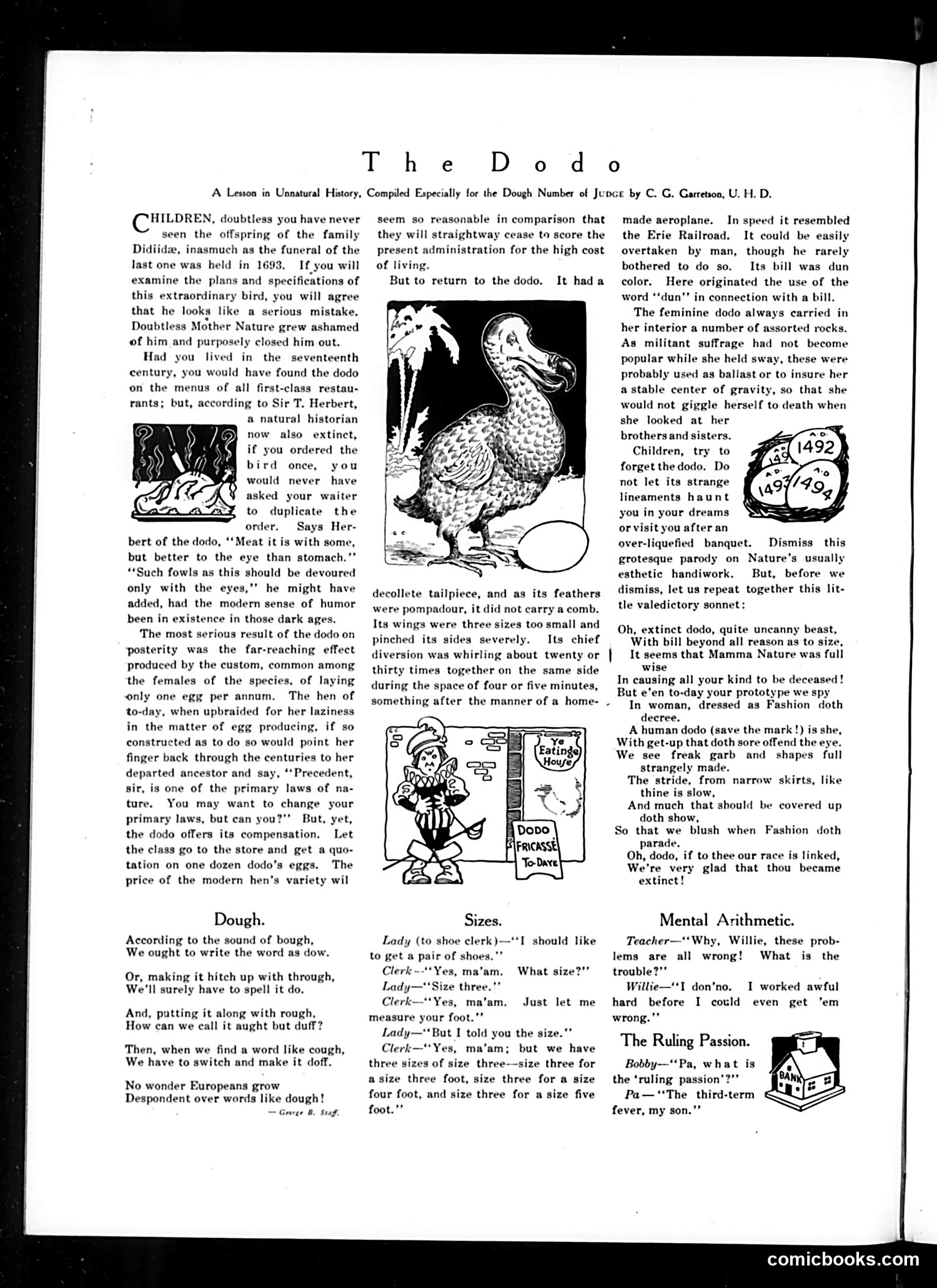
This satirical article uses the extinct dodo bird as a vehicle for contemporary criticism. The piece parodies "lessons in natural history" while actually commenting on modern American issues. The main target appears to be the **high cost of living** under the current administration (likely Woodrow Wilson's presidency, given Judge's era). The author suggests that examining the dodo's impracticality—a creature so useless it was rightfully extinct—makes present economic grievances seem "reasonable in comparison." The humor also mocks **gender politics**, referencing "militant suffrage" and suggesting female dodos used rocks as ballast, a dig at women's suffrage activism. Additionally, the page includes humorous vignettes about **English language absurdities** ("dough" pronunciation) and shoe-sizing confusion, which are unrelated satirical sketches typical of Judge magazine's miscellaneous comedy content. The overall tone is conservative social satire—using natural history as cover for political complaint about inflation and women's activism.
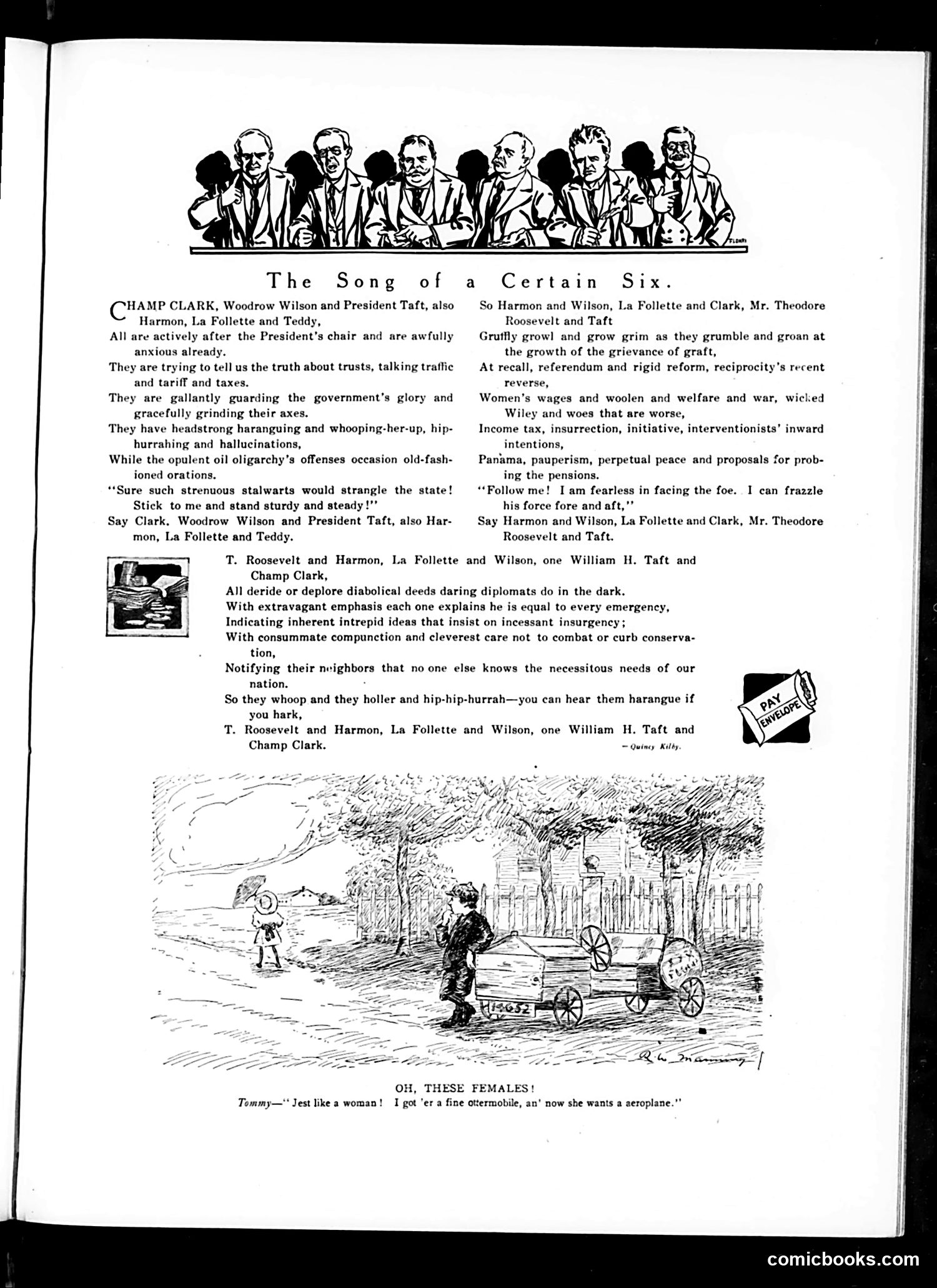
This 1912 Judge magazine page mocks six presidential candidates competing for the White House: Champ Clark, Woodrow Wilson, President William H. Taft, James Harmon, Robert La Follette, and Theodore Roosevelt. The satirical song ridicules their campaign rhetoric—each claiming sole ability to fight corruption, trusts, and graft while attacking opponents. Judge suggests these politicians are hypocritically "grinding their axes" (pursuing self-interest) while posturing as reformers. They all address identical issues (women's rights, tariffs, income tax, Panama Canal) yet claim unique competence. The accompanying cartoon illustrates the "greedy oligarch" theme: a boy complains his girlfriend wants an airplane after he bought her a motorcar—mocking women's supposedly insatiable desires. This reflects period gender attitudes. The satire's core message: all six candidates sound identical in their reform promises, making their competition meaningless posturing rather than substantive policy debate.
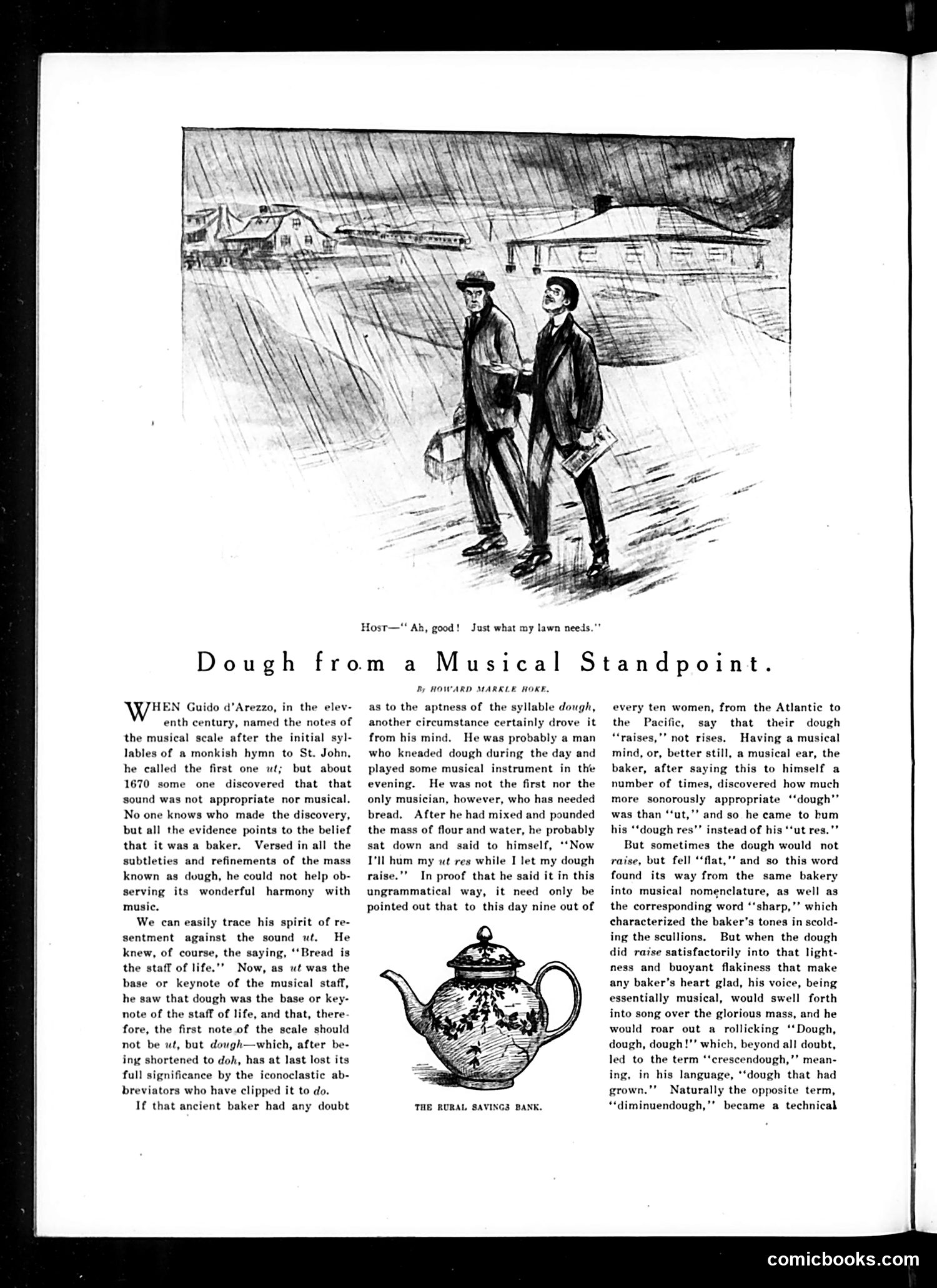
This is a humorous essay with accompanying cartoon, not political satire. The piece playfully traces the origin of musical terminology to a baker, claiming the musical note "do" (originally "ut") derives from "dough." **The cartoon** shows two men on what appears to be a snowy field near farm buildings. One says "Ah, good! Just what my lawn needs"—likely referring to the "dough" or snow visible in the background, creating a visual pun. **The satire** is linguistic wordplay: the author humorously argues that a musical baker, frustrated with kneading dough daily while playing instruments nightly, originated musical terms like "dough," "raise," "flat," and "sharp" from bread-baking experiences. Terms like "crescendough" (dough that has grown) and "diminuendough" are invented extensions of this conceit. The separate illustration of a teapot labeled "The Rural Savings Bank" appears unrelated—likely an advertisement or filler image common in Judge magazine.
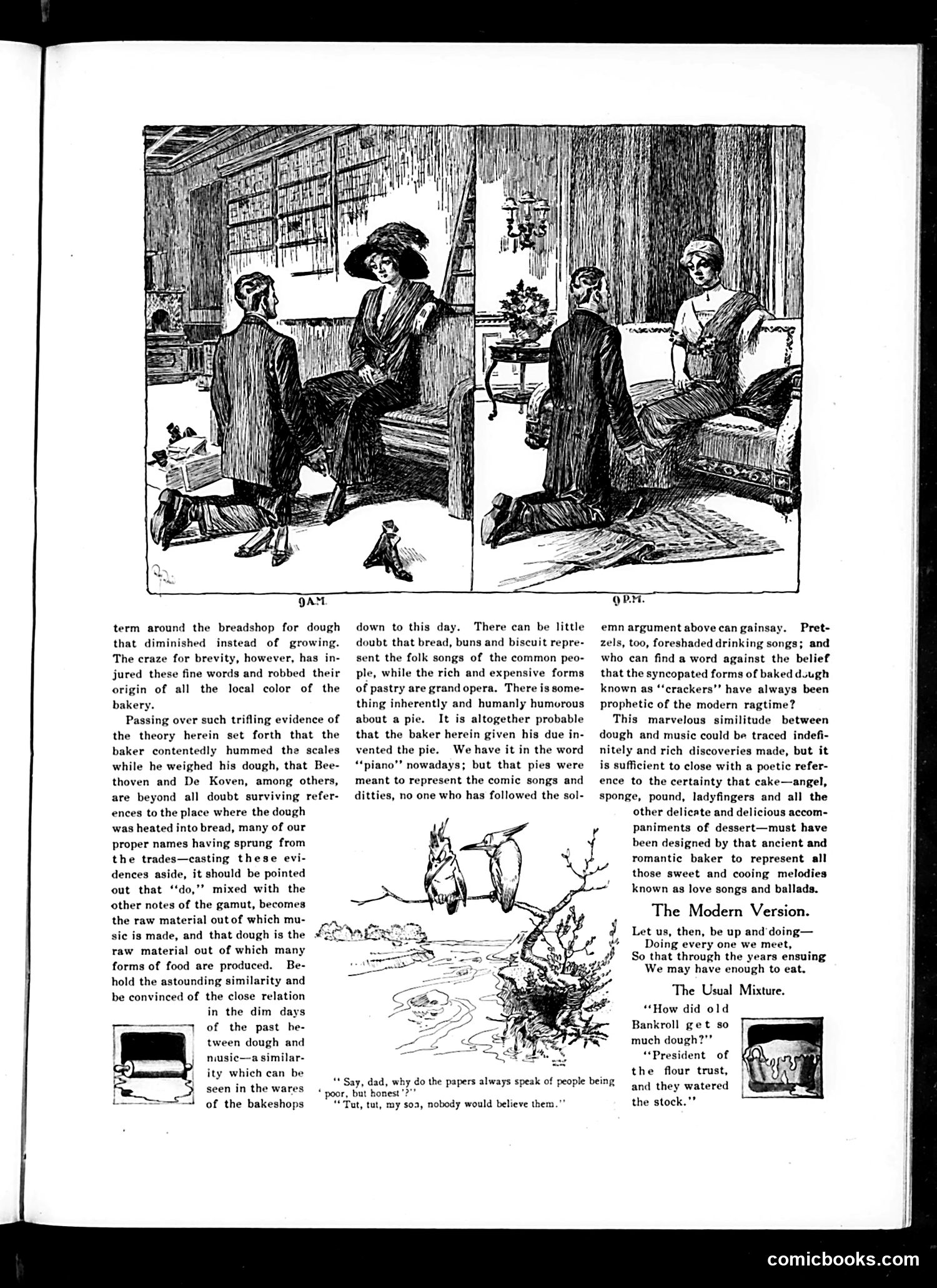
This page satirizes **economic inequality and food access** in early 20th-century America through wordplay and social commentary. The main article uses a whimsical extended metaphor: bread-baking terminology (dough, do, etc.) supposedly derives from music, with folk breads representing "common people's songs" and fancy pastries representing "grand opera." This establishes a hierarchy—cheap bread versus expensive pastry mirrors class divisions. The cartoon dialogue at bottom provides the actual social critique: A child asks why newspapers call poor people "honest," while his father explains that the wealthy "President of the flour trust" accumulated "dough" (money) by controlling the flour industry and "watering the stock" (financial fraud). The implication: wealth comes from monopolistic manipulation, not honest labor, yet the press romanticizes poverty while ignoring corporate dishonesty. The satire targets both **corrupt business practices** (trust monopolies, stock manipulation) and **media hypocrisy** in portraying the poor favorably while enabling the rich to exploit them.
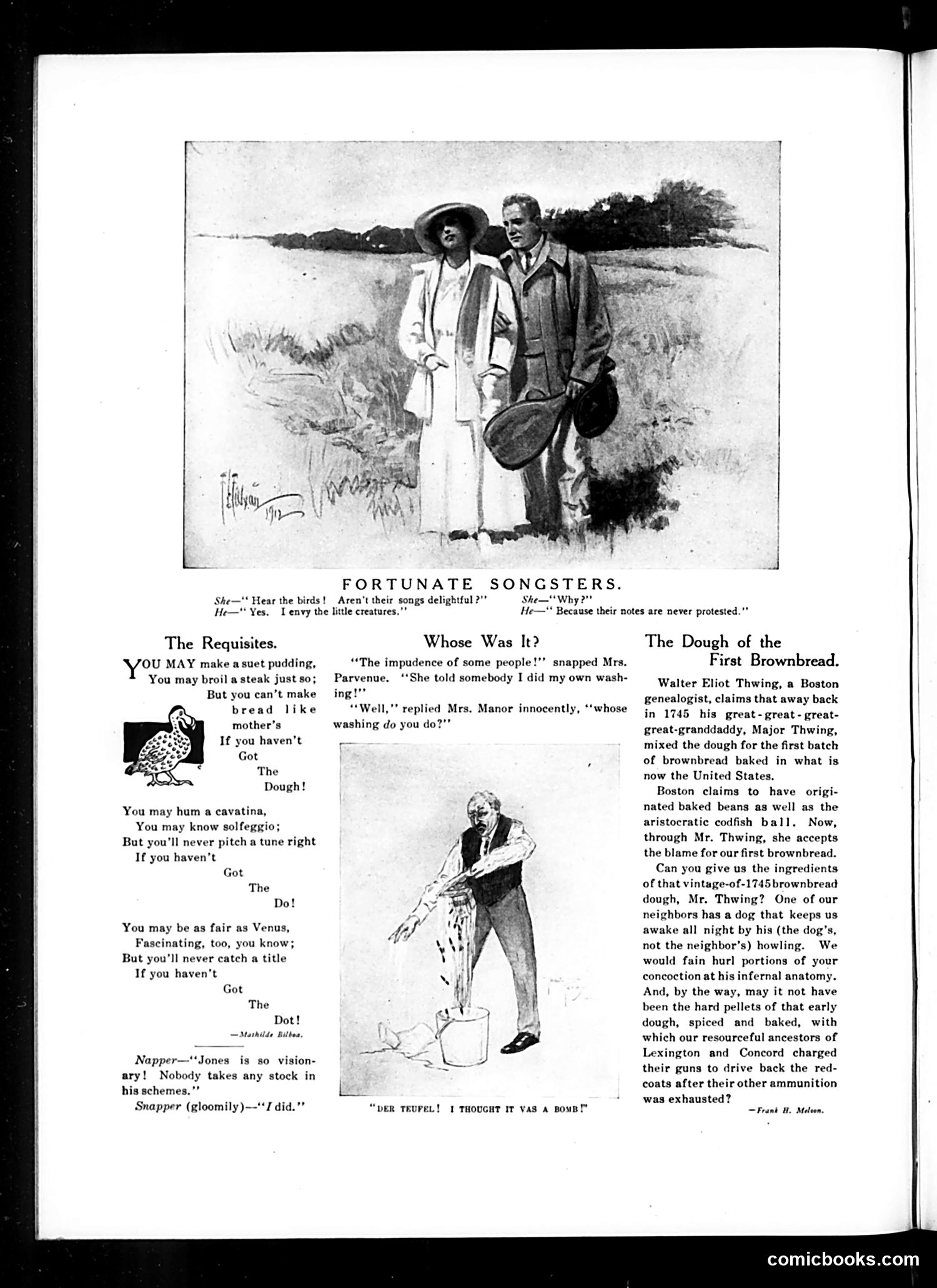
This Judge magazine page contains several brief satirical pieces mocking social pretension and economic reality. **"Fortunate Songsters"** (top): A couple appreciates birds' songs because "their notes are never protested"—a financial pun on promissory notes, suggesting wealthy people need not worry about unpaid debts, while ordinary people do. **"The Requisites"** (left): Humorous poems playing on double meanings. "The Dough" satirizes that money ("dough") is essential to success in cooking, music, and marriage, just as technical skill is. "The Do" uses musical terminology for similar effect. **"Whose Was It?"** (center): Mocks new-money pretension. Mrs. Parvenue (a French surname suggesting nouveau riche) is offended someone suggested she does her own washing, revealing her insecurity about her social status. **"The Dough of the First Brownbread"** (right): A humorous genealogical claim by a Bostonian that his ancestor invented brownbread in 1745, playfully suggesting readers could use the hard, early recipe as ammunition—mocking both genealogical snobbery and Boston's claim to culinary invention.
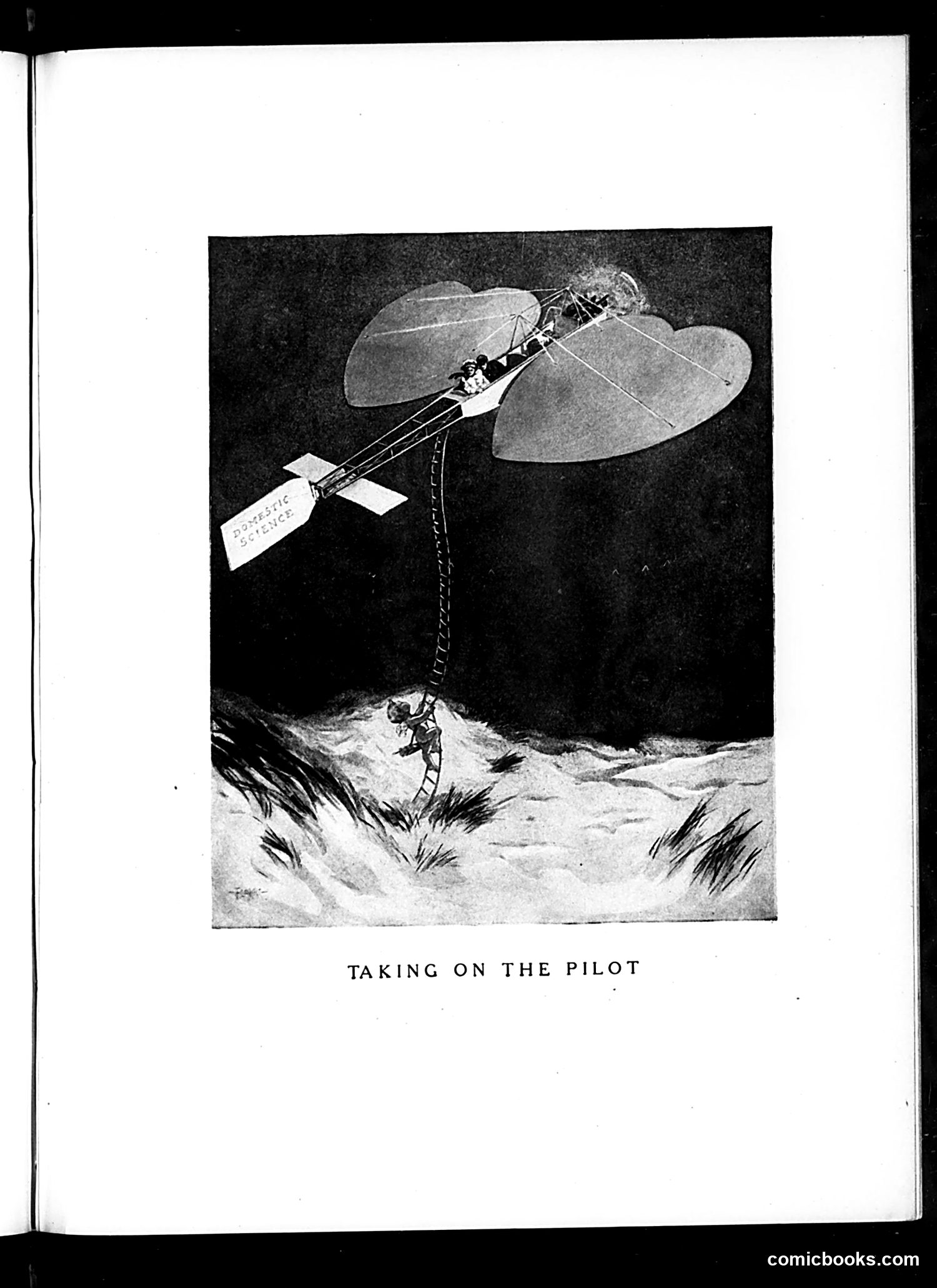
This appears to be a satirical illustration from *Judge* magazine depicting an absurdist scenario. The image shows a giant dragonfly with transparent wings suspended above a sandy landscape where a small human figure stands below, tethered to the insect by a rope. The caption "TAKING ON THE PILOT" suggests a play on words—a "pilot" typically commands an aircraft, but here a human appears to be attempting to control or ride a dragonfly as if it were a flying vessel. The satire likely mocks either overambitious aviation schemes, human hubris in attempting to master nature, or possibly critiques early aviation experiments of the era when *Judge* was published. The scale disparity emphasizes the comedic impossibility of the endeavor.
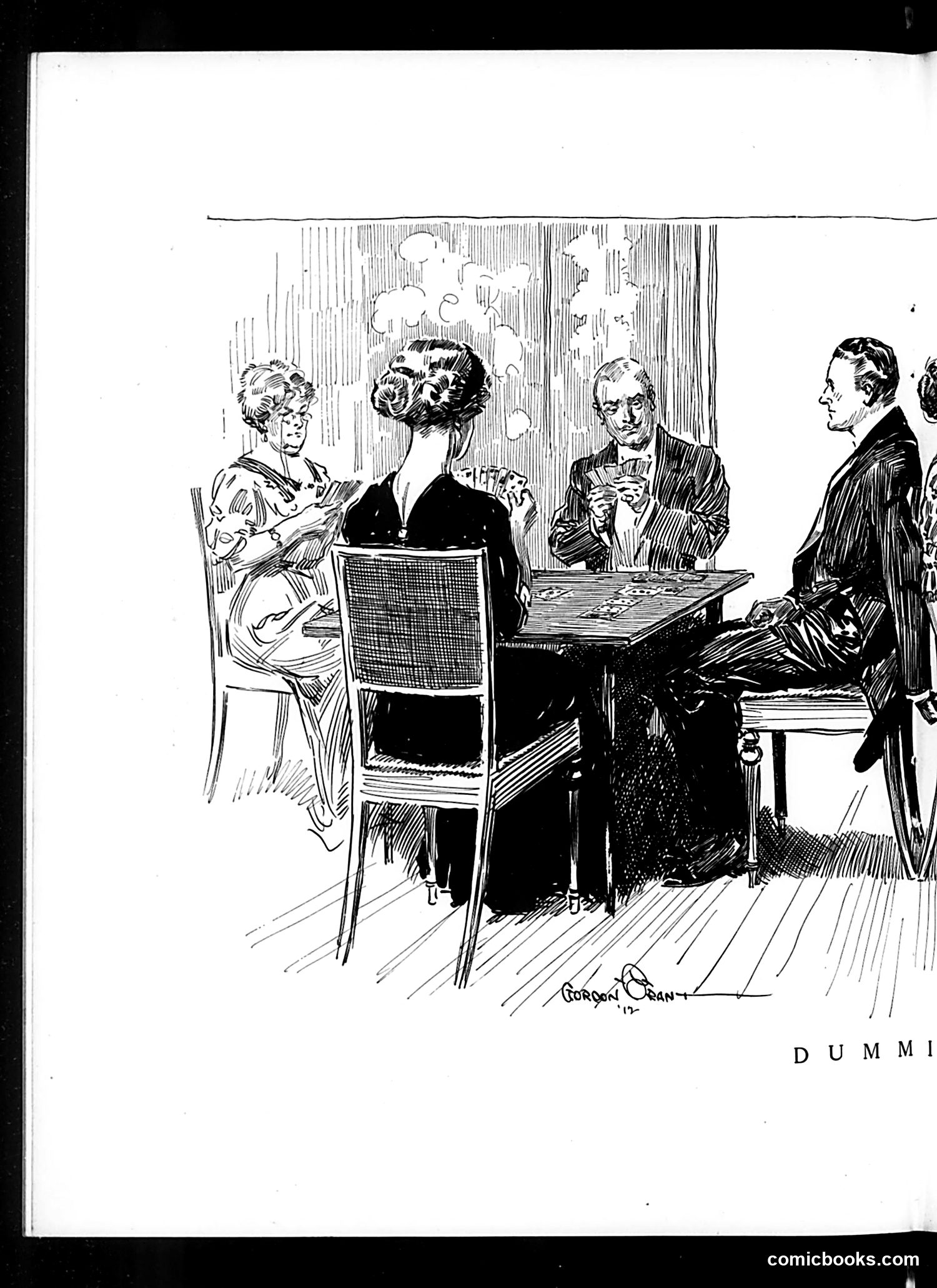
This appears to be a social satire cartoon from *Judge* magazine, signed by Gordon Cnan (or similar). The illustration depicts four well-dressed figures gathered around a table, apparently engaged in conversation or cards. The title "DUMMI" (spelled deliberately misspelled, likely "Dummy") suggests the cartoon's satirical point concerns foolishness or gullibility among the depicted characters. The formal attire and indoor setting suggest these are upper-class figures, possibly critiquing the behavior or judgment of wealthy society members. Without additional context from the magazine's publication date or accompanying text, the specific social or political target remains unclear, though the careful rendering and formal composition indicate a commentary on contemporary society's absurdities.
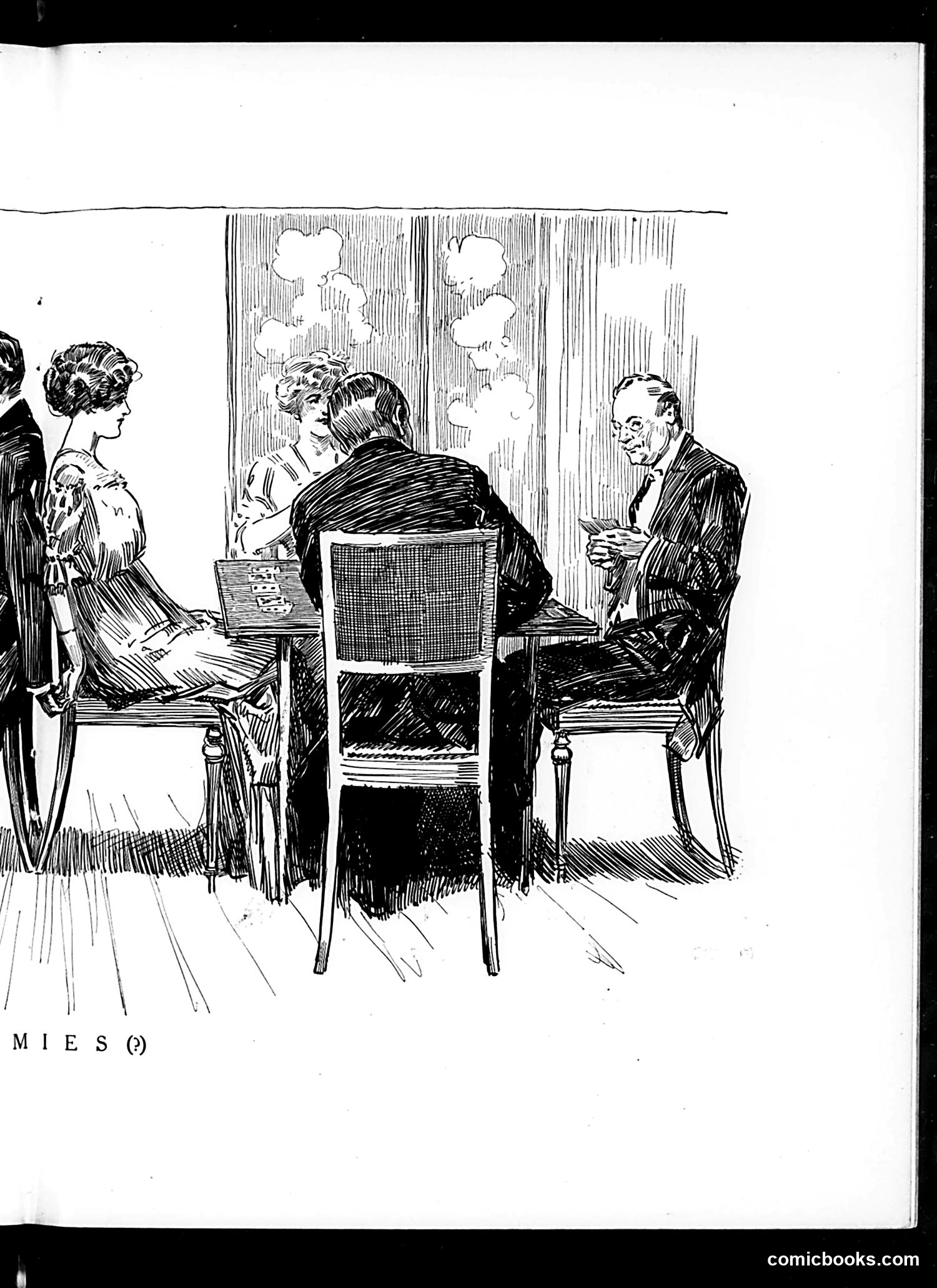
This is a black-and-white sketch from *Judge* magazine showing a social scene with several figures in what appears to be an interior setting with curtained windows. A man in a dark suit is seated centrally, engaged with others around him. Women in period dress are visible on the left side. The OCR text "MIES (?) comicbooks.com" provides minimal context. Without clearer text, caption, or signature visible in the image, I cannot definitively identify the specific political or social satire intended. The sketch's style and composition suggest commentary on upper-class social interaction or etiquette, but the exact subject, date, and satirical point remain unclear from this image alone. Additional page context would be needed for accurate interpretation.
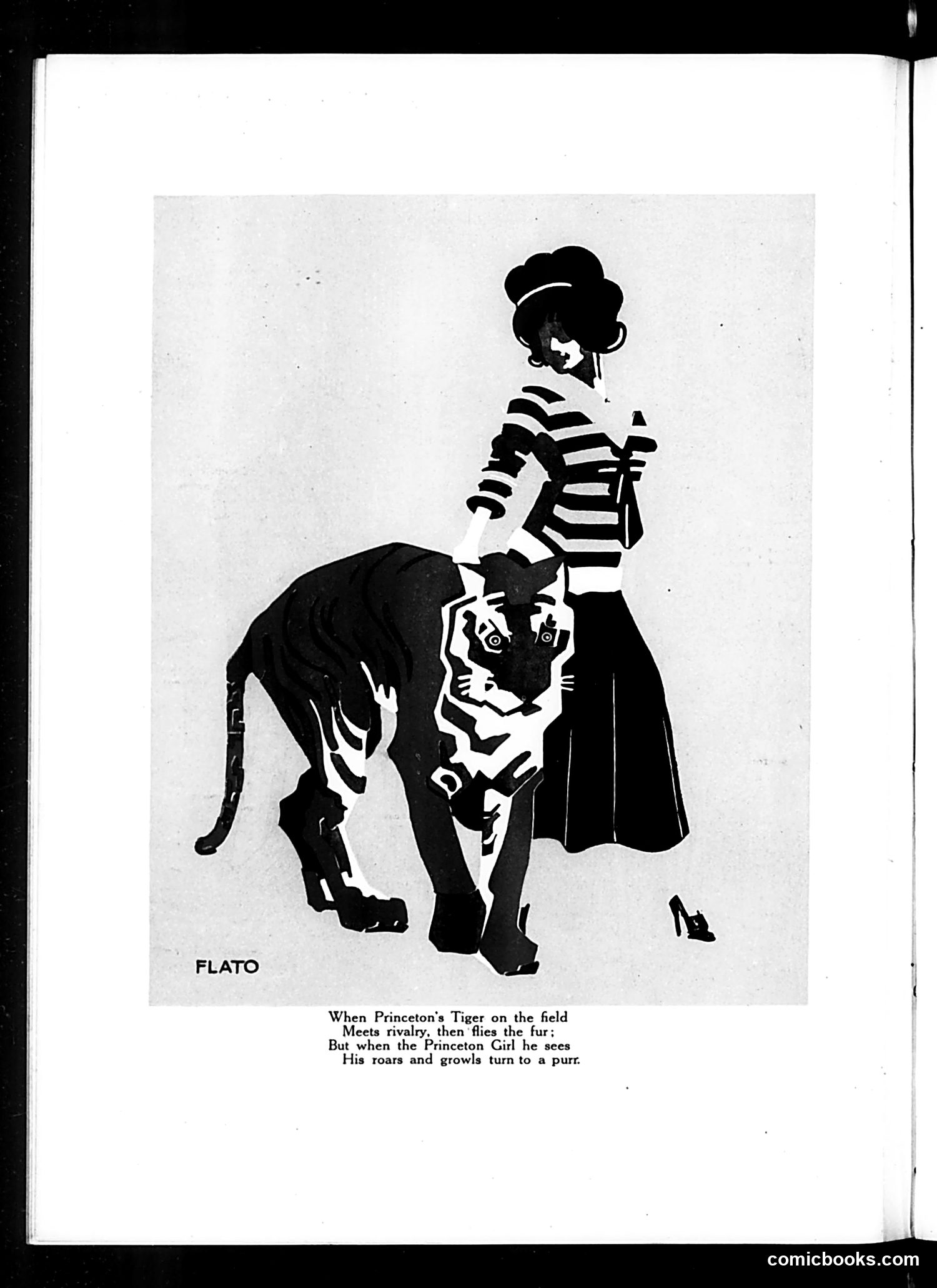
This is a satirical cartoon by Flato about Princeton University athletics and gender dynamics. The image shows a tiger (Princeton's mascot) in an aggressive stance, with a fashionably dressed young woman riding on its back. The verse jokes that while the Princeton Tiger is fierce in athletic competition ("roars and growls"), it becomes docile and affectionate ("turn to a purr") when encountering a Princeton girl. The satire targets the contradiction between masculine athletic aggression and masculine submissiveness around women—suggesting that even the fiercest competitor becomes meek in romantic/social contexts. The woman's confident posture and the tiger's tamed demeanor humorously invert traditional power dynamics of the era.
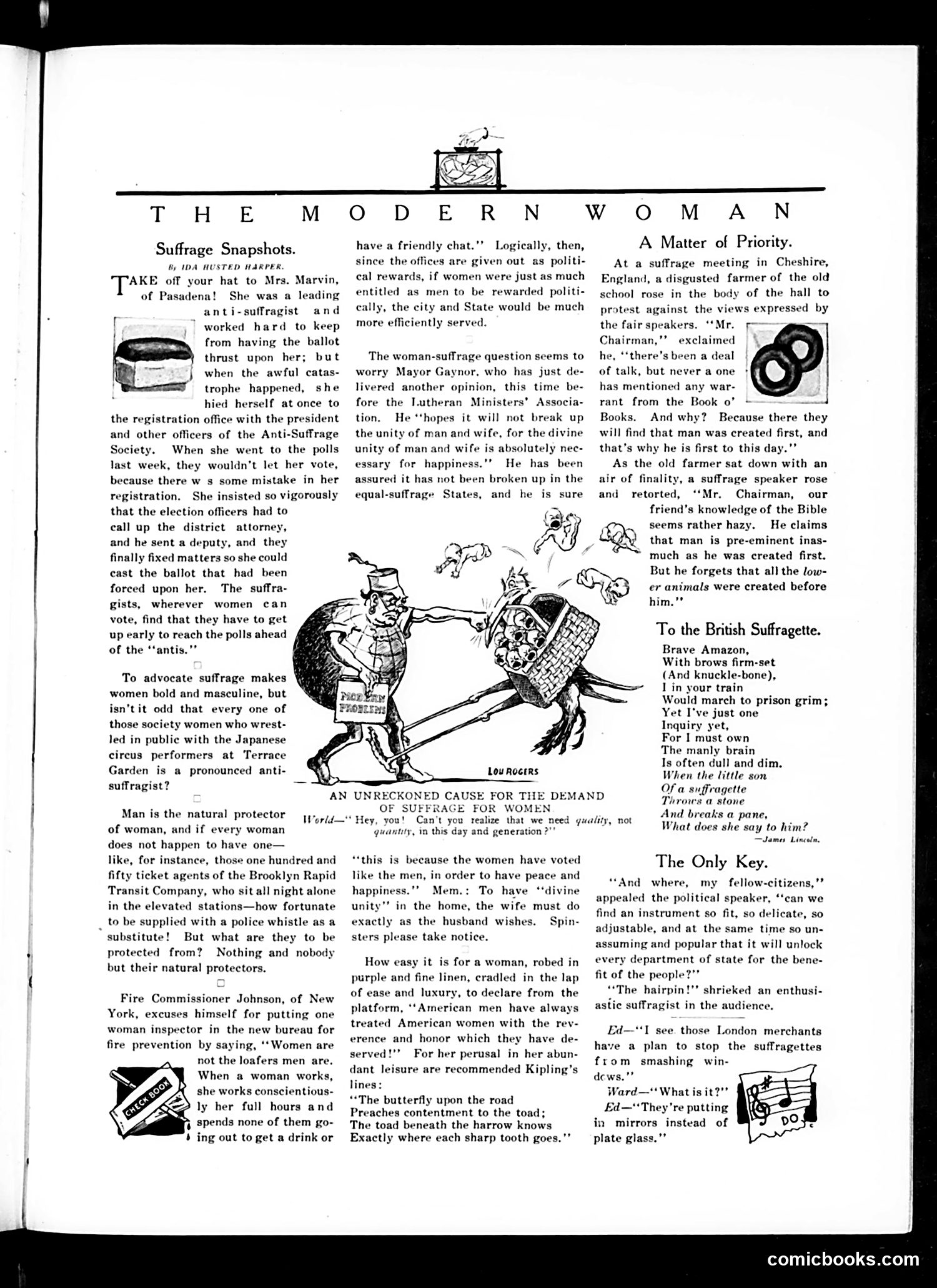
This 1910s satirical page attacks anti-suffrage arguments through columnist Ida Husted Harper's "Suffrage Snapshots." **Main cartoon (Lou Rogers)**: Shows a well-dressed woman striking a man with a club labeled "SUFFRAGE"—mocking claims that voting would make women unfeminine or violent. The cartoon's irony: if women become "bold and masculine" through suffrage advocacy, why were society women who publicly opposed it also considered bold? **Key satirical points:** - Mrs. Marvin (Pasadena) was an anti-suffragist forced to register and vote despite opposition - Fire Commissioner Johnson admits women workers outperform men, yet opposes their political participation - Mayor Gaynor fears suffrage will destroy marriages—Harper's rebuttal: it hasn't in equal-suffrage states - A Kipling poem excerpt mocks wealthy women claiming men treat women honorably while ignoring poor women's struggles **The argument**: Anti-suffragists use selective logic and self-interest to deny women's political equality, contradicting their own observations about women's capability and integrity.
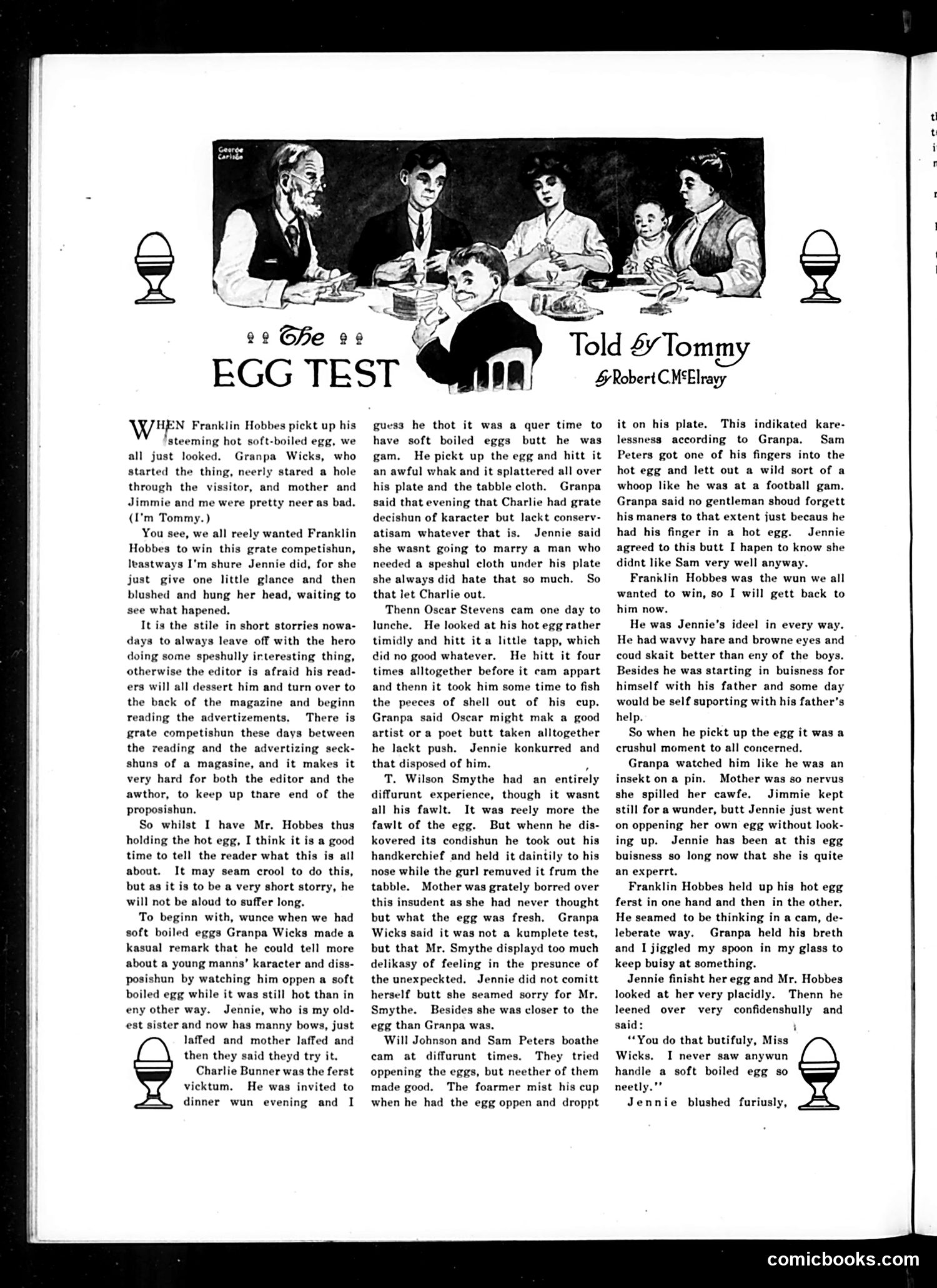
This humorous short story describes a parlor game where Grandpa Wicks evaluates young men's character by observing how they open a soft-boiled egg. The premise is that eating habits reveal personality traits. The story follows several suitors being tested: Charlie Bunner splatters everywhere (reckless); Oscar Stevens taps repeatedly (lacks decisiveness); Wilson Smythe uses a handkerchief delicately (overly fastidious); Will Johnson and Sam Peters fumble the task (careless and undignified). Franklin Hobbes, implied to be winning Jennie's affection, is shown holding his egg, the outcome suspended to keep readers engaged rather than turning to advertisements. The satire gently mocks early 20th-century social rituals—the elaborate character-judging games families played—while the deliberately misspelled narrative voice ("pickt," "speshully") humorously establishes Tommy as the young narrator telling this story.
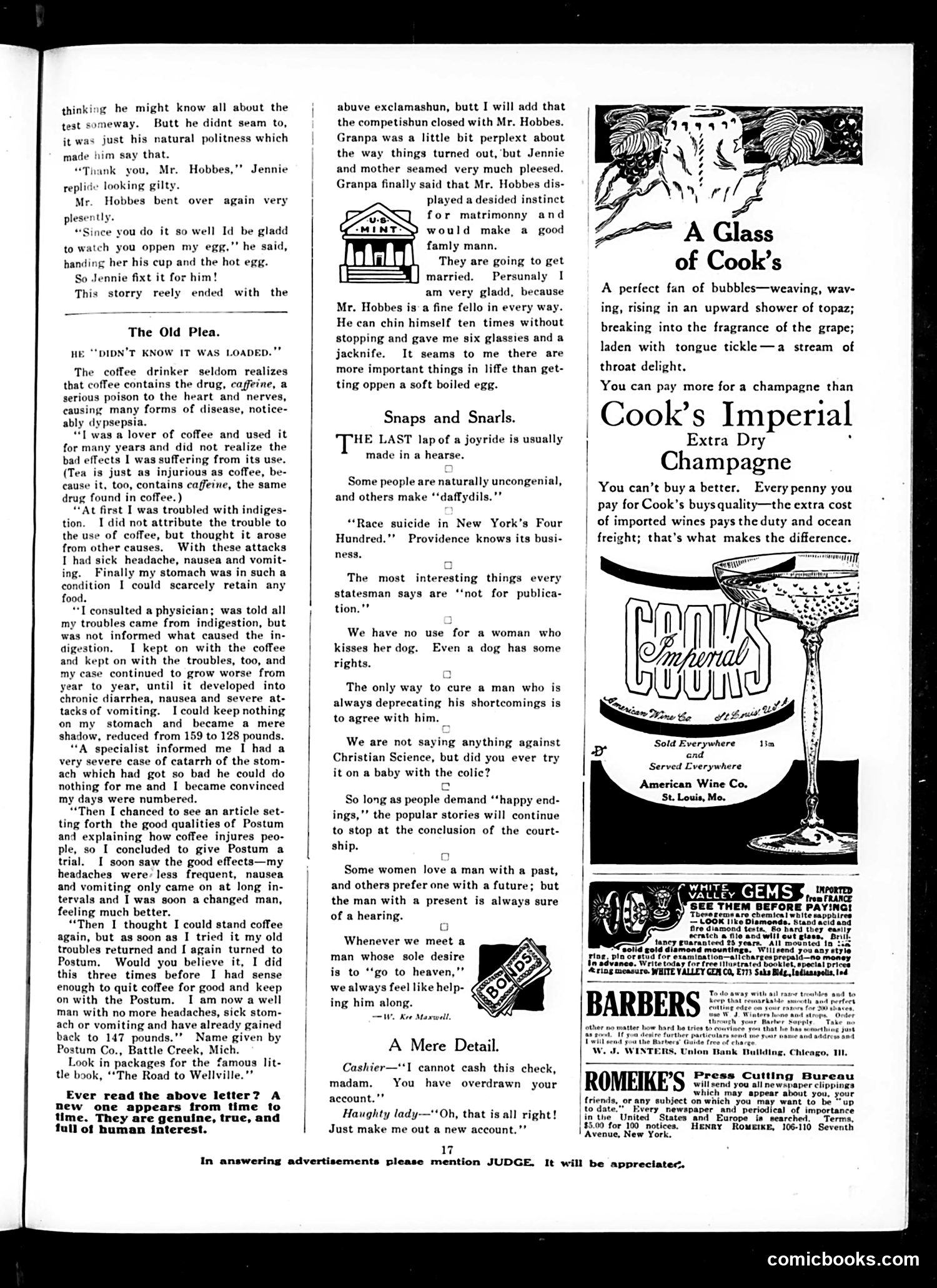
This page mixes satirical fiction with advertisements and social commentary typical of early 20th-century Judge magazine. **The Main Story** ("The Old Plea"): A humorous narrative about a man seeking a wife, focusing on an egg-opening test. The satire appears gentle—poking fun at courtship rituals and the protagonist's obvious preference for the capable Jennie. **"Snaps and Snarls" Section**: Brief satirical quips about contemporary society—mocking "race suicide" among New York's wealthy elite (a period concern about declining birth rates among the upper classes) and making cynical observations about politicians and human nature. **The Postum Advertisement**: Takes up significant space with a testimonial about coffee's dangers (caffeine as a poison causing digestive ailments) and promoting Postum as a healthful alternative. This reflects early 1900s health anxieties and patent medicine marketing, though Postum was legitimate. **Other Advertisements**: Cook's champagne, barbershops, and a press clipping bureau fill remaining space. The page reflects Judge's typical blend of light satire, domestic humor, and commercial content aimed at middle-class readers.
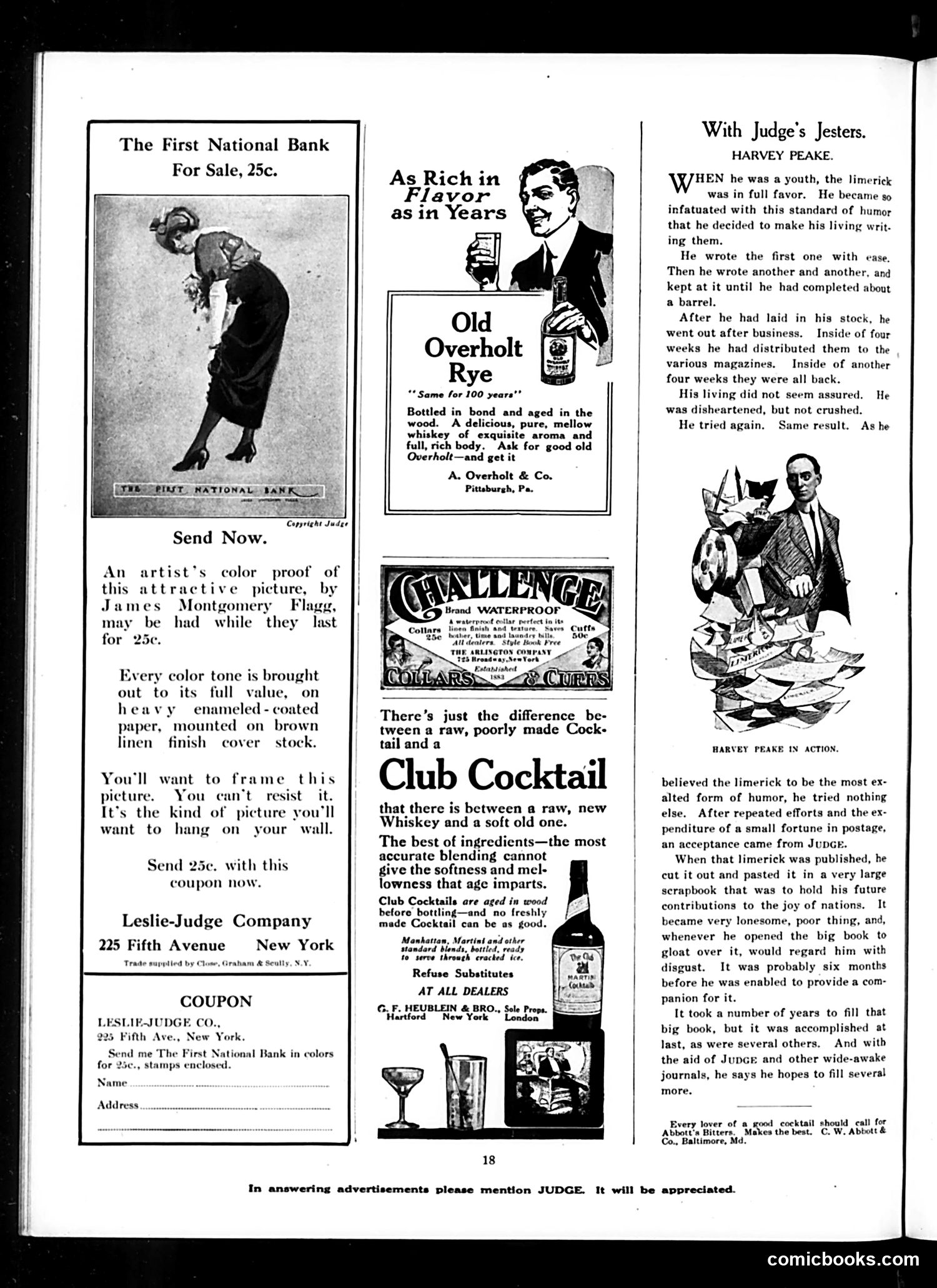
This page is primarily **advertising and humor content**, not political satire. The main features are: 1. **"The First National Bank" print**: A James Montgomery Flagg illustration sold by Leslie-Judge Company for 25 cents—a commercial reproduction offer, not satire. 2. **Liquor advertisements**: Old Overholt Rye and Club Cocktail ads emphasizing age and quality (typical Prohibition-era advertising, though the date is unclear from this page alone). 3. **"With Judge's Jesters" by Harvey Peake**: A humorous biographical sketch about a struggling limerick writer who eventually finds success publishing in *Judge* magazine itself. The cartoon shows Peake submitting work and later celebrating acceptance. It's self-promotional humor—*Judge* jokingly credits itself for discovering this writer's talent. The page reflects early 20th-century magazine culture: commercial art reproduction, liquor marketing, and light satirical humor about the publishing industry itself.
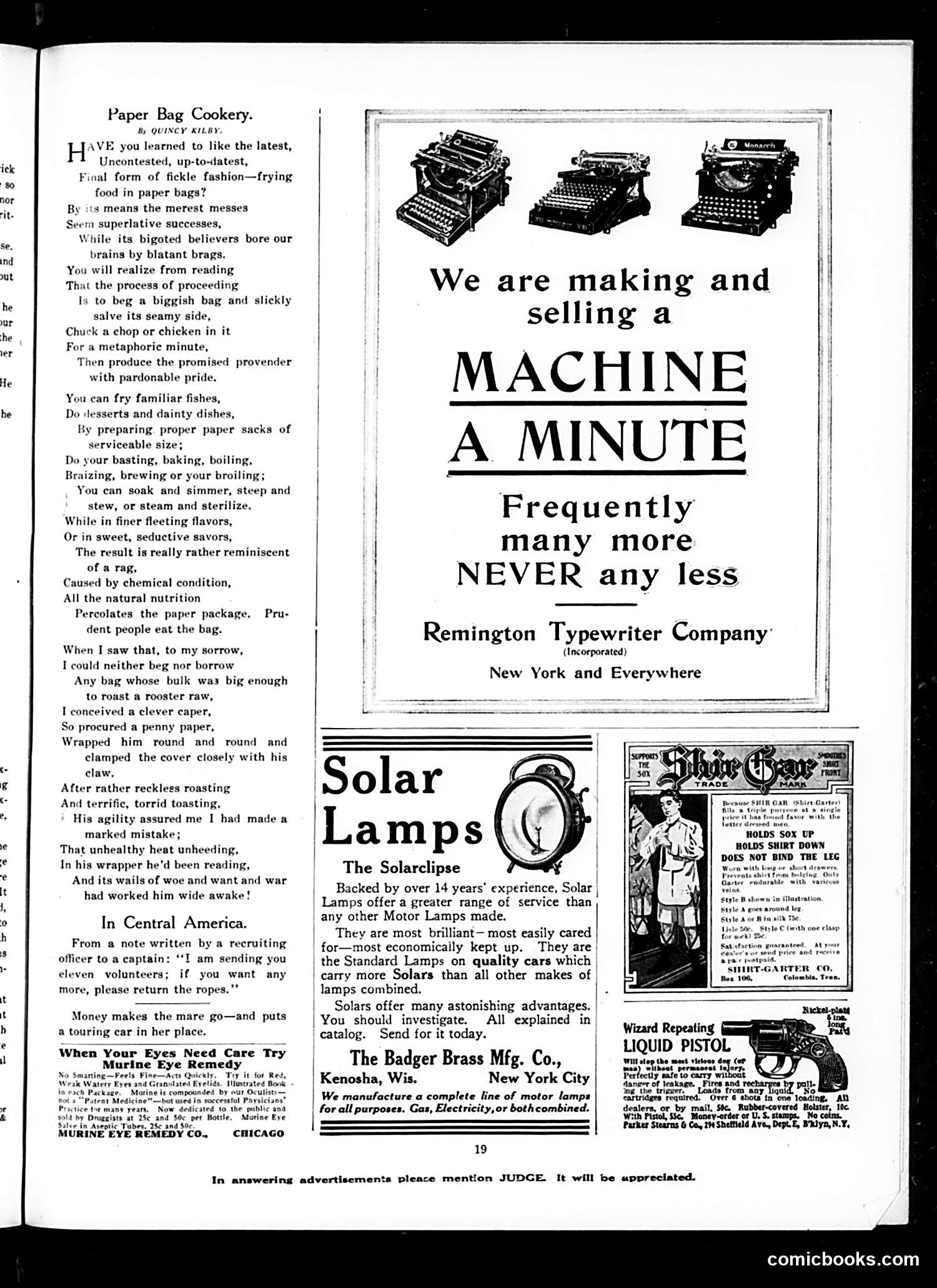
This page is primarily **advertising with one satirical poem**. The poem mocks a contemporary cooking fad: frying food in paper bags, apparently a real trendy method of the era. The poet Quincy Kilby ridicules this as absurd—the food tastes like the bag itself, nutrition escapes through the paper, and the bags themselves become unexpectedly animated (a surreal joke about overheating). The poem's excessive alliteration throughout is intentional parody of bombastic food-trend language. The Central America anecdote is a dark joke about colonial-era labor recruitment: a military officer jokes about needing "ropes" to return volunteer workers, implying coercion or suicide. The rest comprises period advertisements: Remington typewriters ("a machine a minute"), Solar lamps for cars, Murine eye remedy, and other products. These reveal what affluent early-20th-century consumers purchased. No political figures or events are referenced on this page.
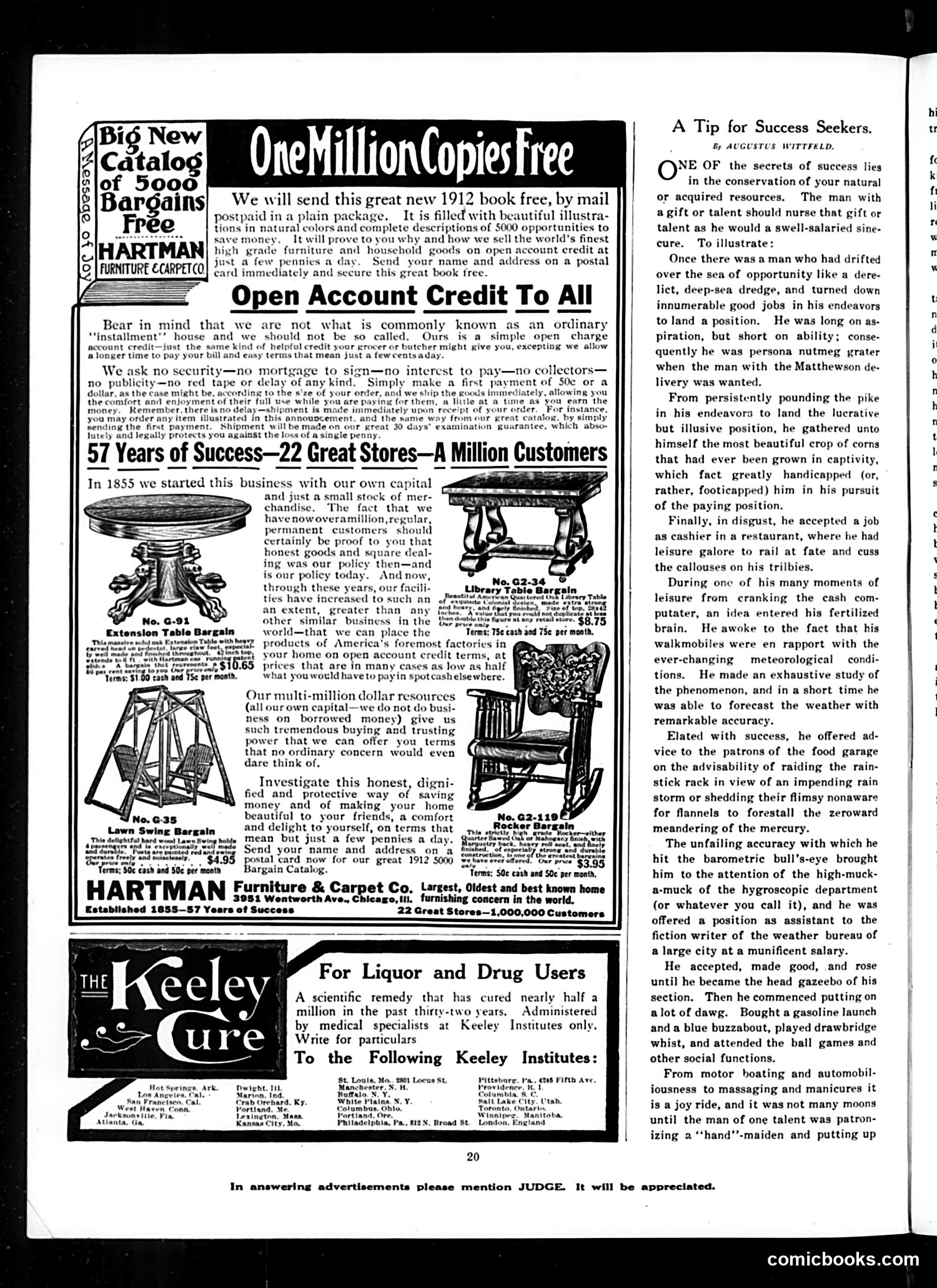
This page is primarily **advertising**, not political satire. The dominant content is a Hartman Furniture Carpet Co. advertisement promoting open-account credit purchasing—a relatively novel concept in 1912. The small essay "A Tip for Success Seekers" (right column) is a morality tale about resource conservation, illustrated by an anecdote about a man who "drifted" through opportunities until accepting a cashier job at a restaurant. Through careful observation—studying weather patterns and mechanical systems—he rose to prominence, eventually securing a lucrative position with a city weather bureau. The essay's implicit message: success rewards those who nurture their talents and observe the world carefully, rather than passively accepting circumstances. The Keeley Institutes advertisement (bottom) promotes treatment for alcohol and drug addiction—a legitimate medical service of the era, though modern readers would recognize such claims with skepticism. The page reflects early 20th-century consumer culture and progressive-era faith in both commercial accessibility and self-improvement.
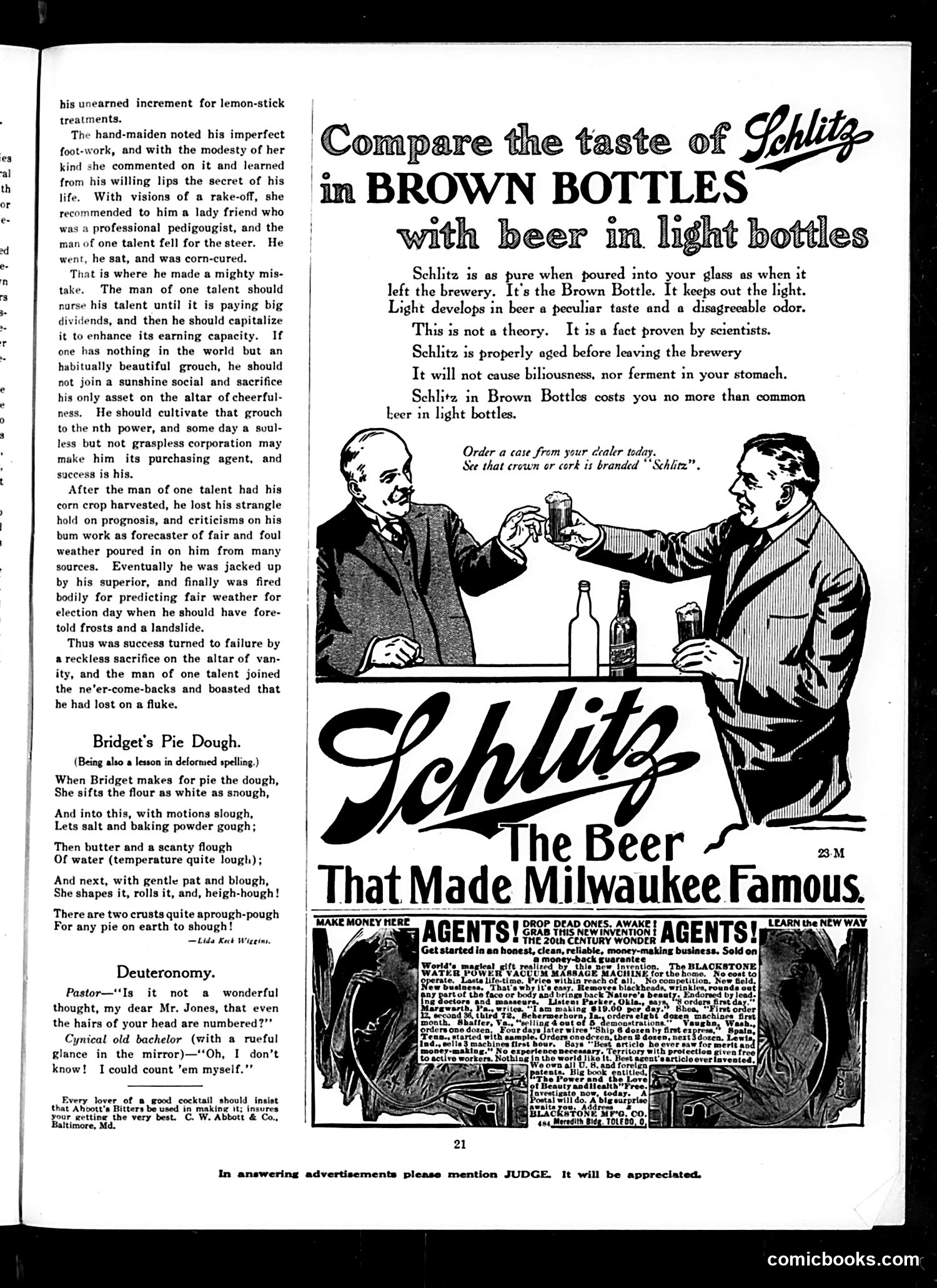
This page contains primarily **advertising** rather than political satire. The dominant content is a large **Schlitz beer advertisement** featuring two men in a tasting comparison. The ad's central claim—that brown bottles preserve beer quality better than light bottles, which develop an off-taste—was a genuine commercial argument of the era. The smaller humorous pieces are light domestic humor: - **"Bridget's Pie Dough"** is a comic poem mocking Irish immigrant speech patterns through deliberate misspellings ("snough" for "snow," "gough" for "go"), reflecting period ethnic stereotyping. - **"Deuteronomy"** is a brief joke about baldness and hair loss. - Other small ads include patent medicine endorsements and business opportunity pitches typical of early 20th-century magazines. The page reflects Judge's mix of satirical commentary with commercial advertising and gentle domestic humor, without significant political content visible here.
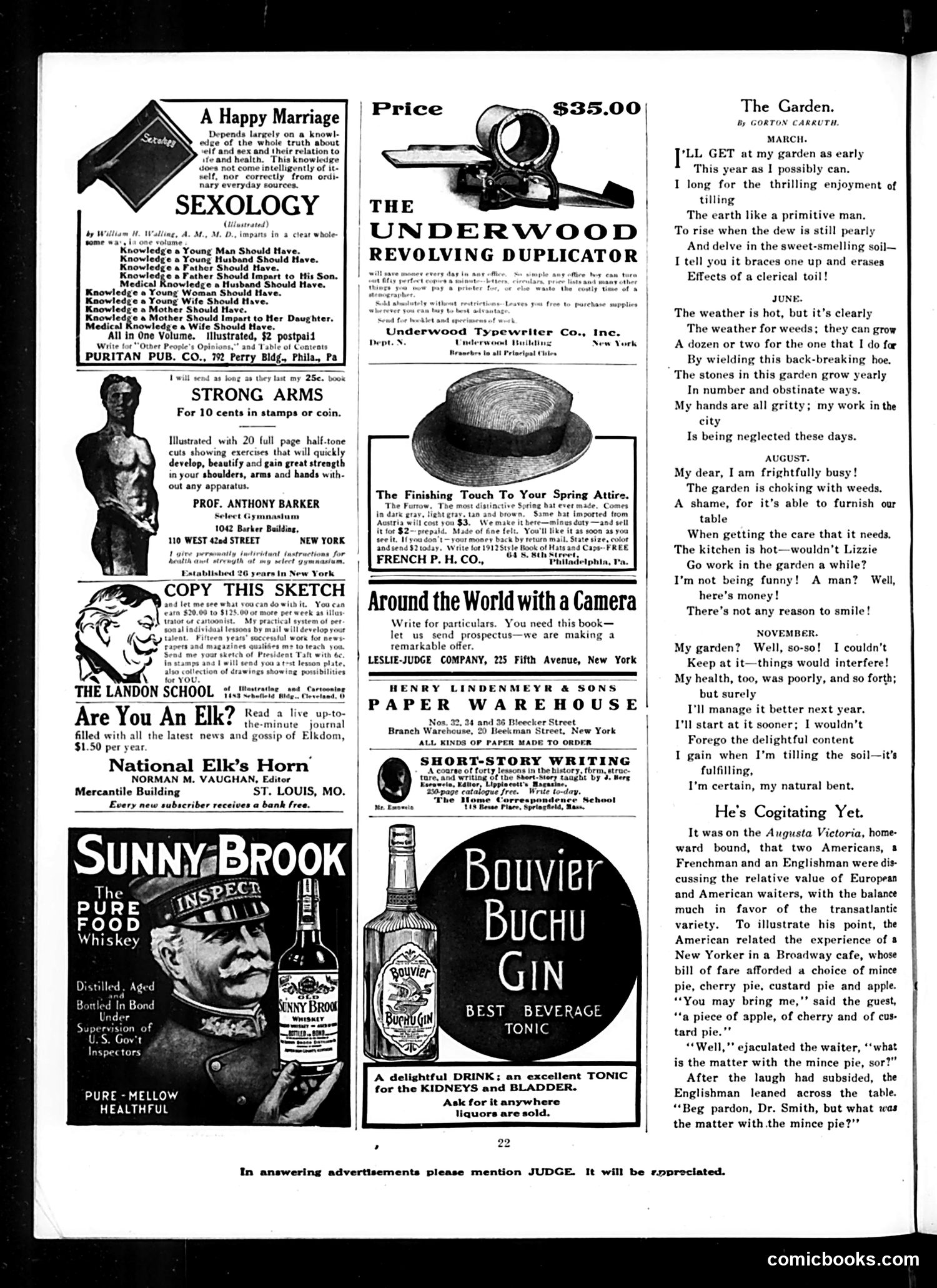
This page features a humorous poem mocking the genteel male urbanite's romantic fantasies about gardening versus reality. The speaker enthusiastically declares in March his intention to reconnect with nature through gardening—imagining himself a "primitive man" rising at dawn to till soil. By June, reality sets in: weeds proliferate, stones multiply mysteriously, and his city work suffers neglect. By August, desperation drives him to suggest *his female servant* do the work instead, offering money when she refuses. By November, he admits defeat through excuses (poor health, interference) yet still romanticizes returning to gardening next year. The satire targets upper-middle-class male sentimentality—the tendency to idealize rustic simplicity while avoiding actual labor, and to exploit domestic staff when personal effort proves inconvenient. The poem's cyclical structure emphasizes how such enthusiasm perpetually reasserts itself despite repeated failure.
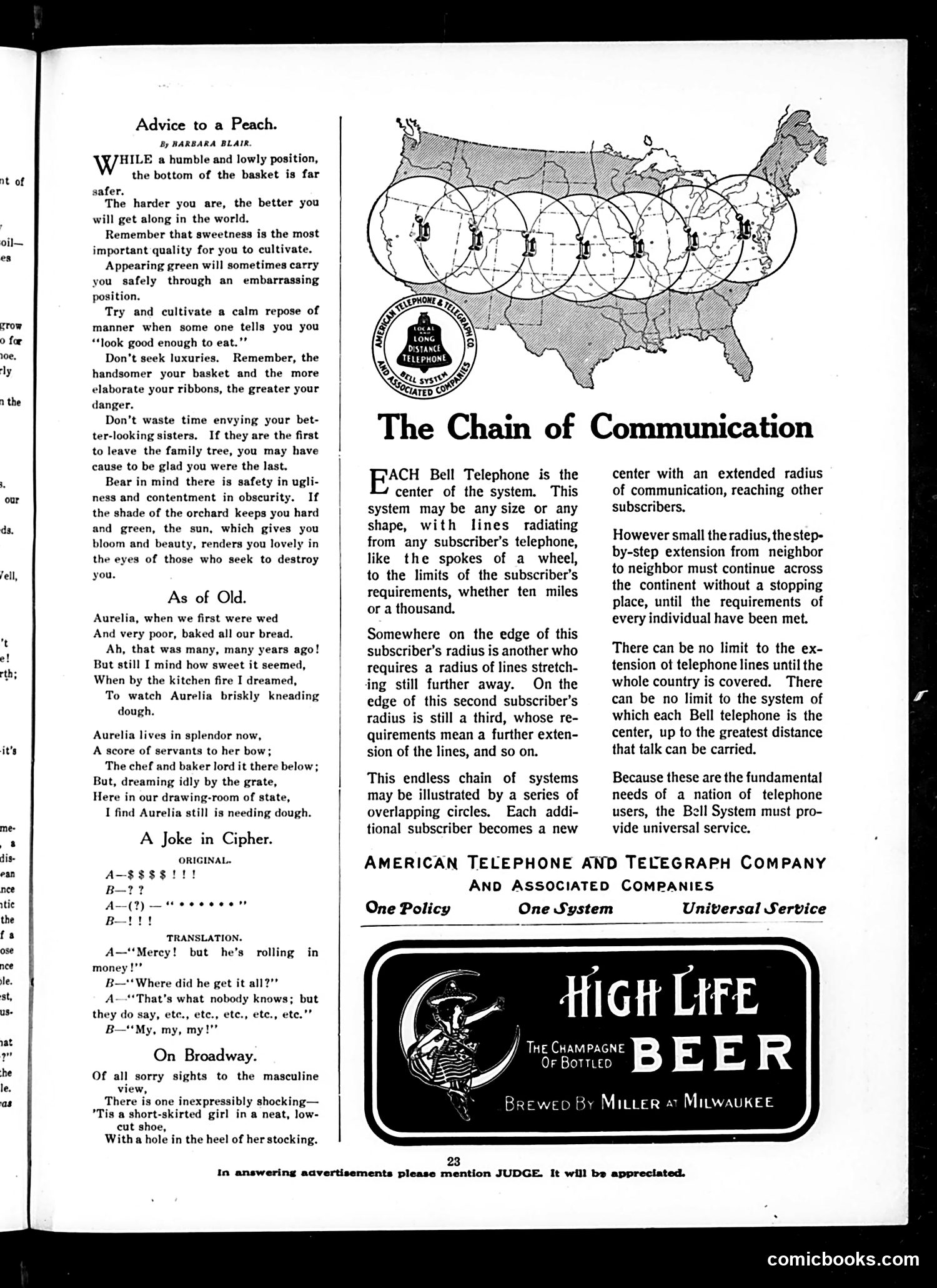
This page contains **several distinct pieces** rather than a unified political cartoon: **"Advice to a Peach"** (by Barbara Blair) is satirical verse addressing a woman as if she were fruit—counseling humility, sweetness, and inconspicuousness. The satire mocks contemporary advice to women to be passive, attractive, and unambitious to avoid danger or unwanted attention. The irony is that safety requires remaining "green" and unattractive. **"As of Old"** is nostalgic verse about a man missing his wife's former domestic role, despite her now having servants—satirizing male nostalgia for simpler times and resentment of women's improved circumstances. **"A Joke in Cipher"** and **"On Broadway"** are brief comic pieces about gossip and women's fashion (specifically hosiery with holes). **The remainder is advertising**: a lengthy Bell Telephone System corporate explanation of network expansion, and a High Life Beer advertisement. The page reflects early 20th-century Judge humor—genteel satire of gender roles, aspiration, and social anxieties, alongside corporate messaging.