
Judge, 1912-05-04 · page 7 of 23
Judge — May 4, 1912 — page 7: what you’re looking at
What you’re looking at
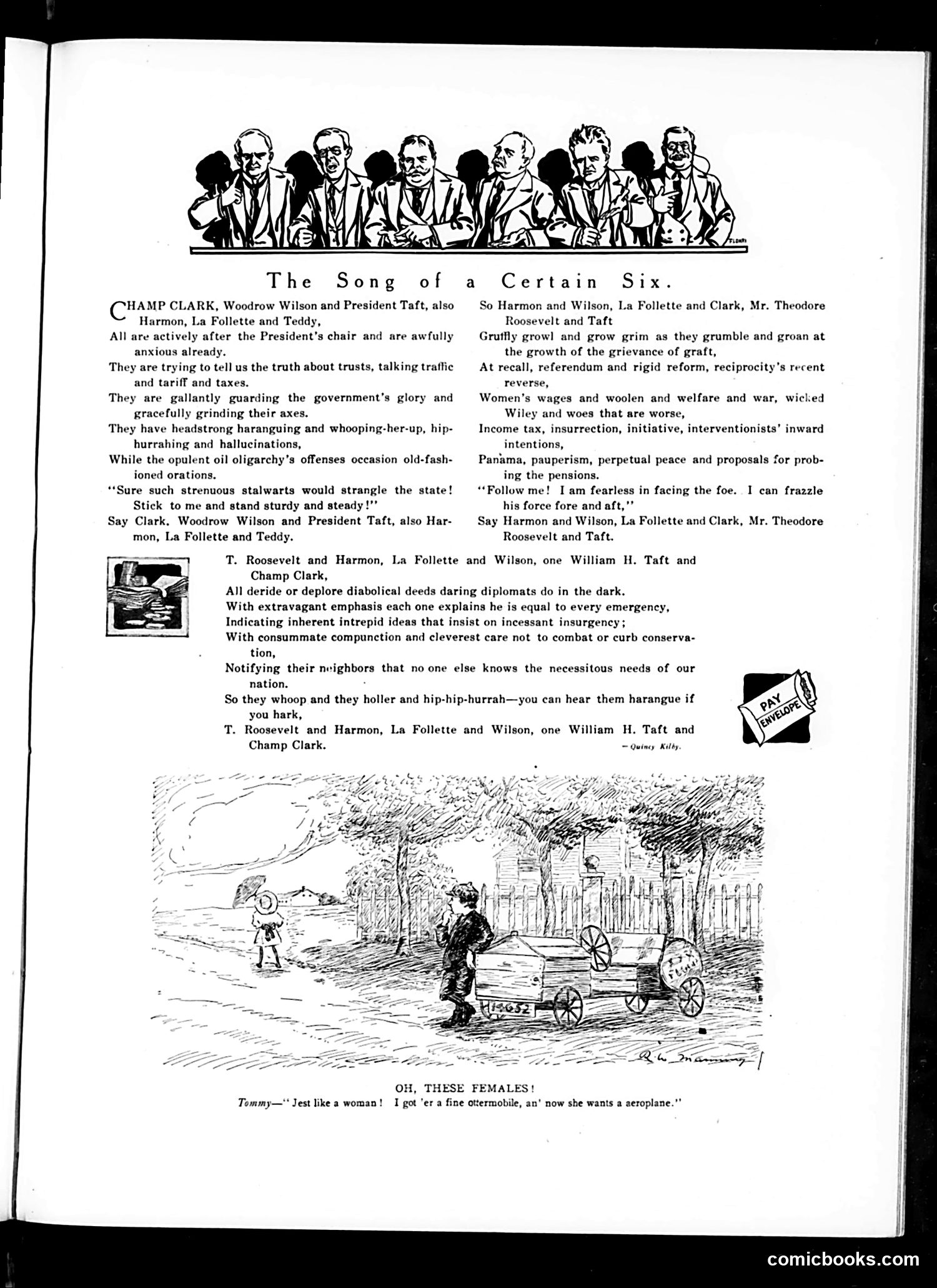
This 1912 Judge magazine page mocks six presidential candidates competing for the White House: Champ Clark, Woodrow Wilson, President William H. Taft, James Harmon, Robert La Follette, and Theodore Roosevelt. The satirical song ridicules their campaign rhetoric—each claiming sole ability to fight corruption, trusts, and graft while attacking opponents. Judge suggests these politicians are hypocritically "grinding their axes" (pursuing self-interest) while posturing as reformers. They all address identical issues (women's rights, tariffs, income tax, Panama Canal) yet claim unique competence. The accompanying cartoon illustrates the "greedy oligarch" theme: a boy complains his girlfriend wants an airplane after he bought her a motorcar—mocking women's supposedly insatiable desires. This reflects period gender attitudes. The satire's core message: all six candidates sound identical in their reform promises, making their competition meaningless posturing rather than substantive policy debate.
📄 Transcribed text from this page (OCR, searchable)
Machine-transcribed from the original scan — historical spelling and the odd misread are preserved.
The Song of HAMP CLARK, Woodrow Wilson and President Taft, also Harmon, La Follette and Teddy, All are actively after the President's chair and are awfully anxious already. They are trying to tell us the truth about trusts, talking traffic and tariff and taxes. They are gallantly guarding the government's glory and gracefully grinding their axes. They have headstrong haranguing and whooping-her-up, hip- burrahing and hallucinations, While the opulent oil oligarchy’s offenses occasion old-fash- ioned orations. ‘Sure such strenuous stalwarts would strangle the state! Stick to me and stand sturdy and steady !’’ Say Clark. Woodrow Wilson and President Taft, also Har- mon, La Follette and Teddy. Certain Six. So Harmon and Wilson, La Follette and Clark, Mr. Theodore Roosevelt and Taft Grutfly growl and grow grim as they grumble and groan at the growth of the grievance of graft, At recall, referendum and rigid reform, reciprocity’s recent reverse, Women’s wages and woolen and welfare and war, wicked Wiley and woes that are worse, Income tax, insurrection, initiative, interventionists’ inward intentions, Panama, pauperism, perpetual peace and proposals for prob- ing the pensions. “Follow me! I am fearless in facing the foe. I can frazzle his force fore and aft,’’ Say Harmon and Wilson, La Follette and Clark, Mr. Theodore Roosevelt and Taft. T. Roosevelt and Harmon, La Follette and Wilson, one William H. Taft and Champ Clark, All deride or deplore diabolical deeds daring diplomats do in the dark. With extravagant emphasis each one explains he is equal to every emergency, Indicating inherent intrepid ideas that insist on incessant insurgency ; With consummate compunction and cleverest care not to combat or curb conserva- tion, Notifying their neighbors that no one else knows the necessitous needs of our nation. So they whoop and they holler and hip-hip-hurrah—you can hear them harangue if you hark, T. Roosevelt and Harmon, La Follette and Wilson, one William H. Taft and Champ Clark. Quincy Kilby OH, THESE FEMALES! Tommy—* Jest like a woman! I got ‘er a fine ottermobile, an’ now she wants a aeroplane." comicbooks.com