
Judge, 1912-05-04 · page 10 of 23
Judge — May 4, 1912 — page 10: what you’re looking at
What you’re looking at
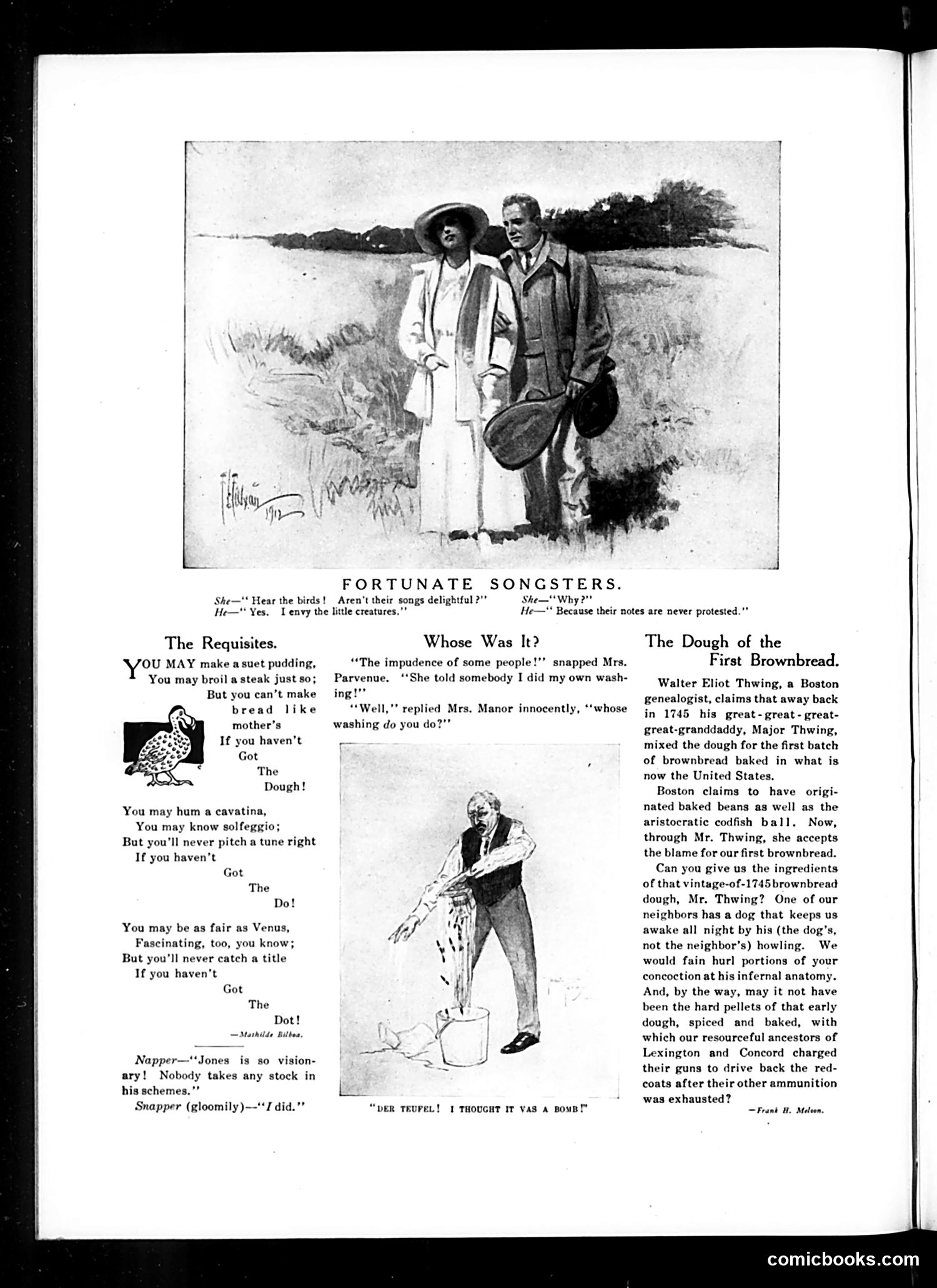
This Judge magazine page contains several brief satirical pieces mocking social pretension and economic reality. **"Fortunate Songsters"** (top): A couple appreciates birds' songs because "their notes are never protested"—a financial pun on promissory notes, suggesting wealthy people need not worry about unpaid debts, while ordinary people do. **"The Requisites"** (left): Humorous poems playing on double meanings. "The Dough" satirizes that money ("dough") is essential to success in cooking, music, and marriage, just as technical skill is. "The Do" uses musical terminology for similar effect. **"Whose Was It?"** (center): Mocks new-money pretension. Mrs. Parvenue (a French surname suggesting nouveau riche) is offended someone suggested she does her own washing, revealing her insecurity about her social status. **"The Dough of the First Brownbread"** (right): A humorous genealogical claim by a Bostonian that his ancestor invented brownbread in 1745, playfully suggesting readers could use the hard, early recipe as ammunition—mocking both genealogical snobbery and Boston's claim to culinary invention.
📄 Transcribed text from this page (OCR, searchable)
Machine-transcribed from the original scan — historical spelling and the odd misread are preserved.
* Hear the birds! Yes. Lenvy the little creatures.”” The Requisites. ‘OU MAY make asuet pudding, You may broil a steak just so; But you can’t make bread like mother’s If you haven't Got The Dough! You may hum a cavatina, You may know solfeggio; But you'll never pitch a tune right If you haven't Got The Do! You may be as fair as Venus, Fascinating, too, you know; But you'll never catch a title If you haven't Got The Dot! —Mathilde Bilbes, Napper—'‘Jones is so vision- ary! Nobody takes any stock in his schemes.”” Snapper (gloomily)—-'I did.”” FORTUNATE SONGSTERS. Aren't their songs delightful ?”” “Why 2” Whose Was It? “The impudence of some people!’ snapped Mrs. Parvenue. ‘‘She told somebody I did my own wash- ing!"" “*Well,’’ replied Mrs. Manor innocently, ‘‘whose washing do you do?”” “DER TEUPEL! I THOUGHT IT VAS A BoB!” Because their notes are never protested."" The Dough of the First Brownbread. Walter Eliot Thwing, a Boston genealogist, claims that away back in 1745 his great-great -great- great-granddaddy, Major Thwing, mixed the dough for the first batch of brownbread baked in what is now the United States. Boston claims to have origi- nated baked beans as well as the aristocratic codfish ball. Now, through Mr. Thwing, she accepts the blame for our first brownbread. Can you give us the ingredients of that vintage-of-1745 brownbread dough, Mr. Thwing? One of our neighbors has a dog that keeps us awake all night by his (the dog’s, not the neighbor's) howling. We would fain hurl portions of your concoction at his infernal anatomy. And, by the way, may it not have been the hard pellets of that early dough, spiced and baked, with which our resourceful ancestors of Lexington and Concord charged their guns to drive back the red- coats after their other ammunition was exhausted? — Frank H. Maleon. comicbooks.com