
Judge, 1912-05-04 · page 9 of 23
Judge — May 4, 1912 — page 9: what you’re looking at
What you’re looking at
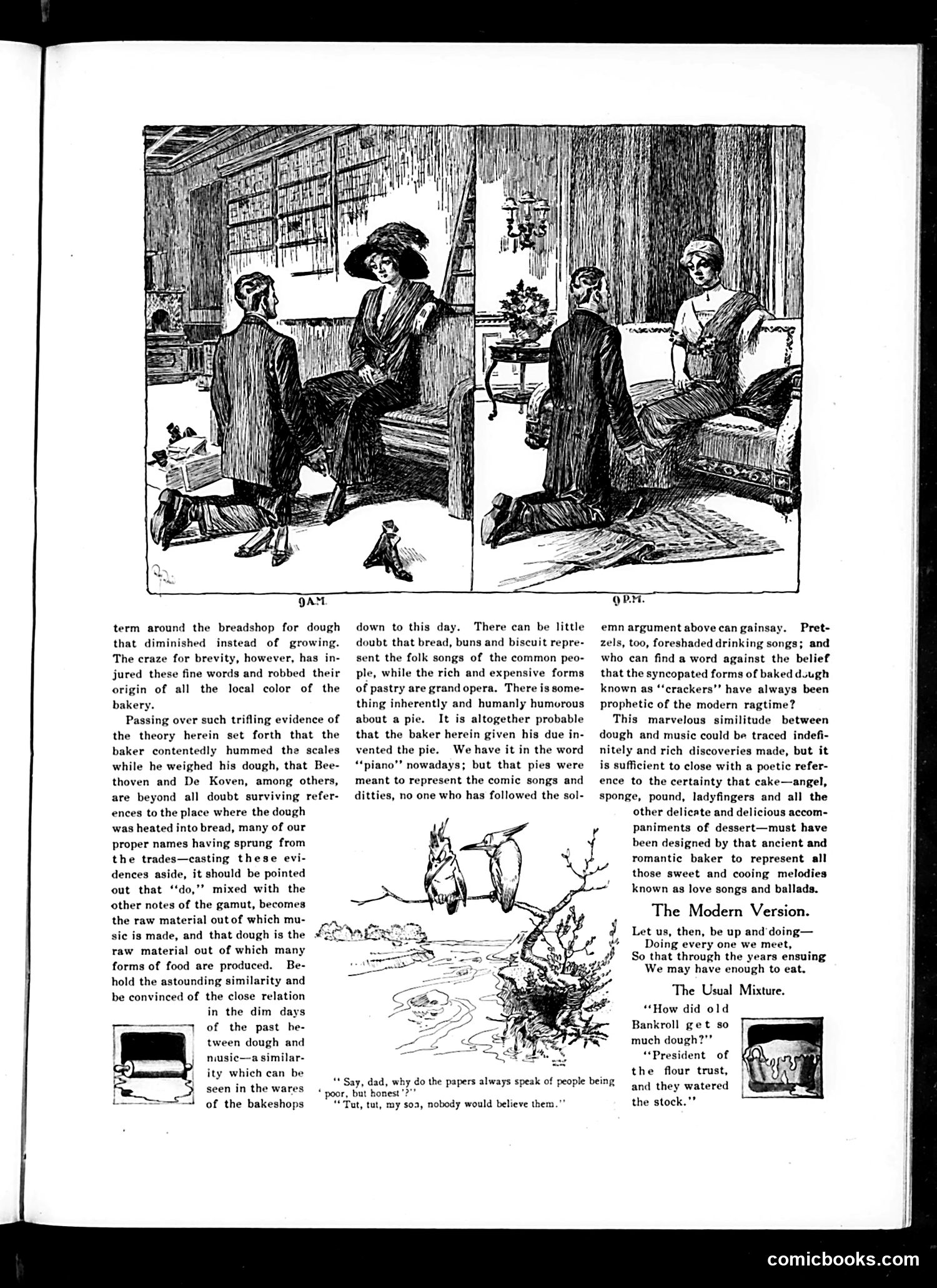
This page satirizes **economic inequality and food access** in early 20th-century America through wordplay and social commentary. The main article uses a whimsical extended metaphor: bread-baking terminology (dough, do, etc.) supposedly derives from music, with folk breads representing "common people's songs" and fancy pastries representing "grand opera." This establishes a hierarchy—cheap bread versus expensive pastry mirrors class divisions. The cartoon dialogue at bottom provides the actual social critique: A child asks why newspapers call poor people "honest," while his father explains that the wealthy "President of the flour trust" accumulated "dough" (money) by controlling the flour industry and "watering the stock" (financial fraud). The implication: wealth comes from monopolistic manipulation, not honest labor, yet the press romanticizes poverty while ignoring corporate dishonesty. The satire targets both **corrupt business practices** (trust monopolies, stock manipulation) and **media hypocrisy** in portraying the poor favorably while enabling the rich to exploit them.
📄 Transcribed text from this page (OCR, searchable)
Machine-transcribed from the original scan — historical spelling and the odd misread are preserved.
term around the breadshop for dough that diminished instead of growing. The craze for brevity, however, has in- jured these fine words and robbed their origin of all the local color of the bakery. Passing over such trifling evidence of the theory herein set forth that the baker contentedly hummed the scales while he weighed his dough, that Bee- thoven and De Koven, among others, are beyond all doubt surviving refer- ences to the place where the dough was heated into bread, many of our proper names having sprung from the trades—casting these evi- dences aside, it should be pointed out that ‘‘do,’’? mixed with the other notes of the gamut, becomes the raw material out of which mu- sic is made, and that dough is the raw material out of which many forms of food are produced. Be- hold the astounding similarity and be convinced of the close relation in the dim days of the past he- tween dough and niusic—a similar- ity which can be seen in the wares a down to this day. There can be little doubt that bread, buns and biscuit repre- sent the folk songs of the common peo- ple, while the rich and expensive forms of pastry are grand opera. There is some- thing inherently and humanly humorous about a pie. It is altogether probable that the baker herein given his due in- vented the pie. We have it in the word “‘piano’’ nowadays; but that pies were meant to represent the comic songs and ditties, no one who has followed the sol- “Say, dad, why do the papers always speak of people being QRH. emn argument above can gainsay. Pret- zels, too, foreshaded drinking songs; and who can find a word against the belief that the syncopated forms of baked dsugh known as “‘crackers’’ have always been prophetic of the modern ragtime? This marvelous similitude between dough and music could be traced indefi- nitely and rich discoveries made, but it is sufficient to close with a poetic refer- ence to the certainty that cake—angel, sponge, pound, ladyfingers and all the other delicate and delicious accom- paniments of dessert—must have been designed by that ancient and romantic baker to represent all those sweet and cooing melodies known as love songs and ballads. The Modern Version. Let us, then, be up and doing— Doing every one we meet, So that through the years ensuing We may have enough to eat. The Usual Mixture. “How did old Bankroll get so much dough?"’ “President of the flour trust, and they watered * poor, but honest?’ “Tut, tut, my soa, nobody would believe them." of the bakeshops the stock.’’ comicbooks.com