
Judge, 1912-05-04 · page 8 of 23
Judge — May 4, 1912 — page 8: what you’re looking at
What you’re looking at
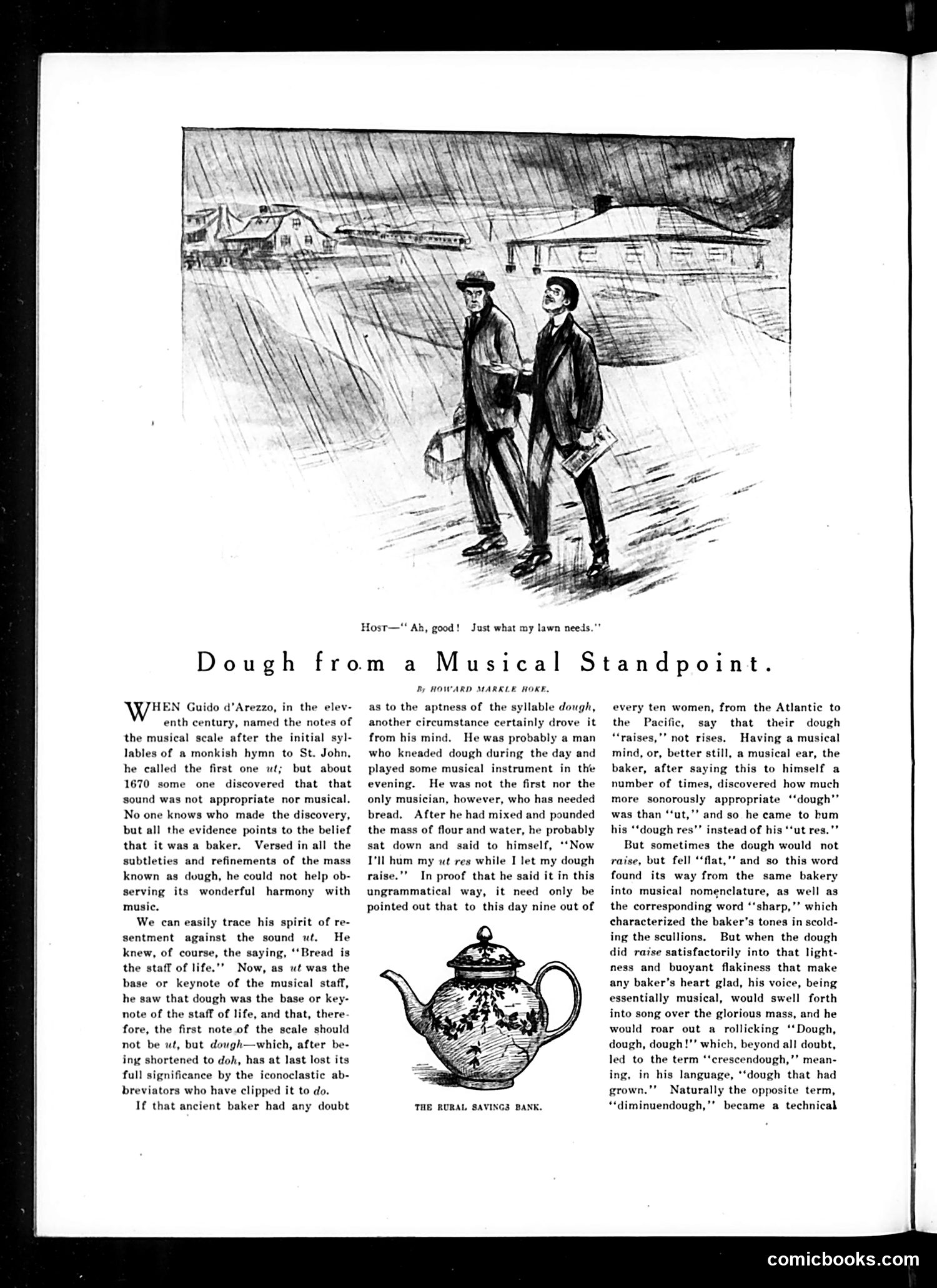
This is a humorous essay with accompanying cartoon, not political satire. The piece playfully traces the origin of musical terminology to a baker, claiming the musical note "do" (originally "ut") derives from "dough." **The cartoon** shows two men on what appears to be a snowy field near farm buildings. One says "Ah, good! Just what my lawn needs"—likely referring to the "dough" or snow visible in the background, creating a visual pun. **The satire** is linguistic wordplay: the author humorously argues that a musical baker, frustrated with kneading dough daily while playing instruments nightly, originated musical terms like "dough," "raise," "flat," and "sharp" from bread-baking experiences. Terms like "crescendough" (dough that has grown) and "diminuendough" are invented extensions of this conceit. The separate illustration of a teapot labeled "The Rural Savings Bank" appears unrelated—likely an advertisement or filler image common in Judge magazine.
📄 Transcribed text from this page (OCR, searchable)
Machine-transcribed from the original scan — historical spelling and the odd misread are preserved.
Hosr—“‘ Ah, good! Just what my lawn needs." Dough from a Musical Standpoint. HEN Guido d’Arezzo, in the elev- enth century, named the notes of the musical scale after the initial syl- lables of a monkish hymn to St. John, he called the first one wf; but about 1670 some discovered that that sound was not appropriate nor musical. No one knows who made the discovery, but all the evidence points to the belief that it was a baker. Versed in all the subtleties and refinements of the mass known as dough, he could not help ob- harmony with one serving its wonderful music. We can easily trace his spirit of re- sentment against the sound ut. He knew, of course, the saying, ‘Bread is the staff of life.’’ Now, as ut was the base or keynote of the musical staff, he saw that dough was the base or key- note of the staff of life, and that, there fore, the first note of the scale should not be ut, but dough—which, after be- ing shortened to doh, has at last lost its full significance by the iconoclastic ab- breviators who have clipped it to do. If that ancient baker had any doubt By HOWARD MARKLE HOKE. as to the aptness of the syllable dough, another circumstance certainly drove it from his mind. He was probably a man who kneaded dough during the day and played some musical instrument in the evening. He was not the first nor the only musician, however, who has needed bread. After he had mixed and pounded the mass of flour and water, he probably sat down and said to himself, **Now I'll hum my ut res while I let my dough raise.’’ In proof that he said it in this ungrammatical way, it need only be pointed out that to this day nine out of THE RURAL SAVING3 BANK. every ten women, from the Atlantic to the that their dough “raises,’’ not rises. Having a musical mind, or, better still, a musical ear, the baker, after saying this to himself a number of times, discovered how much more sonorously appropriate ‘‘dough’’ was than ‘‘ut,"’ and so he came to hum his ‘‘dough res’’ instead of his ‘‘ut res."" But sometimes the dough would not raise, but fell ‘‘flat,’’ and so this word found its way from the same bakery into musical nomenclature, as well as the corresponding word ‘‘sharp,’’ which characterized the baker’s tones in scold- ing the scullions, But when the dough did raise satisfactorily into that light- ness and buoyant flakiness that make any baker's heart glad, his voice, being essentially musical, would swell forth into song over the glorious mass, and he would roar out a rollicking ‘Dough, dough, dough!’’ which, beyond all doubt, led to the term ‘‘crescendough,’’ mean- ing, in his language, ‘‘dough that had grown.’’ Naturally the opposite term, “‘diminuendough,’’ became a technical Pacific, say comicbooks.com