
Judge, 1912-05-04 · page 6 of 23
Judge — May 4, 1912 — page 6: what you’re looking at
What you’re looking at
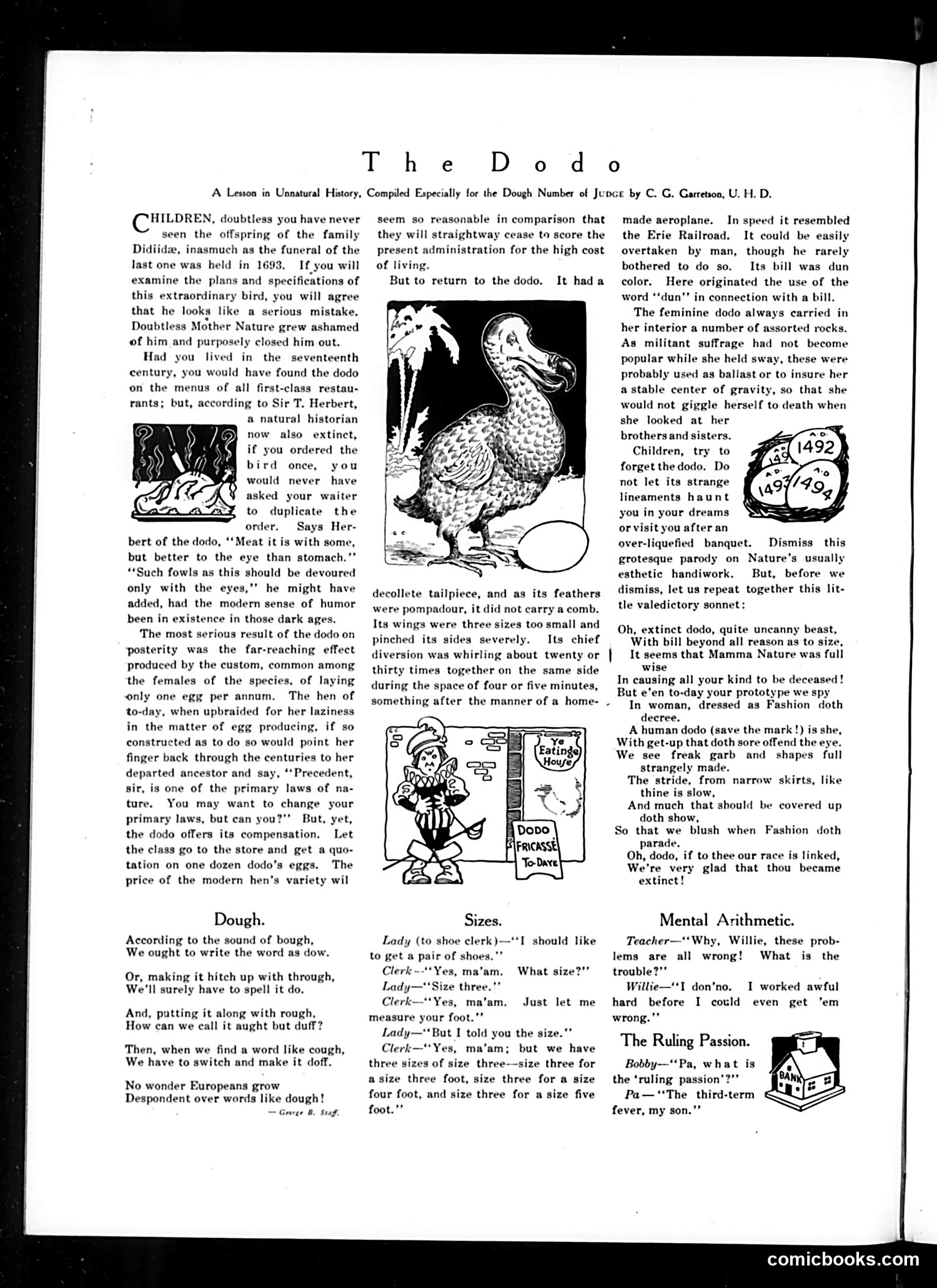
This satirical article uses the extinct dodo bird as a vehicle for contemporary criticism. The piece parodies "lessons in natural history" while actually commenting on modern American issues. The main target appears to be the **high cost of living** under the current administration (likely Woodrow Wilson's presidency, given Judge's era). The author suggests that examining the dodo's impracticality—a creature so useless it was rightfully extinct—makes present economic grievances seem "reasonable in comparison." The humor also mocks **gender politics**, referencing "militant suffrage" and suggesting female dodos used rocks as ballast, a dig at women's suffrage activism. Additionally, the page includes humorous vignettes about **English language absurdities** ("dough" pronunciation) and shoe-sizing confusion, which are unrelated satirical sketches typical of Judge magazine's miscellaneous comedy content. The overall tone is conservative social satire—using natural history as cover for political complaint about inflation and women's activism.
📄 Transcribed text from this page (OCR, searchable)
Machine-transcribed from the original scan — historical spelling and the odd misread are preserved.
T h e Dodo A Lesson in Unnatural History, Compiled Especially for the Dough Number of Junce by C. G. Garretson, U. H. D. HILDREN, doubtless you have never n the offspring of the family inasmuch as the funeral of the last one was held in 1693. If you will examine the plans and specifications of this extraordinary bird, you will agree that he looks like a serious mistake. Doubtless Mother Nature grew ashamed of him and purposely closed him out. Had lived in the seventeenth century, you would have found the dodo on the menus of all first-class restau- rants; but, according to Sir T. Herbert, a natural historian now also extinct, if you ordered the bird once, you would never have asked your waiter to duplicate the order. Says Her- bert of the dodo, ‘‘Meat it is with some, but better to the eye than stomach.” “Such fowls as this should be devoured only with the eyes,’’ he might have added, had the modern sense of humor been in existence in those dark ages. The most serious result of the dodo on posterity was the far-reaching effect produced by the custom, common among the females of the species, of laying only one egg per annum. The hen of to-day, when upbraided for her laziness in the matter of egg producing, if so constructed as to do so would point her finger back through the centuries to her departed ancestor and say, ‘Precedent, sir, is one of the primary laws of na- You may want to change your primary laws, but can you?"’ But, yet, the dodo offers its compensation, Let the class go to the store and get a quo- tation on one dozen dodo’s eggs. The price of the modern hen’s variety wil you ture. Dough. According to the sound of bough, We ought to write the word as dow. Or, making it hitch up with through, We'll surely have to spell it do. And, putting it along with rough, How can we call it aught but duff? Then, when we find a word like cough, We have to switch and make it doff. No wonder Europeans grow Despondent over words like dough! — Grover B. Staf. seem so reasonable in comparison that they will straightway cease to score the present administration for the high cost of living. But to return to the dodo. It hada decollete tailpiece, and as its feathers were pompadour, it did not carry a comb. Its wings were three sizes too small and pinched its sides severely. Its chief diversion was whirling about twenty or thirty times together on the same side during the space of four or five minutes, something after the manner of a home- Lady (to shoe clerk)—*'I should like to get a pair of shoes."’ Clerk --*Yes, ma’am. Lady—'‘Size three.”” Clerk—"*Yes, measure your foot."’ Lady—*‘But I told you the size.’ Clerk—'Yes, ma'am; but we have three sizes of size three—size three for asize three foot, size three for a size four foot, and size three for a size five foot."” What size?’’ ma'am, Just let me made aeroplane. In speed it resembled the Erie Railroad. It could be easily overtaken by man, though he rarely bothered to do so. Its bill was dun color. Here originated the use of the word ‘‘dun’’ in connection with a bill. The feminine dodo always carried in her interior a number of assorted rocks. As militant suffrage had not become popular while she held sway, these were probably used as ballast or to insure her astable center of gravity, so that she would not giggle herself to death when she looked at her brothers and sisters. Children, try to forget the dodo. Do not let its strange lineaments haunt you in your dreams or visit you after an over-liquefied banquet. Dismiss this grotesque parody on Nature’s usually esthetic handiwork. But, before we dismiss, let us repeat together this lit- tle valedictory sonnet: Oh, extinct dodo, quite uncanny beast, With bill beyond all reason as to size, {It seems that Mamma Nature was full wise In causing all your kind to be deceased! But e’en to-day your prototype we spy In woman, dressed as Fashion doth decree. A human dodo (save the mark !) is she, With get-up that doth sore offend the eye. We see freak garb and s! s full strangely made. The stride, from narrow skirts, like thine is slow, And much that should be covered up doth show, So that we blush when Fashion doth parade. Oh, dodo, if to thee our race is linked, We're very glad that thou became extinct! Mental Arithmetic. Teacher—'*Why, Willie, these prob- lems are all wrong! What is the trouble?’’ Willie—T don’no. hard before I could wrong."’ The Ruling Passion. Bobby—‘‘Pa, what is the ‘ruling passion’?’’ Pa—‘‘The third-term fever, my son."’ I worked awful even get ‘em comicbooks.com