
A complete issue · 23 pages · 1912
Judge — April 27, 1912
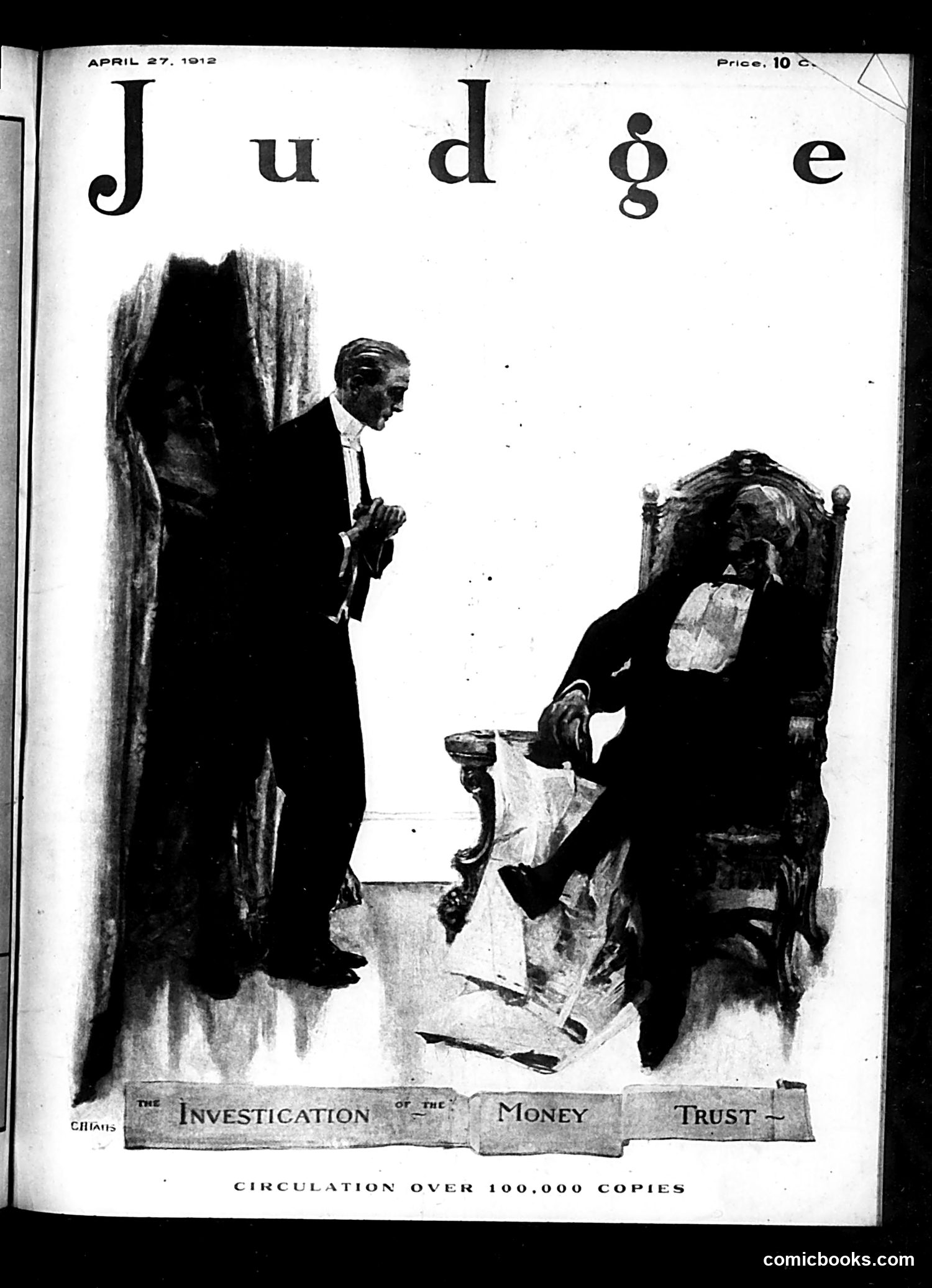
This satirical cover depicts "The Investigation of the Money Trust." The image shows two figures in formal attire in what appears to be a courtroom or official setting: one standing (appearing to present or testify) and one seated (in a position of authority, likely a judge). The "Money Trust" refers to the period's widespread concern about banking monopolies and financial concentration. Congressional investigations into alleged trusts—combinations of wealthy financiers controlling credit and capital—were prominent political issues in the early 1910s. Judge magazine's satire likely critiques either the ineffectiveness of these investigations or suggests that powerful financial interests could manipulate or evade oversight through the legal process itself.
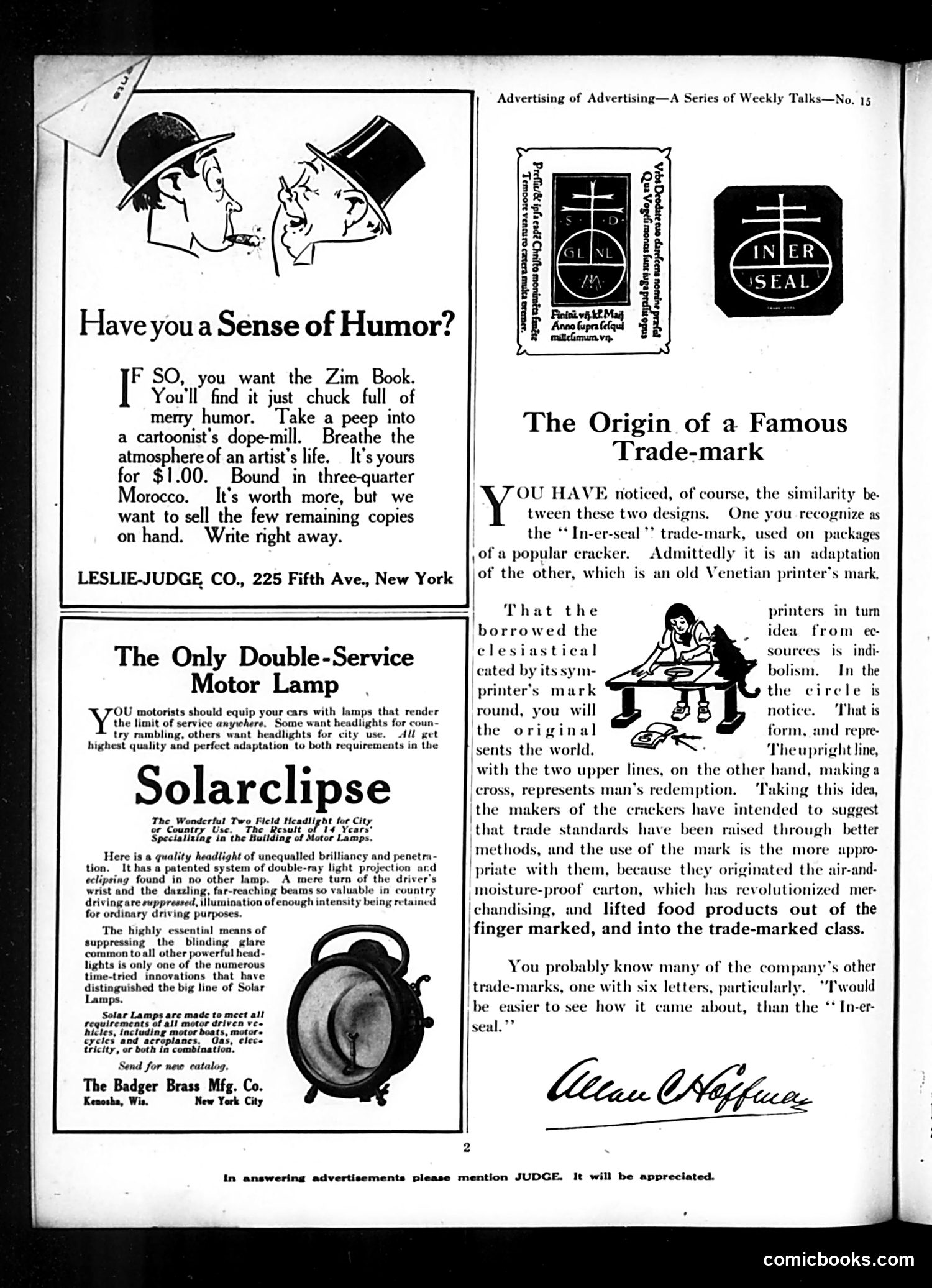
This page is primarily **advertising**, not political satire. It contains three distinct product advertisements: 1. **"Have you a Sense of Humor?"** — Leslie-Judge Co. advertising the "Zim Book," a cartoonist's humor collection selling for $1.00. 2. **"The Only Double-Service Motor Lamp"** — Solareclipse brand headlights for automobiles, emphasizing dual functionality for both city and country driving. 3. **"The Origin of a Famous Trade-mark"** — An article explaining the similarity between the "In-er-seal" cracker brand's cross-and-circle logo and a Venetian printer's mark, tracing its ecclesiastical origins to Christian symbolism representing redemption. The page demonstrates early 20th-century advertising strategy: combining product promotion with educational/entertaining content to engage readers while selling goods.
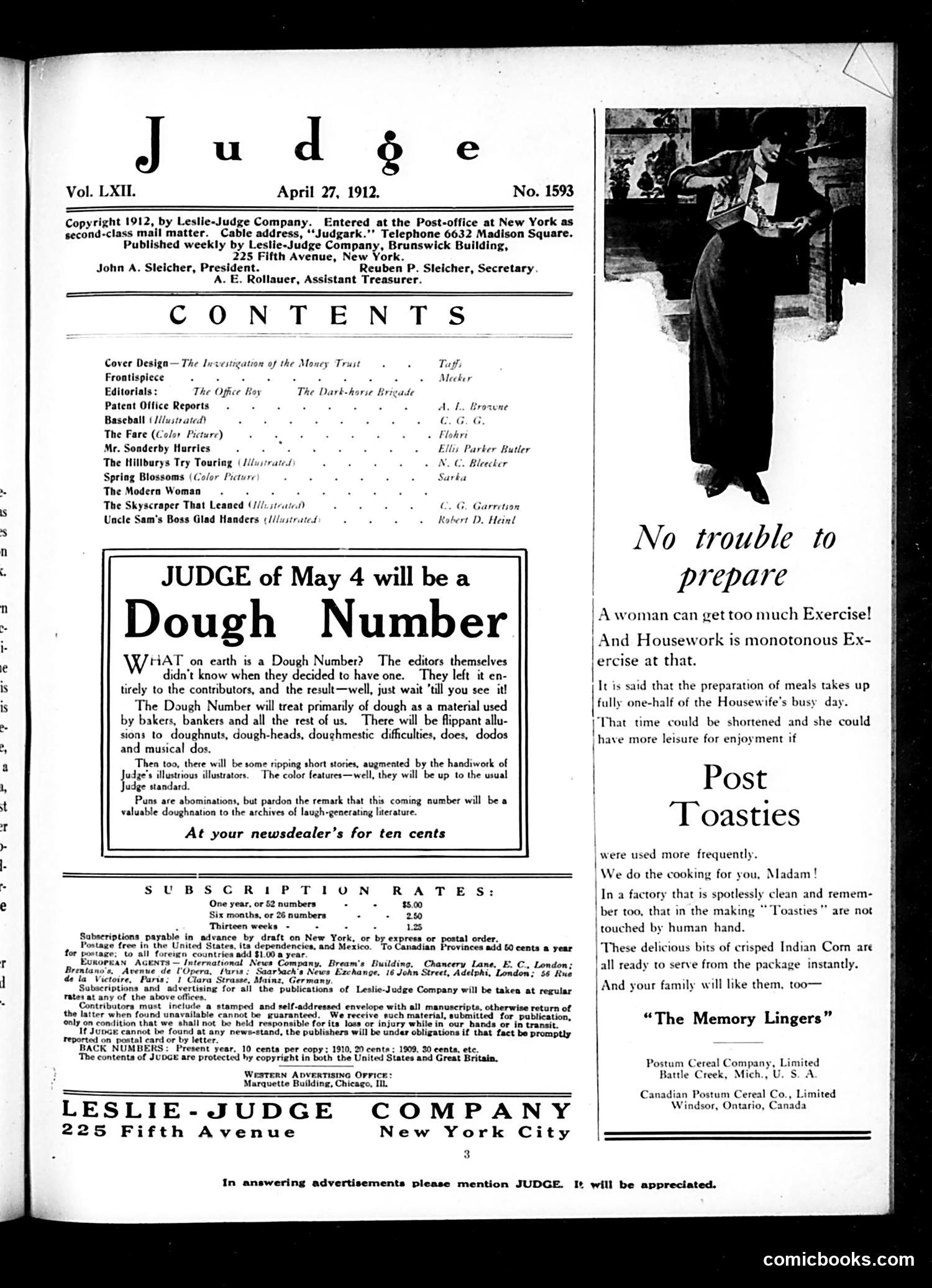
This page is primarily **advertising and magazine content** rather than political cartoons. The main visual elements are: 1. **Right side**: An advertisement for "Post Toasties" cereal featuring a woman in dark clothing with text "No trouble to prepare." The ad emphasizes convenience—that meal preparation takes half a housewife's day, so ready-made cereal offers leisure time. 2. **Left side**: A house ad announcing the May 4 "Dough Number" issue, explaining it will feature stories about dough as material (used by bakers, laundries, etc.) plus wordplay about "dough" (money). This is a pun-based special issue. The content reflects **early 1900s gender roles and consumer culture**—advertising targets housewives by promising time savings from domestic labor.
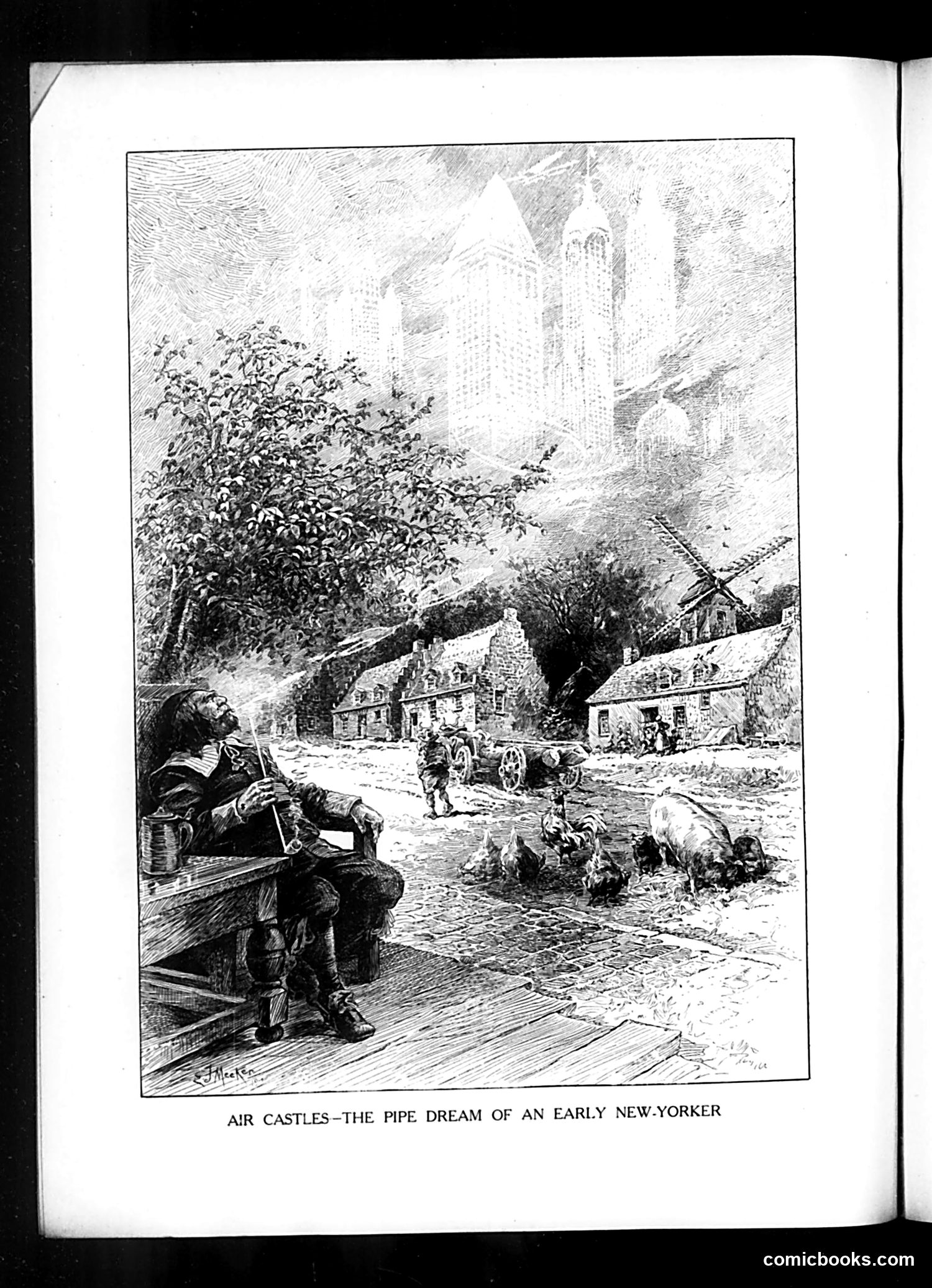
This engraving satirizes unrealistic optimism about New York's future development. The title references "air castles"—a period idiom for impossible dreams or fantasies. The scene depicts a poor man sitting contentedly in a modest rural village setting, smoking a pipe while gazing toward grand Gothic buildings materializing in the mist above. The contrast—between his humble present circumstances and the magnificent urban vision he imagines—suggests the cartoon mocks either: 1. Naive speculation about New York's expansion into undeveloped areas, or 2. Working-class fantasies about personal prosperity through urban development The satire critiques unrealistic expectations, possibly targeting early real estate speculation or immigrant aspirations for wealth in rapidly expanding New York. The elaborate architecture hovering impossibly above emphasizes the gap between dream and reality.
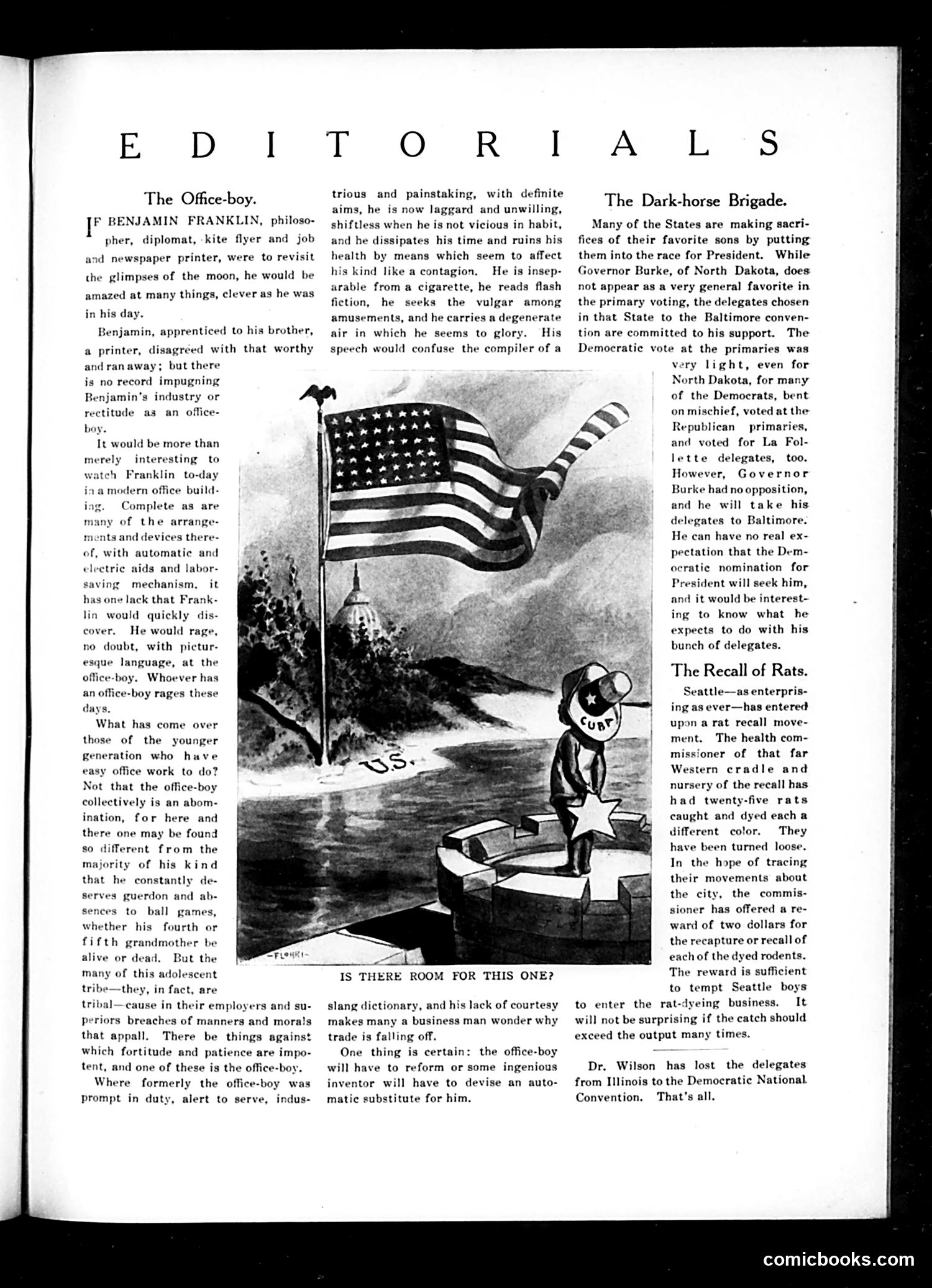
This cartoon satirizes the "Dark-horse Brigade" — candidates competing for the Democratic presidential nomination at the Baltimore convention. The image shows a donkey (symbol of the Democratic Party) already burdened with multiple previous candidates, with a new hopeful attempting to climb aboard labeled "BURKE" (likely Governor Burke of North Dakota, mentioned in the adjacent editorial). The satire suggests the Democratic field is so crowded with nomination contenders that there's literally no room for another candidate. The editorial notes Burke expected no real chance at the nomination, making his candidacy absurdly redundant. The cartoon mocks both the overcrowded primary competition and the futility of fringe candidates seeking the party's presidential nod.
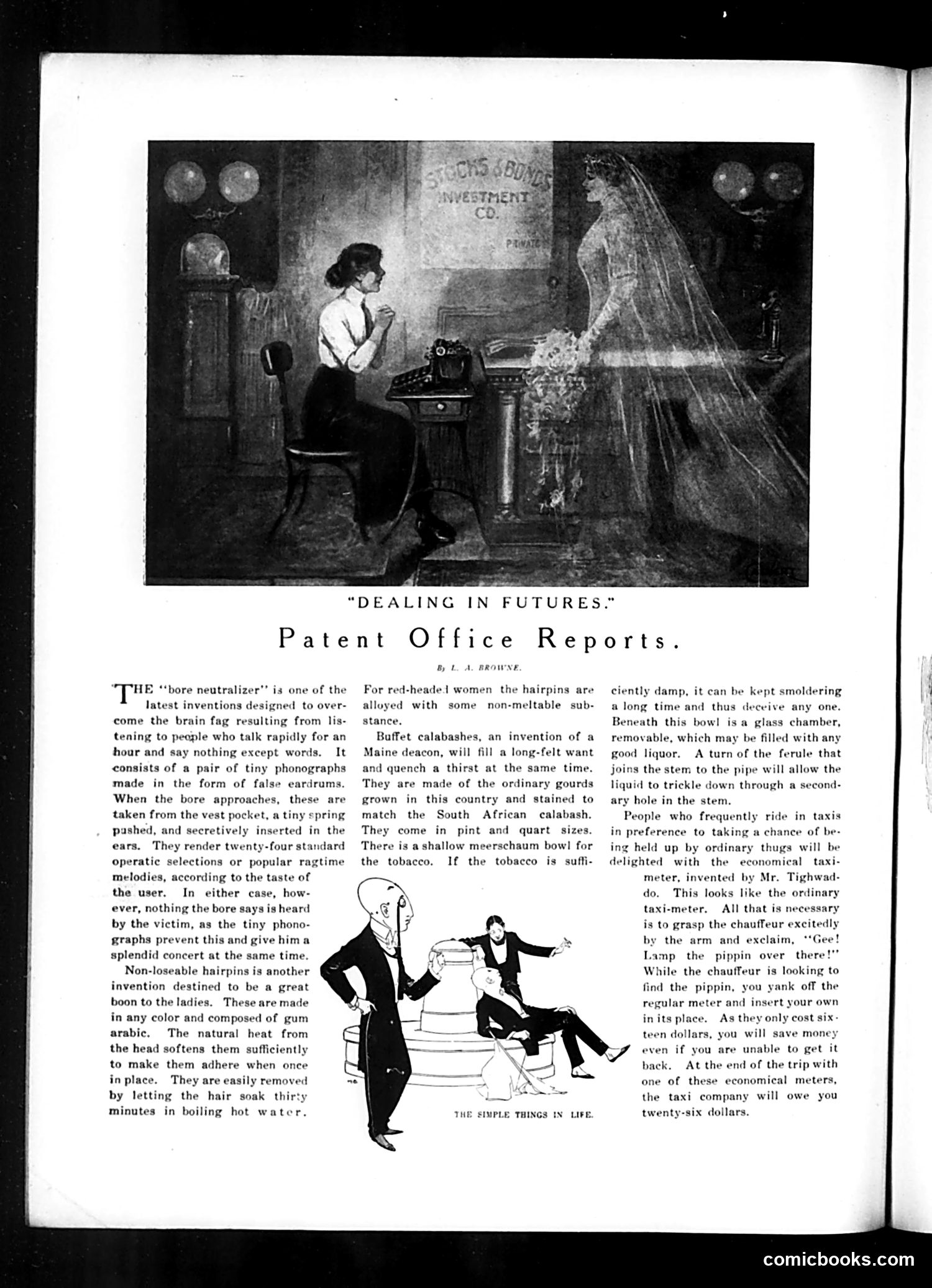
This page satirizes absurd fictional inventions through mock "patent office reports." The top illustration shows a séance-like scene titled "Dealing in Futures," likely referencing stock speculation or fortune-telling fraud. The inventions mocked include: - **"Bore neutralizer"**: Fake eardrums containing phonographs to block tedious talkers while playing opera/ragtime—satirizing the social problem of boring conversationalists. - **Non-loseable hairpins**: Made of gum arabic that soften with head heat but require boiling water to remove—mocking women's frustration with hairpin loss. - **Buffet calabashes**: Drinking vessels disguised as decorative gourds, with hidden compartments for liquor—poking fun at Prohibition-era subterfuge. - **Economical taxi-meters**: Fake meters customers can swap for real ones to cheat taxi companies—satirizing both passenger dishonesty and inflated cab fares. The humor targets everyday annoyances (bores, lost hairpins, expensive taxis) while gently critiquing moral shortcuts and consumer fraud during the early 20th century.
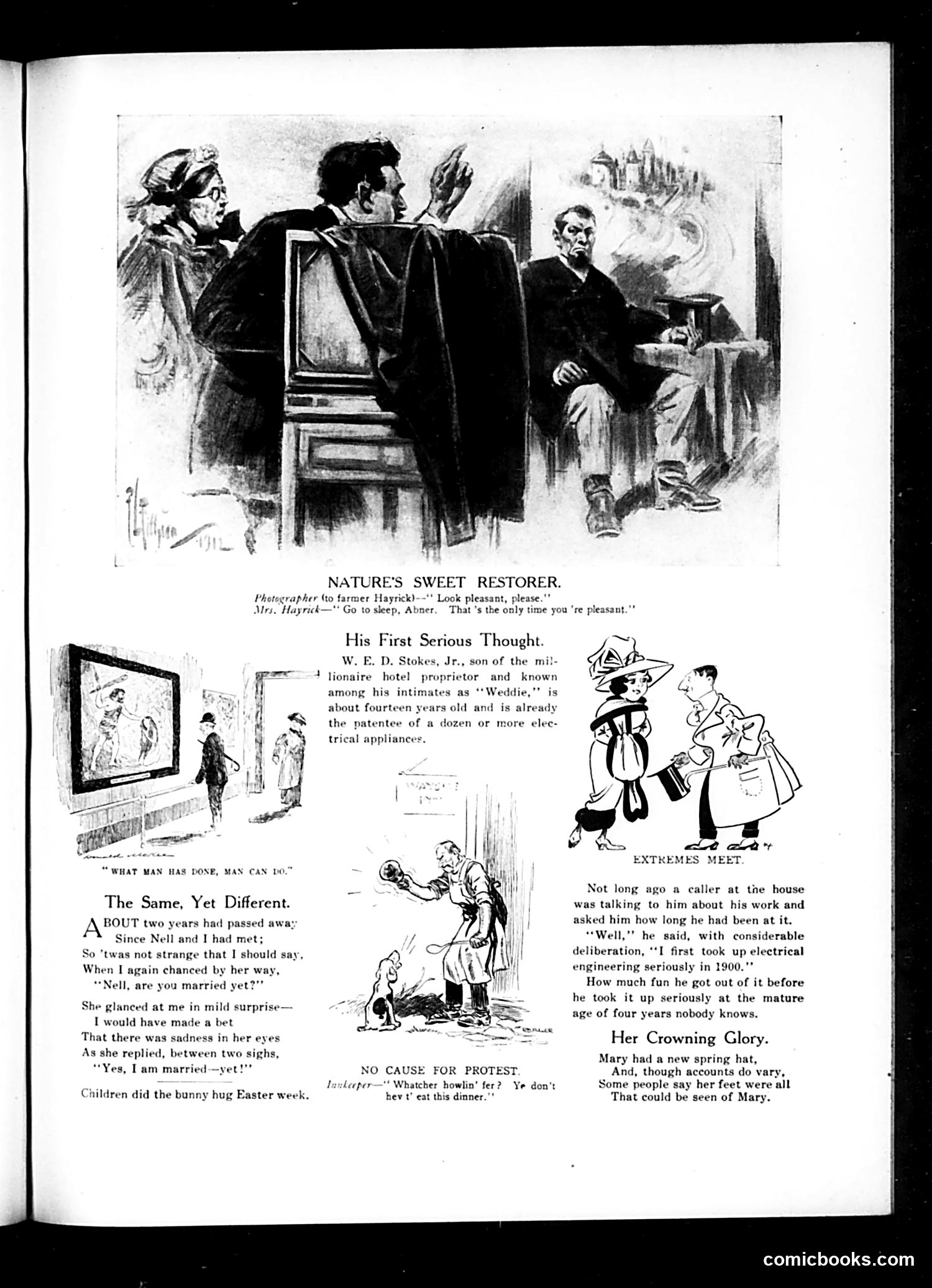
This page contains several short humor pieces typical of early 1900s satirical magazines: **"Nature's Sweet Restorer"** mocks rural life through a photographer's exchange with a farmer ("Hayrick"), suggesting farmers are only pleasant when sleeping—a dig at rural tedium. **"His First Serious Thought"** satirizes W.E.D. Stokes Jr., son of a wealthy hotel magnate, who claims he took up electrical engineering "seriously in 1900" at age fourteen. The joke: a rich boy dabbling in hobbies calls it "serious work," implying wealthy youth lack genuine purpose or dedication. **"The Same, Yet Different"** is a sentimental poem about reuniting with an old acquaintance (Nell) who reveals she's now married—playing on romantic nostalgia. **"Extremes Meet"** appears to be a brief caption about human achievement. **"No Cause for Protest"** shows a working-class dispute over meal quality. **"Her Crowning Glory"** jokes that Mary's new spring hat is so large her feet are invisible beneath it—mocking contemporary oversized women's fashion. The page emphasizes class contrasts, fashion absurdity, and rural-urban differences typical of Judge's satirical voice.
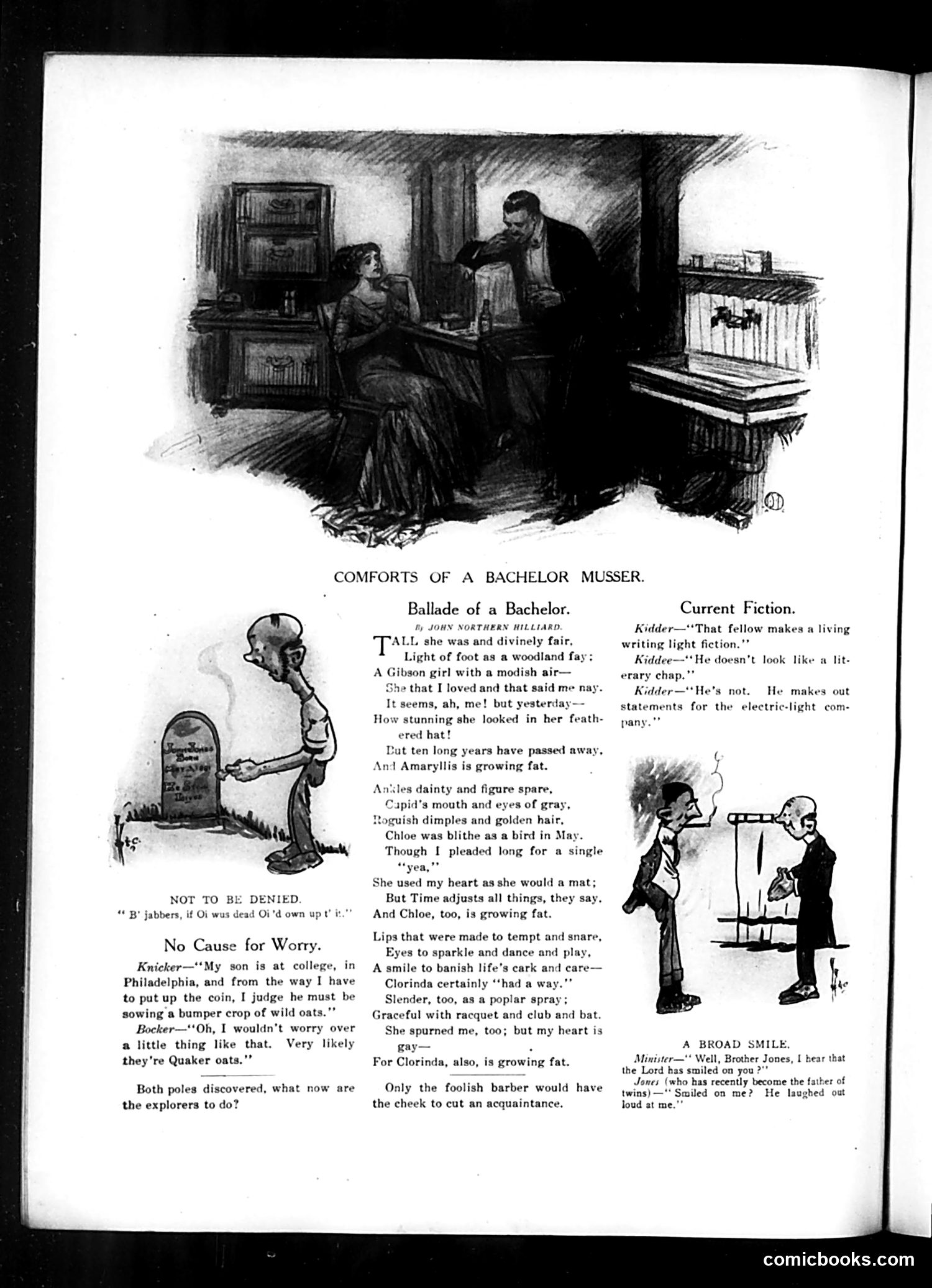
This page contains humorous sketches and text satirizing bachelor life and romantic disappointment. The main feature is a poem ("Ballade of a Bachelor") by John Northern Hilliard lamenting how beautiful women he courted—described as Gibson Girls (the idealized female beauty standard of the era)—have all aged poorly and "grown fat" over ten years. The joke targets both male vanity and the passage of time's cruel effects on attractiveness. Supporting jokes mock parental worries about sons' college expenses ("sowing wild oats"), explore the absurdity of polar exploration's purpose, and play on wordplay about barbers and acquaintances. The sketch at top shows a domestic scene, likely illustrating bachelor life's mundane realities. The cartoons emphasize themes of aging, disappointed romance, and the gap between youthful ideals and reality—common Judge magazine fare poking fun at middle-class male anxieties.
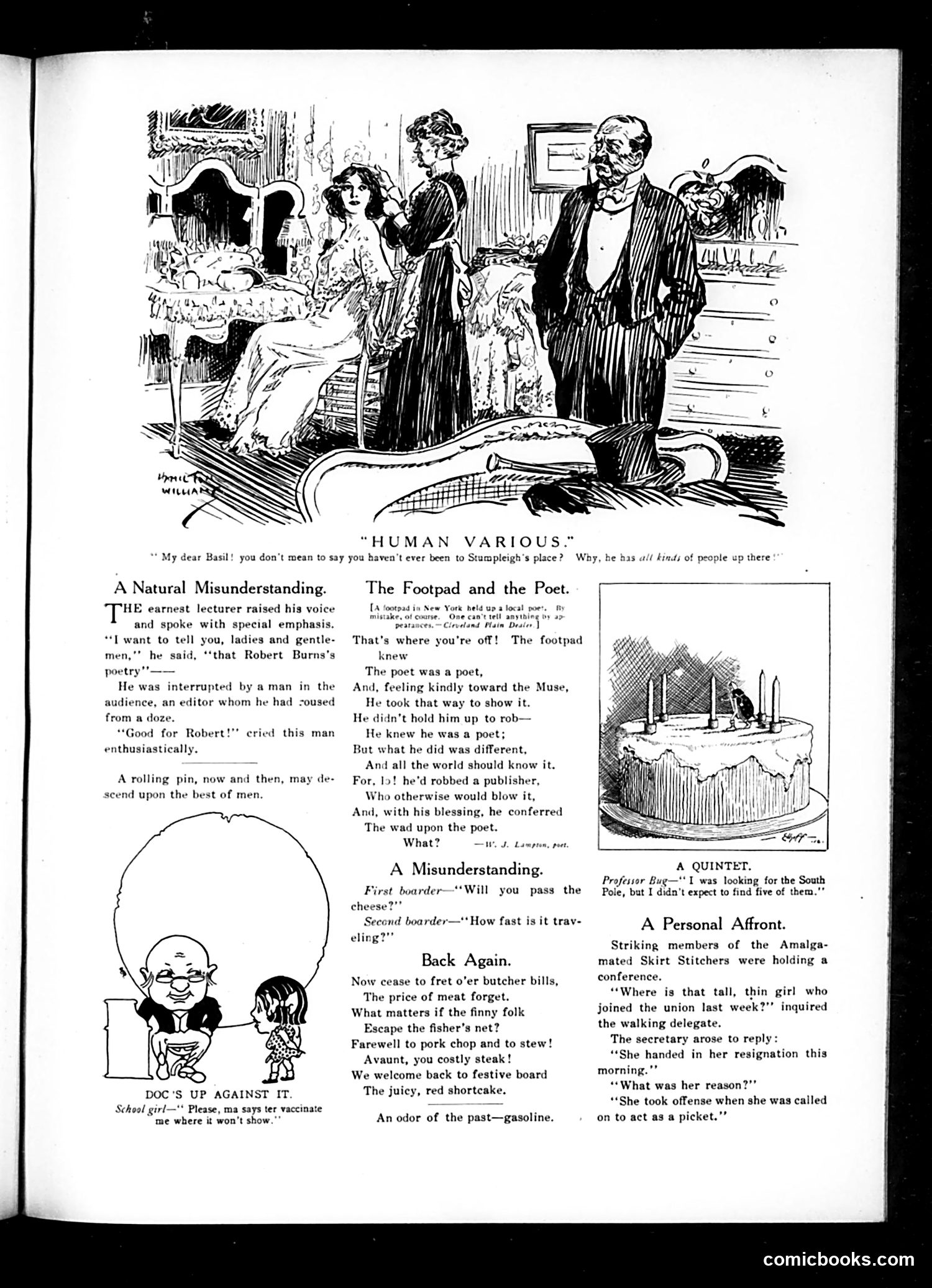
This page contains multiple satirical sketches typical of early 20th-century American humor: **"A Natural Misunderstanding"**: A lecturer discussing Robert Burns's poetry is interrupted by a dozing editor who mishears and enthusiastically shouts approval, thinking Burns is being praised rather than discussed. **"The Footpad and the Poet"**: A humorous inversion—a robber steals from a *publisher* rather than the poet directly, then gives the money to the poet. The satire targets publishers' exploitation of writers. **"Back Again"**: Celebrates the return of affordable shortcake (strawberry shortcake appears seasonal or newly available), mocking recent meat price inflation by welcoming cheaper desserts instead. **"Doc's Up Against It"** and **"A Misunderstanding"**: Quick joke sketches about miscommunication. **"A Personal Affront"**: Satirizes labor organizing—a striking skirt stitcher resigns from her union when asked to picket, finding the work insulting. The page reflects period concerns: literary economics, food prices/availability, labor disputes, and vaccination hesitancy.
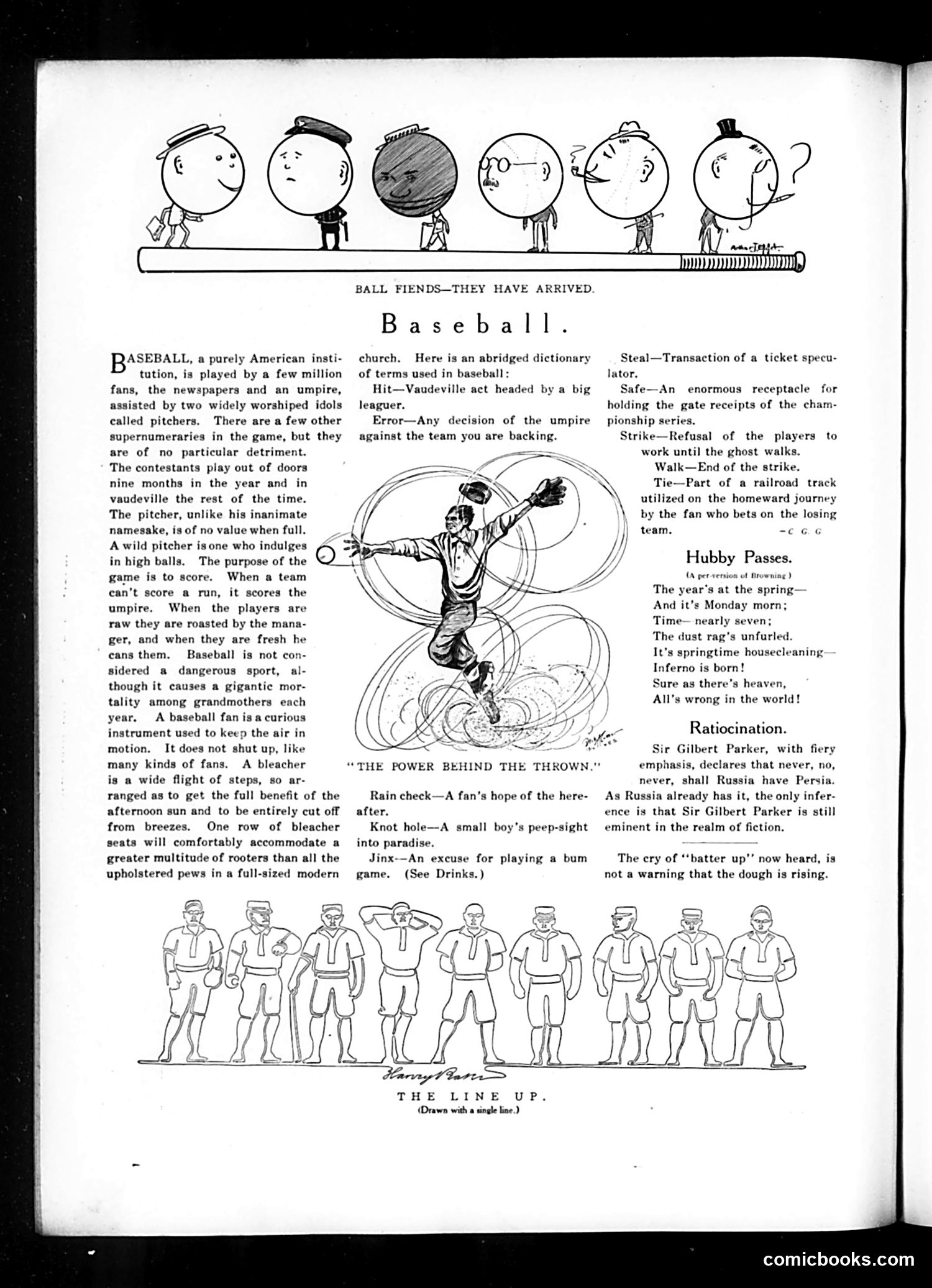
This page is a satirical celebration of baseball as a purely American institution. The top cartoon shows six anthropomorphic baseballs arriving like guests—a visual pun on "ball fiends" (fans obsessed with the sport). The main article humorously defines baseball terminology through exaggeration and social commentary. For example, an "error" is defined as "any decision of the umpire against the team you are backing"—mocking fans' bias. A "bleacher" is sarcastically described as steps arranged to maximize sun exposure while cutting fans off from breezes. The piece jokes that baseball causes "gigantic mortality among grandmothers each year," suggesting elderly women die from excitement. The dictionary includes cynical definitions: "Strike" means players refusing to work until "the ghost walks" (slang for payday); "Safe" is a receptacle holding championship gate receipts; "Tie" refers to railroad tracks used by losing-team bettors to journey home. The page also includes unrelated satirical pieces on housecleaning and Sir Gilbert Parker's fictional claims about Russia and Persia, typical of Judge's mixed-content format.
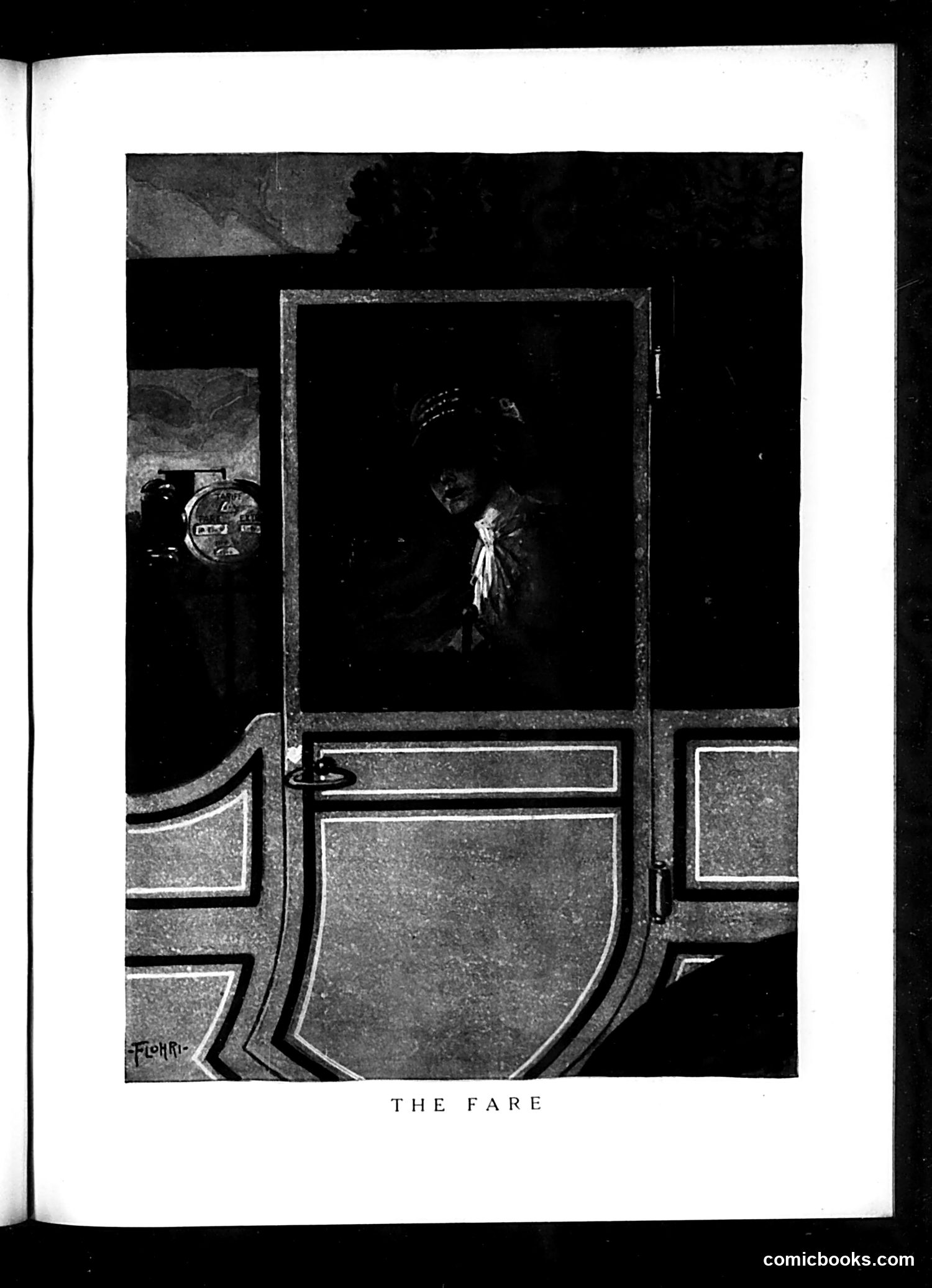
This illustration, titled "The Fare," depicts a passenger looking out from what appears to be a streetcar or trolley window. The image shows someone peering from an elevated vantage point, with a fare box visible on the left side of the composition. The cartoon likely satirizes urban transit experiences—possibly commenting on passenger discomfort, cramped conditions, or the experience of paying fares for public transportation. The composition emphasizes the passenger's somewhat confined, shadowed position looking outward, which may suggest commentary on the limitations or indignities of public transit use during this era. Without additional context from accompanying text or advertisements on the page, the precise satirical target remains somewhat unclear, though it appears to critique aspects of urban commuting life.
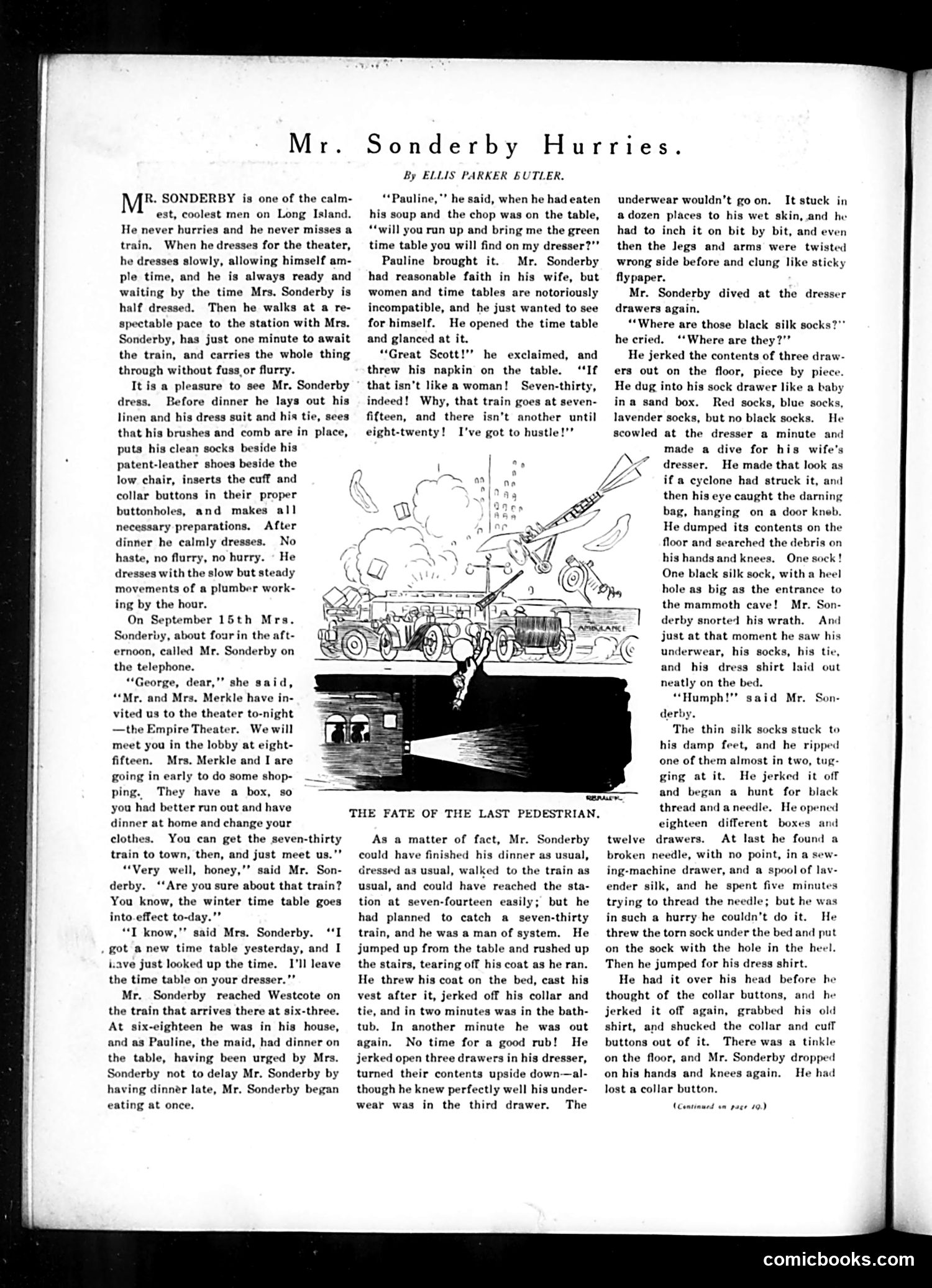
This is a humorous story about domestic chaos, illustrated by a cartoon showing a man rushing to catch a train after a traffic accident. The satire targets the stereotype of scatterbrained wives: Mrs. Sonderby gives her famously punctual husband the *wrong* train time from the new winter schedule, causing him to panic. His composed, methodical nature—normally his virtue—becomes a liability: he frantically tears apart drawers searching for black socks, finds only a darned one with a hole "as big as the entrance to the mammoth cave," and rushes into chaos. The cartoon depicts "THE FATE OF THE LAST PEDESTRIAN"—presumably showing Sonderby's frantic dash to the station. The joke is ironic: his careful nature couldn't save him from his wife's error, and his hurried scramble to compensate leads to disaster. The story satirizes both the incompetence attributed to women regarding practical matters like timetables and the fragility of male composure when domestic routines collapse.
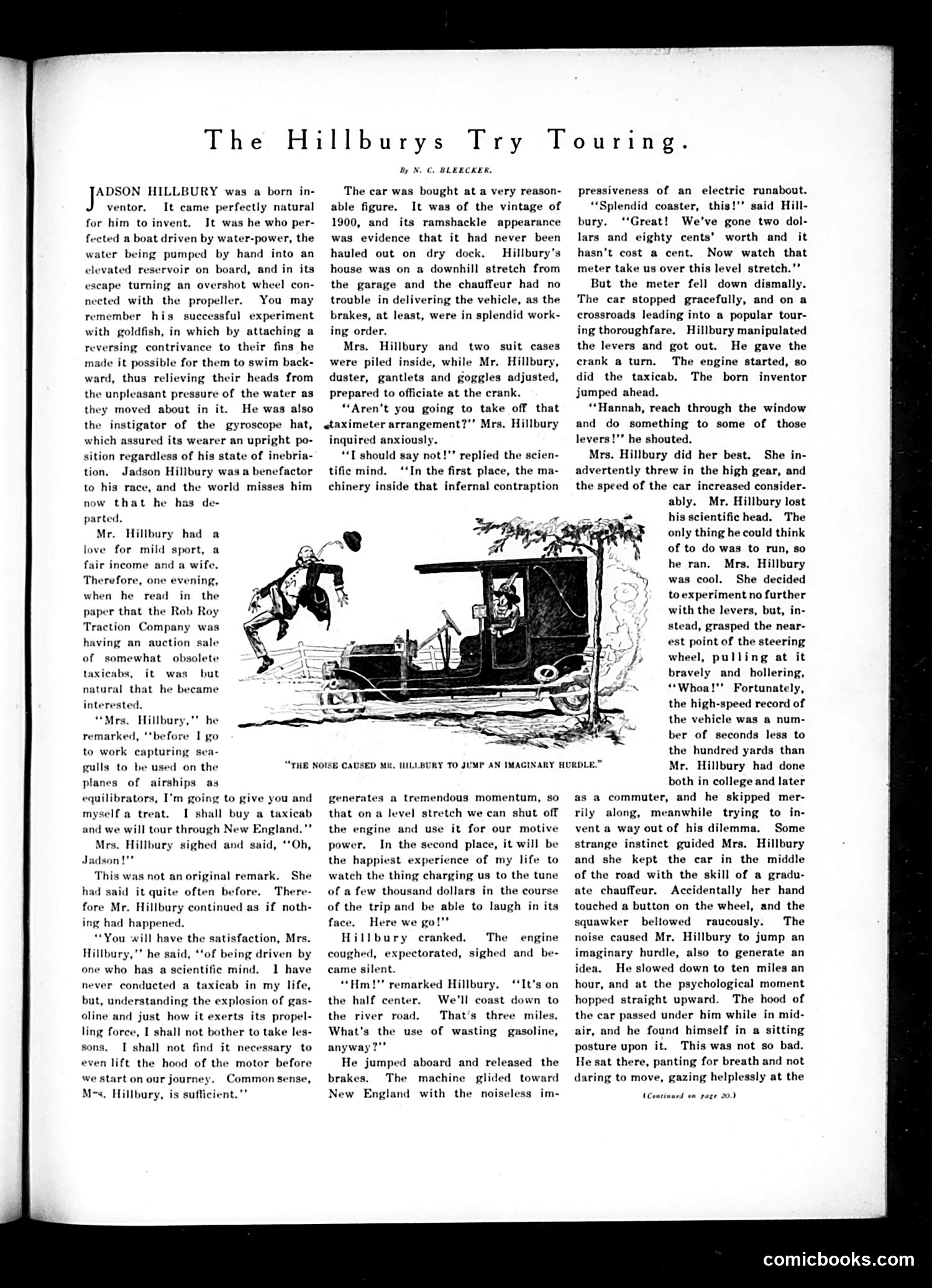
This is a humorous short story about Jadson Hillbury, a comically impractical inventor with no common sense despite his scientific pretensions. The joke centers on his overconfidence: he buys a decrepit 1900 taxicab and insists on driving it through New England without any experience, believing that understanding combustion theory is sufficient to operate it safely. The satire targets turn-of-the-century amateur automobilists and pseudo-intellectuals who confused theoretical knowledge with practical competence—a common source of comedy as automobiles were still novel and many untrained drivers caused accidents. The cartoon shows Hillbury jumping at imaginary obstacles, suggesting the chaotic journey ahead. His determination to leave the taximeter running while laughing at the accumulating charges adds to the portrait of an absurd, impractical man. The story invites readers to anticipate the inevitable disasters his arrogance will cause.
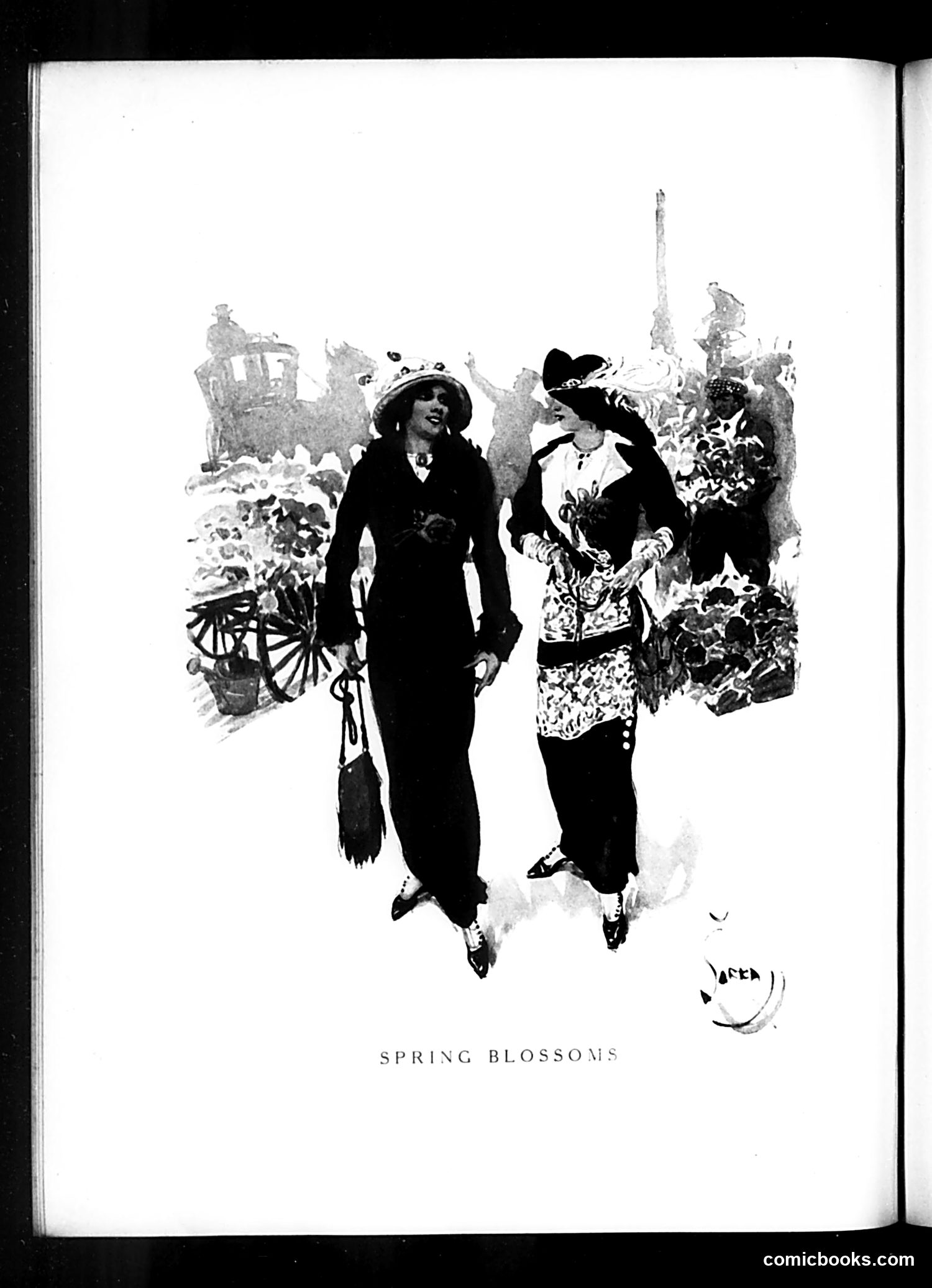
This illustration from *Judge* magazine depicts two fashionably dressed women strolling through a spring garden setting. The woman on the left wears an all-black ensemble with a feathered hat, while the woman on the right sports a patterned dress with a large black hat and carries flowers. The satire likely comments on **early 20th-century female fashion and social rituals**—specifically the tradition of elaborate spring promenades and conspicuous display of expensive clothing. The exaggerated hats and formal attire, contrasted against the natural garden backdrop, may mock the artificiality of high society's springtime social season or the absurdity of women's restrictive fashion conventions of the era. The specific individuals caricatured remain unclear from the image alone.
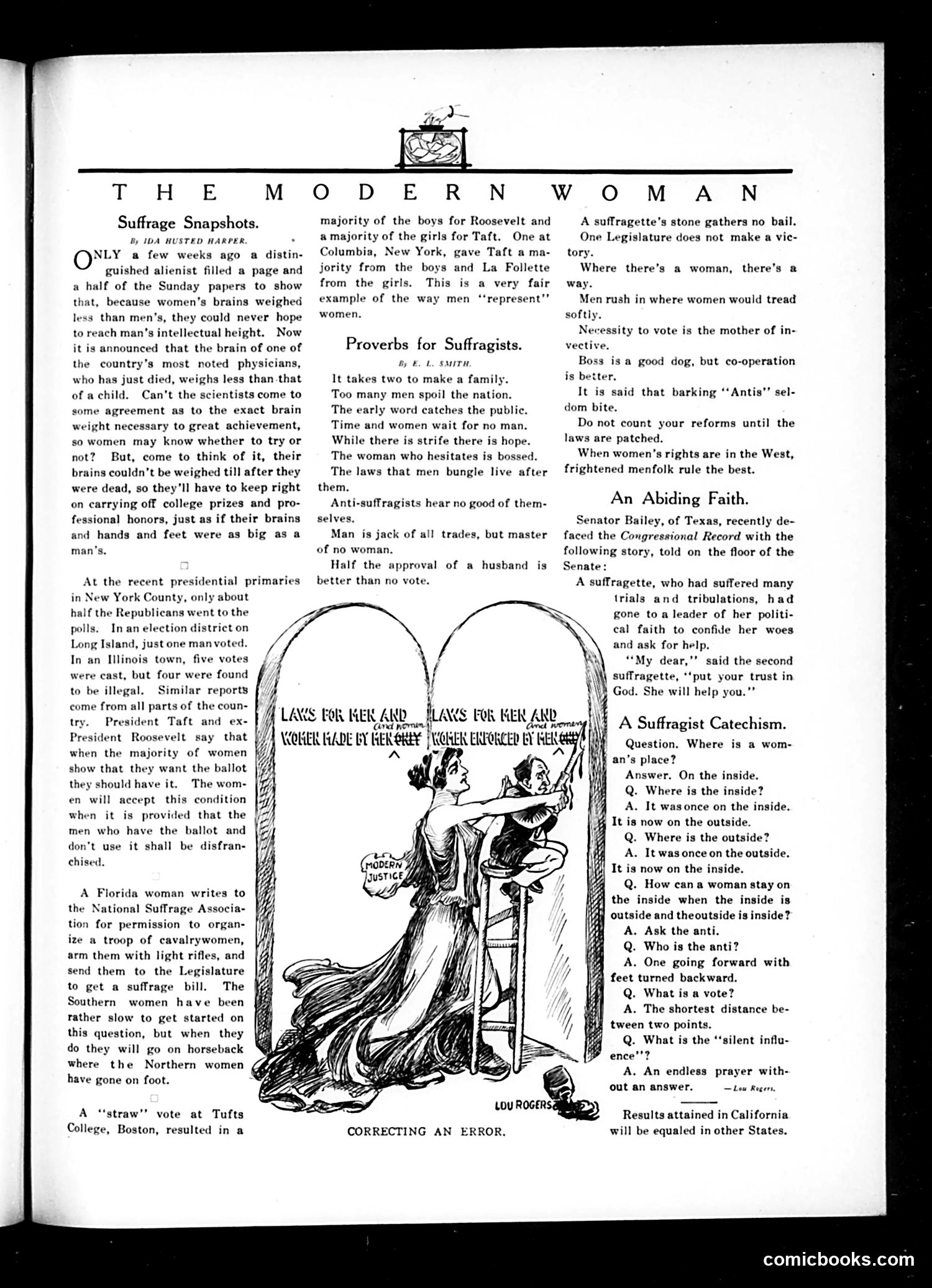
This **anti-suffrage political cartoon** by Lou Rogers satirizes women's suffrage activists. The image depicts two female figures straining to push open a large door labeled "LAWS FOR HER AND WOMEN MADE BY HER ONLY" / "LAWS FOR HER AND WOMEN ENFORCED BY HER ONLY." A male figure (likely representing male legislators or authority) sits comfortably inside, seemingly unmoved by their efforts. **The satire's point:** The cartoon mocks suffragettes' demands for self-governance by exaggerating the absurdity—suggesting women want laws made *exclusively* by women, excluding men entirely. The title "Correcting an Error" implies the cartoon positions women's suffrage itself as the error being "corrected." The surrounding text reinforces anti-suffrage arguments through mock "proverbs" and a condescending anecdote where a male senator ridicules a suffragette's faith. This page represents *Judge* magazine's editorial stance against women's voting rights during the early 1900s suffrage movement.
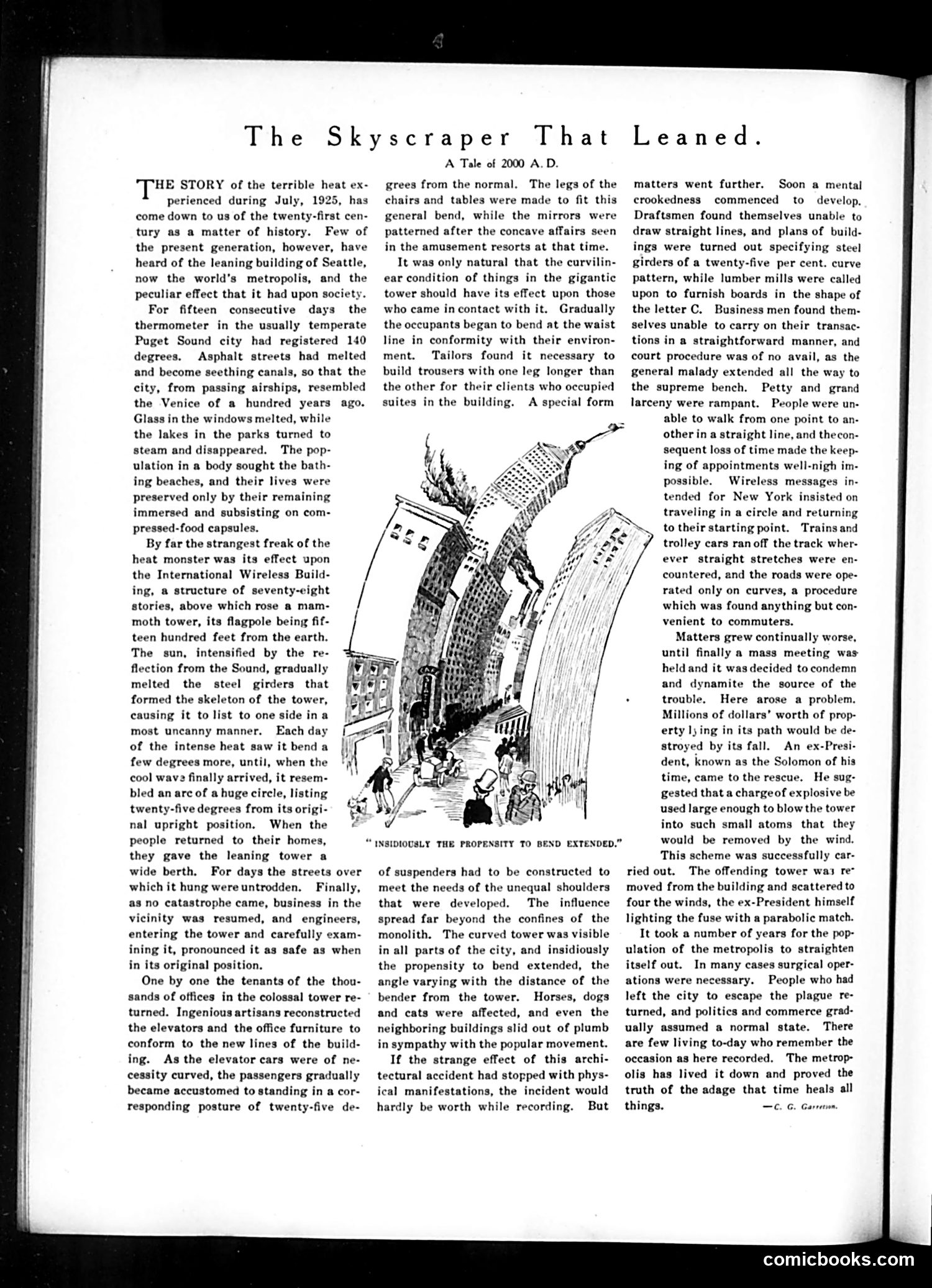
This is a humorous science fiction story set in the year 2000, imagining Seattle as Earth's metropolis. The narrative describes an extreme heat wave in 1925 that literally melts the steel girders of a 78-story building, causing it to lean 25 degrees from vertical. The satire targets human adaptation and conformity: rather than demolish the dangerous structure, tenants simply adjust to it. Furniture gets custom-built at angles, clothing is tailored with unequal legs, and people gradually contort their posture to match the building's slant. The cartoon caption ("Insidiously the Propensity to Bend Extended") underscores the joke—the physical deformity spreads psychologically to the entire neighborhood, even affecting animals and neighboring buildings. The implicit critique: people will rationalize and normalize absurdity rather than address root problems. It's satirizing human tendency toward passive acceptance of dysfunction, wrapped in a tall-tale science fiction premise.
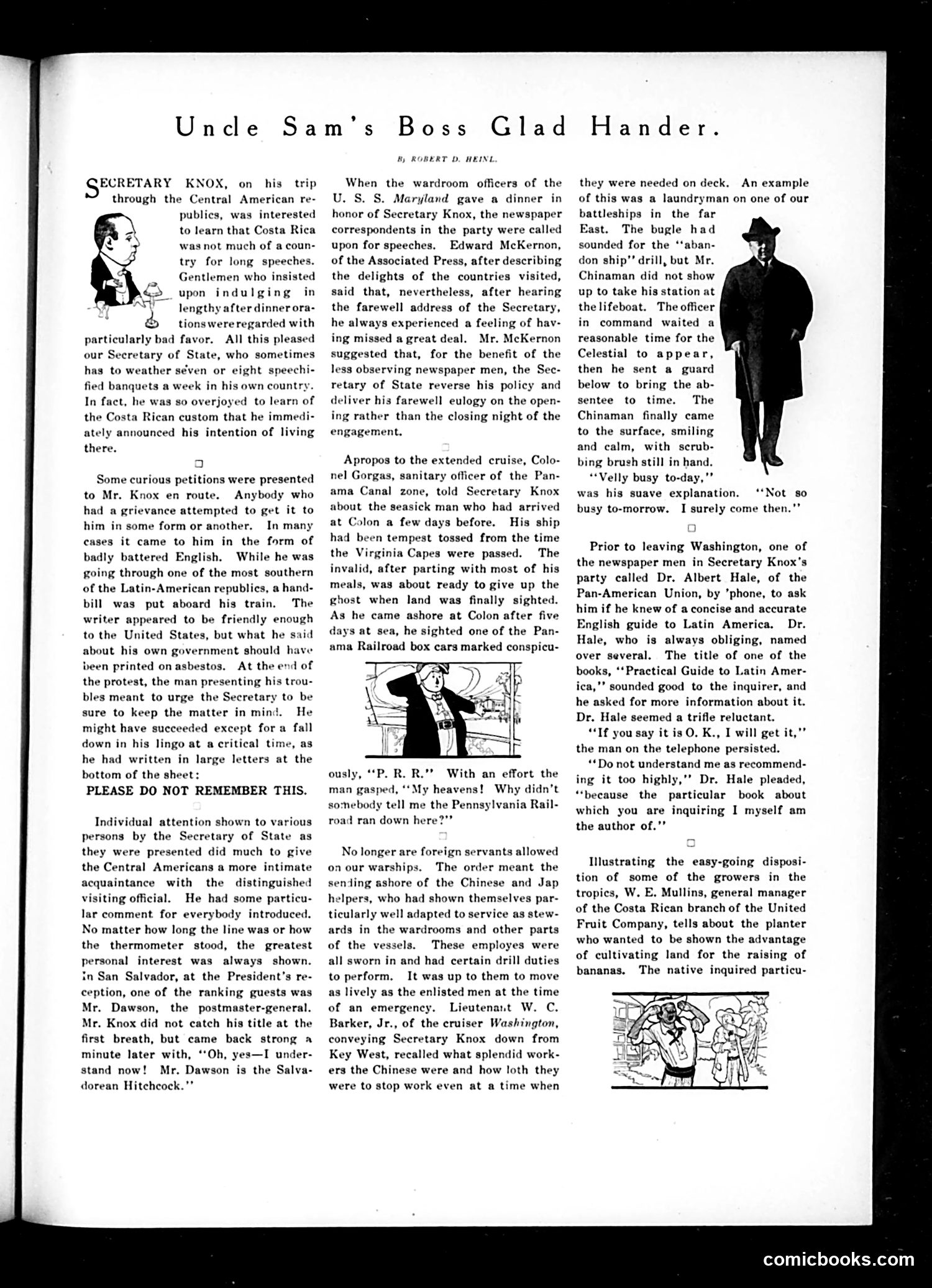
This article satirizes Secretary of State **Philander Knox's** diplomatic tour through Central America. The piece uses humorous anecdotes to mock Knox's excessive chattiness and forced sociability—ironic given his pleasure at learning Costa Rica discourages long speeches. The satire includes several jokes at Knox's expense: a petitioner's mistranslation asking Knox to "PLEASE DO NOT REMEMBER THIS"; Knox's garbled compliment calling a Salvadoran postmaster "the Salvadorean Hitchcock" (likely referencing U.S. Postmaster General Frank Hitchcock); and a sick sailor misreading "P.R.R." (Panama Railroad) as the Pennsylvania Railroad. The title "Uncle Sam's Boss Glad Hander" suggests Knox, as the nation's top diplomat, personifies America's superficial charm offensive in the region. The humor targets both Knox's ineffectiveness and American diplomatic pretensions.
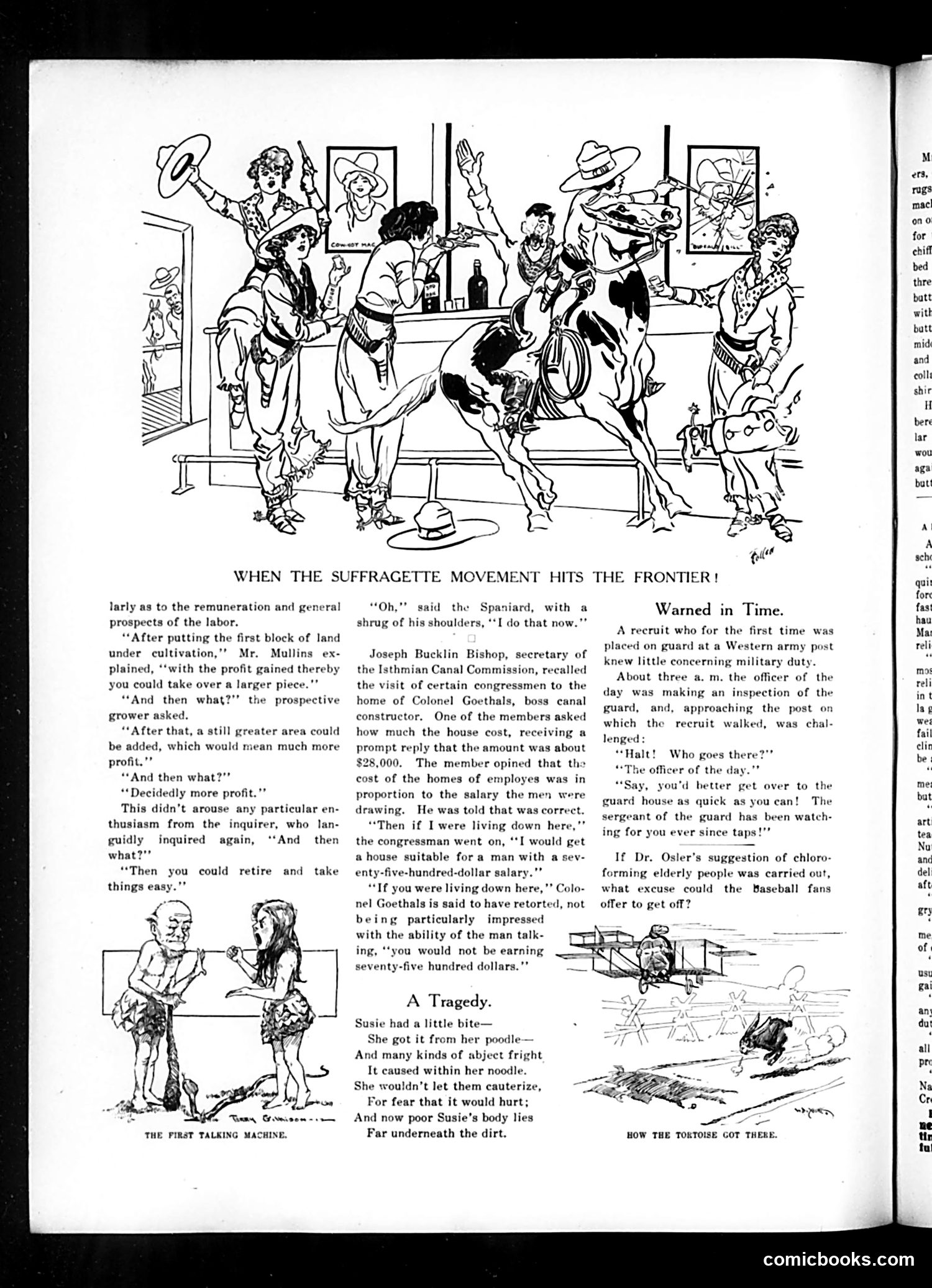
**Top Cartoon:** "When the Suffragette Movement Hits the Frontier" depicts women in Western/cowgirl attire causing chaos in a saloon—one riding a horse indoors, others wielding guns and lassos. This mocks the suffragette movement (women's voting rights activism) by suggesting that if such "radical" women gained power in the American West, they would bring disorder and chaos. The satire reflects early 20th-century anti-suffrage sentiment that portrayed feminists as dangerous and unfit for civic participation. **Other Content:** The page includes unrelated humor pieces: a dialogue about agricultural profit margins; an anecdote about a congressman visiting the Panama Canal Zone (referencing Colonel Goethals, the real canal administrator); a tragic poem about a girl bitten by a poodle; and a military anecdote about a confused recruit. These represent typical Judge magazine fare—miscellaneous satirical commentary on contemporary events and social absurdities. The suffragette cartoon represents mainstream anti-women's suffrage propaganda of the era.
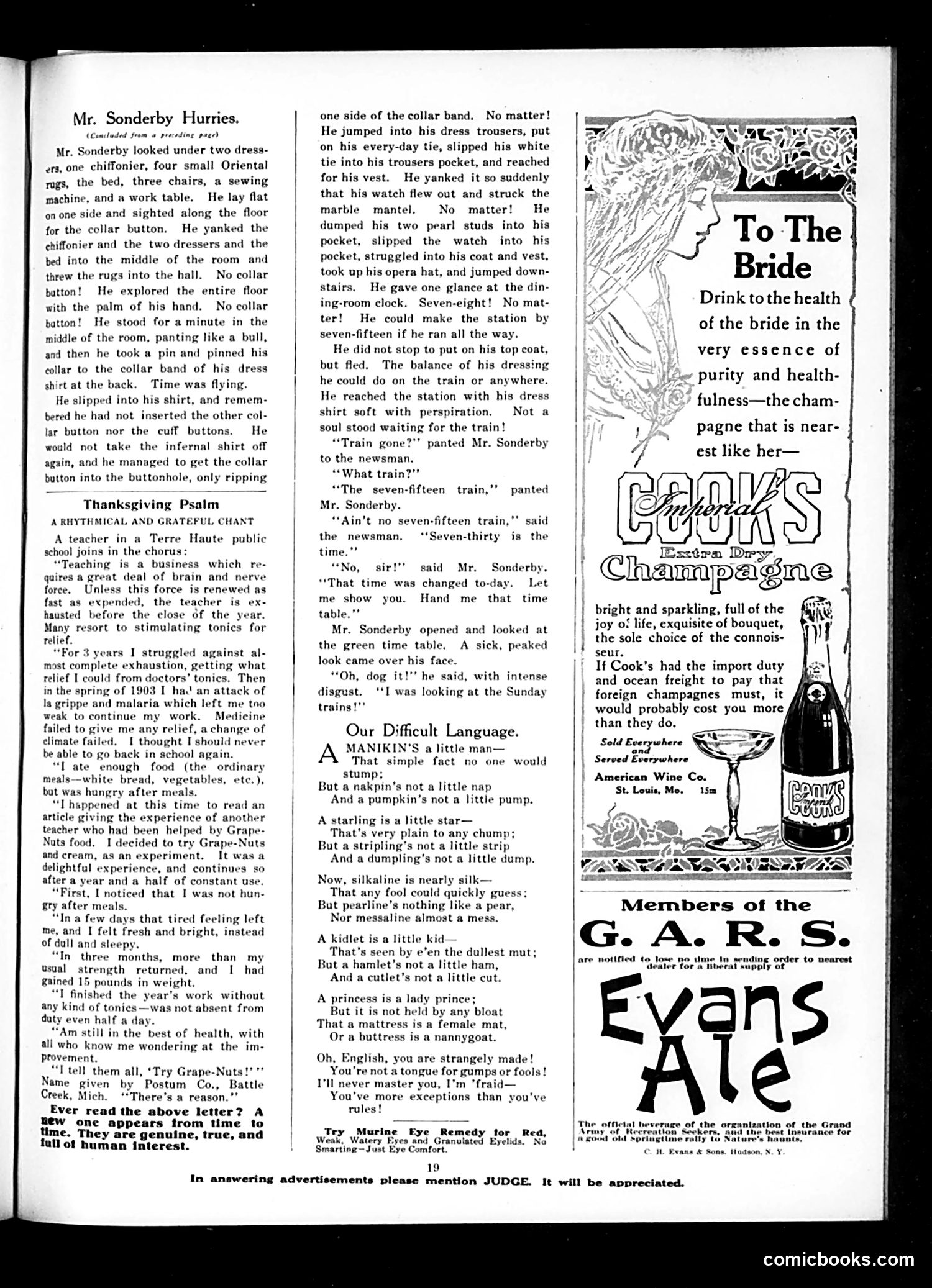
This page contains a humorous short story (concluded from a prior installment) about a man's frantic morning preparing to catch a train. The satire targets the absurdity of male vanity and rushing: Mr. Sonderby dismantles his entire bedroom searching for a lost collar button, ultimately pins his collar with a safety pin, loses his watch, forgets his studs, and arrives at the station disheveled—only to discover he's missed his train anyway and misread the schedule. The joke is that his desperate scrambling accomplished nothing. His anxiety about punctuality and proper appearance proves futile. The page also includes period advertisements (Grape-Nuts food testimonial, Cook's champagne) and "Our Difficult Language," a humorous poem about English homophones and near-homophones ("a starling is a little star / That's very plain to any chump").
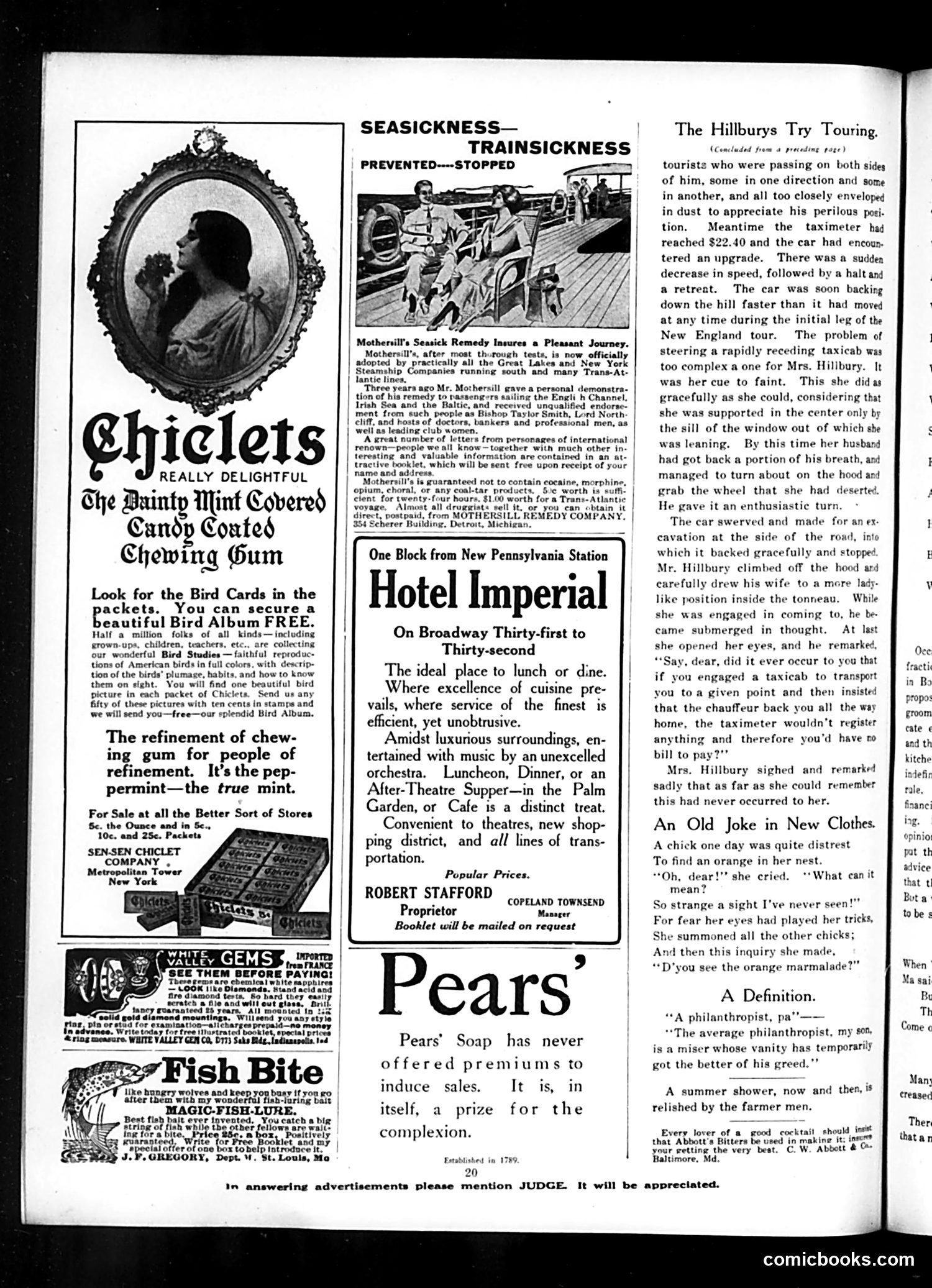
This is primarily an **advertising page** from Judge magazine, interspersed with a continuing narrative story titled "The Hillburys Try Touring." **Main Content:** The page features period advertisements for consumer goods (Chiclets gum, Pears' Soap, Hotel Imperial, Fish-Lure bait) and a remedy called Mothersill's for seasickness and train sickness. These are straightforward commercial ads typical of early 20th-century magazines. **Story Element:** "The Hillburys Try Touring" describes a comedic automobile mishap during a New England tour. Mrs. Hillbury, steering a taxicab on an upgrade, loses control as it backs rapidly downhill. The humor derives from her theatrical fainting—presented as a genteel escape from managing the crisis. This reflects period attitudes about women drivers and genteel femininity. **No political cartoons appear on this page.** It's a commercial/entertainment page without satirical commentary.
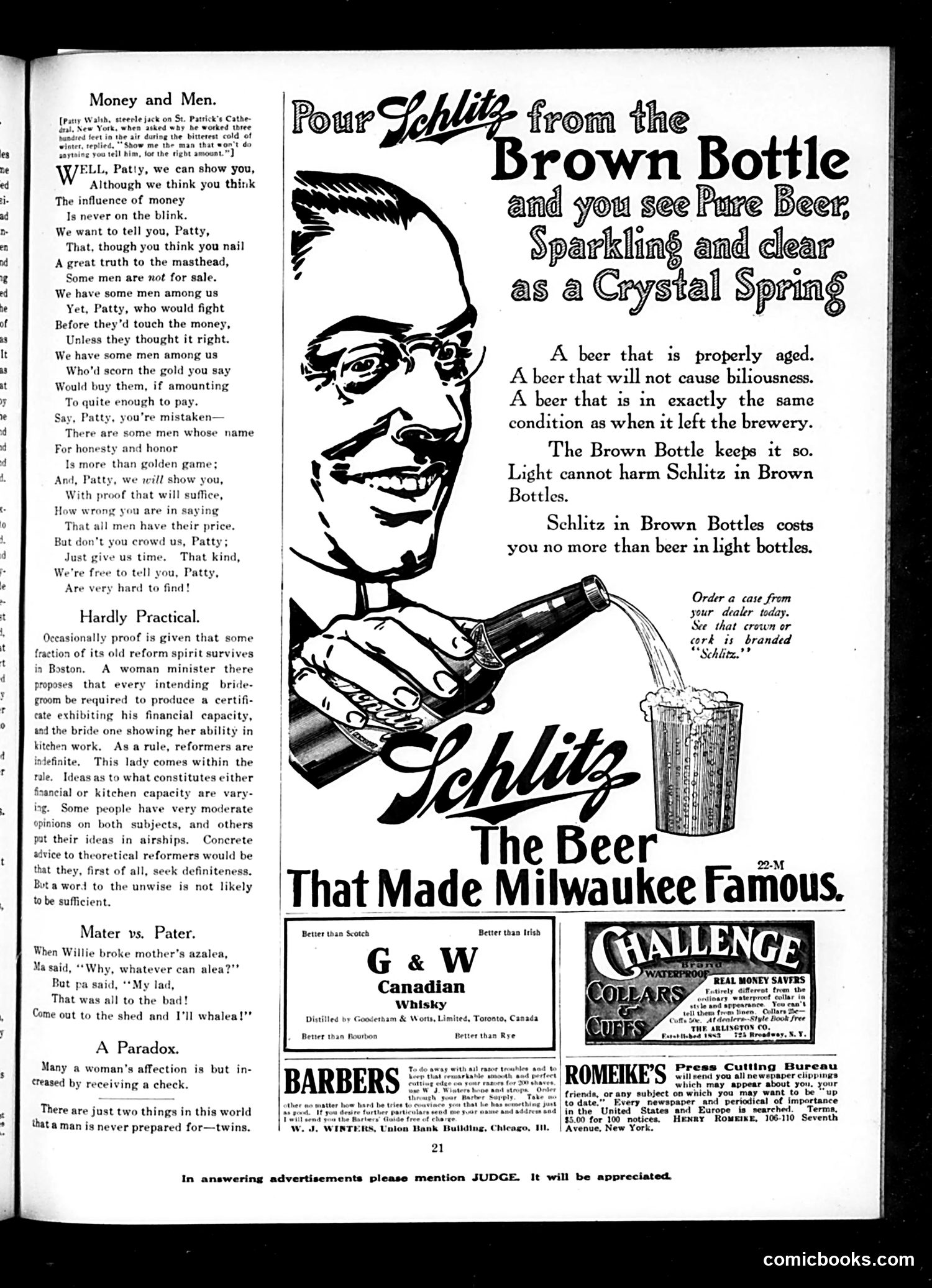
This page primarily contains **advertising** rather than political cartoons. The dominant content is a large Schlitz beer advertisement featuring a caricatured man's face pouring beer into a glass, promoting the brown bottle as superior because it protects beer from light damage. The left side contains several brief **humorous verse pieces** labeled "Money and Men," "Hardly Practical," "Mater vs. Pater," and "A Paradox"—these are light satirical commentary on social topics (corruption, Boston reformers, parental discipline, female behavior) rather than political cartoons. The other advertisements include G&W Canadian Whisky and Arlington collar/cuff products. The page reflects **early 20th-century American magazine culture**: heavy advertising revenue funding editorial content, and satire focused on domestic social behavior rather than political figures. The humor is genteel and moralistic by modern standards, addressing character, honesty, and propriety.
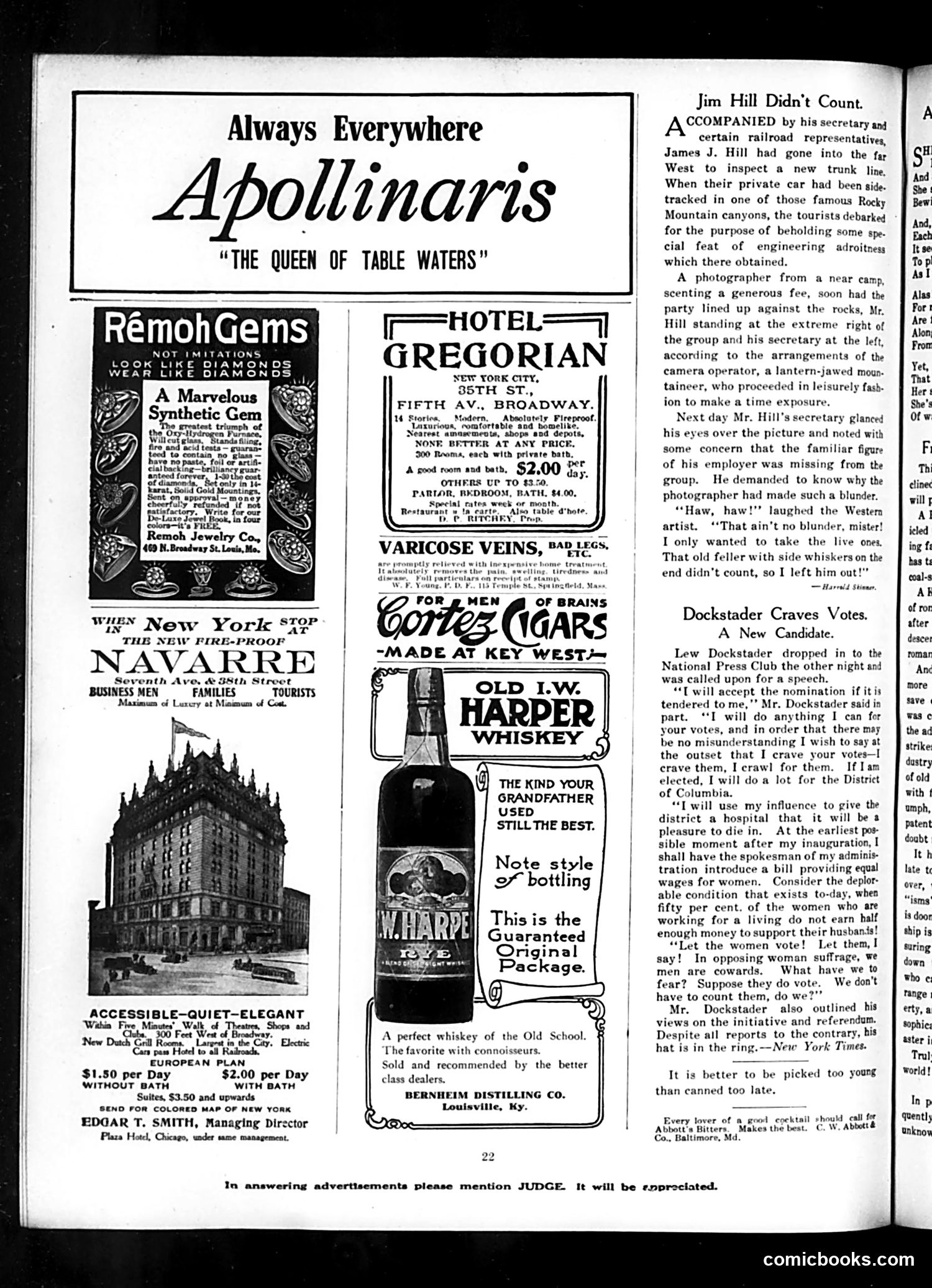
This page is primarily **advertisements** with one notable satirical article. The main content is "**Dockstader Craves Votes**," a humorous piece about **Lew Dockstader** (a well-known vaudeville performer/comedian of the era), who jokingly announces his candidacy for office. The satire mocks politicians' empty promises: he pledges hospitals and equal wages for women, then undercuts himself with a crass joke—suggesting men needn't fear women voting because "we don't have to count them, do we?" The separate anecdote, "**Jim Hill Didn't Count**," is a darker joke about railroad magnate **James J. Hill**. A photographer deliberately excludes the elderly Hill from a group portrait, callously remarking he only wanted "live ones." The pun—that Hill "didn't count"—suggests he's already dead or irrelevant. Both pieces use cynical humor about exclusion and invisibility: the first satirizes political indifference toward women; the second mocks age and irrelevance in the business world. The page otherwise contains hotel and product advertisements typical of the era.
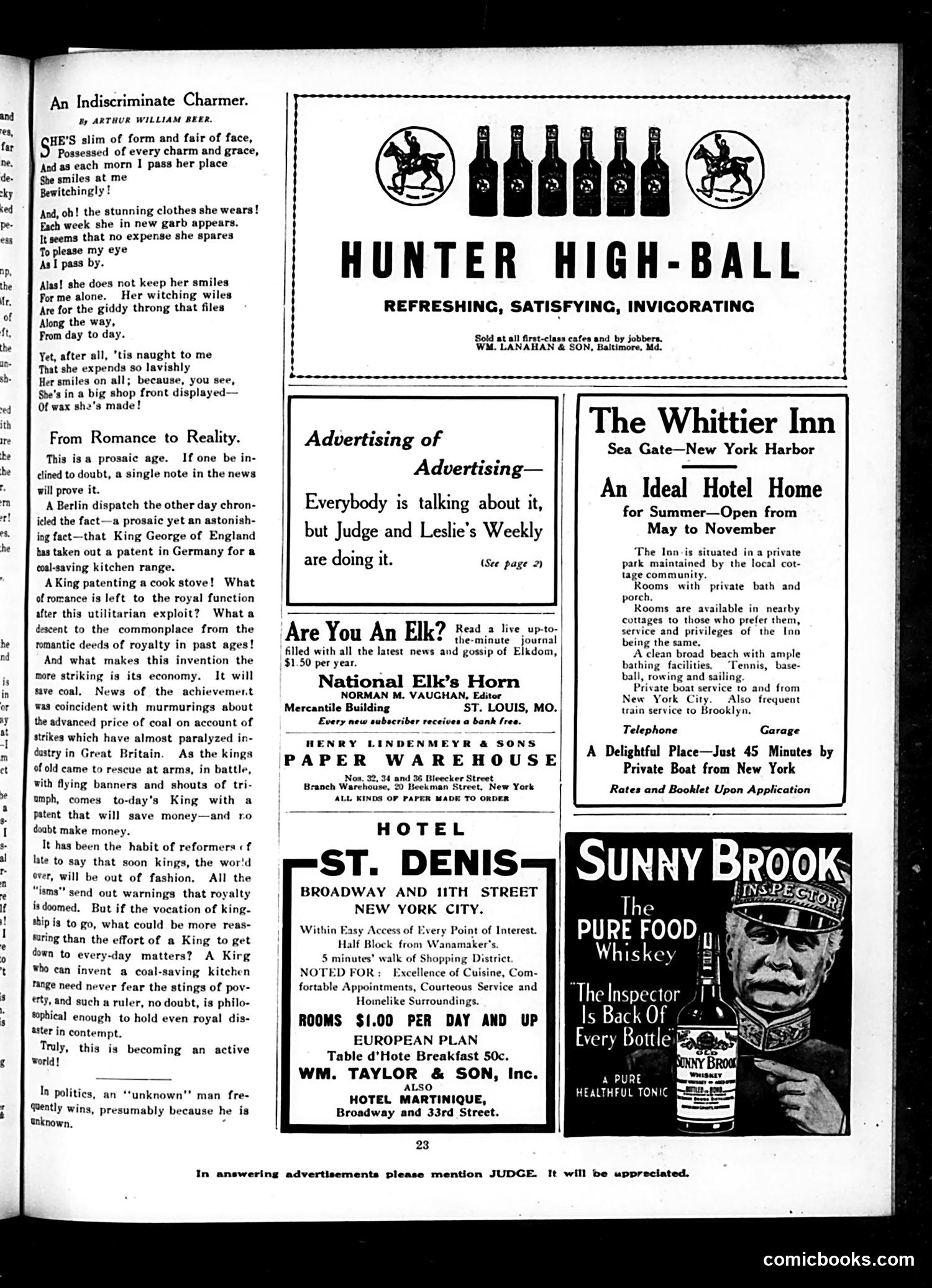
This page is primarily **advertising with accompanying light verse and social commentary**, rather than political cartoons. The main content includes: **"An Indiscriminate Charmer"** — A poem mocking a man who admires a woman's beauty and expensive clothing, only to discover she's a department store mannequin. It's gentle satire on shallow attraction and consumerism. **"From Romance to Reality"** — Commentary on King George V of England patenting a coal-saving kitchen range. The piece sarcastically laments that modern royalty has become mundane and utilitarian rather than romantic and martial. It's a critique of how industrialization and practicality have replaced traditional notions of kingship—presented tongue-in-cheek as both amusing and oddly reassuring. The remainder is **advertisements** for hotels, whiskey, paper warehouses, and other establishments typical of early 20th-century Judge magazine. The satirical tone throughout reflects Judge's characteristic irreverent commentary on contemporary society and modern life's prosaic nature.