
Judge, 1912-04-27 · page 17 of 23
Judge — April 27, 1912 — page 17: what you’re looking at
What you’re looking at
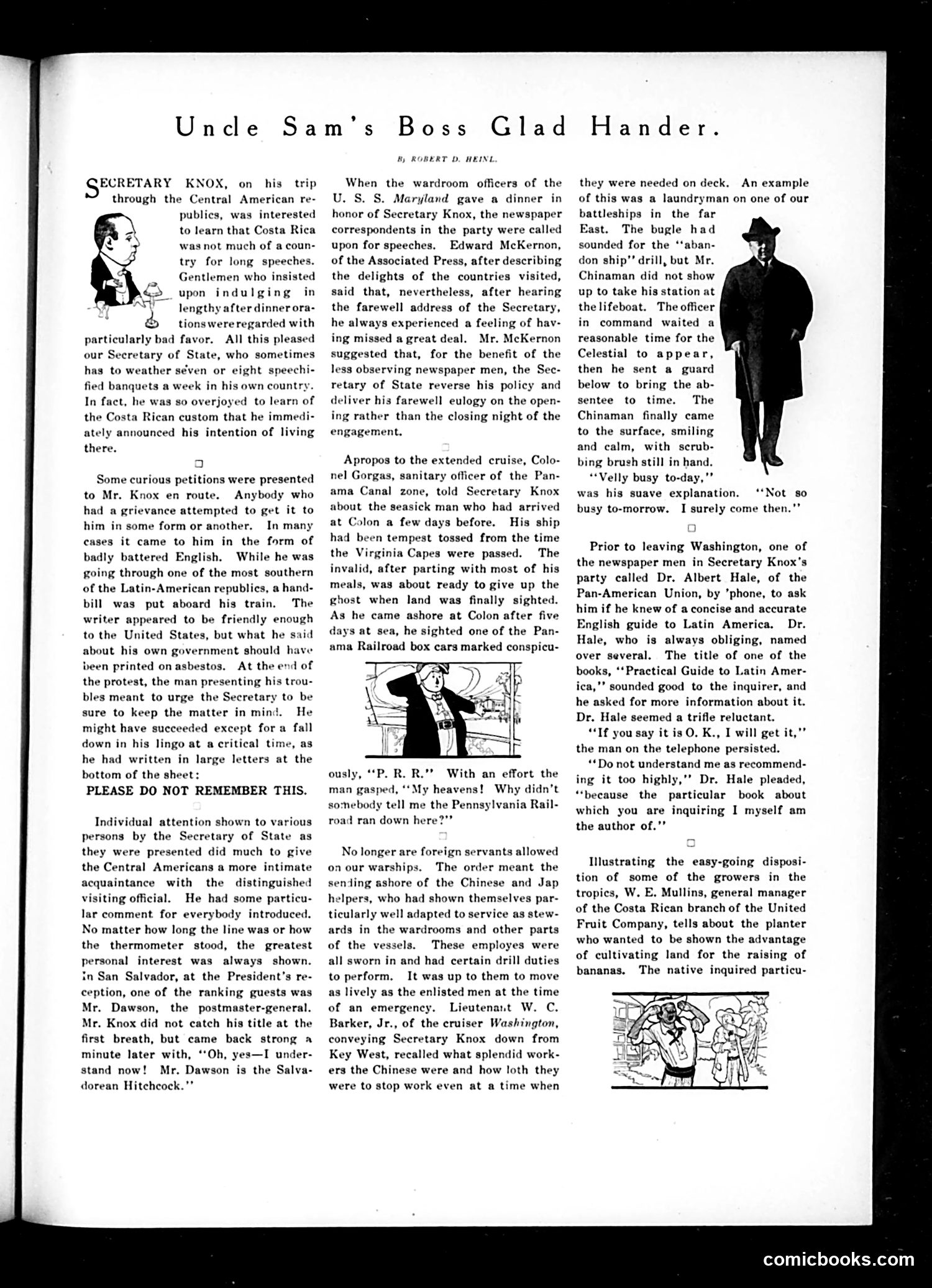
This article satirizes Secretary of State **Philander Knox's** diplomatic tour through Central America. The piece uses humorous anecdotes to mock Knox's excessive chattiness and forced sociability—ironic given his pleasure at learning Costa Rica discourages long speeches. The satire includes several jokes at Knox's expense: a petitioner's mistranslation asking Knox to "PLEASE DO NOT REMEMBER THIS"; Knox's garbled compliment calling a Salvadoran postmaster "the Salvadorean Hitchcock" (likely referencing U.S. Postmaster General Frank Hitchcock); and a sick sailor misreading "P.R.R." (Panama Railroad) as the Pennsylvania Railroad. The title "Uncle Sam's Boss Glad Hander" suggests Knox, as the nation's top diplomat, personifies America's superficial charm offensive in the region. The humor targets both Knox's ineffectiveness and American diplomatic pretensions.
📄 Transcribed text from this page (OCR, searchable)
Machine-transcribed from the original scan — historical spelling and the odd misread are preserved.
Uncle ECRETARY KNOX, on his trip through the Central American re- publics, was interested to learn that Costa Rica was not much of a coun- try for long speeches. Gentlemen who insisted upon indulging in lengthy after dinner ora- tions were regarded with particularly bad favor. All this pleased our Secretary of State, who sometimes has to weather seven or eight speechi- fied banquets a week in his own country. In fact, he was so overjoyed to learn of the Costa Rican custom that he immedi- ately announced his intention of living there. a Some curious petitions were presented to Mr. Knox en route. Anybody who had a grievance attempted to get it to him in some form or another. In many cases it came to him in the form of badly battered English. While he was going through one of the most southern of the Latin-American republics, a hand- bill was put aboard his train. The writer appeared to be friendly enough to the United States, but what he said about his own government should ha been printed on asbestos. At the end of the protest, the man presenting his trou- bles meant to urge the Secretary to be sure to keep the matter in mind. He might have succeeded except fora fall down in his lingo at a critical time, as he had written in large letters at the bottom of the sheet: PLEASE DO NOT REMEMBER THIS. Individual attention shown to various persons by the Secretary of State as they were presented did much to give the Central Americans a more intimate acquaintance with the distinguished visiting official. He had some particu- lar comment for everybody introduced. No matter how long the line was or how the thermometer stood, the greatest personal interest was always shown. in San Salvador, at the President's re- ception, one of the ranking guests was Mr. Dawson, the postmaster-general. Mr. Knox did not catch his title at the first breath, but came back strong a minute later with, ‘‘Oh, yes—I under- stand now! Mr. Dawson is the Salva- dorean Hitchcock.”’ Sam’s Boss By ROBERT D. HEINL When the wardroom officers of the U. S. S. Marland gave a dinner in honor of Secretary Knox, the newspaper correspondents in the party were called upon for speeches, Edward McKernon, of the Associated Press, after describing the delights of the countries visited, said that, nevertheless, after hearing the farewell address of the Secretary, he always experienced a feeling of hav- ing missed a great deal. Mr. McKernon suggested that, for the benefit of the less observing newspaper men, the Sec- retary of State reverse his policy and deliver his farewell eulogy on the open- ing rather than the closing night of the engagement. Apropos to the extended cruise, Colo- nel Gorgas, sanitary officer of the Pan- ama Canal zone, told Secretary Knox about the seasick man who had arrived at Colon a few days before. His ship had been tempest tossed from the time the Virginia Capes were passed. The invalid, after parting with most of his meals, was about ready to give up the ghost when land was finally sighted. As he came ashore at Colon after five days at sea, he sighted one of the Pan- ama Railroad box cars marked conspicu- ously, “P. R. R."? With an effort the man gasped, ‘‘My heavens!’ Why didn’t somebody tell me the Pennsylvania Rail- road ran down here?"’ No longer are foreign servants allowed on our warships. The order meant the sending ashore of the Chinese and Jap helpers, who had shown themselves par- ticularly well adapted to service as stew- ards in the wardrooms and other parts of the vessels. These employes were all sworn in and had certain drill duties to perform. It was up to them to move as lively as the enlisted men at the time of an emergency. Lieutenant W. C. Barker, Jr., of the cruiser Washington, conveying Secretary Knox down from Key West, recalled what splendid work- ers the Chinese were and how loth they were to stop work even at a time when Glad Hander. they were needed on deck. An example of this was a laundryman on one of our battleships in the far East. The bugle had sounded for the ‘‘aban- don ship’ drill, but Mr. Chinaman did not show up to take his station at the lifeboat. The officer in command waited a reasonable time for the Celestial to appear, then he sent a guard below to bring the ab- sentee to time. The Chinaman finally came to the surface, smiling and calm, with scrub- bing brush still in hand. “*Velly busy to-day,’” was his suave explanation. ‘‘Not so busy to-morrow. I surely come then."’ } Prior to leaving Washington, one of the newspaper men in Secretary Knox's party called Dr. Albert Hale, of the Pan-American Union, by ’phone, to ask him if he knew of a concise and accurate English guide to Latin America. Dr. Hale, who is always obliging, named over several. The title of one of the books, ‘*Practical Guide to Latin Amer- ica,’’ sounded good to the inquirer, and he asked for more information about it. Dr. Hale seemed a trifle reluctant. “If you say it is O. K., I will get it,"’ the man on the telephone persisted. “*Do not understand me as recommend- ing it too highly,’? Dr. Hale pleaded, “‘because the particular book about which you are inquiring I myself am the author of.’” Illustrating the easy-going disposi- tion of some of the growers in the tropics, W. E. Mullins, general manager of the Costa Rican branch of the United Fruit Company, tells about the planter who wanted to be shown the advantage of cultivating land for the raising of bananas, The native inquired particu- comicbooks.com