
Judge, 1912-04-27 · page 16 of 23
Judge — April 27, 1912 — page 16: what you’re looking at
What you’re looking at
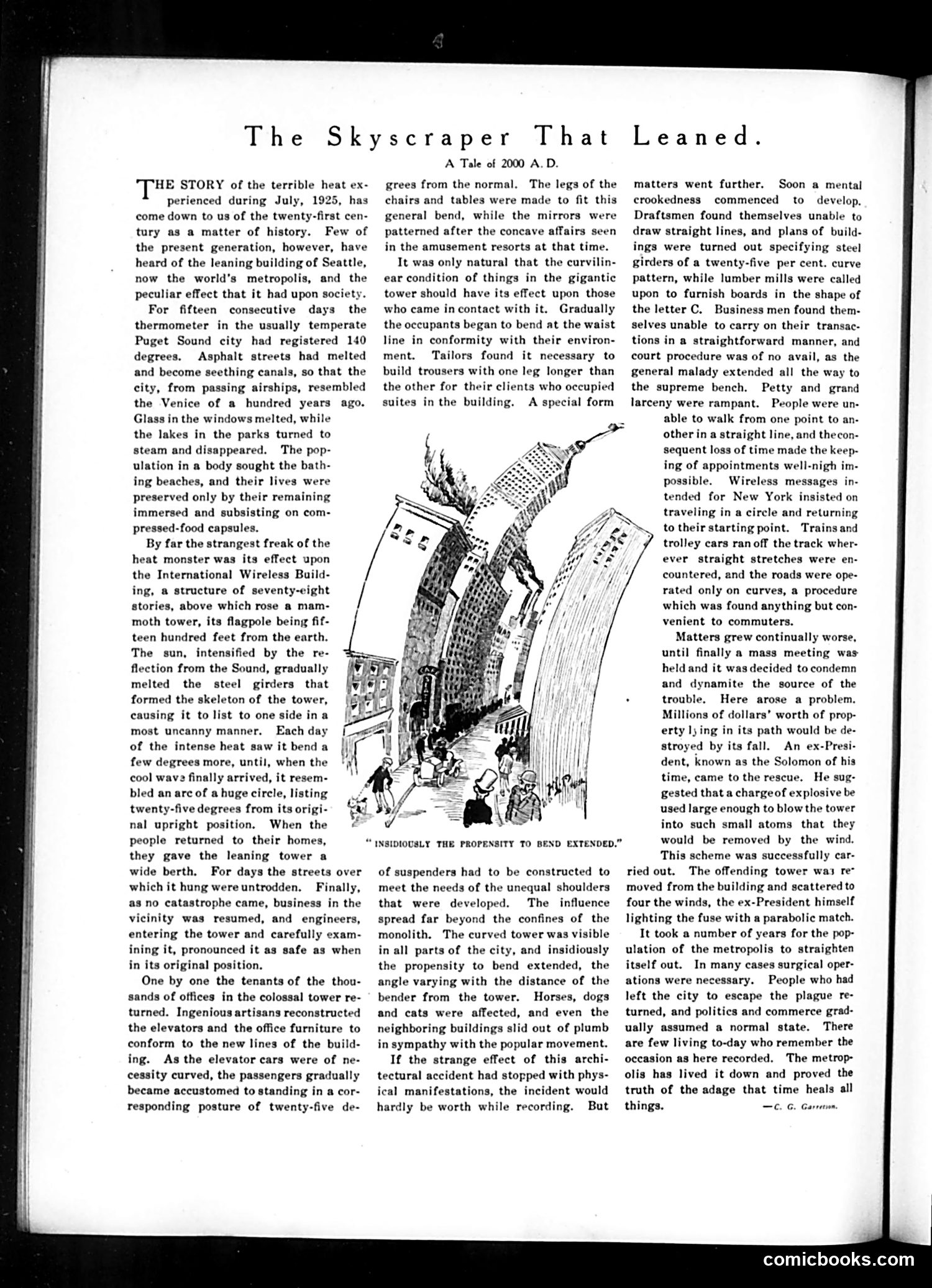
This is a humorous science fiction story set in the year 2000, imagining Seattle as Earth's metropolis. The narrative describes an extreme heat wave in 1925 that literally melts the steel girders of a 78-story building, causing it to lean 25 degrees from vertical. The satire targets human adaptation and conformity: rather than demolish the dangerous structure, tenants simply adjust to it. Furniture gets custom-built at angles, clothing is tailored with unequal legs, and people gradually contort their posture to match the building's slant. The cartoon caption ("Insidiously the Propensity to Bend Extended") underscores the joke—the physical deformity spreads psychologically to the entire neighborhood, even affecting animals and neighboring buildings. The implicit critique: people will rationalize and normalize absurdity rather than address root problems. It's satirizing human tendency toward passive acceptance of dysfunction, wrapped in a tall-tale science fiction premise.
📄 Transcribed text from this page (OCR, searchable)
Machine-transcribed from the original scan — historical spelling and the odd misread are preserved.
The Skyscraper That HE STORY of the terrible heat ex- perienced during July, 1925, has come down to us of the twenty-first cen- tury as a matter of history. Few of the present generation, however, have heard of the leaning building of Seattle, now the world’s metropolis, and the peculiar effect that it had upon society. For fifteen consecutive days the thermometer in the usually temperate Puget Sound city had registered 140 degrees. Asphalt streets had melted and become seething canals, so that the city, from passing airships, resembled the Venice of a hundred years ago. Glass in the windows melted, while the lakes in the parks turned to steam and disappeared. The pop- ulation in a body sought the bath- ing beaches, and their lives were preserved only by their remaining immersed and subsisting on com- pressed-food capsules. By far the strangest freak of the heat monster was its effect upon the International Wireless Build- ing, a structure of seventy-eight stories, above which rose a mam- moth tower, its flagpole being fif- teen hundred feet from the earth. The sun, intensified by the re- flection from the Sound, gradually melted the steel girders that formed the skeleton of the tower, causing it to list to one side ina most uncanny manner. Each day of the intense heat saw it bend a few degrees more, until, when the cool wave finally arrived, it resem- bled an arc of a huge circle, listing twenty-five degrees from its origi- nal upright position. When the people returned to their homes, they gave the leaning tower a wide berth, For days the streets over which it hung were untrodden. Finally, as no catastrophe came, business in the vicinity was resumed, and engineers, entering the tower and carefully exam- ining it, pronounced it as safe as when in its original position. One by one the tenants of the thou- sands of offices in the colossal tower re- turned. Ingenious artisans reconstructed the elevators and the office furniture to conform to the new lines of the build- ing. As the elevator cars were of ne- cessity curved, the passengers gradually became accustomed to standing in a cor- responding posture of twenty-five de- A Tale of 2000 A. D. grees from the normal. The legs of the chairs and tables were made to fit this general bend, while the mirrors were patterned after the concave affairs seen in the amusement resorts at that time. It was only natural that the curv ear condition of things in the gigantic tower should have its effect upon those who came in contact with it. Gradually the occupants began to bend at the waist line in conformity with their environ- ment. Tailors found it necessary to build trousers with one leg longer than the other for their clients who occupied suites in the building. A special form “INSIDIOUSLY THE PROPENSITY TO BEND EXTENDED.” of suspenders had to be constructed to meet the needs of the unequal shoulders that were developed. The influence spread far beyond the confines of the monolith. The curved tower was ble in all parts of the city, and insidiously the propensity to bend extended, the angle varying with the distance of the bender from the tower. Horses, dogs and cats were affected, and even the neighboring buildings slid out of plumb in sympathy with the popular movement. If the strange effect of this archi- tectural accident had stopped with phys- ical manifestations, the incident would hardly be worth while recording. But Leaned. Soon a mental to matters went further. crookedness commenced Draftsmen found themselves unable to draw straight lines, and plans of build- ings were turned out specifying steel girders of a twenty-five per cent. curve pattern, while lumber mills were called upon to furnish boards in the shape of the letter C. Business men found them- selves unable to carry on their transac- tions in a straightforward manner, and court procedure was of no avail, as the general malady extended all the way to the supreme bench. Petty and grand larceny were rampant. People were un- able to walk from one point to an- other in a straight line, and thecon- sequent loss of time made the keep- ing of appointments well-nigh im- possible. Wireless messages in- tended for New York insisted on traveling in a circle and returning to their starting point. Trains and trolley cars ran off the track wher- ever straight stretches were en- countered, and the roads were ope- rated only on curves, a procedure which was found anything but con- venient to commuters. Matters grew continually worse, until finally a mass meeting was held and it was decided to condemn and dynamite the source of the trouble. Here arose a problem. Millions of dollars’ worth of prop- erty ly ing in its path would be de- stroyed by its fall. An ex-Presi- dent, known as the Solomon of his time, came to the rescue. He sug- gested that a chargeof explosive be used large enough to blow the tower into such small atoms that they would be removed by the wind. This scheme was successfully car- ried out. The offending tower was re” moved from the building and scattered to four the winds, the ex-President himself lighting the fuse with a parabolic match. It took a number of years for the pop- ulation of the metropolis to straighten itself out. In many cases surgical oper- ations were necessary. People who had left the city to escape the plague re- turned, and politics and commerce grad- ually assumed a normal state. There are few living to-day who remember the occasion as here recorded. The metrop- olis has lived it down and proved the truth of the adage that time heals all things. develop. 6.6, comicbooks.com