
A complete issue · 24 pages · 1912
Judge — March 23, 1912
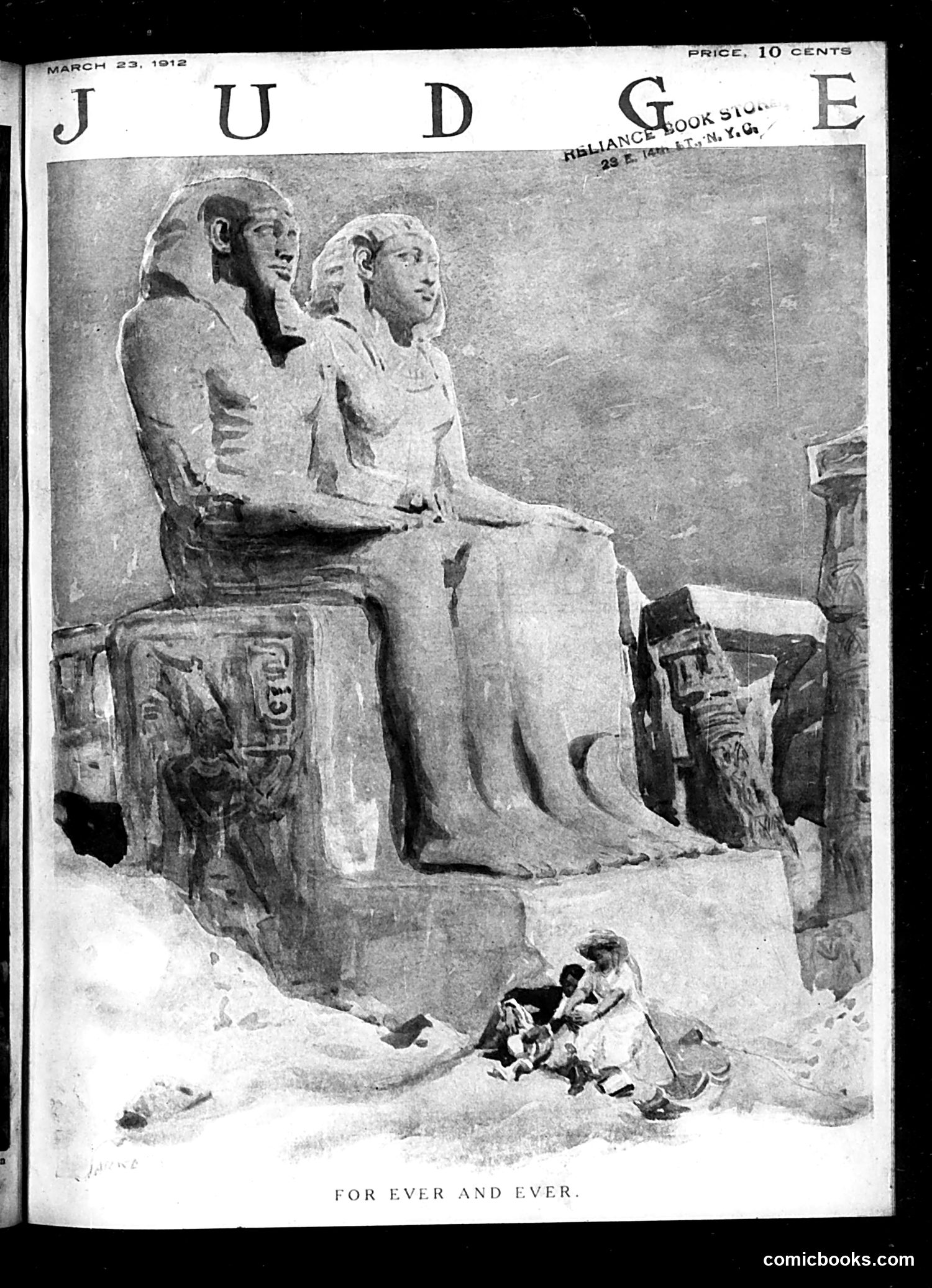
This satirical illustration depicts Egyptian statuary with the caption "FOR EVER AND EVER." The image shows colossal seated figures resembling ancient Egyptian pharaohs or gods, with a small modern figure examining them at their base. The satire likely comments on **permanence versus human mortality**—contrasting the eternal, monumental nature of ancient Egyptian civilization with the insignificance of contemporary people. In 1912, such imagery commonly appeared in discussions of archaeology, imperial legacy, or civilization's transience. Without additional context or visible identifying text beyond the title, the specific political target remains unclear. It may reference debates about archaeology, colonialism in Egypt (under British control in 1912), or more broadly, humanity's relationship to history and legacy. The "Reliance Book Store" stamp suggests institutional provenance rather than editorial commentary.
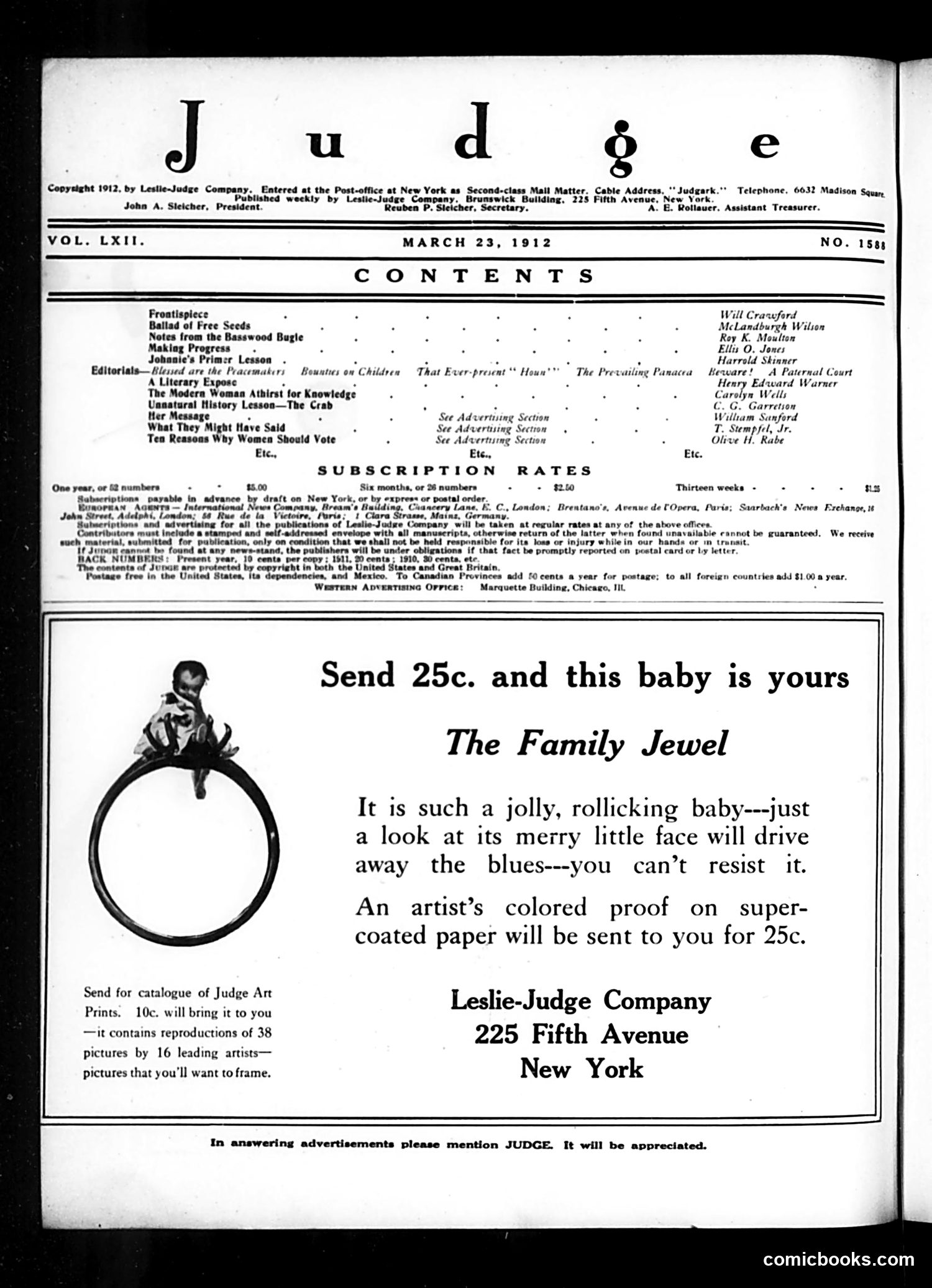
This is primarily a **contents and advertising page** rather than a political cartoon. The page lists editorial and article titles for that week's issue, along with contributor names. The main visual element is an **advertisement for "The Family Jewel,"** a novelty item sold by Leslie-Judge Company for 25 cents. It features an illustration of a baby sitting atop a ring, with text promising "a jolly, rollicking baby" whose "merry little face will drive away the blues." The ad humorously commodifies cuteness—suggesting one can purchase whimsy and joy. This reflects early 20th-century consumer culture and novelty merchandise marketing. The specific reference or joke about why a baby-topped ring was called "The Family Jewel" is unclear from context alone.
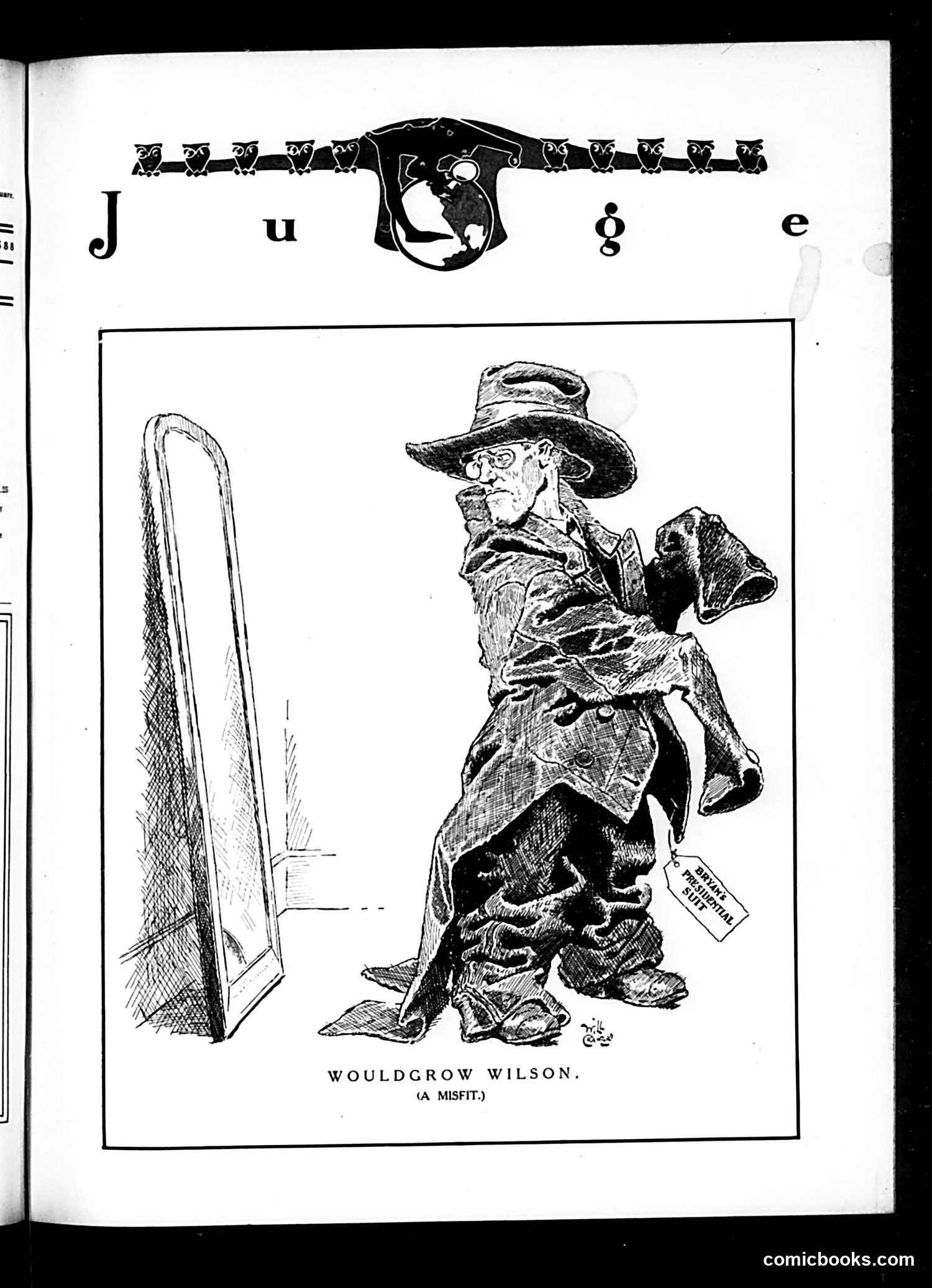
This is a political caricature of Woodrow Wilson, labeled as "a misfit." The cartoon depicts him as a ragged, poorly-dressed figure holding an axe and looking disheveled—suggesting incompetence or unsuitability for leadership. The mirror on the left appears to reflect his appearance, emphasizing the satirical critique. The "misfit" label suggests Judge magazine's view that Wilson was unsuited for his position, likely President. The deliberately unkempt appearance and crude presentation mock his capability or character. The cartoon's title uses "Wouldcrow" instead of "Woodrow," a play on words possibly suggesting he "would crow" (boast) falsely or perform poorly. This represents Judge's satirical opposition to Wilson during his presidency, using visual ridicule to criticize his political leadership or policies.
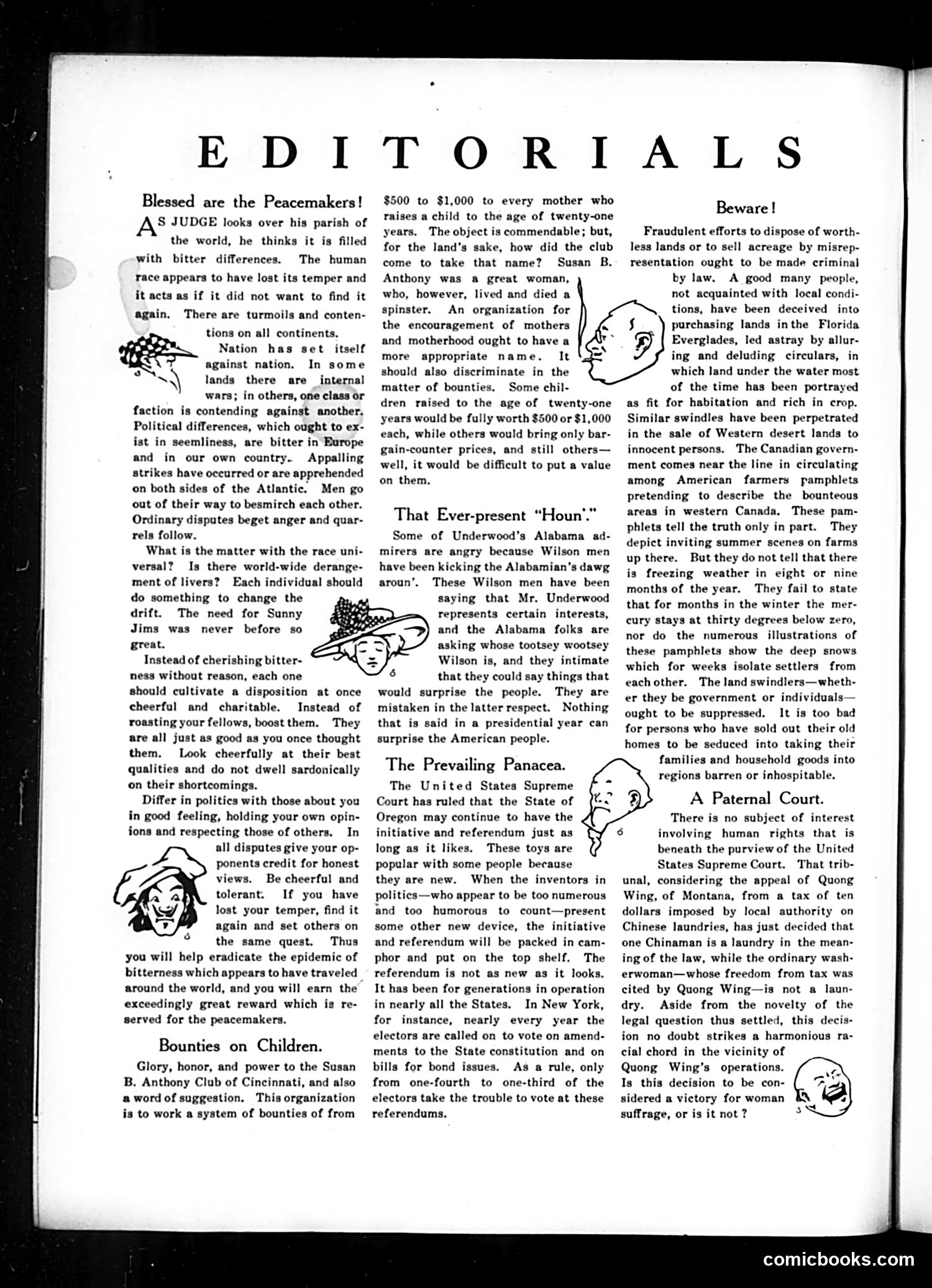
This page contains four separate editorial commentaries with small illustrative cartoons rather than a single large political cartoon. **"Blessed are the Peacemakers"** criticizes the Susan B. Anthony Club of Cincinnati for offering bounties ($500-$1,000) to mothers raising children to age twenty-one. The editor argues the organization should have a more appropriate name, as it discriminates based on bounty amounts rather than supporting all motherhood equally. **"That Ever-present 'Houn'"** mocks Alabama residents angry at fictional character Underwood's "Houn," suggesting Wilson men mistake the literary reference for reality and spread misinformation about western lands. **"The Prevailing Panacea"** critiques the Oregon initiative and referendum system as overly popular but potentially frivolous. **"A Paternal Court"** discusses a Supreme Court case regarding Chinese laundries and woman suffrage, though specifics remain unclear from the OCR'd text.
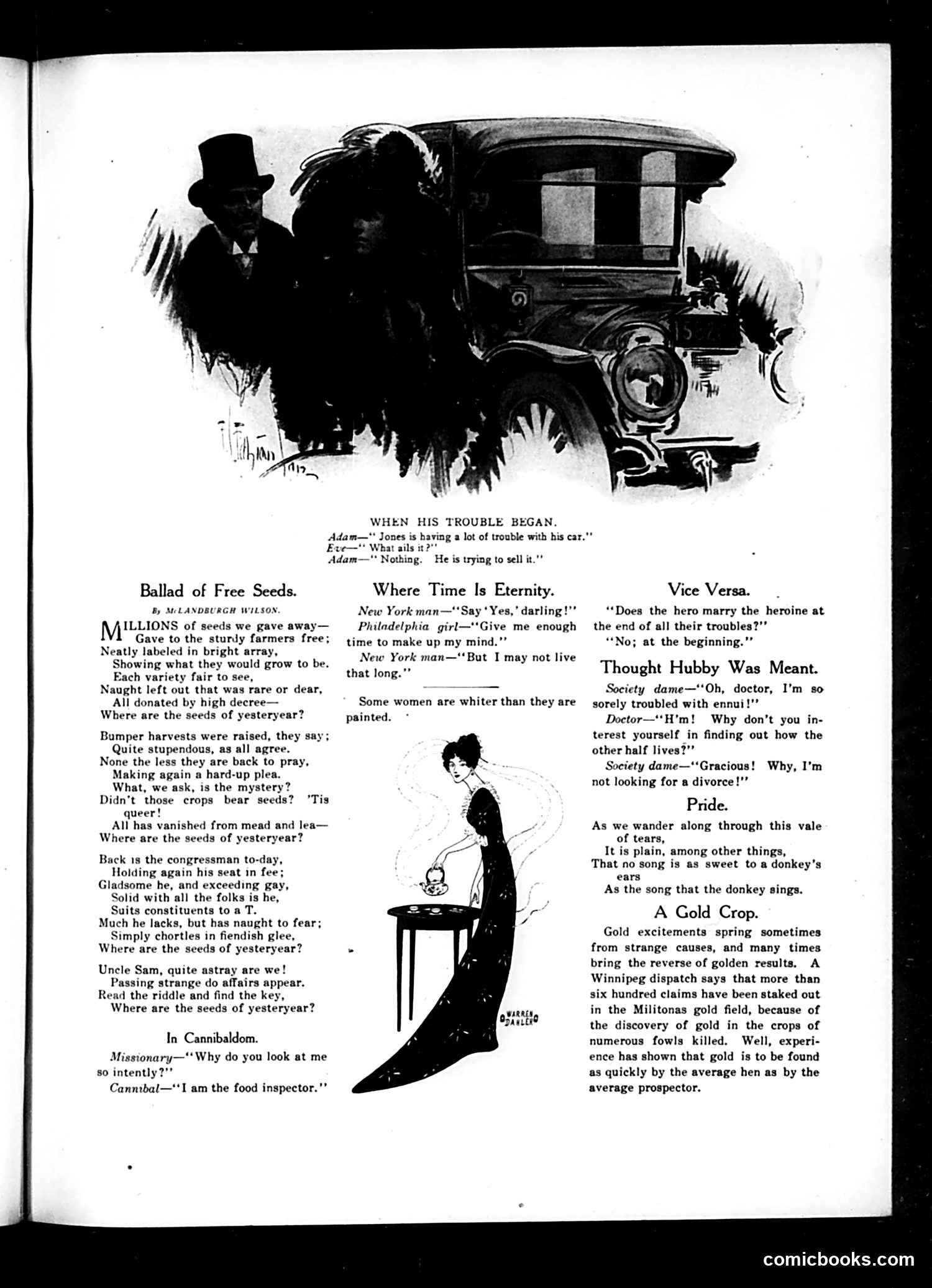
This page contains satirical poetry and humor pieces rather than political cartoons. The top illustration depicts two well-dressed figures near an automobile, captioned "WHEN HIS TROUBLE BEGAN," with dialogue about selling a car—likely satirizing automotive sales and consumer disputes of the early 20th century. The poems address social themes: "Ballad of Free Seeds" criticizes government agricultural giveaways; "Where Time Is Eternity" and other pieces mock romantic disappointments and marital troubles. "A Gold Crop" appears to reference gold mining claims in the Klondike or similar regions, satirizing get-rich-quick schemes. The illustrated vignette shows a woman at a piano, accompanying the marriage-related humor. Overall, the page satirizes early-1900s consumer culture, romance, and economic schemes rather than specific political figures or events.
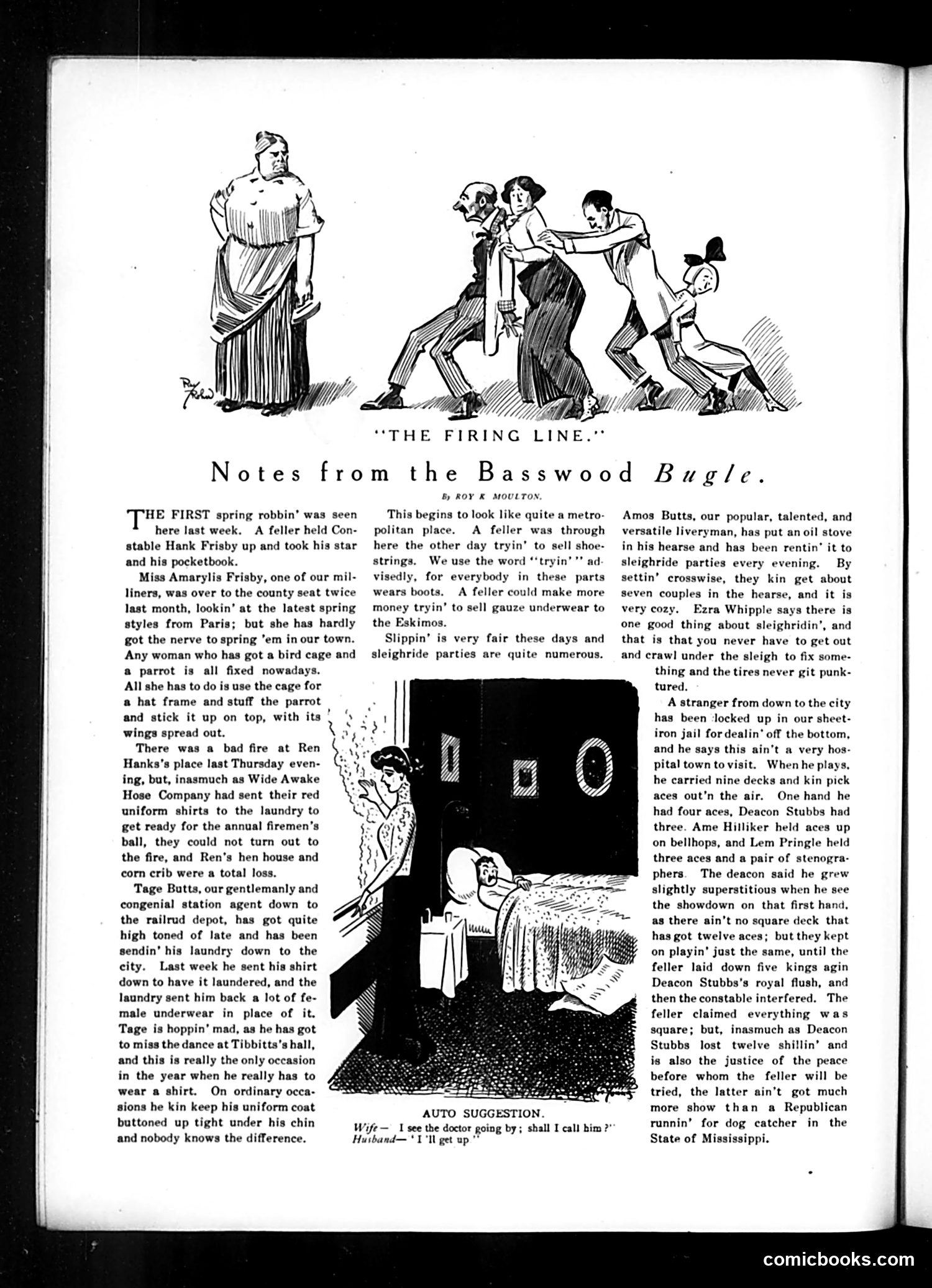
This page from *Judge* satirizes small-town American life through fictional "Notes from the Basswood Bugle," a rural newspaper column by Roy K. Moulton. The top cartoon mocks incompetent law enforcement: a woman stands unmoved while men struggle to arrest a criminal, suggesting rural constables are ineffectual. The main text uses humorous anecdotes to ridicule rustic life: constables robbed of their badges, fashionable Parisien styles rejected as impractical, a volunteer fire company so preoccupied with social events (their ball) that they miss an actual fire, and a city laundry mixing up male and female garments—stranding a man without acceptable attire for the town dance. The "Auto Suggestion" joke mocks domestic marital dynamics. The final anecdote satirizes both rural corruption and anti-Republican sentiment: a card sharp is jailed, but the judge (Deacon Stubbs) was actually cheated himself, yet will try the case anyway—suggesting a Republican defendant would fare worse. The humor targets rural incompetence, provincial attitudes, and small-town hypocrisy.
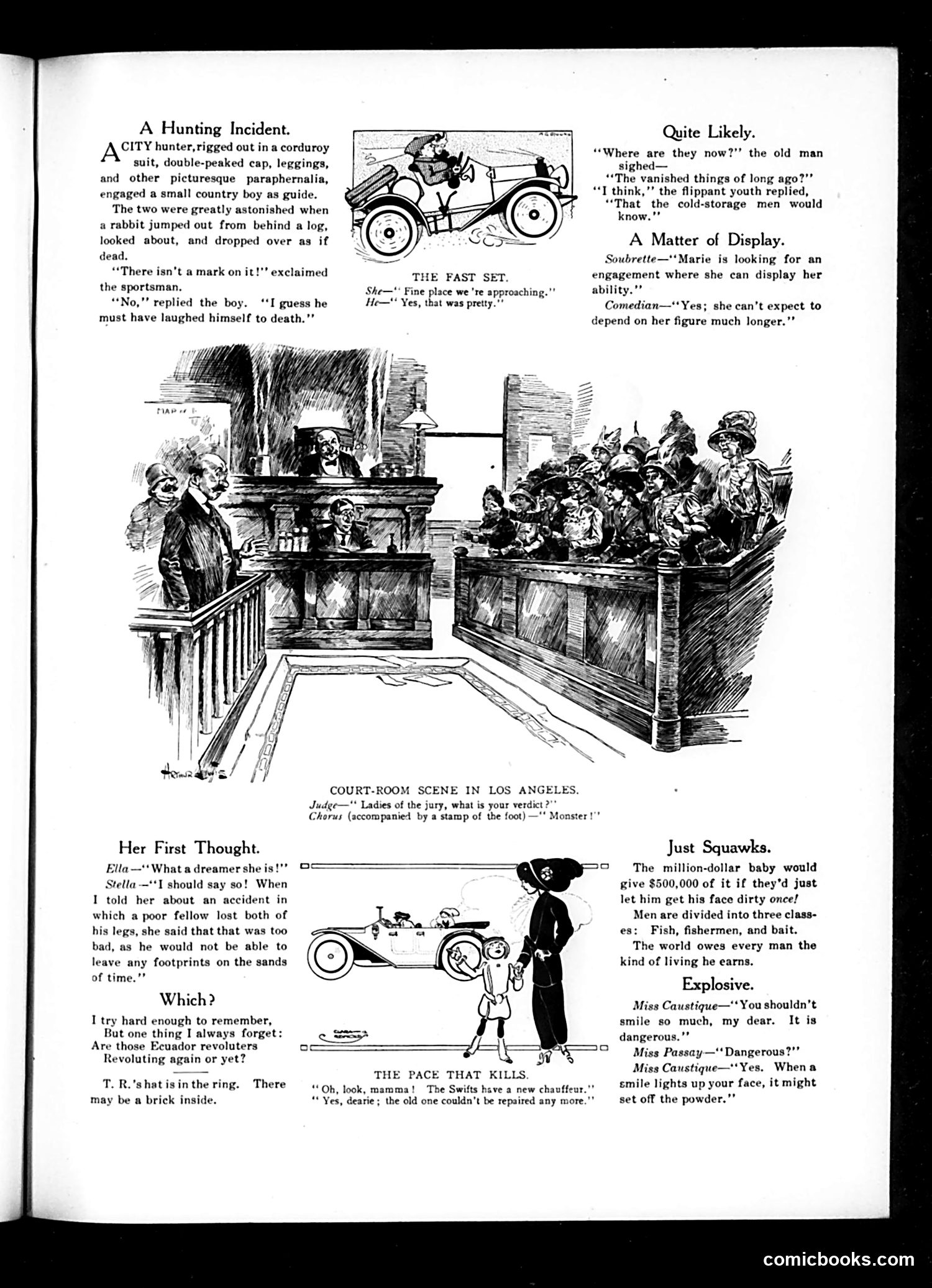
This page contains multiple satirical shorts typical of early 20th-century humor magazines: **"A Hunting Incident"** mocks inexperienced city hunters—the rabbit dies laughing at the sportsman's incompetence rather than from marksmanship. **"The Fast Set"** and **"The Pace That Kills"** satirize wealthy automobile owners, suggesting chauffeurs are disposable (the old one "couldn't be repaired"). **"Her First Thought"** ridicules sentimental women who romanticize tragedies rather than face practical realities. **"Which?"** references Theodore Roosevelt ("T.R.'s in the ring"), likely about his 1912 Progressive Party split, with unclear allusion to Ecuador. **"A Matter of Display"** and **"Explosive"** are theater/society gossip: actresses seeking engagements to showcase talents; heavy makeup jokes. **"Court-Room Scene"** shows a jury pronouncing "Monster!" at an unseen verdict. The tone is light, class-conscious satire targeting wealthy pretenders, theatrical vanity, and contemporary political figures.
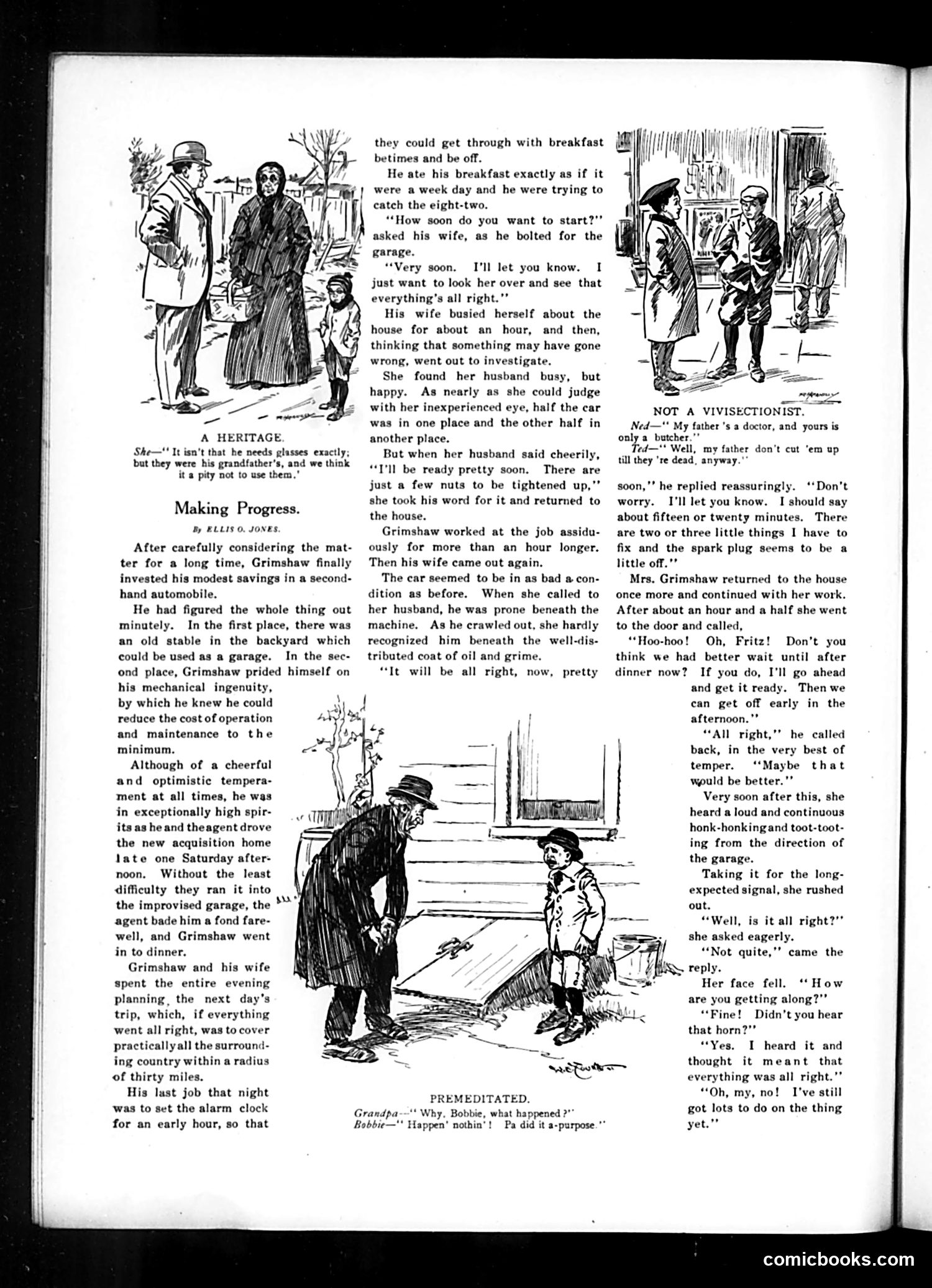
This page contains three distinct satirical pieces: **"A Heritage"** (top left): A brief joke mocking penny-pinching frugality—a woman justifies wearing her grandfather's old eyeglasses simply because they're a family heirloom, despite their being outdated and impractical. **"Making Progress"** (main story): A longer narrative satirizing the new automobile craze and male overconfidence. Grimshaw, a middle-class man, purchases a secondhand car and confidently assures his wife he can maintain it himself. He spends the entire day futilely tinkering in the garage, repeatedly underestimating repair work ("just a few nuts to tighten"), ultimately never actually taking the promised trip. The satire targets both the mechanical complexity of early automobiles and masculine self-delusion about technical competence. **Three smaller cartoons** satirize class pretension and hypocrisy: a child's accidental mischief blamed as intentional, and a butcher's son defending his father's profession against a doctor's son's snobbery. The overall tone mocks contemporary attitudes toward new technology, class consciousness, and masculine pride.
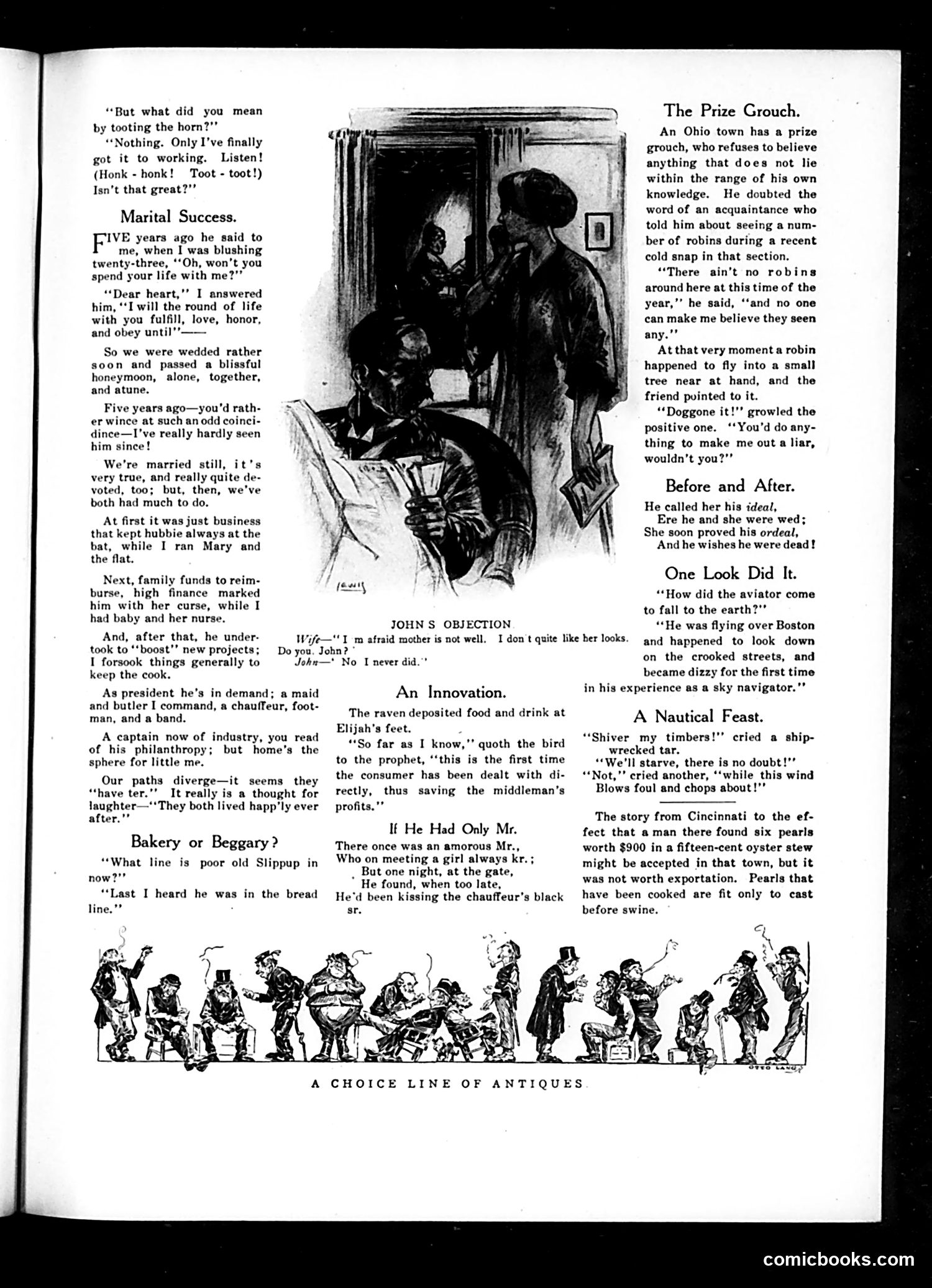
This page contains several short humorous pieces typical of early-20th-century American satirical magazines: **"Marital Success"** satirizes how marriages evolve from romantic passion to practical disconnection. The couple, once devoted, gradually become absorbed in separate professional and domestic spheres—he in business ambitions, she in household management—until they're strangers despite legal union. The joke undercuts the fairy-tale ending ("they both lived happily ever after"). **"The Prize Grouch"** mocks stubborn skepticism: an Ohio man refuses to believe robins appear in winter because it contradicts his personal experience. When a robin immediately appears, he accuses his friend of staging it rather than admit error—satirizing willful ignorance and obstinate pride. **Other brief jokes** target contemporary targets: failed business ventures ("Bakery or Beggary"), mistaken identity (kissing the chauffeur), failed romance, and urban absurdities (Boston's crooked streets). The page is primarily humorous commentary on American social life, marriage, character flaws, and modern inconveniences—typical Judge content mixing domestic and social satire with occasional topical references.
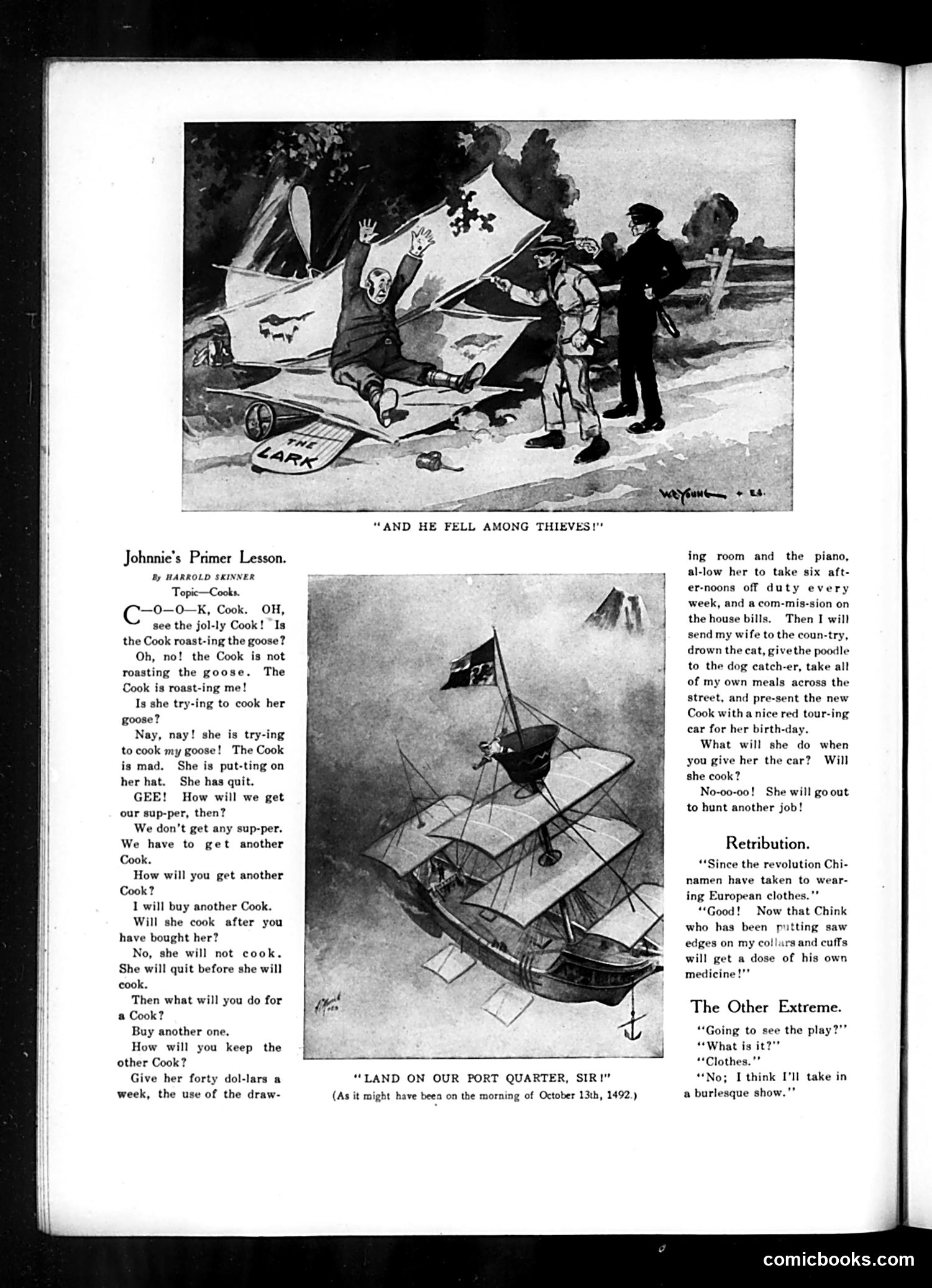
This Judge magazine page contains three satirical pieces reflecting early 1900s American social anxieties: **"Johnnie's Primer Lesson"** mocks the "servant problem"—domestic help shortages and workers' demands for better wages and conditions. The humor depicts an employer's escalating concessions (forty dollars weekly, days off, a car) as ridiculous, yet the cook still quits. The satire targets employers' bewilderment at workers' refusal to accept poor treatment. **"Land on Our Port Quarter, Sir"** references Columbus's 1492 voyage, satirizing American attitudes toward discovery and conquest. **"Retribution"** expresses xenophobic resentment: Chinese laundry workers adopting European dress is presented as suspicious, with the implied threat they'll sabotage (saw-edged collars) their employers in revenge. **"The Other Extreme"** contrasts choosing burlesque over serious theater, satirizing lowbrow entertainment preferences. These pieces reveal period prejudices against immigrants, domestic workers asserting rights, and class anxieties.
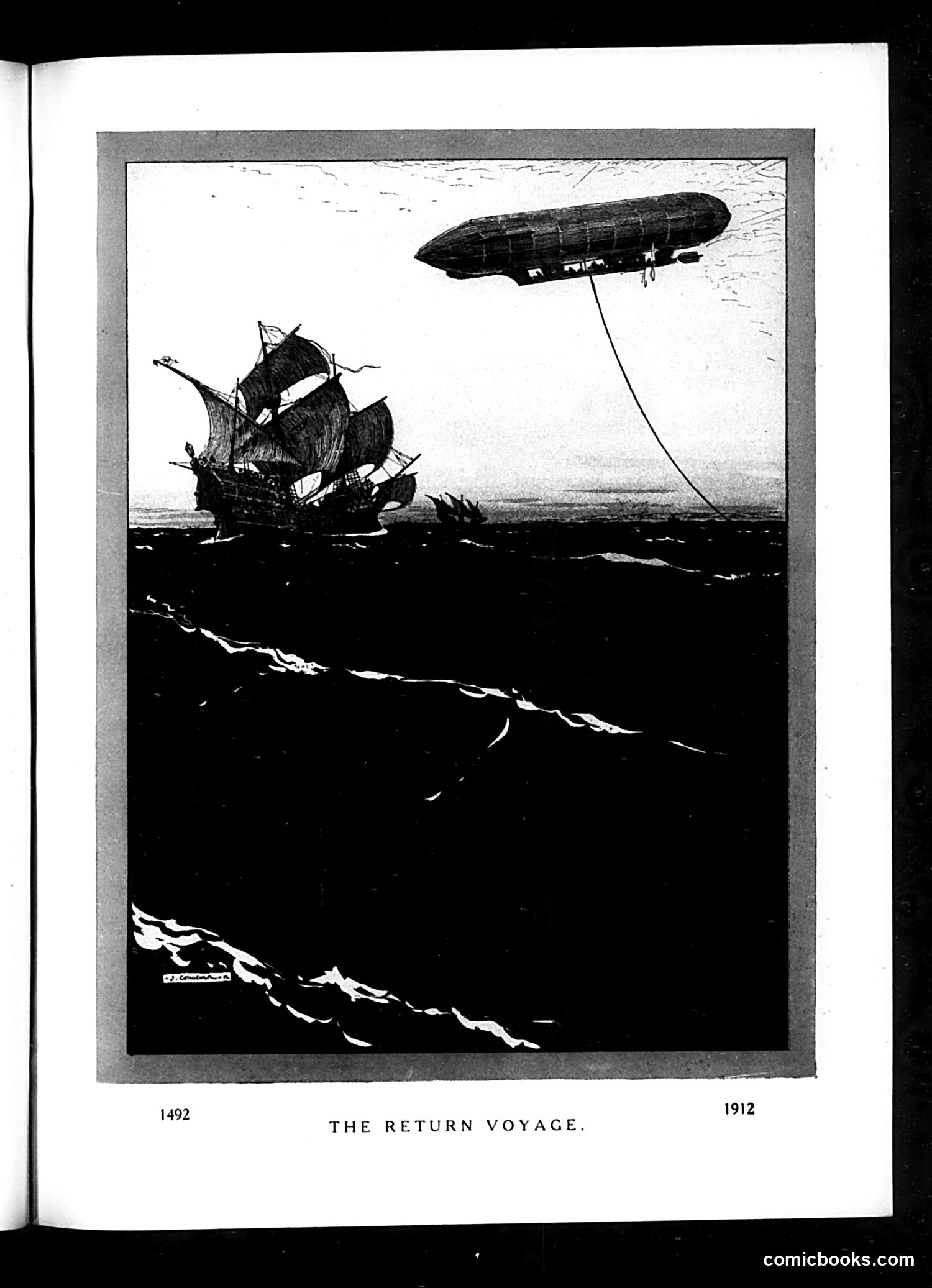
This political cartoon contrasts Columbus's 1492 voyage with modern 1912 technology. On the left, a traditional sailing ship (representing Columbus's era) struggles in turbulent waters. Above it, a modern airship or zeppelin hovers, tethered by a line to the old vessel below. The satire compares maritime exploration across four centuries: what required fragile wooden ships and months of perilous ocean travel in Columbus's time could now be accomplished via advanced aviation. The title suggests humanity's "return" to exploration—but now with dramatically superior technology. The cartoon celebrates 1912 modernity and technological progress, likely marking the 420th anniversary of Columbus's voyage while marveling at how far transportation innovation had advanced.
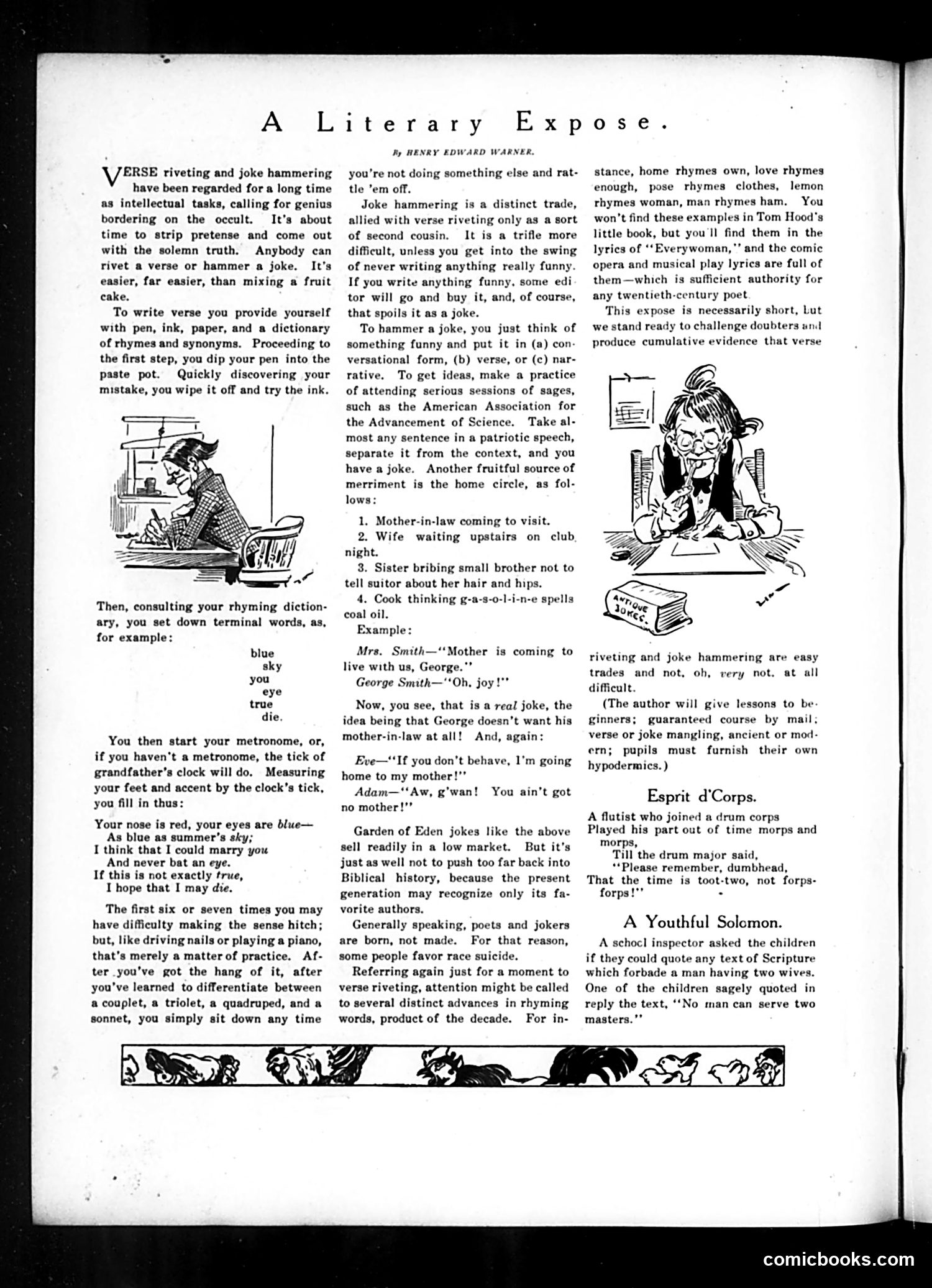
This is a satirical how-to guide mocking the supposedly difficult crafts of verse-writing and joke-making. Warner's point: both are actually trivial and formulaic, not requiring genuine talent or intellect. The satire targets: 1. **Pretentious literary culture**: The opening mocks intellectuals who treat poetry and humor as requiring "genius bordering on the occult." 2. **Mechanical mediocrity**: Warner demonstrates that verse-writing is merely mechanical—consult a rhyming dictionary, tap out a metronome rhythm, fill in blanks. The example "Your nose is red, your eyes are blue" exemplifies this dull formula. 3. **Low-quality humor**: Joke-hammering similarly reduces to formula: take sentences from patriotic speeches or domestic situations, strip context, repeat. The mother-in-law joke exemplifies this banality. 4. **Contemporary pop lyrics**: The reference to "Everywoman" and musical-play lyrics suggests these new entertainment forms represent a decline in literary standards—they're full of forced, absurd rhymes ("lemon/woman," "man/ham"). The cartoons show a writer laboring mechanically at a desk, suggesting the drudgery rather than inspiration required.
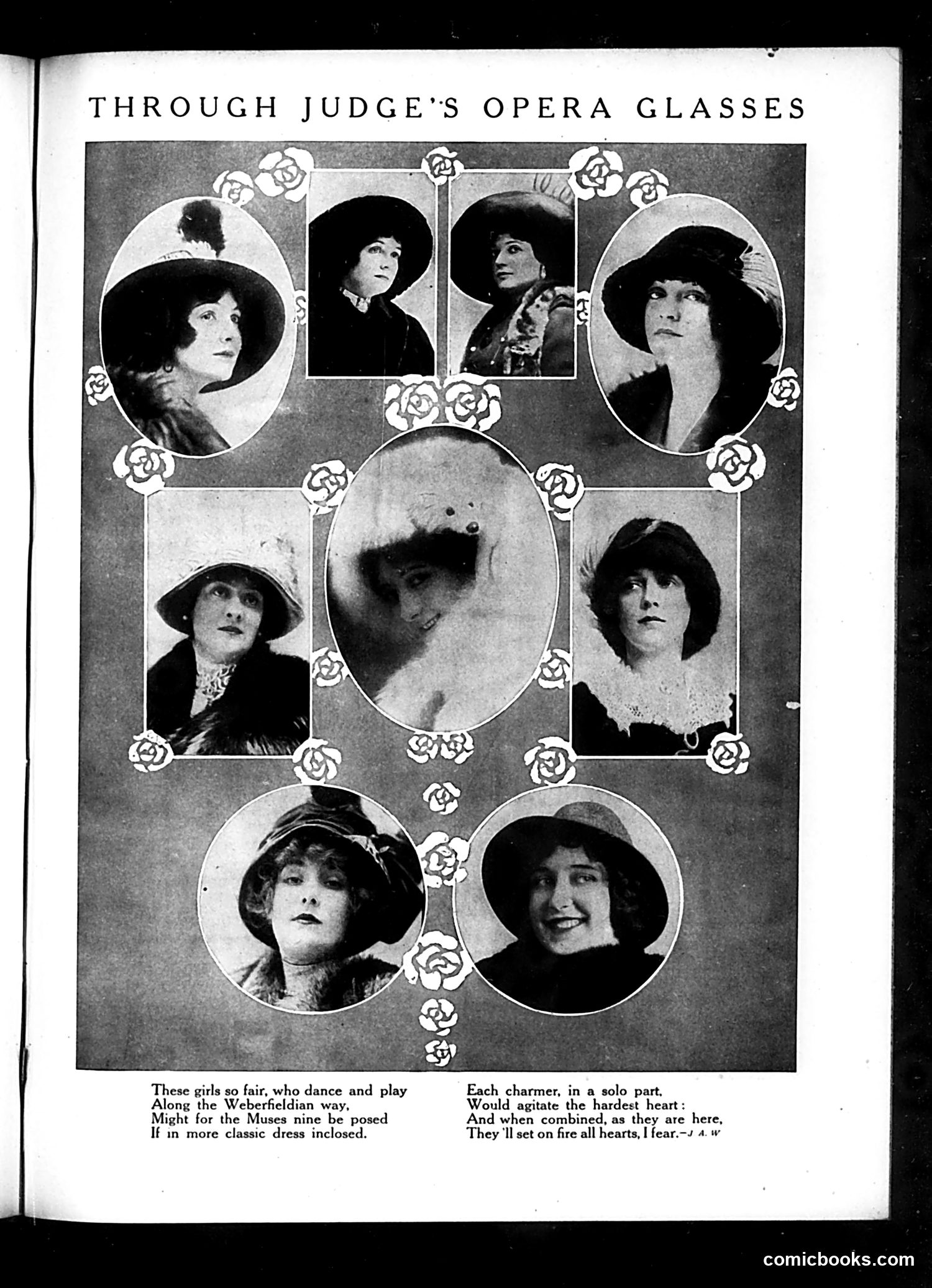
This page features nine portrait photographs of young women arranged in an ornate frame with decorative flourishes. The title references viewing through opera glasses—a humorous lens for examining attractive women. The accompanying verse praises these "fair" girls who perform along the "Weberfieldian way" (likely referencing a theatrical venue or producer). The satire suggests these performers could pose as classical muses if dressed more formally, but in their current attire, they're presented as dangerously attractive—capable of igniting passion in observers. This appears to be theatrical promotion disguised as satirical social commentary, typical of Judge magazine's early 20th-century approach to covering entertainment and beauty while maintaining a veneer of artistic critique.
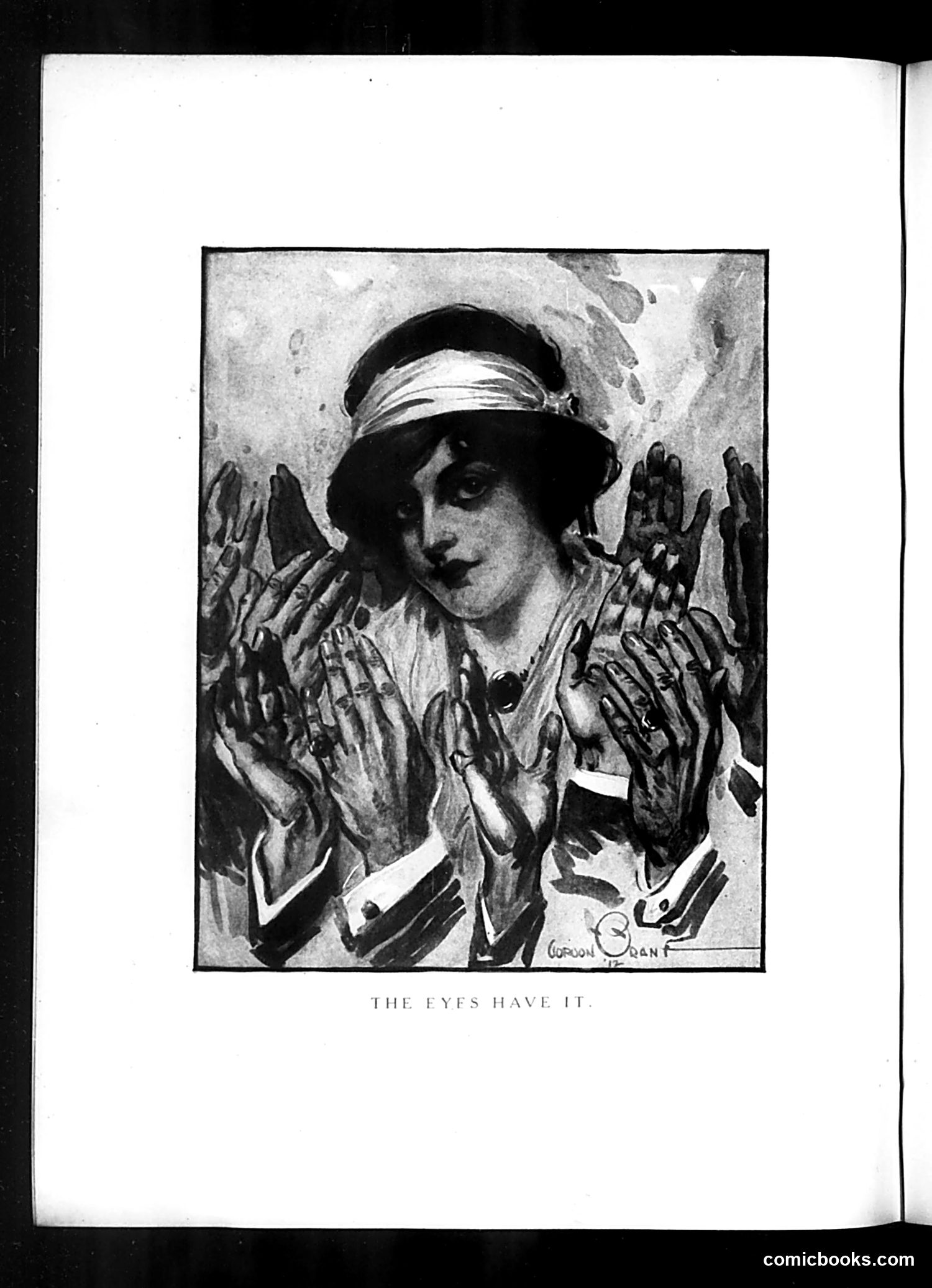
This appears to be a satirical illustration from *Judge* magazine titled "The Eyes Have It." The image shows a figure wearing a blindfold and what looks like a visor or headpiece, surrounded by hands gesturing from all sides. The figure's face is drawn with exaggerated, prominent eyes that are visible despite the blindfold. The satire likely critiques someone in a position of power or authority who claims blindness to wrongdoing or corruption while actually being fully aware of it—hence "the eyes have it." The surrounding hands may represent various interests or parties attempting to influence the blindfolded figure. Without specific OCR context or date information, the exact political target remains unclear, but the metaphor of willful blindness combined with revealing eyes was a common *Judge* device for exposing hypocrisy.
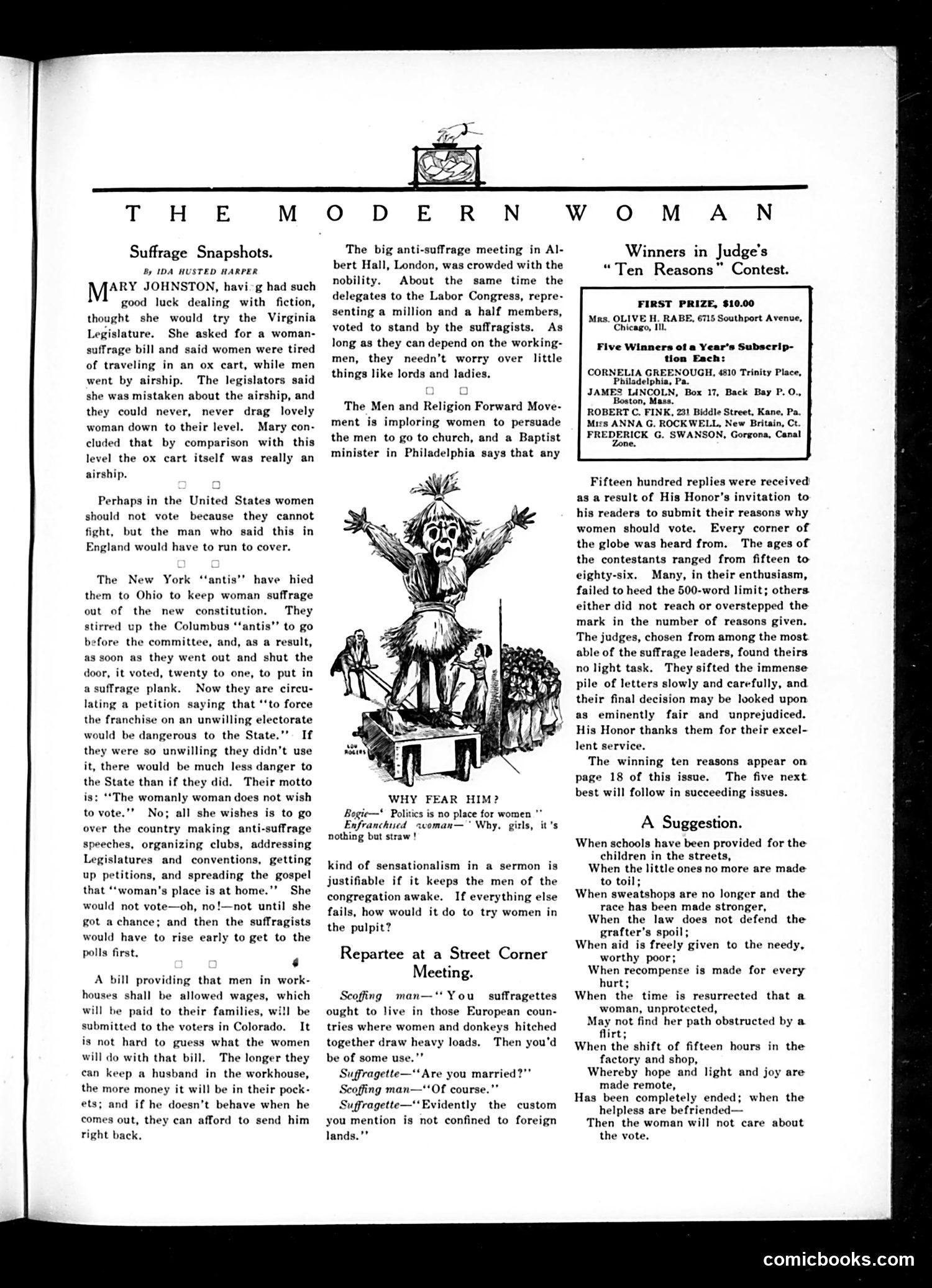
This page satirizes early-1900s opposition to women's suffrage. The column "Suffrage Snapshots" by Ida Husted Harper mocks anti-suffrage arguments through anecdotes. Mary Johnston's appeal to Virginia legislators—that women deserve voting rights equal to men's modern conveniences—is rejected with patronizing claims that voting would "drag lovely woman down." The cartoon "Why Fear Him?" depicts a well-dressed man ("Bogie") dismissing politics as unsuitable for women, while an "Enfranchised woman" retorts that it's "nothing but straw"—implying politics lacks substance. The "Repartee" section uses humor: a scoffing man compares suffragettes to donkeys; a suffragette responds that since he's married, the custom of women bearing burdens applies in his own home. The page represents Judge's satirical stance *supporting* suffrage by ridiculing anti-suffrage arguments as illogical, patronizing, and self-serving. The contest for "Ten Reasons" suggests readers submitted arguments for women's voting rights.
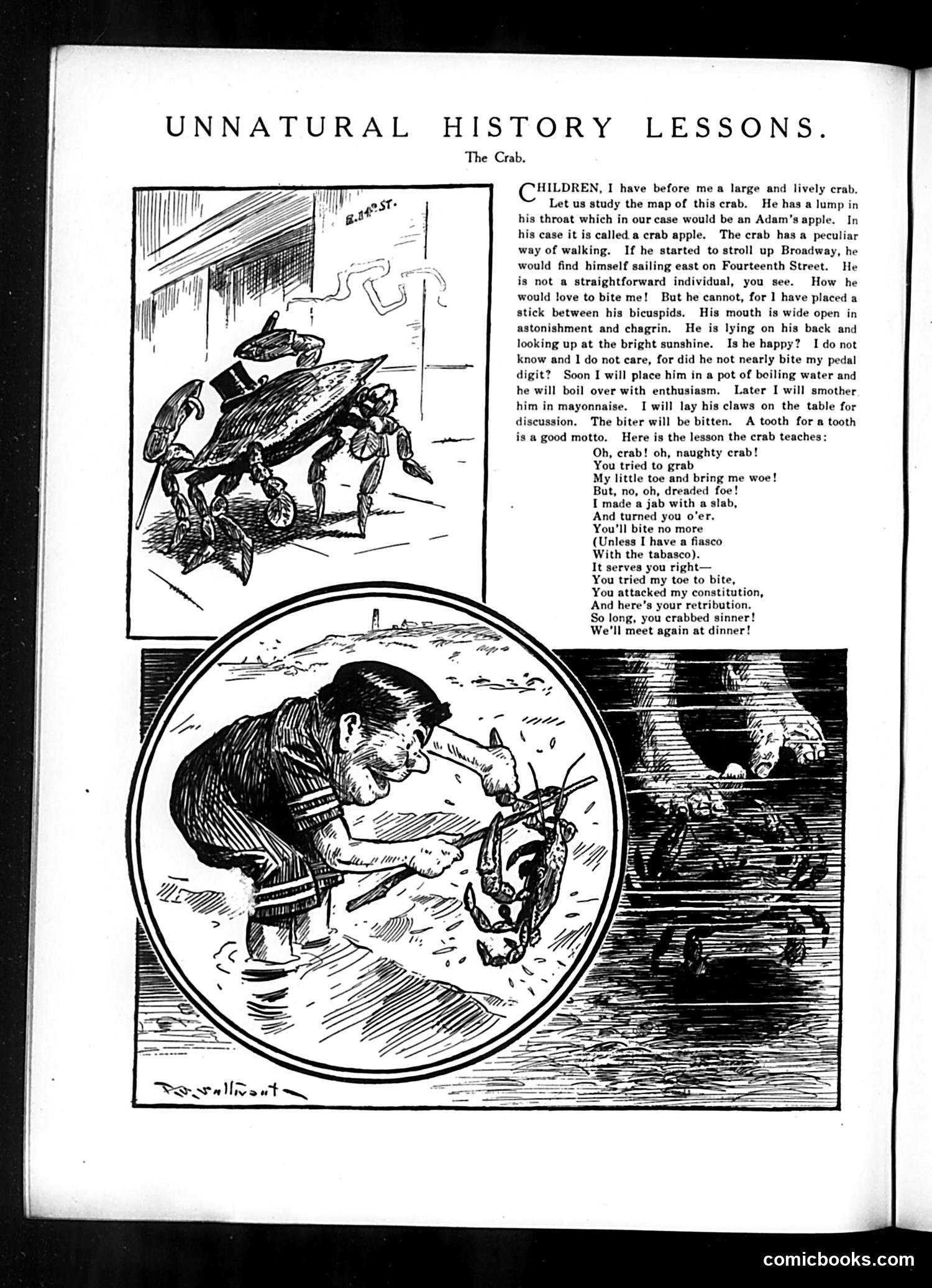
This educational satire uses a crab as an anthropomorphized teaching subject. The upper illustration shows a detailed crab with anatomical labels. The accompanying text addresses children, describing the crab's physical characteristics—its lump (crab apple), sideways walk, and wide mouth—in a playful, condescending tone. The lower circular illustration depicts a man examining a crab, likely representing a naturalist or teacher. The poem concludes with mock-serious moralizing: the crab teaches retribution through its bite, presented as comeuppance for human aggression. The satire appears to target overly earnest Victorian-era natural history education and its tendency toward anthropomorphic lessons and forced morality tales. The tone is humorous and slightly mocking of such didactic approaches.
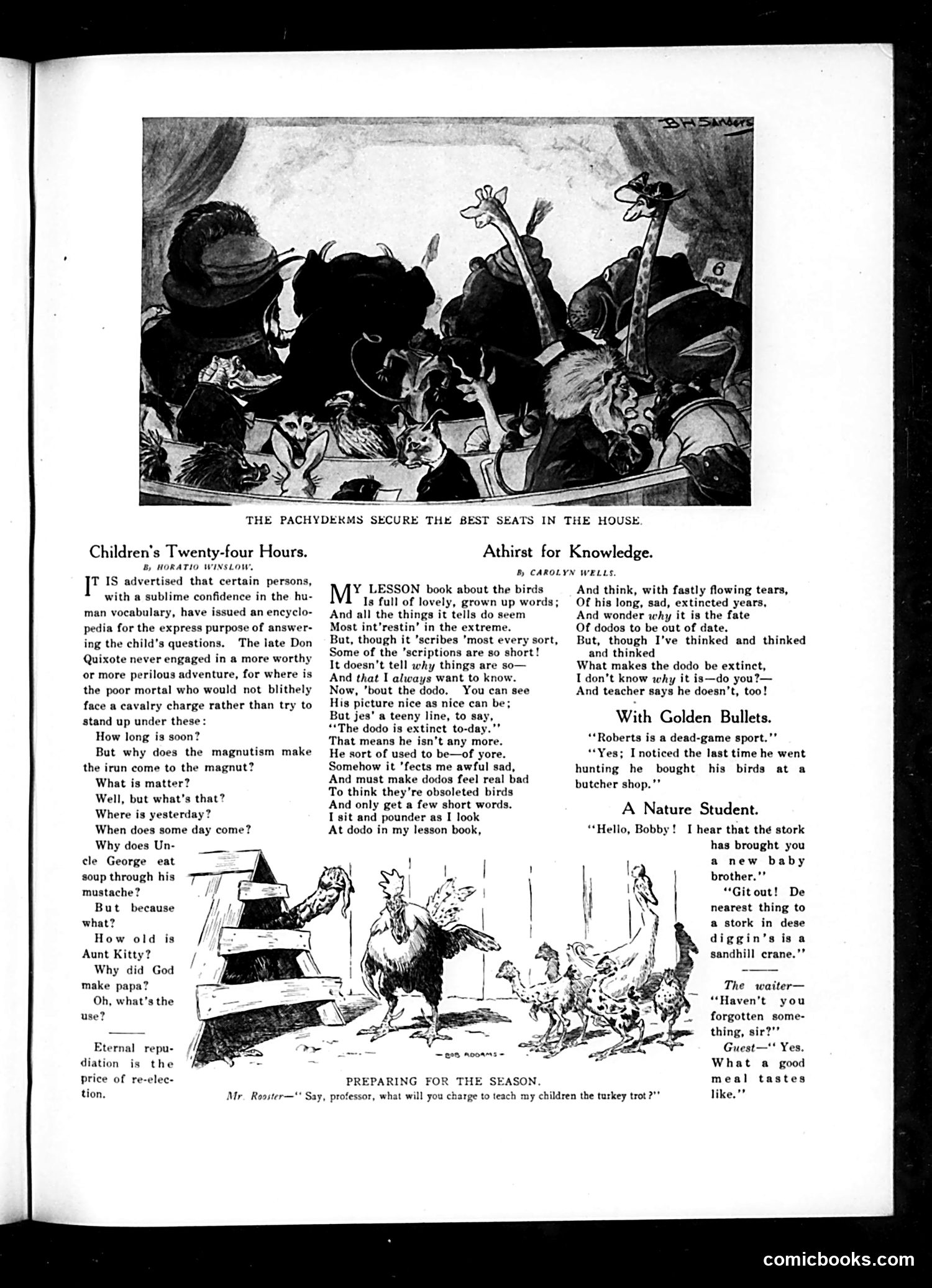
This page contains three separate humorous pieces targeting common targets of early 20th-century satire: **"The Pachyderms Secure the Best Seats"** (top cartoon): A political cartoon depicting elephants (representing the Republican Party) monopolizing the best theater seats, likely satirizing Republican dominance or their tendency to crowd out others from power or prominence. **"Children's Twenty-four Hours" and "Athirst for Knowledge"**: Two poems mocking adults' inability to answer children's endless, impossible questions—"How long is soon?" "Why does Uncle George eat soup through his mustache?"—and children's obsession with learning, particularly about extinct creatures like the dodo. **"With Golden Bullets" and "A Nature Student"**: Brief jokes about a hunter buying dead game rather than hunting it, and a child correcting an adult's assumption about storks delivering babies (replacing it with a sandhill crane, a regional alternative). The page emphasizes humor about human pretension, parental frustration, and regional American references.
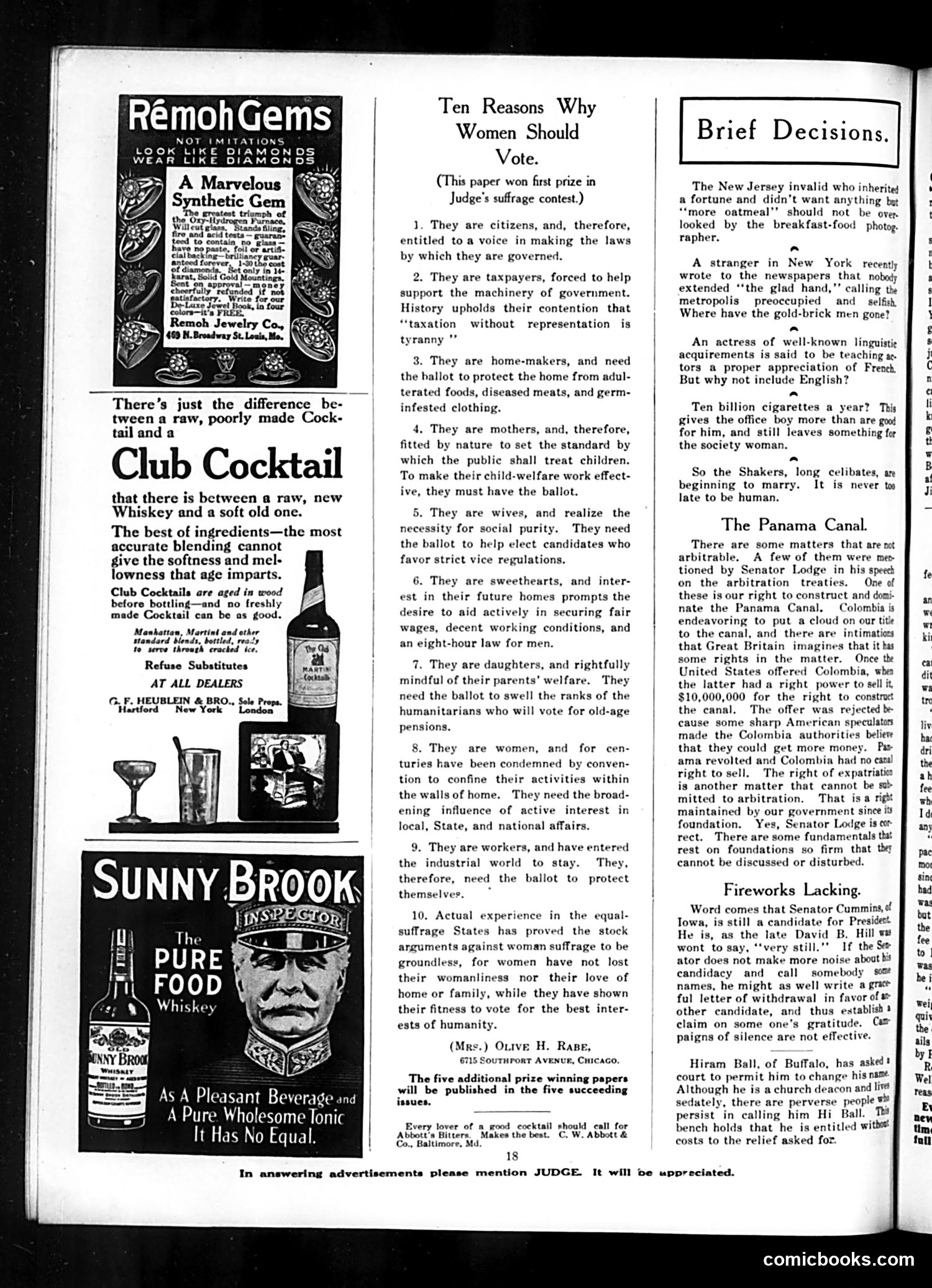
This page primarily contains **advertisements and editorial content supporting women's suffrage**, rather than political cartoons. The main feature is a prize-winning essay titled "Ten Reasons Why Women Should Vote," authored by Mrs. Olive H. Rabe of Chicago. The arguments reflect early-20th-century suffrage rhetoric: women as citizens and taxpayers deserve representation; as mothers and homemakers, they need voting power to protect families from contaminated food and unsafe working conditions; as workers entering industry, they require ballot access; and experience in equal-suffrage states proves women haven't lost femininity or family values. The page is surrounded by whiskey and synthetic gem advertisements typical of Judge's era. The "Brief Decisions" section contains satirical short jokes about contemporary topics—a New Jersey invalid, New York coldness, linguistic pretension, and cigarette consumption. The suffrage essay's publication indicates Judge's stance on this contentious issue during the pre-1920 period when women's voting rights remained hotly debated in America.
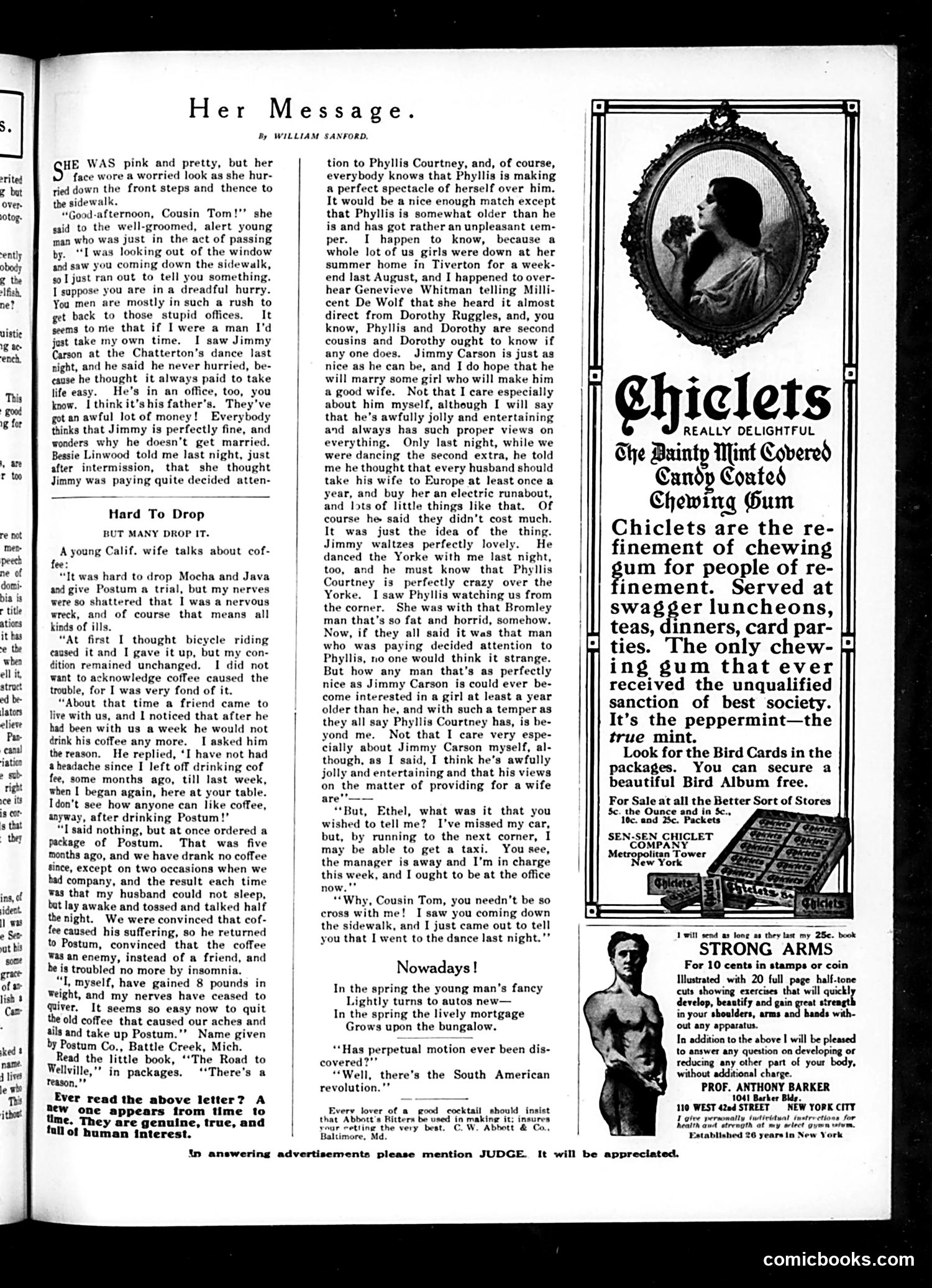
This page contains primarily **advertising and serialized fiction**, not political satire. The main content is "Her Message," a gossipy domestic story by William Sanford about a young woman breathlessly sharing social rumors with her cousin about eligible bachelors and marriage prospects among their social circle. The right side features **product advertisements**: Chiclets chewing gum (marketed as refined confectionery for proper society), a "Strong Arms" physical development course, and a Postum coffee substitute testimonial. There is **no political cartoon** on this page. The "satire" of Judge magazine appears in the *writing itself*—the breathless, shallow gossiping of the female character is presented as humorous commentary on women's preoccupations with marriage and social standing. The Postum ad similarly uses humor (a wife's conversion narrative) to sell a caffeine-free alternative. This reflects early 20th-century magazine humor: domesticated, consumer-focused, and gently mocking of middle-class social anxiety rather than political targets.
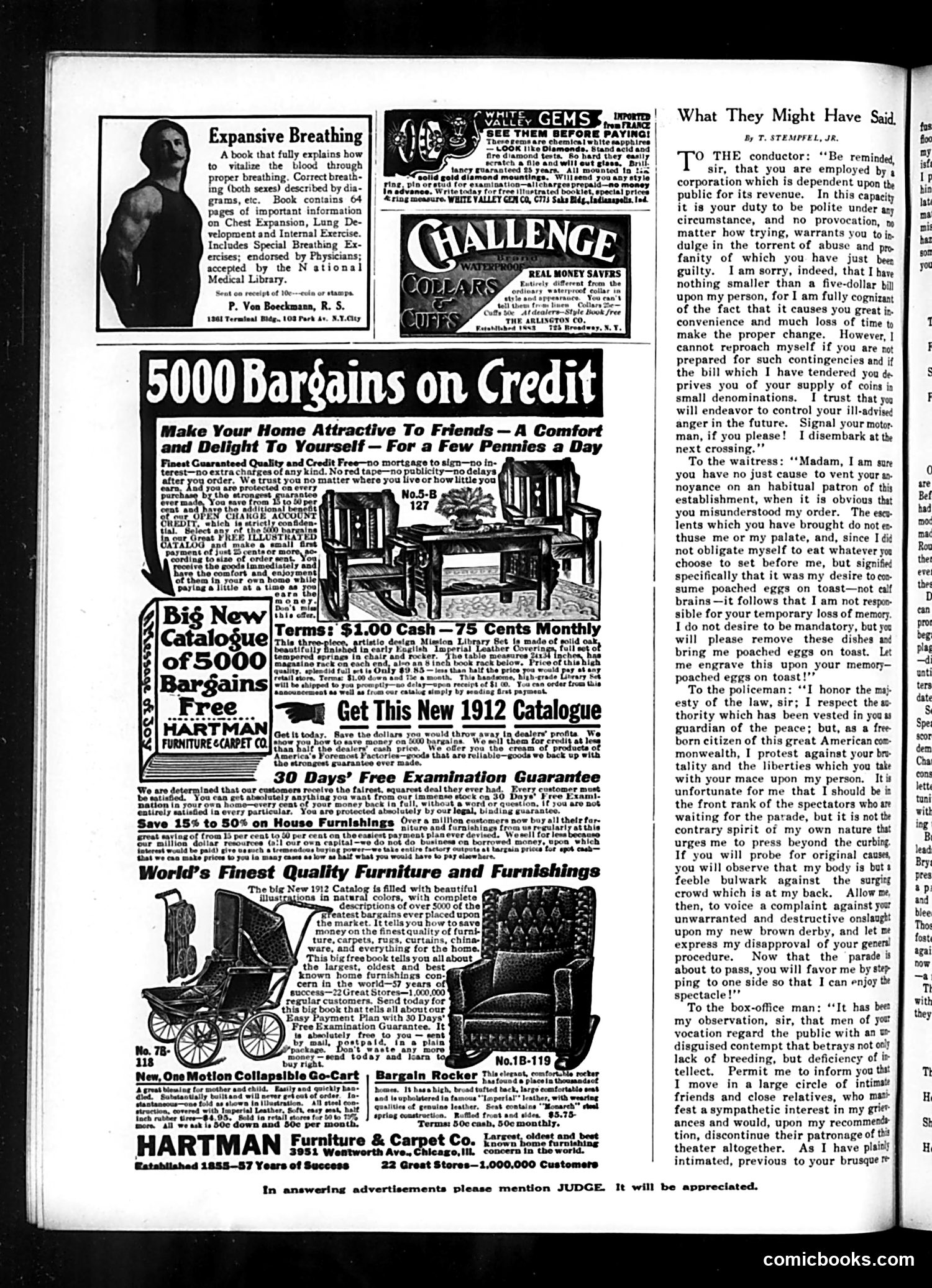
This is primarily an **advertising page** from Judge magazine, dominated by a massive Hartman Furniture & Carpet Co. advertisement promoting "5000 Bargains on Credit" with easy payment terms ($1.00 cash, 75 cents monthly). The ad emphasizes affordability and accessibility to working-class customers. The page includes minor **satirical content** titled "What They Might Have Said" by T. Stempfel, Jr., which presents imagined polite, elaborate responses to everyday rudeness—a conductor's abuse over a large bill, a waitress's annoyance. The humor lies in the absurd formality and flowery language these fictional characters use to respond to ordinary service-industry frustrations, gently mocking both working-class rudeness and upper-class pretension. The remaining space contains smaller ads for self-help books on breathing and various "gems" of advice—typical of period Judge content mixing commerce with light social satire.
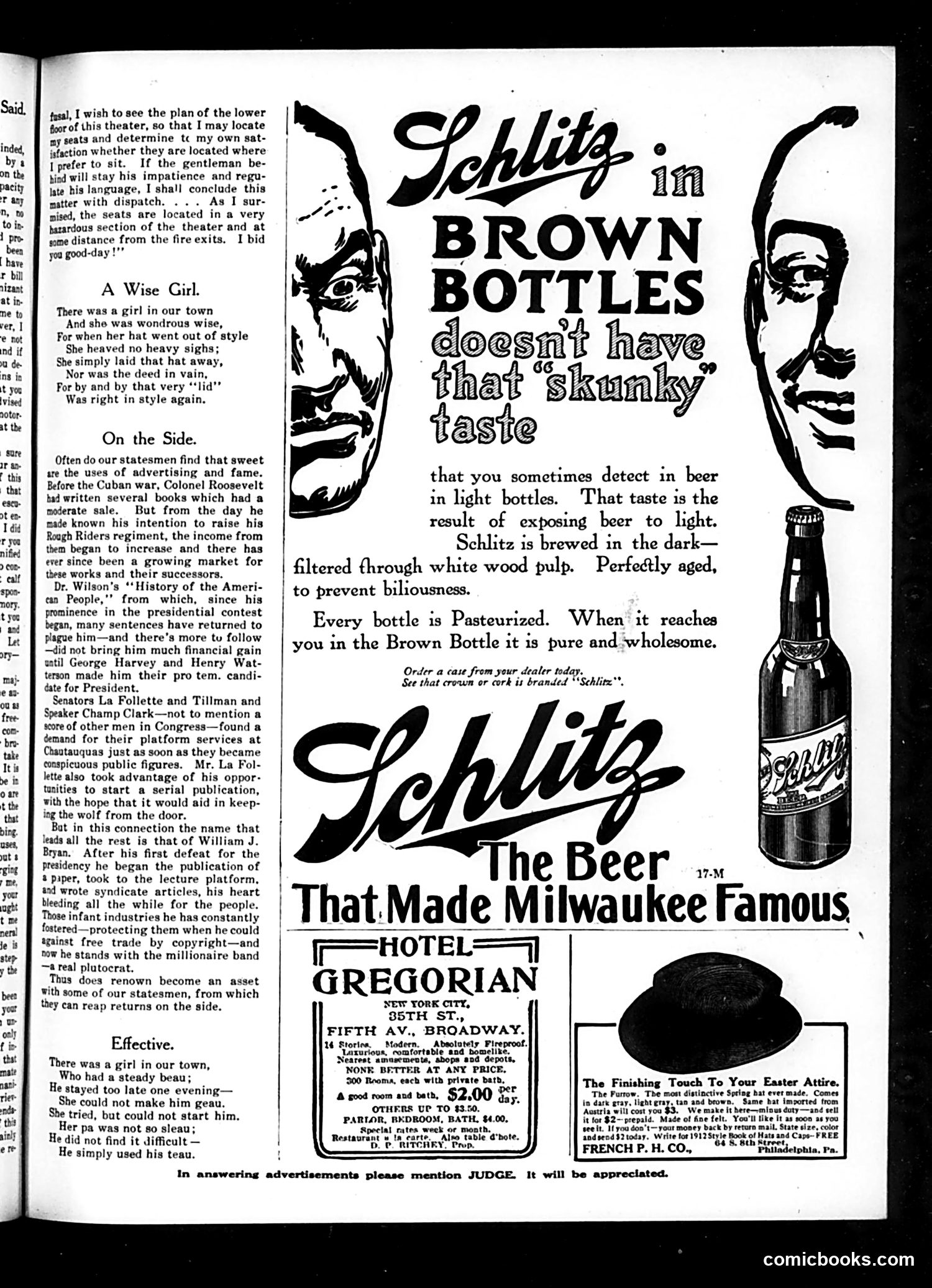
This page mixes editorial content with advertising. The main satirical pieces are short poems ("A Wise Girl," "On the Side," "Effective") that mock social conventions and political hypocrisy—particularly how politicians and public figures exploit their fame for financial gain, mentioning Roosevelt, Bryan, La Follette, and Speaker Champ Clark as examples of men who leveraged their prominence into lucrative book deals and lecture tours. The dominant feature is a **Schlitz beer advertisement** using two caricatured male faces (their identity unclear from the image alone) to emphasize that brown bottles protect beer from light exposure, preventing an undesirable taste. The ad emphasizes Pasteurization and purity—marketing concerns relevant to early-1900s beer consumption when quality control was inconsistent. Below is a Hotel Gregorian advertisement and a "Furrow" hat ad, typical period classified advertising. The page reflects Judge's characteristic blend of humor, social commentary, and commercial content.
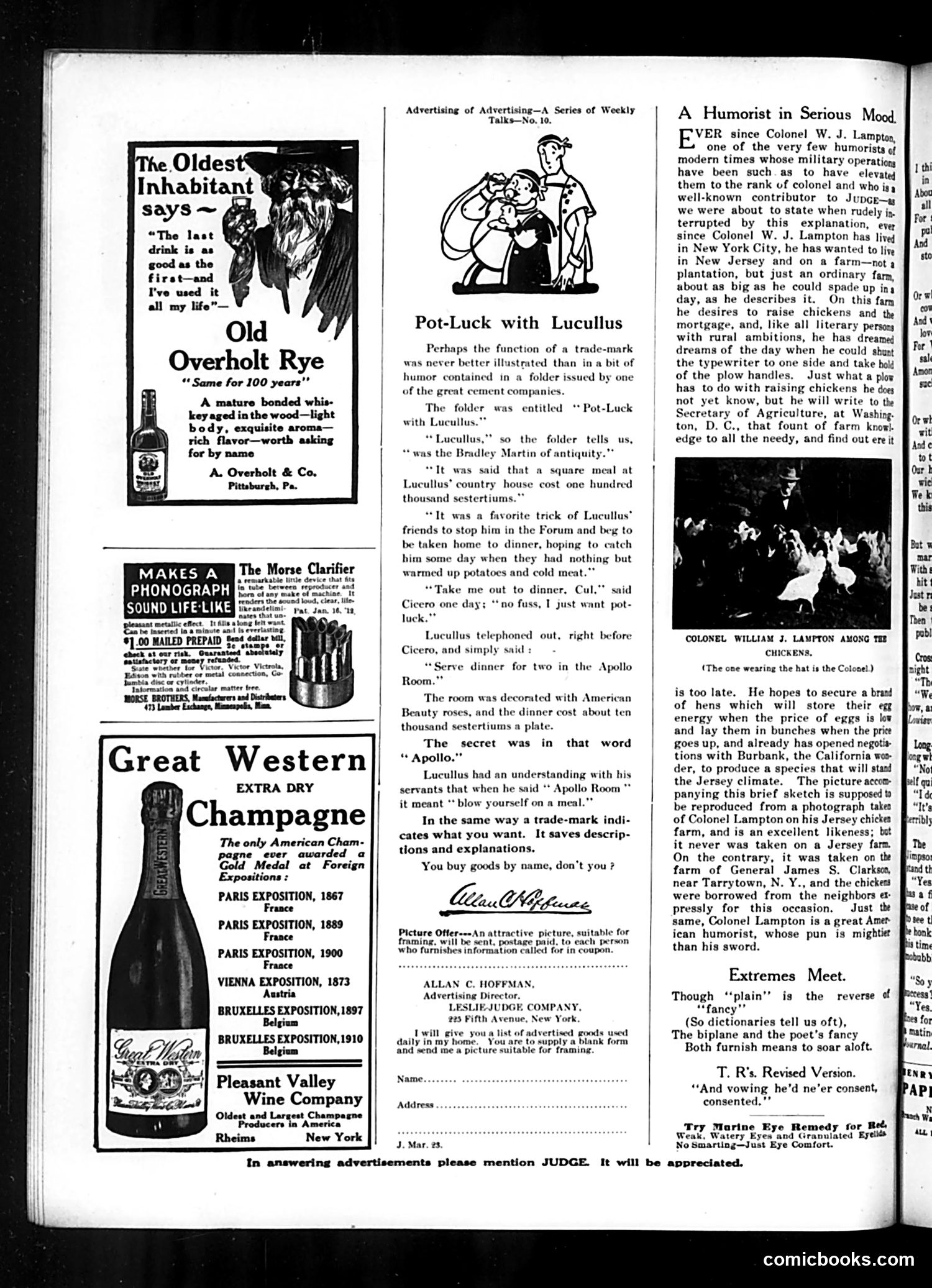
This page is primarily **advertisements** interspersed with humor content. The main satirical article, "A Humorist in Serious Mood," profiles **Colonel W. J. Lampton**, a military officer and *Judge* contributor. The satire gently mocks his rural aspirations—though he's an urban New York writer, he dreams of farming in New Jersey, wanting to raise chickens and manage a mortgage while maintaining literary pursuits. The joke emphasizes the disconnect between his intellectual life and his romantic notions of agricultural work (notably, he plans to use a plow with chickens, suggesting naive farm knowledge). The "Pot-Luck with Lucullus" section illustrates advertising principles through a Roman anecdote: Lucullus's servants understood that "Apollo Room" meant an extravagant meal without explanation. Similarly, **brand names function as shorthand**—consumers "buy goods by name" rather than requiring detailed descriptions. This directly supports the magazine's advertising philosophy. The remaining content consists of product advertisements for whiskey, champagne, and phonographs.
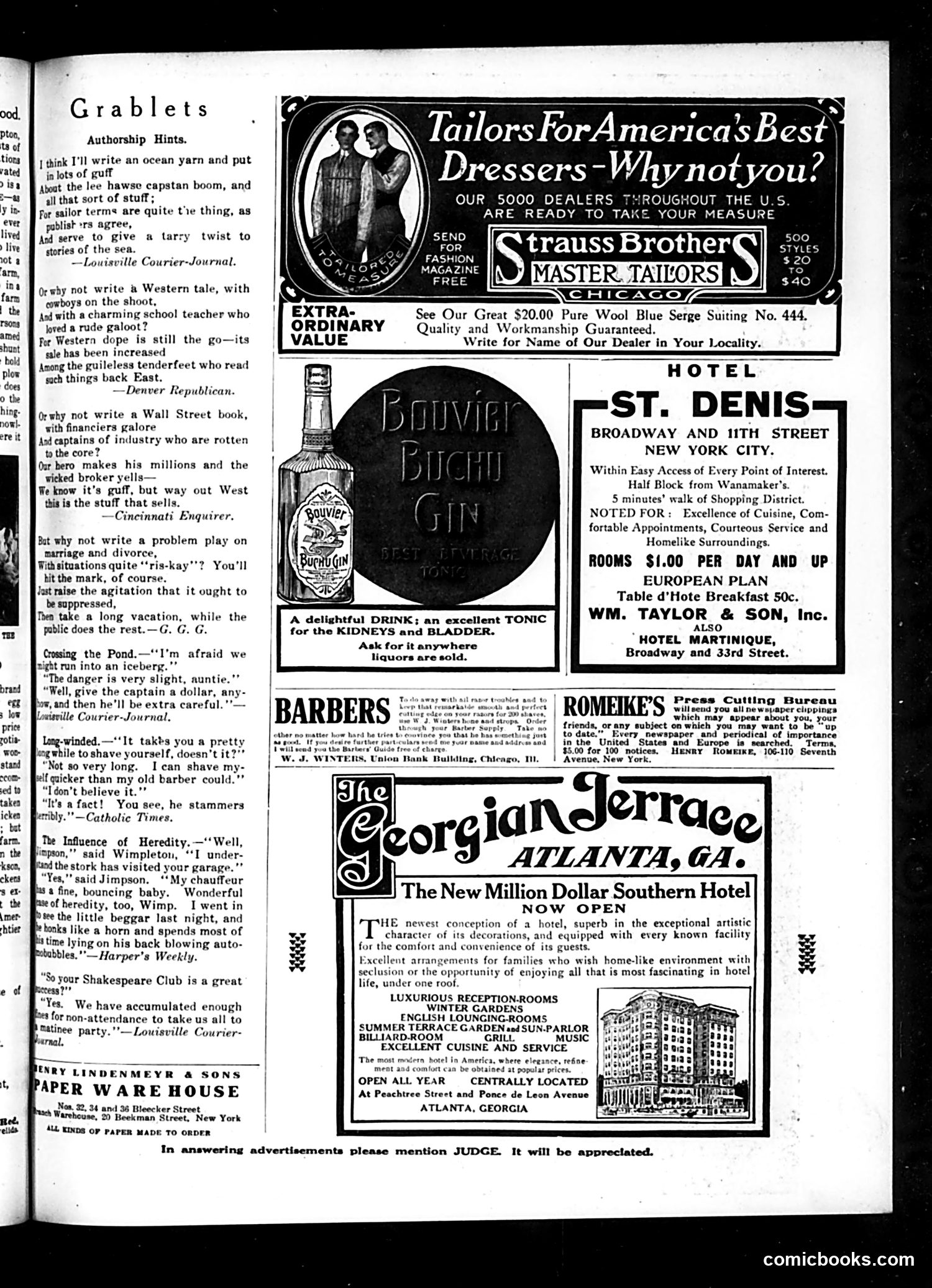
This page is primarily **humorous writing advice** disguised as satire. The "Grablets" section mocks popular commercial fiction formulas of the era through fictional editorial advice: 1. **Ocean yarns** should use nautical jargon to appeal to unsophisticated readers 2. **Western tales** exploit "tenderfeet" (Eastern city dwellers) craving Wild West fantasies 3. **Wall Street novels** feature corrupt industrialists—formulaic but profitable 4. **Problem plays** about divorce generate public controversy that boosts sales The satirical point: Publishers and writers cynically exploit reader appetites for sensational, morally questionable content. Authors should abandon literary integrity for commercial success. The remaining short jokes mock everyday absurdities (stammering barbers, inherited bad habits, Shakespeare clubs). The page is otherwise **advertisements**—tailors, hotels, gin, a press-clipping bureau—typical of Judge magazine's revenue model. No specific political figures or events are referenced; this is cultural/literary satire targeting popular taste and publishing industry cynicism.
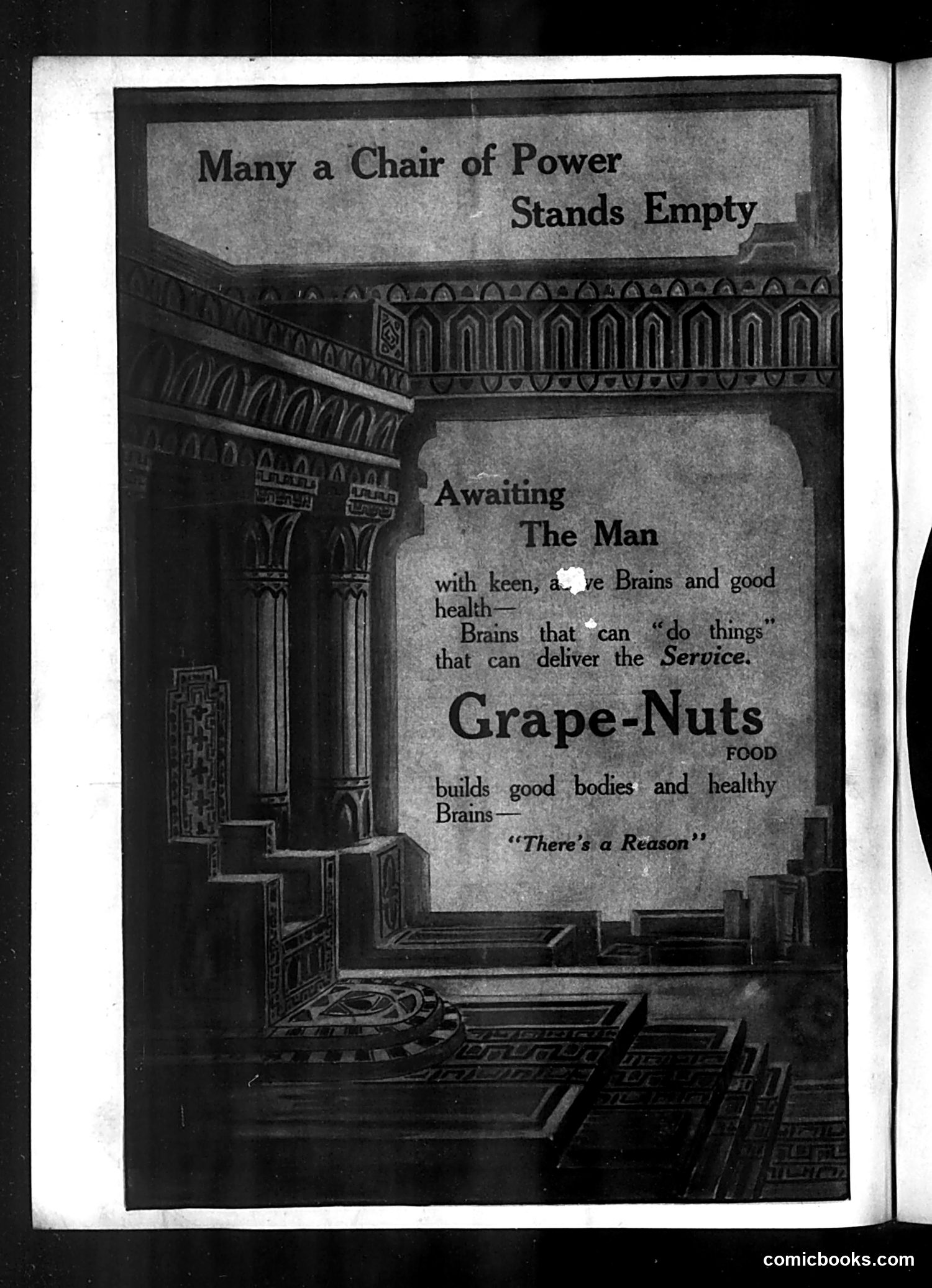
This page is a **Grape-Nuts cereal advertisement**, not a political cartoon. The "Chair of Power" imagery—an ornate, empty throne in what appears to be a grand governmental or institutional chamber—is metaphorical advertising copy. The ad argues that nations/organizations need capable leaders with "keen, active Brains and good health" to "deliver the Service." Grape-Nuts cereal, it claims, "builds good bodies and healthy Brains," making it the food for such leaders. This reflects early 20th-century advertising's tendency to link commercial products to civic virtue and national strength. The theatrical architectural setting creates gravitas, positioning the breakfast cereal as essential to producing competent leadership.