
Judge, 1912-03-23 · page 12 of 24
Judge — March 23, 1912 — page 12: what you’re looking at
What you’re looking at
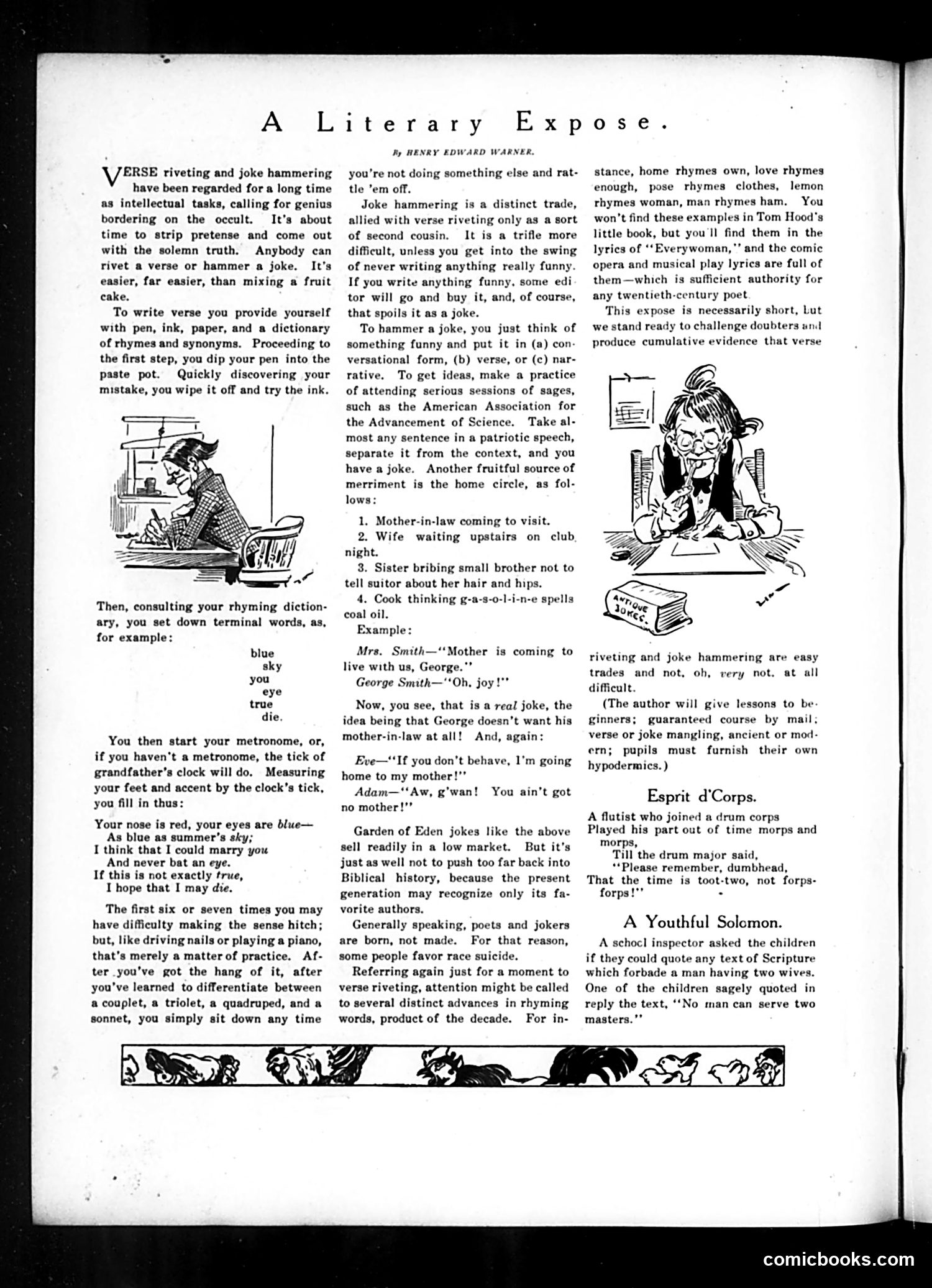
This is a satirical how-to guide mocking the supposedly difficult crafts of verse-writing and joke-making. Warner's point: both are actually trivial and formulaic, not requiring genuine talent or intellect. The satire targets: 1. **Pretentious literary culture**: The opening mocks intellectuals who treat poetry and humor as requiring "genius bordering on the occult." 2. **Mechanical mediocrity**: Warner demonstrates that verse-writing is merely mechanical—consult a rhyming dictionary, tap out a metronome rhythm, fill in blanks. The example "Your nose is red, your eyes are blue" exemplifies this dull formula. 3. **Low-quality humor**: Joke-hammering similarly reduces to formula: take sentences from patriotic speeches or domestic situations, strip context, repeat. The mother-in-law joke exemplifies this banality. 4. **Contemporary pop lyrics**: The reference to "Everywoman" and musical-play lyrics suggests these new entertainment forms represent a decline in literary standards—they're full of forced, absurd rhymes ("lemon/woman," "man/ham"). The cartoons show a writer laboring mechanically at a desk, suggesting the drudgery rather than inspiration required.
📄 Transcribed text from this page (OCR, searchable)
Machine-transcribed from the original scan — historical spelling and the odd misread are preserved.
A Literary VERSE riveting and joke hammering have been regarded for a long time as intellectual tasks, calling for genius bordering on the occult. It’s about time to strip pretense and come out with the solemn truth. Anybody can rivet a verse or hammer a joke. It's easier, far easier, than mixing a fruit cake, To write verse you provide yourself with pen, ink, paper, and a dictionary of rhymes and synonyms. Proceeding to the first step, you dip your pen into the paste pot. Quickly discovering your mistake, you wipe it off and try the ink. Then, consulting your rhyming diction- ary, you set down terminal words, as, for example: blue sky you eye true die. You then start your metronome, or, if you haven't a metronome, the tick of grandfather's clock will do. Measuring your feet and accent by the clock’s tick, you fill in thus: Your nose is red, your eyes are blue— As blue as summer's sky; I think that I could marry you And never bat an eye. If this is not exactly true, I hope that I may die. The first six or seven times you may have difficulty making the sense hitch; but, like driving nails or playing a piano, that’s merely a matter of practice. Af- ter you've got the hang of it, after you've learned to differentiate between a couplet, a triolet, a quadruped, and a sonnet, you simply sit down any time By HENRY EDWARD WARNER. you're not doing something else and rat- tle ’em off. Joke hammering is a distinct trade, allied with verse riveting only as a sort of second cousin. It is a trifle more difficult, unless you get into the swing of never writing anything really funny. If you write anything funny, some edi tor will go and buy it, and, of course, that spoils it as a joke. To hammer a joke, you just think of something funny and put it in (a) con- versational form, (b) verse, or (c) nar- rative. To get ideas, make a practice of attending serious sessions of sages, such as the American Association for the Advancement of Science. Take al- most any sentence in a patriotic speech, separate it from the context, and you have a joke. Another fruitful source of merriment is the home circle, as fol- lows: 1, Mother-i w coming to visit. 2. Wife waiting upstairs on club night. 3. Sister bribing small brother not to tell suitor about her hair and hips. 4. Cook thinking g-a-s-o-I-i-n-e spells coal oil. Example: Mrs. Smith—'Mother is coming to live with us, George." George Smith—‘‘Oh, joy!" Now, you see, that is a real joke, the idea being that George doesn't want his mother-in-law at all! And, again: Eve—‘‘If you don’t behave, I'm going home to my mother!"’ Adam—‘‘Aw, g’wan! no mother!’" You ain’t got Garden of Eden jokes like the above sell readily in a low market. But it's just as well not to push too far back into Biblical history, because the present generation may recognize only its fa- vorite authors. Generally speaking, poets and jokers are born, not made. For that reason, some people favor race suicide. Referring again just for a moment to verse riveting, attention might be called to several distinct advances in rhyming words, product of the decade. For in- Expose. stance, home rhymes own, love rhymes enough, pose rhymes clothes, lemon rhymes woman, man rhymes ham. You won't find these examples in Tom Hood's little book, but you'll find them in the lyrics of ‘‘Everywoman,"’ and the comic opera and musical play lyrics are full of them—which is sufficient authority for any twentieth-century poet This expose is necessarily short, Lut we stand ready to challenge doubters wn produce cumulative evidence that verse riveting and joke hammering are easy trades and not, oh, very not. at all difficult. (The author will give lessons to be- ginners; guaranteed course by mail; verse or joke mangling, ancient or mod- ern; pupils must furnish their own hypodermics. ) Esprit d'Corps. A flutist who joined a drum corps Played his part out of time morps and morps, Till the drum major said, ‘*Please remember, dumbhead, That the time is toot-two, not forps- forps!"" : A Youthful Solomon. A schocl inspector asked the children if they could quote any text of Scripture which forbade a man having two wives. One of the children sagely quoted in reply the text, ‘‘No man can serve two masters."" comicbooks.com