
Judge, 1912-03-23 · page 8 of 24
Judge — March 23, 1912 — page 8: what you’re looking at
What you’re looking at
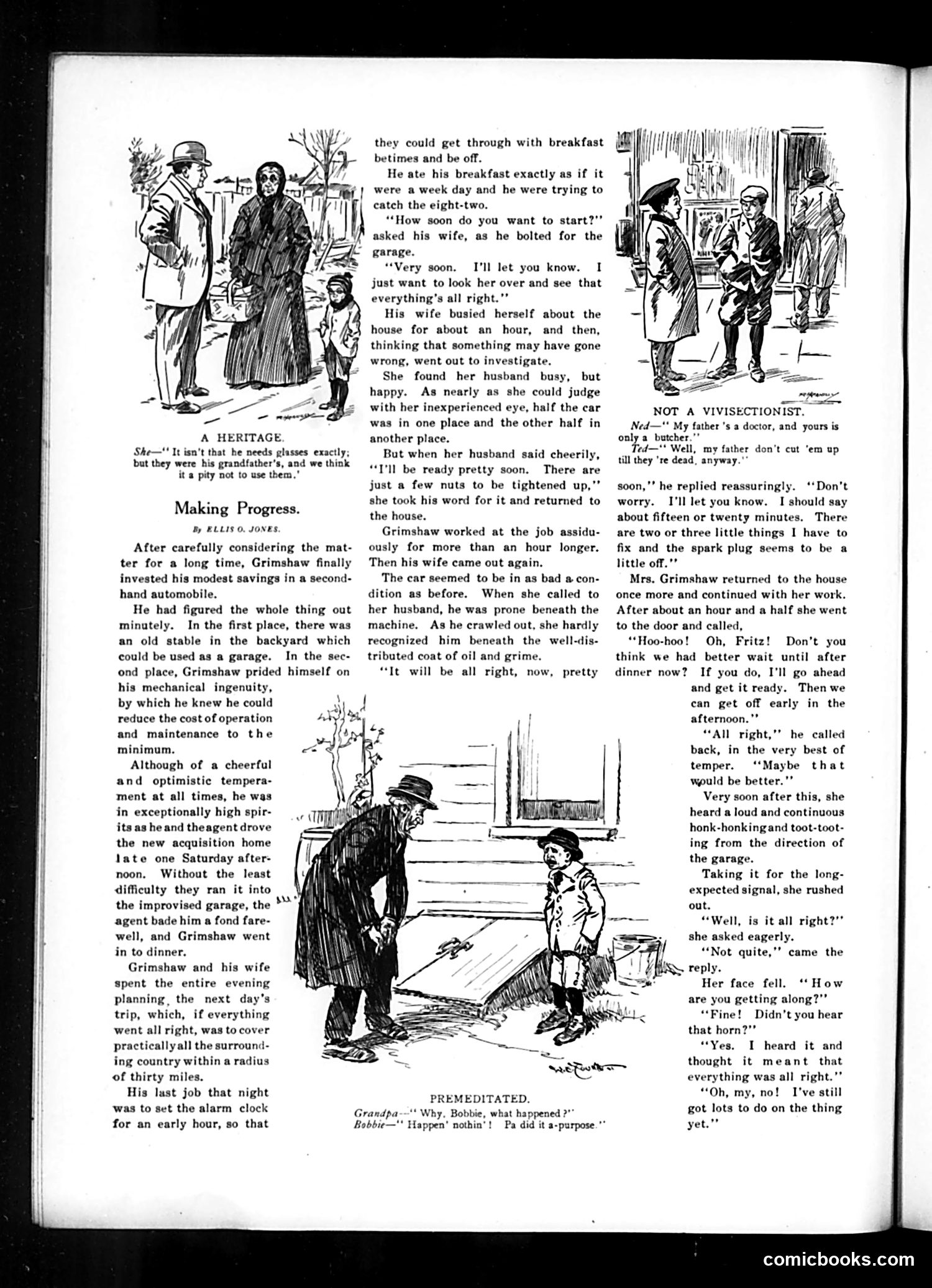
This page contains three distinct satirical pieces: **"A Heritage"** (top left): A brief joke mocking penny-pinching frugality—a woman justifies wearing her grandfather's old eyeglasses simply because they're a family heirloom, despite their being outdated and impractical. **"Making Progress"** (main story): A longer narrative satirizing the new automobile craze and male overconfidence. Grimshaw, a middle-class man, purchases a secondhand car and confidently assures his wife he can maintain it himself. He spends the entire day futilely tinkering in the garage, repeatedly underestimating repair work ("just a few nuts to tighten"), ultimately never actually taking the promised trip. The satire targets both the mechanical complexity of early automobiles and masculine self-delusion about technical competence. **Three smaller cartoons** satirize class pretension and hypocrisy: a child's accidental mischief blamed as intentional, and a butcher's son defending his father's profession against a doctor's son's snobbery. The overall tone mocks contemporary attitudes toward new technology, class consciousness, and masculine pride.
📄 Transcribed text from this page (OCR, searchable)
Machine-transcribed from the original scan — historical spelling and the odd misread are preserved.
A HERITAGE She—"' It isn't that he needs glasses exactly; but they were his grandfather's, and we think it @ pity not to use them," Making Progress. By ELLIS 0, JONES. After carefully considering the mat- ter for a long time, Grimshaw finally invested his modest savings in a second- hand automobile. He had figured the whole thing out minutely. In the first place, there was an old stable in the backyard which could be used as a garage. In the sec- ond place, Grimshaw prided himself on his mechanical ingenuity, by which he knew he could reduce the cost of operation and maintenance to the minimum. Although of a cheerful and optimistic tempera- ment at all times, he was in exceptionally high spir- its as he and theagent drove the new acquisition home tate one Saturday after- noon. Without the least difficulty they ran it into the improvised garage, the agent bade him a fond fare- well, and Grimshaw went in to dinner. Grimshaw and his wife spent the entire evening planning, the next day's trip, which, if everything went all right, was to cover practically all the surround- ing country within a radius of thirty miles. His last job that night was to set the alarm clock for an early hour, so that they could get through with breakfast betimes and be off. He ate his breakfast exactly as if it were a week day and he were trying to catch the eight-two. “How soon do you want to start?”’ asked his wife, as he bolted for the garage. “Very soon. I'll let you know. I just want to look her over and see that everything's all right.’” His wife busied herself about the house for about an hour, and then, thinking that something may have gone wrong, went out to investigate, She found her husband busy, but happy. As nearly as she could judge with her inexperienced eye, half the car was in one place and the other half in another place. But when her husband said cheerily, “I'll be ready pretty soon. There are just a few nuts to be tightened up,” she took his word for it and returned to the house. Grimshaw worked at the job assidu- ously for more than an hour longer. Then his wife came out again. The car seemed to be in as bad a con- dition as before. When she called to her husband, he was prone beneath the machine. As he crawled out, she hardly recognized him beneath the well-dis- tributed coat of oil and grime. “It will be all right, now, pretty PREMEDITATED. “* Why, Bobbie, what happened ?"" Happen’ nothin’! Grandpa Bobbie—"* Pa did it a-purpose."* OT th II NOT A VIVISECTIONIST, Ned—"' My father 's a doctor, and yours is only a butcher.” Ted—"* Well, my father don't cut ‘em up till they ‘re dead, anyway.'* soon,’ he replied reassuringly. ‘Don’t worry. I'll let you know. I should say about fifteen or twenty minutes. There are two or three little things I have to fix and the spark plug seems to be a little off.” Mrs. Grimshaw returned to the house once more and continued with her work. After about an hour and a half she went to the door and called, **Hoo-hoo! Oh, Fritz! Don’t you think we had better wait until after dinner now? If you do, I'll go ahead and get it ready. Then we can get off early in the afternoon."" “All right,’’ he called back, in the very best of temper. ‘‘Maybe that would be better.’’ Very soon after this, she heard a loud and continuous honk-honking and toot-toot- ing from the direction of the garage. Taking it for the long- expected signal, she rushed out. “Well, is it all right?’ she asked eagerly. “Not quite,’’ came the reply. Her face fell. ‘‘How are you getting along?”’ “Fine! Didn't you hear that horn?"’ “Yes. I heard it and thought it meant that everything was all right.”” “Oh, my, no! I've still got lots to do on the thing yet." comicbooks.com