
A complete issue · 24 pages · 1912
Judge — February 17, 1912
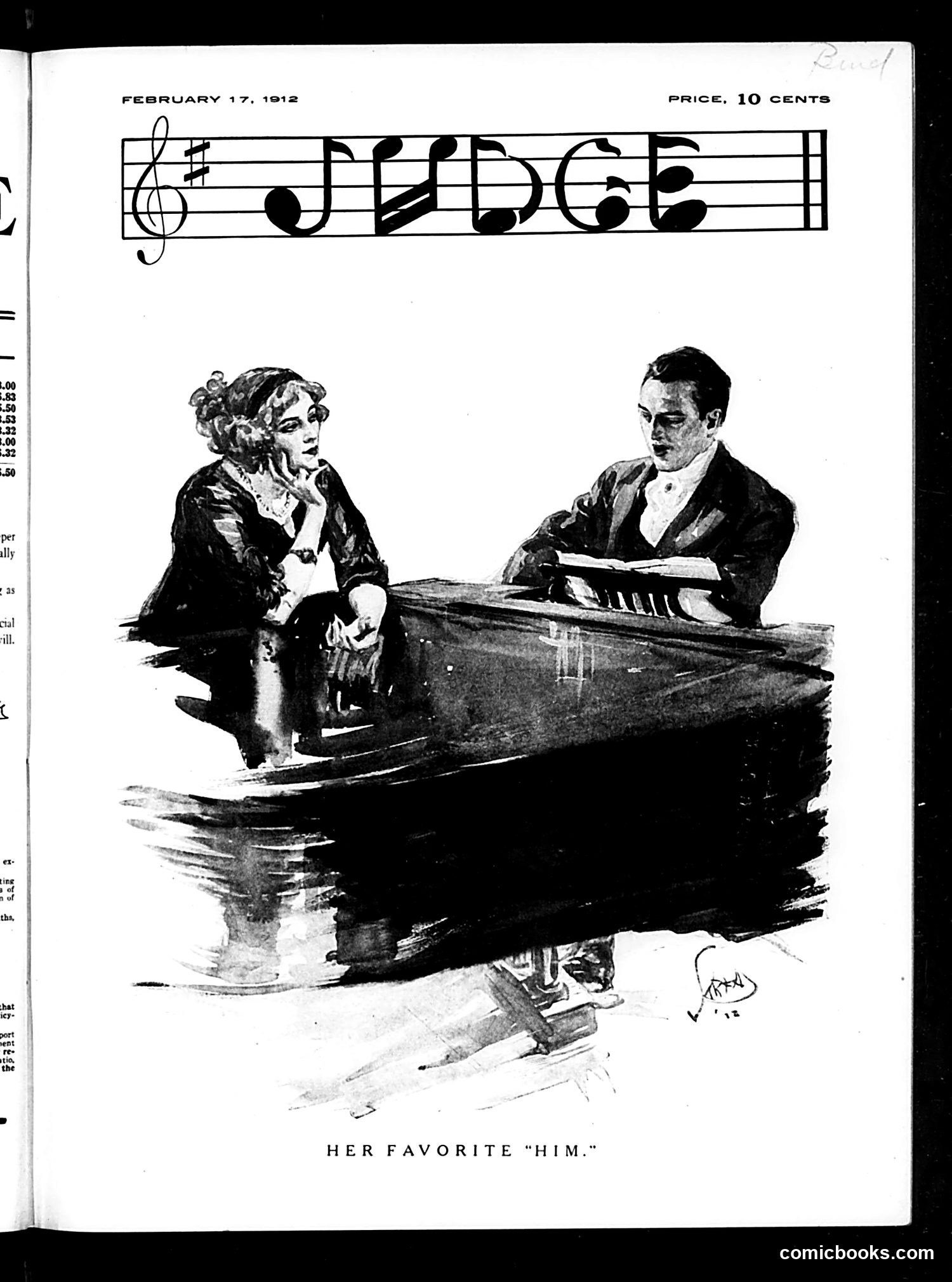
This page from *Judge* magazine (February 17, 1912) shows a sketch titled "Her Favorite 'Him.'" The illustration depicts a woman at a piano with a man beside her, seemingly engaged in musical activity. The musical notation at the top suggests this relates to a song or musical composition. The caption "Her Favorite 'Him'" appears to be a pun playing on the title of a popular song from that era. Without additional text on the page, the specific satire remains unclear, though it likely comments on contemporary popular music, romantic entertainment, or social courtship customs of 1912. The sketch's style is typical of *Judge*'s society-focused humor, suggesting this mocks fashionable leisure activities or romantic sentimentality among the upper classes.
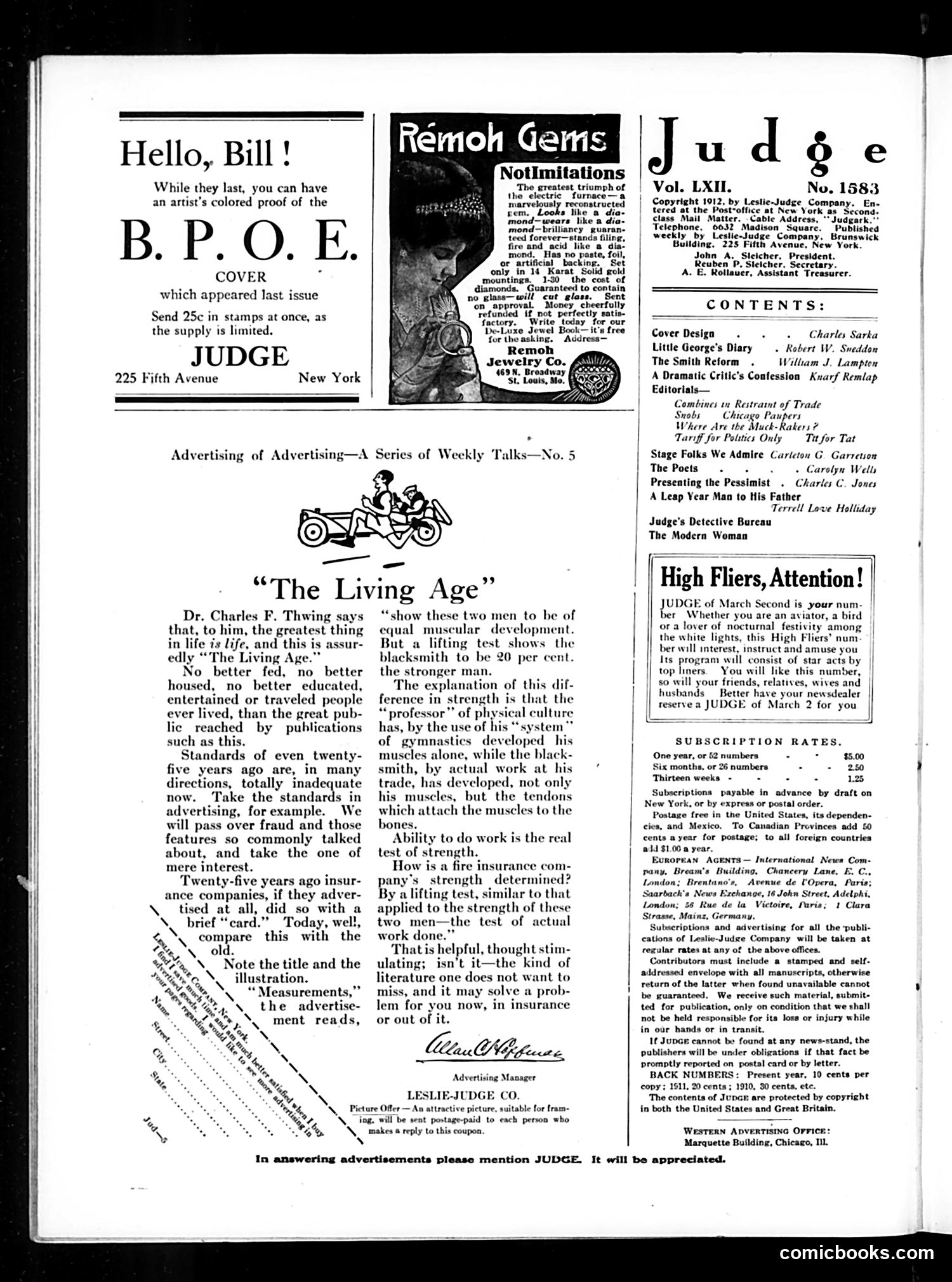
This page is primarily **advertising and editorial content** rather than political satire. The main feature is "Advertising of Advertising—A Series of Weekly Talks—No. 5," titled **"The Living Age."** Dr. Charles P. Thwing argues that life's greatest thing is **physical fitness**, contrasting the "blacksmith" (who develops strength through actual labor) with the "professor" (whose gymnasium exercises develop muscles but lack practical application). The satire critiques how modern advertising promotes physical culture without real-world utility. The accompanying illustration shows two men on a motorcycle—likely representing the contrast between practical strength and mere appearance. The article concludes that true strength comes from meaningful work, not just exercise marketed by publications like *Judge* itself—a self-aware critique of advertising culture.
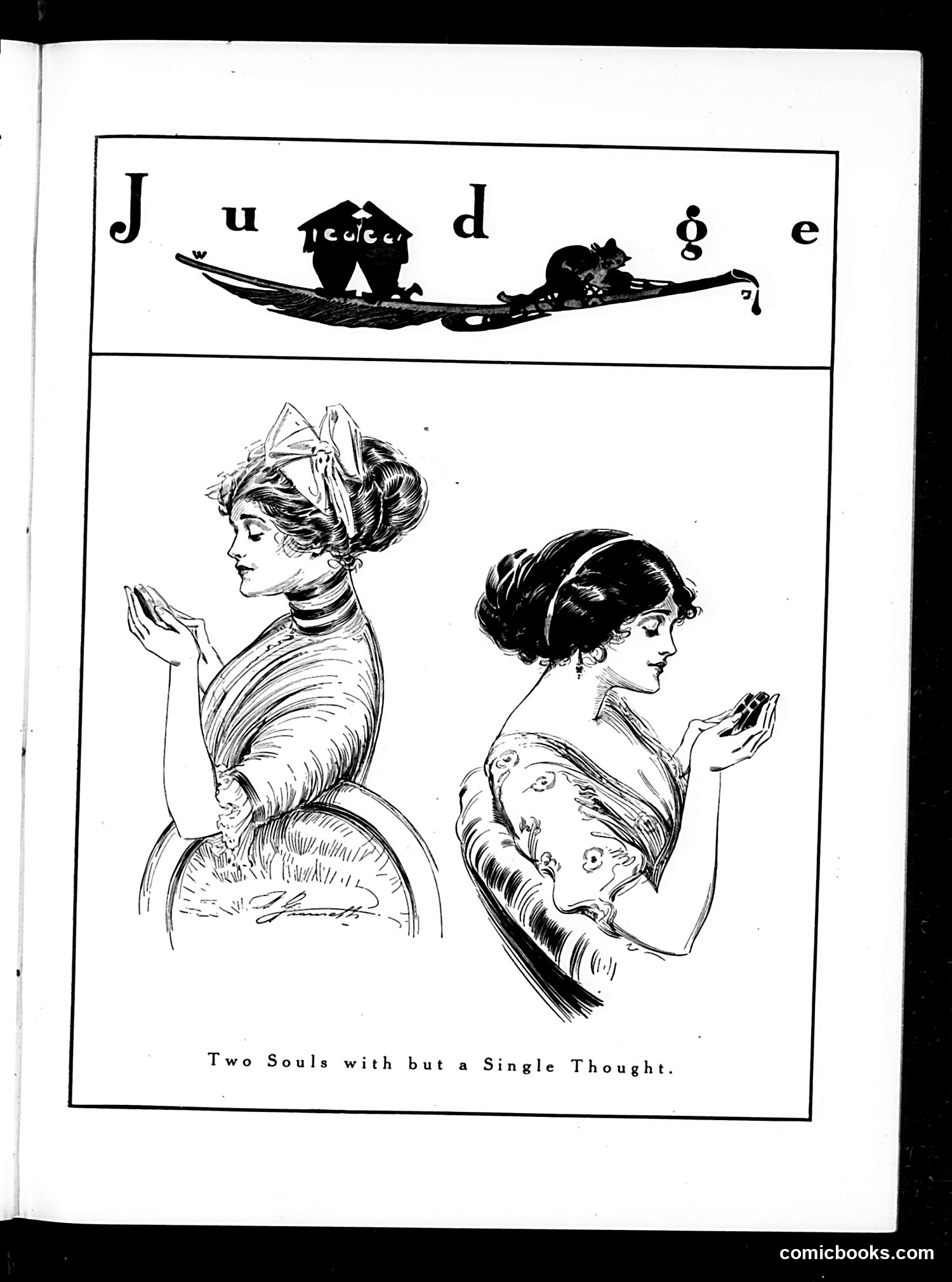
This page from *Judge* magazine features the title "Judged" with decorative artwork at the top. The main illustration shows two women in profile, back-to-back, with the caption "Two Souls with but a Single Thought." This appears to be social satire about female conformity or romantic rivalry—a common theme in early 20th-century humor. The identical poses and expressions suggest the women are so alike (or so focused on the same person or goal) they're practically one entity. The classical allusion to "two souls with but a single thought" was a romantic cliché of the era, here apparently used ironically to mock either women's perceived lack of individuality or competitive female dynamics. The elaborate hairstyles and fashionable dress suggest commentary on women's vanity or social pretension.
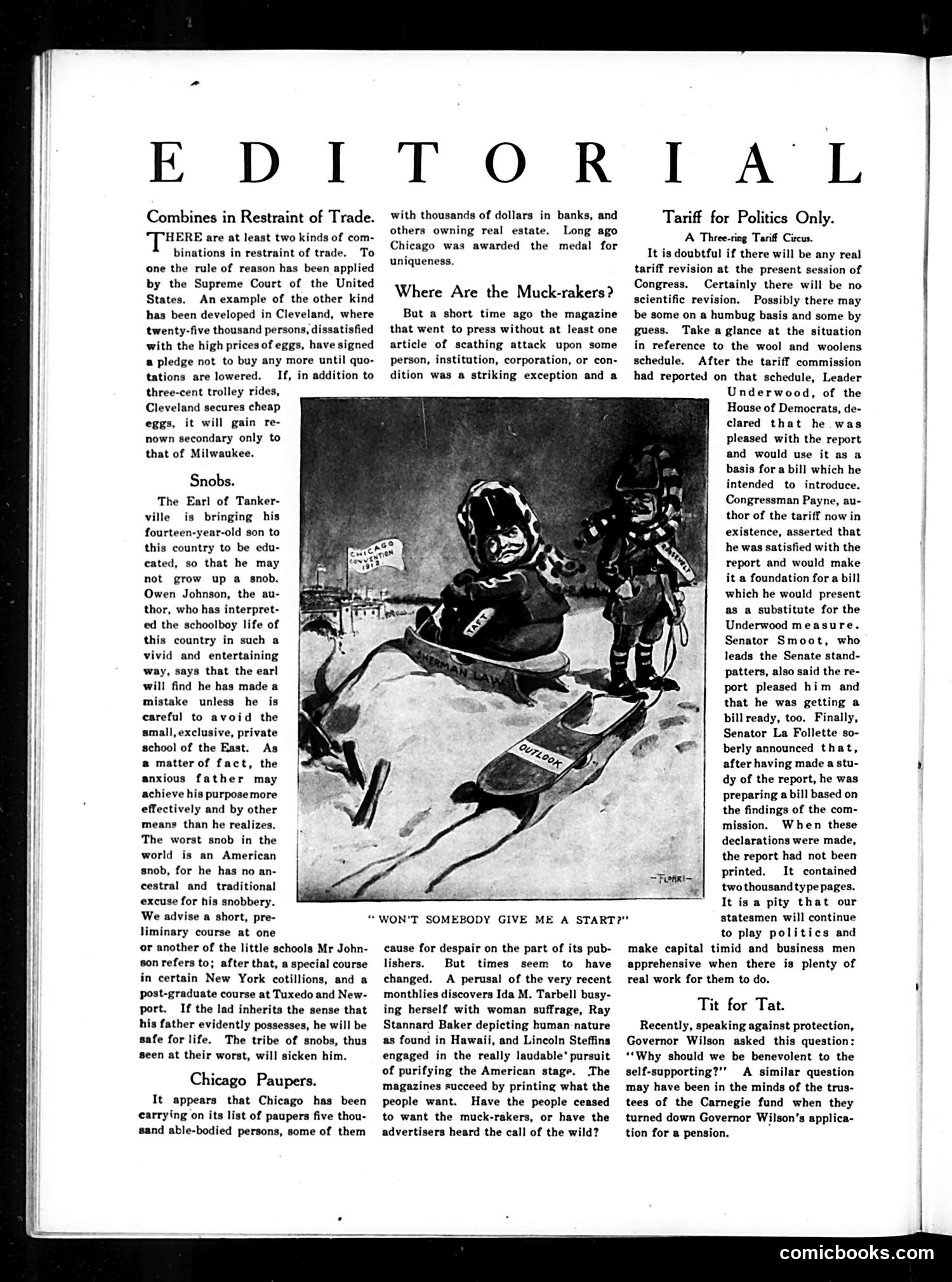
The cartoon titled **"Won't Somebody Give Me a Start"** depicts a figure (appears to be a baby or small character) on a sledge, illustrated by Forel. The image satirizes economic opportunity or relief during what appears to be an economic downturn. The surrounding editorials address: 1. **Trade combinations** - criticizing anti-competitive practices by Cleveland egg dealers 2. **Social snobbery** - mocking the Earl of Tankerville's plan to send his son to America to avoid becoming a snob 3. **Chicago paupers** - questioning whether Chicago is harboring thousands of unemployed persons 4. **Tariff politics** - discussing Congressional tariff revision debates, with references to Representatives Underwood and La Follette The overall theme appears to critique both economic inequality and governmental response to it.
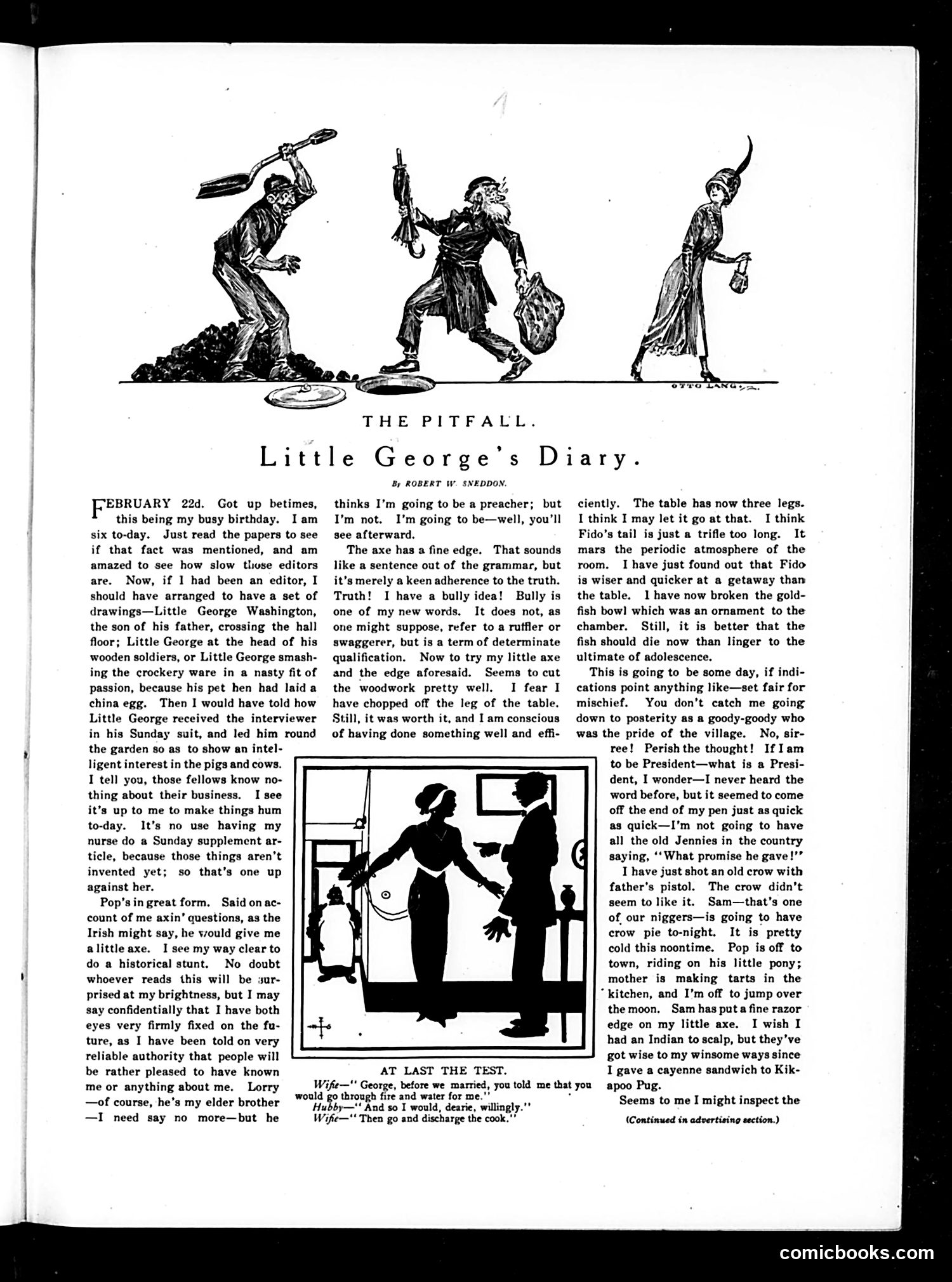
This is a satirical diary entry by Robert W. Edgdon mocking a child named "Little George" (likely referencing George Washington, given the "crossing the ball floor" reference and later mention of presidential ambitions). The humor targets the child's grandiose self-importance and precocious behavior—breaking furniture, shooting crows with his father's pistol, and declaring intentions to become President. The satire critiques both the boy's violent antics and his inflated sense of destiny. The embedded illustration titled "AT LAST THE TEST" shows a domestic scene where a wife tests her husband's devotion with rhetorical challenges about sacrifice—a separate social satire about marriage expectations. The overall piece uses childhood misbehavior as a vehicle for broader social and political commentary typical of Judge magazine's satirical approach.
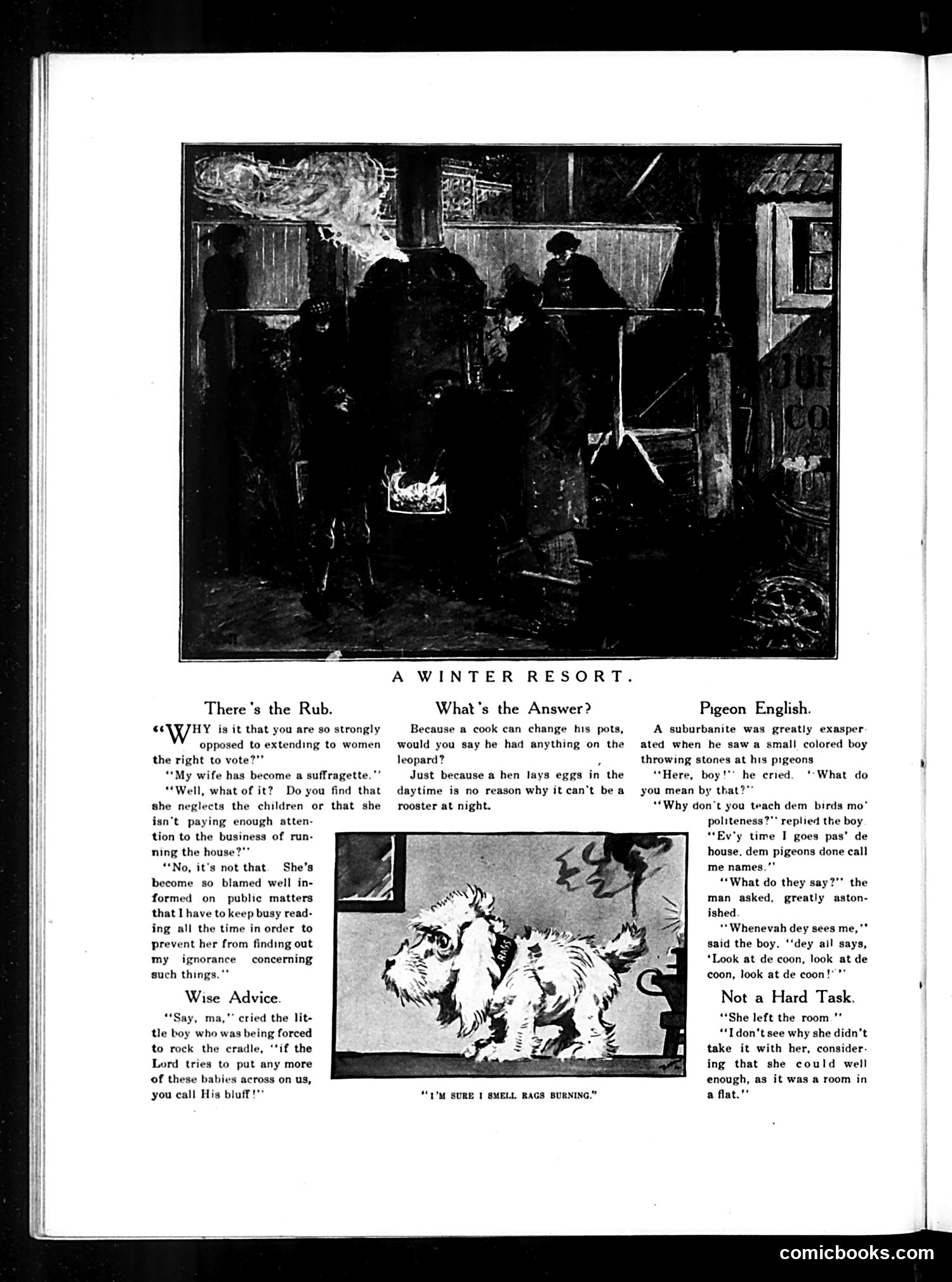
This page contains four unrelated satirical humor pieces typical of early 20th-century Judge magazine: **"There's the Rub"** mocks the women's suffrage movement by suggesting anti-suffrage men oppose it only because educated, politically-informed wives would expose their ignorance—a dig at male ego rather than legitimate concerns. **"Wise Advice"** presents a child's irreverent quip about large families, joking that parents should call God's "bluff" on having more children—mild social commentary on family size. **"What's the Answer?"** offers absurdist riddles with no logical answers, pure nonsense humor. **"Pigeon English"** uses stereotypical dialect ("dem birds," "Whenevah") to present a crude racial joke about a Black child misinterpreting pigeons' cooing as insults. The humor relies on racist caricature and mock-dialect speech common to the era's "humor." **"Not a Hard Task"** is a simple pun about a woman leaving a room in an apartment—she couldn't remove the room itself. The page reflects period attitudes toward suffrage, family, and particularly reflects the casual racism endemic to early 20th-century American humor publications.
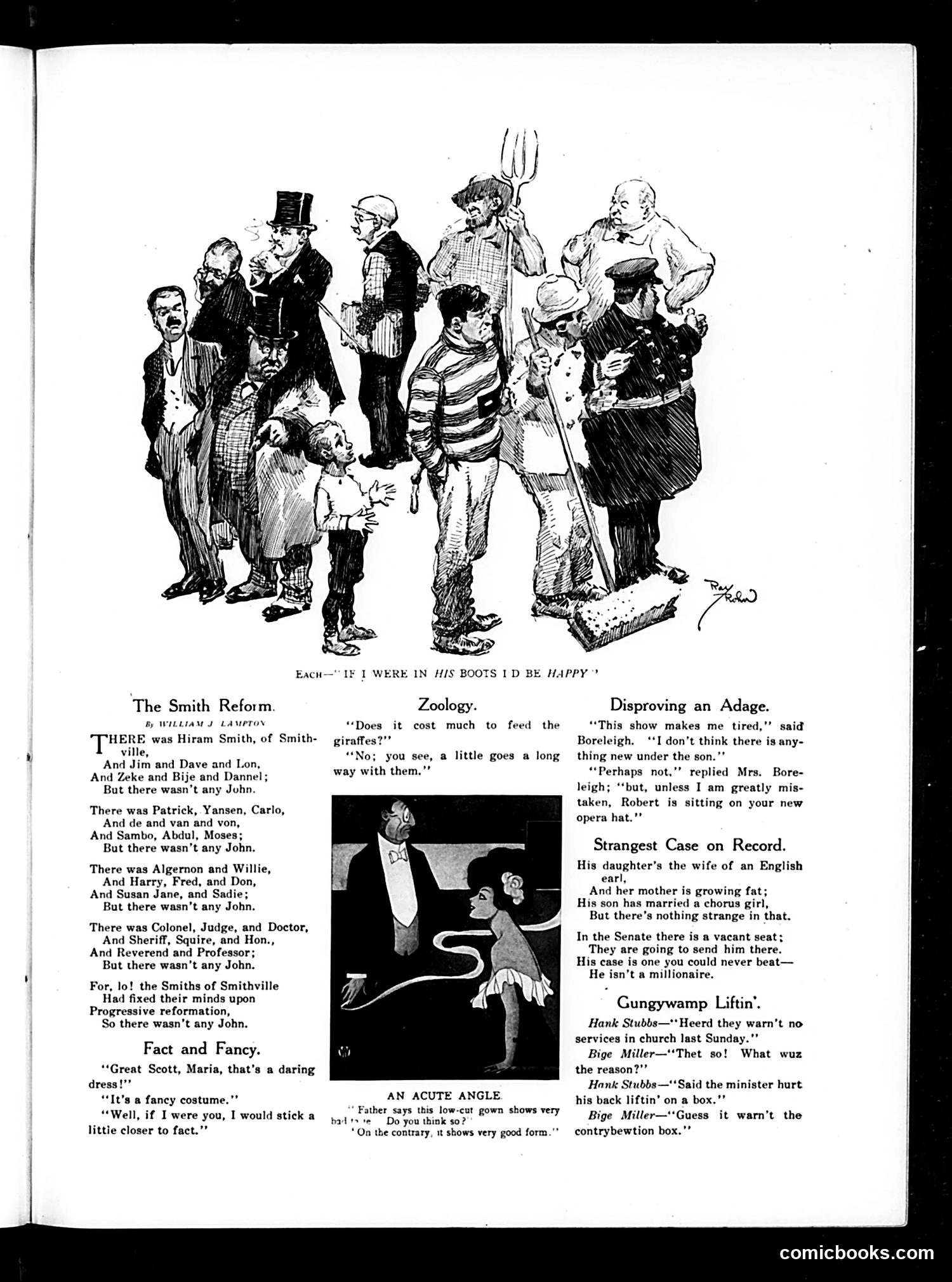
This page contains multiple satirical pieces from Judge, a humor magazine: **"The Smith Reform"** satirizes Progressive Era reform movements. The poem lists diverse names (Irish, German, Middle Eastern, Black) alongside traditional American names, then notes "there wasn't any John"—suggesting reformers excluded ordinary American citizens from their initiatives. The satire implies Progressive reforms were exclusionary or focused on outsiders rather than native-born Americans. **Other brief jokes** mock social pretensions ("Fact and Fancy"), exploit ethnic/racial stereotypes (the giraffe keeper joke), and make innuendo about women's fashion ("An Acute Angle"). **"Strangest Case on Record"** satirizes social climbing: a man's relatives marry into aristocracy and marry entertainers, yet he's still not wealthy enough for Senate—the real "stranger" is a politician who isn't rich. **"Gungywamp Liftin'"** uses rural dialect humor, joking that a minister injured himself lifting—implying the church contribution box is too light to cause injury. The overall tone reflects Judge's upper-class perspective, blending political satire with class-based and ethnic humor typical of early 20th-century American publications.
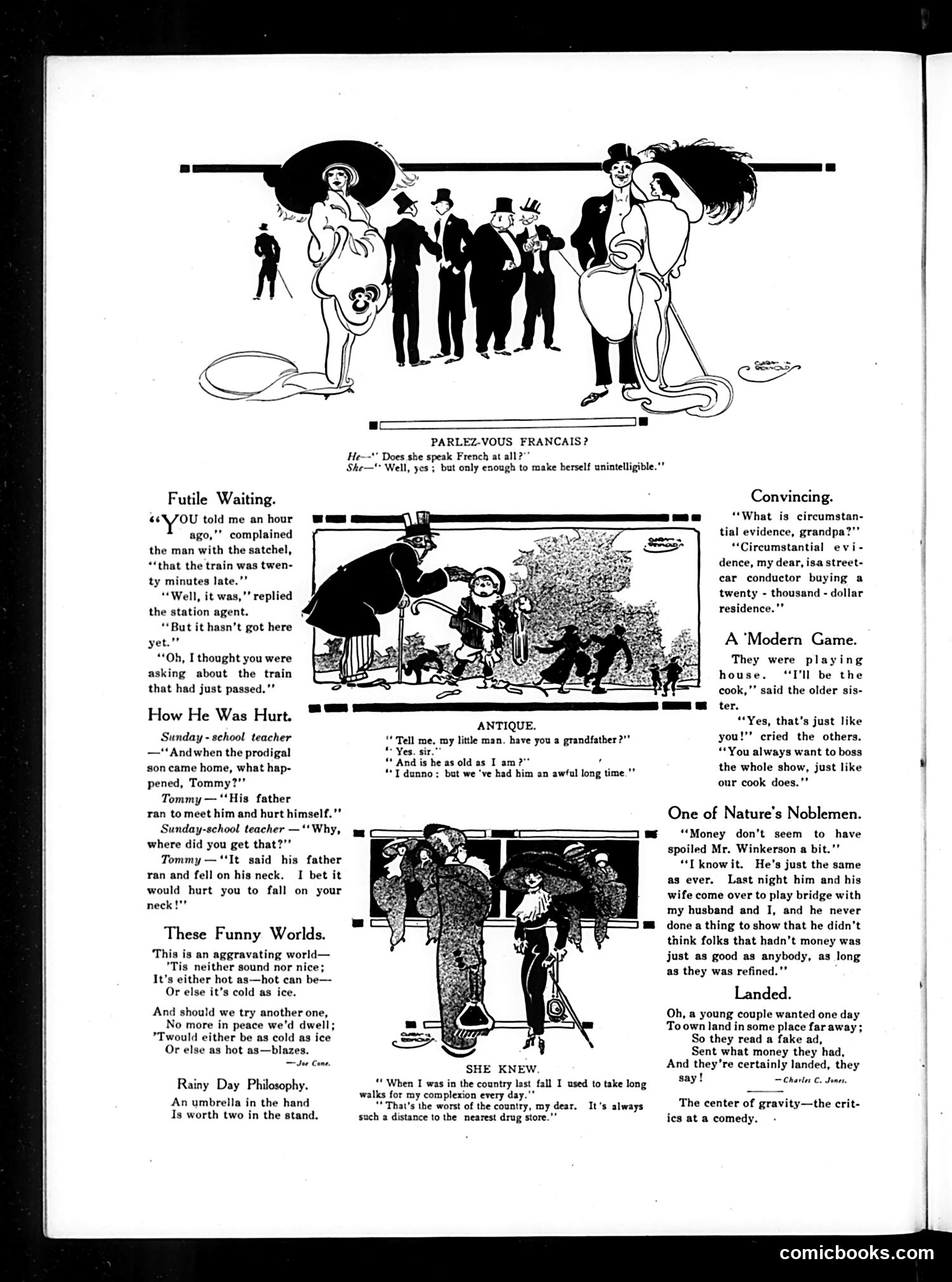
This page contains short humor pieces typical of early 20th-century American satirical magazines. The cartoons mock everyday absurdities and social pretensions: **"Futile Waiting"**: Satirizes bureaucratic incompetence—a station agent's pedantic distinction between a train being "twenty minutes late" versus "not here yet" is meaningless to the frustrated traveler. **"How He Was Hurt"**: A child's literal interpretation of biblical language ("fell on his neck") exposes the gap between formal religious instruction and common sense. **"Convincing"** and **"One of Nature's Noblemen"**: Both mock nouveau-riche social anxiety—someone buying expensive property on modest income, and Mr. Winkerson's careful performance of egalitarianism despite wealth differences, suggesting money doesn't naturally confer dignity. **"She Knew"** and **"ANTIQUE"**: Wordplay humor (drug stores near country walks; grandparents' age measured by duration owned). The overall tone reflects period anxieties about class mobility, pretension, and the gap between how people present themselves versus their true character.
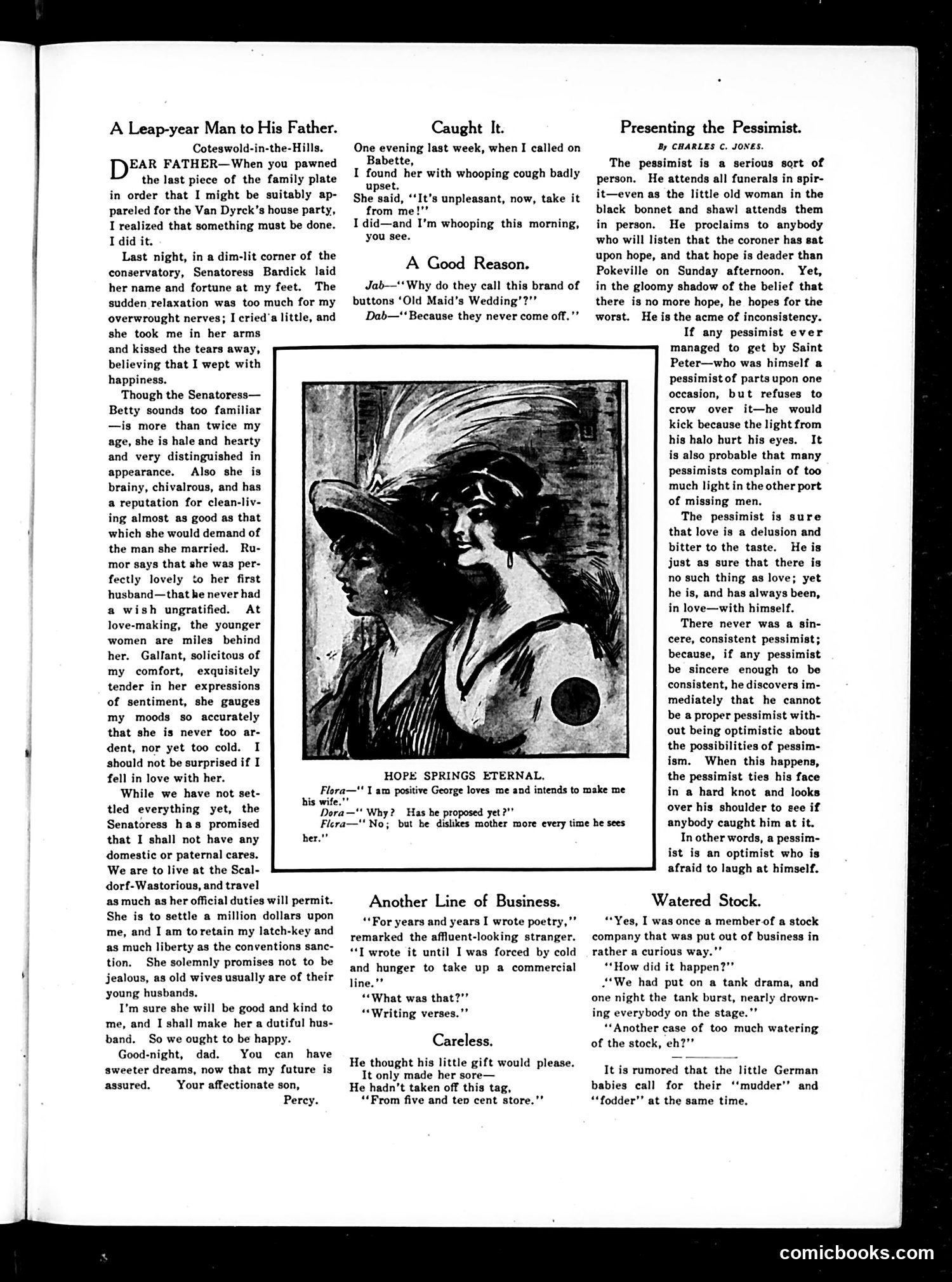
This page contains several short humor pieces typical of early 20th-century American satire: **"A Leap-year Man to His Father"** satirizes fortune-hunting. A young man (Percy) announces his engagement to a wealthy older "Senatoress" solely for money—she'll settle a million dollars on him. The humor mocks both his shameless mercenary motives and the absurdity of a leap-year tradition where women propose to men. **The cartoon "Hope Springs Eternal"** depicts a young woman (Flora) naively insisting her indifferent boyfriend loves her and will propose, when he clearly dislikes even her mother. It mocks female romantic delusion. The remaining pieces are brief jokes about minor social embarrassments: catching whooping cough, buttons that don't come off (mocking "Old Maid" brand), and a gift still bearing its five-and-ten-cent store price tag. **"Presenting the Pessimist"** is a character sketch mocking someone so consistently gloomy he'd complain even in heaven. The overall theme: human foolishness, self-deception, and social awkwardness.
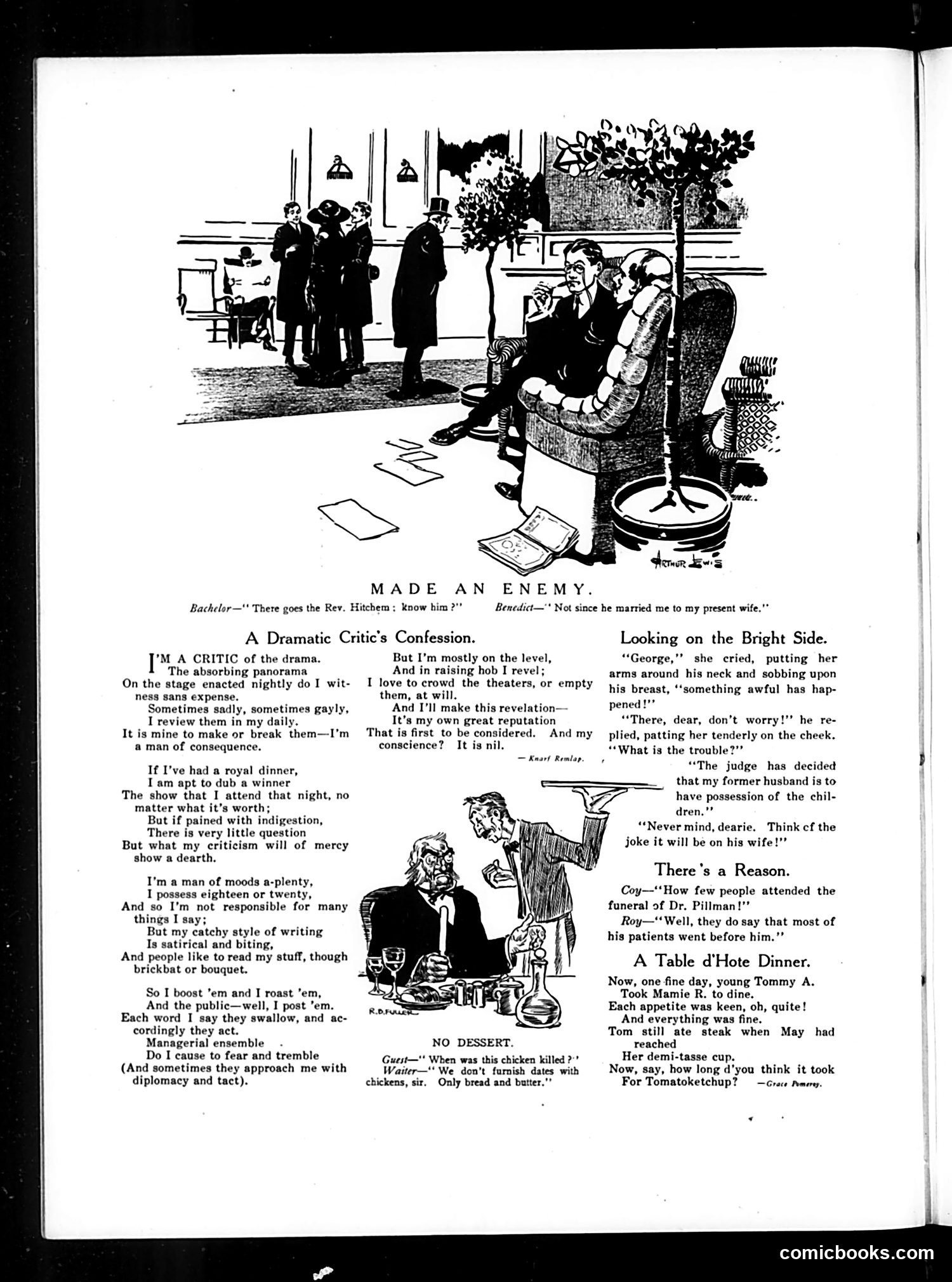
This page contains multiple satirical pieces typical of early 20th-century humor: **Top Cartoon ("Made an Enemy"):** Shows a clergyman (Rev. Hitchem) departing while seated men discuss him. The caption reveals the bachelor married the reverend to his current wife—implying the reverend performed an unwanted wedding, making him an "enemy." **"A Dramatic Critic's Confession":** A poem mocking theater critics who claim authority over shows' success or failure, yet admit their reviews depend on personal moods (indigestion, dinner quality) rather than actual merit. The satire targets critics' self-importance and their power over public opinion despite their arbitrary judgments. **Other pieces** include brief jokes about: a waiter's evasive answer about chicken freshness; a wife finding dark humor in losing custody to a difficult ex-husband; a doctor with few funeral attendees (patients died under his care); and a couple on a date with mismatched eating paces. The page exemplifies Judge's formula: satirizing professional pretension and domestic irony through short comedic pieces.
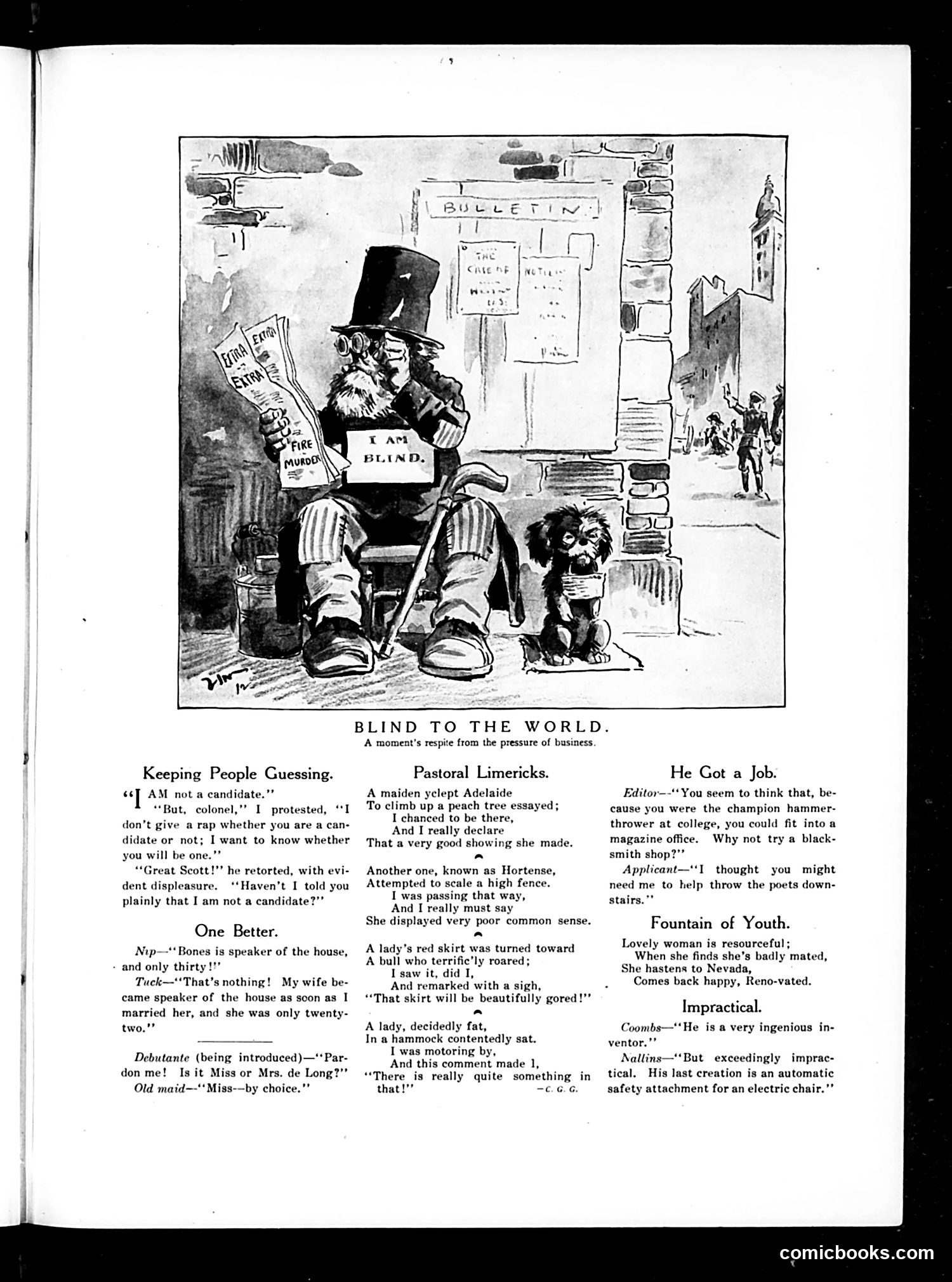
The main cartoon depicts a blindfolded businessman surrounded by papers and a "BULLETIN" board—representing someone willfully ignoring pressing business matters while claiming ignorance ("I AM BLIND"). The satire targets politicians and public figures who deny their ambitions or dodge accountability through evasion, exemplified in "Keeping People Guessing," where a colonel refuses to clarify whether he'll run for office, frustrating the questioner. The page collects various brief satirical pieces mocking social pretension and absurdity: women's vanity in the "Pastoral Limericks," marital discontent remedied by Nevada divorce ("Reno-vated"), and foolish invention (a "safety attachment for an electric chair"). The humor relies on wordplay and observational comedy about contemporary American life—workplace dynamics, political ambition, gender relations, and technological progress viewed skeptically.
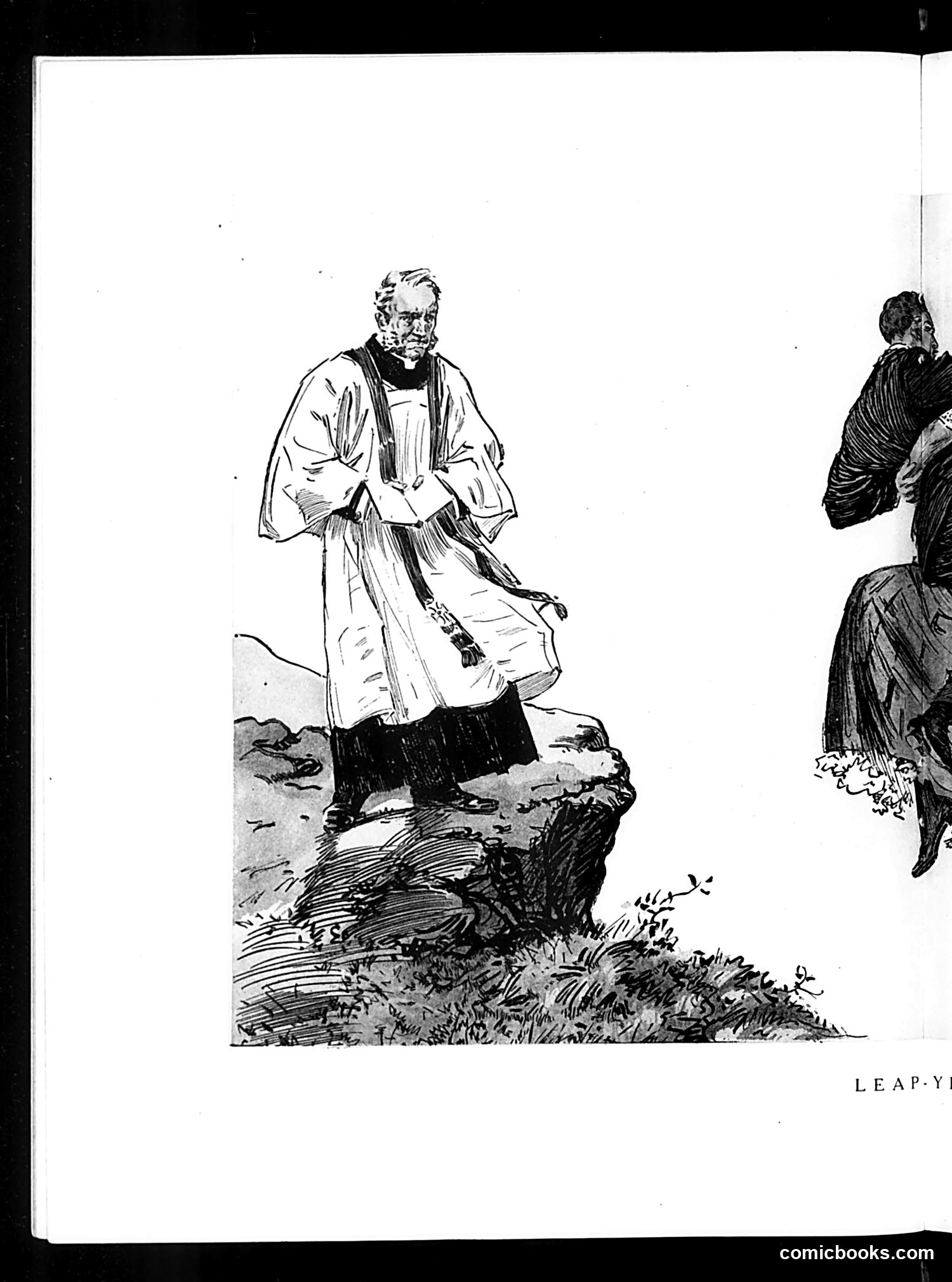
This appears to be a satirical cartoon from *Judge* magazine, though the OCR text is minimal ("LEAP-Y" and a website attribution). The image shows a bearded man in religious robes standing on a log or elevated position, with what appears to be figures in darker clothing to the right. The religious garments and the man's dignified pose suggest he may represent a clergy member or religious figure. Without clearer context or caption text, I cannot definitively identify the specific political or social reference this cartoon makes. The composition suggests commentary on religious authority or a particular clergyman's position, but the exact target of satire remains unclear from the visible information alone. Additional caption text would be needed for accurate interpretation.
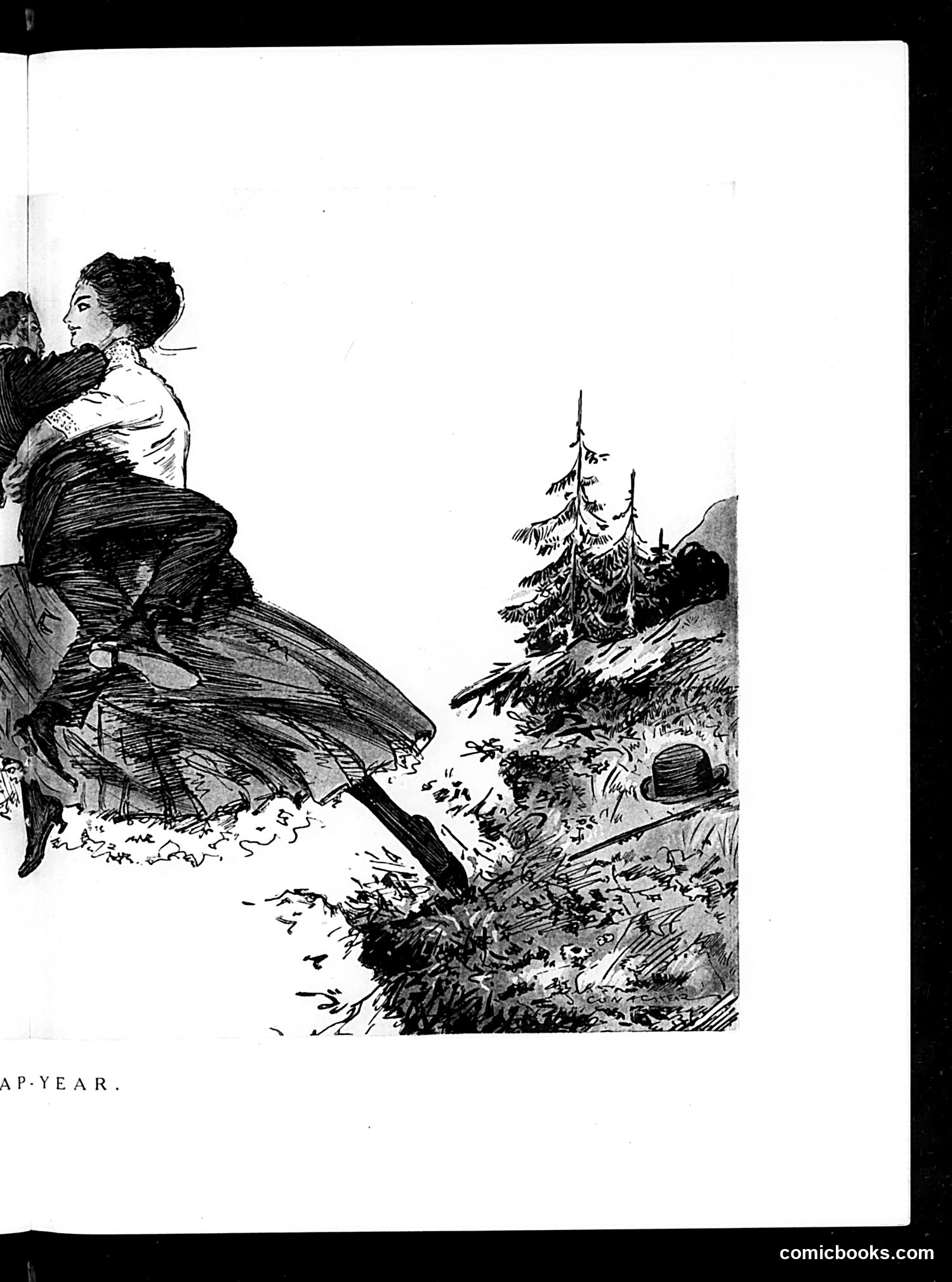
This appears to be a satirical illustration from *Judge* magazine, likely from the early 1900s based on the art style. The image shows a elegantly dressed woman in elaborate clothing (suggesting wealth or high social status) positioned on the left side, while on the right sits a man in casual attire wearing a hat, positioned near evergreen trees in a natural landscape. The title "AP-YEAR" (possibly "A P-YEAR" or incomplete text) is unclear. Without additional context or caption text visible, the specific satirical point is difficult to determine with certainty. The composition suggests commentary on class differences, courtship dynamics, or social pretensions, but the exact target of the satire cannot be reliably identified from the image alone.
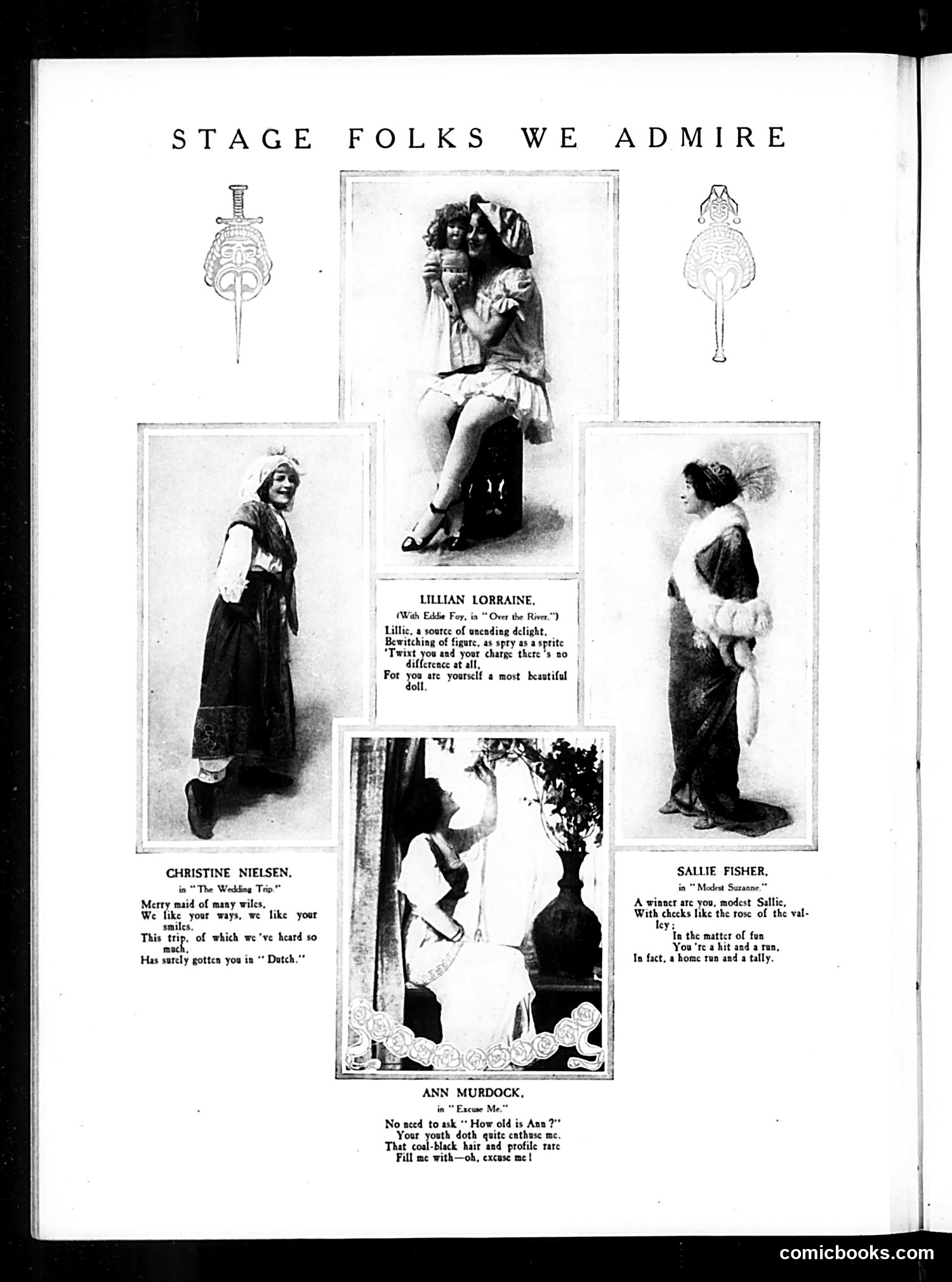
This is a *complimentary* feature page from Judge magazine celebrating four theatrical performers of the era. Rather than satire, it presents admiring (if somewhat flirtatious) verses about stage actresses: - **Lillian Lorraine** (from "Over the River") is praised for beauty and sprightliness - **Christine Nielsen** (from "The Wedding Trip") is called a "merry maid" audiences enjoy - **Ann Murdock** (from "Excuse Me") is complimented on her youthful appearance and dark hair - **Sallie Fisher** (from "Modest Suzanne") receives baseball metaphors praising her comedic talents The decorative sword hilts framing the page suggest theatrical grandeur. This represents Judge's lighter content—celebrity appreciation rather than political commentary. The verses use period theatrical slang and romantic language typical of early 20th-century entertainment journalism, treating actresses as both talented performers and objects of admiration for their appearance.
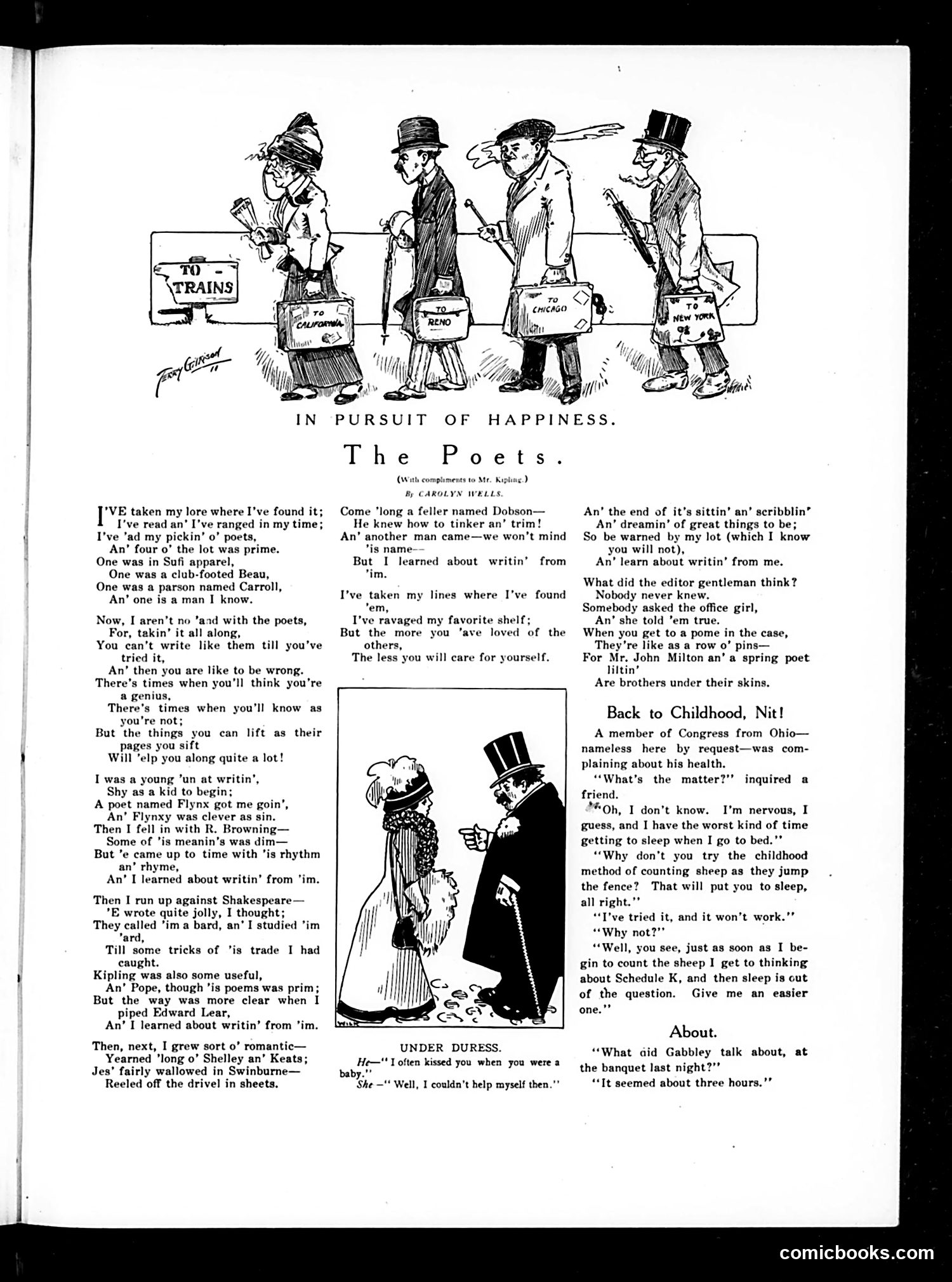
**Main Cartoon (Top):** Four travelers carrying suitcases labeled with destinations (California, Reno, Chicago, New York) head toward a "TO TRAINS" sign. The caption "IN PURSUIT OF HAPPINESS" suggests these figures represent people seeking fortune or escape, likely referencing the post-WWI era's restlessness. **"The Poets" (Carolyn Wells):** This poem, credited "with compliments to Mr. Kipling," parodies Rudyard Kipling's style. It humorously traces a writer's education through famous poets (Shakespeare, Browning, Keats, Swinburne, Edward Lear, Kipling himself)—suggesting all writers are derivative, assembling their craft from predecessors. The self-deprecating tone satirizes both aspiring writers and literary pretension. **"Under Duress":** A brief flirtation joke about a woman who can't resist when a man recalls kissing her as a baby. **"Back to Childhood, Nit!":** An Ohio congressman complains insomnia prevents sleep even using the childhood remedy of counting sheep—because he keeps thinking about "Schedule K," likely a tax or legislative matter. Satirizes how modern bureaucracy intrudes even on attempts to escape it.
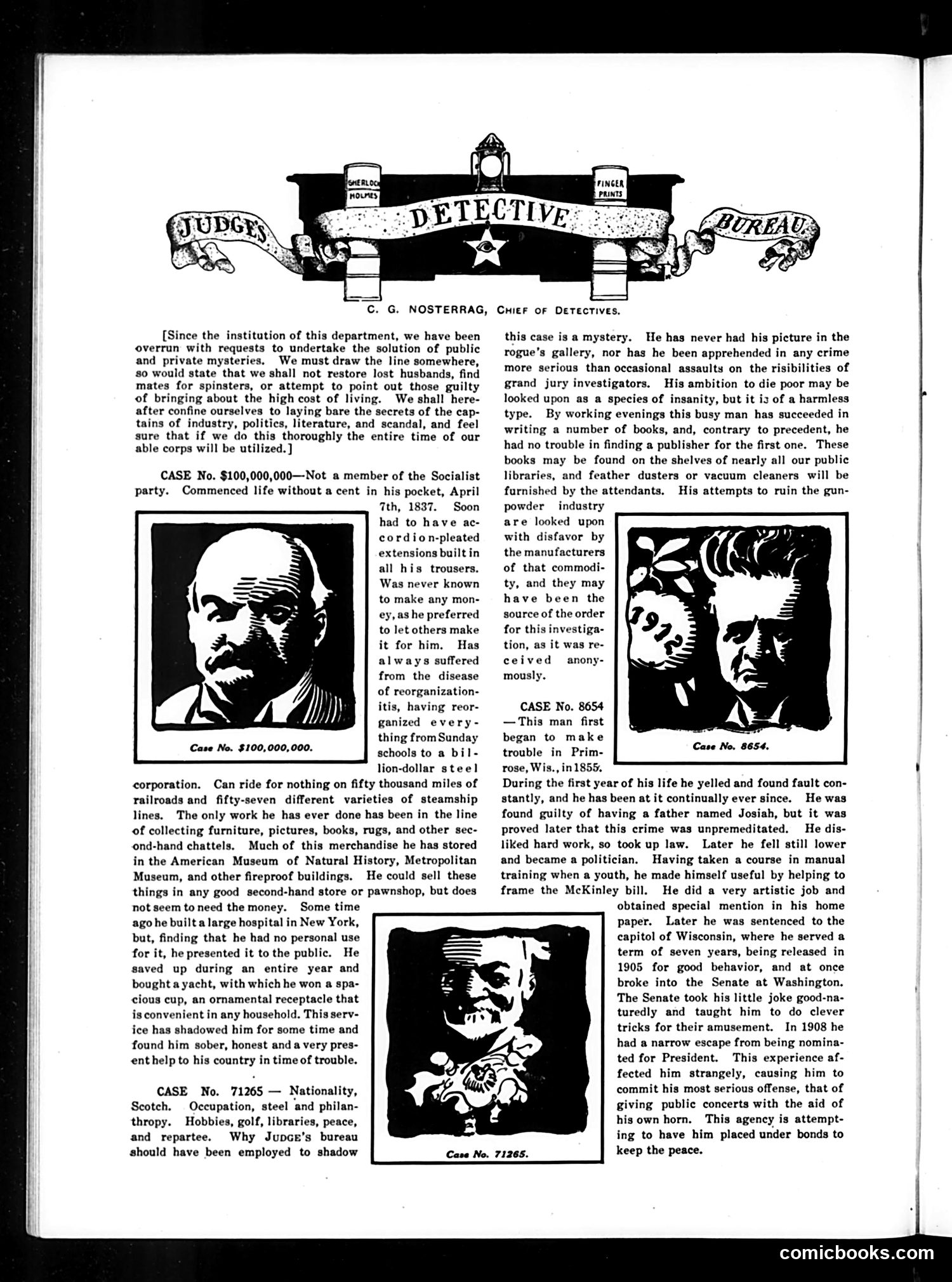
This page parodies Judge magazine's fictional "Detective Bureau," mocking wealthy industrialists and reformers of the Gilded Age through mock "case files." **Case $100,000,000** satirizes a robber baron (likely Andrew Carnegie or similar figure)—a self-made millionaire who obsessively reorganizes corporations, collects art for museums, and built hospitals for public relations. The satire suggests his wealth comes from letting "others make it for him" while he merely shuffles assets around. **Case 71265** appears to reference a Scottish steel magnate and philanthropist (likely Carnegie again, given "steel" and Scottish nationality) who writes books and opposes the gunpowder industry—possibly alluding to his peace activism. The joke: manufacturers anonymously ordered his investigation out of spite. **Case 8654** describes a troublemaking politician from Wisconsin born in 1855 who became a lawyer and politician after avoiding honest work—possibly referencing a specific contemporary political figure, though identity is unclear. The satire targets wealthy "captains of industry" masquerading as philanthropists while their actual motives remain mercenary.
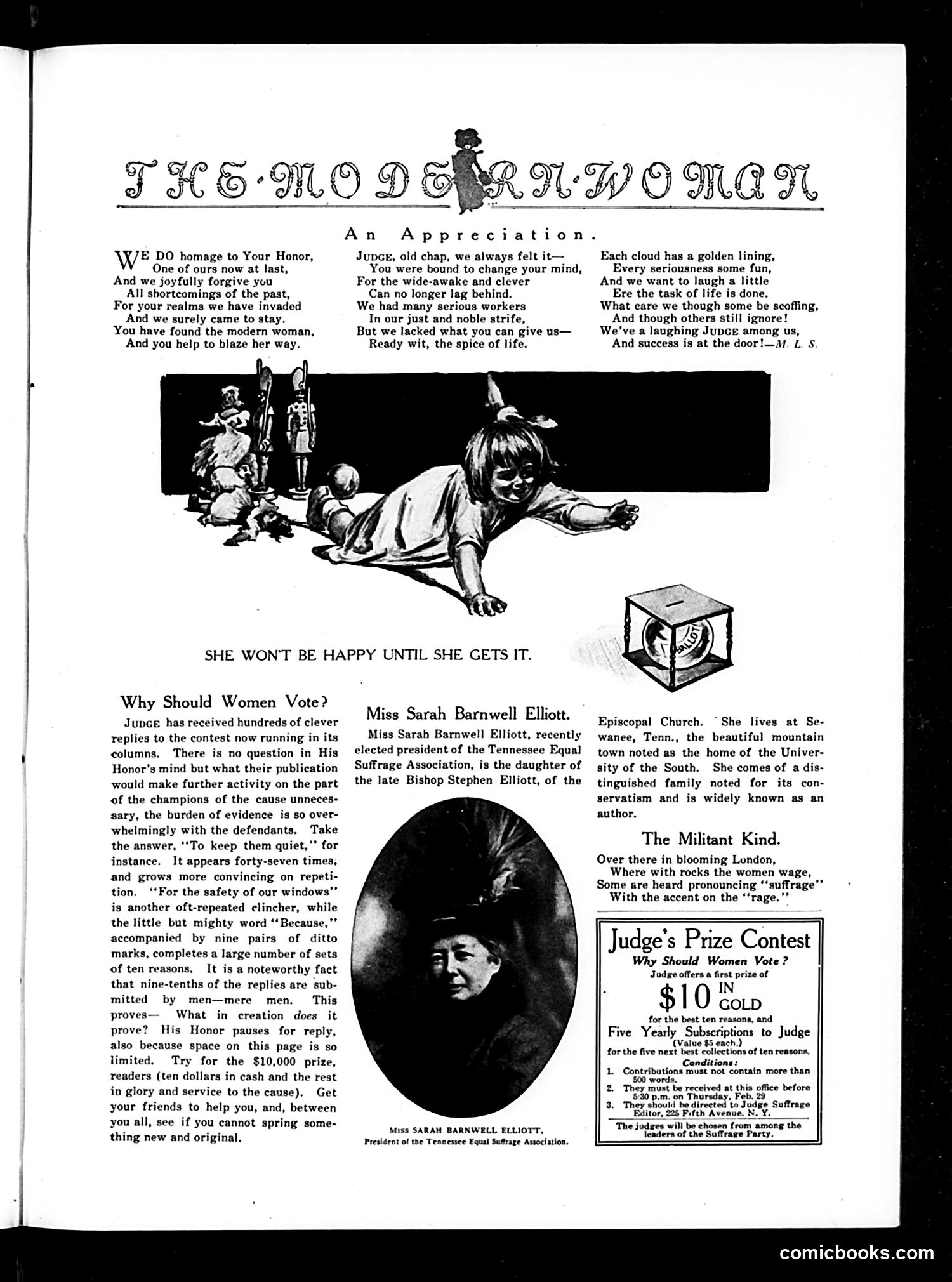
This page celebrates Judge magazine's adoption of pro-suffrage positions, featuring a contest asking "Why Should Women Vote?" The satire works on multiple levels: **The Main Cartoon:** A child crawling toward a ballot box (labeled with a suffrage symbol) represents women's persistence in pursuing voting rights—"She won't be happy until she gets it." **The Joke:** Judge ironically mocks anti-suffrage arguments by printing them seriously. Responses like "to keep them quiet" and "for the safety of our windows" are presented as if they're legitimate reasons *against* women voting. The editor notes that nine-tenths of submissions come from men, sarcastically asking "what does it prove?" The obvious implication: men's weak, repetitive objections actually strengthen the suffrage case. **Miss Sarah Barnwell Elliott** is featured as a suffrage advocate—a respectable, educated woman from a distinguished family, countering stereotypes. **"The Militant Kind"** references British suffragettes' direct-action tactics (throwing rocks), using "rage" as wordplay. The entire page uses mockery to advance women's voting rights.
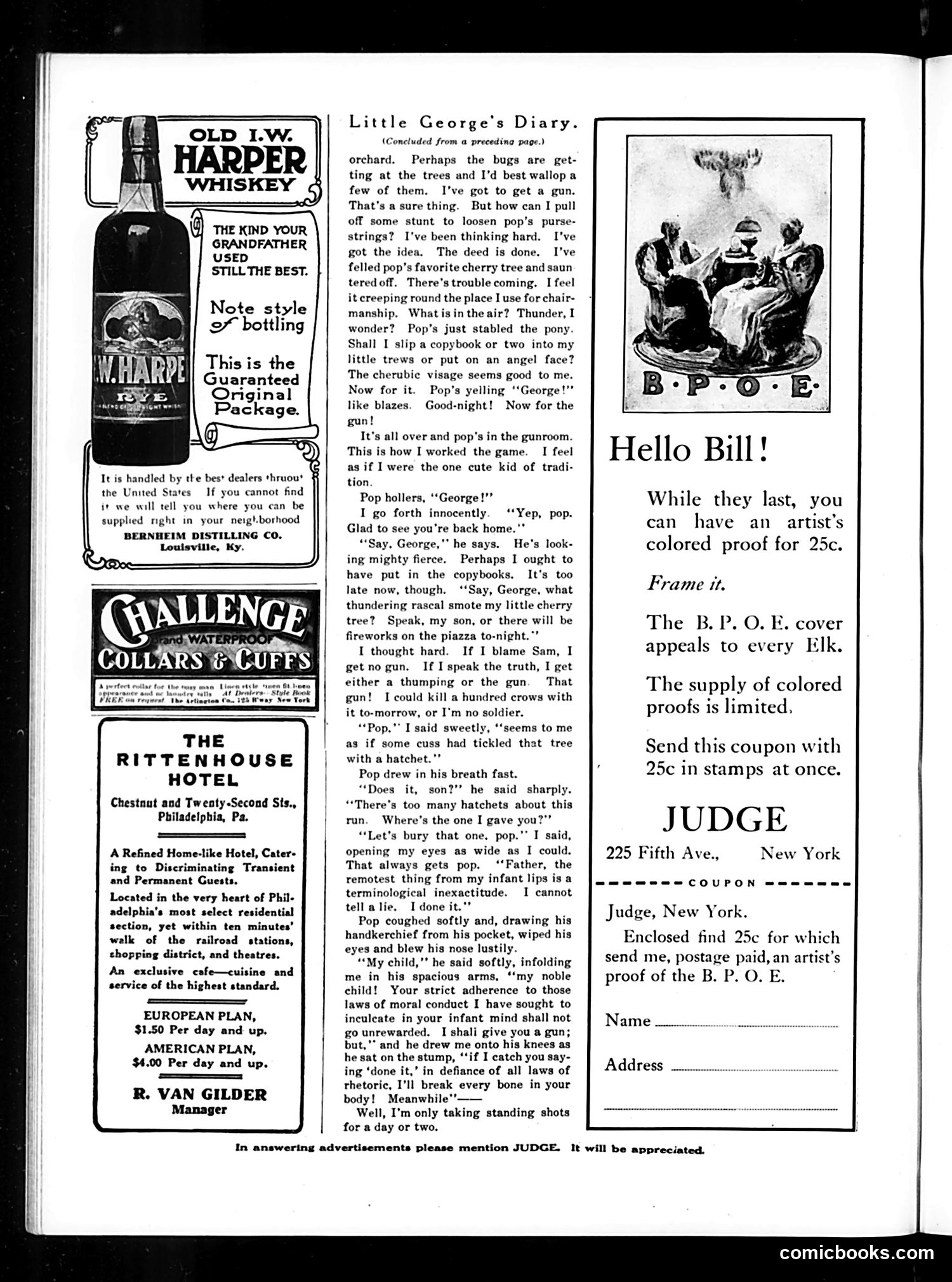
This piece parodies the famous (apocryphal) anecdote of young George Washington confessing to chopping down his father's cherry tree, presented here as a cynical inversion: Little George deliberately fells the tree to manipulate his father into buying him a gun. The satire mocks both childhood innocence and parental gullibility. George strategically admits guilt—framing it as moral rectitude ("I cannot tell a lie")—knowing his father values strict adherence to moral principles. The father, moved to tears by what appears to be his son's virtue, rewards the deception with the desired gun. The joke targets 1910s-era sentimentality about childhood virtue and suggests that moral lessons can be weaponized by cunning children. The final line—where the father threatens violence over grammar while rewarding the original deception—underscores the absurdity of selective moral enforcement. This appears in *Judge*, a satirical magazine using humor to critique American social pretensions.
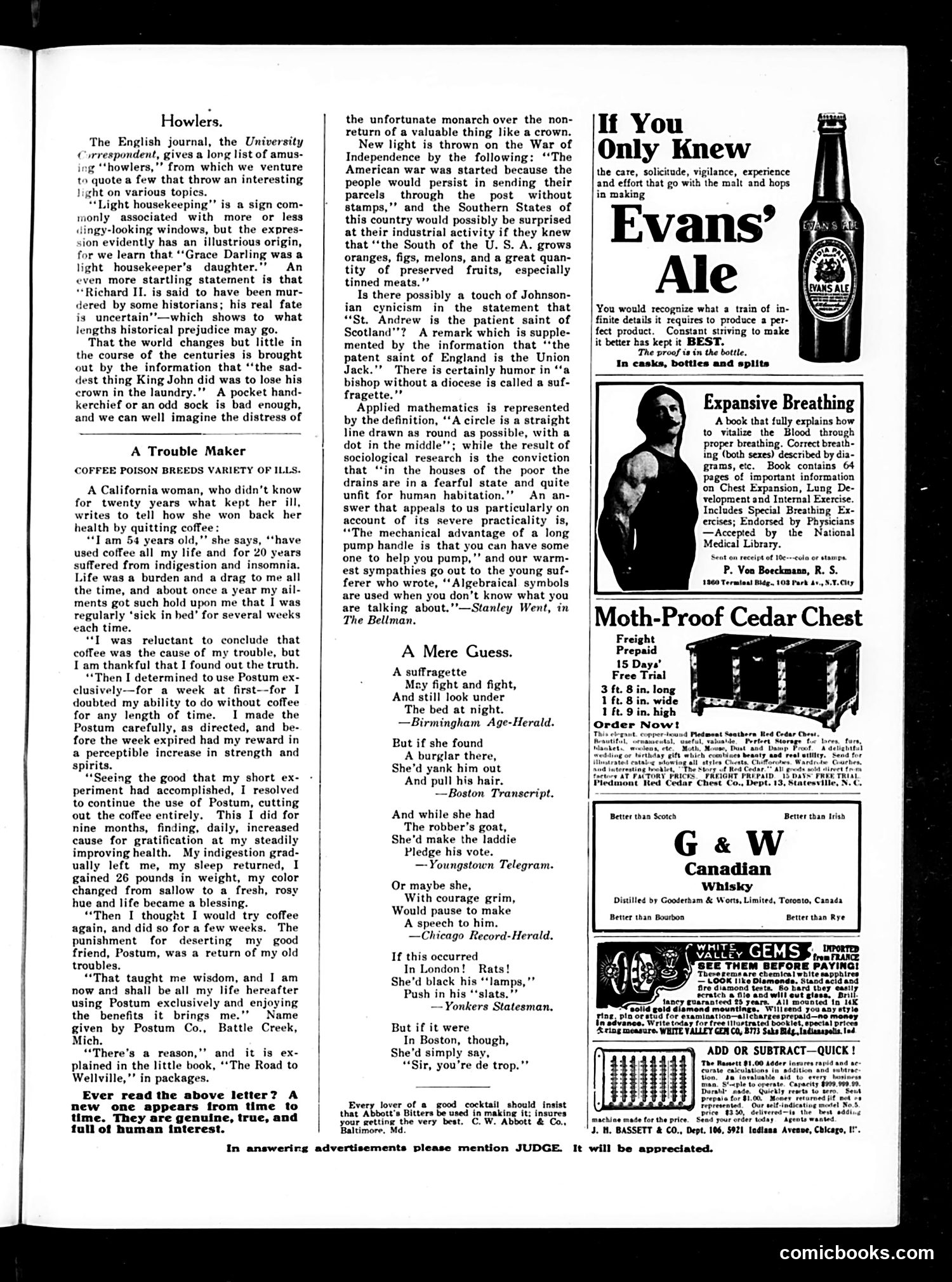
This page contains primarily **humorous articles and advertisements** rather than political cartoons. The main content includes: 1. **"Howlers"** — A column reprinting amusing student essay errors from a British university publication. These joke about historical/geographical misunderstandings (e.g., King John losing his crown "in the laundry," misidentifications of saints). The satire targets student ignorance rather than political figures. 2. **"A Trouble Maker"** — A testimonial advertisement for Postum (a coffee substitute), presenting a woman's account of health improvements after quitting coffee. This is a product advertisement disguised as personal narrative. 3. **Various advertisements** — Evans' Ale, G&W Canadian Whisky, and other branded products occupy the right column. **No clear political satire or caricature appears on this page.** The humor is gentle and focused on linguistic/intellectual errors rather than social commentary or political critique. This appears to be a relatively light issue mixing consumer advertising with humorous content.
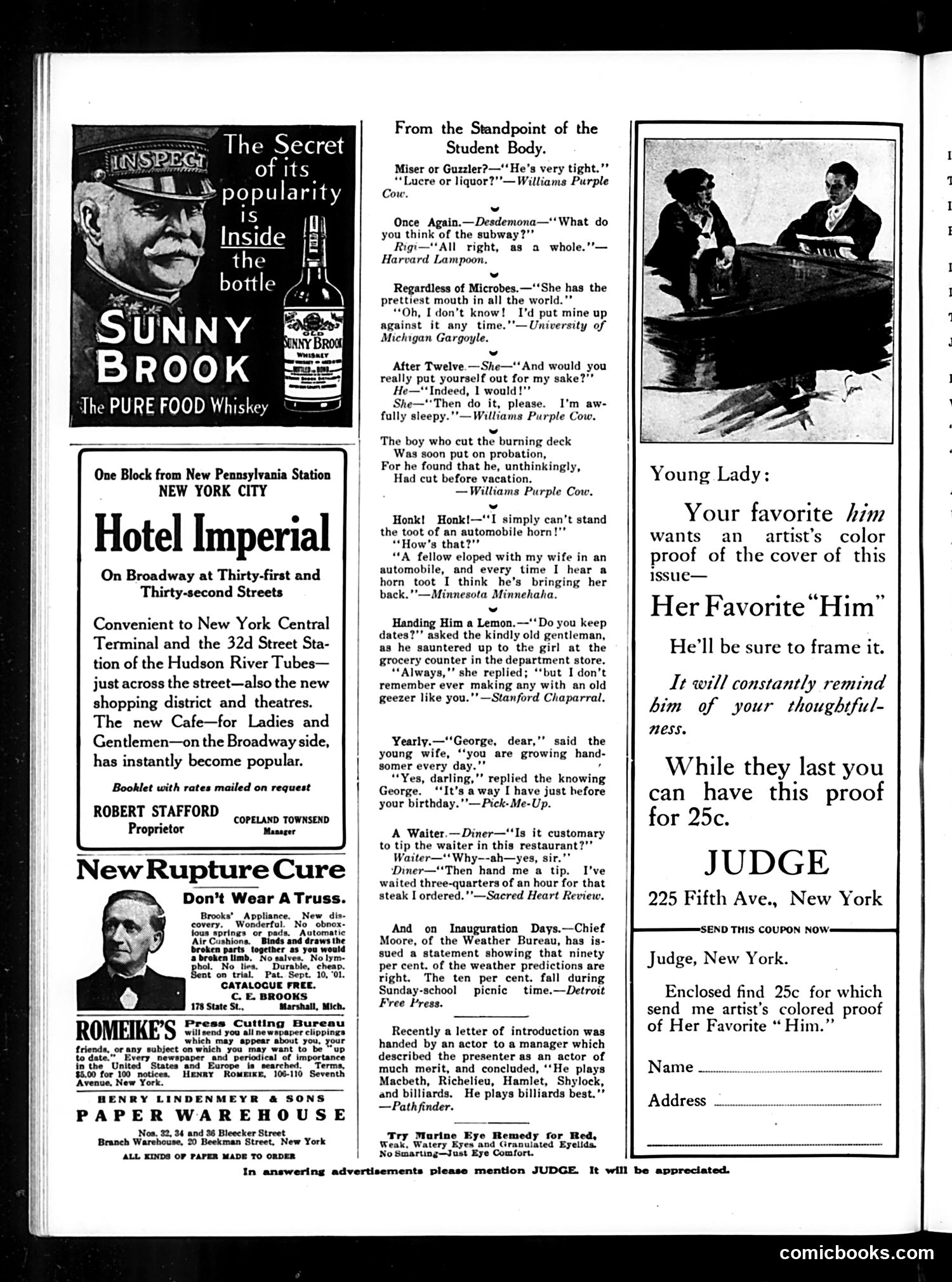
This page is primarily **advertisements and humor reprints** from college magazines, not original Judge content. The "From the Standpoint of the Student Body" section collects jokes from university publications (Williams Purple Cow, Harvard Lampoon, University of Michigan Gargoyle, etc.). These jokes address early-1900s student life: tight-fisted behavior, the newfangled subway, automobile elopements, department store flirtation, and restaurant tipping customs. The humor relies on wordplay and mild sexual innuendo acceptable for the era. Notable themes include: a wife running away in an automobile (reflecting anxiety about new technology enabling moral transgressions), tired courtship rituals, and economic class consciousness (the "old geezer" rebuff). The advertisements—for a rupture cure, hotel, paper warehouse, and press clipping service—reflect contemporary commercial concerns. The Judge coupon advertisement sells an artist's color proof, suggesting magazine promotional strategies of the period. Overall, this represents **ephemeral college humor and commercial content** rather than Judge's signature political satire.
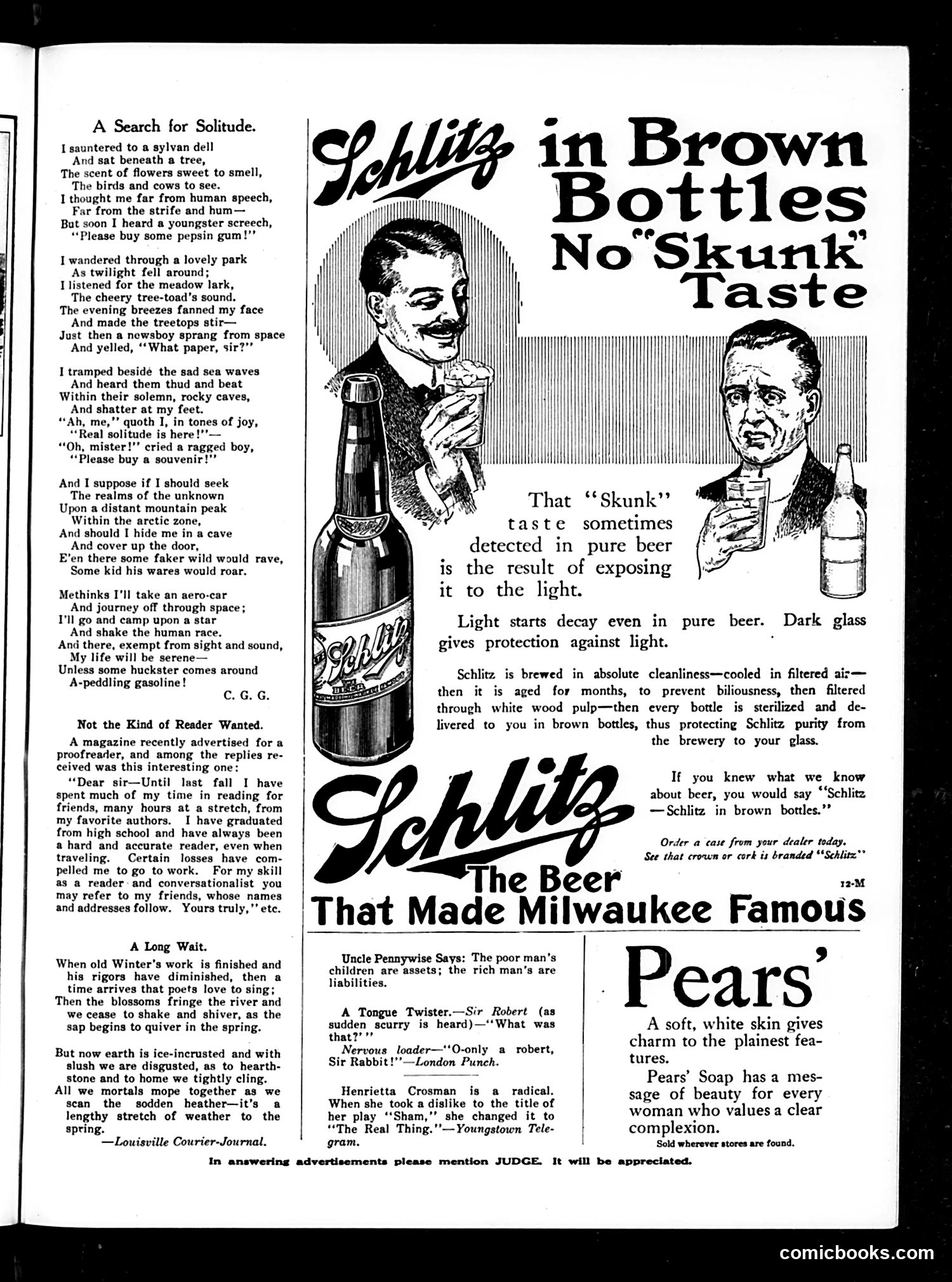
This page from *Judge* magazine contains several distinct pieces: **"A Search for Solitude"** (left column): A poem satirizing the impossibility of escaping commercial life in America. The narrator seeks peaceful nature but is repeatedly interrupted by aggressive street vendors—children selling pepsin gum, newsboys, souvenir hawkers, and eventually a gasoline salesman in space. The satire targets relentless commercialism and unwanted sales pitches that invade even imaginary refuges. **Schlitz Beer Advertisement** (center/right): Uses the "skunk" taste metaphor to explain why brown bottles are superior—they protect beer from light damage. This is not satire but genuine product marketing emphasizing scientific brewing methods. **Minor items** ("Not the Kind of Reader Wanted," "A Long Wait," "Uncle Pennywise Says"): Brief humorous snippets about employment, seasons, and proverbs—typical filler content in satirical magazines of this era. The page's central theme is consumer culture's inescapability, though juxtaposed against straightforward advertising.
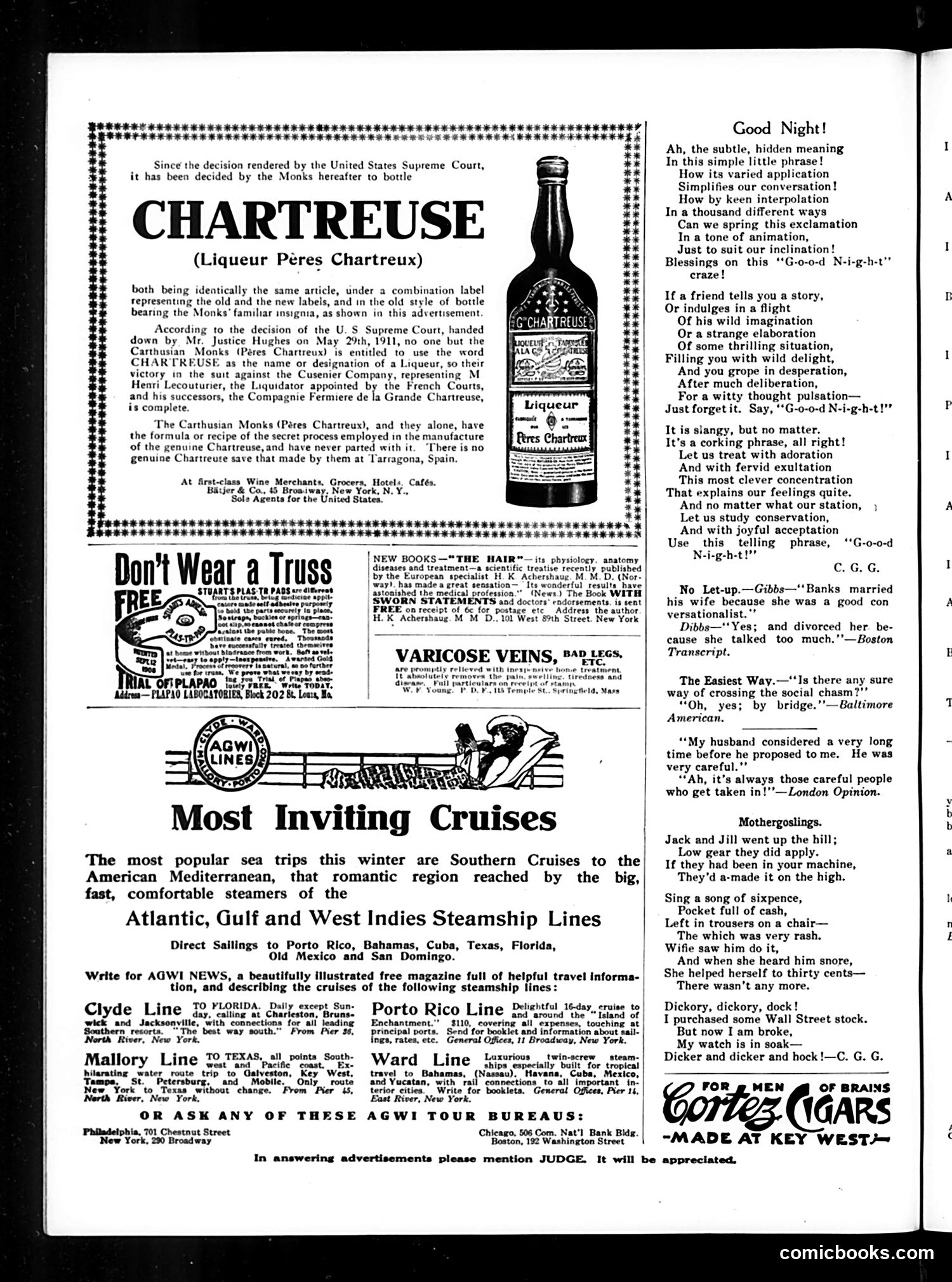
This page is primarily **advertising with minimal editorial content**. The main items are: **Chartreuse Liqueur Advertisement**: References a 1911 U.S. Supreme Court decision (by Justice Hughes) granting Carthusian Monks exclusive rights to the "Chartreuse" name. This settled a trademark dispute against competitors like the Cusenier Company. The monks manufacture the liqueur in Tarragona, Spain. **Medical/Patent Advertisements**: Include dubious treatments—a hair-growth book and varicose vein remedy—typical of early 20th-century magazine advertising before FDA regulation. **Cruise Line Advertisements**: Promote winter steamship cruises to the Caribbean and Gulf Coast via various lines (Clyde, Mallory, Porto Rico, Ward). **Sidebar Humor**: Brief jokes under "Good Night!" and anecdotes ("No Let-up," "Mothergoings") occupy the right margin. **Context**: As a satirical magazine, Judge mixed legitimate advertising with humorous content. The page reflects pre-WWI American consumer culture and leisure travel marketing.
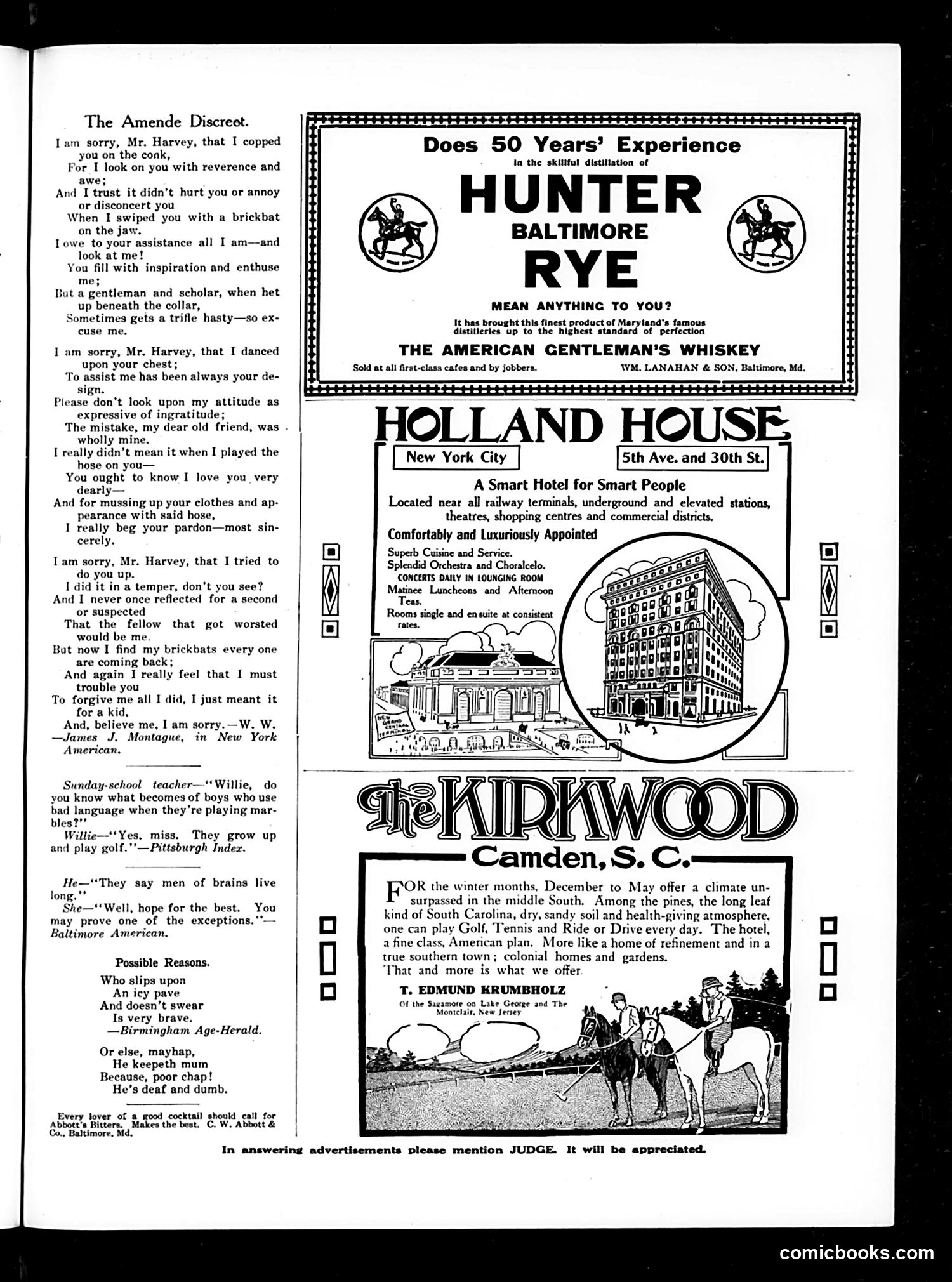
This page features a poem by James J. Montague satirizing excessive apologies. The speaker repeatedly apologizes to "Mr. Harvey" for increasingly violent acts—hitting him with a brick, dancing on his chest, spraying him with a hose, and attempting to fight him. Each apology grows more obsequious and absurd, framing serious violence as minor social transgressions ("expressive of ingratitude"). The joke appears to target either a specific public figure named Harvey or satirize the general phenomenon of insincere, overwrought apologies common in society. The punch line emerges when the speaker confesses that his brickbats "are coming back"—suggesting his victim fought back and won—yet still demands forgiveness. The page is primarily advertising (whiskey, hotels, golf resorts), typical of Judge magazine's format during this era.
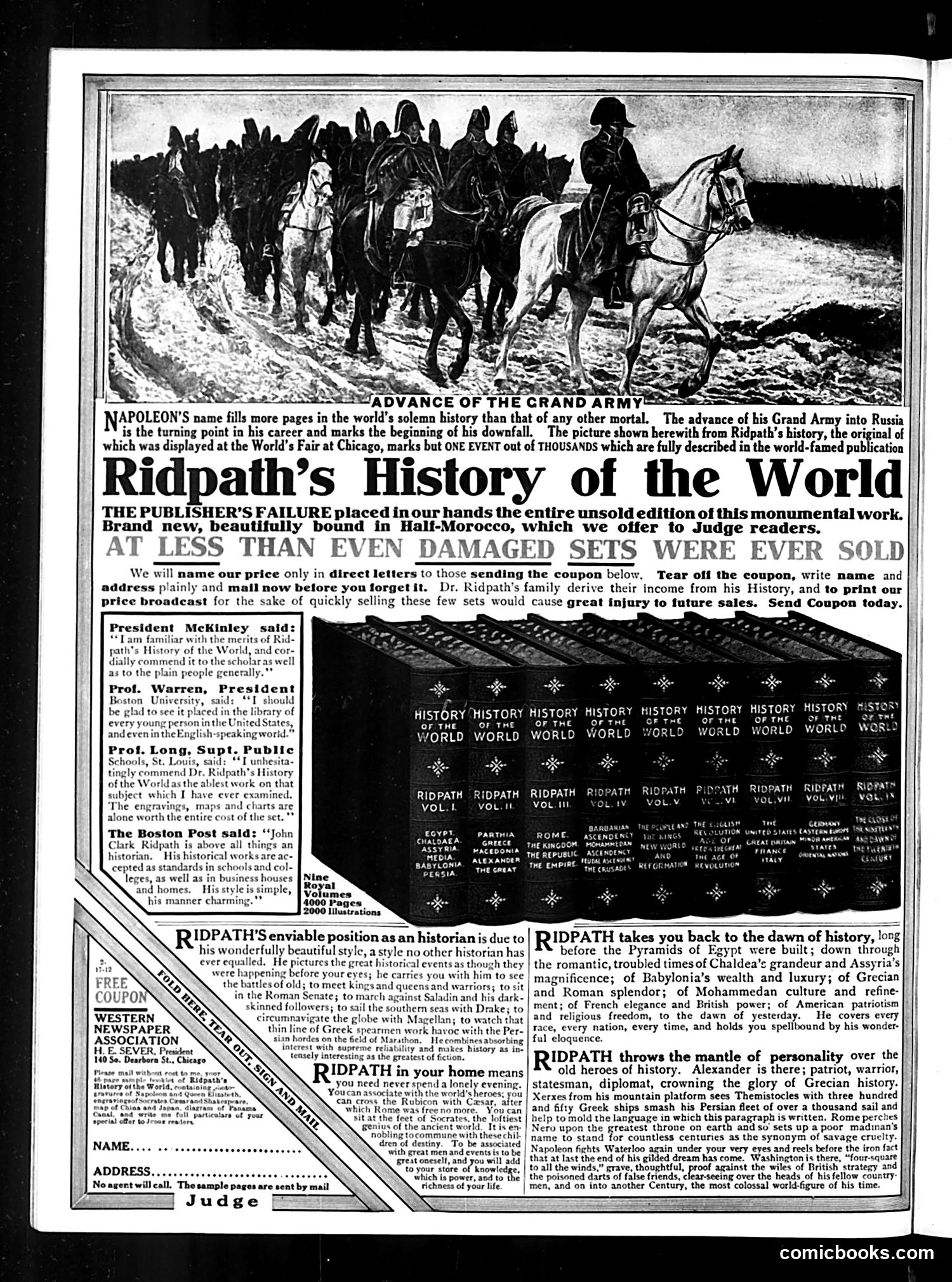
This page is primarily a **book advertisement**, not a political cartoon. It promotes "Ridpath's History of the World," a comprehensive historical encyclopedia, by claiming Judge magazine obtained overstock copies from a publisher's failure. The ad uses endorsements from President McKinley, Boston University's president, and other authorities to establish credibility. It emphasizes the work's scope—from ancient Egypt through contemporary times—and its accessibility to both scholars and general readers. The opening image depicts **Napoleon's Grand Army advancing into Russia**, illustrating one of thousands of historical events the book covers. This dramatic example demonstrates the work's ambition and illustrated quality. The advertisement appeals to readers by offering these expensive, leather-bound volumes at unusually low prices, while noting that Dr. Ridpath's family depends on sales. It's a straightforward commercial pitch, not satirical commentary.