
Judge, 1912-02-17 · page 16 of 24
Judge — February 17, 1912 — page 16: what you’re looking at
What you’re looking at
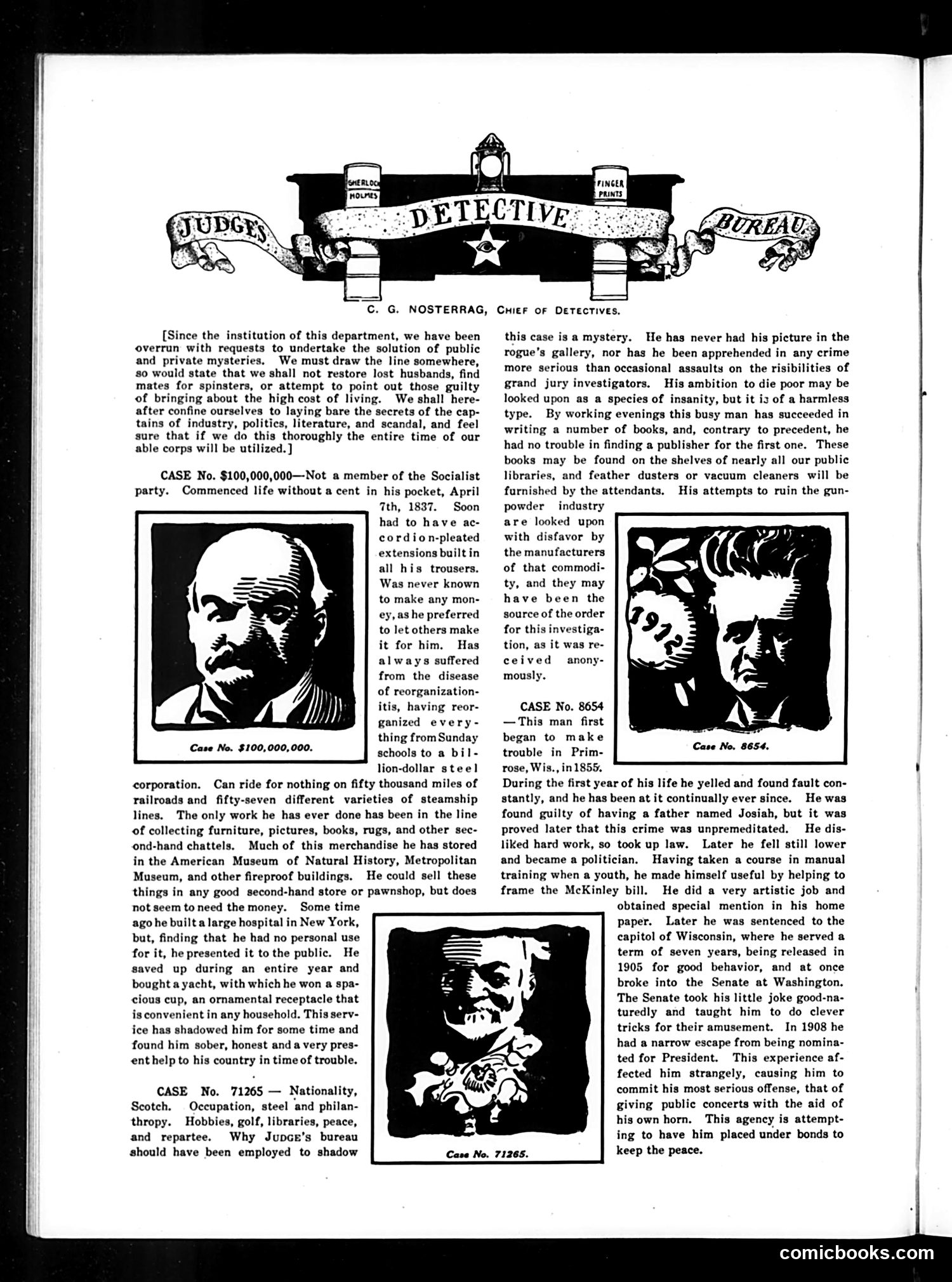
This page parodies Judge magazine's fictional "Detective Bureau," mocking wealthy industrialists and reformers of the Gilded Age through mock "case files." **Case $100,000,000** satirizes a robber baron (likely Andrew Carnegie or similar figure)—a self-made millionaire who obsessively reorganizes corporations, collects art for museums, and built hospitals for public relations. The satire suggests his wealth comes from letting "others make it for him" while he merely shuffles assets around. **Case 71265** appears to reference a Scottish steel magnate and philanthropist (likely Carnegie again, given "steel" and Scottish nationality) who writes books and opposes the gunpowder industry—possibly alluding to his peace activism. The joke: manufacturers anonymously ordered his investigation out of spite. **Case 8654** describes a troublemaking politician from Wisconsin born in 1855 who became a lawyer and politician after avoiding honest work—possibly referencing a specific contemporary political figure, though identity is unclear. The satire targets wealthy "captains of industry" masquerading as philanthropists while their actual motives remain mercenary.
📄 Transcribed text from this page (OCR, searchable)
Machine-transcribed from the original scan — historical spelling and the odd misread are preserved.
[Since the institution of this department, we have been overrun with requests to undertake the solution of public and private mysteries. We must draw the line somewhere, so would state that we shall not restore lost husbands, find mates for spinsters, or attempt to point out those guilty of bringing about the high cost of living. We shall here- after confine ourselves to laying bare the secrets of the cap- tains of industry, politics, literature, and scandal, and feel sure that if we do this thoroughly the entire time of our able corps will be utilized.) CASE No. $100,000,000—Not a member of the Socialist party. Commenced life without a cent in his pocket, April 7th, 1837. Soon had to have ac- cordion-pleated extensions built in all his trousers. Was never known to make any mon- ey, ashe preferred to let others make it for him. Has always suffered from the disease of reorganization- itis, having reor- ganized every- thing from Sunday schools to a bil- lion-dollar steel corporation. Can ride for nothing on fifty thousand miles of railroads and fifty-seven different varieties of steamship lines. The only work he has ever done has been in the line of collecting furniture, pictures, books, rugs, and other sec- ond-hand chattels. Much of this merchandise he has stored in the American Museum of Natural History, Metropolitan Museum, and other fireproof buildings. He could sell these things in any good second-hand store or pawnshop, but does not seem to need the money. Some time ago he built a large hospital in New York, but, finding that he had no personal use for it, he presented it to the public. He saved up during an entire year and bought a yacht, with which he won a spa- cious cup, an ornamental receptacle that is convenient in any household. This serv- ice has shadowed him for some time and found him sober, honest anda very pres- ent help to his country in time of trouble. Case No. $100,000,000. CASE No. 71265 — Nationality, Scotch. Occupation, steel thropy. Hobbies, golf, libraries, peace, and repartee. Why Jupce’s bureau should have been employed to shadow C. G. NOSTERRAG, CwieF oF Detectives, Case No. 71265. this case is a mystery. He has never had his picture in the rogue’s gallery, nor has he been apprehended in any crime more serious than occasional assaults on the risibilities of grand jury investigators. His ambition to die poor may be looked upon as a species of insanity, but it is of a harmless type. By working evenings this busy man has succeeded in writing a number of books, and, contrary to precedent, he had no trouble in finding a publisher for the first one. These books may be found on the shelves of nearly all our public libraries, and feather dusters or vacuum cleaners will be furnished by the attendants, His attempts to ruin the gun- powder industry are looked upon with disfavor by the manufacturers of that commodi- ty, and they may have been the source of the order for this investiga- tion, as it was re- ceived anony- mously, CASE No. 8654 —This man first began to make trouble in Prim- rose, Wis., in 1855, During the first year of his life he yelled and found fault con- stantly, and he has been at it continually ever since. He was found guilty of having a father named Josiah, but it was proved later that this crime was unpremeditated. He dis- liked hard work, so took up law. Later he fell still lower and became a politician. Having taken a course in manual training when a youth, he made himself useful by helping to frame the McKinley bill. He did a very artistic job and obtained special mention in his home paper. Later he was sentenced to the capitol of Wisconsin, where he served a term of seven years, being released in 1905 for good behavior, and at once broke into the Senate at Washington. The Senate took his little joke good-na- turedly and taught him to do clever tricks for their amusement. In 1908 he had a narrow escape from being nomina- ted for President. This experience af- fected him strangely, causing him to commit his most serious offense, that of giving public concerts with the aid of his own horn. This agency is attempt- ing to have him placed under bonds to keep the peace. Case No, 8654. comicbooks.com