
Judge, 1912-02-17 · page 4 of 24
Judge — February 17, 1912 — page 4: what you’re looking at
What you’re looking at
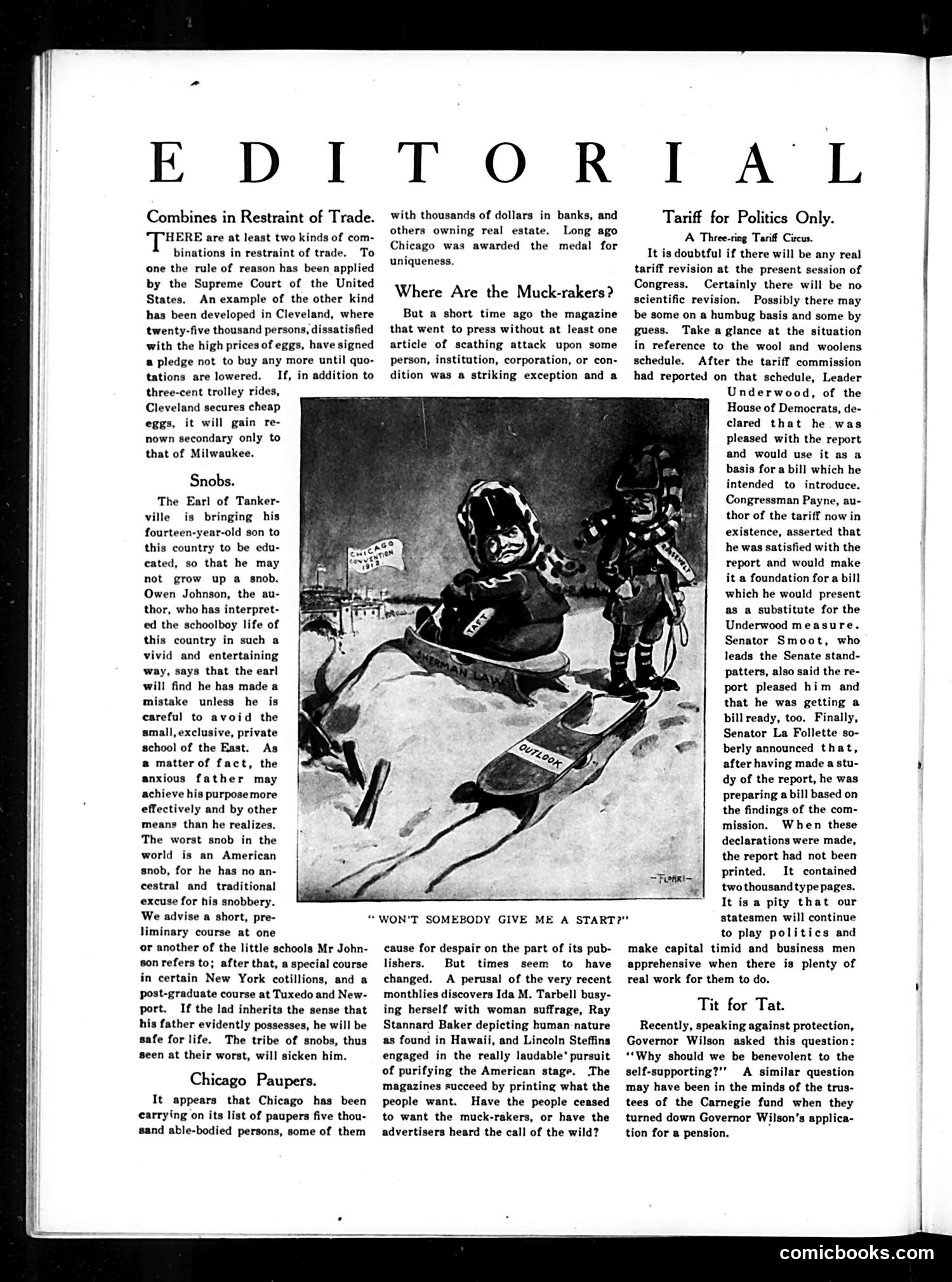
The cartoon titled **"Won't Somebody Give Me a Start"** depicts a figure (appears to be a baby or small character) on a sledge, illustrated by Forel. The image satirizes economic opportunity or relief during what appears to be an economic downturn. The surrounding editorials address: 1. **Trade combinations** - criticizing anti-competitive practices by Cleveland egg dealers 2. **Social snobbery** - mocking the Earl of Tankerville's plan to send his son to America to avoid becoming a snob 3. **Chicago paupers** - questioning whether Chicago is harboring thousands of unemployed persons 4. **Tariff politics** - discussing Congressional tariff revision debates, with references to Representatives Underwood and La Follette The overall theme appears to critique both economic inequality and governmental response to it.
📄 Transcribed text from this page (OCR, searchable)
Machine-transcribed from the original scan — historical spelling and the odd misread are preserved.
Combines in Restraint of Trade. HERE are at least two kinds of com- binations in restraint of trade. To one the rule of reason has been applied by the Supreme Court of the United States, An example of the other kind has been developed in Cleveland, where twenty-five thousand persons, dissatisfied with the high prices of eggs, have signed a pledge not to buy any more until quo- tations are lowered. If, in addition to three-cent trolley rides, Cleveland secures cheap eggs, it will gain re- nown secondary only to that of Milwaukee. Snobs. The Earl of Tanker- ville is bringing his fourteen-year-old son to this country to be edu- cated, so that he may not grow up a snob. Owen Johnson, the au- thor, who has interpret- ed the schoolboy life of this country in such a vivid and entertaining way, says that the earl will find he has made a mistake unless he is careful to avoid the small, exclusive, private school of the East. As a matter of fact, the anxious father may achieve his purpose more effectively and by other means than he realizes. The worst snob in the world is an American snob, for he has no an- cestral and traditional excuse for his snobbery. We advise a short, pre- liminary course at one or another of the little schools Mr John- son refers to; after that, a special course in certain New York cotillions, and a post-graduate course at Tuxedo and New- port. If the lad inherits the sense that his father evidently possesses, he will be safe for life. The tribe of snobs, thus seen at their worst, will sicken him. Chicago Paupers. It appears that Chicago has been carrying on its list of paupers five thou- sand able-bodied persons, some of them EF DITORIA L with thousands of dollars in banks, and others owning real estate. Long ago Chicago was awarded the medal for uniqueness. Where Are the Muck-rakers? But a short time ago the magazine that went to press without at least one article of scathing attack upon some person, institution, corporation, or con- dition was a striking exception and a “WON'T SOMEBODY GIVE ME A START?" cause for despair on the part of its pub- lishers. But times seem to have changed. A perusal of the very recent monthlies discovers Ida M. Tarbell busy- ing herself with woman suffrage, Ray Stannard Baker depicting human nature as found in Hawaii, and Lincoln Steffins engaged in the really laudable‘ pursuit of purifying the American stage. The magazines succeed by printing what the people want. Have the people ceased to want the muck-rakers, or have the advertisers heard the call of the wild? Tariff for Politics Only. A Three-ring Tariff Circus. It is doubtful if there will be any real tariff revision at the present session of Congress. Certainly there will be no scientific revision. Possibly there may be some on a humbug basis and some by guess. Take a glance at the situation in reference to the wool and woolens schedule. After the tariff commission had reported on that schedule, Leader Underwood, of the House of Democrats, de- clared that he was pleased with the report and would use it as a basis for a bill which he intended to introduce. Congressman Payne, au- thor of the tariff now in existence, asserted that he was satisfied with the report and would make it a foundation for a bill which he would present as a substitute for the Underwood measure. Senator Smoot, who leads the Senate stand- patters, also said the re- port pleased him and that he was getting a bill ready, too. Finally, Senator La Follette so- berly announced that, after having made a stu- dy of the report, he was preparing a bill based on the findings of the com- mission. When these declarations were made, the report had not been printed. It contained two thousand type pages. It is a pity that our statesmen will continue to play politics and make capital timid and business men apprehensive when there is plenty of real work for them to do. Tit for Tat. Recently, speaking against protection, Governor Wilson asked this question: “‘Why should we be benevolent to the self-supporting?” A similar question may have been in the minds of the trus- tees of the Carnegie fund when they turned down Governor Wilson's applica- tion for a pension. comicbooks.com