
Judge, 1912-02-17 · page 9 of 24
Judge — February 17, 1912 — page 9: what you’re looking at
What you’re looking at
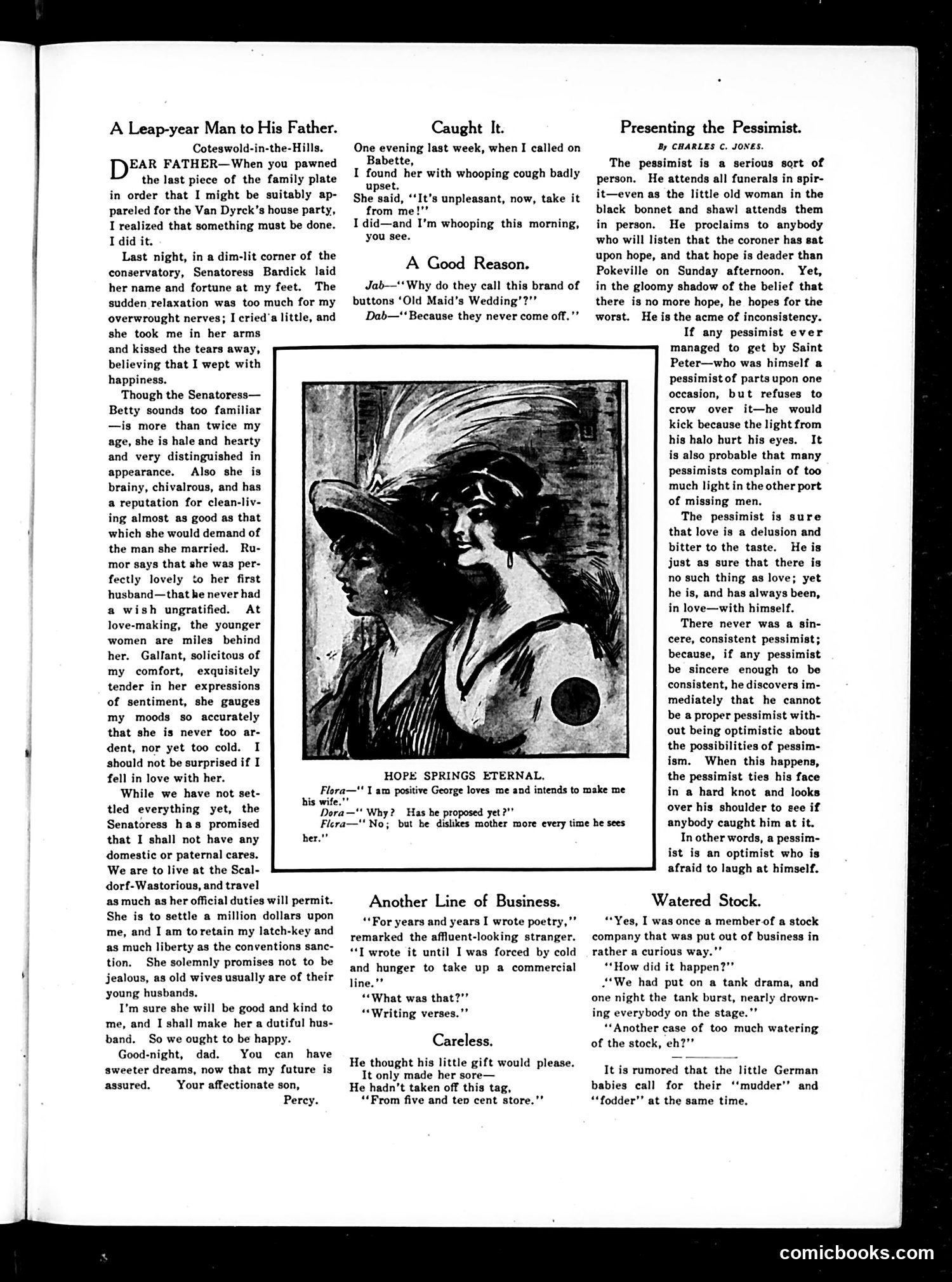
This page contains several short humor pieces typical of early 20th-century American satire: **"A Leap-year Man to His Father"** satirizes fortune-hunting. A young man (Percy) announces his engagement to a wealthy older "Senatoress" solely for money—she'll settle a million dollars on him. The humor mocks both his shameless mercenary motives and the absurdity of a leap-year tradition where women propose to men. **The cartoon "Hope Springs Eternal"** depicts a young woman (Flora) naively insisting her indifferent boyfriend loves her and will propose, when he clearly dislikes even her mother. It mocks female romantic delusion. The remaining pieces are brief jokes about minor social embarrassments: catching whooping cough, buttons that don't come off (mocking "Old Maid" brand), and a gift still bearing its five-and-ten-cent store price tag. **"Presenting the Pessimist"** is a character sketch mocking someone so consistently gloomy he'd complain even in heaven. The overall theme: human foolishness, self-deception, and social awkwardness.
📄 Transcribed text from this page (OCR, searchable)
Machine-transcribed from the original scan — historical spelling and the odd misread are preserved.
A Leap-year Man to His Father. Coteswold-in-the-Hills. EAR FATHER—When you pawned the last piece of the family plate in order that I might be suitably ap- pareled for the Van Dyrck’s house party, I realized that something must be done. I did it. Last night, in a dim-lit corner of the conservatory, Senatoress Bardick laid her name and fortune at my feet. The sudden relaxation was too much for my overwrought nerves; I cried‘a little, and she took me in her arms and kissed the tears away, believing that I wept with happiness. Though the Senatoress— Betty sounds too familiar —is more than twice my age, she is hale and hearty and very distinguished in appearance. Also she is brainy, chivalrous, and has a reputation for clean-liv- ing almost as good as that which she would demand of the man she married. Ru- mor says that she was per- fectly lovely to her first husband—that he never had a wish ungratified. At love-making, the younger women are miles behind her. Gallant, solicitous of my comfort, exquisitely tender in her expressions of sentiment, she gauges my moods so accurately that she is never too ar- dent, nor yet too cold. I should not be surprised if I fell in love with her. While we have not set- tled everything yet, the Senatoress has promised that I shall not have any her. domestic or paternal cares. We are to live at the Scal- dorf-Wastorious, and travel as much as her official duties will permit. She is to settle a million dollars upon me, and I am toretain my latch-key and as much liberty as the conventions sanc- tion. She solemnly promises not to be jealous, as old wives usually are of their young husbands. I'm sure she will be good and kind to me, and I shall make her a dutiful hus- band. So we ought to be happy. Good-night, dad. You can have sweeter dreams, now that my future is Your affectionate son, Percy. assured. Caught It. One evening last week, when I called on Babette, I found her with whooping cough badly upset. She said, ‘‘It’s unpleasant, now, take it from me!” I did—and I’m whooping this morning, you see. A Good Reason. Jab—‘‘Why do they call this brand of buttons ‘Old Maid’s Wedding’?”’ Dab—‘‘ Because they never come off.’’ HOPE SPRINGS ETERNAL. Flora—"' 1 am positive George loves me and intends to make me his wife." Dora—"* Why? Has he proposed yet ?"* Flera—"* No; but be dislikes mother more every time he sees Another Line of Business. “For years and years I wrote poetry,” remarked the affluent-looking stranger. “I wrote it until I was forced by cold and hunger to take up a commercial line.”” “‘What was that?’’ “Writing verses.”” Careless. He thought his little gift would please. It only made her sore— He hadn’t taken off this tag, “From five and ten cent store.’’ Presenting the Pessimist. By CHARLES C. JONES. The pessimist is a serious sort of person. He attends all funerals in spir- it—even as the little old woman in the black bonnet and shawl attends them in person. He proclaims to anybody who will listen that the coroner has sat upon hope, and that hope is deader than Pokeville on Sunday afternoon. Yet, in the gloomy shadow of the belief that there is no more hope, he hopes for the worst. He is the acme of inconsistency. If any pessimist ever managed to get by Saint Peter—who was himself a pessimist of parts upon one occasion, but refuses to crow over it—he would kick because the light from his halo hurt his eyes. It is also probable that many pessimists complain of too much light in the other port of missing men. The pessimist is sure that love is a delusion and bitter to the taste. He is just as sure that there is no such thing as love; yet he is, and has always been, in love—with himself. There never was a sin- cere, consistent pessimist; because, if any pessimist be sincere enough to be consistent, he discovers im- mediately that he cannot be a proper pessimist with- out being optimistic about the possibilities of pessim- ism. When this happens, the pessimist ties his face in a hard knot and looks over his shoulder to eee if anybody caught him at it. In other words, a pessim- ist is an optimist who is afraid to laugh at himself. Watered Stock. “Yes, I was once a member of a stock company that was put out of business in rather a curious way." “How did it happen?” ‘We had put on a tank drama, and one night the tank burst, nearly drown- ing everybody on the stage."” ‘Another case of too much watering of the stock, eh?’’ It is rumored that the little German babies call for their ‘‘mudder’’ and “‘fodder’’ at the same time. comicbooks.com