
A complete issue · 24 pages · 1912
Judge — February 10, 1912
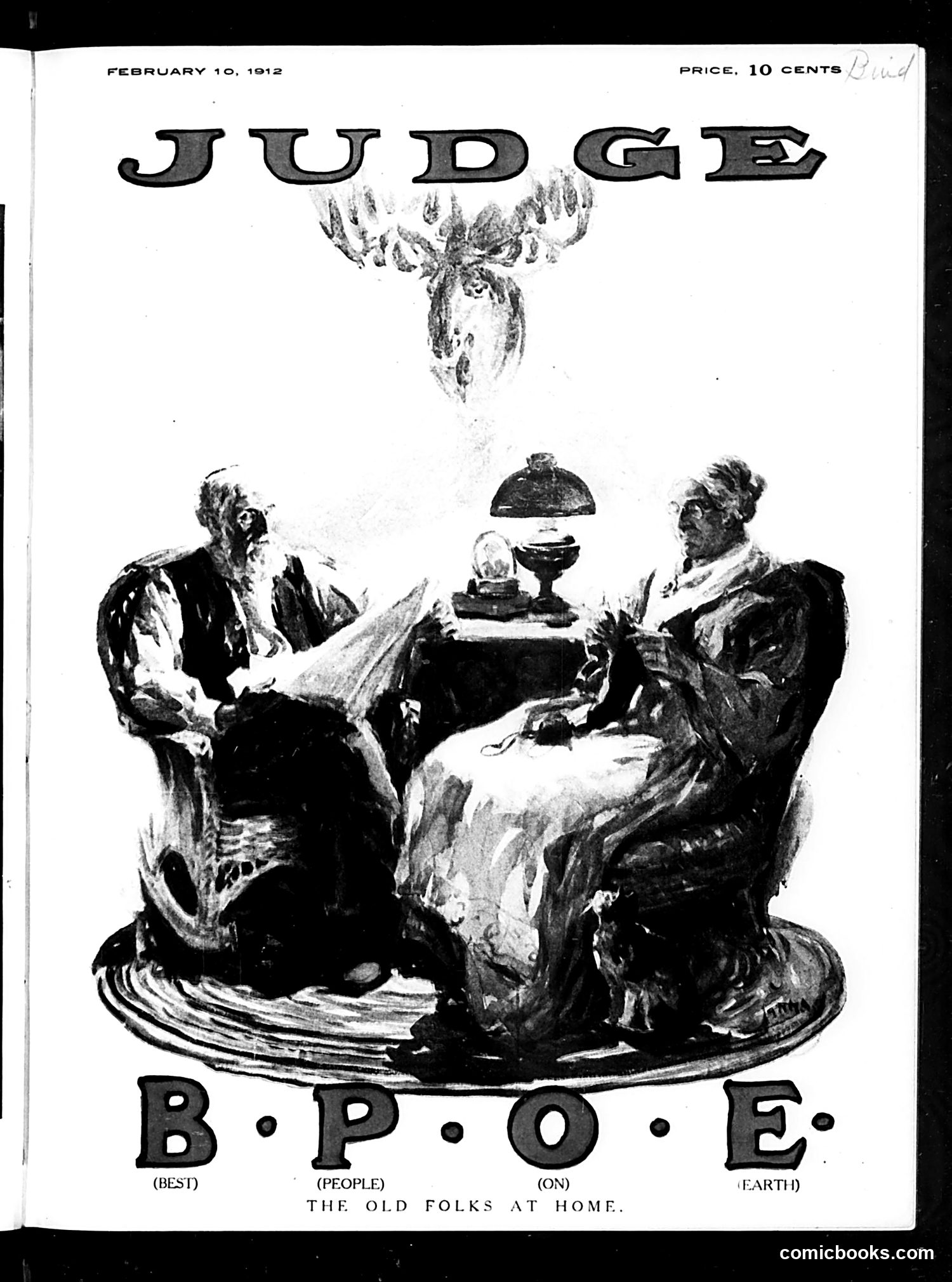
This cover illustrates "B.P.O.E." (Best People On Earth), a humorous acronym playing on the Benevolent and Protective Order of Elks, a fraternal organization popular in early 20th-century America. The cartoon depicts elderly men gathered around a table at home, examining what appears to be a crystal ball or mystical object under a lamp. The satire mocks the pretensions of such fraternal societies—suggesting their members viewed themselves as society's elite while engaging in folksy, domestic activities. The ornate clothing and solemn poses contrast with the mundane "old folks at home" scene, ridiculing the grandiosity of fraternal lodge culture and the self-importance of its members.
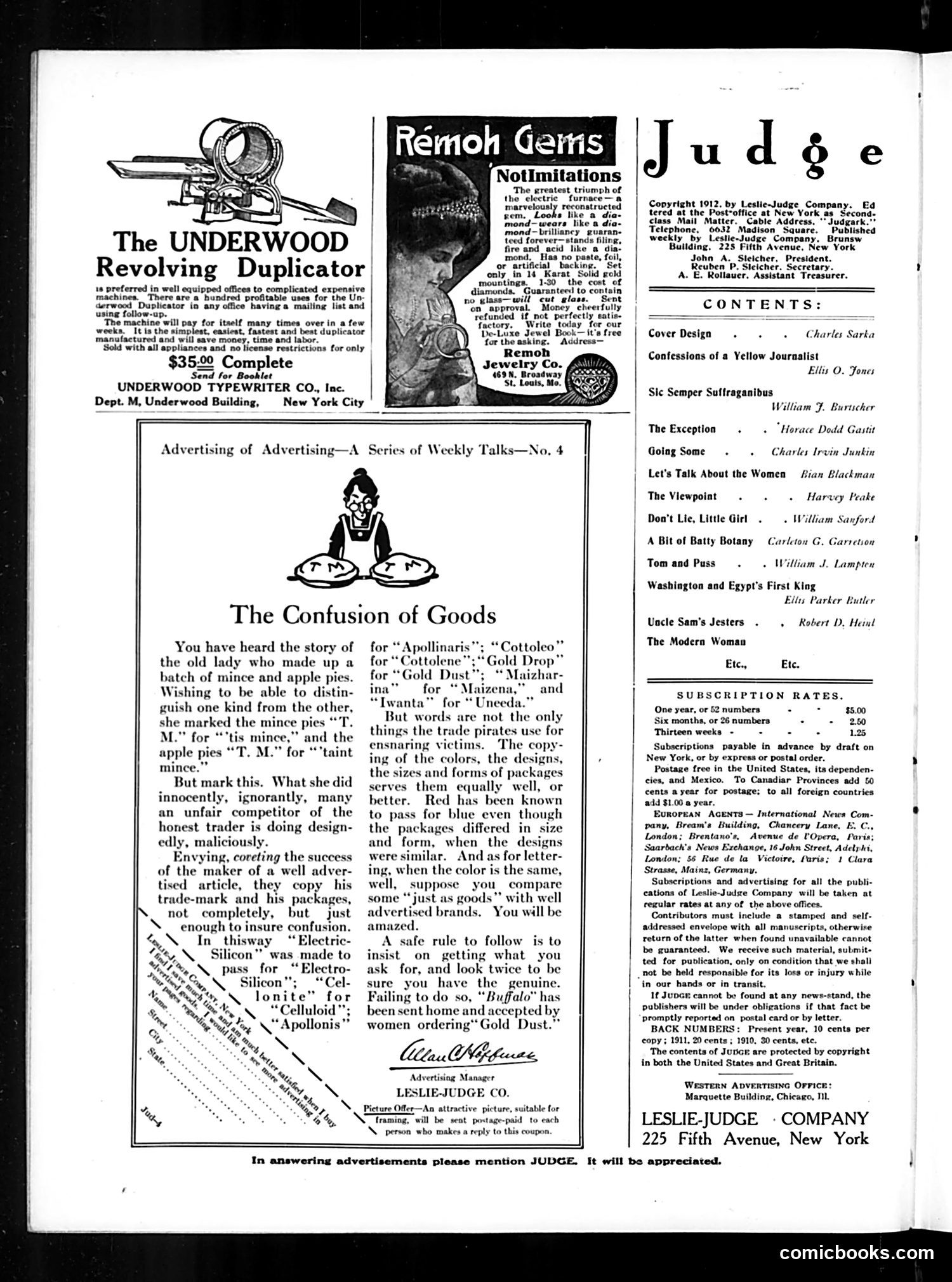
This page is primarily **advertising and editorial content** rather than political satire. The main cartoon, "The Confusion of Goods," satirizes **trademark and packaging piracy** in early 1900s commerce. The illustration shows a woman confused by similar product names—legitimate brands like "Apollinaris" water being undercut by counterfeit competitors using nearly identical names ("Cottoleo" vs. "Cottolene," "Gold Dust" variants). The satire critiques how trade pirates exploited consumer confusion by copying successful packaging designs and sizes while using slightly different names. This reflects genuine early-20th-century concerns about trademark protection and consumer fraud, before modern intellectual property laws were well-established. The piece advocates for careful brand verification—a practical consumer warning dressed as satire.
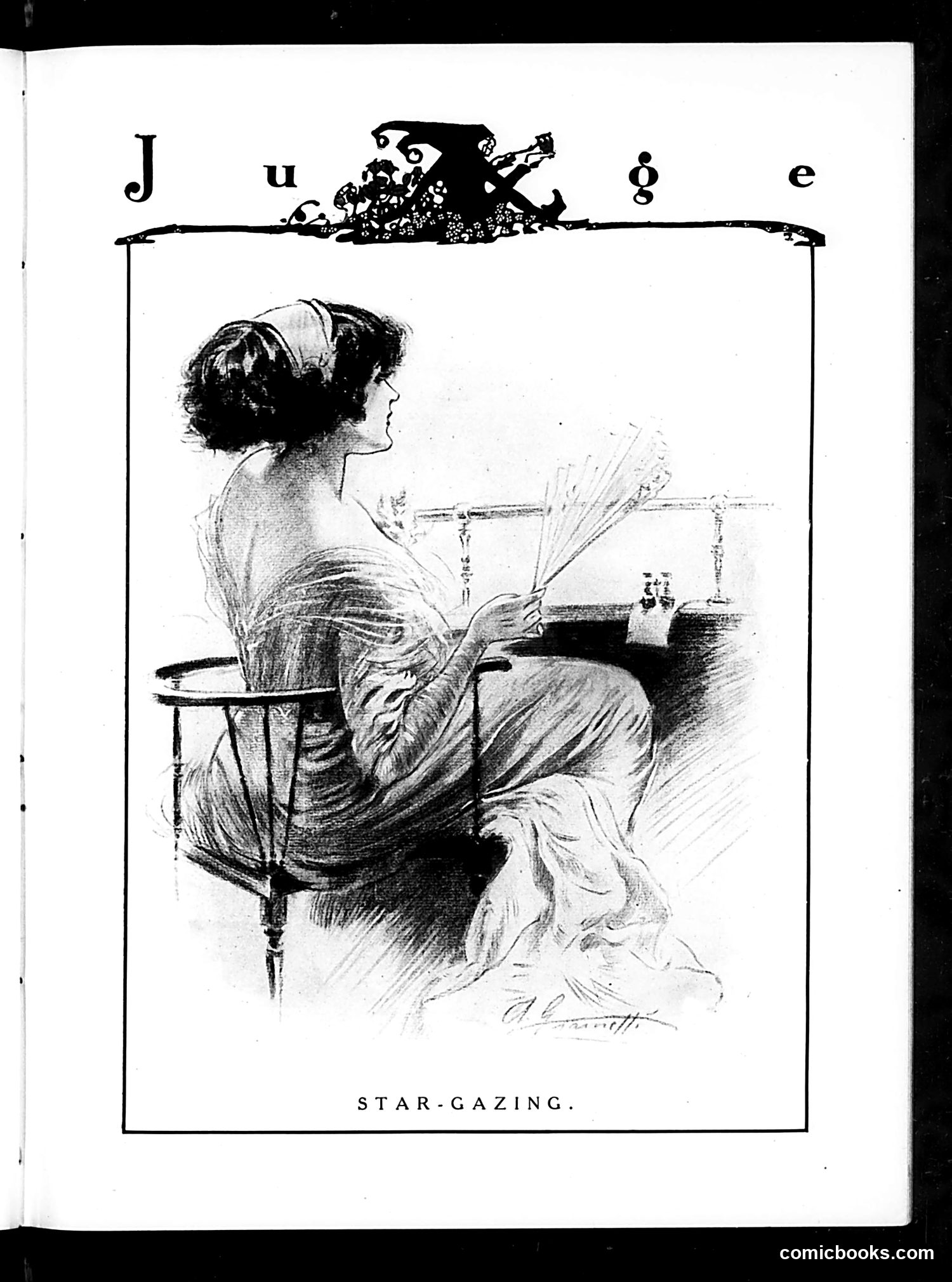
This illustration depicts a woman in elegant Edwardian dress seated at a vanity table, gazing into a mirror while holding a fan. The title "Star-Gazing" creates a double meaning: she appears to be admiring herself rather than literally observing stars. The satire targets female vanity and self-absorption—a common theme in early 20th-century humor. The woman's absorbed contemplation of her own reflection, framed as "star-gazing," mocks the notion that women regard themselves as stars or celebrities worthy of constant admiration. The decorative header above suggests this is part of Judge's regular satirical commentary on contemporary social behavior and gender dynamics of the era.
This editorial page contains three satirical pieces with accompanying illustrations: 1. **"Success!"** - Advocates cooperation and community spirit during prosperity, warning against selfishness. 2. **"A Trust in Embryo"** - Critiques Governor Hoke Smith of Georgia for advising cotton growers to hold staples off the market to force higher prices, comparing this to monopolistic trust behavior that the era's reformers opposed. 3. **"The Silk-stocking Age"** - Mocks wealthy women's expensive silk stockings as frivolous luxury while laborers struggle. The illustration depicts an elegant woman, suggesting class commentary on conspicuous consumption. 4. **"The Derby and Democracy"** - References Governor Foss of Massachusetts and derby hat symbolism in democratic politics, though the specific point remains unclear from the text provided. The page reflects Progressive Era concerns: monopolies, class inequality, and political accountability.
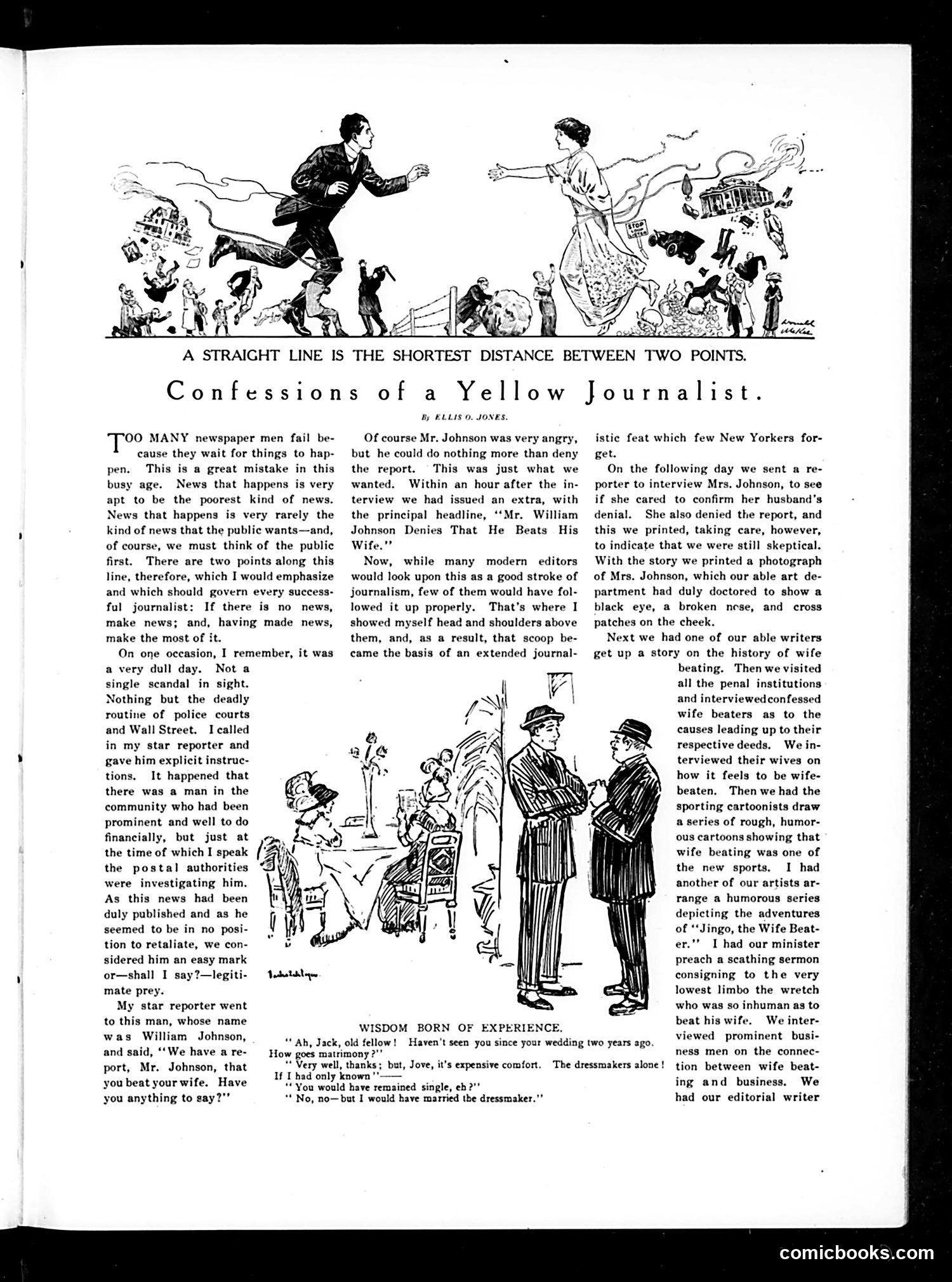
This page from Judge magazine satirizes yellow journalism practices. The top cartoon shows a man and woman leaping across a chasm toward each other—illustrating the maxim "A straight line is the shortest distance between two points." This appears to mock sensationalist reporters who fabricate or distort stories for headlines. The article "Confessions of a Yellow Journalist" describes how the author's newspaper falsely reported that a man named Mr. Johnson beat his wife. When confronted, they printed a denial but maintained their "skeptical" stance. The piece criticizes how newspapers manufacture scandals, then exploit the resulting controversy with follow-up stories about wife-beating as entertainment. The bottom illustration labeled "Wisdom Born of Experience" shows men discussing marriage expenses, satirizing how journalists exploited domestic discord as content.
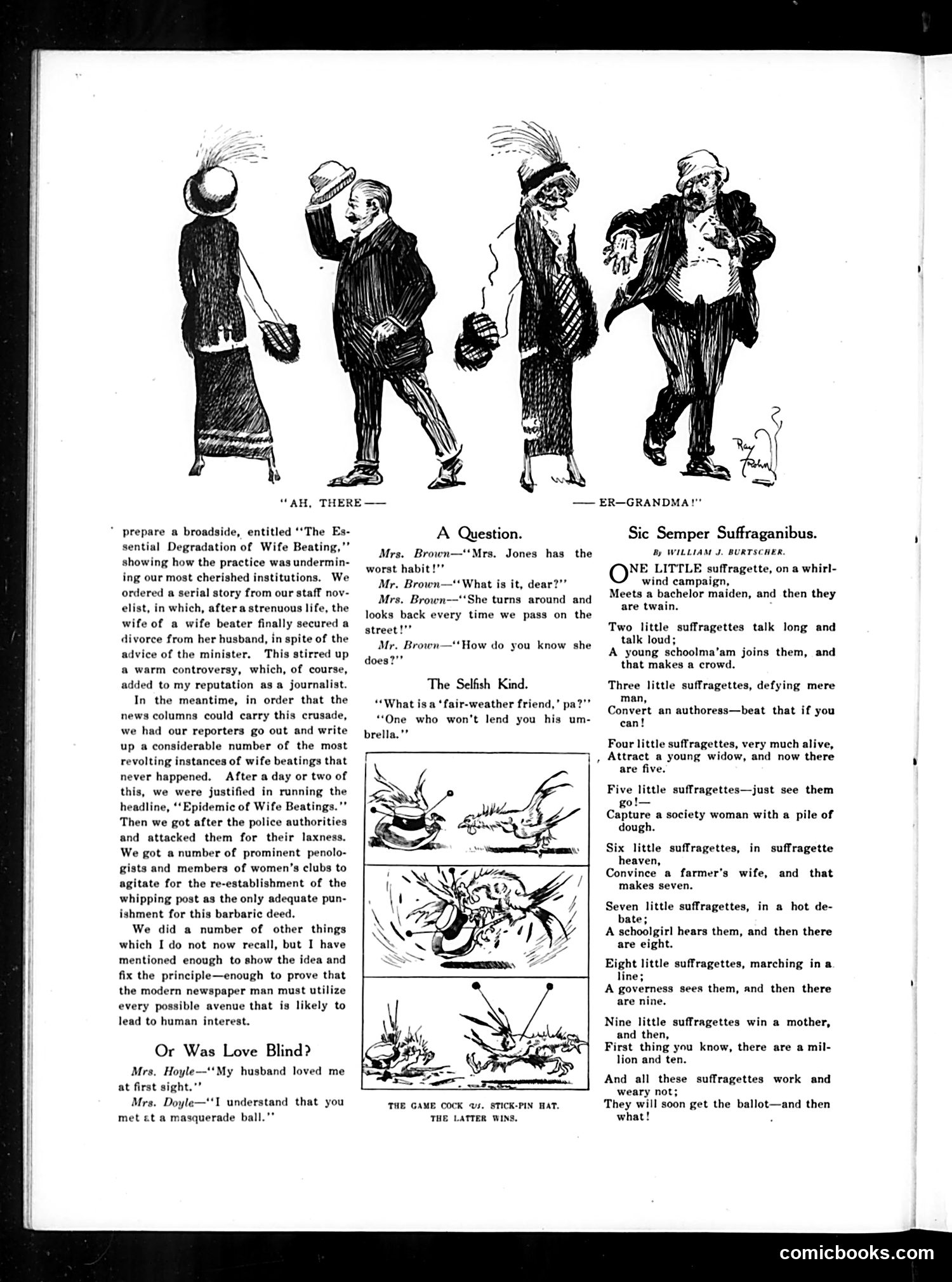
This page satirizes early-20th-century American journalism and the women's suffrage movement. **Top section:** A cynical editor boasts about manufacturing a "Wife Beating Epidemic" story—inventing fake incidents and fabricating statistics to drive readership and appear morally righteous. The satire critiques yellow journalism: newspapers creating sensational false narratives while claiming to serve the public interest. **"Sic Semper Suffraganibus"** parodies the children's rhyme "Ten Little [Indians]." It mocks the women's suffrage movement's growing momentum, depicting suffragettes converting women across social classes (widow, society woman, farmer's wife, governess, mother) through contagious activism. The punchline—"they will soon get the ballot—and then what!"—expresses skepticism about women's ability to use voting power meaningfully, a common anti-suffrage taunt. The cartoons throughout mock social hypocrisy: shallow marriages, selfish friendships, and here, political movements Judge's editors viewed as both spreading "infection-like" and fundamentally misguided.
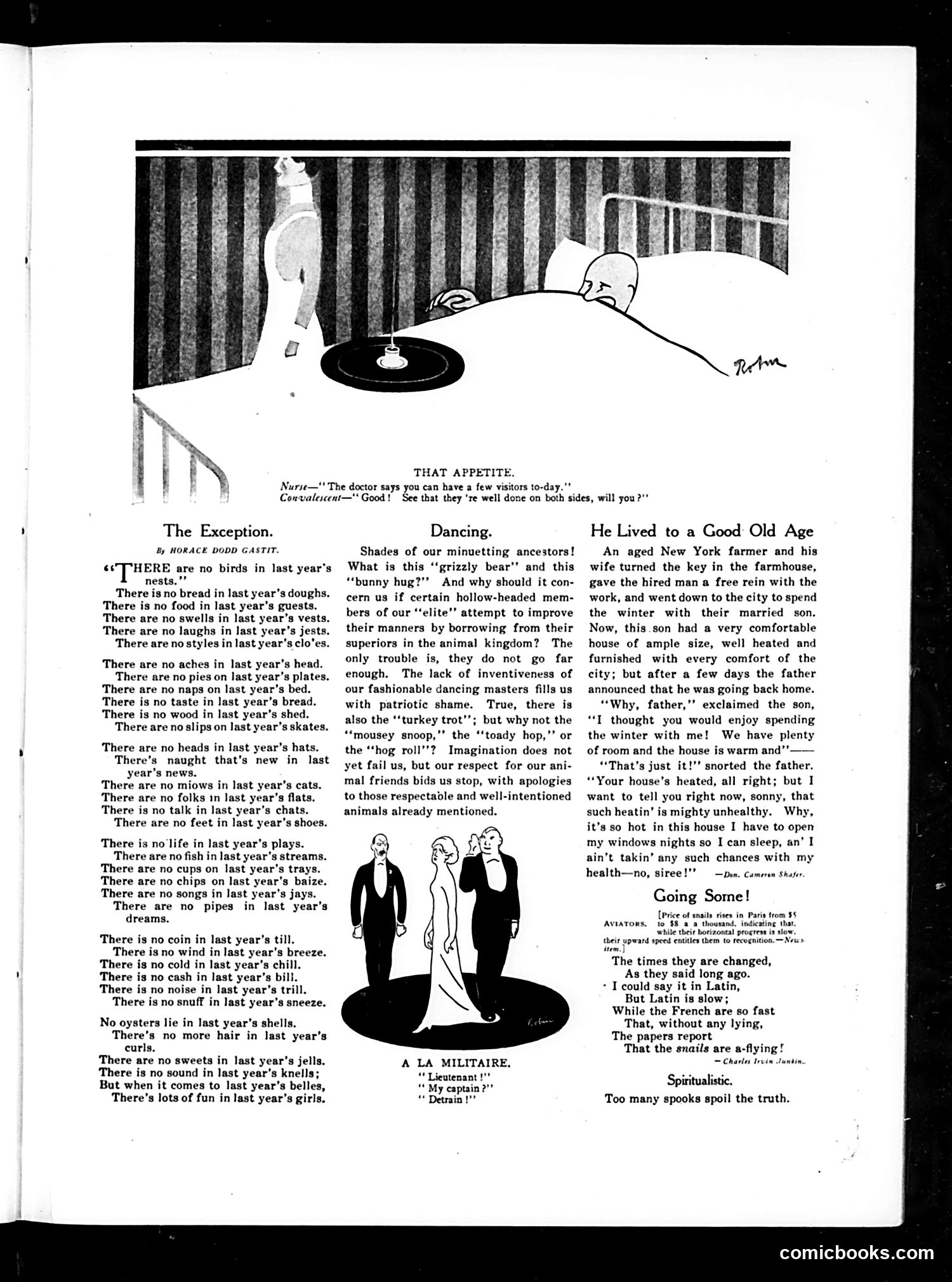
This page contains three distinct pieces of early 20th-century satire: **"The Exception"** is a humorous poem listing all the things that become obsolete or worthless from year to year—ending with the joke that "last year's girls" remain eternally enjoyable. It's a playful commentary on disposable culture and aging. **"Dancing"** mocks newly fashionable modern dances like the "grizzly bear," "bunny hug," and "turkey trot"—animal-named dances that shocked conservative society. The satirist sarcastically suggests dancers should go further with absurd names like "mousey snoop" or "hog roll," ridiculing both the dances themselves and the pretentiousness of dismissing them. **"He Lived to a Good Old Age"** presents a farmer rejecting his son's comfortable heated city house as unhealthy, insisting on returning to his drafty farmhouse—a comedic clash between old-fashioned rural values and modern urban comfort. The page also includes brief quips about rising snail prices in Paris and faster aviation speeds. These reflect typical Judge content: light social and cultural commentary aimed at middle-class readers.
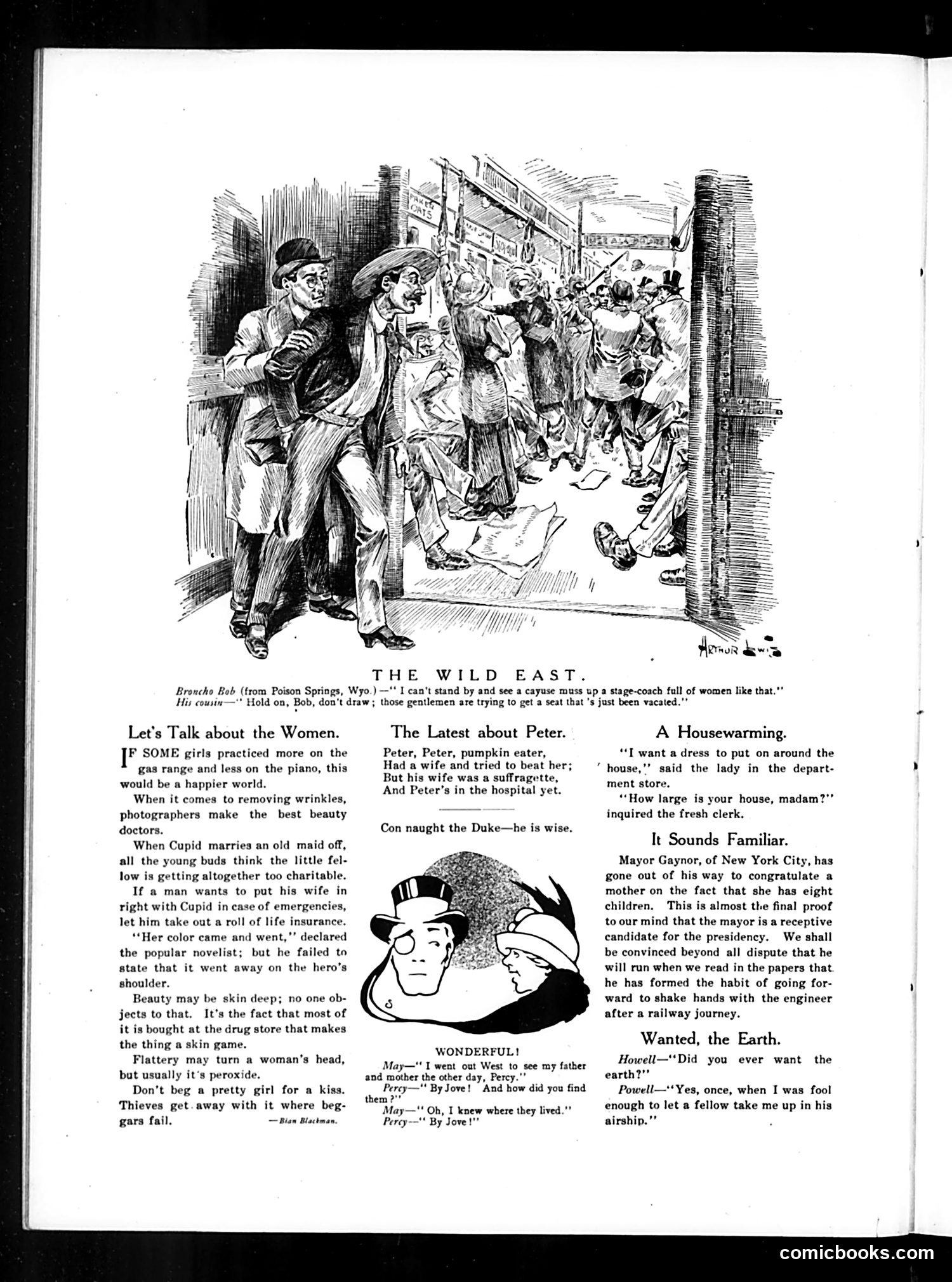
**Main Cartoon**: "Broncho Bob" depicts a Wild West cowboy restraining his cousin from drawing guns at gentlemen fighting over a recently-vacated stagecoach seat. The joke satirizes the contrast between frontier violence (where gunfights are expected) and civilized urban behavior—the men scrambling for a seat represent the same desperate, crude behavior as a western brawl, yet occur in "polite society." **Surrounding Content**: The page mixes brief satirical commentary on contemporary topics: - Women's suffrage ("suffragette" wife beats her husband) - Mayor Gaynor's presidential ambitions (congratulating large families to gain votes) - Early aviation ("airship" mishaps) - Dating and marriage conventions The overall tone mocks urban pretension by suggesting Americans—whether in the Wild West or cities—behave identically when motivated by self-interest or desire.
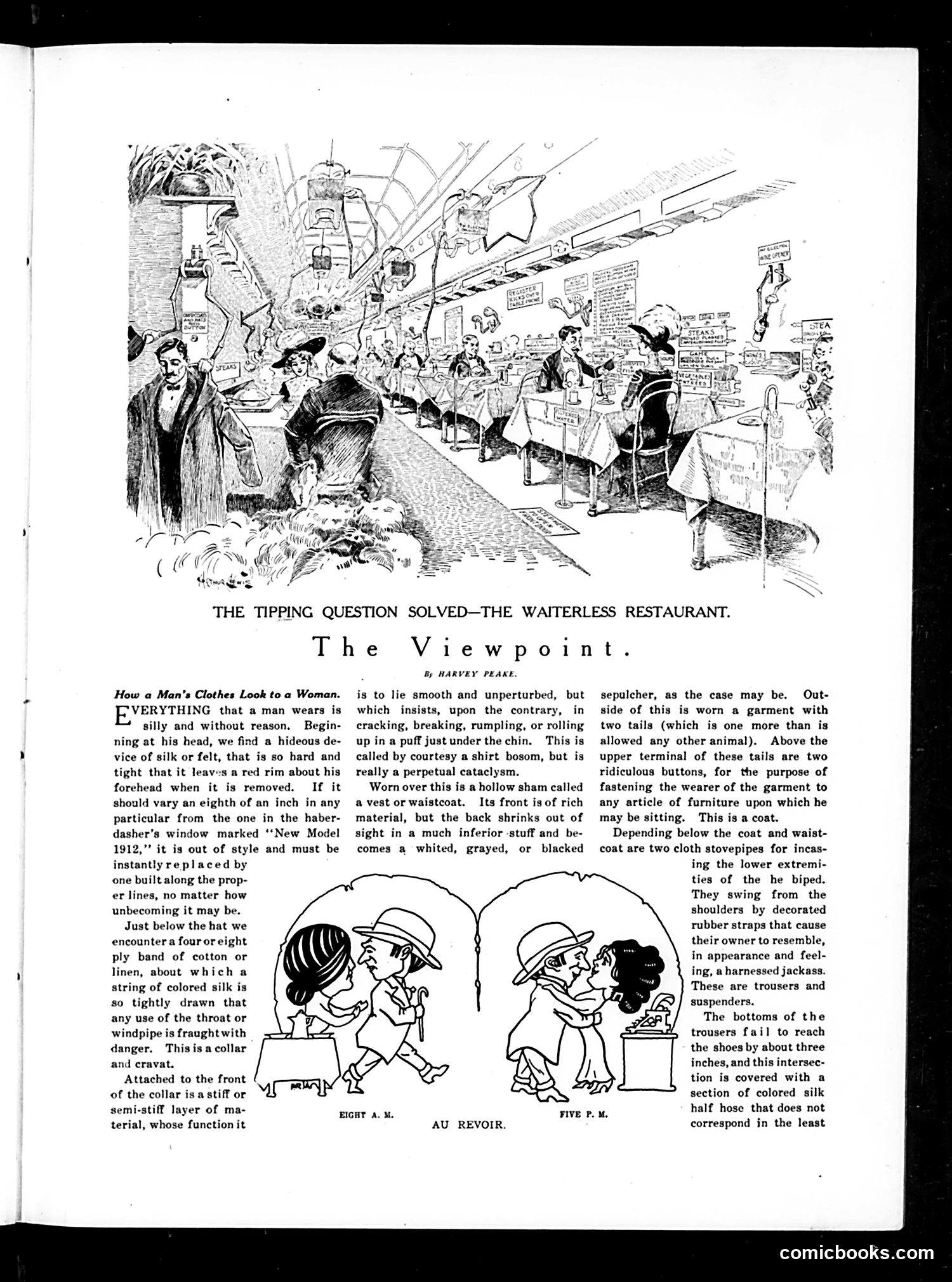
This page contains two distinct pieces of satire from Judge magazine: **Top illustration**: "The Tipping Question Solved—The Waiterless Restaurant" depicts a futuristic automated restaurant where mechanical servers (appearing as robot-like contraptions) deliver food, eliminating the social awkwardness of tipping waiters—a contemporary etiquette dilemma. **Bottom content**: "How a Man's Clothes Look to a Woman" by Harvey Peake is a humorous critique of men's formal fashion. The accompanying caricatures show men at "Eight A.M." (presumably arriving somewhere) and "Five P.M." (departing). The text mockingly describes each element of men's clothing—hats, collars, vests, coats, trousers, suspenders—as absurd, uncomfortable, and illogical conventions that men blindly follow despite their impracticality. The satire targets the rigid, restrictive nature of early 1900s menswear fashion and masculine conformity.
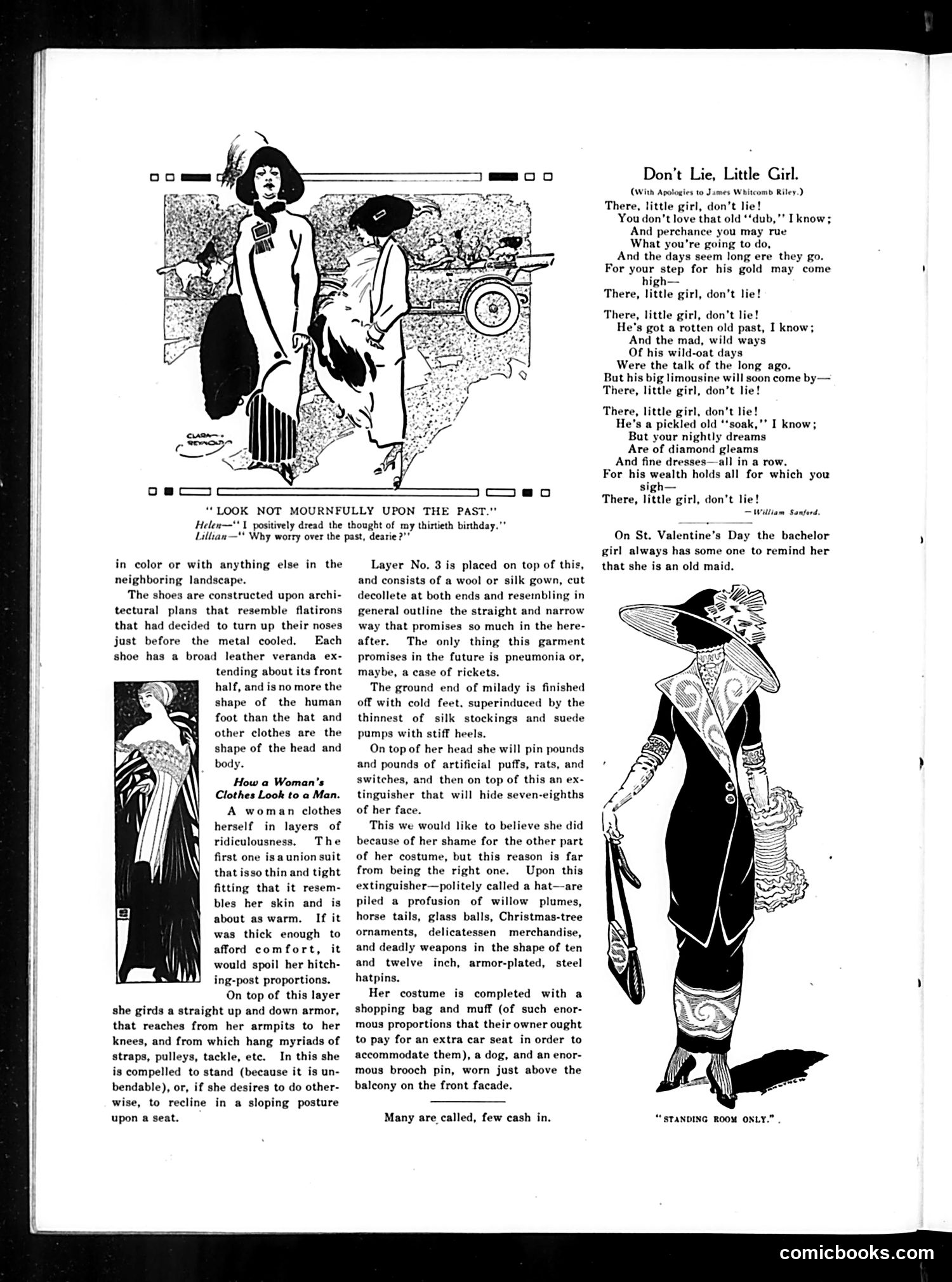
**Top Cartoon:** Two women discuss aging anxiously. Helen dreads her thirtieth birthday; Lillan quips "Why worry over the past, dearie?"—satirizing women's obsession with youth and marriageability in the early 1900s. **Middle Section:** A lengthy satirical essay titled "How a Woman's Clothes Look to a Man" mocks women's restrictive, impractical fashion. The author ridicules corsets, excessive layers, towering hats with deadly hatpins, and absurdly large muffs and accessories—presenting women's fashion as ridiculous, uncomfortable armor that deforms the body while claiming to beautify it. **Right Side Poem:** "Don't Lie, Little Girl" (parody of James Whitcomb Riley) cynically warns a young woman against marrying a wealthy but morally bankrupt man—while acknowledging she'll do it anyway for diamonds and dresses. The satire exposes mercenary marriage motivations. **Bottom Right Caption:** "Standing Room Only" appears to accompany an illustration of a fashionably dressed woman, likely commenting on how excessive clothing/accessories consume public space. **Overall Theme:** Satirizes women's vanity, materialism, and compromised life choices driven by fashion and financial desperation.
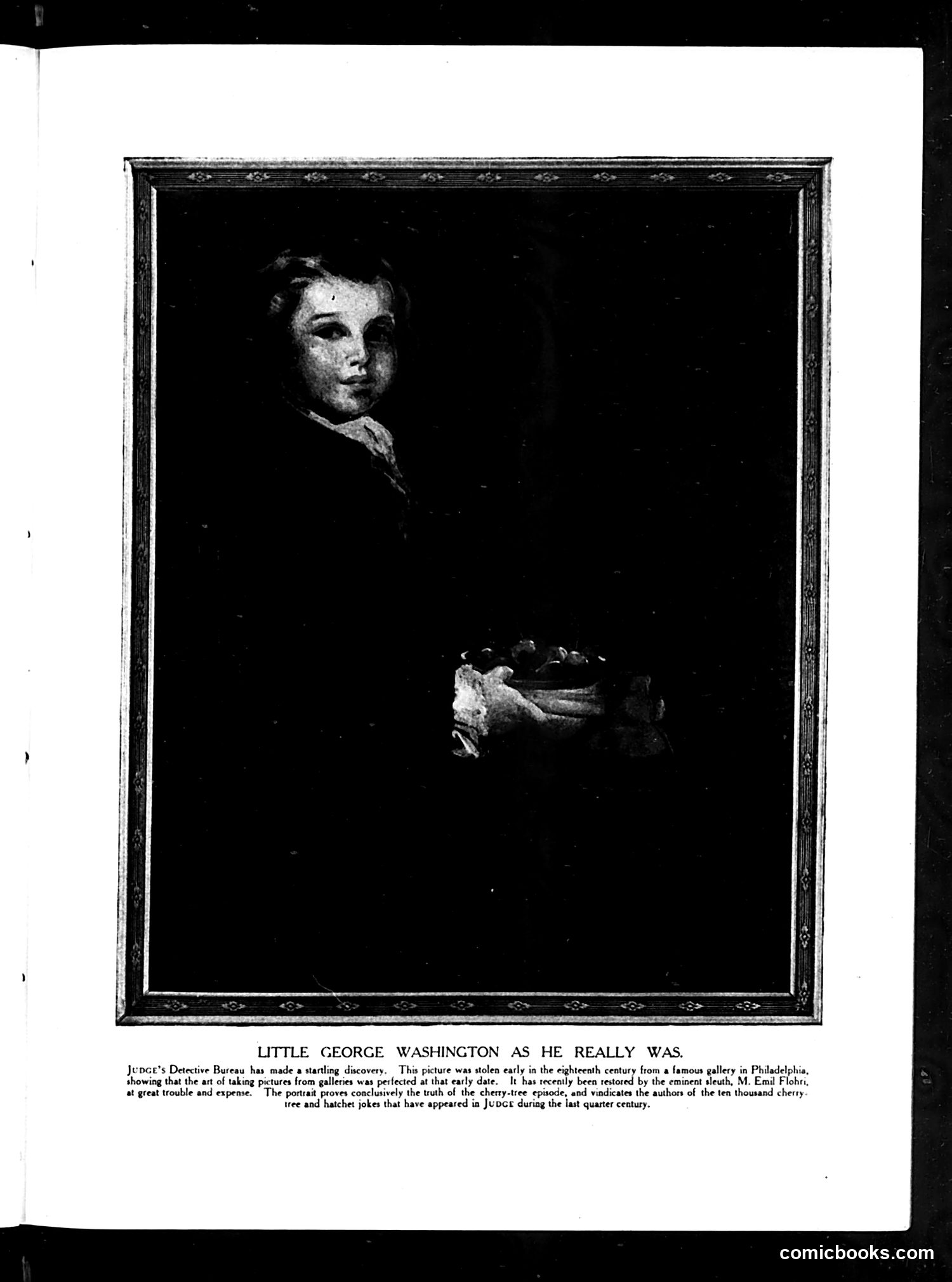
This is satirical commentary on the famous (false) legend of young George Washington confessing to chopping down his father's cherry tree. The text humorously claims Judge's Detective Bureau discovered an "eighteenth-century" portrait "stolen from Philadelphia," recently restored by "M. Emil Floh." The satire works on multiple levels: Judge is mocking its own decade of cherry-tree and hatchet jokes as if validating them through fake historical "discovery." The portrait itself appears quite dark and crude—hardly conclusive evidence. The joke targets both the widespread perpetuation of apocryphal Washington anecdotes and the magazine's own reliance on tired material. By claiming the portrait "proves conclusively the truth of the cherry-tree episode," Judge winks at readers that even dubious "evidence" gets used to support beloved national myths. The entire piece gently ribbed American hagiography and historical embellishment.
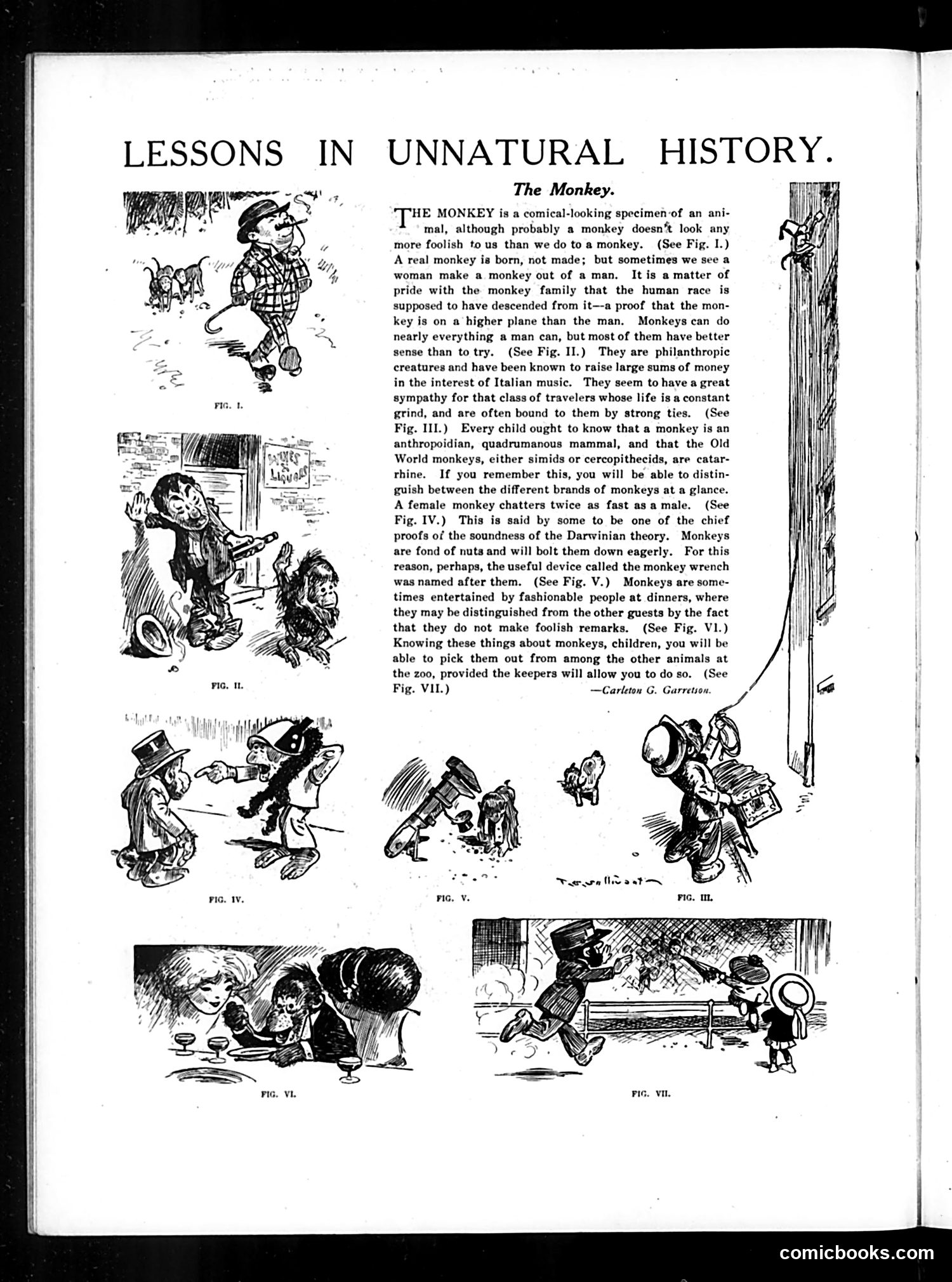
This is a humorous satirical piece using monkeys as a vehicle for social commentary. The text makes several barbed jokes: **The Darwin Reference**: The piece sarcastically notes that monkeys supposedly descend from humans—reversing actual evolutionary theory—to mock both monkey vanity and human foolishness. **Gender Satire**: Fig. IV jokes that female monkeys chatter twice as fast as males, claiming this "proves" Darwin's theory. This is likely a jab at contemporary stereotypes about women's talkativeness. **Class Commentary**: References to monkeys earning money for "Italian music" (street organ grinders) and being "bound" to travelers by "strong ties" mock working-class street performers and their animals. **Dinner Scene** (Fig. VI): The punchline that monkeys at fashionable dinner parties are distinguished "by the fact that they do not make foolish remarks" satirizes high society's pretensions—suggesting wealthy diners are less sensible than actual monkeys. The overall tone mocks human vanity, gender stereotypes, and class pretension through the guise of "natural history."
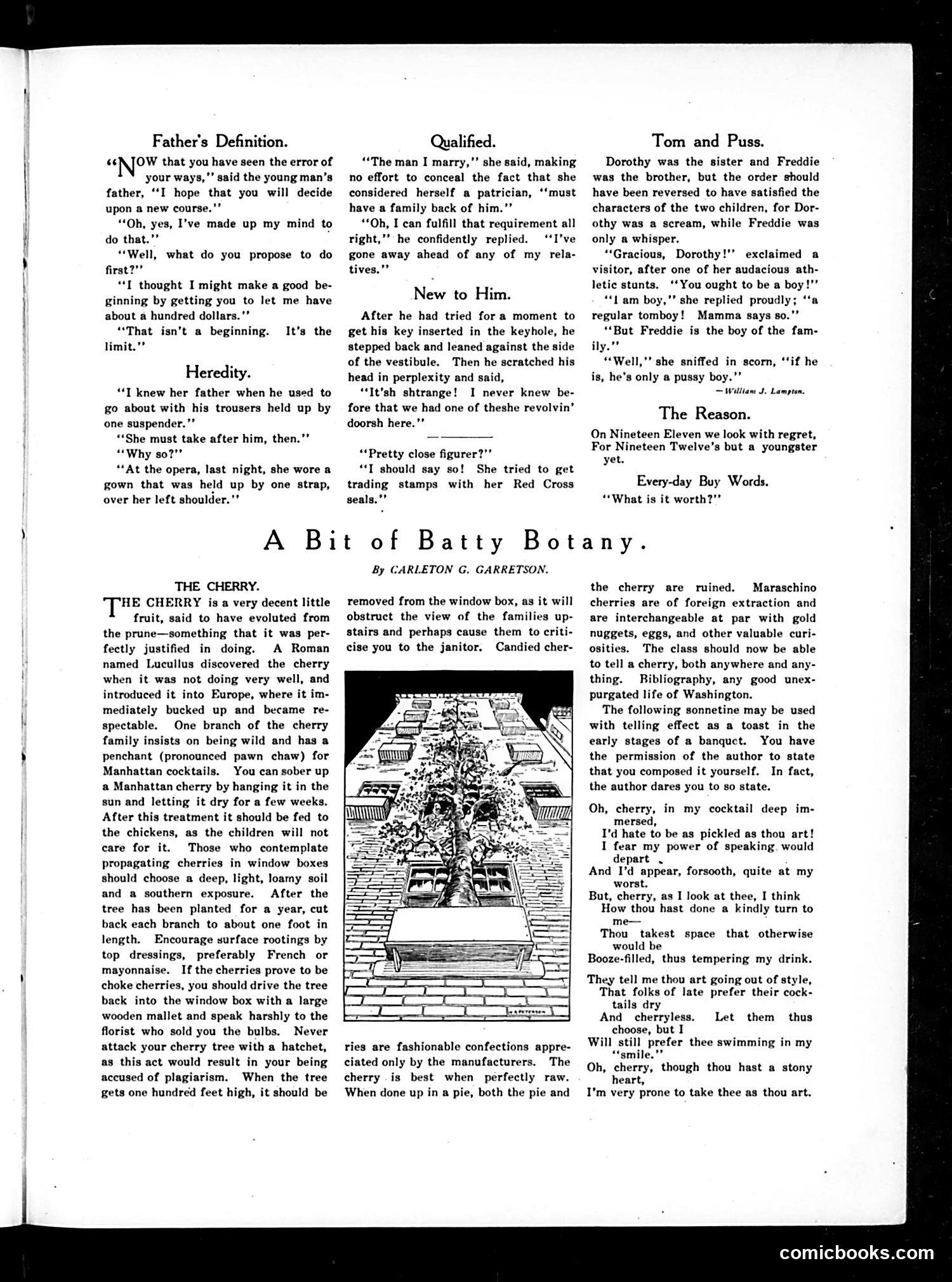
This page from *Judge* contains several short humorous pieces typical of early 20th-century American satirical magazines: **"Father's Definition"** mocks a spendthrift young man who, after promising reform, immediately asks his father for money—treating financial discipline as a joke. **"Heredity"** uses class pretension as humor: a woman wears a gown held up by a single strap, just as her father once wore trousers held up by one suspender—suggesting poor breeding shows through generations. **"Qualified"** satirizes social climbing: a woman demands her husband have "family back of him," and he replies he's "gone away ahead of any of my relatives"—a clever reversal implying he's abandoned his family, not elevated by it. **"New to Him"** depicts a drunk man unfamiliar with revolving doors, a then-modern technology. **"Tom and Puss"** humorously inverts gender roles: tomboy Dorothy is the "real boy" while her brother Freddie is merely a "pussy boy"—reflecting period anxieties about masculinity. **"A Bit of Batty Botany"** is absurdist nonsense about cherry cultivation, deliberately ridiculous advice presented deadpan.
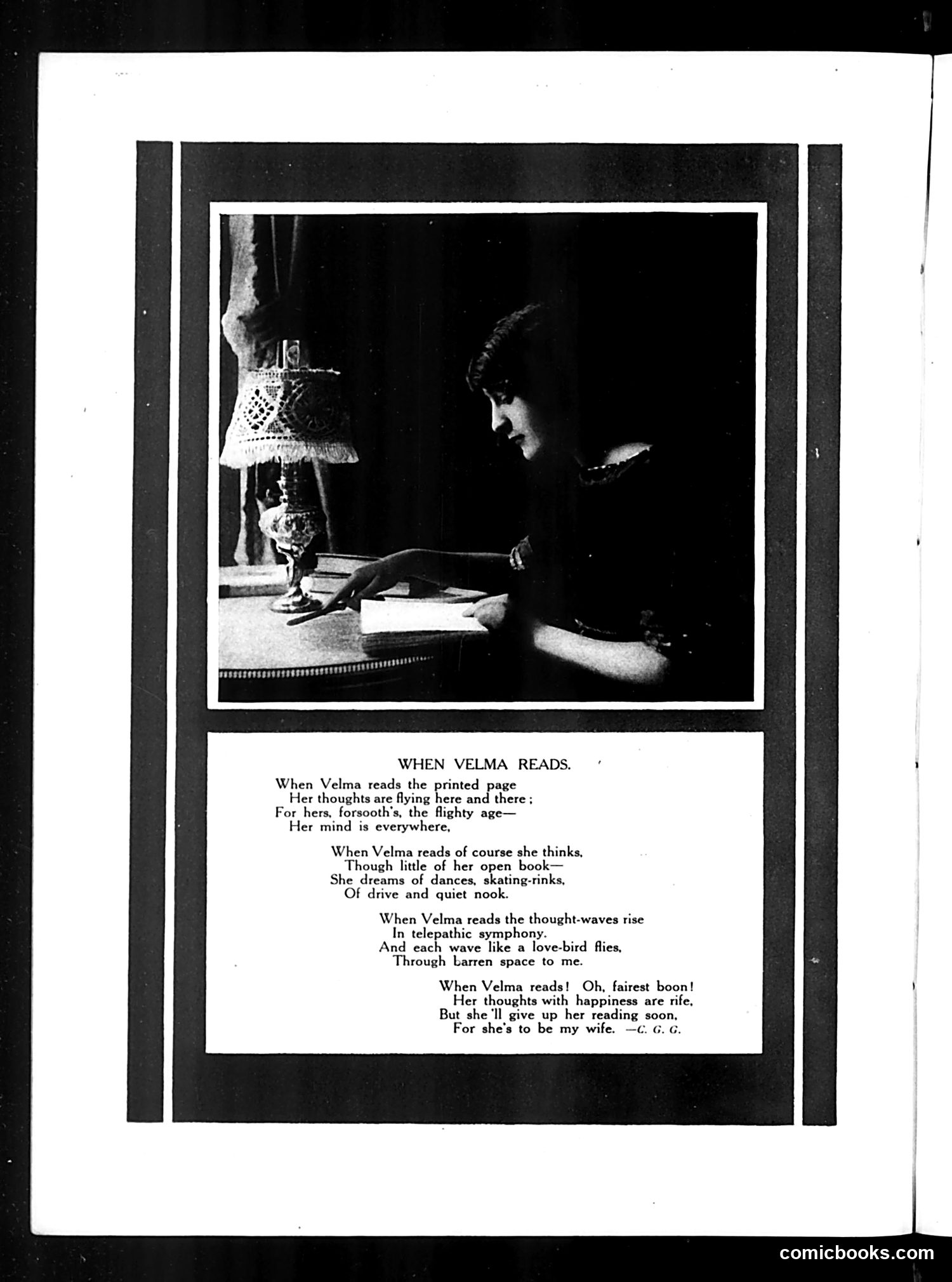
This is a romantic poem accompanying a photograph of a young woman reading. The piece satirizes modern courtship and the "flighty" nature attributed to young women of the era (likely 1910s-1920s based on style). The satire operates on multiple levels: the poem's narrator romanticizes his beloved Velma's distracted mind while she reads, claiming her thoughts "fly here and there" to dances and romantic settings. The joke is the contradiction—he celebrates her daydreaming as charming, yet the final lines reveal his true expectation: that marriage will end her independence and reading altogether ("she'll give up her reading soon, / For she's to be my wife"). The cartoon mocks both the sentimental male suitor and period attitudes about women's education and autonomy, suggesting that courtship rhetoric about women's intellectual and romantic freedom was merely temporary—marriage meant surrendering such pursuits.
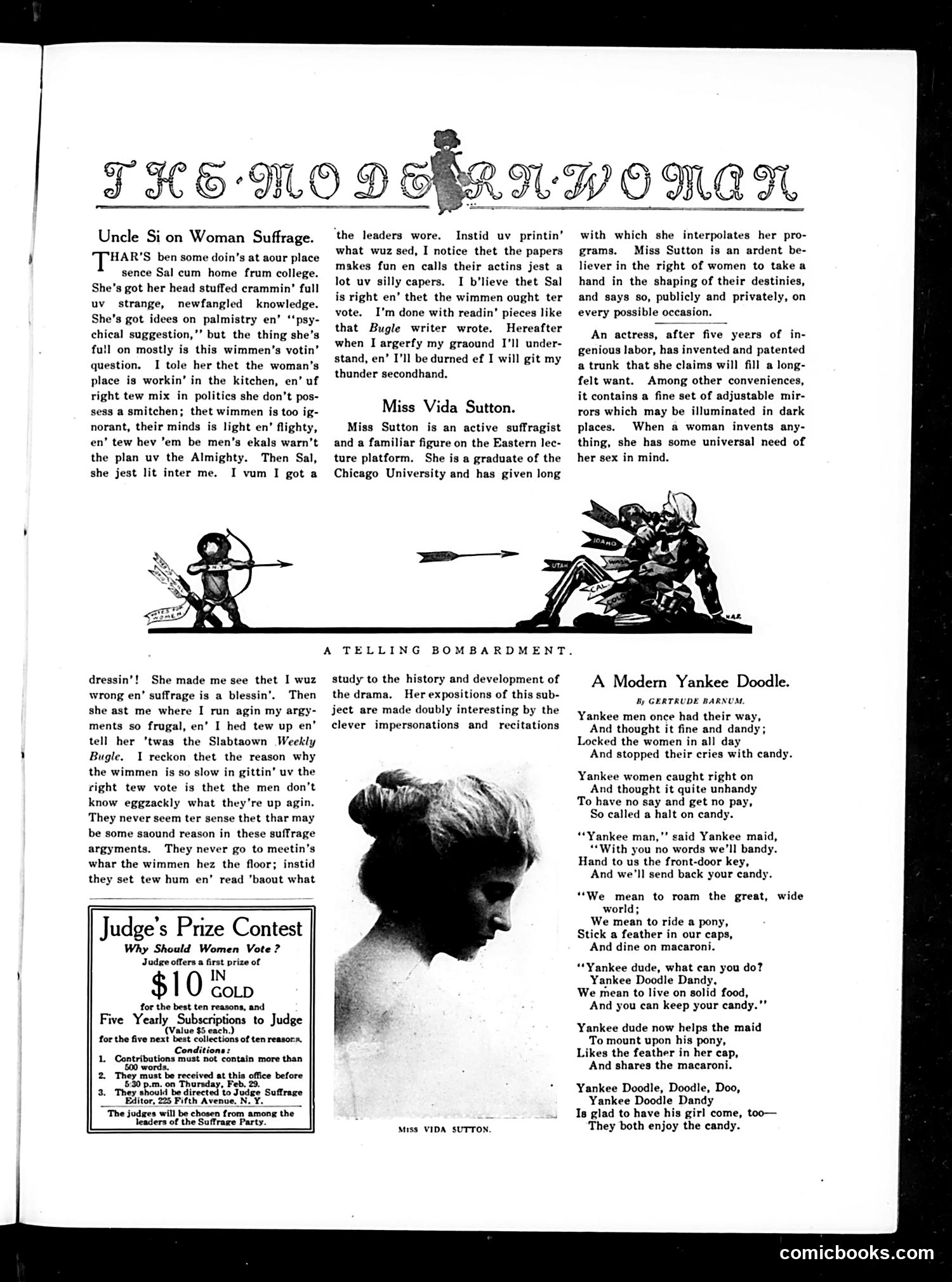
This page presents pro-suffrage arguments disguised as satire. "Uncle Si," a rural character speaking in dialect, initially opposes women's voting as foolish and contrary to divine plan. However, his daughter Sal convinces him otherwise by demonstrating that men ignore suffrage arguments because they don't attend women's speeches—they stay home reading dismissive newspaper coverage instead of engaging seriously. The page features **Miss Vida Sutton**, identified as an actual suffragist lecturer and University of Chicago graduate, legitimizing the pro-vote position. A sidebar **Judge's Prize Contest** solicits essays on "Why Should Women Vote?" with judges chosen from "leaders of the Suffrage Party." "A Modern Yankee Doodle" poem argues women deserve equality, autonomy, and economic independence—using patriotic American imagery to reframe suffrage as consistent with national values. The satire's target is *male dismissiveness*, not female suffrage. Judge magazine appears to be advocating for women's voting rights.
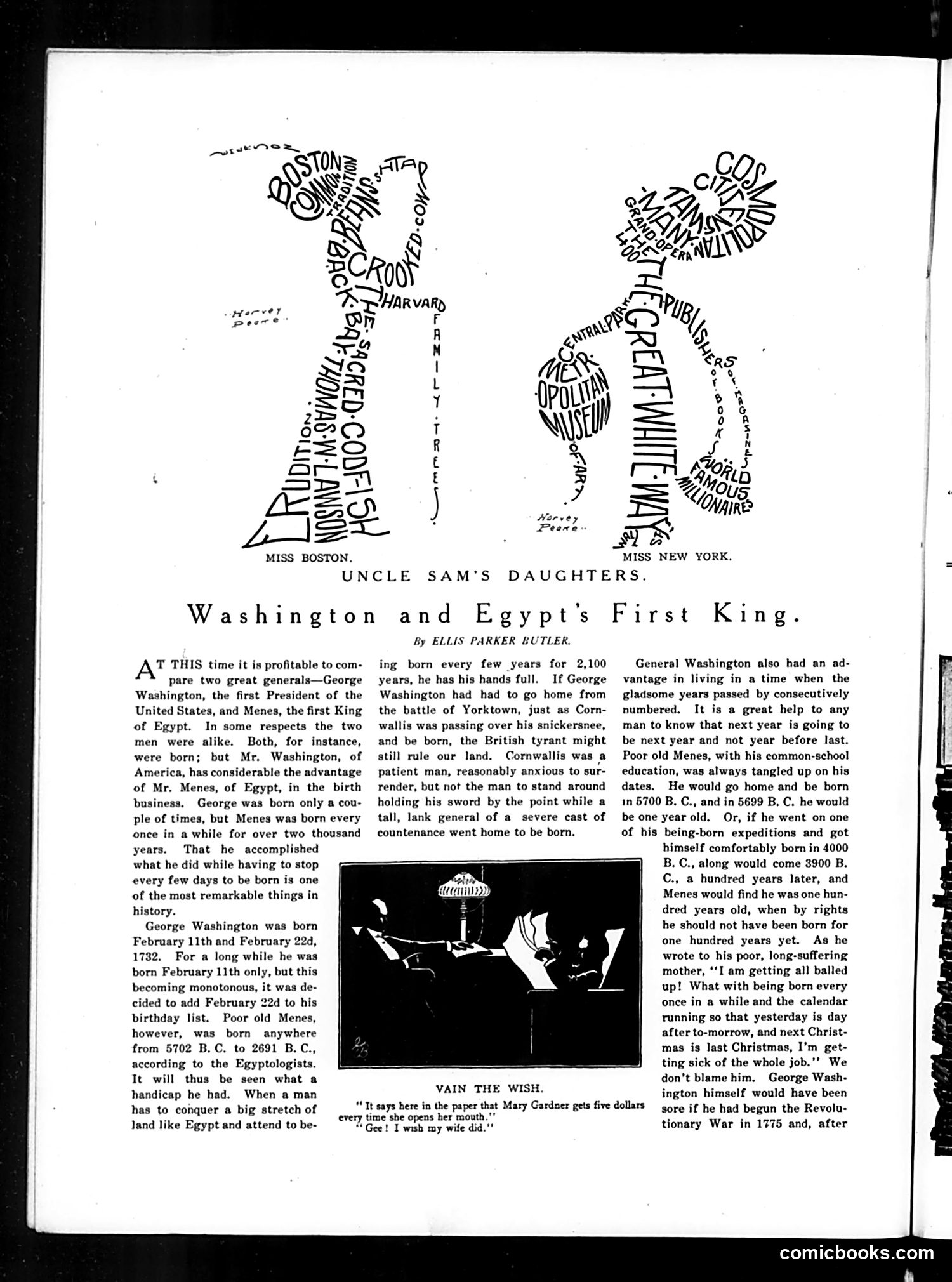
This page contains two satirical pieces from *Judge* magazine: **"Washington and Egypt's First King"** (main article by Ellis Parker Butler): A humorous comparison between George Washington and Menes of Egypt. The joke exploits historical uncertainty about Menes's birth dates (ranging from 5702-2691 B.C. according to Egyptologists). Butler satirizes this by claiming Menes was "born" repeatedly over 2,100 years, creating absurd scenarios where he'd age backward or forward depending on which date scholars used. The implied target appears to be Egyptologists' conflicting chronologies and academic uncertainty—suggesting their inability to establish reliable dates made Menes's life logistically impossible. Washington, by contrast, had his birth dates standardized (February 11th and 22nd, 1782), making his accomplishments more feasible. **"Uncle Sam's Daughters"** (top cartoons): Two word-cloud silhouettes labeled "Miss Boston" and "Miss New York" composed of American city/institution names, apparently representing regional or civic characteristics. The specific satirical point is unclear without fuller context. **"Vain the Wish"** (small joke): A married couple joke about a woman paid for speaking—the husband wishes his wife had similar economic value.
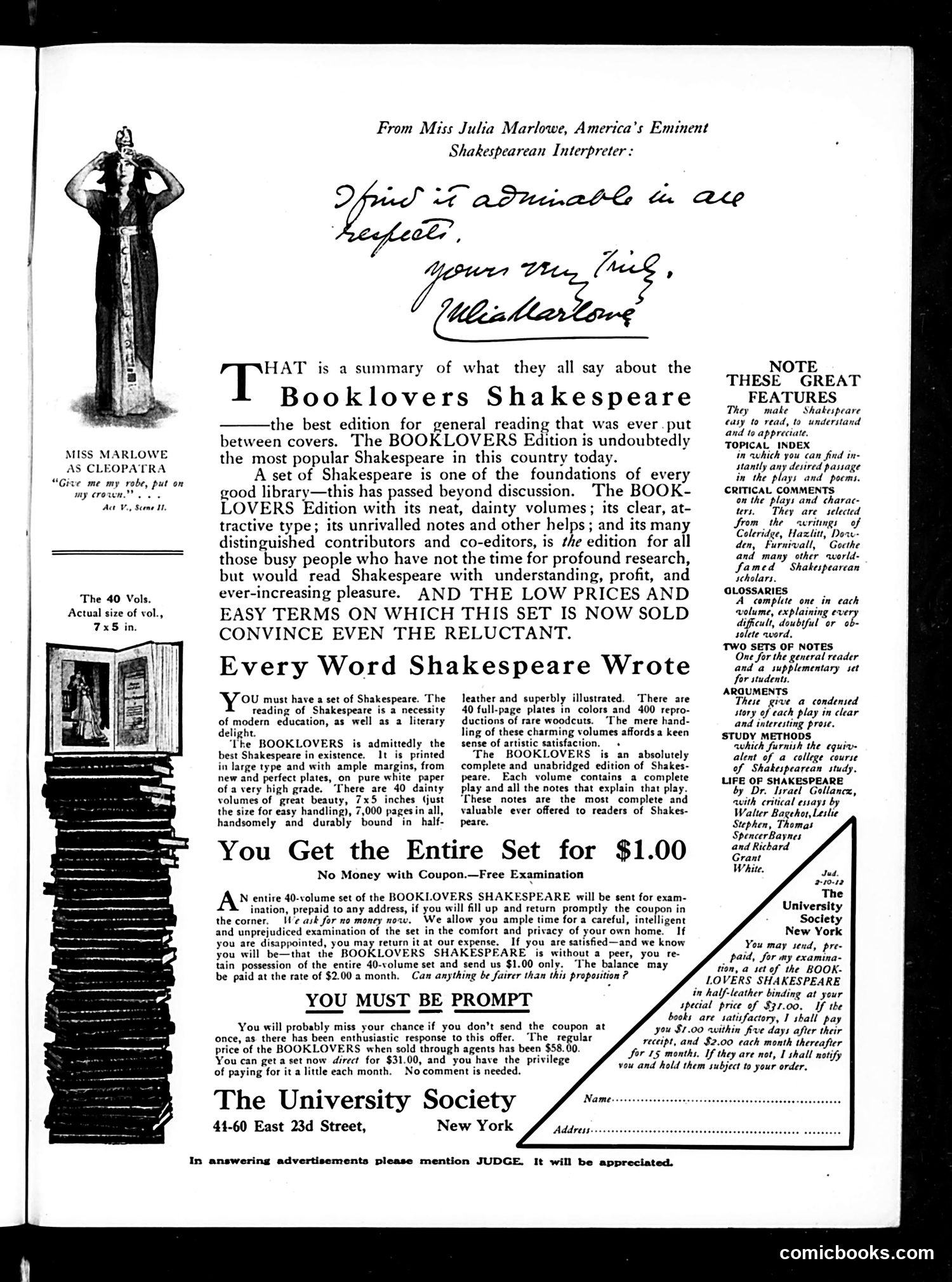
This page is primarily **advertising**, not satire or political commentary. It promotes the "Booklovers Shakespeare" edition—a 40-volume set being sold for $1.00 (with installment payments). The only visual element is a classical illustration of **Miss Julia Marlowe as Cleopatra**, a famous Shakespearean actress of the era whose endorsement ("Africa is admirable in all respects") lends prestige to the product. This was a common advertising tactic: celebrity endorsements to boost sales. The satirical magazine *Judge* was running this advertisement, which was typical for such publications—they needed revenue from advertisers. The pitch emphasizes affordability and accessibility, marketing Shakespeare to middle-class "busy people" who couldn't afford expensive editions or time for "profound research." There is no political satire here; it's a straightforward (if enthusiastic) commercial pitch for an educational product, using the magazine's credibility as its platform.
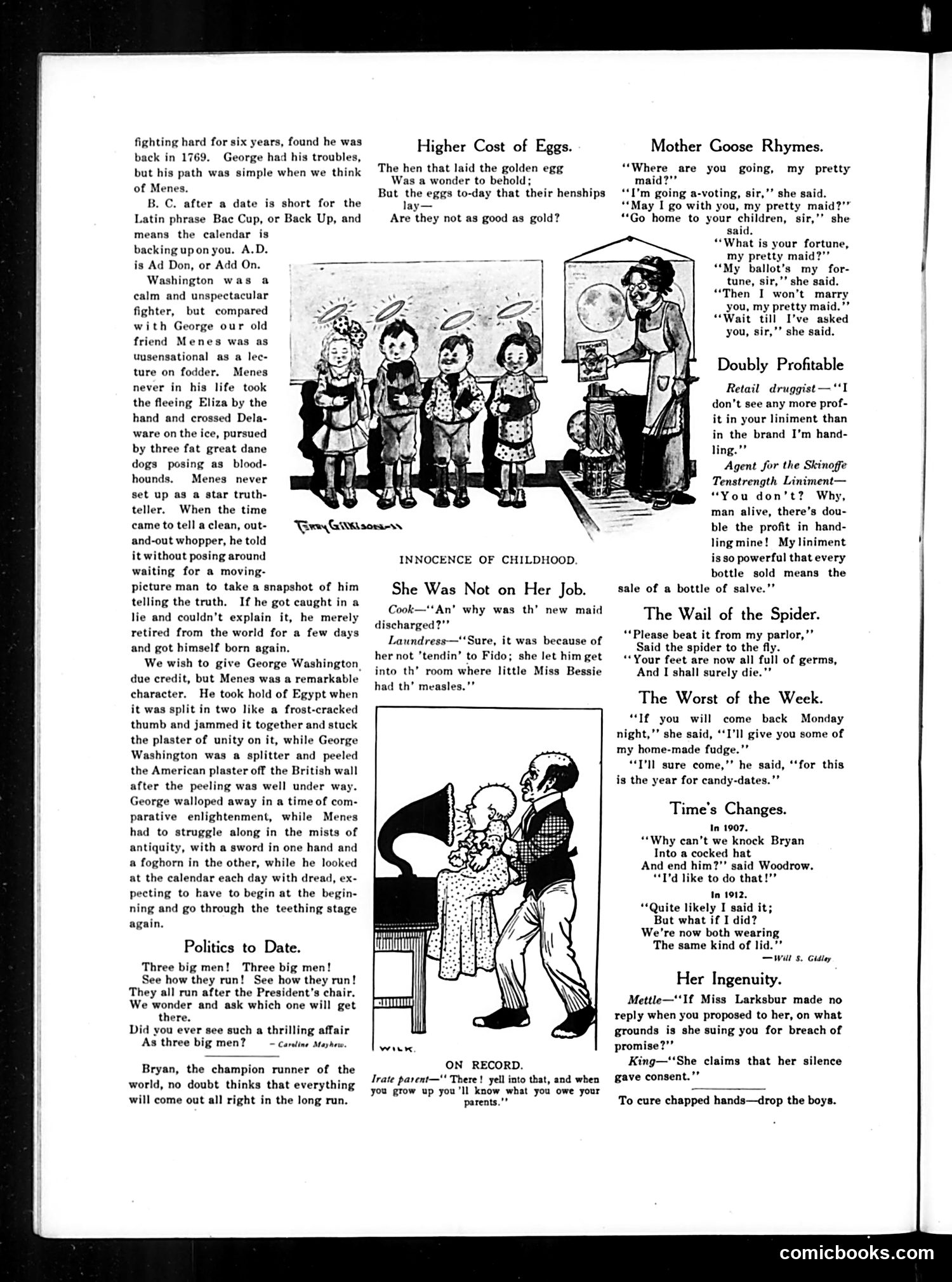
This page from Judge magazine contains multiple satirical pieces reflecting early 1900s American concerns: **"Politics to Date"** references the 1900 presidential race, depicting Bryan (William Jennings Bryan, three-time Democratic candidate) and two unnamed rivals competing for the presidency. The satire mocks their endless campaigning. **"Mother Goose Rhymes"** cleverly adapts traditional nursery rhymes to address women's suffrage—a major contemporary debate. A "pretty maid" going "a-voting" rejects a suitor's advances, asserting her political independence and right to vote before marriage. **"Higher Cost of Eggs"** comments on inflation and economic hardship, contrasting the mythical golden egg with disappointing real eggs. The remaining pieces are lighter humor about domestic life, children, and advertising copy for patent medicines—typical Judge content mixing social commentary with entertainment. The overall tone reflects Judge's role as a voice for progressive social criticism wrapped in humor.
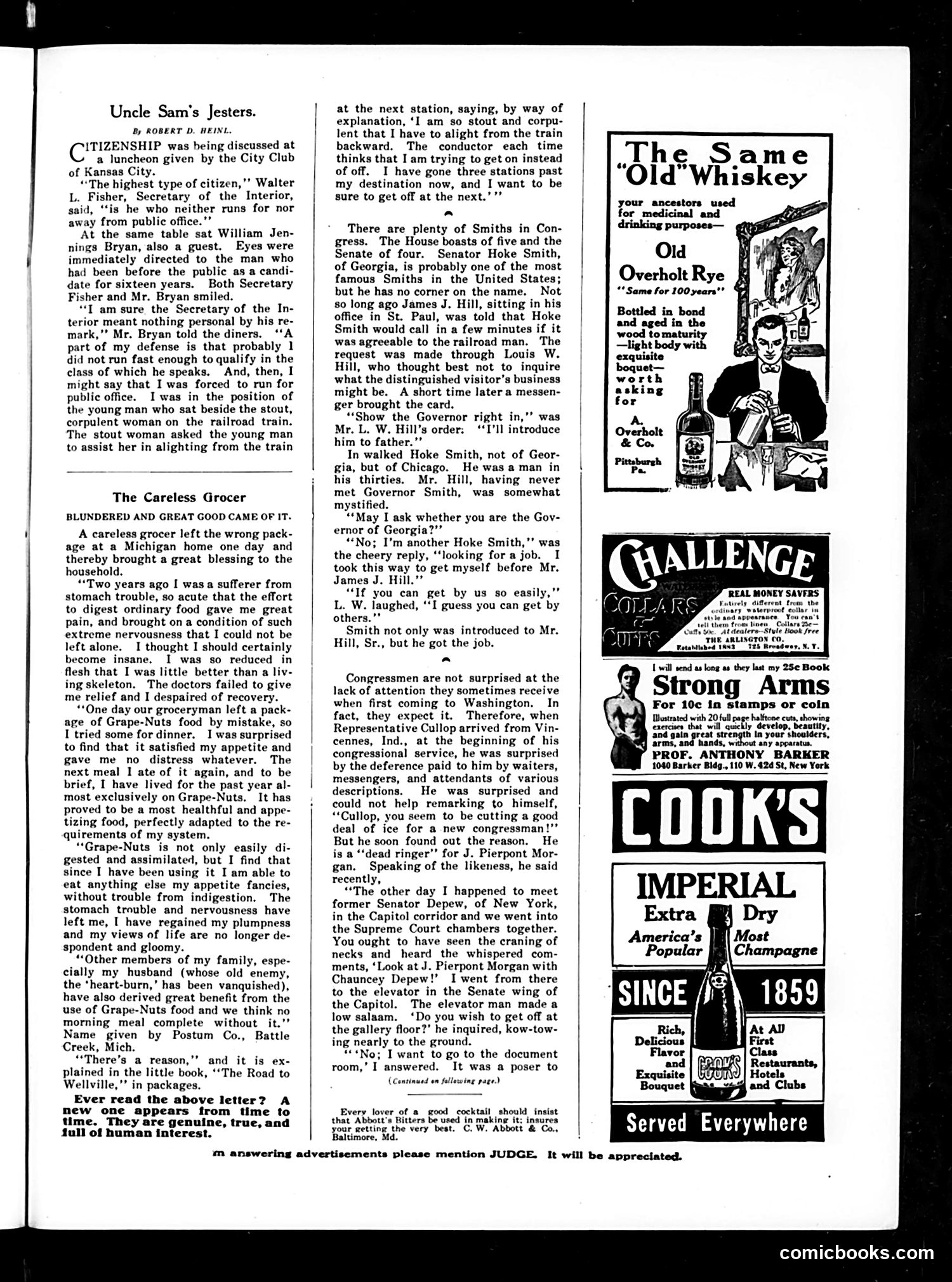
This page contains three distinct pieces, mostly text-based rather than visual cartoons: 1. **"Uncle Sam's Jesters"** (main story): A humorous anecdote about Interior Secretary Walter L. Fisher remarking that good citizens don't avoid public office. William Jennings Bryan—who had run for president multiple times (likely referring to his three unsuccessful campaigns, 1896-1908)—responds with self-deprecating wit, joking that he "did not run fast enough" to qualify as Fisher's ideal citizen. The satire mocks Bryan's perpetual candidacies. 2. **"The Careless Grocer"**: A Grape-Nuts cereal testimonial advertisement masquerading as journalism—common in early-20th-century magazines. Not satirical content. 3. **Side advertisements**: For whiskey, "Strong Arms" (a physical-development product), and champagne—typical period advertising. The page's satire targets Bryan's repeated political ambitions and the pretensions of public figures, using gentle humor rather than sharp caricature.
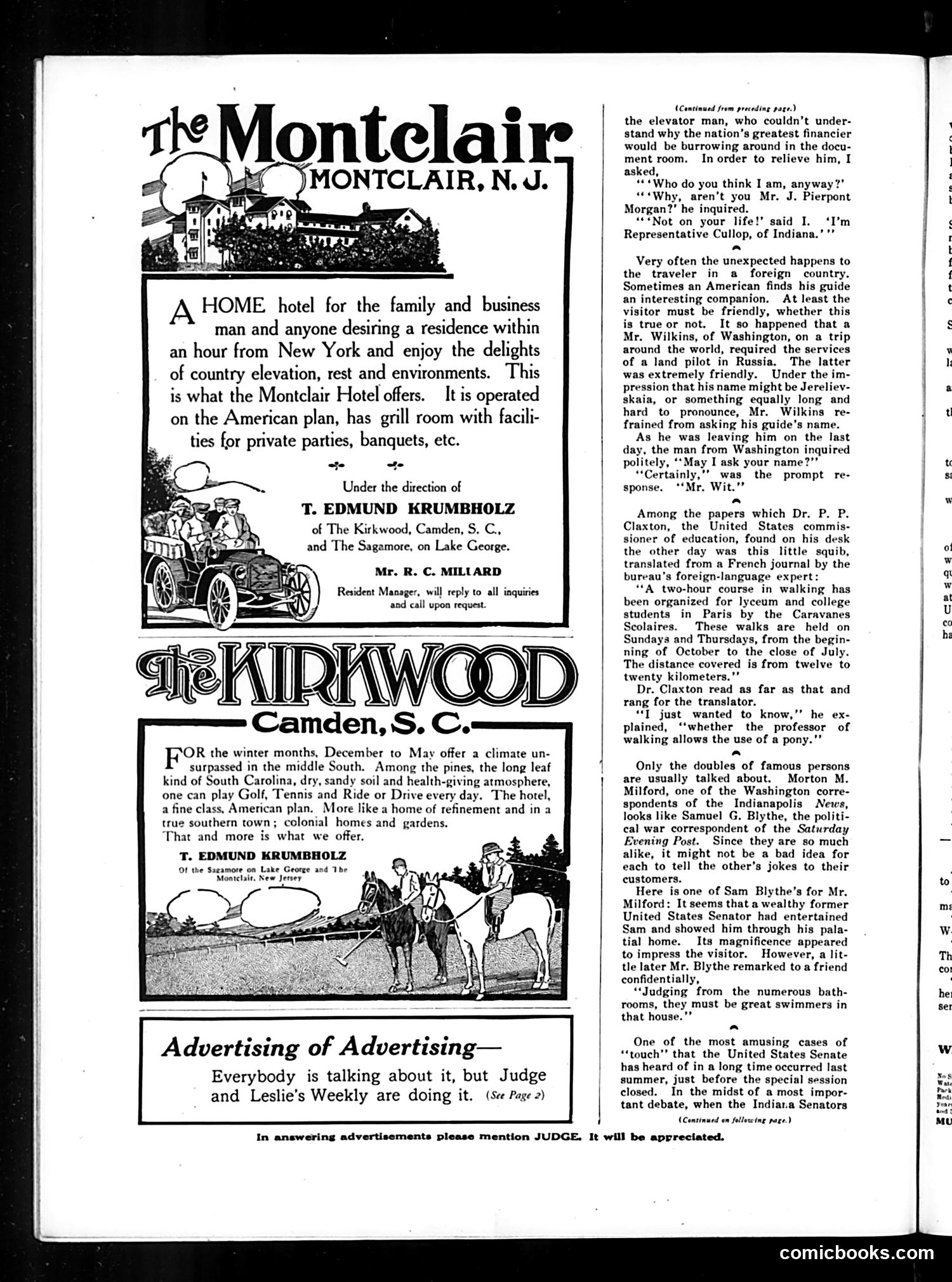
This page is primarily **hotel advertisements** for the Montelair (New Jersey) and Kirkwood (Camden, South Carolina) resorts, interspersed with humorous anecdotes. The satirical content consists of brief jokes: 1. **The elevator man/J.P. Morgan joke**: A congressman is mistaken for the famous financier J. Pierpont Morgan (America's most prominent banker), whom the elevator operator assumes would never work in a document room—poking fun at the congressman's obscurity versus Morgan's prominence. 2. **The Russian guide anecdote**: A traveler assumes his Russian guide has an unpronounceable name (Jerelievskaia) but discovers it's simply "Wit"—gentle satire about American assumptions regarding foreign names. 3. **The walking course joke**: Dr. Claxton finds a French article about organized walking lessons and satirizes French bureaucracy by asking if students need "a pony"—mocking the formalization of basic activities. The page illustrates *Judge*'s formula: resort advertising paired with light social commentary targeting American pretensions, confusion about class status, and foreign customs.
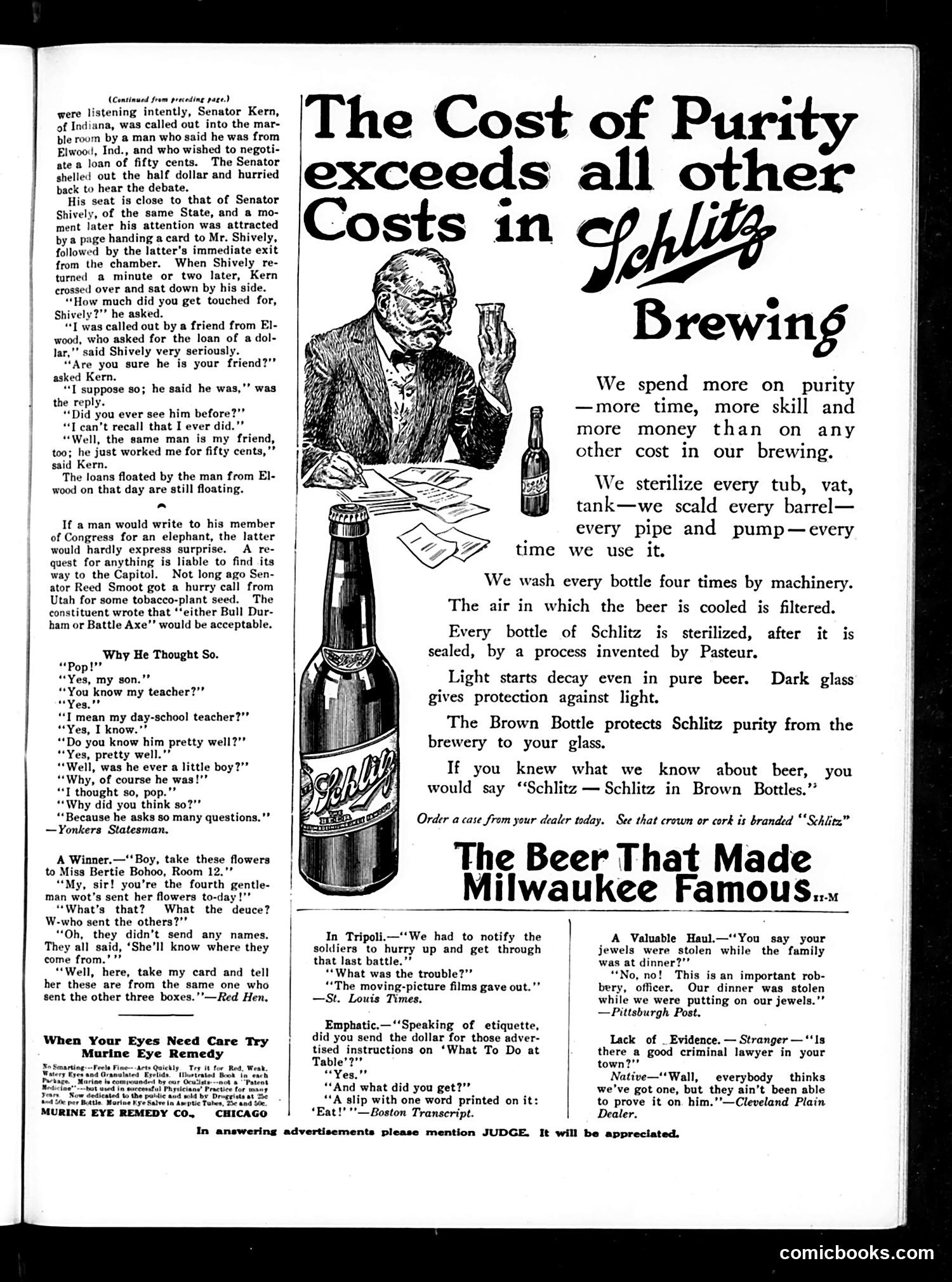
This page contains satirical anecdotes typical of *Judge* magazine's humor, plus a Schlitz beer advertisement. The main cartoon/anecdote concerns **two U.S. Senators (Kern and Shively of Indiana)** who are repeatedly approached during a Senate debate by a con artist from Elwood, Indiana, requesting small loans (50 cents, then a dollar). Each senator believes the man is a personal acquaintance, but neither recognizes him—suggesting either poor memory or gullibility among lawmakers. The satire mocks senators as easy marks for panhandlers. Other brief jokes satirize: **congressmen's willingness to handle absurd constituent requests**; a **schoolteacher asking many questions** (implying teachers were once inquisitive children); and various social mishaps. The **Schlitz advertisement** emphasizes purity and sterilization processes as selling points—relevant given early-1900s food-safety concerns before FDA regulation. The *Judge* content reflects Progressive Era skepticism toward government officials and commercial trust-building during an era of food adulteration scandals.
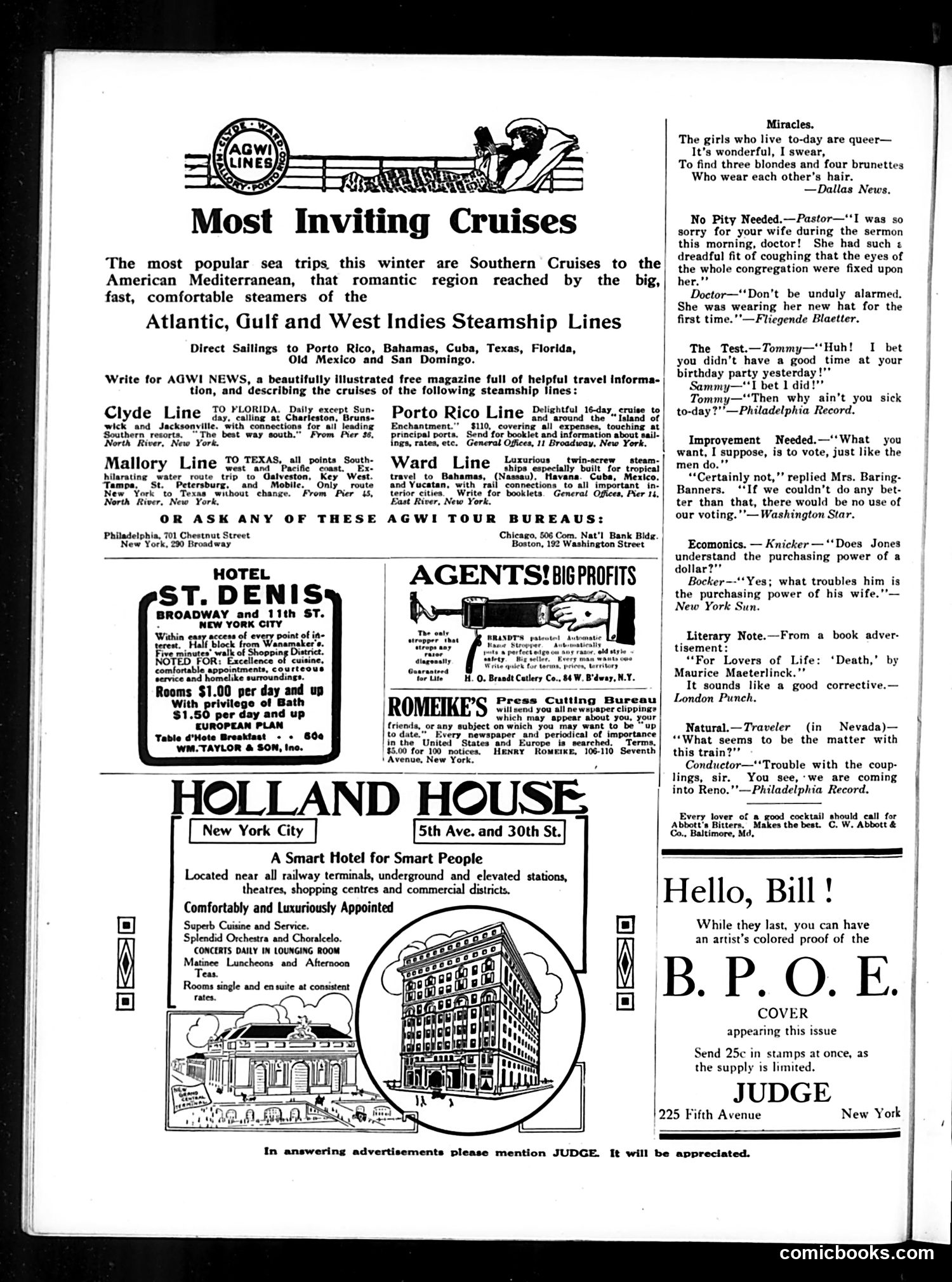
This page is primarily **advertising and humor content** rather than political cartoons. The main section promotes winter cruises to the Caribbean and American South via steamship lines (Clyde Line, Porto Rico Line, Mallory Line, Ward Line), typical luxury travel marketed to wealthy readers. The right column contains **brief humorous anecdotes** on everyday topics: women wearing false hair ("Miracles"), a pastor's misunderstanding about a wife's cough (she was showing off a new hat), children's party banter, women's suffrage satire, and economics jokes. These are gentle social humor rather than political satire—poking fun at contemporary manners and gender relations in early 20th-century America. The advertisements include hotels (St. Denis, Holland House) and services (H.O. Brandt Cutlery, press clipping bureau). This is a typical Judge magazine page blending travel promotion with light domestic humor aimed at its affluent audience.
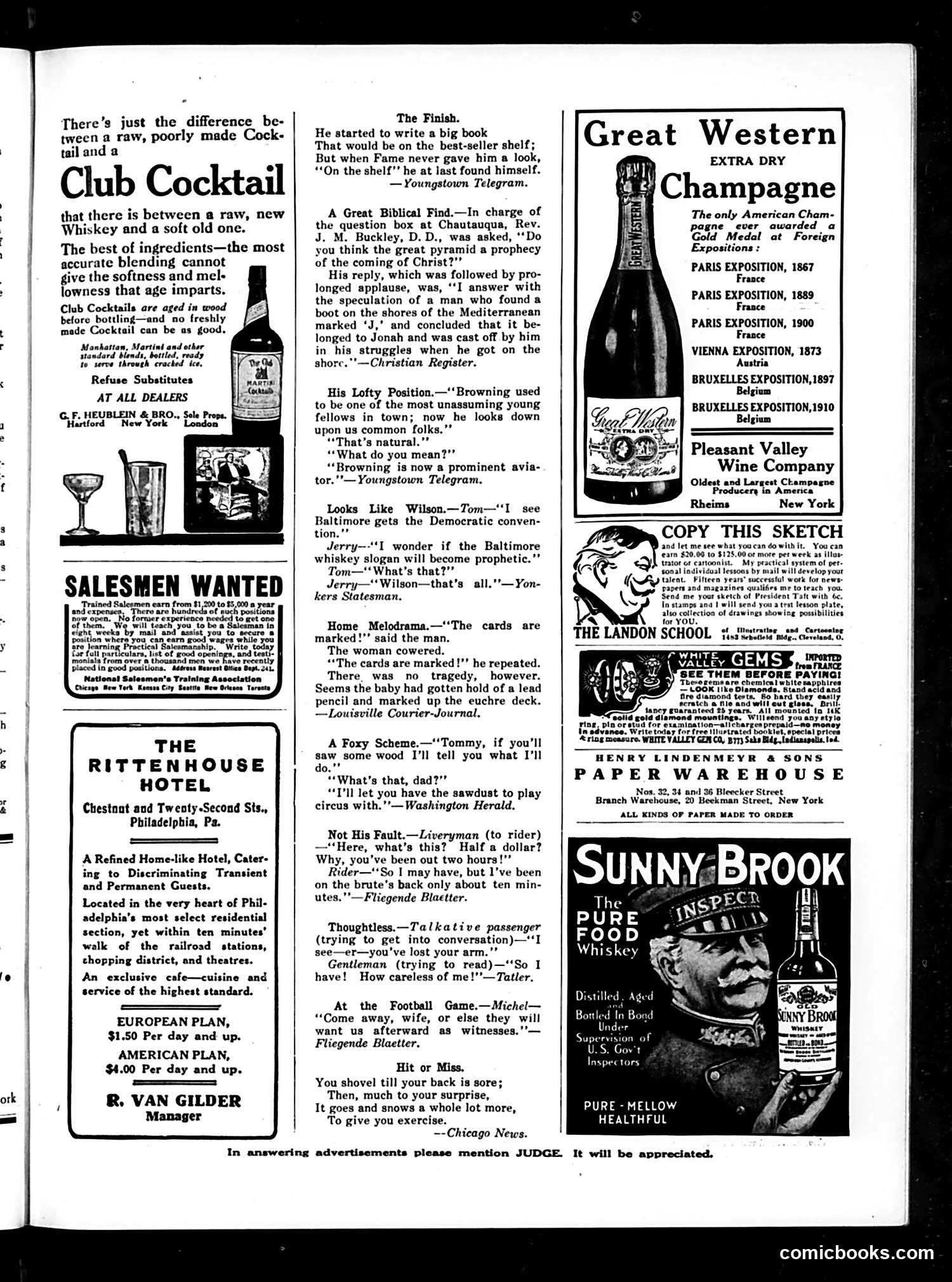
This page is primarily **advertisements and humorous anecdotes** rather than political cartoons. The content includes: **Advertisements** for Club Cocktail whiskey, a hotel, sales training, and various products (champagne, whiskey brands). **Humorous short jokes** on topics including: - A failed author whose book ends up literally "on the shelf" - A minister's absurd logic about biblical pyramids - Social climbing ("Browning" becoming an aviator) - A reference to "Wilson" and Baltimore whiskey, likely alluding to **Woodrow Wilson and the 1912 Democratic Convention** held in Baltimore - Domestic humor about marked playing cards **The Wilson joke** is the closest to political content—it appears to be satirizing Wilson's rise to prominence, playing on the Baltimore whiskey slogan "Wilson—that's all" to suggest Wilson represents the Democratic party's entire platform or appeal. The page reflects *Judge*'s typical mix of commercial content and light social satire rather than hard-hitting political commentary.
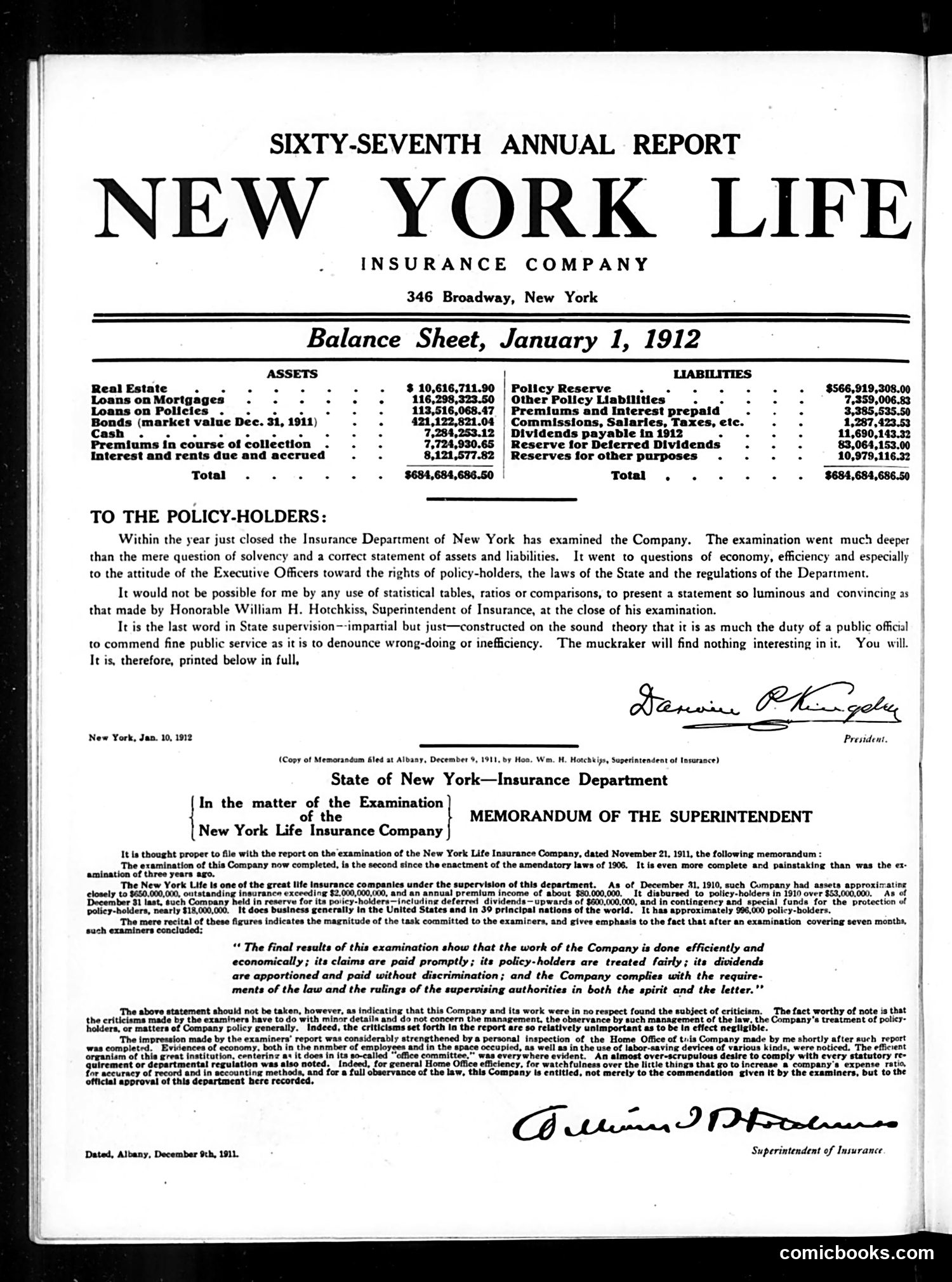
This is a **title page and official financial document** from New York Life Insurance Company's 67th Annual Report (January 1, 1912). It contains: - A balance sheet listing assets ($684+ million) and liabilities - A letter to policyholders from the company president - An official memorandum from New York State's Insurance Superintendent William H. Hotchkiss, praising the company's examination The superintendent's language is notably **self-congratulatory**, emphasizing impartial but fair state supervision. The president's letter dismisses "muckrakers" (Progressive Era investigative journalists), suggesting the company welcomes this clean examination report. **This is a corporate public-relations document**, not satire. Judge magazine likely published this as factual business news or possibly as ironic commentary on corporate self-promotion—but the page itself contains no cartoons or satirical imagery.