
Judge, 1912-02-10 · page 4 of 24
Judge — February 10, 1912 — page 4: what you’re looking at
What you’re looking at
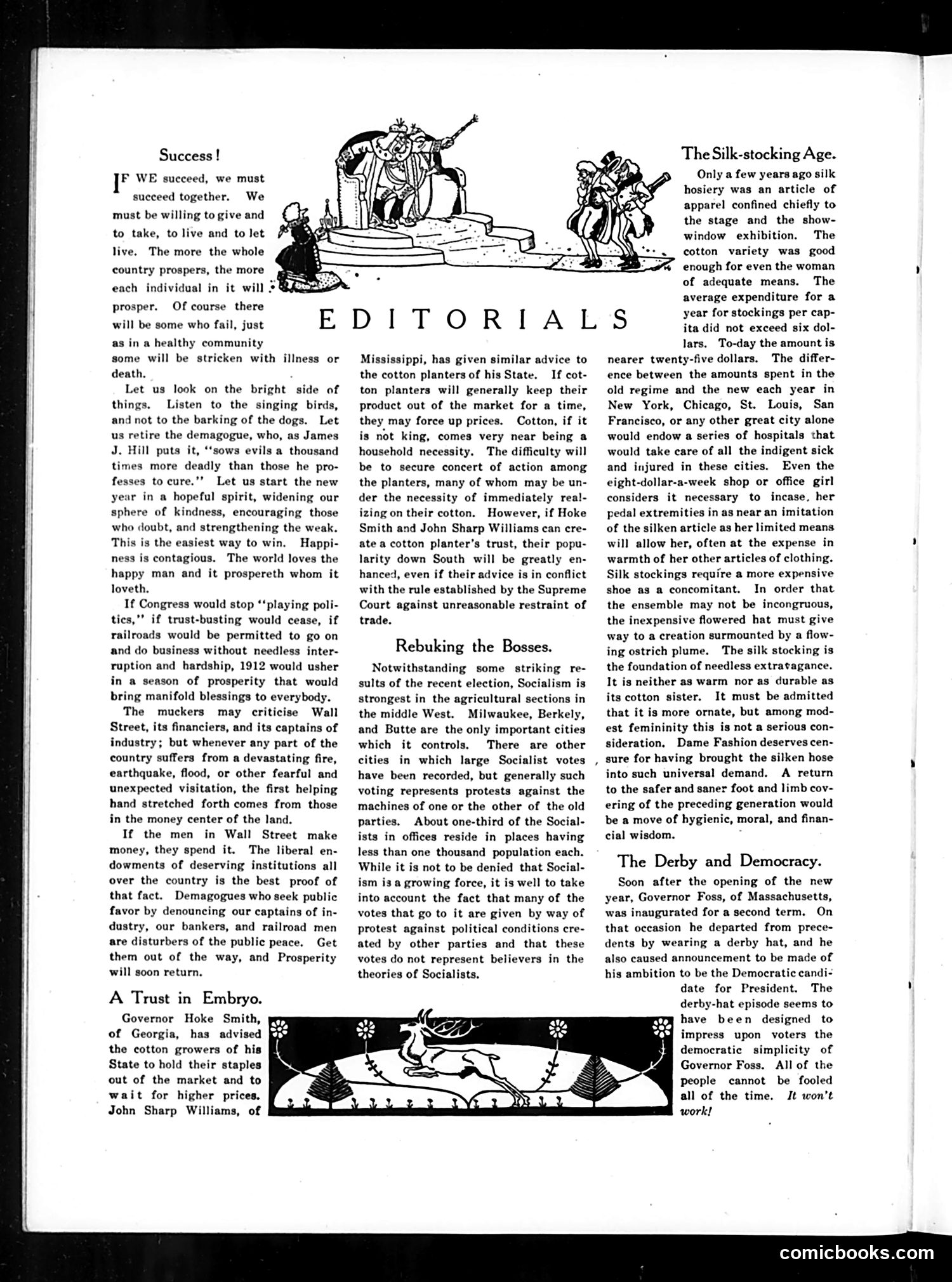
This editorial page contains three satirical pieces with accompanying illustrations: 1. **"Success!"** - Advocates cooperation and community spirit during prosperity, warning against selfishness. 2. **"A Trust in Embryo"** - Critiques Governor Hoke Smith of Georgia for advising cotton growers to hold staples off the market to force higher prices, comparing this to monopolistic trust behavior that the era's reformers opposed. 3. **"The Silk-stocking Age"** - Mocks wealthy women's expensive silk stockings as frivolous luxury while laborers struggle. The illustration depicts an elegant woman, suggesting class commentary on conspicuous consumption. 4. **"The Derby and Democracy"** - References Governor Foss of Massachusetts and derby hat symbolism in democratic politics, though the specific point remains unclear from the text provided. The page reflects Progressive Era concerns: monopolies, class inequality, and political accountability.
📄 Transcribed text from this page (OCR, searchable)
Machine-transcribed from the original scan — historical spelling and the odd misread are preserved.
Success ! F WE succeed, we must succeed together. We must be willing to give and to take, to live and to let live. The more the whole country prospers, the more each individual in it will prosper. Of course there will be some who fail, just as in a healthy community some will be stricken with illness or death, Let us look on the bright side of things. Listen to the singing birds, and not to the barking of the dogs. Let us retire the demagogue, who, as James J. Hill puts it, ‘‘sows evils a thousand times more deadly than those he pro- fesses tocure.’’ Let us start the new year in a hopeful spirit, widening our sphere of kindness, encouraging those who doubt, and strengthening the weak. This is the easiest way to win. Happi- ness is contagious. The world loves the happy man and it prospereth whom it loveth. If Congress would stop ‘‘playing poli- tics,"’ if trust-busting would cease, if railroads would be permitted to go on and do business without needless inter- ruption and hardship, 1912 would usher in a season of prosperity that would bring manifold blessings to everybody. The muckers may criticise Wall Street, its financiers, and its captains of industry; but whenever any part of the country suffers from a devastating fire, earthquake, flood, or other fearful and unexpected visitation, the first helping hand stretched forth comes from those in the money center of the land. If the men in Wall Street make money, they spend it. The liberal en- dowments of deserving institutions all over the country is the best proof of that fact. Demagogues who seek public favor by denouncing our captains of in- dustry, our bankers, and railroad men are disturbers of the public peace. Get them out of the way, and Prosperity will soon return. A Trust in Embryo. Governor Hoke Smith, of Georgia, has advised the cotton growers of his State to hold their staples out of the market and to wait for higher prices. John Sharp Williams, of EDITORIALS Mississippi, has given similar advice to the cotton planters of his State. If cot- ton planters will generally keep their product out of the market for a time, they may force up prices. Cotton, if it is not king, comes very near being a household necessity. The difficulty will be to secure concert of action among the planters, many of whom may be un- der the necessity of immediately real- izing on their cotton. However, if Hoke Smith and John Sharp Williams can cre- ate a cotton planter’s trust, their popu- larity down South will be greatly en- hanced, even if their advice is in conflict with the rule established by the Supreme Court against unreasonable restraint of trade. Rebuking the Bosses. Notwithstanding some striking re- sults of the recent election, Socialism is strongest in the agricultural sections in the middle West. Milwaukee, Berkely, and Butte are the only important cities which it controls, There are other cities in which large Socialist votes have been recorded, but generally such voting represents protests against the machines of one or the other of the old parties. About one-third of the Social- ists in offices reside in places having less than one thousand population each. While it is not to be denied that Social- ism i3 a growing force, it is well to take into account the fact that many of the votes that go to it are given by way of protest against political conditions cre- ated by other parties and that these votes do not represent believers in the theories of Socialists. The Silk-stocking Age. Only a few years ago silk hosiery was an article of apparel confined chiefly to the stage and the show- window exhibition. The cotton variety was good enough for even the woman of adequate means. The average expenditure for a year for stockings per cap- ita did not exceed six dol- lars. To-day the amount is nearer twenty-five dollars. The differ- ence between the amounts spent in the old regime and the new each year in New York, Chicago, St. Louis, San Francisco, or any other great city alone would endow a series of hospitals that would take care of all the indigent sick and injured in these cities. Even the eight-dollar-a-week shop or office girl considers it necessary to incase, her pedal extremities in as near an imitation of the silken article as her limited means will allow her, often at the expense in warmth of her other articles of clothing. Silk stockings require a more expensive shoe as a concomitant. In order that the ensemble may not be incongruous, the inexpensive flowered hat must give way to a creation surmounted by a flow- ing ostrich plume. The silk stocking is the foundation of needless extravagance. It is neither as warm nor as durable as its cotton sister. It must be admitted that it is more ornate, but among mod- est femininity this is not a serious con- sideration, Dame Fashion deserves cen- sure for having brought the silken hose into such universal demand. A return to the safer and saner foot and limb cov- ering of the preceding generation would be a move of hygienic, moral, and finan- cial wisdom. The Derby and Democracy. Soon after the opening of the new year, Governor Foss, of Massachusetts, was inaugurated for a second term. On that occasion he departed from prece- dents by wearing a derby hat, and he also caused announcement to be made of his ambition to be the Democratic candi- date for President. The derby-hat episode seems to have been designed to impress upon voters the democratic simplicity of Governor Foss. All of the people cannot be fooled all of the time. Jt won’t work! comicbooks.com