
Judge, 1912-02-10 · page 10 of 24
Judge — February 10, 1912 — page 10: what you’re looking at
What you’re looking at
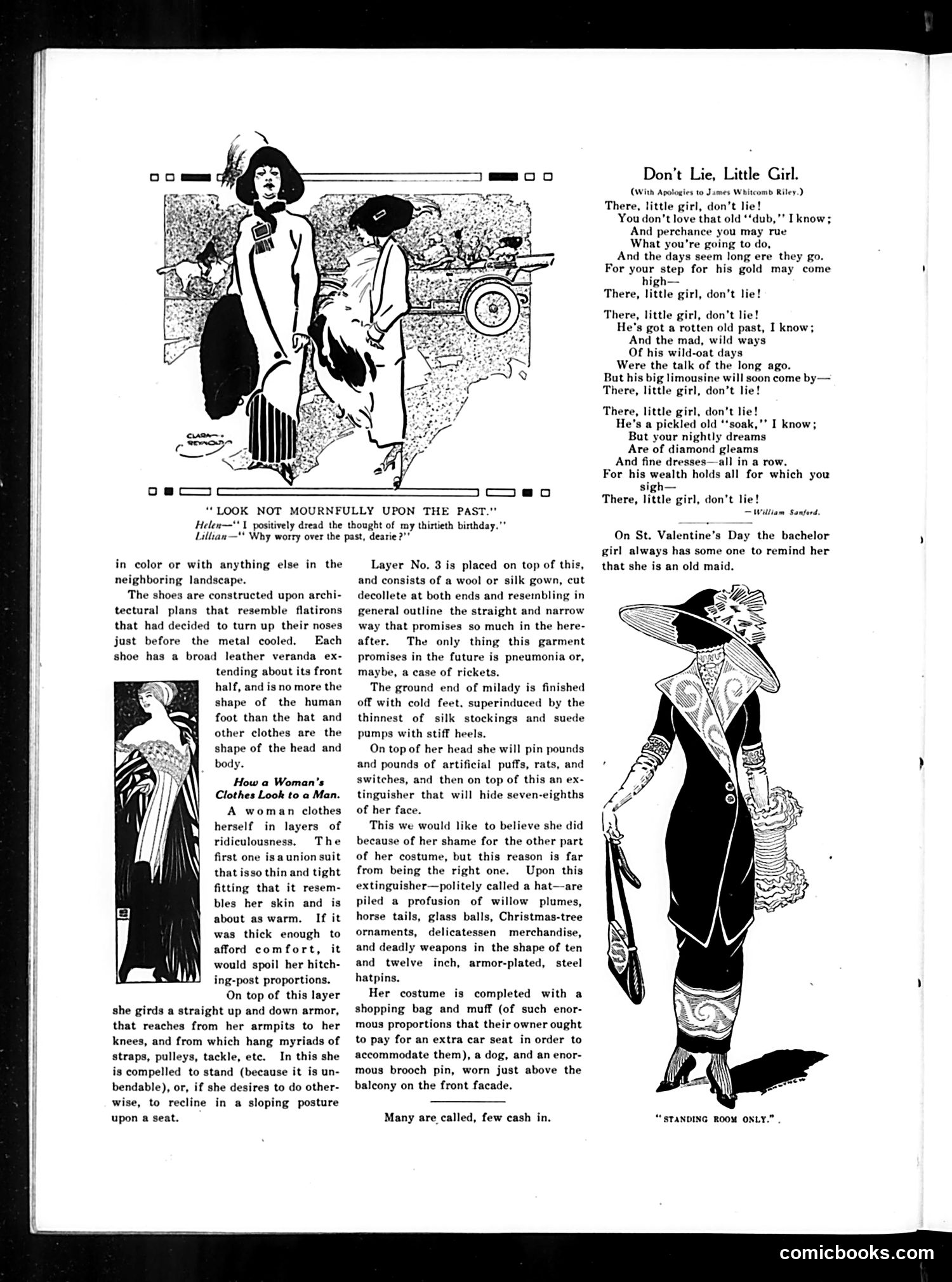
**Top Cartoon:** Two women discuss aging anxiously. Helen dreads her thirtieth birthday; Lillan quips "Why worry over the past, dearie?"—satirizing women's obsession with youth and marriageability in the early 1900s. **Middle Section:** A lengthy satirical essay titled "How a Woman's Clothes Look to a Man" mocks women's restrictive, impractical fashion. The author ridicules corsets, excessive layers, towering hats with deadly hatpins, and absurdly large muffs and accessories—presenting women's fashion as ridiculous, uncomfortable armor that deforms the body while claiming to beautify it. **Right Side Poem:** "Don't Lie, Little Girl" (parody of James Whitcomb Riley) cynically warns a young woman against marrying a wealthy but morally bankrupt man—while acknowledging she'll do it anyway for diamonds and dresses. The satire exposes mercenary marriage motivations. **Bottom Right Caption:** "Standing Room Only" appears to accompany an illustration of a fashionably dressed woman, likely commenting on how excessive clothing/accessories consume public space. **Overall Theme:** Satirizes women's vanity, materialism, and compromised life choices driven by fashion and financial desperation.
📄 Transcribed text from this page (OCR, searchable)
Machine-transcribed from the original scan — historical spelling and the odd misread are preserved.
Ic 7IH@o “*LOOK NOT MOURNFULLY UPON THE PAST." Helen—" 1 positively dread the thought of my thirtieth birthday.”* Lillan—"* Why worry over the past, dearie 2"" in color or with anything else in the neighboring landscape. The shoes are constructed upon archi- tectural plans that resemble flatirons that had decided to turn up their noses just before the metal cooled. Each shoe has a broad leather veranda ex- tending about its front half, and is no more the shape of the human foot than the hat and other clothes are the shape of the head and body. How a Woman's Clothes Look to a Man. A woman clothes herself in layers of ridiculousness, The first one isa union suit that isso thin and tight fitting that it resem- bles her skin and is about as warm. If it was thick enough to afford comfort, it would spoil her hitch- ing-post proportions. On top of this layer she girds a straight up and down armor, that reaches from her armpits to her knees, and from which hang myriads of straps, pulleys, tackle, ete. In this she is compelled to stand (because it is un- bendable), or, if she desires to do other- wise, to recline in a sloping posture upon a seat. Layer No, 3 is placed on top of this, and consists of a wool or silk gown, cut decollete at both ends and resembling in general outline the straight and narrow way that promises so much in the here- after. The only thing this garment promises in the future is pneumonia or, maybe, a case of rickets. The ground end of milady is finished off with cold feet. superinduced by the thinnest of silk stockings and suede pumps with stiff heels. On top of her head she will pin pounds and pounds of artificial puffs, rats, and switches, and then on top of this an ex- tinguisher that will hide seven-eighths of her face. This we would like to believe she did because of her shame for the other part of her costume, but this reason is far from being the right one. Upon this extinguisher—politely called a hat—are piled a profusion of willow plumes, horse tails, glass balls, Christmas-tree ornaments, delicatessen merchandise, and deadly weapons in the shape of ten and twelve inch, armor-plated, steel hatpins. Her costume is completed with a shopping bag and muff (of such enor- mous proportions that their owner ought to pay for an extra car seat in order to accommodate them), a dog, and an enor- mous brooch pin, worn just above the balcony on the front facade. Many are called, few cash in. Don't Lie, Little Girl. (With Apologies to James Whitcomb Riley.) There, little girl, don’t lie! You don't love that old *‘dub,"’ I know; And perchance you may rue What you're going to do, And the days seem long ere they go. For your step for his gold may come high— There, little girl, don’t lie! There, little girl, don’t lie! He's got a rotten old past, I know; And the mad, wild ways Of his wild-oat days Were the talk of the long ago. But his big limousine will soon come by— There, little girl, don’t lie! There, little girl, don’t lie! He’s a pickled old **soak,’’ I know; But your nightly dreams Are of diamond gleams And fine dresses—all in a row. For his wealth holds all for which you sigh— There, little girl, don’t lie! = William Sanford. On St. Valentine’s Day the bachelor girl always has some one to remind her that she is an old maid. “STANDING ROOM ONLY.” comicbooks.com