
A complete issue · 24 pages · 1912
Judge — January 27, 1912
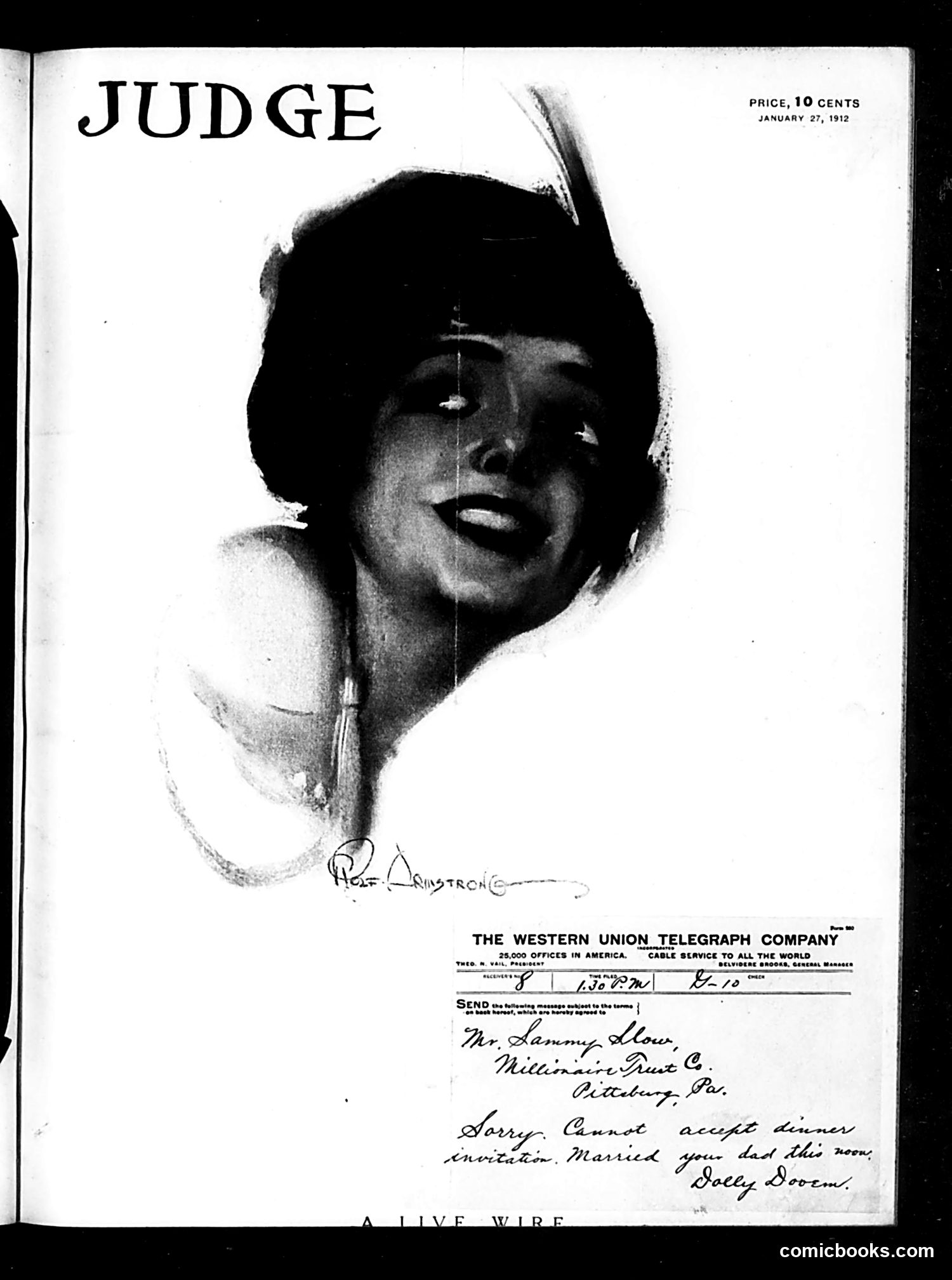
This is primarily a **Western Union Telegraph Company advertisement** disguised as a magazine cover, dated January 27, 1912. The image shows a **portrait illustration** (signed by the artist, appears to read "Armstrong") of a woman's face in profile, wearing what looks like a feathered hat. Below is a **handwritten message** that reads: "Sorry, Cannot accept dinner invitation. Married you dad this noon. Dolly Doores." The "joke" appears to be a humorous telegram announcing an unexpected marriage—specifically, that the sender married the recipient's father. This plays on the era's use of telegrams for urgent announcements and suggests a scandalous domestic situation (possibly involving age differences or social impropriety). The satire mocks both romantic entanglements and the telegraph's role in communicating dramatic personal news quickly and impersonally.
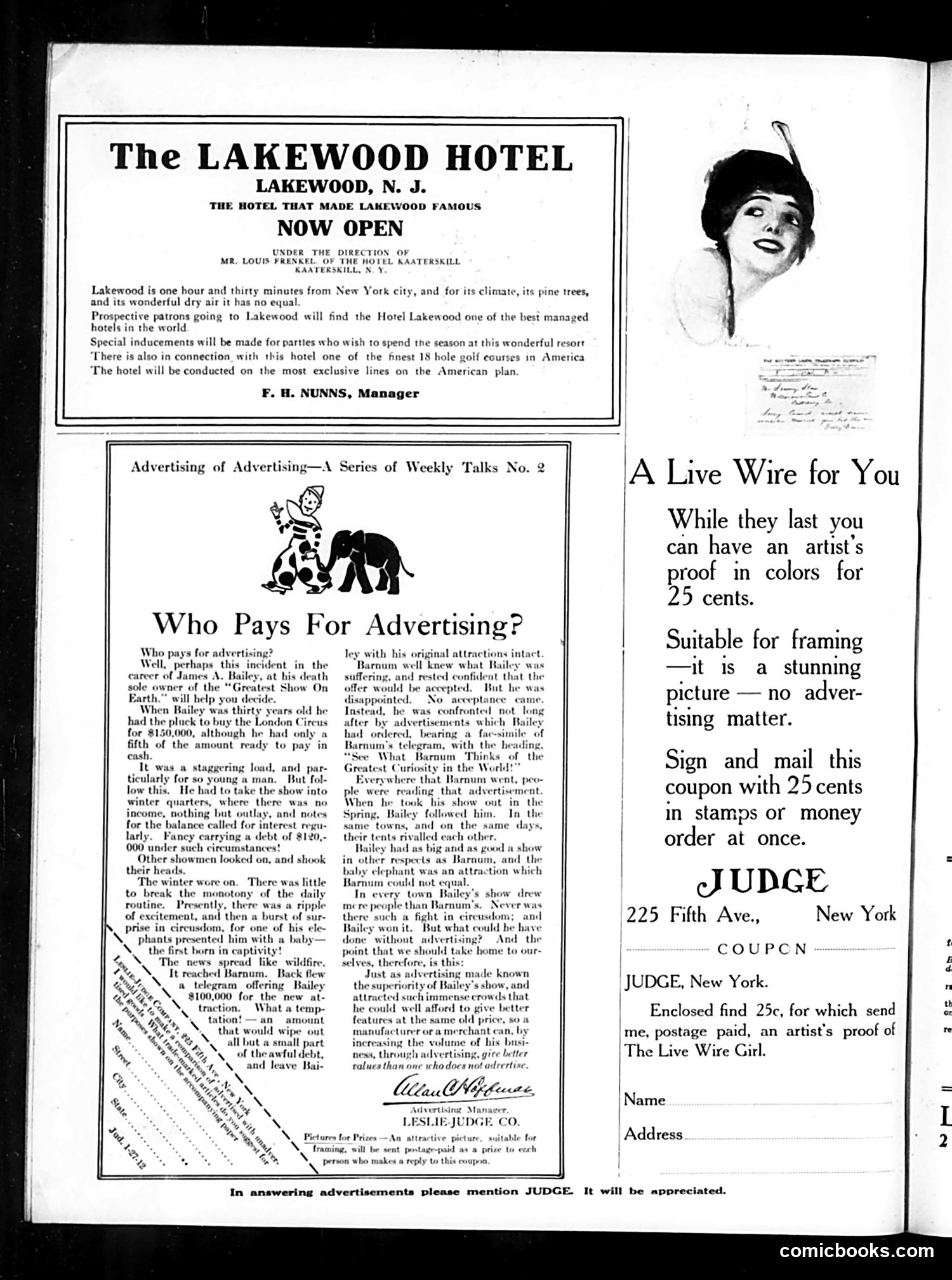
This page is primarily **advertising rather than satirical content**. The main features are: 1. **Lakewood Hotel ad** (top left): A straightforward resort advertisement for Lakewood, New Jersey, near New York City, promoting its golf courses and exclusive American Plan accommodations. 2. **"Advertising of Advertising" article** (center): A satirical piece titled "Who Pays For Advertising?" discussing James A. Bailey (of the famous Barnum & Bailey Circus). The text explains how Bailey's death created a succession crisis and illustrates advertising's power through his historical show business success. 3. **"A Live Wire for You"** (right): A product advertisement for artist's proofs costing 25 cents, with a coupon for "The Live Wire Girl" by Judge/Leslie Judge Co. The page reflects early 20th-century advertising and trade publication practices.
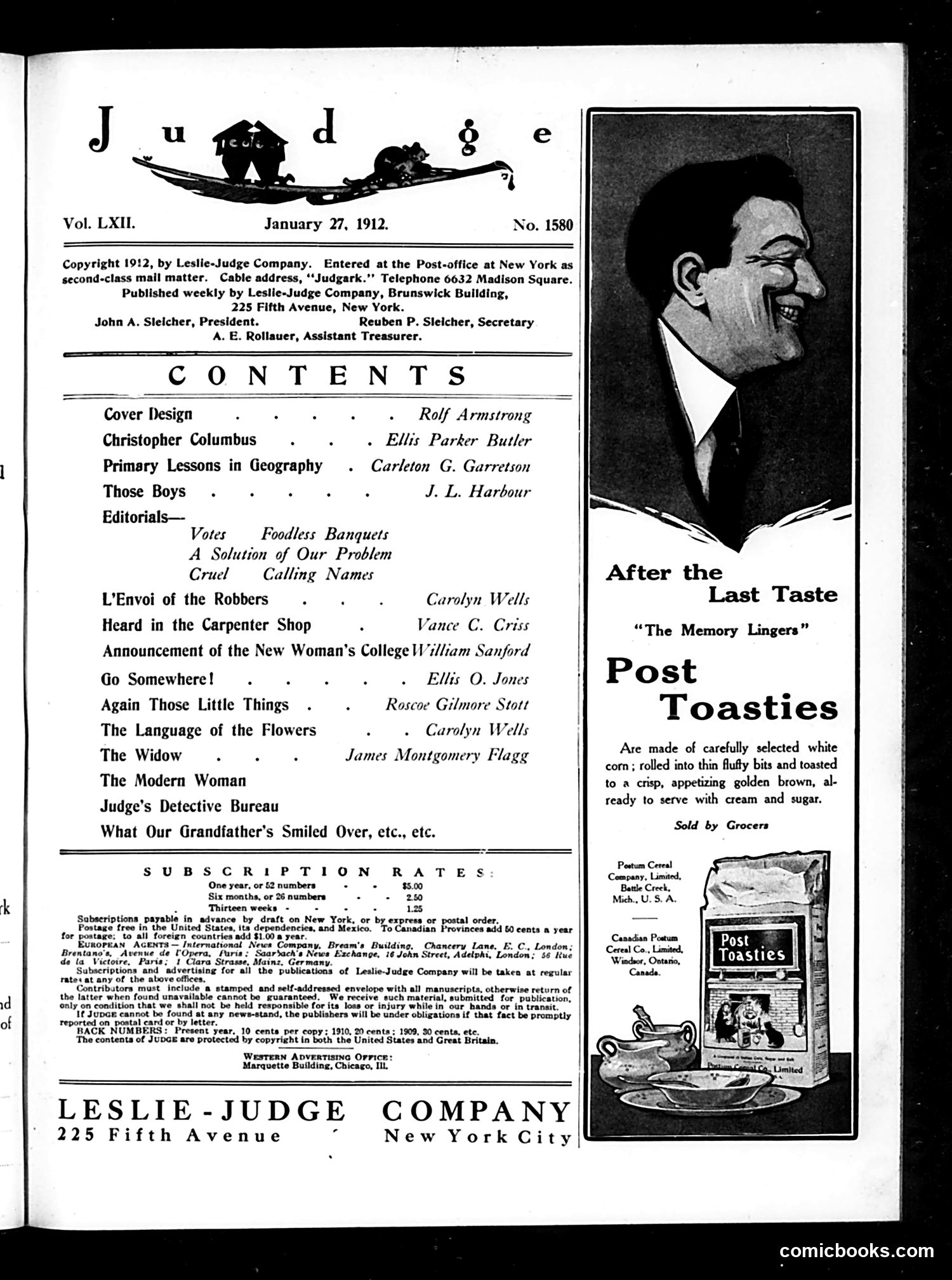
This page is primarily a **table of contents and advertising** rather than political cartoons. The right side features a **Post Toasties cereal advertisement** showing a man's portrait labeled "After the Last Taste" with text promoting the product as "carefully selected white corn; rolled into thin fluffy bits and toasted to a crisp." The left side lists editorial contents including pieces titled "Votes," "Foodless Banquets," and "A Solution of Our Problem," suggesting social commentary on contemporary issues like women's suffrage and economic concerns—topics active in 1912. The actual satirical cartoons referenced in the contents are not visible on this page, making detailed political analysis impossible. This appears to be a contents/advertising page rather than the editorial pages themselves.
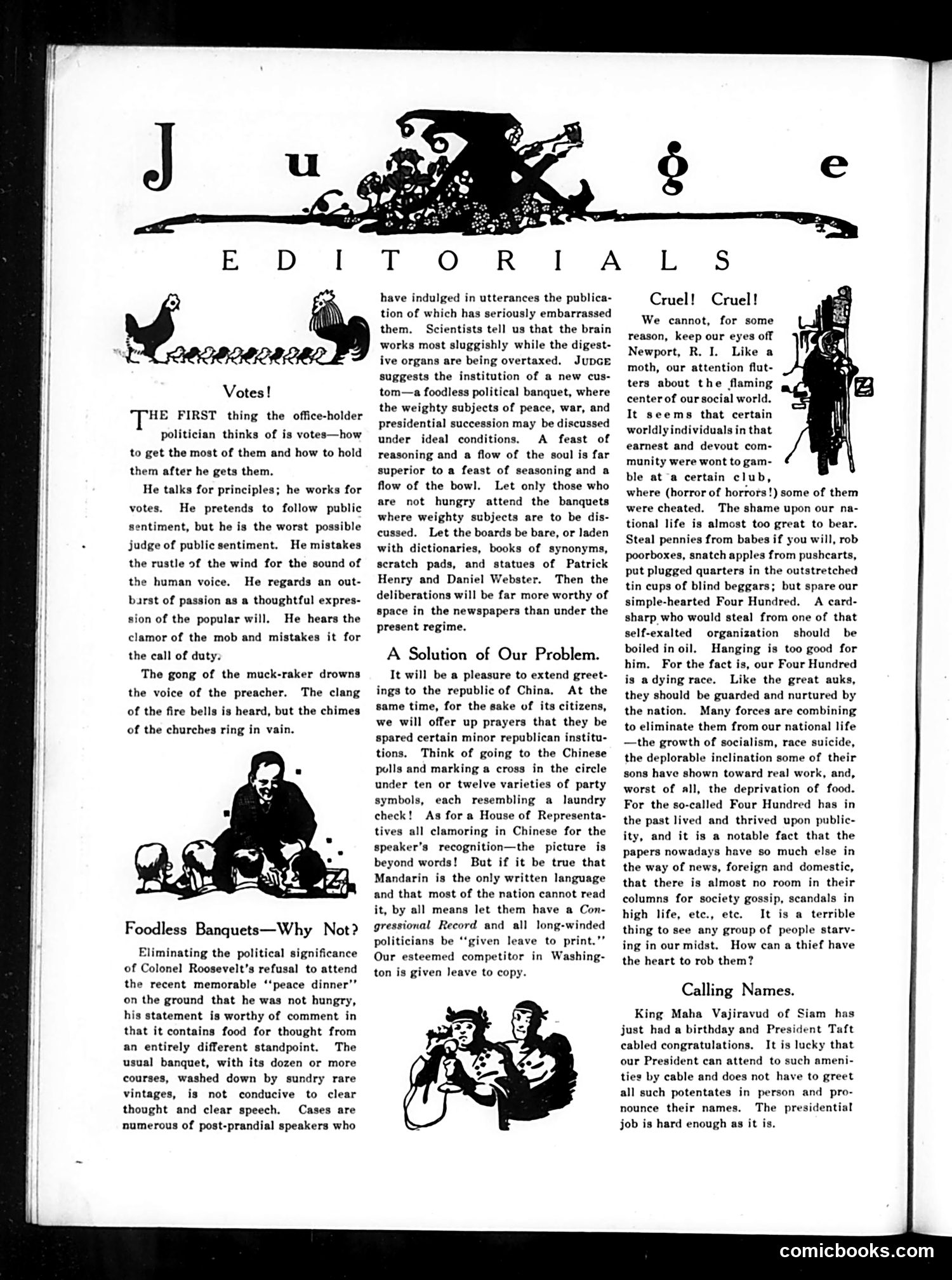
This editorial page satirizes early 20th-century American politics and social issues through multiple pieces: **"Votes!"** mocks politicians who prioritize electoral advantage over principle, comparing their behavior to wind-chasing and claiming they mistake popular passion for actual public sentiment. **"Foodless Banquets—Why Not?"** attacks Colonel Roosevelt's "peace dinner" concept, arguing that elaborate multi-course banquets are incompatible with serious political discourse. The cartoon suggests eliminating formal dining would improve clarity of thought. **"A Solution of Our Problem"** discusses China's political instability and Republican institutional concerns, satirizing American political self-importance. **"Calling Names"** briefly comments on diplomatic protocol regarding King Maha Vajiraud of Siam and President Taft's birthday congratulations. The illustrations feature caricatured figures emphasizing the absurdity of these positions.
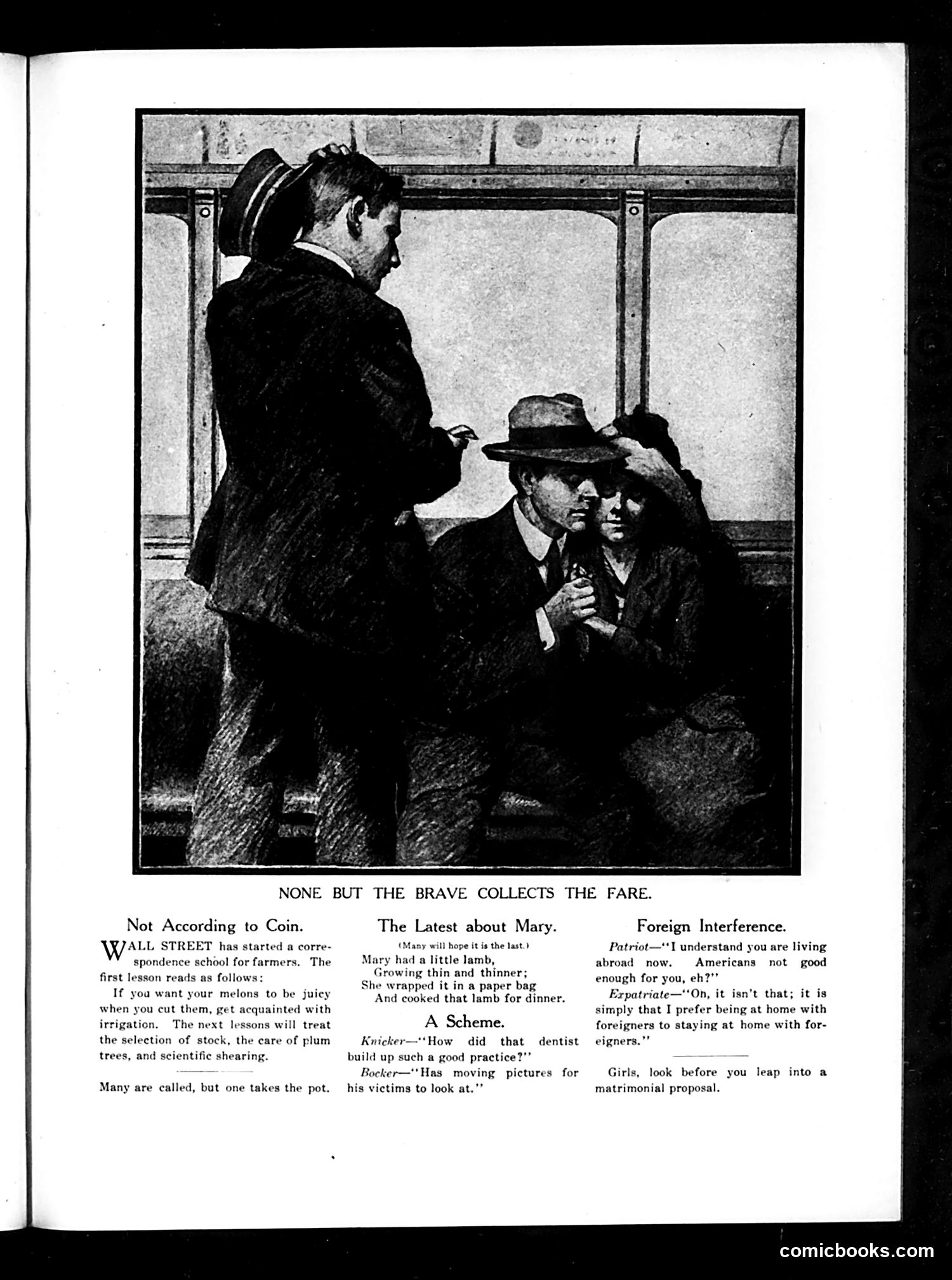
This page contains several brief satirical pieces rather than a single political cartoon. The main image shows what appears to be a streetcar or public transportation scene with passengers. The satirical items include: - **"None But the Brave Collects the Fare"**: A joke about a Wall Street correspondence school teaching farmers, implying that collecting payment requires courage - **"The Latest About Mary"**: A nursery rhyme parody about Mary's lamb, satirizing something (unclear what specifically) - **"A Scheme"**: A brief dialogue between characters named Knicker and Rocker discussing a dentist using moving pictures to attract victims - **"Foreign Interference"**: A piece mocking Americans abroad who prefer socializing with foreigners The content reflects early 20th-century American social attitudes and domestic humor, though without specific historical context, the precise targets remain partially unclear.
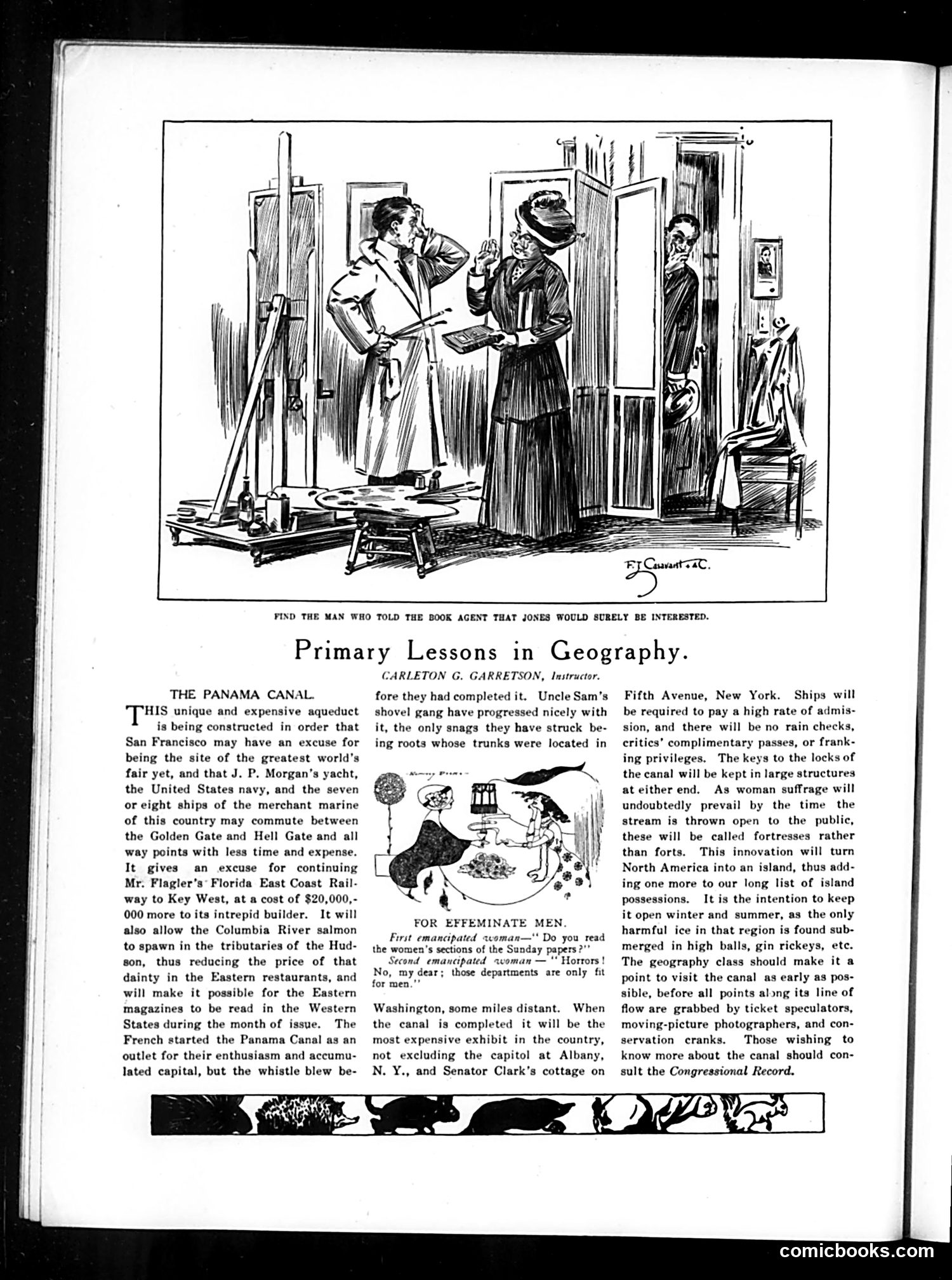
This Judge magazine page contains satirical commentary on early 1900s American developments, presented as a fake geography lesson. **The Main Cartoon** (top) shows a book agent pitching to a man in a studio; the caption mockingly asks readers to identify who told the agent "Jones would surely be interested"—implying the pitch was absurdly wrong. **"Primary Lessons in Geography"** then sarcastically "explains" the Panama Canal's true purposes: not global commerce, but serving wealthy industrialists (J.P. Morgan's yacht), enabling development schemes (Flagler's railroad to Key West), and generating exhibition revenue like a world's fair. **The satire targets**: - Corruption and cronyism in canal construction - Wasteful government spending ($20+ million) - The pretense that projects serve the public rather than elites **"For Effeminate Men"** jokes that only men read women's newspaper sections—inverting era stereotypes about feminine interests. The humor assumes readers shared cynicism about wealthy industrialists controlling major infrastructure projects.
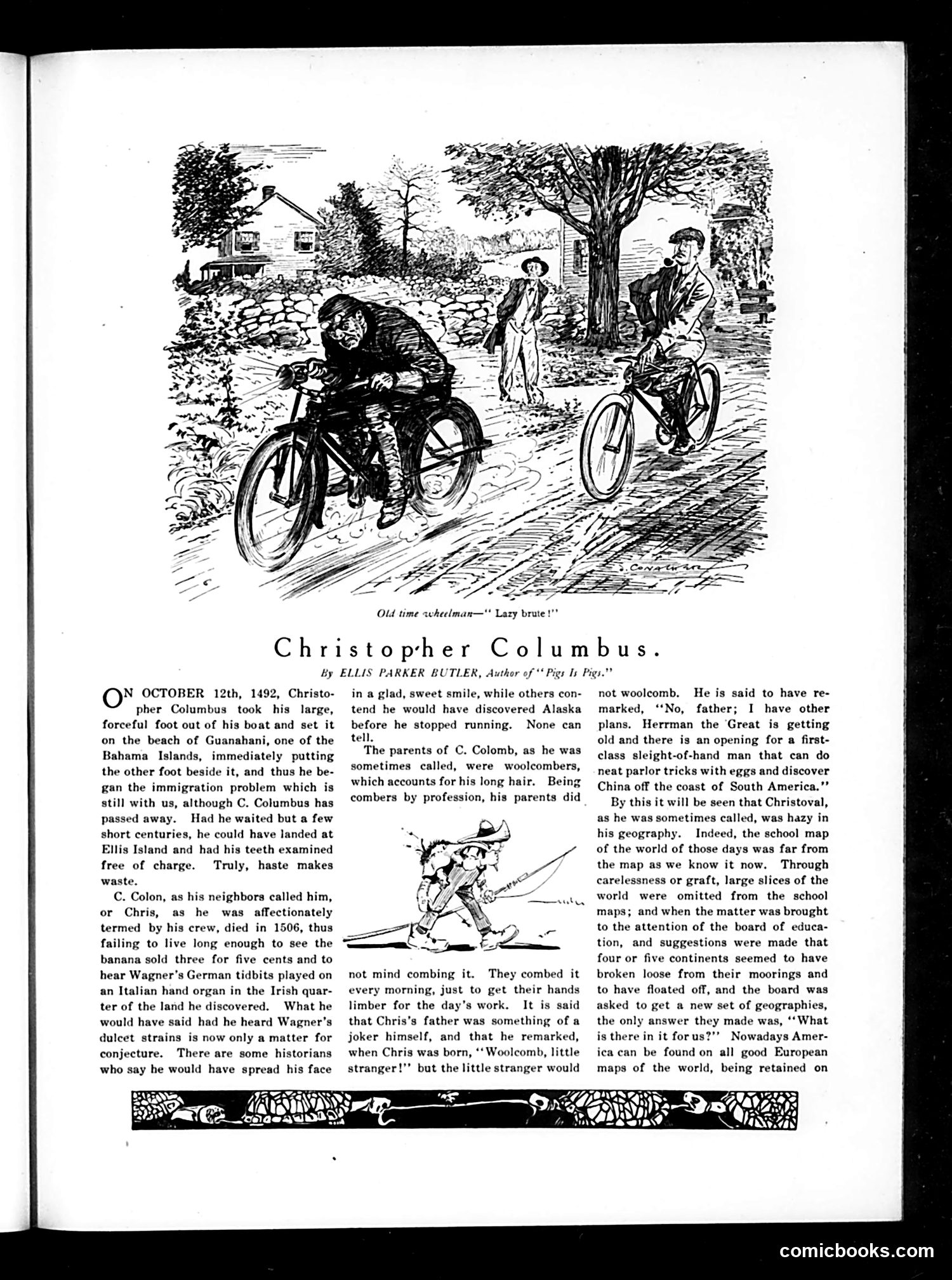
This satirical piece uses Columbus as a vehicle to mock contemporary American immigration and social issues circa 1492's "discovery" anniversary (likely early 1900s). **The cartoon's joke**: The top illustration shows cyclists calling someone "lazy brute"—a pun on "wheelman" (cyclist slang). Columbus becomes the butt of the joke for his leisurely pace of discovery. **The satire's targets**: - **Immigration**: Butler notes Columbus "began the immigration problem which is still with us," referencing ongoing debates about Ellis Island processing - **Educational incompetence**: School maps omitted entire continents; officials ignore corrections, asking "What is there in it for us?"—mocking corruption and indifference - **Social progress**: Columbus couldn't witness bananas at five-for-three-cents prices or immigrant neighborhoods with German opera in Irish quarters—satirizing rapid urbanization and cultural mixing **The deeper point**: By comparing Columbus's era to the present, Butler suggests America's current "problems" (immigration, sloppy infrastructure, educational graft) stem from Columbus's original arrival. It's a darkly humorous critique of American institutional failure and xenophobia.
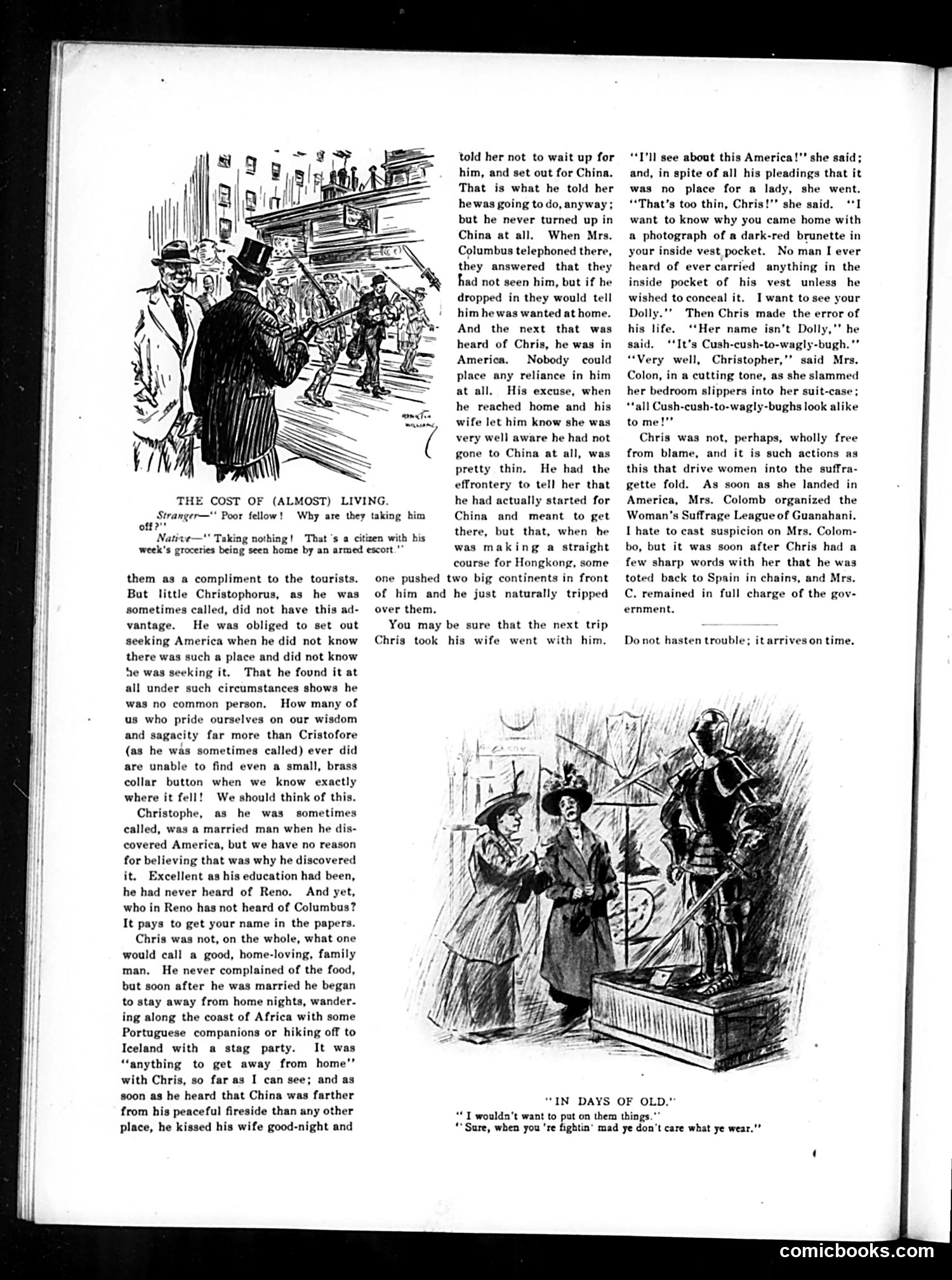
This Judge magazine piece satirizes Christopher Columbus through domestic comedy, presenting him as an irresponsible wanderer and philanderer rather than a heroic explorer. The text humorously reframes his voyages as excuses to escape his wife—he claimed he was going to China but "accidentally" discovered America instead by tripping over continents. The satire peaks when Mrs. Columbus discovers a photograph of "a dark-red brunette" in his vest pocket. When Columbus unconvincingly names her "Cush-cush-to-wagly-bugh" (seemingly a Native American name), his wife responds sharply and becomes a women's suffrage activist in the New World. The joke conflates historical exploration with marital infidelity, suggesting Columbus's "discovery" was as dubious as his excuses. The ending—where Mrs. Columbus organizes the suffrage movement and Columbus returns to Spain "in chains"—transforms the explorer's legacy into a cautionary tale about ignoring women's grievances. The cartoon above illustrates the joke's opening about urban poverty masquerading as "living."
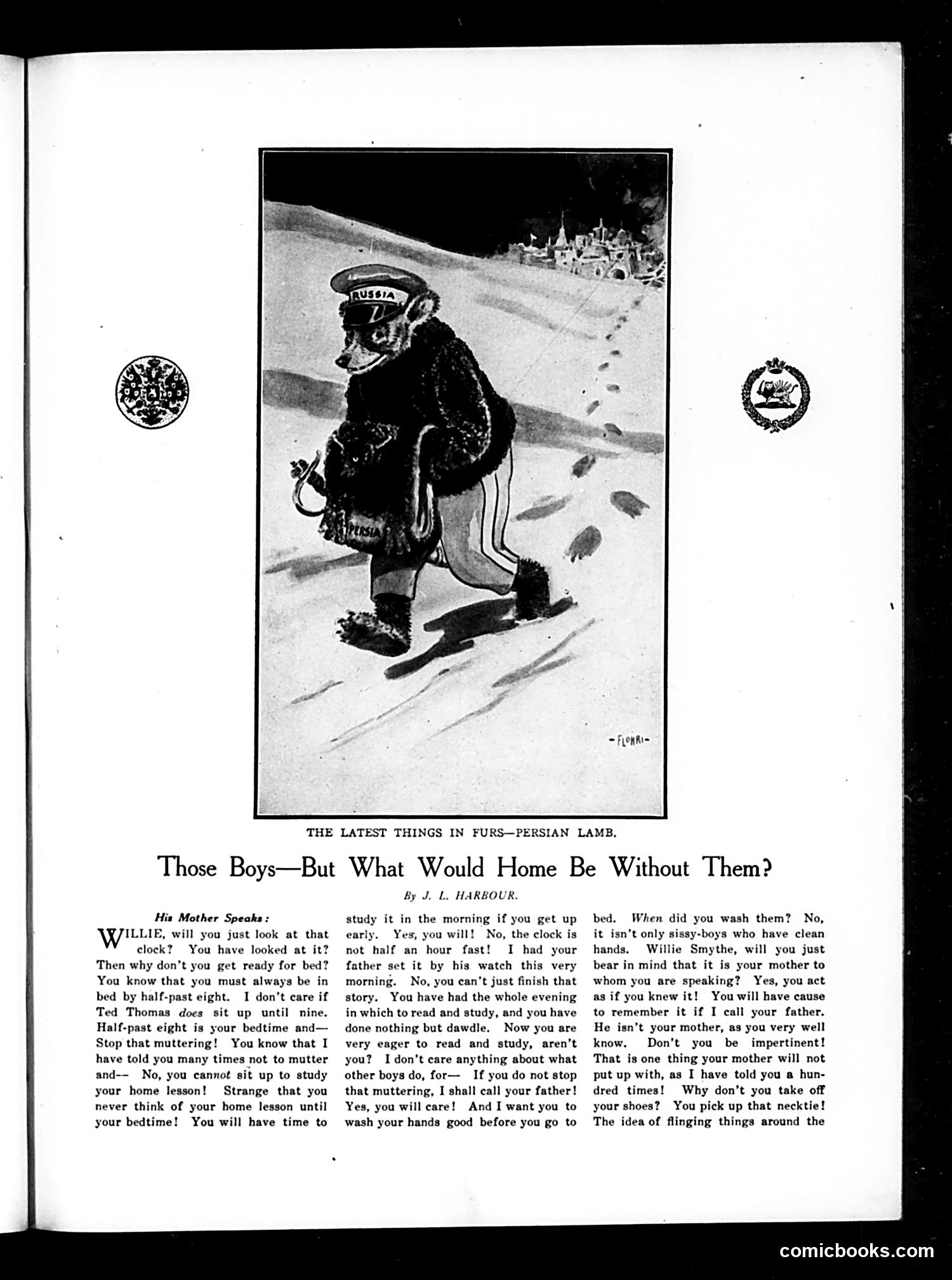
This is a humorous domestic scene satirizing the friction between mothers and boys at bedtime. The illustration shows a Russian soldier (labeled "RUSSIA" on his cap) trudging through snow toward a distant city, seemingly exhausted. The joke plays on the caption: "Those Boys—But What Would Home Be Without Them?" The accompanying text presents a mother's exasperated monologue about her son Willie's bedtime procrastination—endless excuses about studying, complaints about the clock, resistance to washing hands, and messiness. The visual metaphor suggests that boys are so difficult and exhausting that even a hardened soldier enduring harsh winter conditions appears preferable. The satire gently mocks both maternal exasperation and boyish stubbornness as universal domestic struggles. This reflects early-20th-century attitudes about gender roles and child discipline, presenting mothers' authority and boys' resistance as inevitable, humorous domestic theater rather than serious conflict.
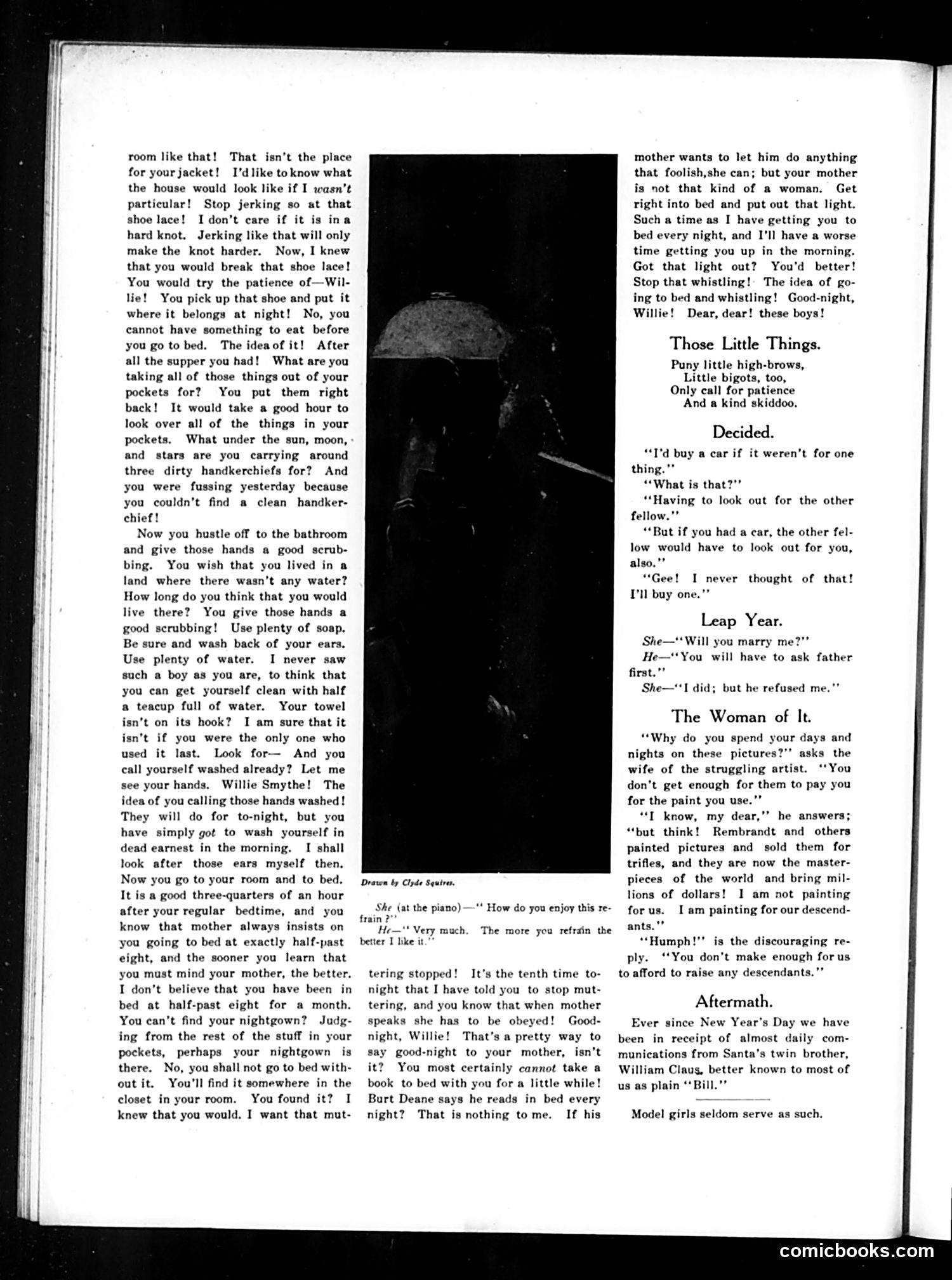
This page from the satirical magazine **Judge** contains multiple pieces of social commentary typical of early 20th-century American humor: **Main Content**: A lengthy monologue depicts an exasperated mother scolding her son Willie before bedtime—covering cleanliness, obedience, pocket clutter, and proper bedtime behavior. The satire targets both the boy's mischievousness and the mother's obsessive-compulsive enforcement of Victorian propriety and discipline. **The Cartoon** (credited to Clyde Squires): Shows a couple at a piano where the woman plays while the man requests she "refrain"—a pun where he enjoys her *refraining* (stopping) more than her playing. **Other Short Pieces**: Include humorous observations on childhood ("Those Little Things"), a man's decision to buy an automobile (social commentary on the car's growing prominence), and leap-year courtship traditions. The overall tone mocks rigid parental authority, childhood frustrations, and modern consumer culture through gentle, domestic humor rather than sharp political satire.
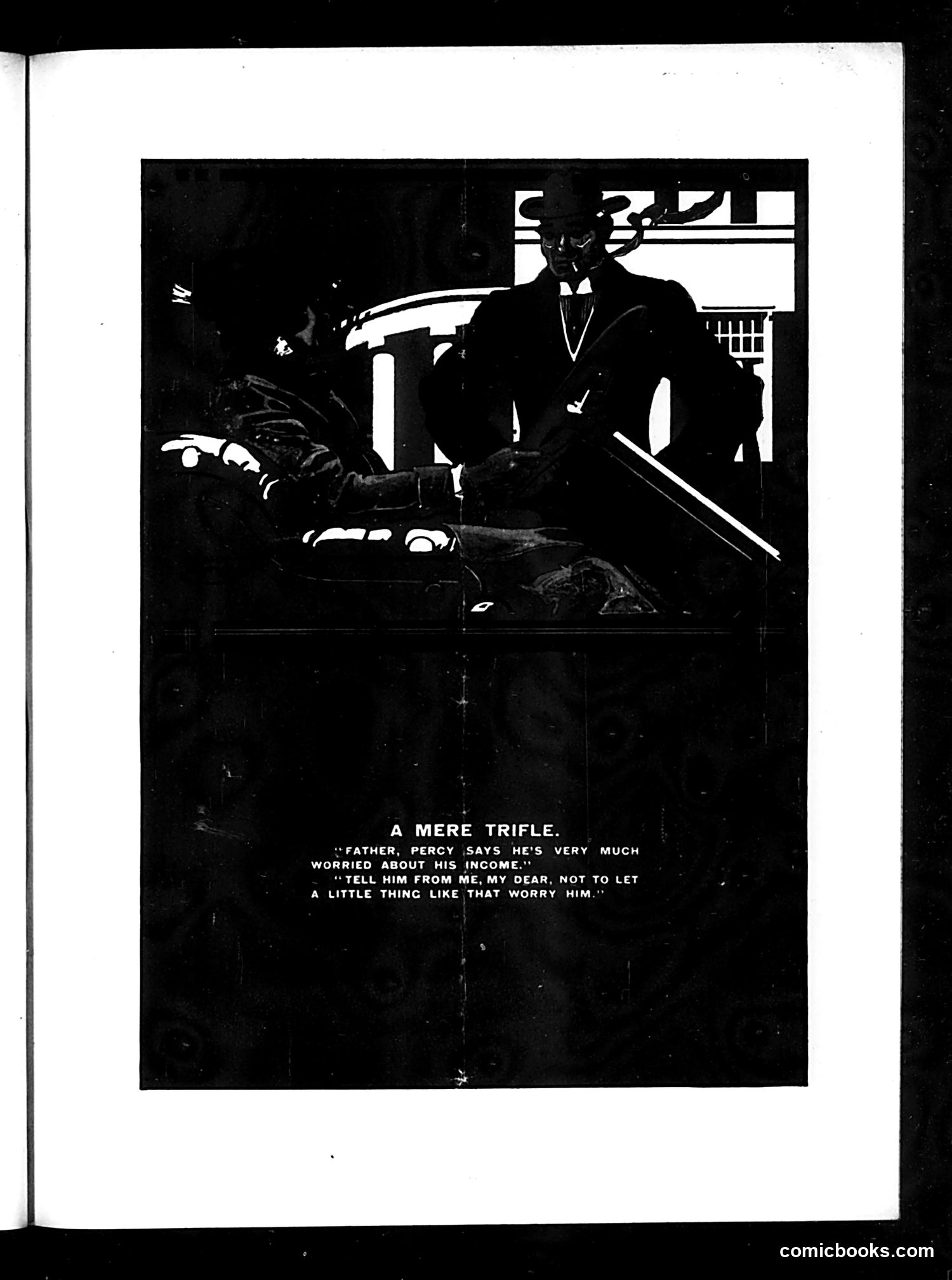
This cartoon satirizes wealth and class privilege. A well-dressed, distinguished gentleman (appearing to be a wealthy father) dismisses his son Percy's financial anxiety as insignificant—"a mere trifle." The son's worry about income is casually brushed aside by someone accustomed to abundance. The satire targets the obliviousness of the wealthy elite who cannot fathom ordinary financial concerns. To the privileged father, income worries are beneath consideration—a "little thing" unworthy of serious concern. This mocks the disconnect between the rich and those struggling economically, suggesting the wealthy lack empathy or understanding of working people's real financial pressures. The title emphasizes this dismissal, presenting monetary anxiety as trivial only from a position of secure wealth.
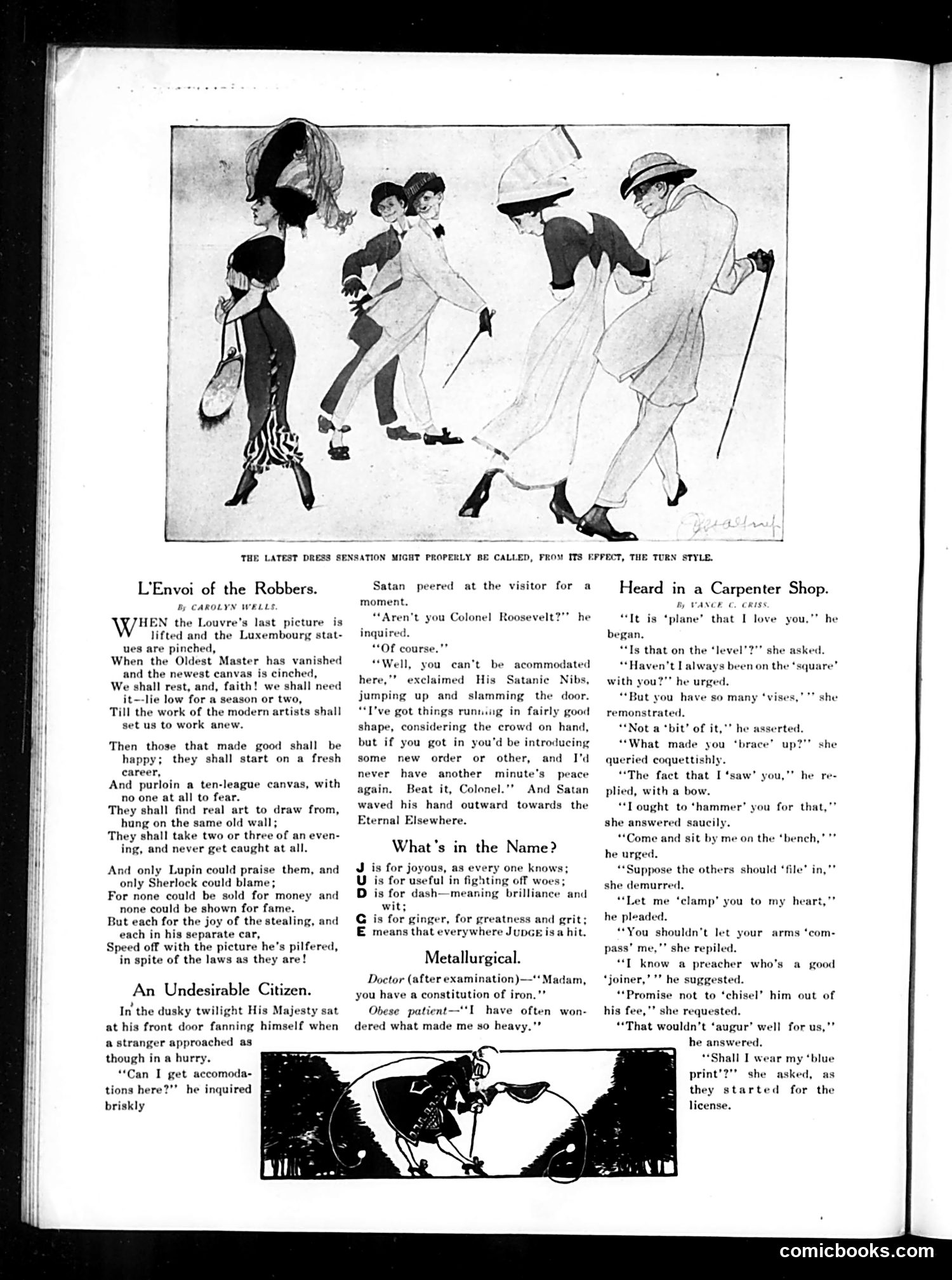
This page contains three satirical pieces: **"L'Envoi of the Robbers"** mocks the Louvre art thefts (likely referencing famous museum robberies of the era). The poem imagines modern artists becoming art thieves, stealing masterpieces with impunity—satirizing both art world pretension and criminal audacity. **"An Undesirable Citizen"** depicts Satan refusing accommodation to Colonel Theodore Roosevelt, suggesting Roosevelt is so aggressive and domineering that even Hell rejects him. This mocks Roosevelt's notoriously forceful personality and interventionist policies. **"Heard in a Carpenter Shop"** is a pun-heavy romantic dialogue where two carpenters-in-love trade construction terminology ("plane," "level," "square," "bit," "chisel," "augur"). It's gentle wordplay humor rather than political satire. The top illustration shows women in the new "turn style" dress—apparently a fashion where the skirt turns/flares dramatically as wearers move, creating a visual sensation.
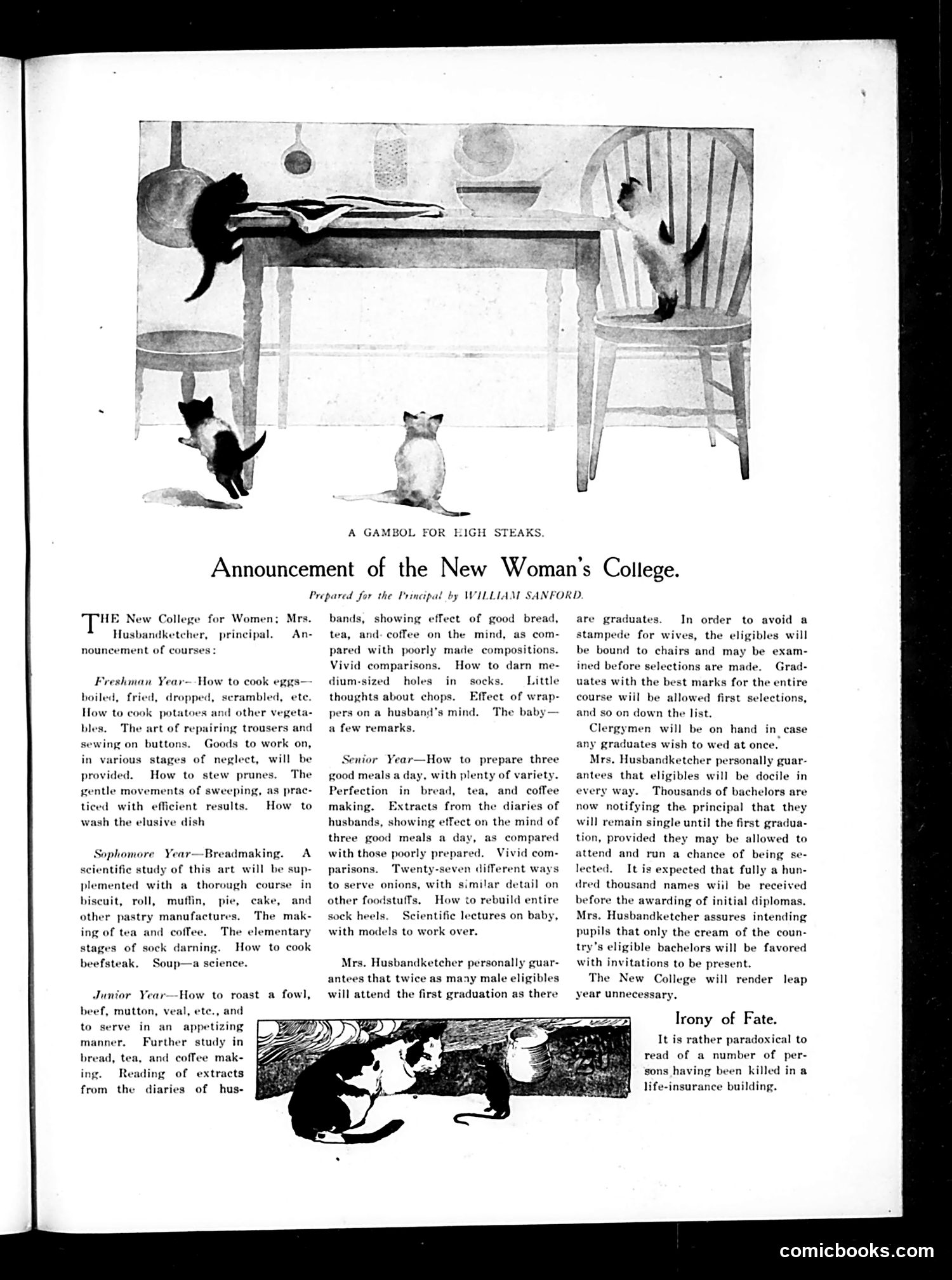
This is a satirical mock-announcement lampooning the "New Woman" movement of the late 19th/early 20th century. The joke targets anxieties about women's education and independence. The cartoon depicts cats lounging on furniture—a visual pun on domestic idleness—while the text parodies a women's college curriculum that consists entirely of domestic skills: cooking, sewing, darning socks, and pleasing husbands. Each year advances from basic egg-cooking to "preparing three good meals a day." The satire's point: while women were genuinely demanding access to serious higher education, Judge ridicules the notion by suggesting a "college" teaching only traditional housework. The final section mocking how "bachelors" will queue for graduates reinforces that women's real "value" remains marriageability, not intellectual achievement. The closing "Irony of Fate" note appears unrelated—likely editorial filler about insurance deaths.
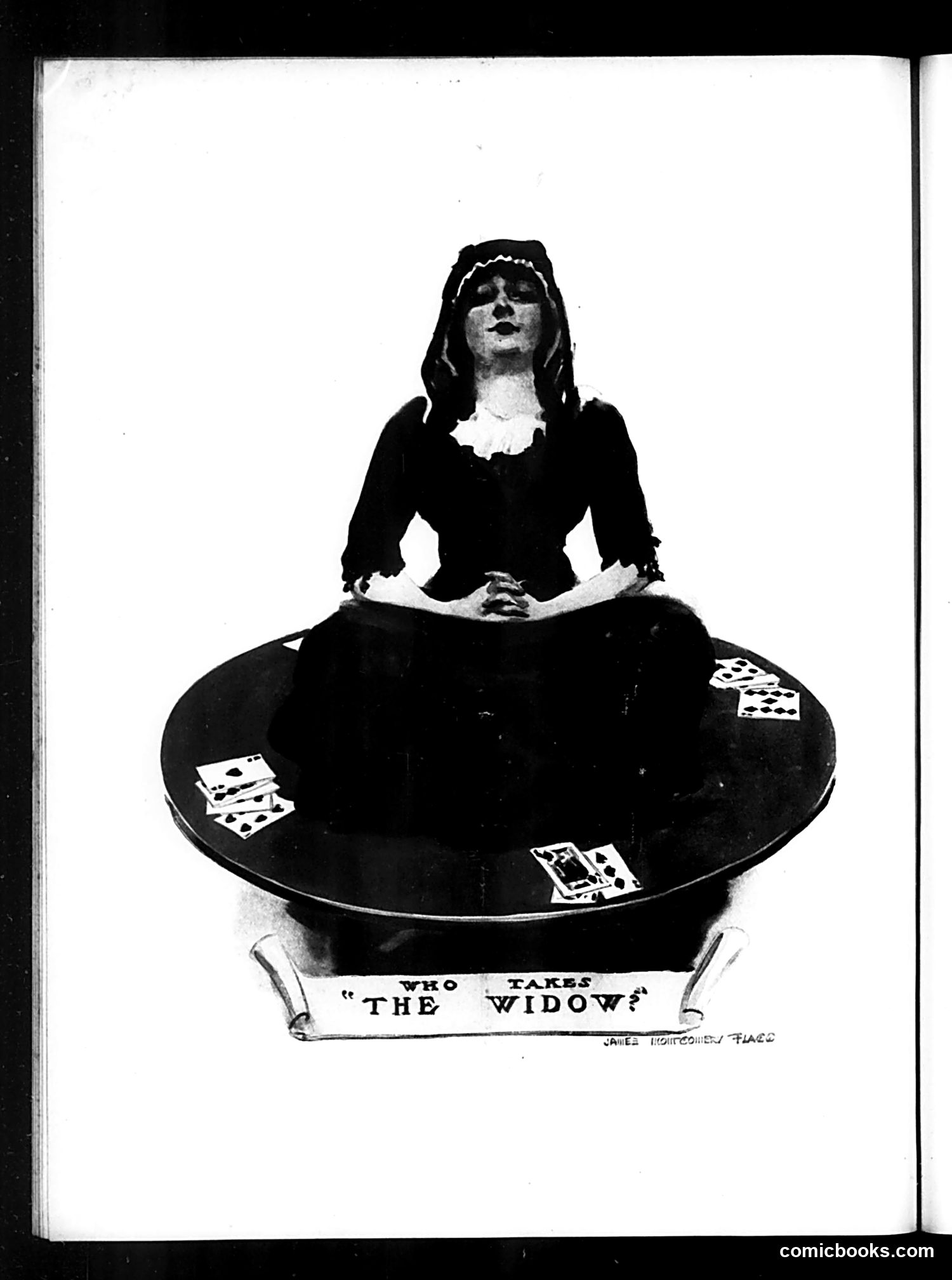
This appears to be a satirical illustration from *Judge* magazine showing a woman in mourning clothes (indicated by her dark dress and headpiece) seated at a round table with playing cards scattered around it. The caption "Who Takes the Widow?" suggests commentary on fortune-hunting or predatory behavior toward wealthy widows. The card game imagery likely references schemes to exploit or swindle a bereaved woman of her inheritance. This reflects a common late 19th/early 20th-century social anxiety about widows being targeted by unscrupulous men seeking their wealth. The illustration's stark silhouette style emphasizes the widow's vulnerable position, surrounded by the games (literally) being played around her. The satire critiques society's willingness to prey on grieving women.
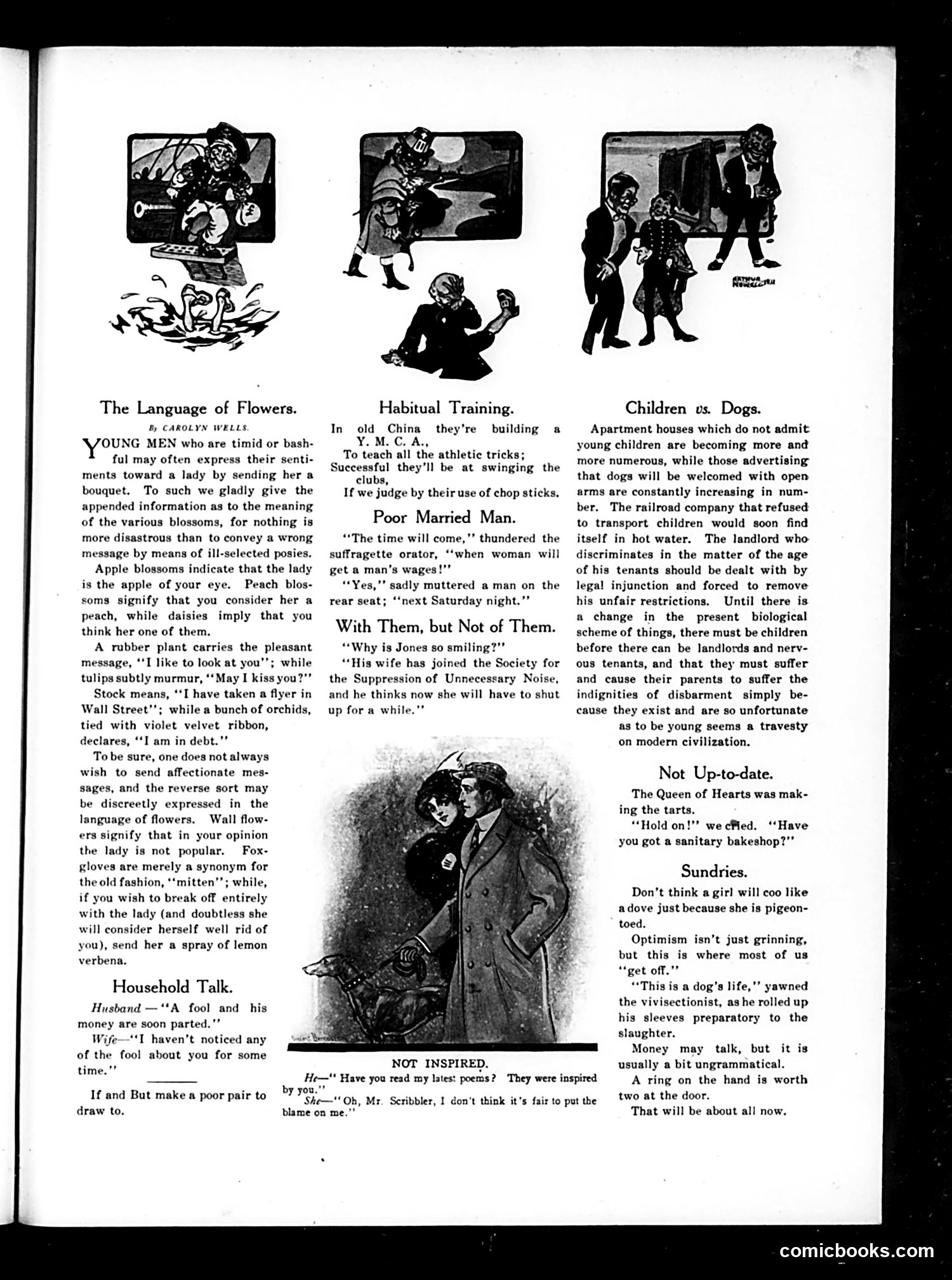
This page contains several brief satirical pieces typical of early 20th-century humor magazines: **"The Language of Flowers"** humorously decodes flower meanings for shy suitors—mocking both Victorian courtship conventions and the financial anxieties of the era. Stock market references ("I have taken a flyer in Wall Street") and debt jokes ("I am in debt") reflect contemporary economic concerns. **"Poor Married Man"** jokes about suffragettes demanding equal wages; the husband cynically notes women will "get a man's wages" when his paycheck arrives Saturday. **"With Them, but Not of Them"** mocks the "Society for the Suppression of Unnecessary Noise"—apparently a real organization—suggesting the husband hopes his talkative wife will be forced to stay quiet. **"Children vs. Dogs"** is social commentary criticizing landlords who welcome dogs but reject child tenants as unfair discrimination against the young. The cartoon "Not Inspired" shows a poet claiming his work was inspired by a woman who sarcastically refuses to take credit. Overall, the page targets suffragettes, urban apartment culture, and courtship anxieties through gentle domestic satire.
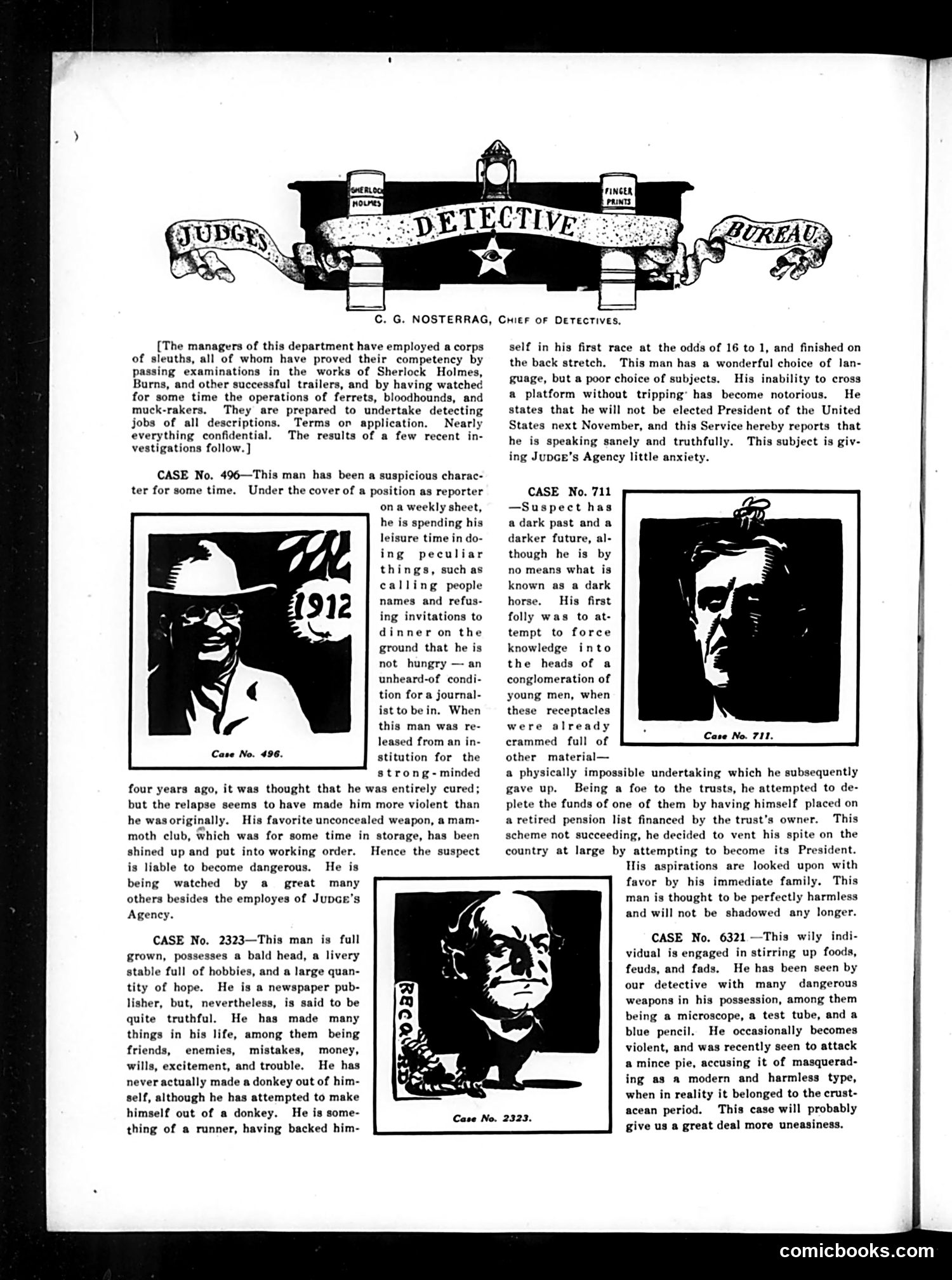
This page satirizes prominent public figures through fake "detective case files." The Detective Bureau, headed by "C. G. NOSTERRAG" (an anagram), humorously investigates suspicious citizens. **Case 496** targets a radical journalist—described as mentally unstable, refusing meals, and carrying a club. The satire mocks reform-minded reporters as dangerously eccentric. **Case 2323** appears to profile a newspaper publisher: bald, prone to tripping, claiming he won't run for president. The exaggerated biography suggests a well-known publisher of the era (unclear from the image alone). **Case 711** describes someone attempting to force education onto unreceptive students, then targeting trusts, now aspiring to the presidency. His family supports him; he's deemed "harmless." **Case 6321** depicts an agitator stirring controversy with scientific instruments and a blue pencil—likely a muckraking journalist attacking institutions. The humor relies on recognizing these as parodies of actual reformers and radicals, mocking their activism as suspicious, mentally unbalanced behavior requiring official surveillance.
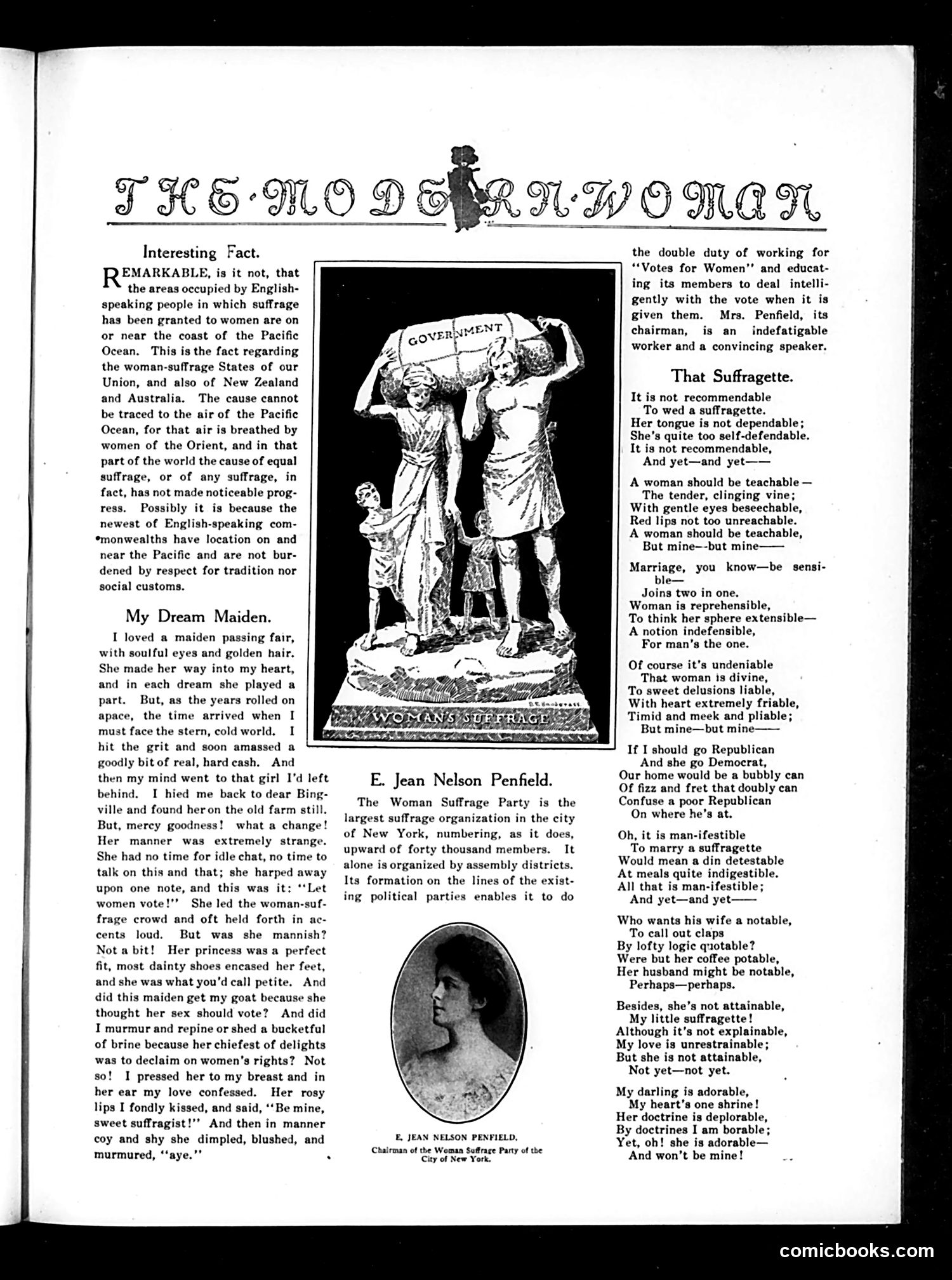
This 1910s satirical magazine page mocks women's suffrage through multiple lenses. The central cartoon depicts "Government" as a woman literally carrying the burden of the vote—visual satire suggesting women aren't equipped to handle political responsibility. The accompanying articles present supposed "facts" (Pacific coast suffrage regions prove women are naturally suited for voting) and poetry titled "That Suffragette," which ridicules pro-suffrage women as shrill, domineering, and unmarriageable. The poem's humor relies on stereotypes: a suffragist woman is "not dependable," threatens domestic harmony, and represents the nightmare scenario of a wife who disagrees politically with her husband. E. Jean Nelson Penfield, pictured as chairman of New York's Woman Suffrage Party, is presented factually but in a context designed to portray suffragists as the eccentric subjects of satire. The "My Dream Maiden" narrative frames a woman's political activism as an unattractive departure from feminine ideals, ultimately endorsing the man's acceptance of her activism only through romantic love—not principle.
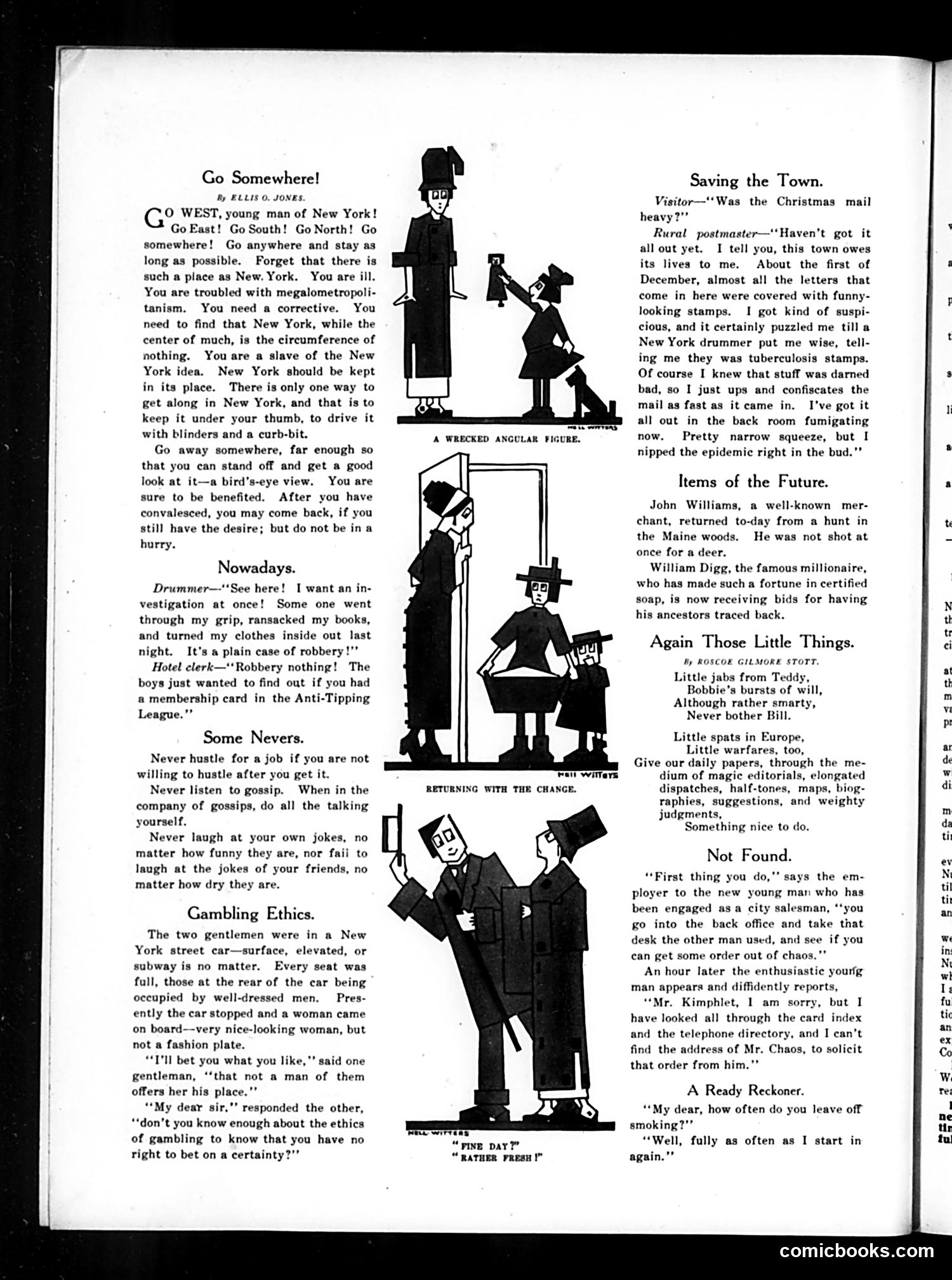
This Judge magazine page contains satirical pieces critiquing early 20th-century American urban life and social attitudes. **"Go Somewhere!"** mocks New Yorkers' obsession with their city, suggesting they suffer from "megalometropolitanism"—an unhealthy fixation on New York's importance. The author ironically prescribes travel as medicine. **"Nowadays"** and related sections offer social commentary: hotel staff ransacking drummers' (traveling salesmen's) luggage to check for "Anti-Tipping League" cards satirizes the growing tipping culture's social friction. **"Gambling Ethics"** presents a street-car anecdote where offering a seat to a poorly-dressed woman is so unlikely that betting on it violates gambling principles—darkly humorous commentary on class-based chivalry. **"Saving the Town"** satirizes rural ignorance: a postmaster confiscates Christmas seals (tuberculosis-awareness stamps) as disease vectors, misunderstanding their purpose entirely. The joke targets both rural naiveté and urban-rural knowledge gaps. The cartoons and brief items throughout maintain this tone of social satire, targeting pretension, class attitudes, and contemporary anxieties about urbanization and commerce.
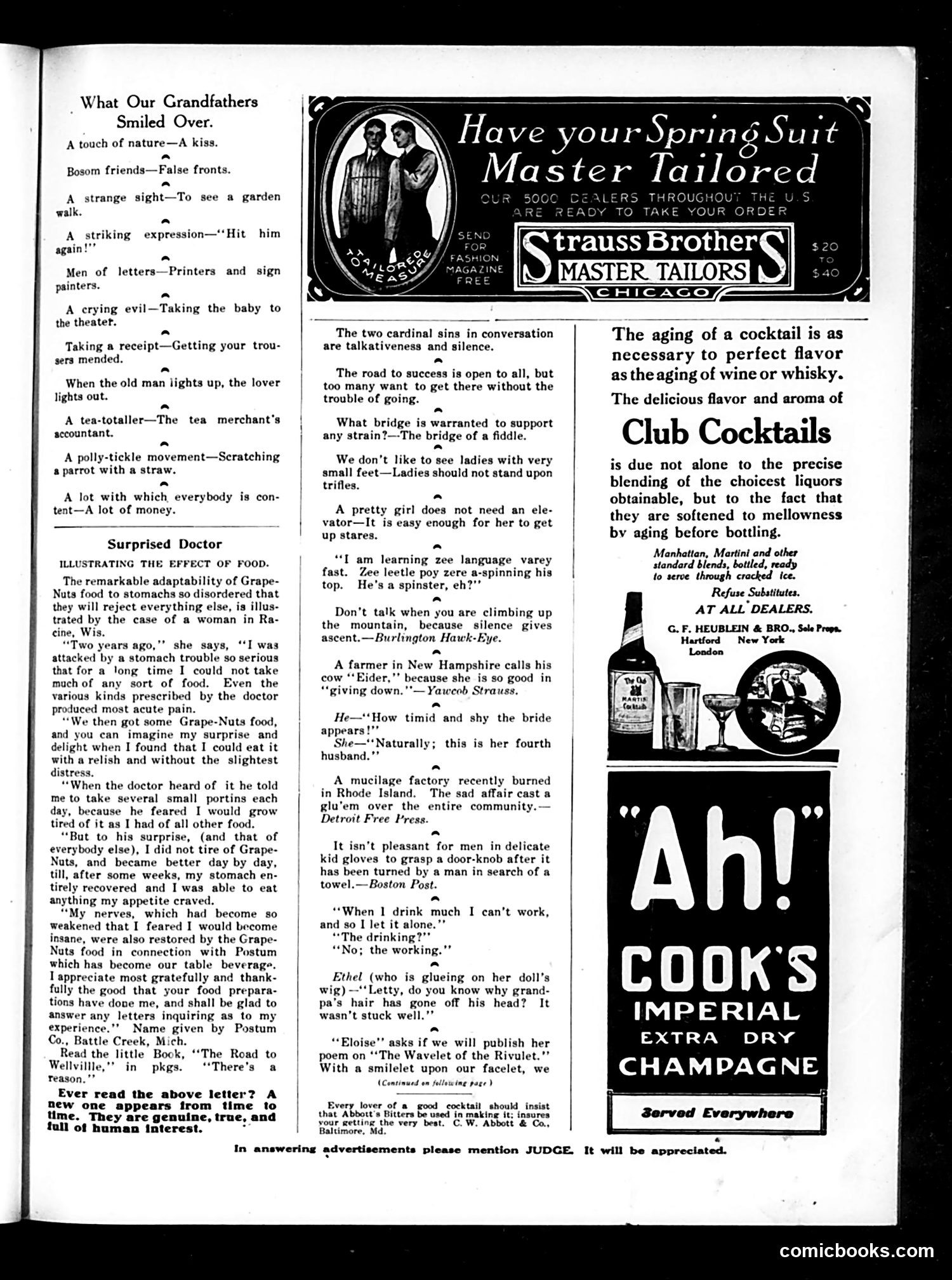
This Judge magazine page is primarily **humorous filler content and advertisements** rather than political satire. The main section, "What Our Grandfathers Smiled Over," presents **old-fashioned wordplay jokes** meant to amuse through puns and double meanings—for example, "Men of letters" meaning printers rather than scholarly people, or "A tea-totaller" being the tea merchant's accountant (since the merchant would claim zero personal consumption). The "Surprised Doctor" section is a **testimonial advertisement for Grape-Nuts cereal**, presenting a woman's story of stomach recovery through the product—a common advertising format of the era claiming near-miraculous health benefits. The remaining content consists of **brief jokes and witticisms** on courtship, marriage, and social behavior, plus **period advertisements** for tailoring services, cocktails, and champagne. The page reflects **early 20th-century humor values**: wordplay, domestic/marital comedy, and earnest product testimonials that would seem absurd today. There's no significant political commentary here—it's entertainment and advertising targeted at Judge's affluent male readership.
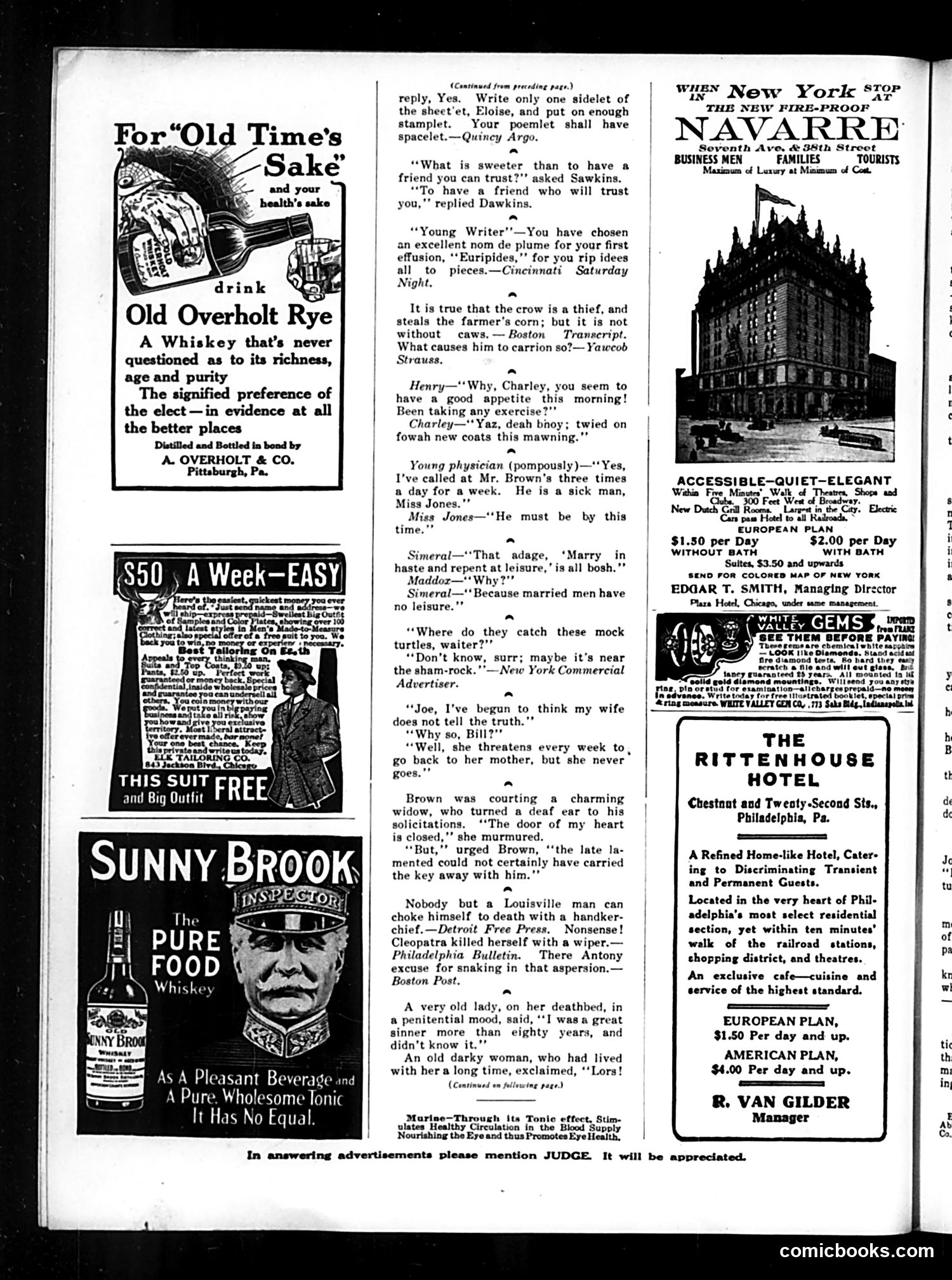
This is primarily an **advertising page** from Judge magazine interspersed with brief humorous anecdotes typical of the era's satirical publications. The main content consists of: 1. **Whiskey advertisements** (Old Overholt Rye, Sunny Brook) - presenting alcohol as a health tonic and refined beverage, which reflects pre-Prohibition American advertising norms. 2. **Short joke column** featuring wordplay and domestic humor common to early 20th-century magazines: - Puns on words ("rip idees," "carrion/caws") - Marriage jokes mocking wives and marital discord - Racial humor (the "old darky woman" anecdote reflects deeply offensive period conventions) - Class-conscious observations about wealthy widows and courtship 3. **Hotel advertisements** for upscale establishments (Navarre, Rittenhouse Hotel). The satirical content is **gentle and formulaic** rather than political - targeting universal human follies (marriage problems, pretentious behavior, small deceptions) rather than specific events or figures. This represents Judge's lighter, entertainment-focused content pages.
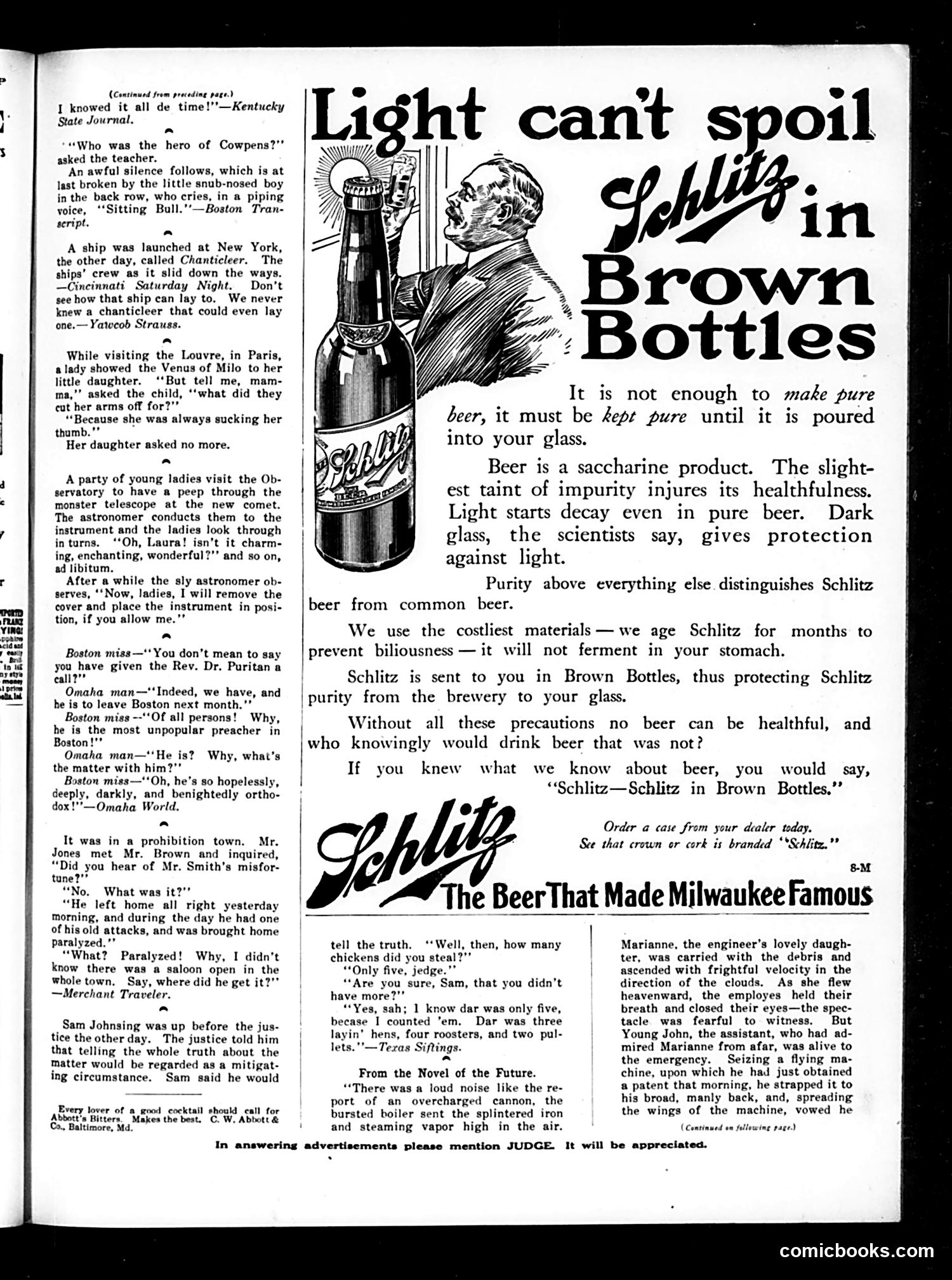
This page consists primarily of **a Schlitz beer advertisement** disguised as editorial content, flanked by humorous short jokes typical of Judge magazine's format. The **Schlitz ad** argues that beer purity requires brown bottles to protect against light decay. It claims scientific superiority and positions the beer as healthful if properly preserved—marketing language reflecting early 1900s advertising that made direct health claims (now illegal). The surrounding **jokes** are period humor: a student confusing the Battle of Cowpens with Sitting Bull; wordplay about a ship named "Chanticleer" that cannot "lay to"; a child asking why the Venus de Milo has no arms; a preacher criticized as "hopelessly...orthodox" in a prohibition town; and a man claiming paralysis in a dry town, implying he obtained liquor mysteriously. These jokes target contemporary subjects—American education gaps, prohibition era contradictions, and religious rigidity—but rely on now-obscure references and punchlines that depend on period attitudes rather than sharp satire. The ad-as-content blurs editorial and advertising boundaries typical of early 20th-century magazines.
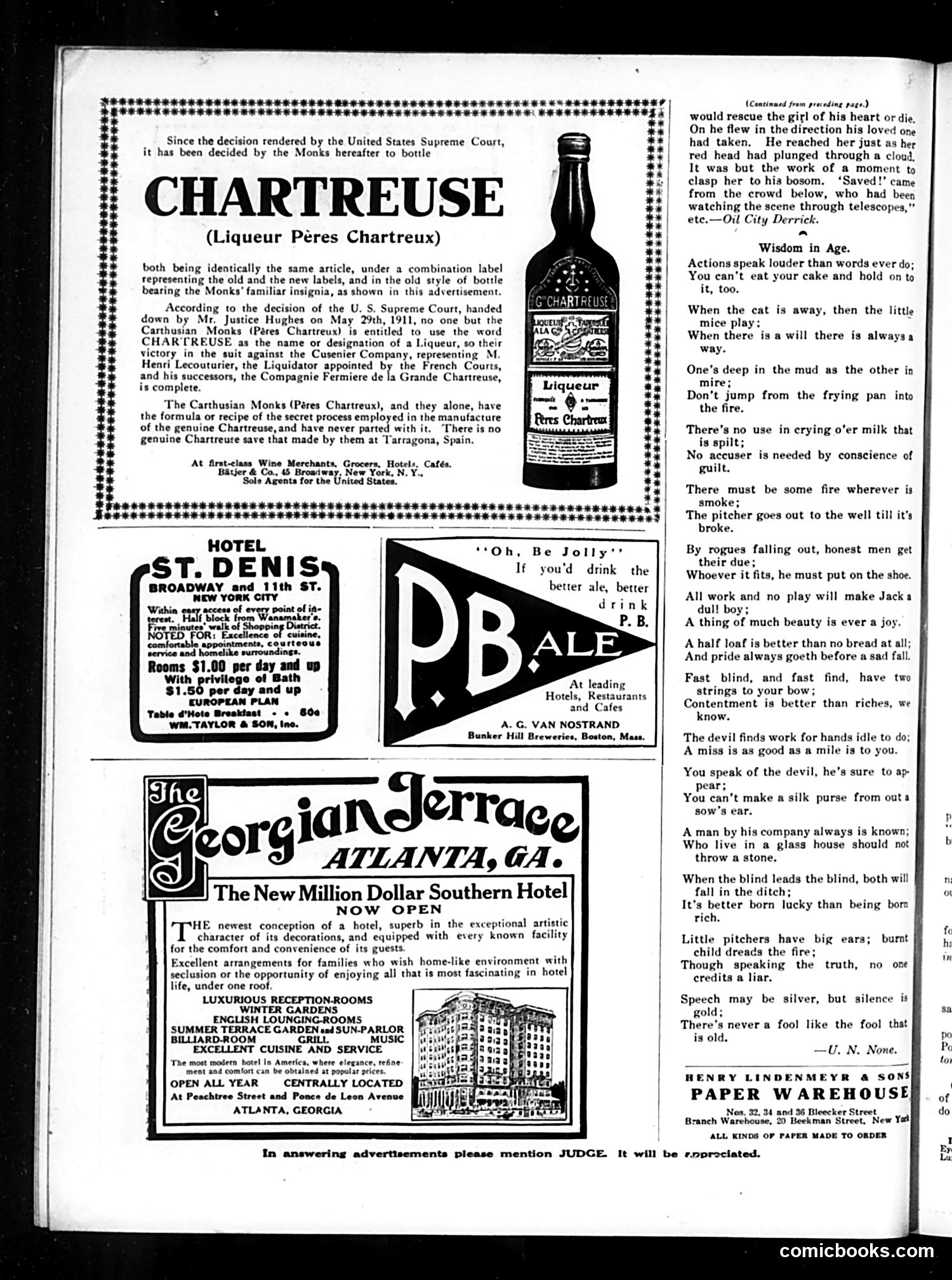
This page is primarily **advertising**, with the main content being a Chartreuse liqueur advertisement and hotel/restaurant ads. The **Chartreuse ad** references a 1911 U.S. Supreme Court decision (Justice Hughes) ruling that only the Carthusian Monks of Tarragona, Spain could legally use the name "Chartreuse" for their liqueur. The suit had been against the Cusenier Company (represented by liquidator Henri Lecouturier). This advertisement announces the monks' victory and explains why their product now bears both old and new labels—establishing their exclusive trademark rights. The right column contains traditional **proverbs and folk wisdom** ("Actions speak louder than words," "When the cat's away," etc.)—common filler content in magazines of this era. The other ads promote the **Hotel St. Denis** (New York), **P. Bale** (ale), and **The Georgian Terrace** (Atlanta's "New Million Dollar Southern Hotel"). This is a commercial page with minimal satirical content—primarily straightforward advertising and moral platitudes typical of early-1900s magazines.
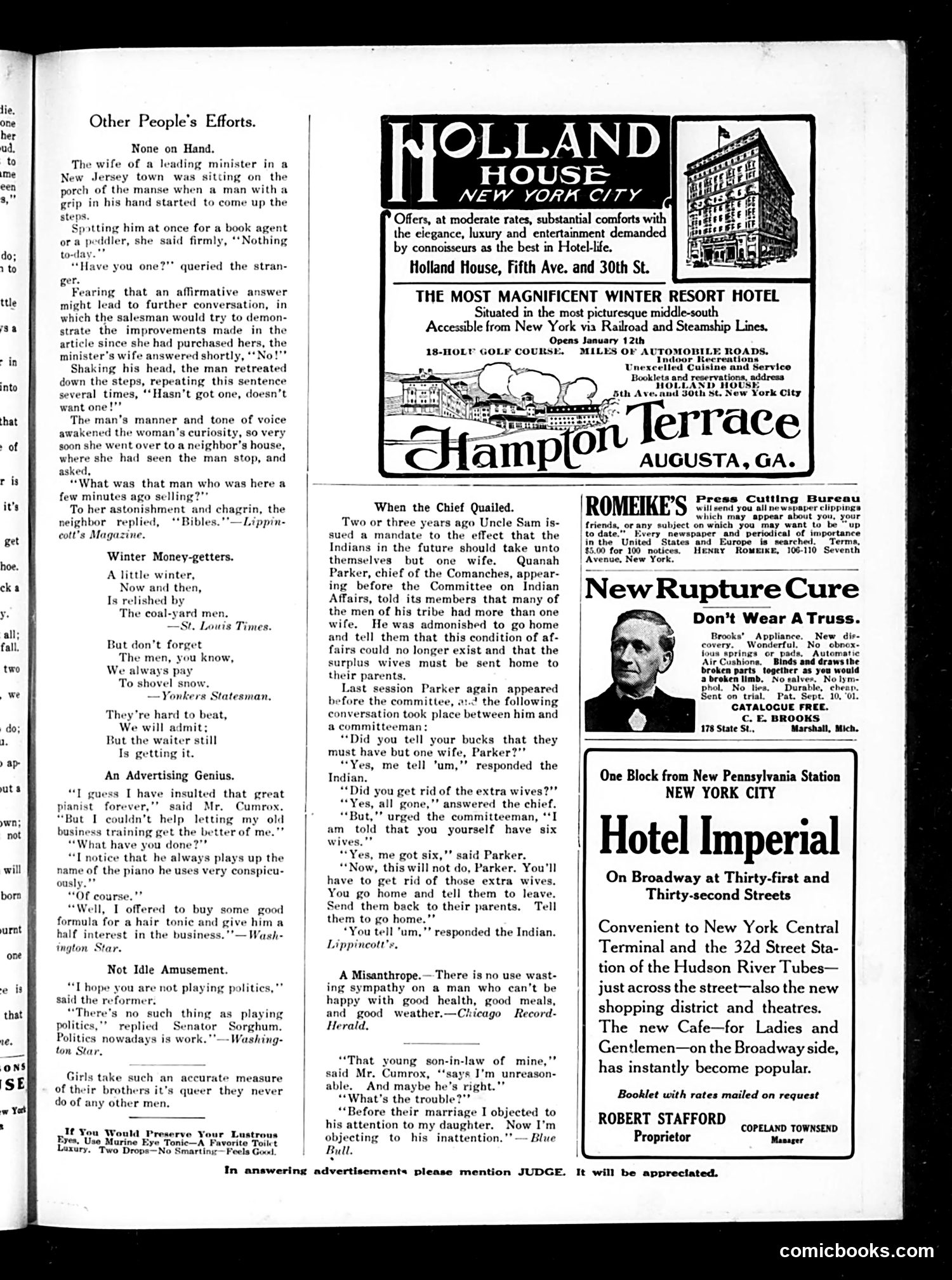
This page is primarily **advertising** with some satirical stories. The main content includes: **"Other People's Efforts"** — A humorous anecdote where a minister's wife rudely rebuffs a visitor, assuming he's a book salesman, only to learn from a neighbor he was actually selling Bibles. The joke satirizes religious hypocrisy and hasty judgment. **"When the Chief Quailed"** — A satirical story about Quanah Parker (actual Comanche chief) being ordered by a Congressional committee to eliminate polygamy among his tribe. The humor derives from the power dynamic: a U.S. government official demands Parker enforce monogamy, but Parker himself claims to have six wives. The satire mocks both the government's paternalistic Indian policy and the absurdity of Parker appearing to comply while personally ignoring the mandate. The remaining content consists of hotel and business advertisements (Holland House, Hotel Imperial, Romeike's Press Cutting Bureau) with brief humorous observations about "winter money-getters" and politics.
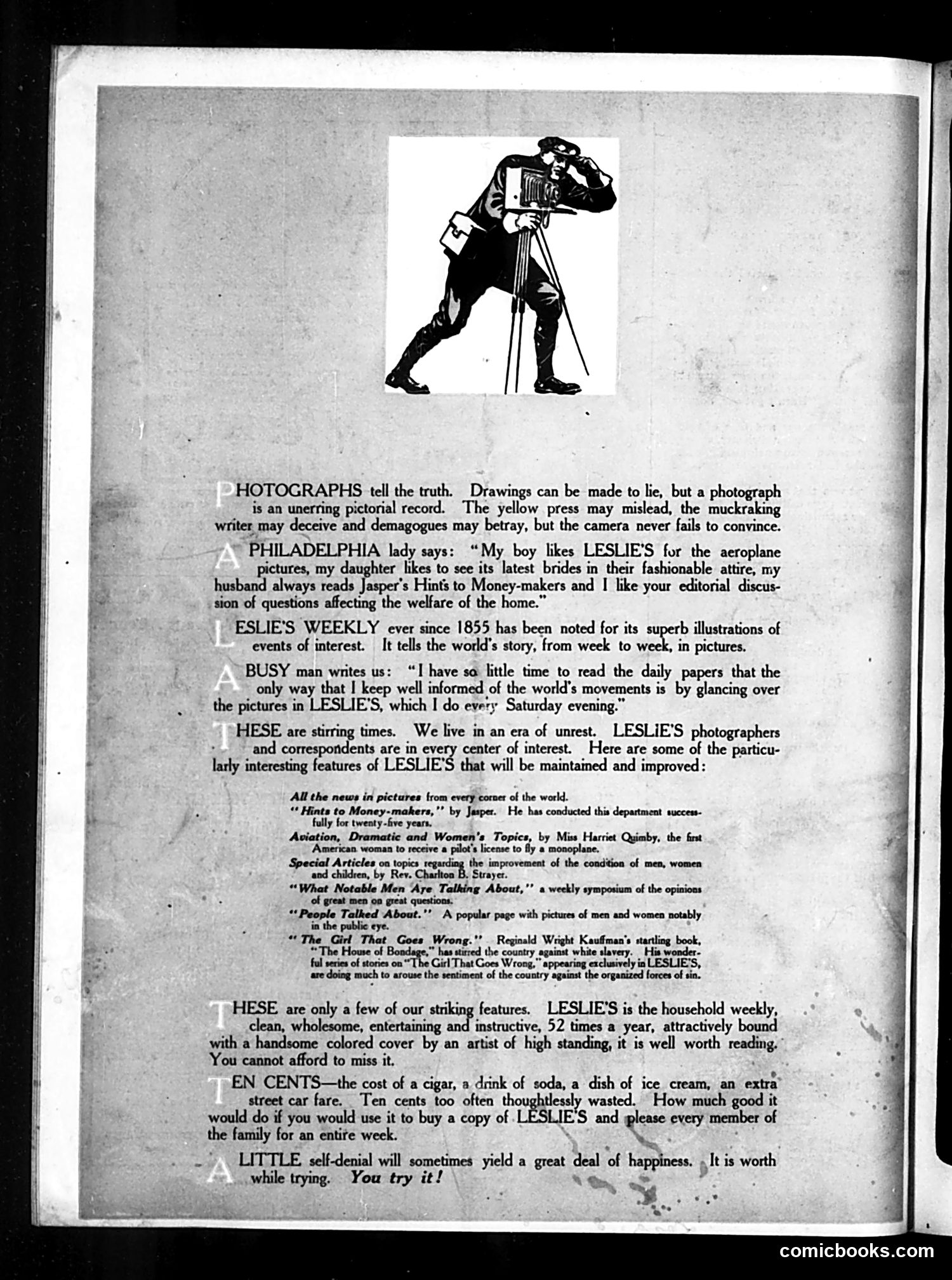
This is primarily a **promotional advertisement** for Leslie's Weekly magazine, not a political cartoon. The image shows a photographer with a large camera on a tripod—symbolizing photojournalism's claim to objective truth. The ad targets middle-class readers by citing testimonials: a Philadelphia family appreciates Leslie's for airplane pictures, fashionable bride coverage, financial advice ("Hints to Money-makers"), and editorial commentary on home welfare. It emphasizes that busy people stay informed through Leslie's pictures rather than lengthy newspaper articles. The magazine advertises specific features including aviation coverage by Harriet Quimby (identified as "the first American woman to receive a pilot's license"), serialized fiction like "The Girl That Goes Wrong" by Reginald Wright Kaufman (described as addressing societal corruption), and symposiums featuring prominent men's opinions. The closing pitch frames a ten-cent subscription as a minor sacrifice—equivalent to a cigar or soda—with moral uplift: "Little self-denial will sometimes yield great happiness."