
Judge, 1912-01-27 · page 4 of 24
Judge — January 27, 1912 — page 4: what you’re looking at
What you’re looking at
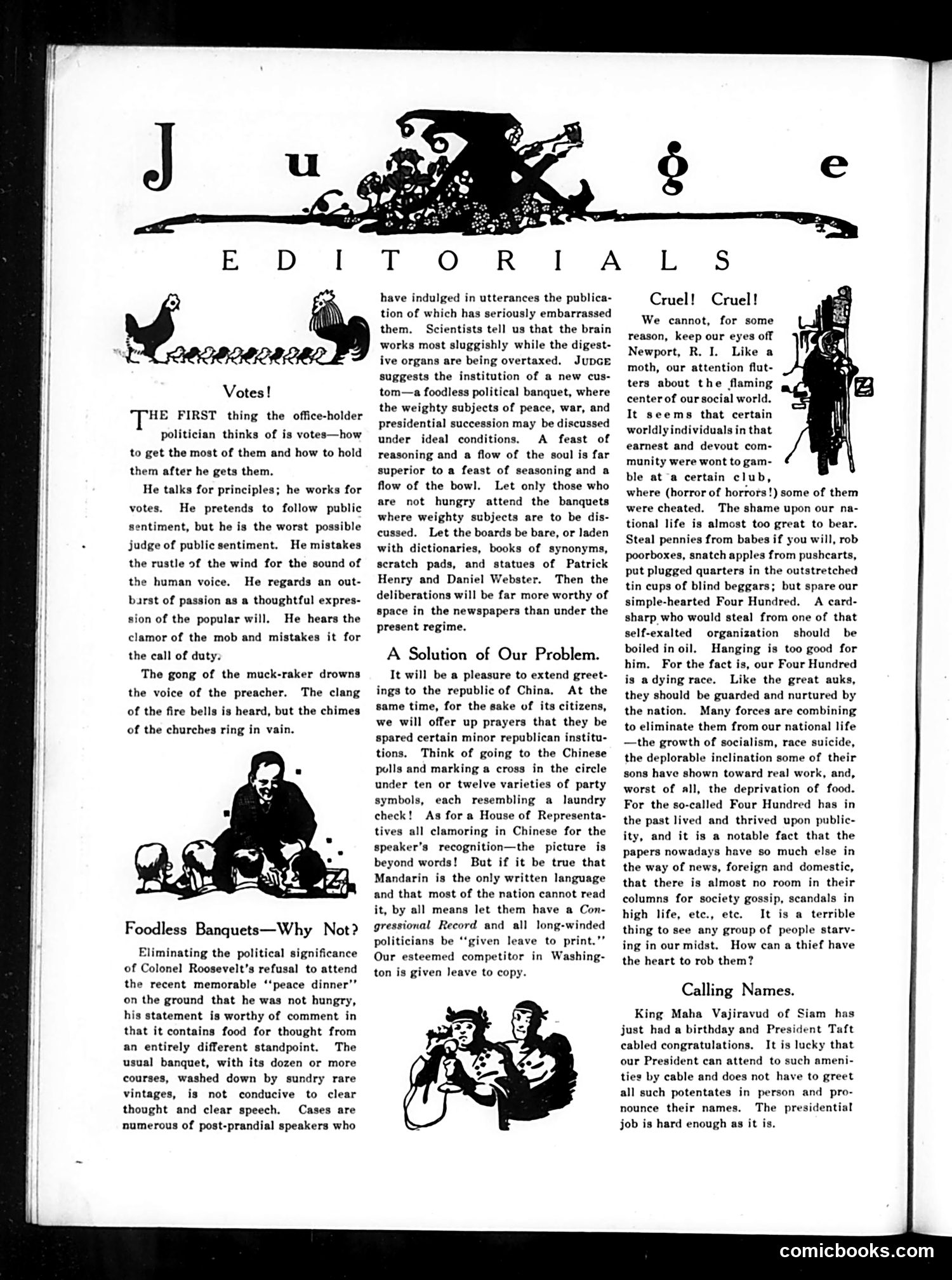
This editorial page satirizes early 20th-century American politics and social issues through multiple pieces: **"Votes!"** mocks politicians who prioritize electoral advantage over principle, comparing their behavior to wind-chasing and claiming they mistake popular passion for actual public sentiment. **"Foodless Banquets—Why Not?"** attacks Colonel Roosevelt's "peace dinner" concept, arguing that elaborate multi-course banquets are incompatible with serious political discourse. The cartoon suggests eliminating formal dining would improve clarity of thought. **"A Solution of Our Problem"** discusses China's political instability and Republican institutional concerns, satirizing American political self-importance. **"Calling Names"** briefly comments on diplomatic protocol regarding King Maha Vajiraud of Siam and President Taft's birthday congratulations. The illustrations feature caricatured figures emphasizing the absurdity of these positions.
📄 Transcribed text from this page (OCR, searchable)
Machine-transcribed from the original scan — historical spelling and the odd misread are preserved.
E D I Votes! HE FIRST thing the office-holder politician thinks of is votes—how to get the most of them and how to hold them after he gets them. He talks for principles; he works for votes. He pretends to follow public sentiment, but he is the worst possible judge of public sentiment. He mistakes the rustle of the wind for the sound of the human voice. He regards an out- barst of passion as a thoughtful expres- sion of the popular will. He hears the clamor of the mob and mistakes it for the call of duty. The gong of the muck-raker drowns the voice of the preacher. The clang of the fire bells is heard, but the chimes of the churches ring in vain. Foodless Banquets—Why Not? Eliminating the political significance of Colonel Roosevelt's refusal to attend the recent memorable ‘‘peace dinner’”’ on the ground that he was not hungry, his statement is worthy of comment in that it contains food for thought from an entirely different standpoint. The usual banquet, with its dozen or more courses, washed down by sundry rare vintages, is not conducive to clear thought and clear speech. Cases are numerous of post-prandial speakers who have indulged in utterances the publi tion of which has seriously embarrassed them. Scientists tell us that the brain works most sluggishly while the digest- ive organs are being overtaxed. JupGE suggests the institution of a new cus- tom—a foodless political banquet, where the weighty subjects of peace, war, and presidential succession may be discussed under ideal conditions. A feast of reasoning and a flow of the soul is far superior to a feast of seasoning and a flow of the bowl. Let only those who are not hungry attend the banquets where weighty subjects are to be dis- cussed. Let the boards be bare, or laden with dictionaries, books of synonyms, scratch pads, and statues of Patrick Henry and Daniel Webster. Then the deliberations will be far more worthy of space in the newspapers than under the present regime. A Solution of Our Problem. It will be a pleasure to extend greet- ings to the republic of China, At the same time, for the sake of its citizens, we will offer up prayers that they be spared certain minor republican institu- tions. Think of going to the Chinese polls and marking a cross in the circle under ten or twelve varieties of party symbols, each resembling a laundry check! As for a House of Representa- tives all clamoring in Chinese for the speaker’s recognition—the picture is beyond words! But if it be true that Mandarin is the only written language and that most of the nation cannot read it, by all means let them have a Con- gressional Record and all long-winded politicians be ‘‘given leave to print.’’ Our esteemed competitor in Washing- ton is given leave to copy. Cruel! Cruel! We cannot, for some reason, keep our eyes off Newport, R. I. Like a moth, our attention flut- ters about the flaming center of our social world. It seems that certain worldly individuals in that earnest and devout com- munity were wont to gam- ble at a certain club, where (horror of horrors!) some of them were cheated. The shame upon our na- tional life is almost too great to bear. Steal pennies from babes if you will, rob poorboxes, snatch apples from pushcarts, put plugged quarters in the outstretched tin cups of blind beggars; but spare our simple-hearted Four Hundred. A card- sharp who would steal from one of that self-exalted organization should be boiled in oil. Hanging is too good for him. For the fact is, our Four Hundred is adying race. Like the great auks, they should be guarded and nurtured by the nation. Many forces are combining to eliminate them from our national life —the growth of socialism, race suicide, the deplorable inclination some of their sons have shown toward real work, and, worst of all, the deprivation of food. For the so-called Four Hundred has in the past lived and thrived upon public- ity, and it is a notable fact that the papers nowadays have so much else in the way of news, foreign and domestic, that there is almost no room in their columns for society gossip, scandals in high life, ete., ete. It is a terrible thing to see any group of people starv- ing in our midst. How can a thief have the heart to rob them? Calling Names. King Maha Vajiravud of Siam has just had a birthday and President Taft cabled congratulations. It is lucky that our President can attend to such ameni- ties by cable and does not have to greet all such potentates in person and pro- nounce their names. The presidential job is hard enough as it is. comicbooks.com