
A complete issue · 24 pages · 1911
Judge — July 22, 1911
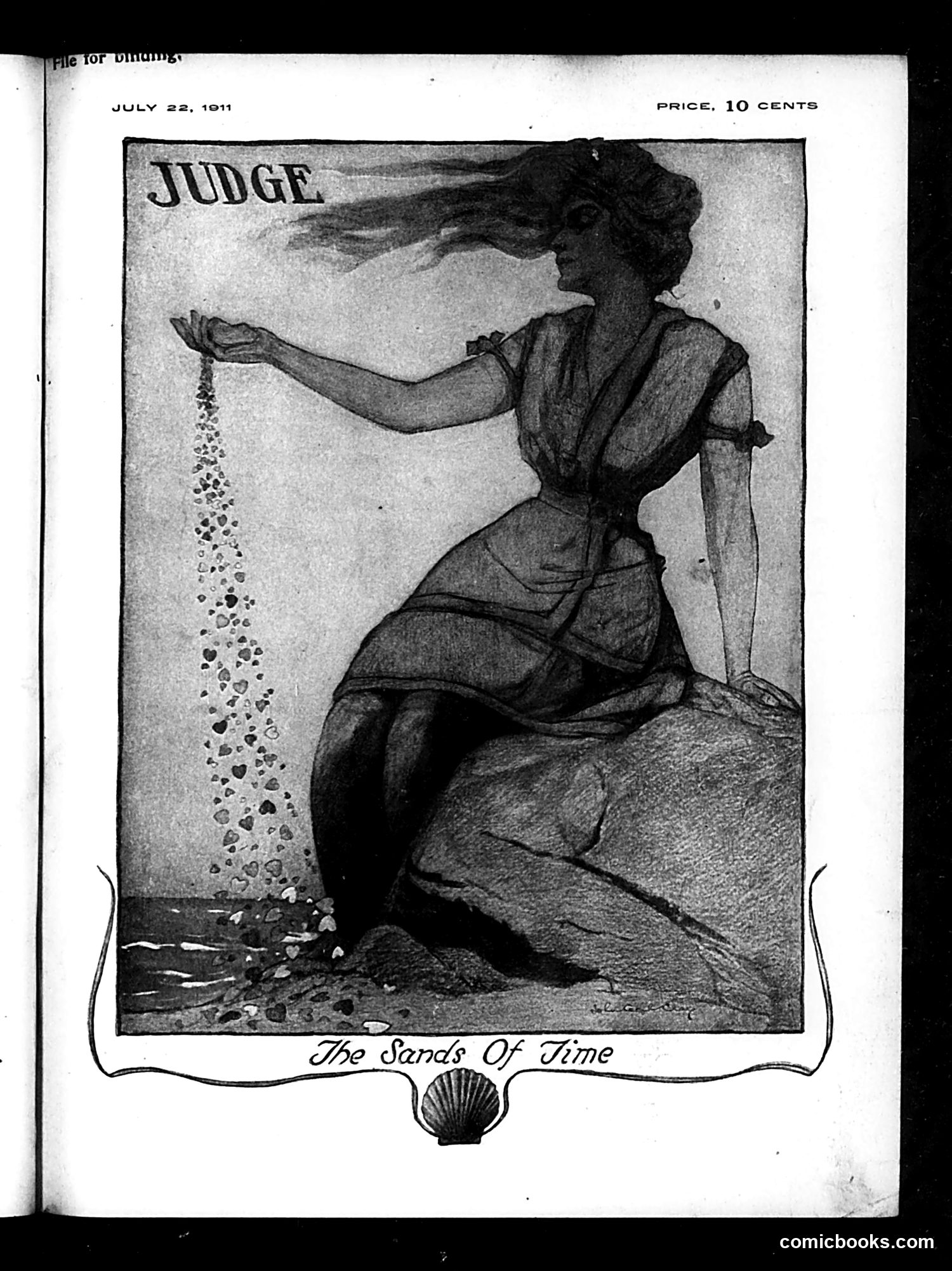
This allegorical illustration depicts a classical female figure (representing Time or Fate) seated on a rock, sifting sand through her fingers. The cascading grains form a stream of hearts—symbols of love or romance. The satire likely comments on the fleeting nature of romantic love or passion, suggesting it slips away inevitably like sand through fingers. The title "The Sands of Time" reinforces this classical metaphor for the passage of time and mortality. Without additional text identifying specific political or social targets, the cartoon appears to offer general philosophical commentary rather than topical satire. It reflects early 20th-century concerns about transience and human emotion typical of Judge's aesthetic-focused pieces.
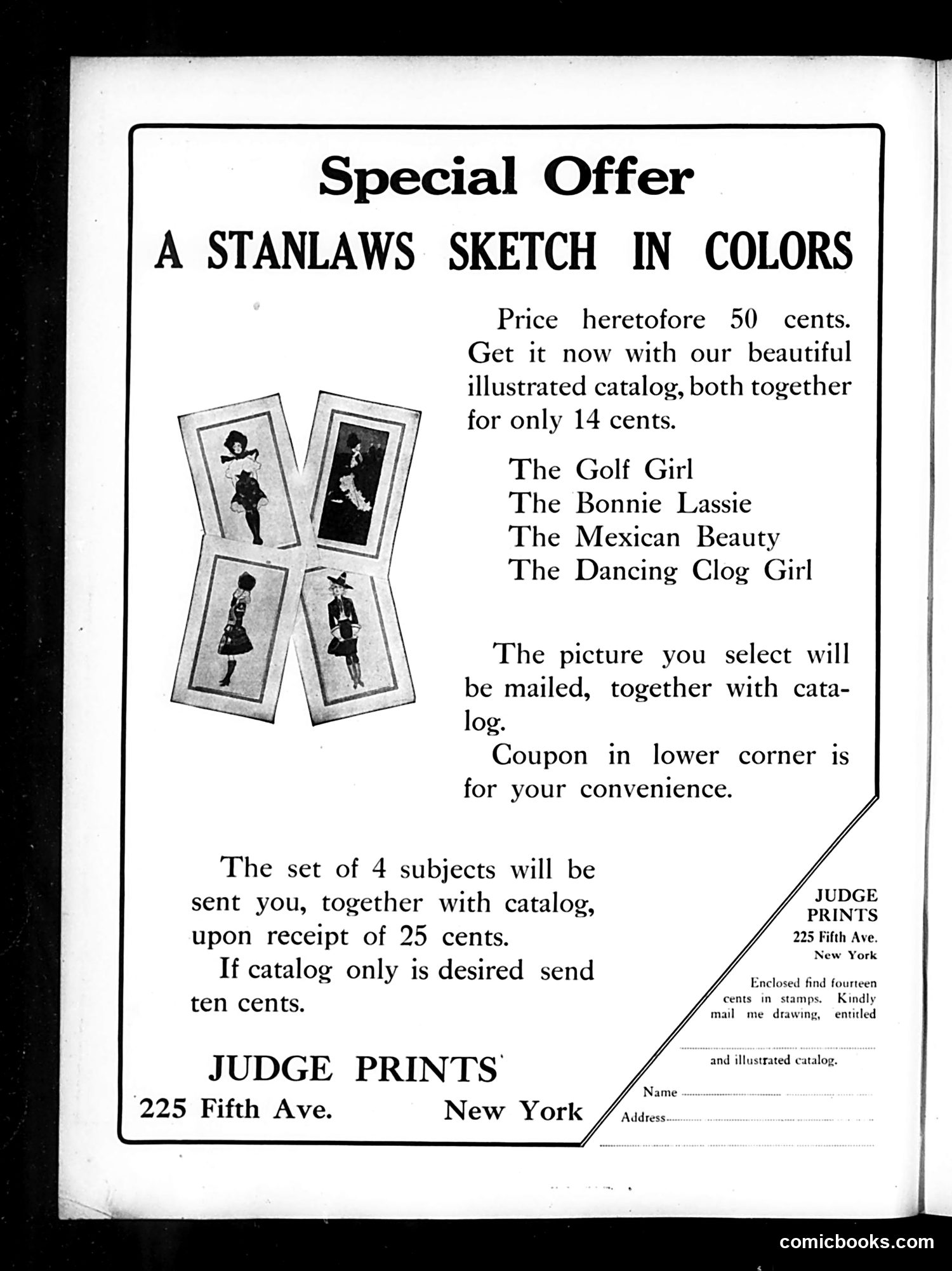
This page is primarily an advertisement rather than satirical content. Judge Prints (a company at 225 Fifth Ave, New York) is offering a special promotional deal: customers can purchase a Stanlaws colored sketch for 14 cents along with an illustrated catalog, down from the sketch's original 50-cent price. Four subjects are available for selection: "The Golf Girl," "The Bonnie Lassie," "The Mexican Beauty," and "The Dancing Clog Girl." Customers could also purchase all four sketches plus catalog for 25 cents, or the catalog alone for 10 cents. A coupon is included for ordering. The sketches appear to be fashion or lifestyle illustrations rather than political cartoons, reflecting early 20th-century popular illustration styles and subjects.
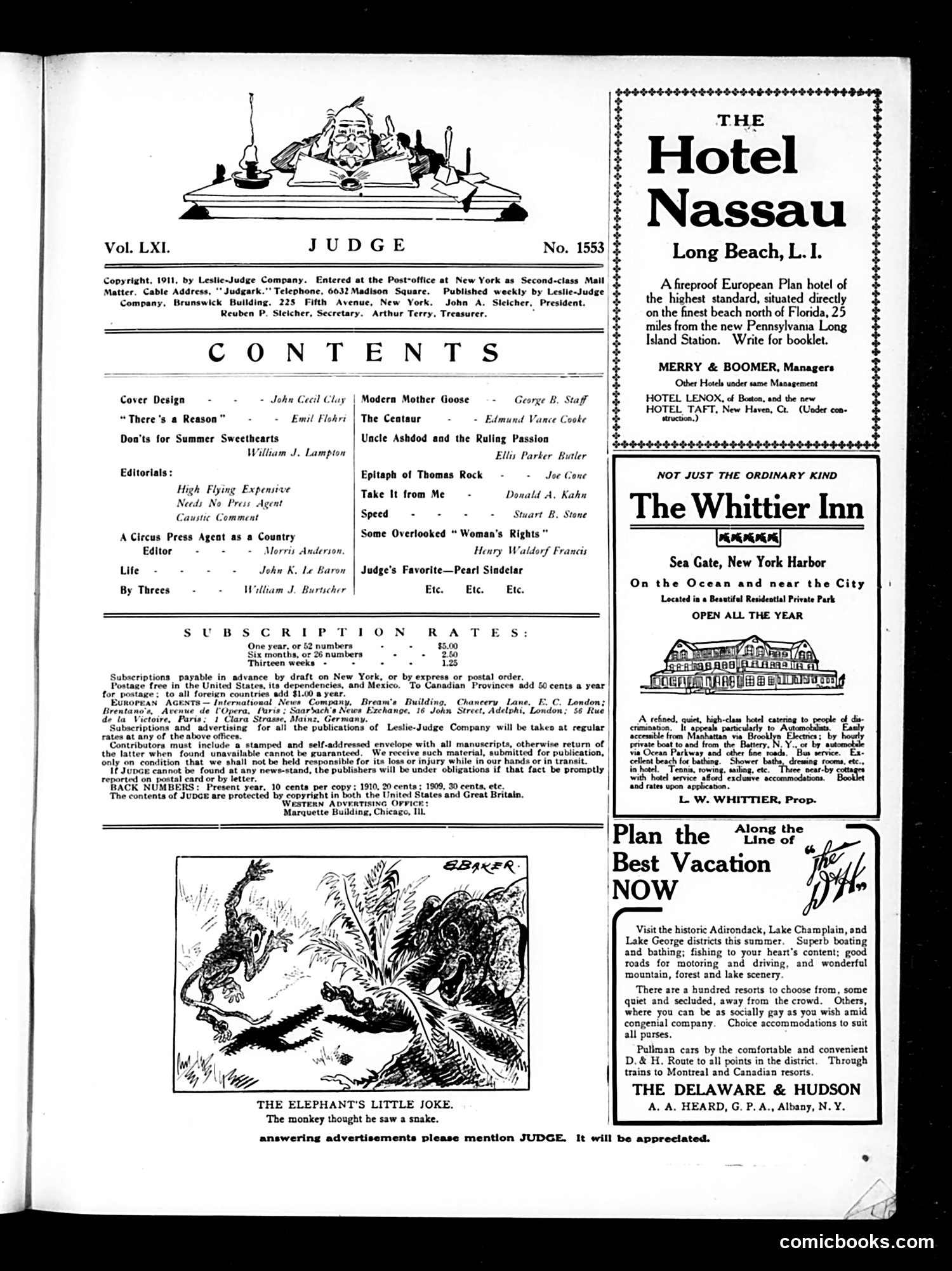
The cartoon shows a monkey observing a snake, with the caption "The monkey bought he saw a snake." This appears to be a simple visual pun rather than political satire. The humor relies on a play of words or perception—the monkey mistakes one thing for another. The cartoon's modest size and placement at the bottom of the page, along with its innocent subject matter (animals rather than political figures), suggests this is filler content rather than Judge magazine's typical satirical commentary on current events or prominent figures. The cartoon lacks the sharp political edge characteristic of Judge's standard offerings, making it likely intended simply as light entertainment for readers.
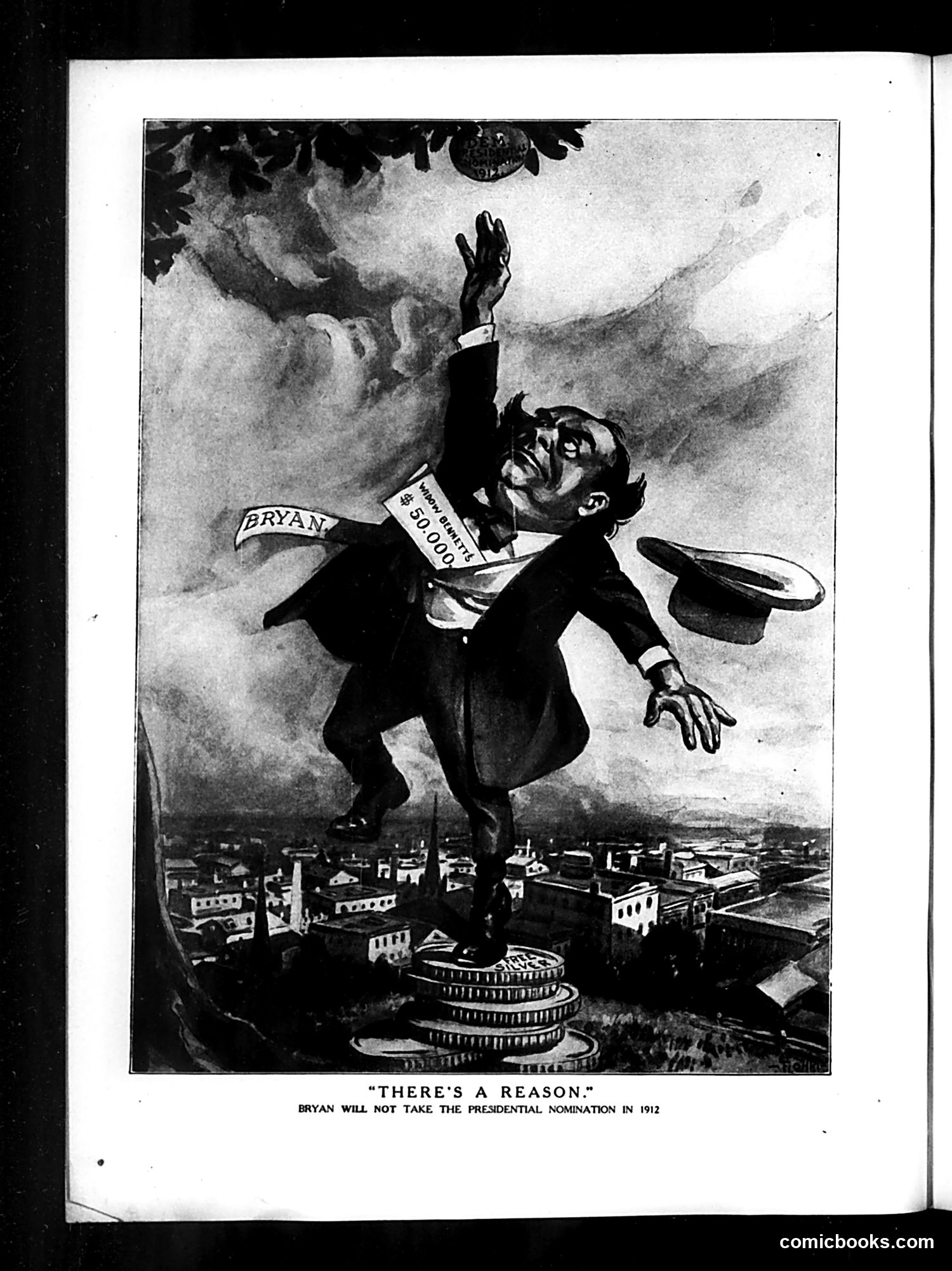
This 1912 Judge magazine cartoon depicts William Jennings Bryan—identified by the labeled sash—standing atop what appears to be the Capitol building, reaching skyward amid storm clouds. He's dropping his top hat and appears distressed. The caption states: "Bryan will not take the presidential nomination in 1912." The cartoon satirizes Bryan's decision to decline the Democratic presidential nomination that year. The dramatic, almost biblical imagery—with Bryan positioned above the cityscape like a falling figure—suggests the cartoonist viewed this as a significant political moment or retreat. The "reason" referenced in the title remains implicit, likely critiquing either Bryan's political judgment or circumstances forcing his withdrawal from consideration.
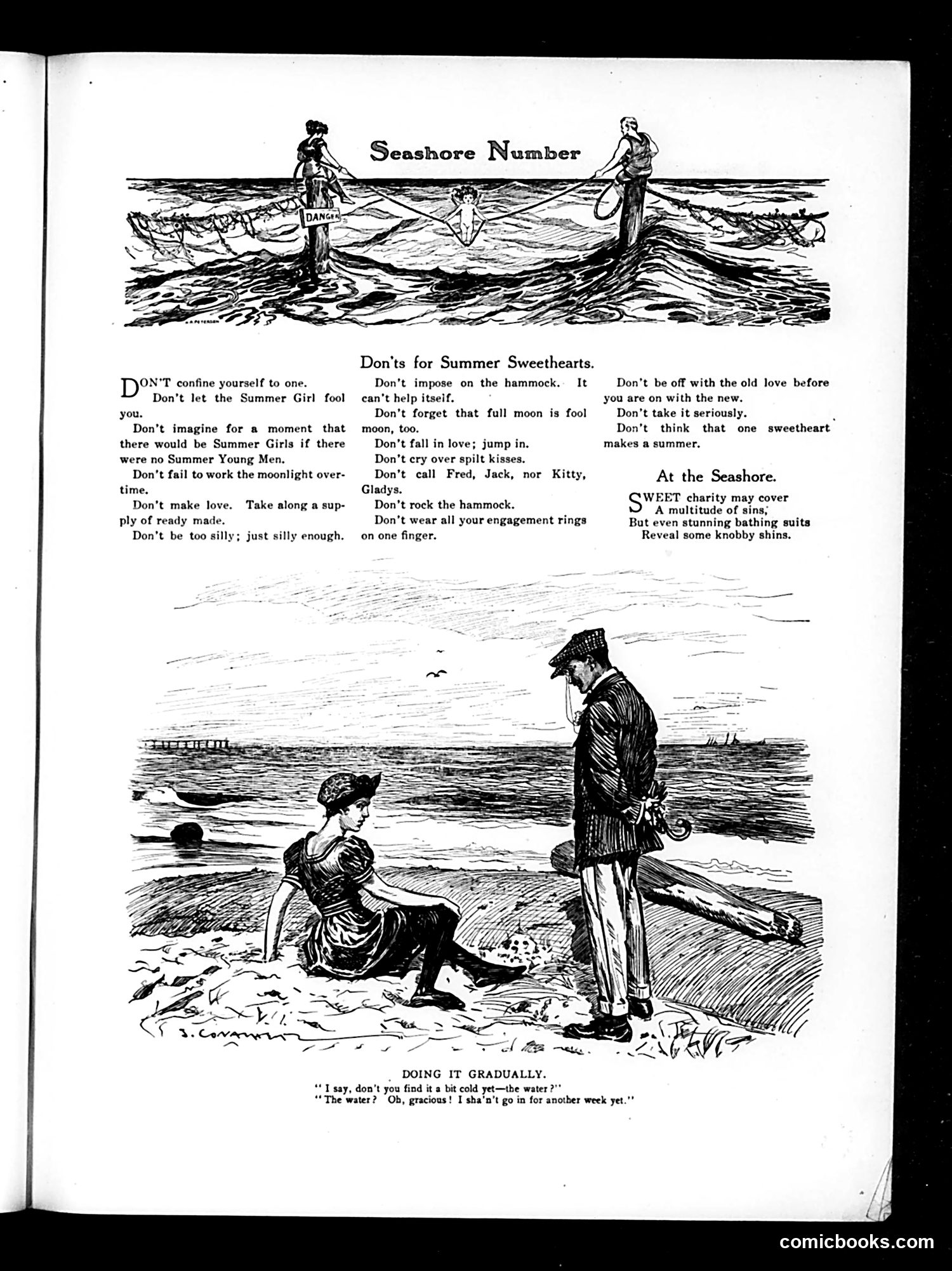
This page presents humorous advice for summer romance at the beach, targeting young couples. The upper section offers tongue-in-cheek "Don'ts" for Summer Sweethearts—cautioning against exclusive relationships, excessive public displays of affection, and romantic clichés like hammock encounters. The cartoon below titled "DOING IT GRADUALLY" depicts a couple at the seashore. A man stands hesitantly while a woman sits in the shallow water, encouraging him to enter. His reluctant response—fearing cold water and refusing to return next week—serves as a metaphor for cautious romantic progression. The humor relies on the double meaning of "doing it gradually" (entering water versus romantic commitment), typical of Judge's sophisticated, adult-oriented satire mocking both timid suitors and summer romance conventions of the era.
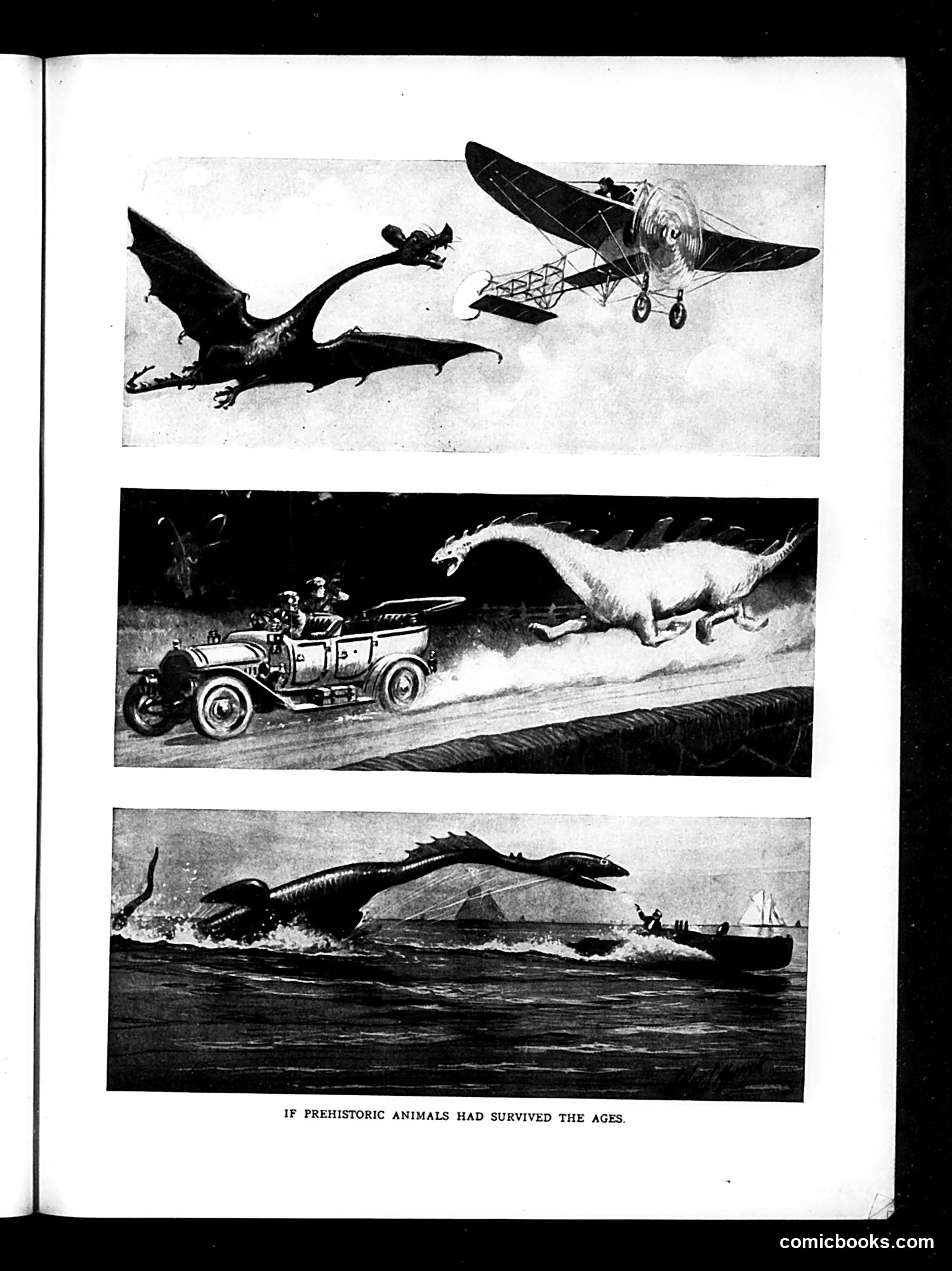
This is a humorous speculative fantasy rather than political satire. The caption "If Prehistoric Animals Had Survived the Ages" frames three whimsical scenes imagining how extinct creatures—likely dinosaurs—would interact with modern civilization (circa early 20th century, based on the aircraft and automobile styles shown). The top image shows pterosaurs alongside early biplanes, the middle depicts a long-necked sauropod alongside a motorcar, and the bottom shows marine reptiles near a ship. The joke relies on the absurdist contrast between prehistoric scale and modern technology, suggesting these massive creatures would dwarf human inventions if they'd never gone extinct. This reflects early-20th-century fascination with paleontology and dinosaurs as popular curiosities, presented as lighthearted visual humor rather than social commentary.
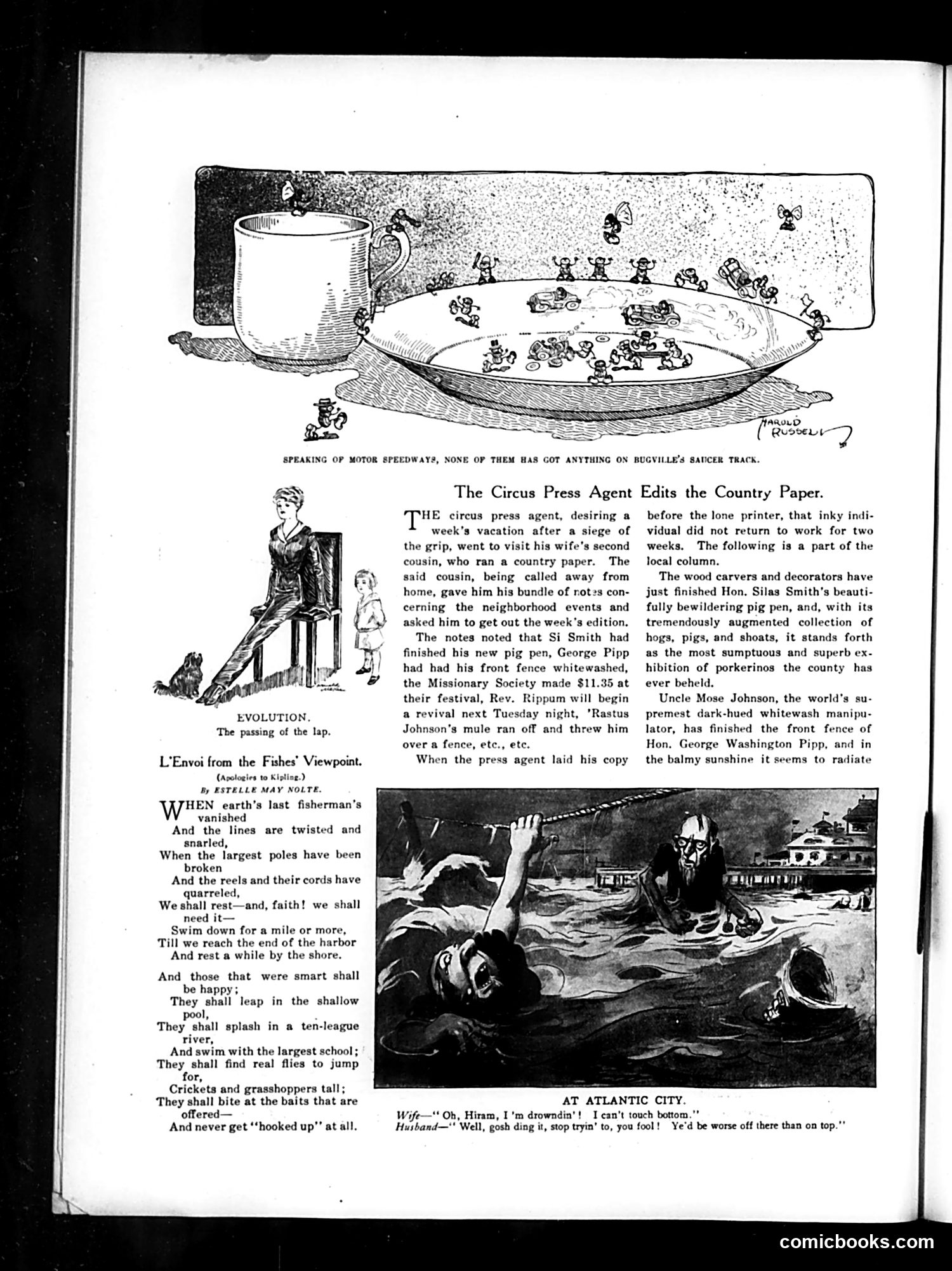
This page contains three separate pieces of humor: **Top cartoon**: A visual joke about motor speedways. Tiny figures race around the rim of a giant bowl/plate next to a cup, captioned "BUGVILLE'S SAUCER TRACK"—satirizing how humans obsess over automobile racing by imagining insects doing the same on household objects. **Middle poem**: "L'Envoi from the Fishes' Viewpoint" parodies Kipling's famous poem "L'Envoi," reimagining it from fish perspectives. It mocks fishing by having fish celebrate a future when they'll never get "hooked up" again—reversing the typical hunter-versus-hunted dynamic into gentle satire about the sport. **Main story**: A circus press agent editing a small-town newspaper hilariously inflates mundane local news. A simple "pig pen" becomes a "sumptuous exhibition of porkerinos"; whitewashing a fence transforms into artistry. It satirizes both circus hucksterism and small-town newspaper pretension. **Bottom cartoon**: A husband-and-wife bathing joke playing on dialect humor common to the era.
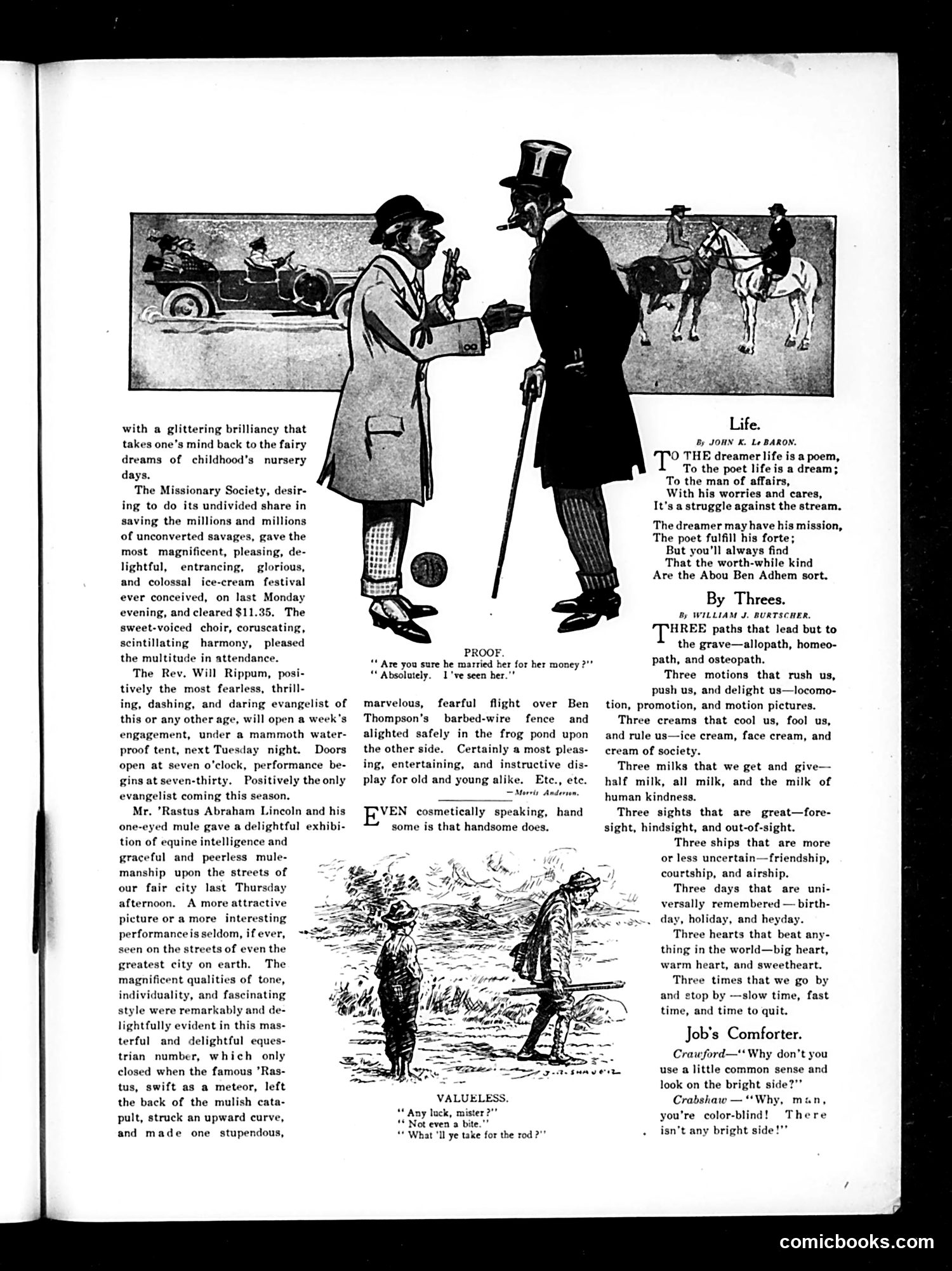
This page contains **multiple unrelated humor pieces and poems**, typical of Judge's miscellaneous format: **Top cartoons**: Two single-panel jokes. The left shows a man asking a woman "Are you sure he married her for her money?"—she replies "Absolutely. I've seen her," implying her ugliness made financial motivation obvious. The right depicts fishing mishaps with period humor about bad luck. **Text sections** include: - Satirical accounts of local events (a Missionary Society ice cream social, a Black performer named "'Rastus Abraham Lincoln" doing a mule riding stunt)—written in exaggerated, overwrought language mocking small-town journalism's breathless reporting - A poem "Life" by John K. Le Baron contrasting dreamers and practical people - "By Threes," a series of clever wordplay contrasts (three paths to the grave, three creams, etc.) - A final joke about pessimism **The satire targets** journalistic excess, racial stereotypes (period-typical), and everyday human nature rather than specific political events.
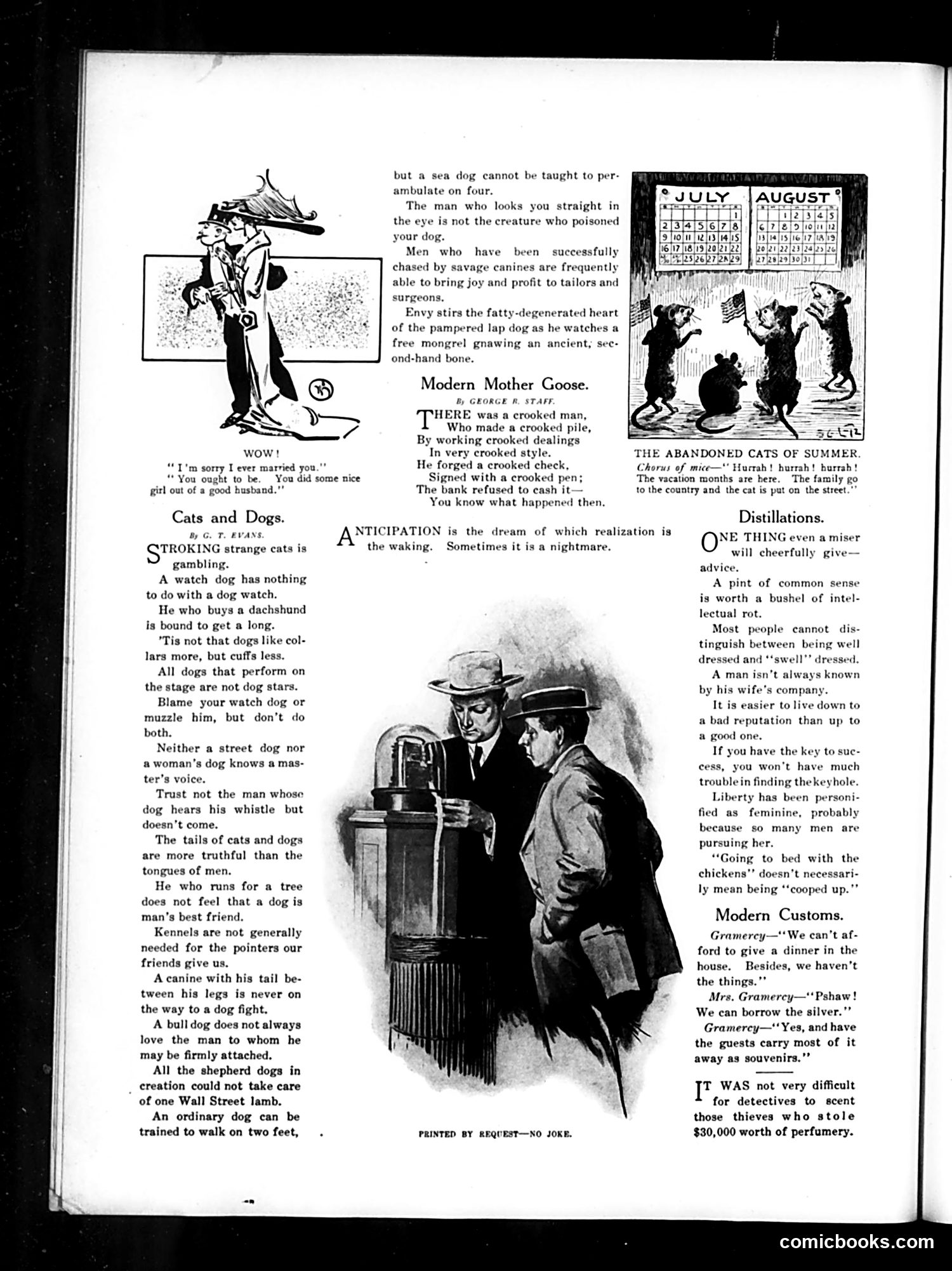
This page contains multiple satirical pieces typical of Judge magazine's humor: **"Cats and Dogs"** by G.T. Evans presents cynical aphorisms comparing pet behavior to human nature—suggesting dogs are unreliable, cats more honest, and that pet ownership reveals character flaws. The opening cartoon shows a married couple where the wife suggests her husband would've been "a good husband" to someone else, mocking marriage dissatisfaction. **"Modern Mother Goose"** by George F. Staff presents a dark nursery rhyme about a crooked businessman who commits fraud and forgery—contemporary satire on Wall Street corruption and white-collar crime. **"The Abandoned Cats of Summer"** (illustration with calendar) depicts street cats abandoned when families vacation, anthropomorphizing mice celebrating their absence. **"Distillations"** offers cynical social commentary on etiquette, reputation, and hypocrisy—notably that "Liberty" is personified as feminine "because so many men are pursuing her." **"Modern Customs"** satirizes upper-class pretense: families who can't afford dinner entertainments borrow silver, which guests steal as souvenirs. Overall, the page reflects early-20th-century Judge's sardonic critique of American social hypocrisy and materialism.
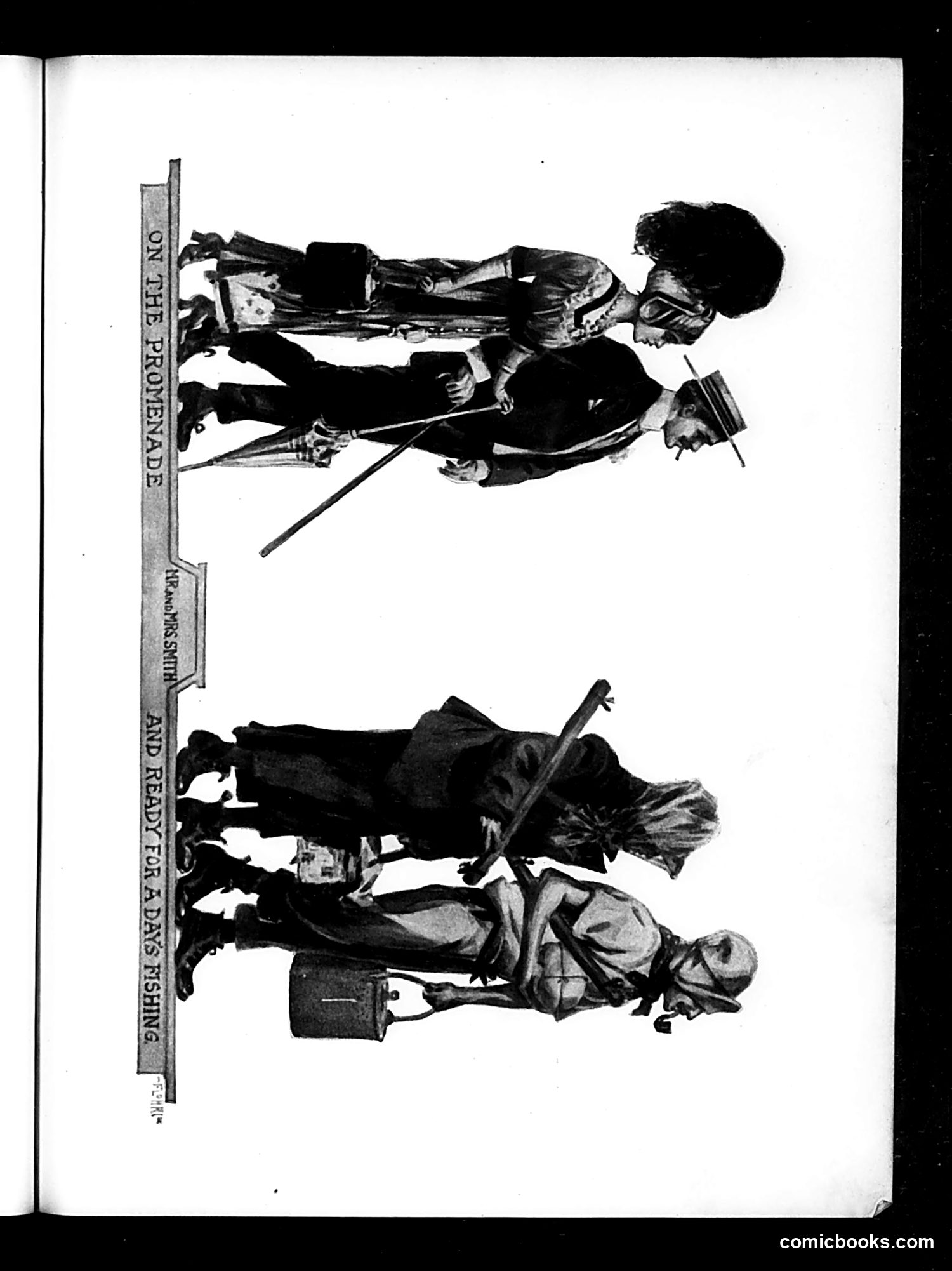
The OCR text is too corrupted to read clearly. However, the image shows two vertically-oriented figures in formal attire (suits and hats), appearing to be engaged in some kind of physical altercation or struggle with implements that look like tools or weapons. Without legible text, I cannot confidently identify the specific political figures, historical event, or satirical point being made. The style and presentation suggest this is indeed a Judge magazine political cartoon, likely early-to-mid 20th century based on the clothing and photographic quality, but determining the actual subjects, context, and satirical message would require either clearer OCR text or additional historical documentation. **I cannot reliably explain this cartoon's meaning given the page's illegibility.**
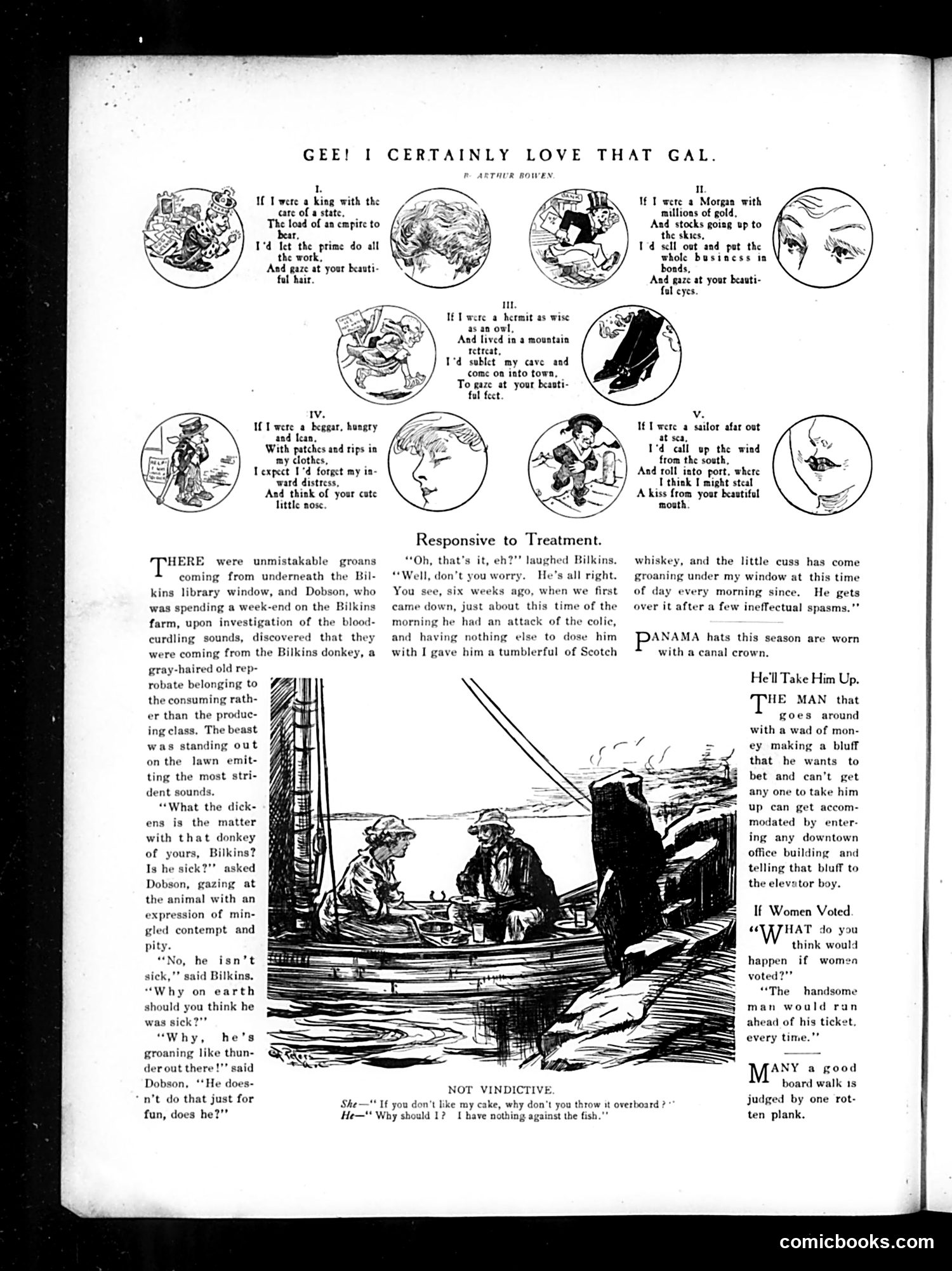
This page from *Judge* (a major American satirical magazine) contains three distinct sections: **"Gee! I Certainly Love That Gal"** (top): A poem by Arthur Bowen illustrated with five circular vignettes. Each verse uses the "If I were..." formula to humorously declare that no matter a man's power or wealth—king, hermit, millionaire, beggar, or sailor—he'd abandon it all to gaze at his beloved's physical features (hair, feet, eyes, nose, mouth). The satire targets romantic sentimentality and male susceptibility to female beauty, mocking overwrought declarations of love. **"Responsive to Treatment"** (middle): A brief humorous anecdote about Bilkins' donkey producing strange groaning sounds. The punchline: the animal has learned that groaning brings Scotch whiskey, so it repeats the behavior daily for reward. The satire mocks habit-forming substance use. **Miscellaneous quips** (right): Brief one-liners satirizing gender dynamics ("If Women Voted"), male bluffing behavior, and everyday observations about judgment and character. Overall, the page reflects early 20th-century American humor emphasizing romantic foolishness, drinking culture, and gender stereotypes.
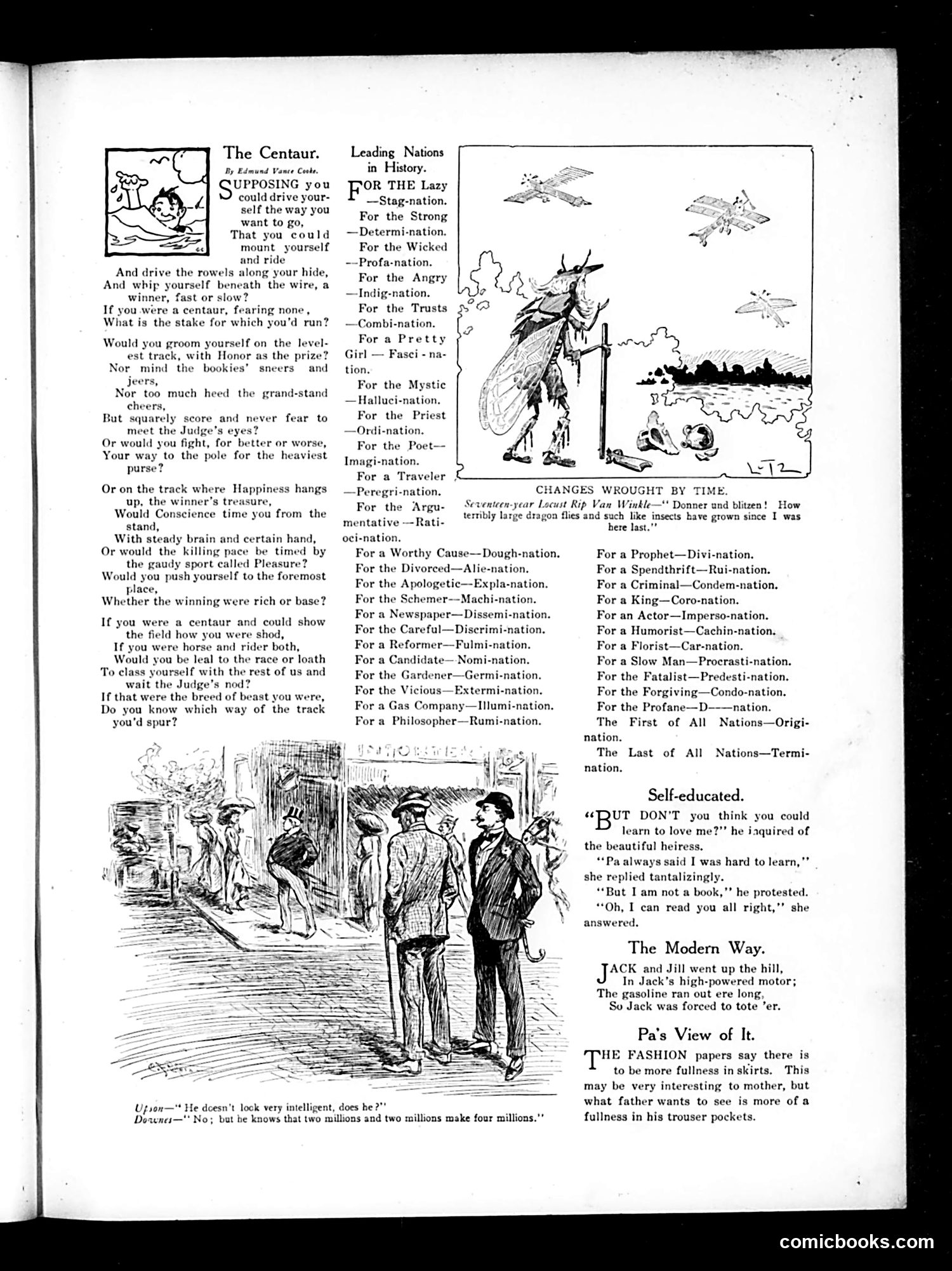
This page satirizes American social types through wordplay. The central poem uses a centaur (half-human, half-horse) as a metaphor for life choices, asking whether one would pursue honor, pleasure, or ruthless success. The accompanying list mocks contemporary institutions and professions by pairing them with "-nation" suffix words: "trusts" get "combination," "priests" get "ordination," newspapers get "dissemination," etc. The illustrations depict various American character types (appearing to represent different social classes and professions) making foolish choices or contradictions. Below are lighter satirical pieces: a joke about an heiress unable to "learn" love, a motorcar humor bit, and a fashion commentary where the father cares more about wallet fullness than skirt fullness. The overall tone mocks American social pretension, materialism, and hypocrisy—suggesting that most people, regardless of calling, pursue base motivations rather than noble ideals.
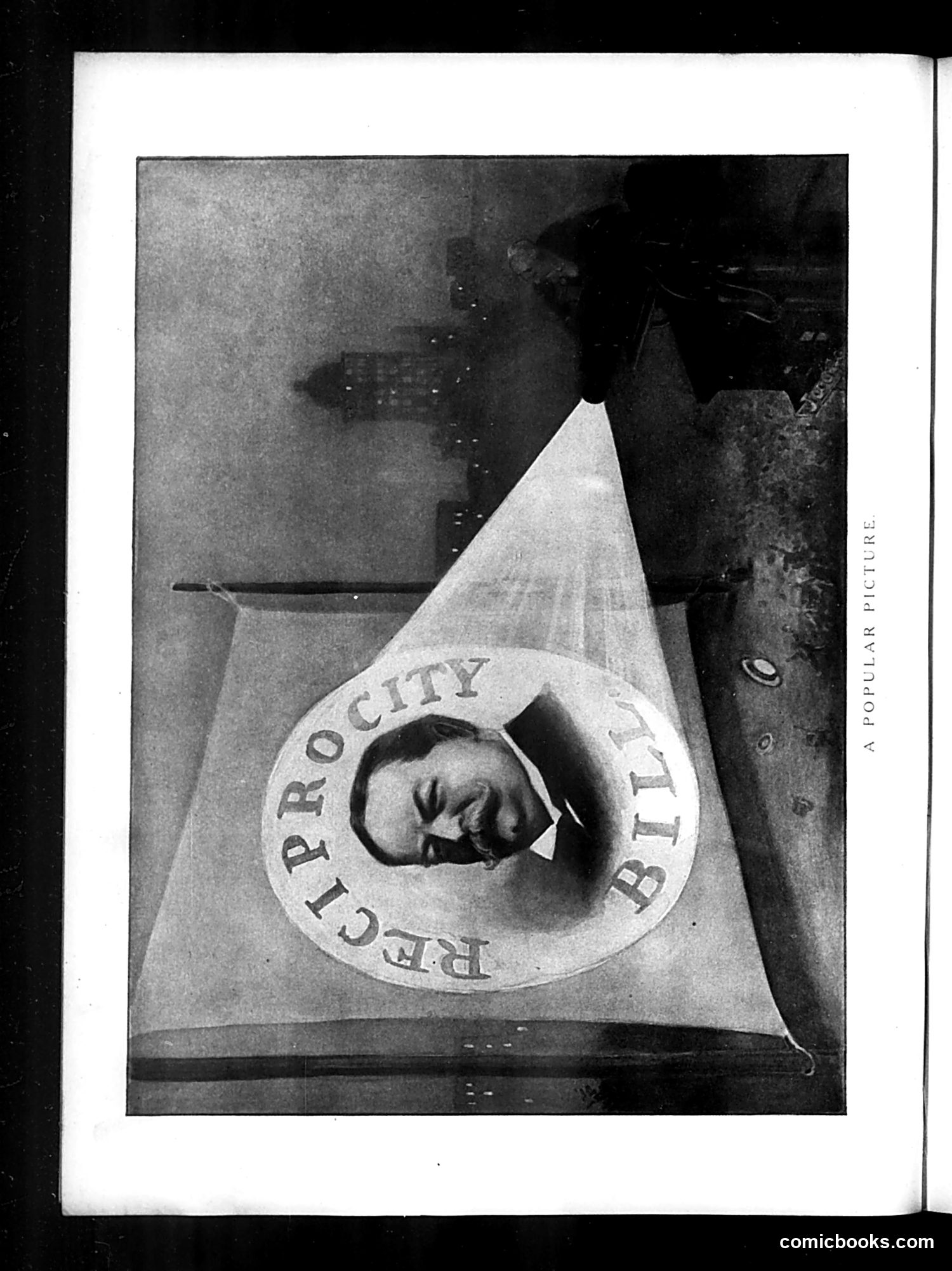
This page appears to be from Judge magazine and shows "A Popular Picture" - a conical party hat or dunce cap with a circular medallion featuring a caricatured face. Text on the medallion reads "BERLIN ROCITY BITT" (likely OCR errors for what may be a German or political reference). The image is rotated 90 degrees in the scan, making it difficult to read fully. Without clearer text or additional context about the publication date, I cannot definitively identify the specific political figure or event being satirized. The dunce cap suggests mockery of someone perceived as foolish, likely a political or military leader. The "Berlin" reference suggests this targets German leadership, possibly from the World War I era when Judge magazine was active in political satire. More context is needed for certain identification.
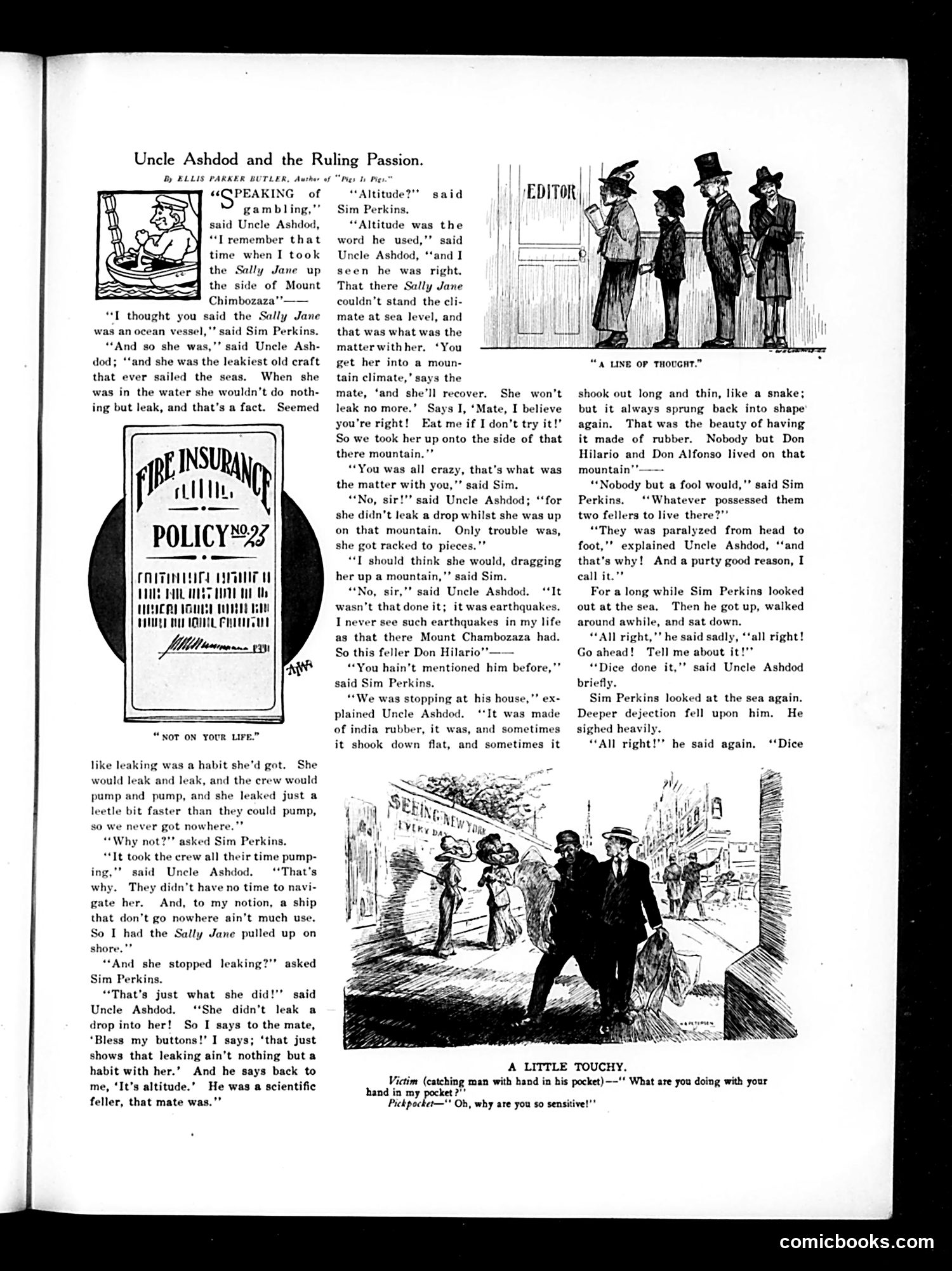
This page contains a tall tale by Ellis Parker Butler about Uncle Ashdod's ship, the Sally Jane. The humor relies on absurd logic: the ship leaked constantly at sea, but when pulled ashore onto a mountain, it stopped leaking—leading the "scientific" mate to blame the problem on sea-level "altitude" rather than water. When moved to Mount Chambozaza, the ship gets destroyed by earthquakes instead, though it no longer leaks. The accompanying advertisement features a fire insurance policy. Below is a separate cartoon ("A Little Touchy") showing a pickpocket caught with his hand in someone's pocket, cheekily asking why the victim is being "so sensitive"—satirizing petty theft as merely a matter of perspective. Both pieces reflect Judge magazine's blend of verbal wit and visual humor aimed at educated readers.
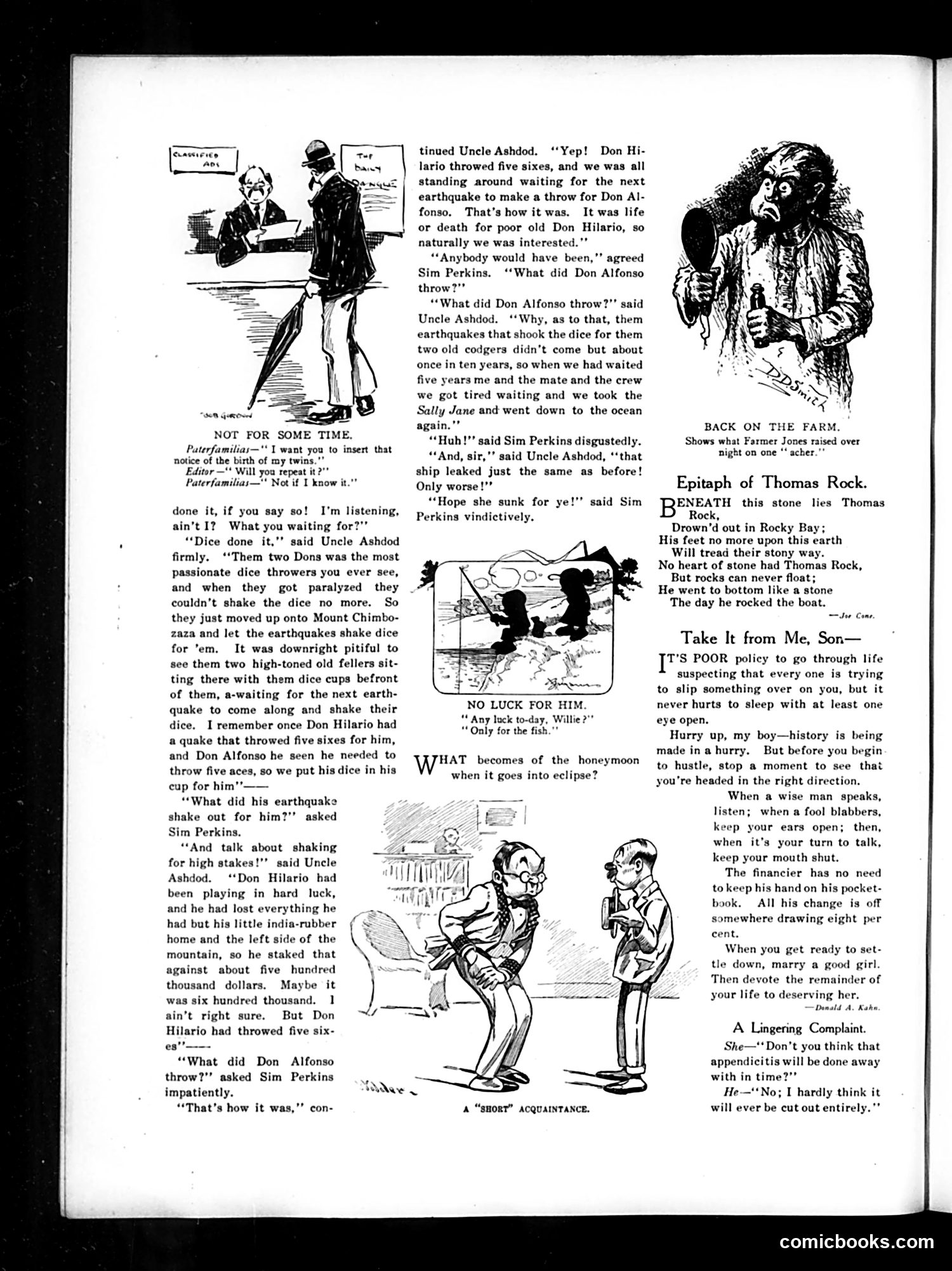
This Judge magazine page contains multiple humor pieces targeting American life and attitudes circa early 20th century. The main narrative features "Uncle Ashdod" telling an absurdly long, pointless tall tale about two Spanish miners ("Don Hilario" and "Don Alfonso") gambling with dice shaken by earthquakes on a mountain—a deliberate parody of rambling, digressive storytelling that frustrates the listener Sim Perkins, who repeatedly interrupts asking for the punchline. The satire mocks American love of drawn-out, meandering anecdotes and impatient modern audiences. Other cartoons lampoon family life (a father not wanting repeated birth announcements), maritime mishaps, and romantic disillusionment. The page's various short quips and epigraphs target financial speculation, marriage advice, and social pretense—typical Judge fare exposing human folly through gentle ridicule rather than sharp political commentary.
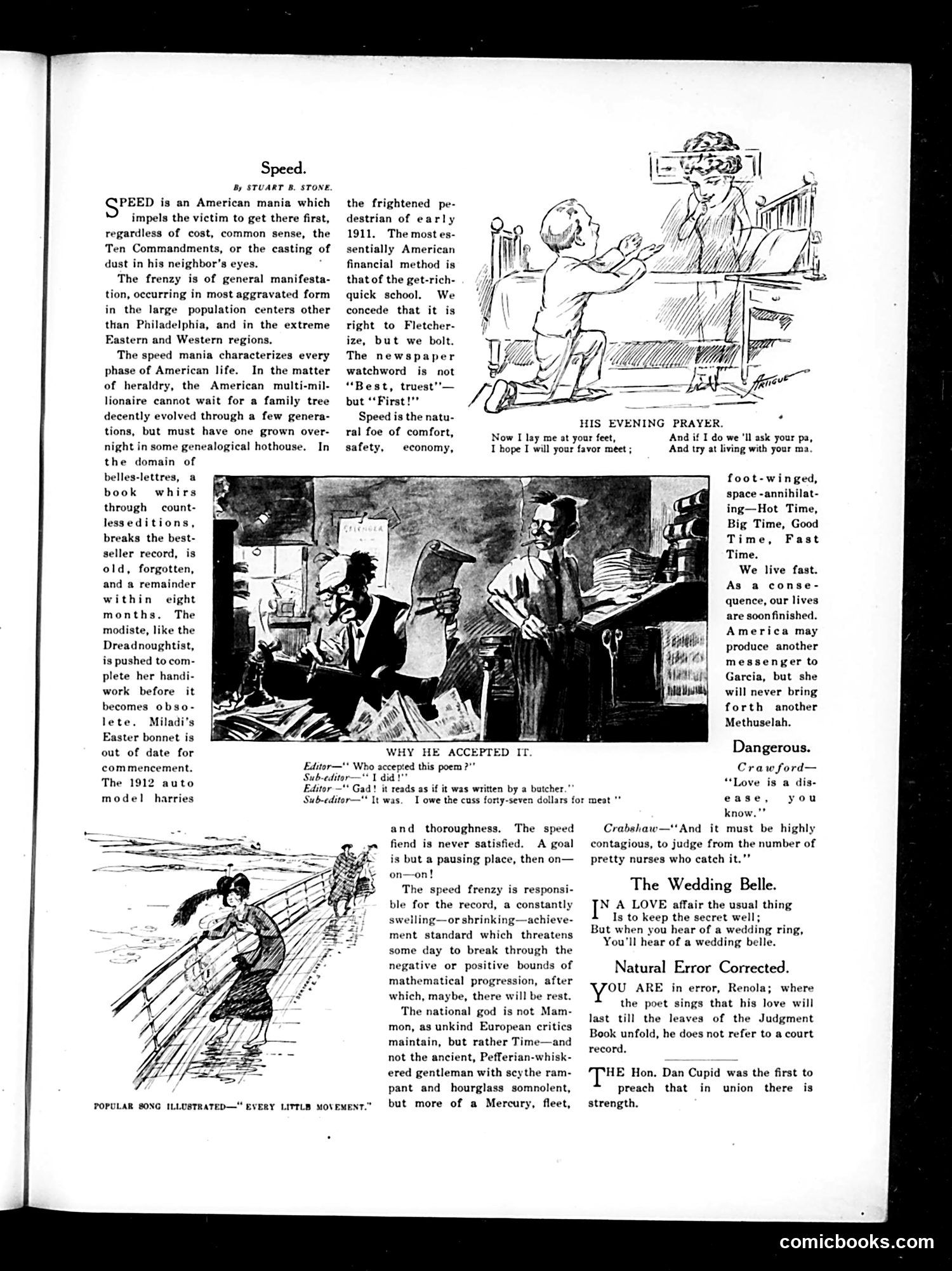
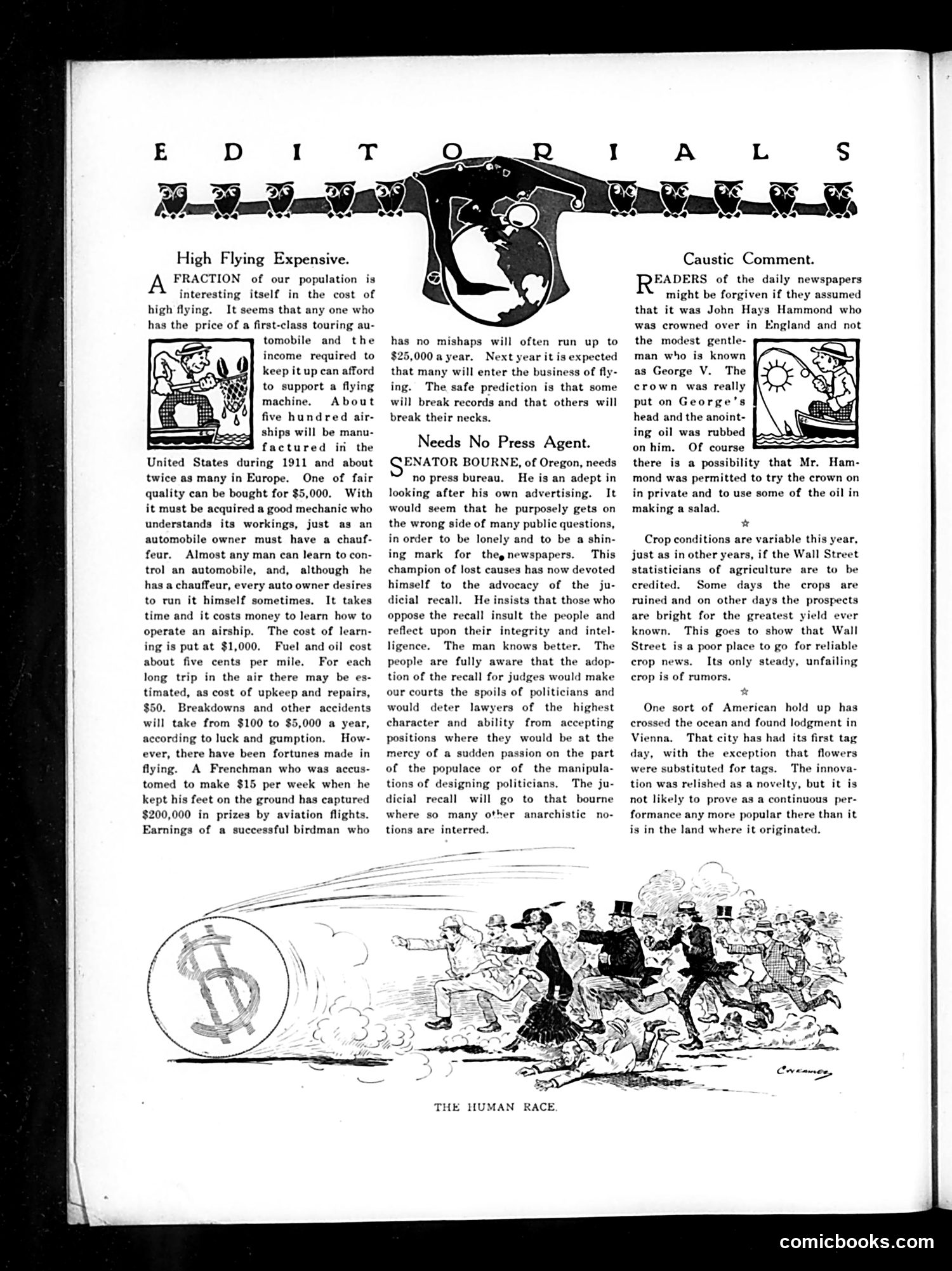
This article satirizes American culture's obsession with speed and rushing, presented as a widespread national "mania." Stone argues that Americans prioritize getting there first over quality, safety, or morality across all domains: genealogy (instant family trees), publishing (books become obsolete within months), fashion, and especially the "get-rich-quick" financial schemes of 1911. The cartoon illustrations reinforce the theme: one shows a child's bedtime prayer about speed; another depicts reckless railroad passengers. The humor lies in Stone's exaggerated critique that Americans worship "Time" as a god (represented as the Roman messenger Mercury rather than the ancient, patient figure with a scythe). The accompanying editorial jokes about accepting poetry "as if written by a butcher" and a quarrel over money further reinforce Judge's conservative satirical stance against modern American values—depicting speed culture as inherently dangerous and spiritually bankrupt.
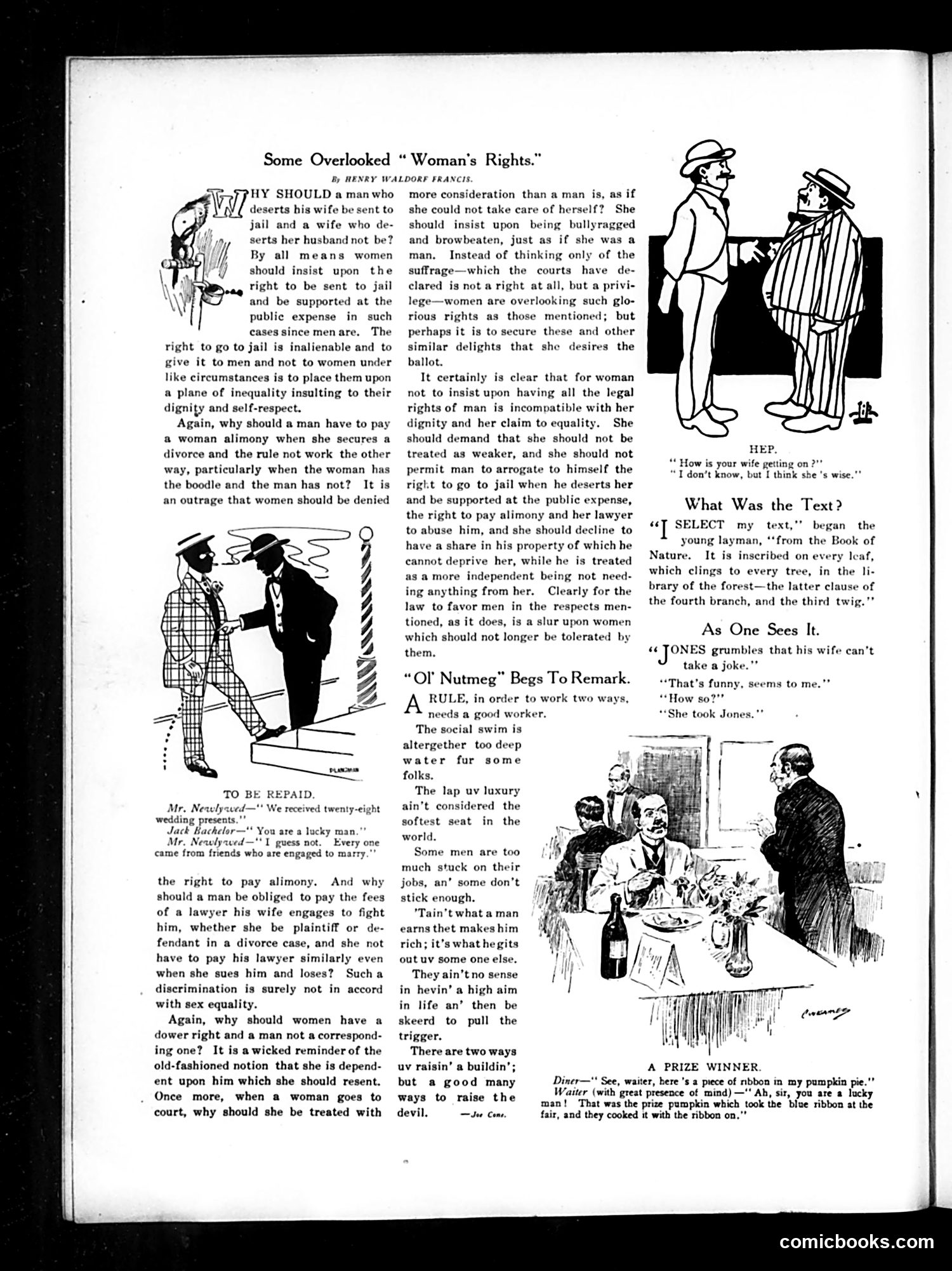
This 1910s satirical piece uses **ironic reversal** to critique women's rights advocates. Henry Waldorf Francis argues that if women truly want equality with men, they should demand the *burdens* men carry—not just voting rights. He sarcastically insists women should have the "right" to go to jail for deserting husbands, pay alimony, cover legal fees, and lack dower protections. The satire's logic is deliberately backwards: Francis suggests women focus on these undesirable obligations rather than the ballot. This ridicules the notion that formal equality means accepting all male responsibilities, while also mocking those who see women's rights as merely symbolic voting power. The accompanying cartoons and jokes reinforce traditional gender roles—a newlywed receives expensive gifts; a wife is "wise" for divorcing a man; marital discord is humorous. The page essentially argues against expanding women's legal independence by making equality sound absurd.
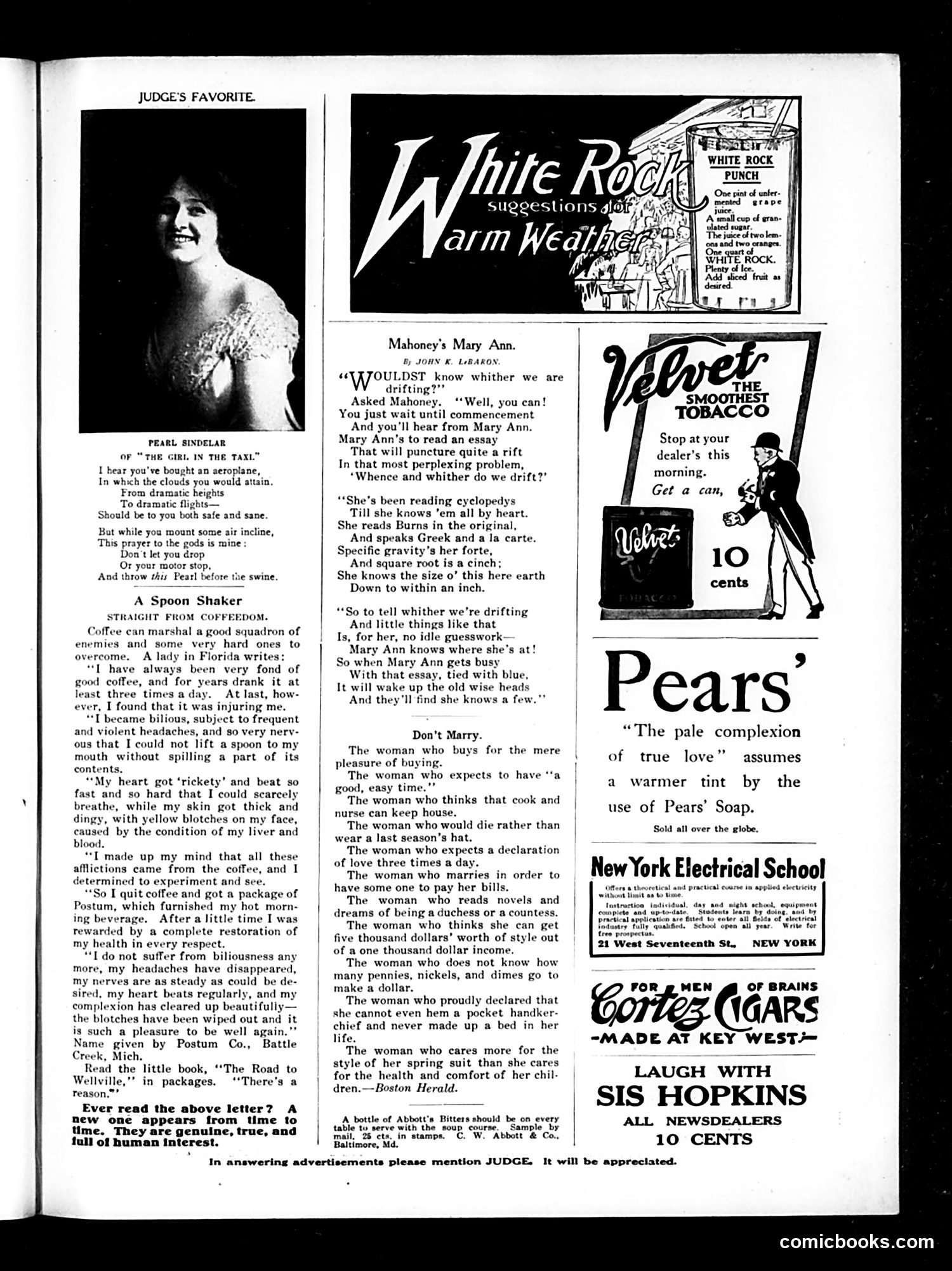
This page from the satirical magazine *Judge* contains primarily **advertisements and light humor** rather than political cartoons. **"Judge's Favorite"** features Pearl Sindelar, an actress from "The Girl in the Taxi," with a playful verse joking about her new airplane—a topical reference to early aviation enthusiasm. The "pearl before swine" punchline is a biblical allusion used as a pun on her name. **"A Spoon Shaker"** is a testimonial advertisement for Postum (a coffee substitute), claiming it cured the writer's coffee-induced ailments. This reflects early-1900s health anxieties about caffeine. **"Mahoney's Mary Ann"** is a humorous poem about a woman so well-educated she can answer philosophical questions about humanity's direction. **"Don't Marry"** is a satirical list mocking frivolous, incompetent, or materialistic women—typical period humor criticizing women's perceived character flaws. The tone reflects early-20th-century gender attitudes. The page also features product advertisements (Velvet tobacco, Pears' Soap, electrical school) typical of magazine content from this era.
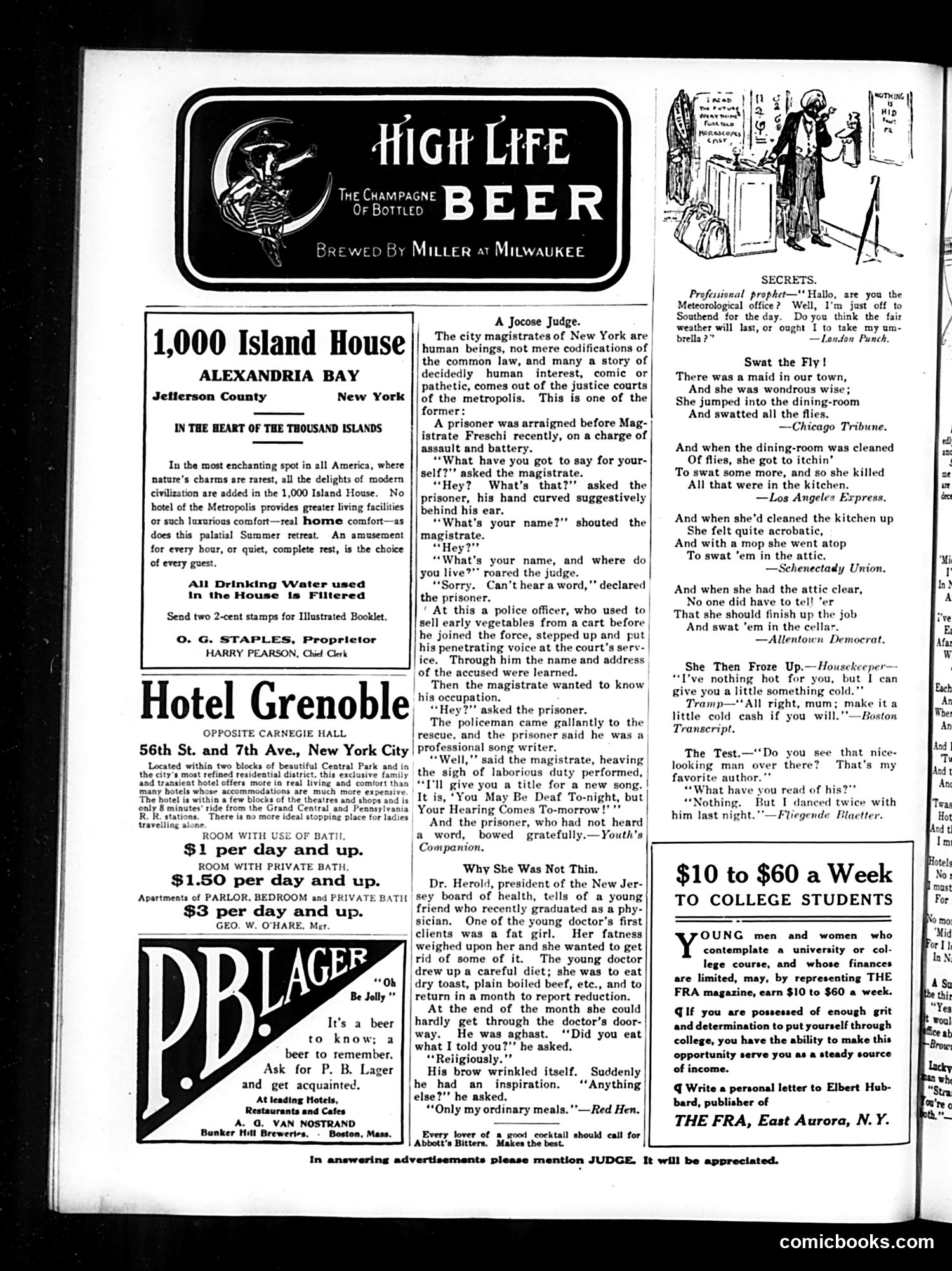
This page is primarily **advertising**, not political satire. It contains multiple hotel and beer advertisements (High Life Beer, the 1,000 Island House, Hotel Grenoble, and P.B. Lager) interspersed with short humorous anecdotes typical of *Judge* magazine's content. The visible comic content includes: - "A Jocose Judge": A courtroom story about a deaf prisoner who can't hear the magistrate's questions, requiring a vegetable-cart-turned-policeman to interpret. The humor relies on the magistrate's exasperated pun about deafness. - "Why She Was Not Thin": An incomplete medical anecdote suggesting a doctor's diet advice backfired humorously. These are light, domestic humor pieces rather than political commentary. The page reflects early-20th-century American magazine format: advertising revenue subsidizing entertainment content.
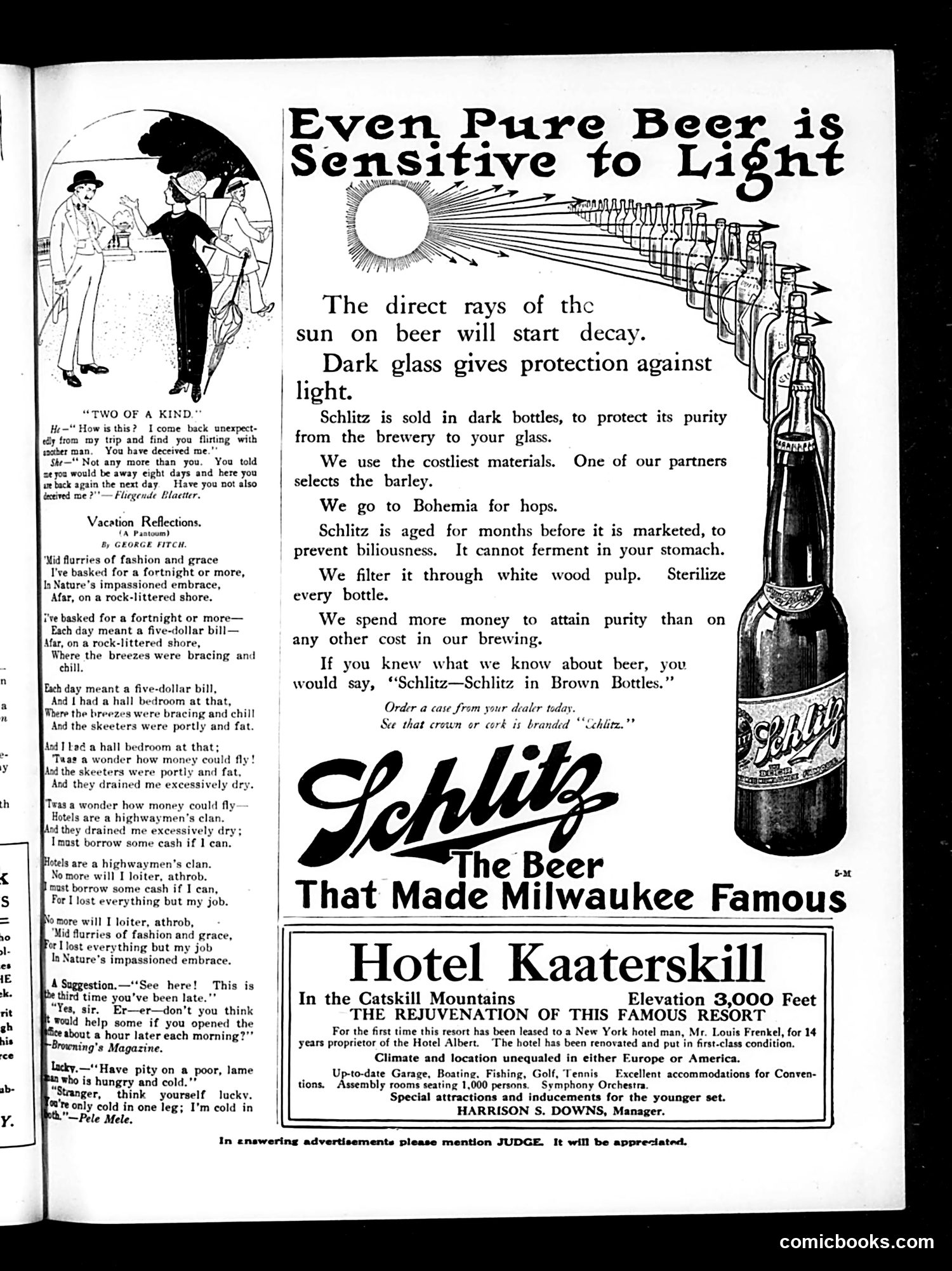
This page contains two distinct sections: **The Cartoon "Two of a Kind"** presents a domestic quarrel where a husband accuses his wife of infidelity during his absence. She responds with witty logic: he lied about his trip's duration (returning early instead of staying eight days), so they're equally guilty of deception. The satire mocks marital hypocrisy and the double standards between spouses—a common theme in early 20th-century humor. **The Remaining Content** consists primarily of advertisements and light verse. George Fitch's "Vacation Reflections" humorously describes a holiday's financial drain through mounting hotel bills and incidental expenses. Several short joke items follow, including workplace humor. The bulk of the page features a Schlitz beer advertisement emphasizing purity and dark-bottle protection, plus a hotel resort ad for the Catskill Mountains property. The page reflects typical Judge magazine format: satirical domestic comedy paired with advertising and miscellaneous humorous filler.
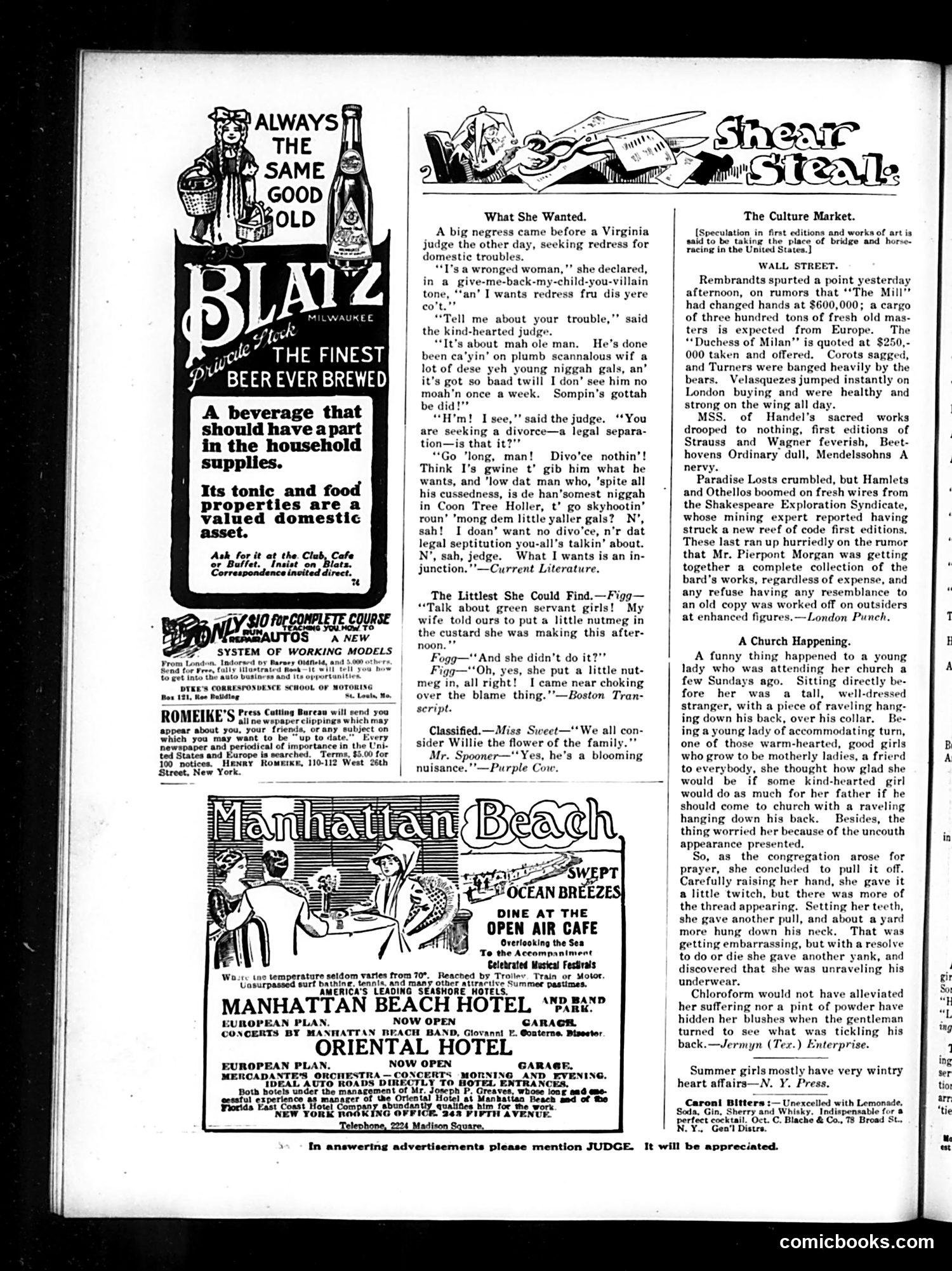
This page contains primarily **advertisements and brief humorous anecdotes** rather than political cartoons. The main satirical content is "**The Culture Market**"—a financial column written as stock-market reporting but about fine art and rare books instead. The joke mocks wealthy Americans' new obsession with collecting Old Masters paintings and first-edition manuscripts as investment speculation, treating Rembrandts and Turners like commodity stocks ("Corots sagged," "Velasquezes jumped"). This satirizes how financial speculation was replacing traditional leisure activities among the wealthy. The other jokes are period humor: "**What She Wanted**" uses heavy racial dialect to depict a Black woman seeking a court injunction (not divorce) to prevent her husband from seeing other women—the humor relies on stereotypical speech patterns common to the era's offensive comedy. The remainder is mostly **hotel and beer advertisements**, typical of Judge magazine's commercial content.
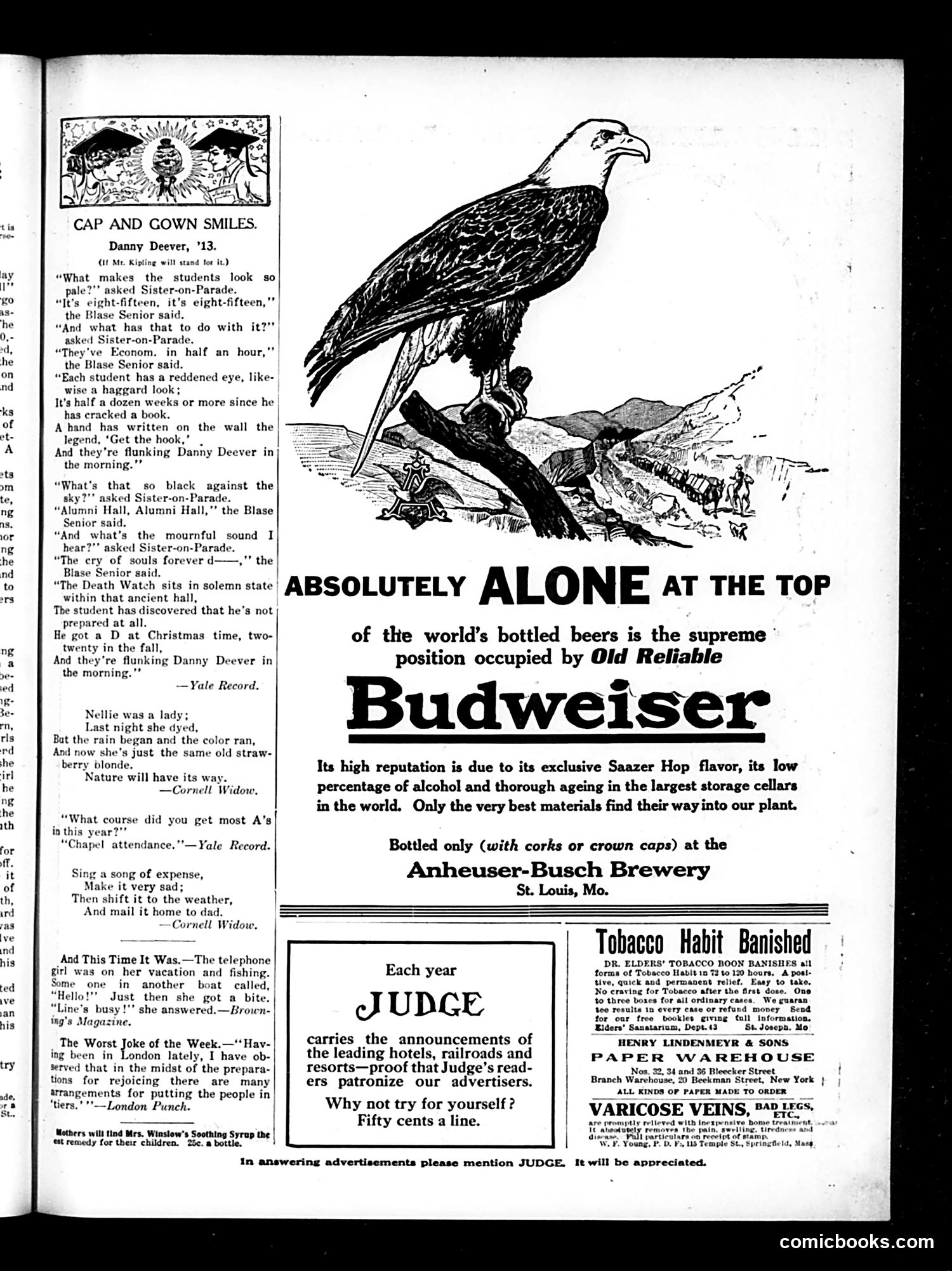
This page is primarily a college humor section spoofing Rudyard Kipling's poem "Danny Deever." The satire mimics Kipling's style to mock unprepared Yale students facing academic consequences. The joke: A "Blase Senior" describes flunking students who haven't studied in weeks, with darkly comic imagery of death watches and doomed souls—treating academic failure as execution. References include cramming before exams, poor grades (D's and 2.20 GPAs), and the metaphorical "Death Watch" sitting in judgment. The humor plays on the contrast between Kipling's poem about a soldier's execution and college life, suggesting exam flunking feels as serious and inevitable as the poem's grim subject. Other college jokes follow (a telephone operator's pun, students' financial complaints to parents). The bulk of the page comprises advertisements—notably a prominent Budweiser ad featuring an eagle, plus tobacco remedies and paper warehouse notices—typical of Judge magazine's revenue model.
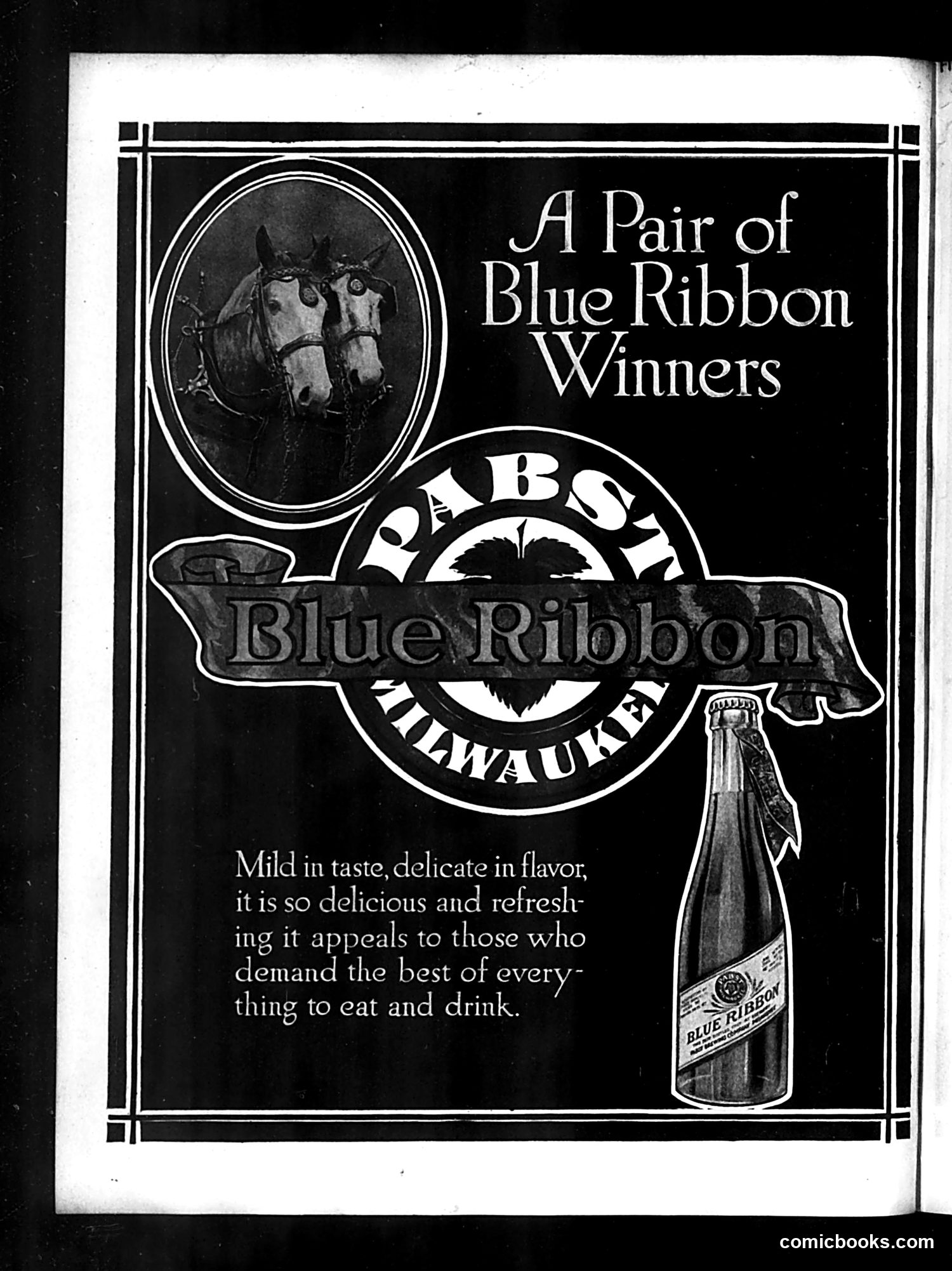
This is a **Pabst Blue Ribbon beer advertisement**, not a political cartoon or satire. The page features the product's logo and branding prominently in the center, with a bottle illustrated on the right side. The "pair of blue ribbon winners" refers to two horses shown in an oval portrait at the top left—likely prize-winning racehorses, used as a metaphor for excellence and quality. The advertisement positions the beer as a luxury product for discerning consumers, emphasizing its mild taste and refinement. This represents typical early-20th-century advertising strategy: associating consumer products with prestige symbols (winning horses, fine taste) to appeal to aspirational audiences. The inclusion in *Judge* magazine suggests it targeted educated, affluent readers.