
A complete issue · 24 pages · 1911
Judge — April 22, 1911
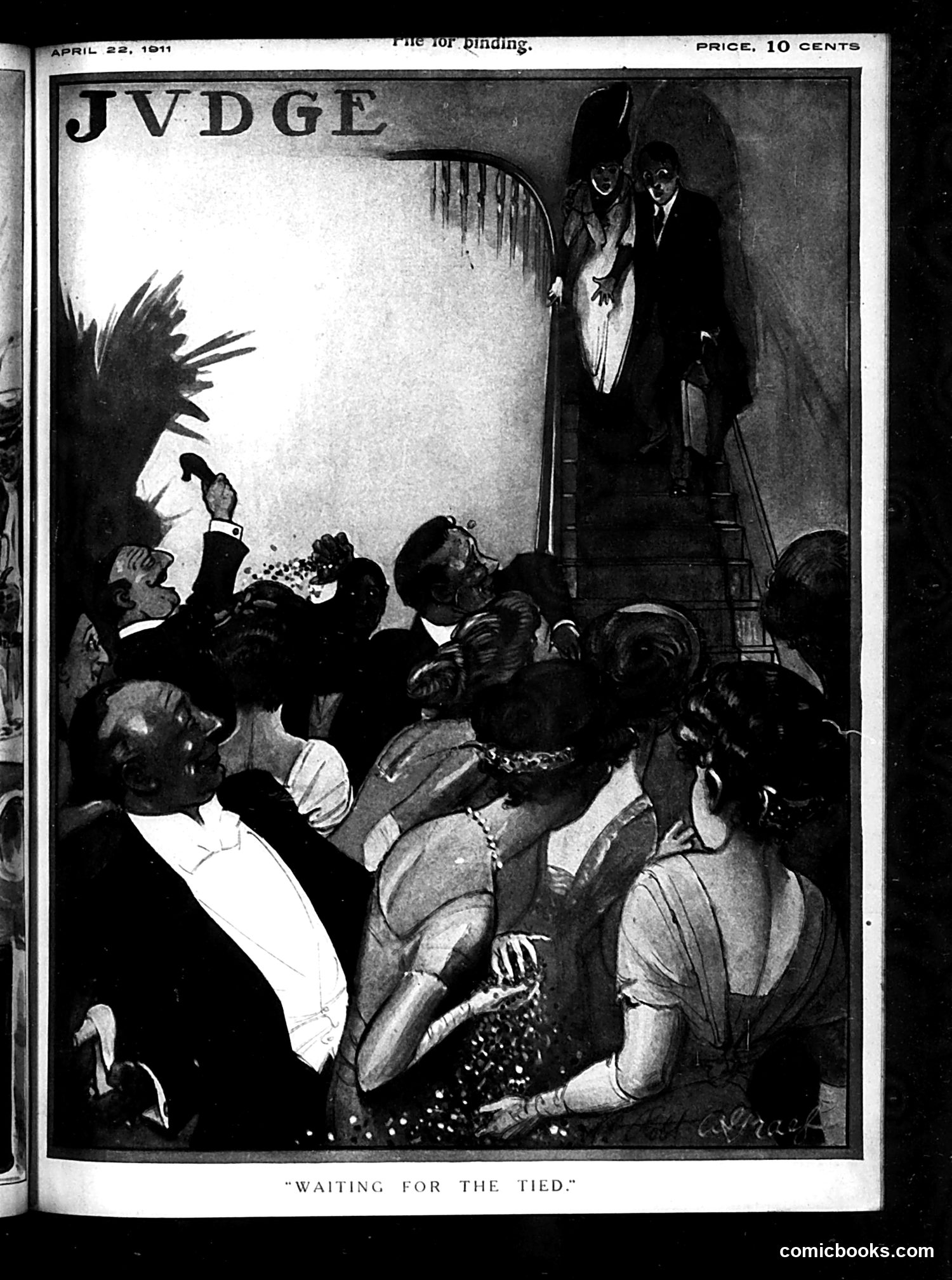
**Title:** "Waiting for the Tied" This cartoon depicts a crowd of formally-dressed men and women gathered at what appears to be a dock or pier, looking upward at two figures on a platform or ship's gangway. The composition suggests a wedding or significant social event about to occur. The caption "Waiting for the Tied" is a pun on "the tide"—suggesting both literal maritime timing and the metaphorical "tying" of marriage. The crowd's formal attire and eager anticipation indicate this satirizes high-society wedding expectations, possibly referencing a specific prominent society wedding of 1911. Without additional context, the specific identities of the figures on the platform remain unclear, though the ornate dress suggests wealthy or notable individuals.
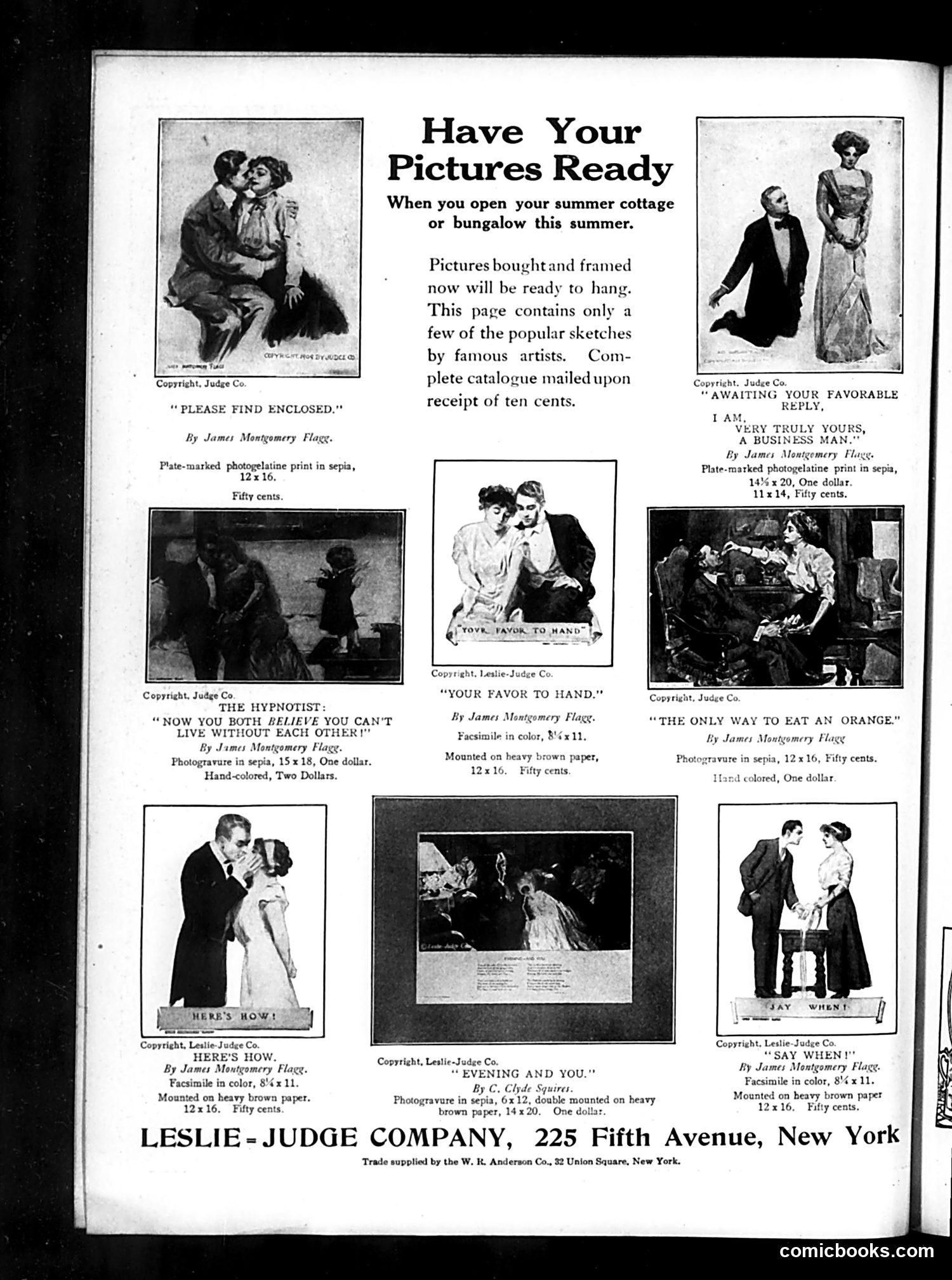
This page is primarily **advertising, not satire or political cartoons**. It's a Leslie-Judge Company catalog page offering framed pictures and photogravures for purchase, marketed to summer cottage and bungalow owners. The images shown are sentimental or romantic scenes by illustrator James Montgomery Flagg—depicting couples in intimate moments ("Please Find Enclosed," "Your Favor to Hand," "Here's How!") and domestic situations ("The Hypnotist," "The Only Way to Eat an Orange"). These were decorative prints meant for home display. The page's headline "Have Your Pictures Ready" suggests these inexpensive artworks (ranging from fifty cents to two dollars) were summer home essentials. This reflects early 1900s middle-class domestic culture and the commercialization of home decoration through mass-produced prints.
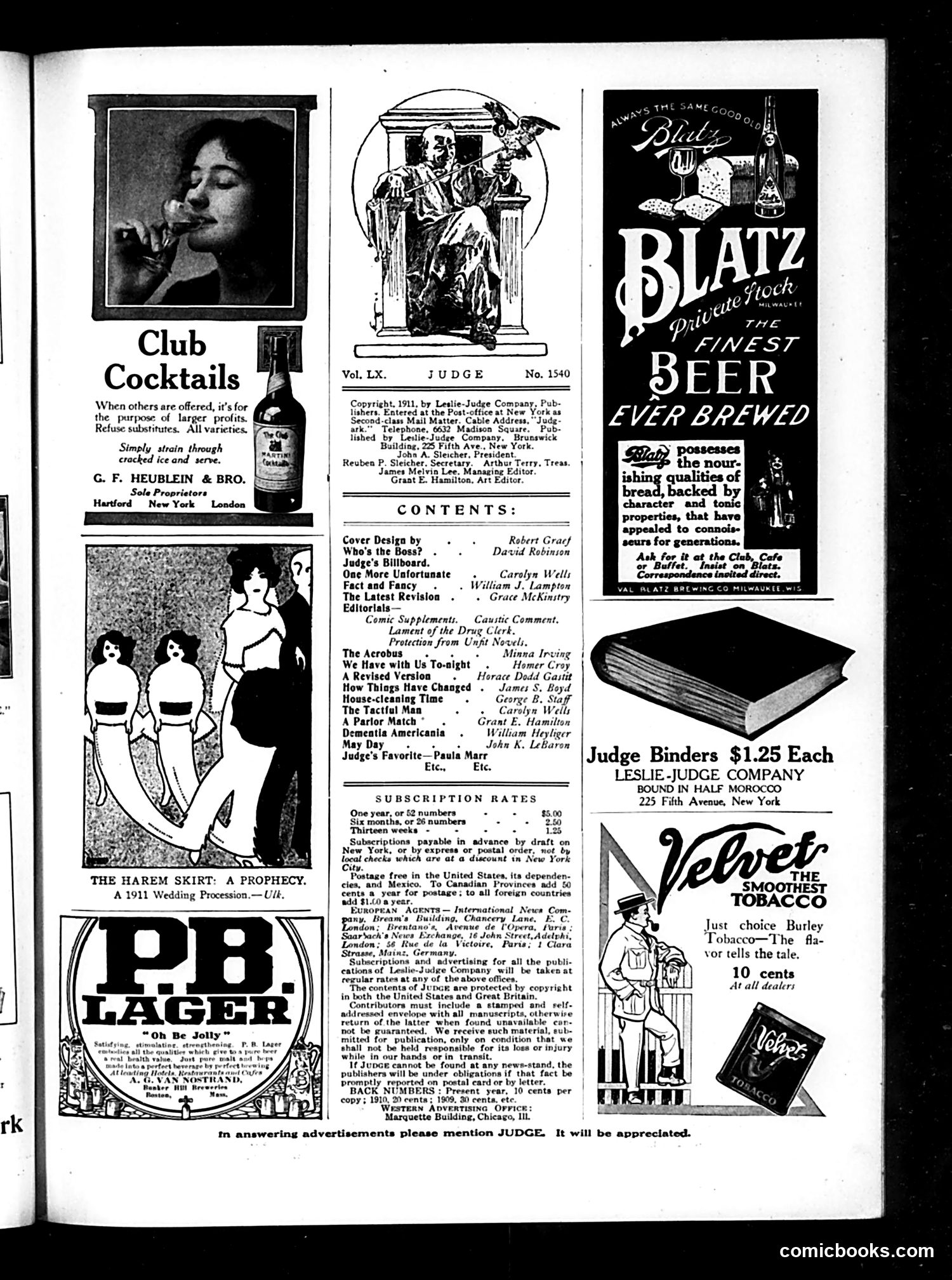
This page is primarily **advertising and table of contents** rather than satirical cartoons. The main content includes: **Advertisements:** - Club Cocktails (liquor) - Blatz Beer ("finest beer ever brewed") - Judge Binders ($1.25) - Velvet Tobacco (10 cents) - P.B. Lager beer **Editorial Content:** A table of contents lists articles and illustrations, including one titled **"The Harem Skirt: A Prophecy"** (depicting women in revealing skirts)—likely satirizing the "harem skirt" fashion trend that scandalized early 1910s America. The cover illustration shows a judge figure, consistent with Judge magazine's branding. The page reflects early 20th-century advertising aesthetics and social attitudes toward fashion, alcohol, and tobacco products.
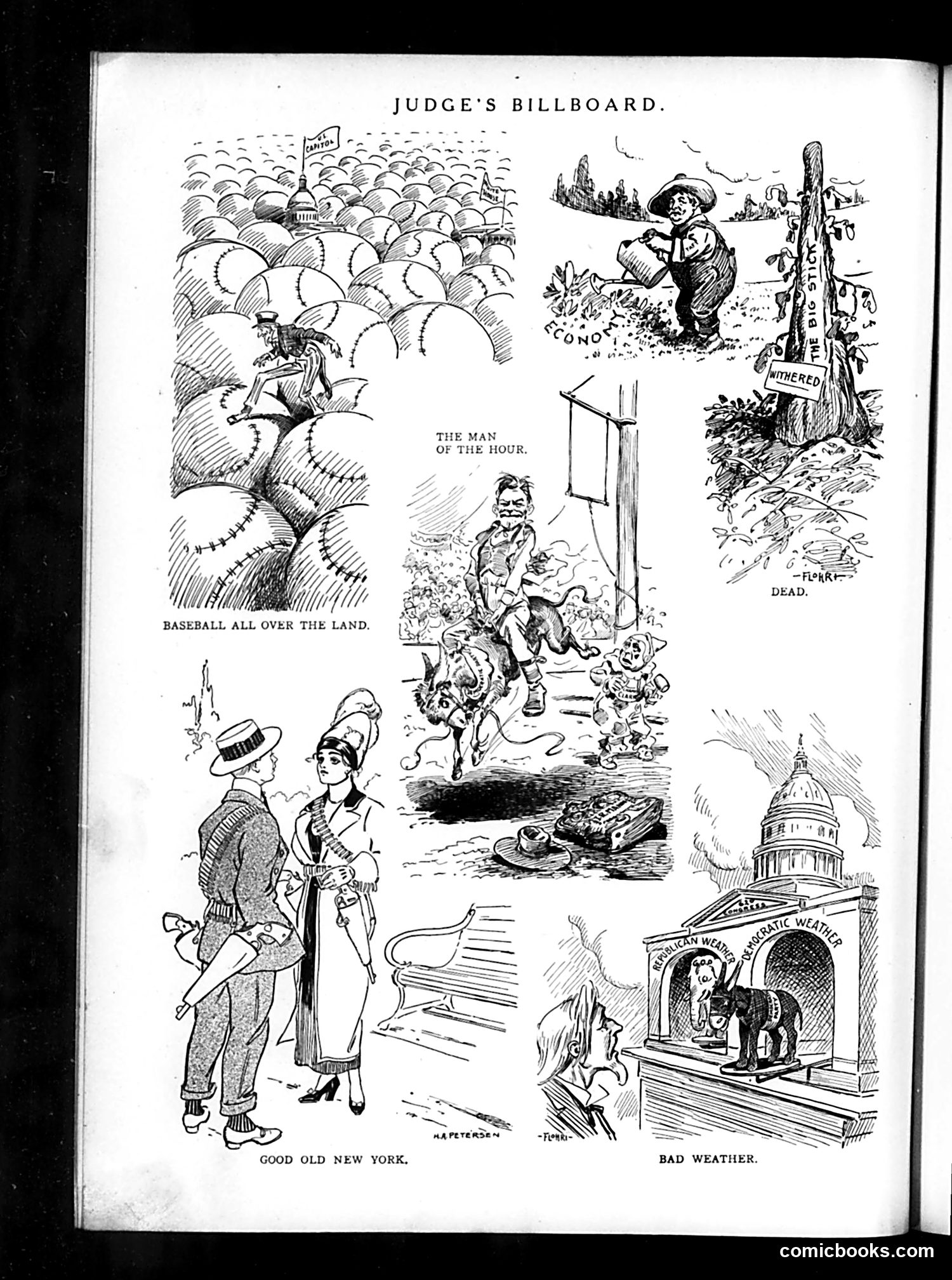
This page from *Judge* magazine contains six satirical cartoons commenting on American politics and society: **"Baseball All Over the Land"** - References baseball's popularity, likely during an election cycle, suggesting the sport distracted voters. **"The Man of the Hour"** - Depicts a politician (unclear which) as the momentary public favorite. **"Dead"** - Shows a withered tree labeled "Withered," possibly representing a failed policy or politician. **"Good Old New York"** - Two fashionable figures, likely satirizing New York society or politics. **"Bad Weather"** - An elephant (Republican symbol) sheltering under a Democratic Weather Bureau building, suggesting Republicans blamed Democrats for economic hardship. The cartoons collectively mock political figures, voter distraction, and partisan blame-shifting typical of Gilded Age American politics.
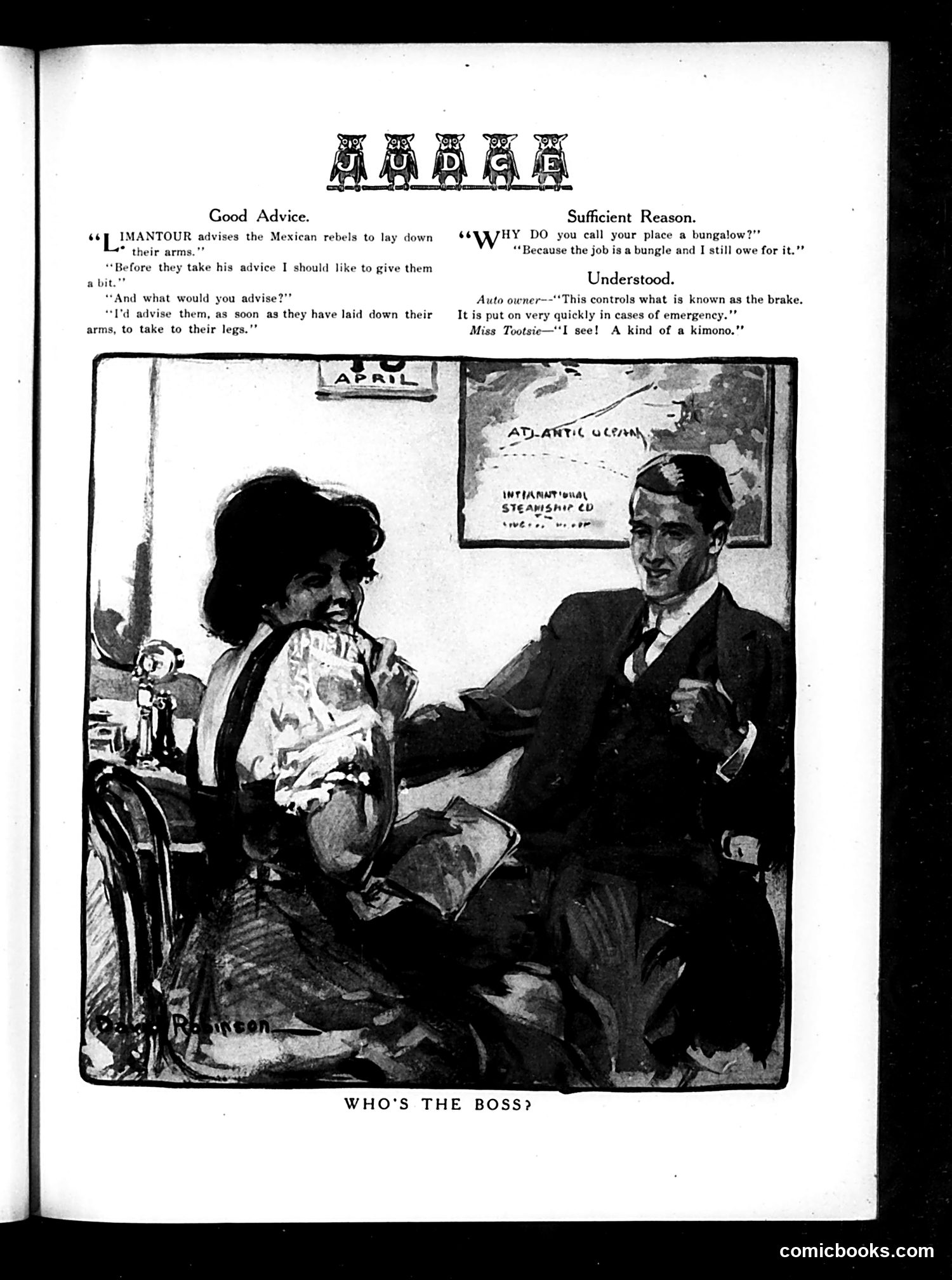
This page contains three separate joke items from *Judge* magazine, likely early 1900s based on the illustration style. **"Good Advice"** mocks General Pershing's counsel to Mexican rebels, with wordplay suggesting they should "take to their legs" (flee) rather than fight. **"Sufficient Reason"** is a brief exchange about calling a house a "bungalow"—the humor relies on the term's then-novelty and the pun that one "owes" money for it. **"Who's the Boss?"** shows a man and woman in what appears to be an automobile showroom (signs visible). The caption's ironic title suggests marital power dynamics—though the image is unclear about the specific satire intended regarding automobiles or gender relations. The page exemplifies *Judge's* style: topical, punchy one-liners mixing political commentary with domestic humor.
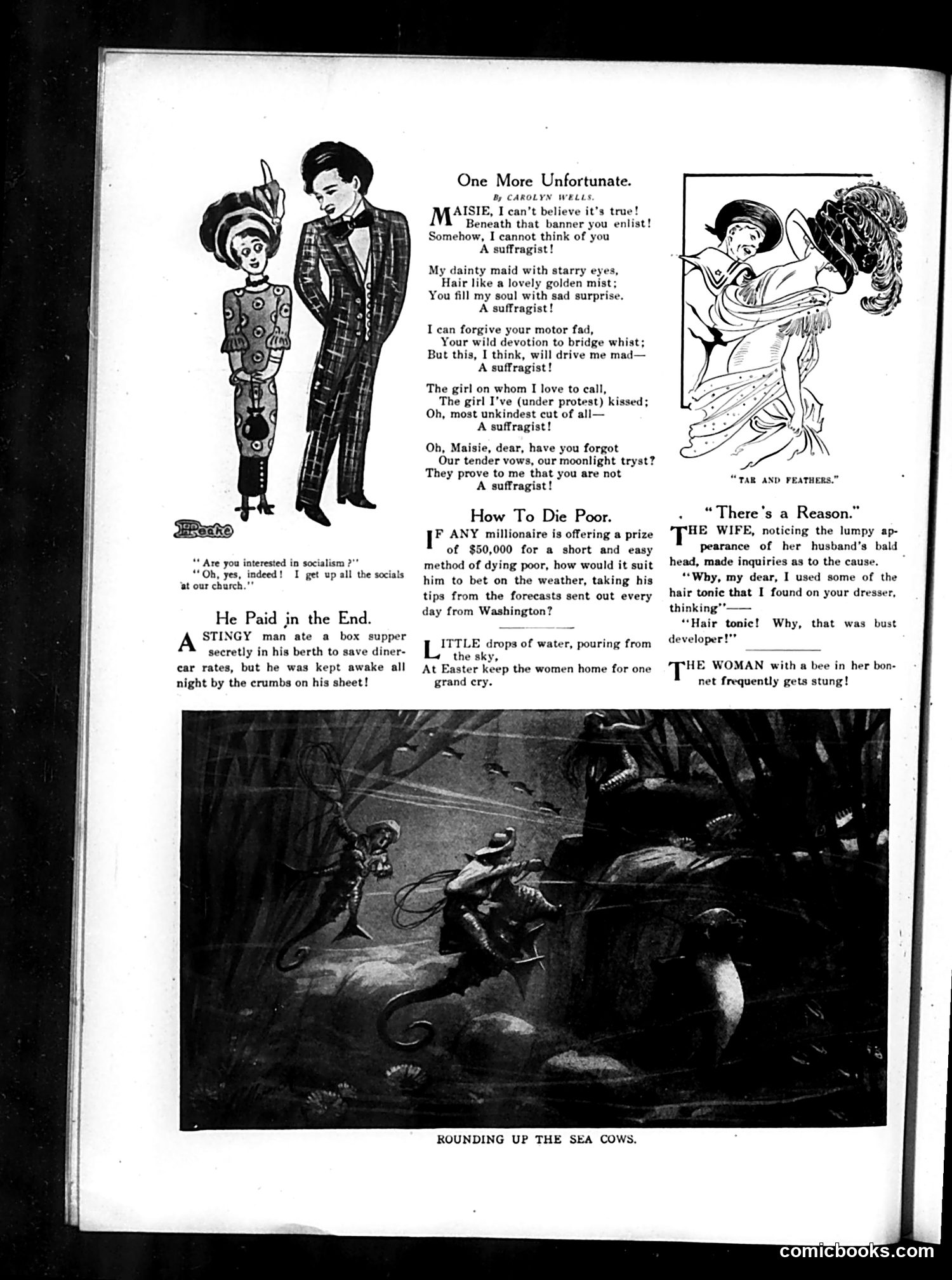
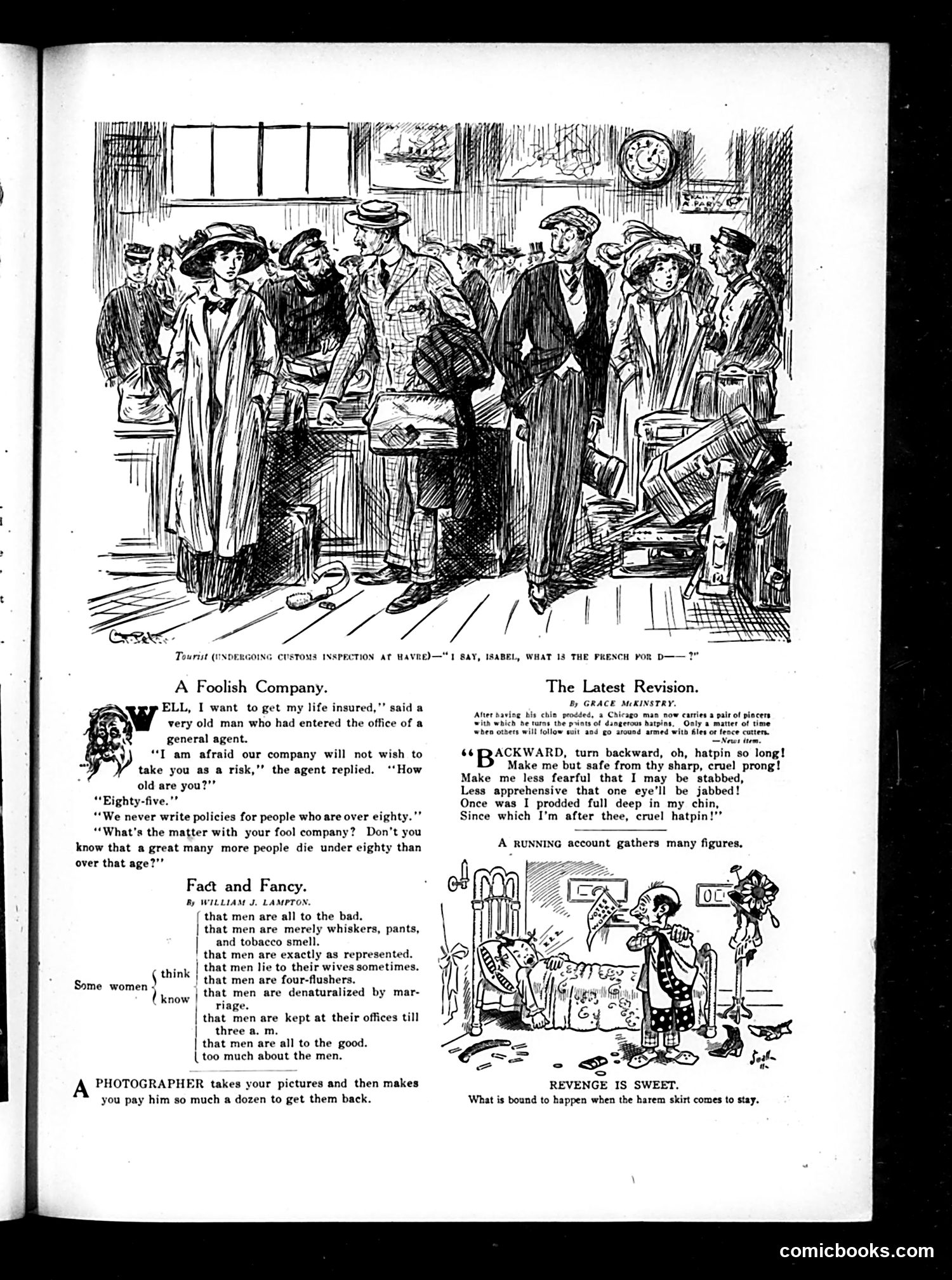
This page contains three distinct satirical pieces typical of early 20th-century Judge magazine: **"A Foolish Company"** mocks life insurance underwriters' illogical age restrictions. An 85-year-old applicant exposes the absurdity: companies refuse elderly clients despite statistically more young people dying, making their risk assessment backwards. **"Fact and Fancy"** by William J. Lampton presents contrasting female opinions about men—portraying women as inconsistent, simultaneously viewing men as worthless yet obsessing over their behavior. **"The Latest Revision"** by Grace McKinistry satirizes the hatpin panic of the era. Hatpins (long, sharp fasteners for women's hats) were genuinely feared as weapons, allegedly used for assault. The poem humorously depicts a woman traumatized by hatpin attacks, now carrying pincers defensively. The accompanying cartoon jokes about "harem skirts" (loose-fitting fashionable garments) leading to physical retaliation—suggesting tight clothing provokes violence, a common sexist argument of the period. These pieces reflect contemporary anxieties about insurance practices, gender relations, and women's fashion controversies.
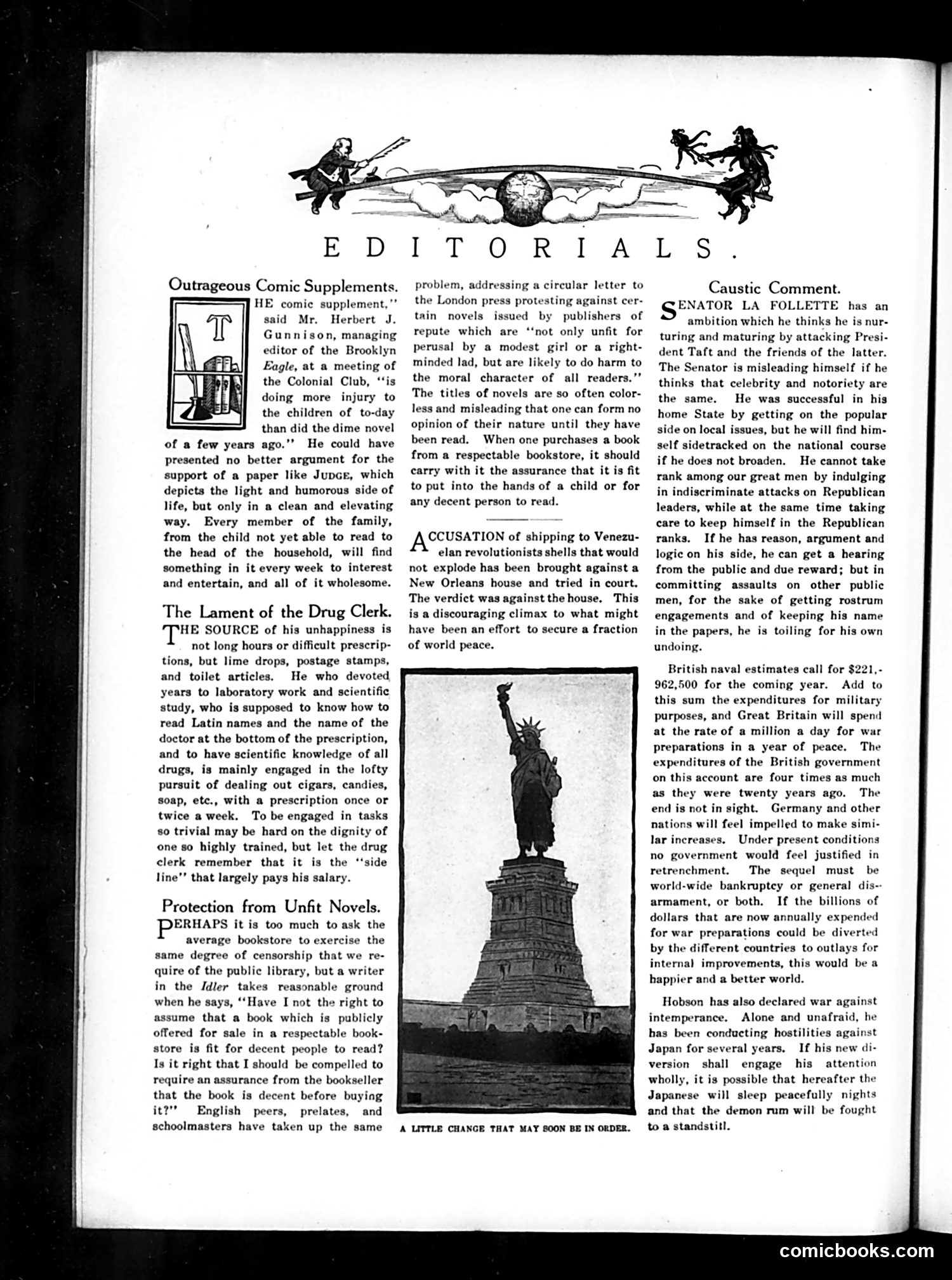
This page contains **editorials and political commentary** rather than cartoons. The key content includes: 1. **"Protection from Unfit Novels"** - Argues that respectable bookstores should curate morally acceptable literature, protecting readers (especially young people) from indecent novels. References British peers and clergy supporting censorship of questionable books. 2. **"The Lament of the Drug Clerk"** - Satirizes pharmacy workers who spent years in scientific training but spend most time selling cigars, candy, and soap rather than dispensing prescriptions. 3. **"Caustic Comment"** - Attacks **Senator La Follette** (likely Robert M. La Follette, Wisconsin progressive) for seeking national prominence through indiscriminate attacks on Republican leaders and President Taft, rather than building credibility through reasoned argument. The **Statue of Liberty illustration** captioned "A Little Change That May Soon Be in Order" appears to comment on American politics, though its specific meaning isn't entirely clear from context alone.
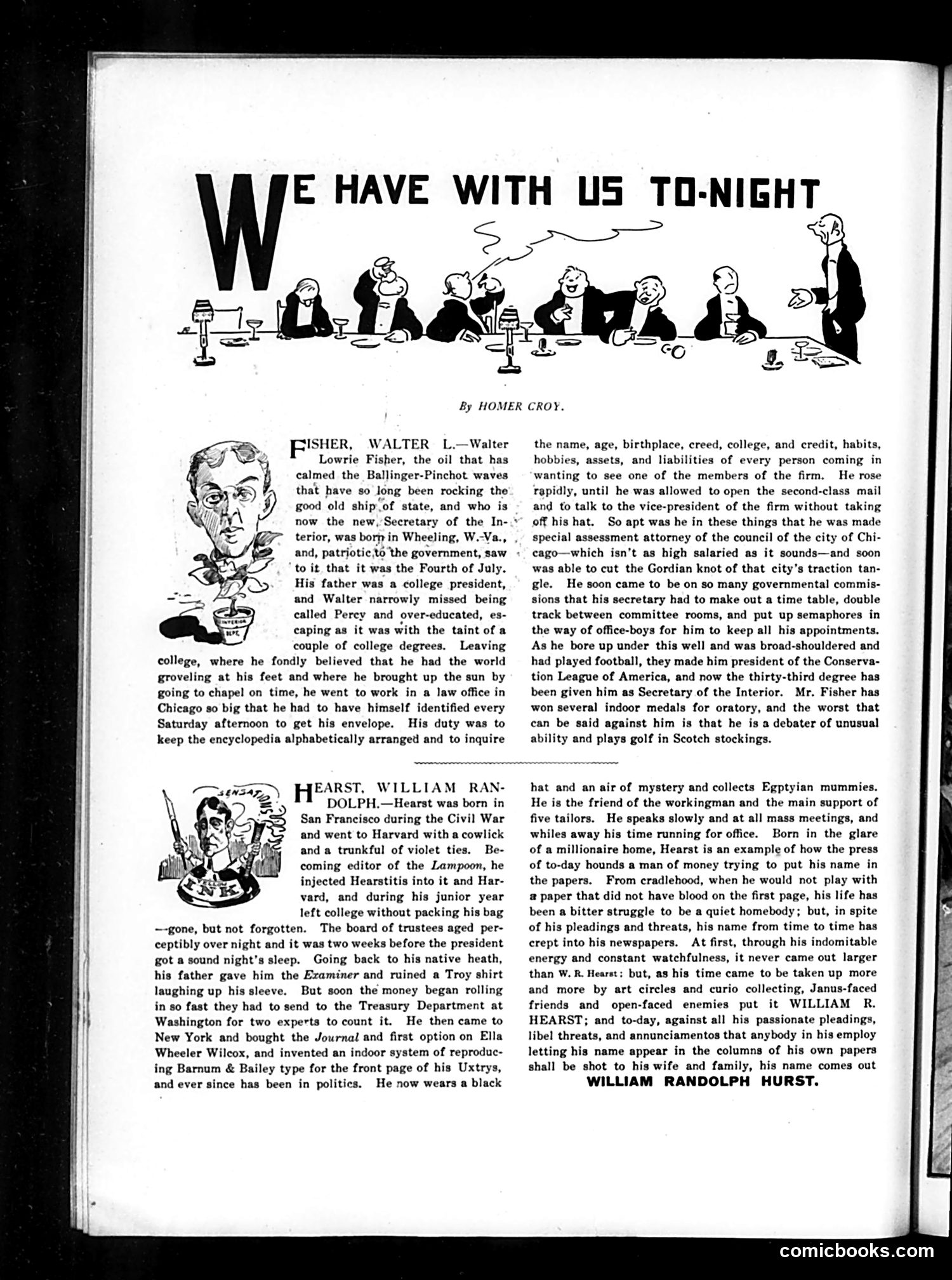
This page from Judge magazine presents satirical biographical sketches of two prominent figures: **Walter L. Fisher**, the new Secretary of the Interior (appointed to resolve the contentious Ballinger-Pinchot conservation scandal), and **William Randolph Hearst**, the newspaper magnate. The humor works through exaggeration and irony. Fisher is portrayed as a bureaucratic functionary who rose through tedious competence—keeping encyclopedias alphabetized, identifying himself for paychecks—yet somehow ended up running major governmental commissions. The satire mocks his relentless overinvolvement in committees. Hearst's sketch ridicules his sensationalism and political ambitions. Starting as a Harvard troublemaker who abandoned his education, he inherited newspapers and allegedly invented yellow journalism ("indoor system of reproducing Barnum & Bailey"), now desperately seeking respectability while collecting mummies and supporting tailors. Both sketches employ Judge's characteristic tone: mock-serious biographical treatment that reveals subjects' absurdities through deadpan narration and exaggerated detail.
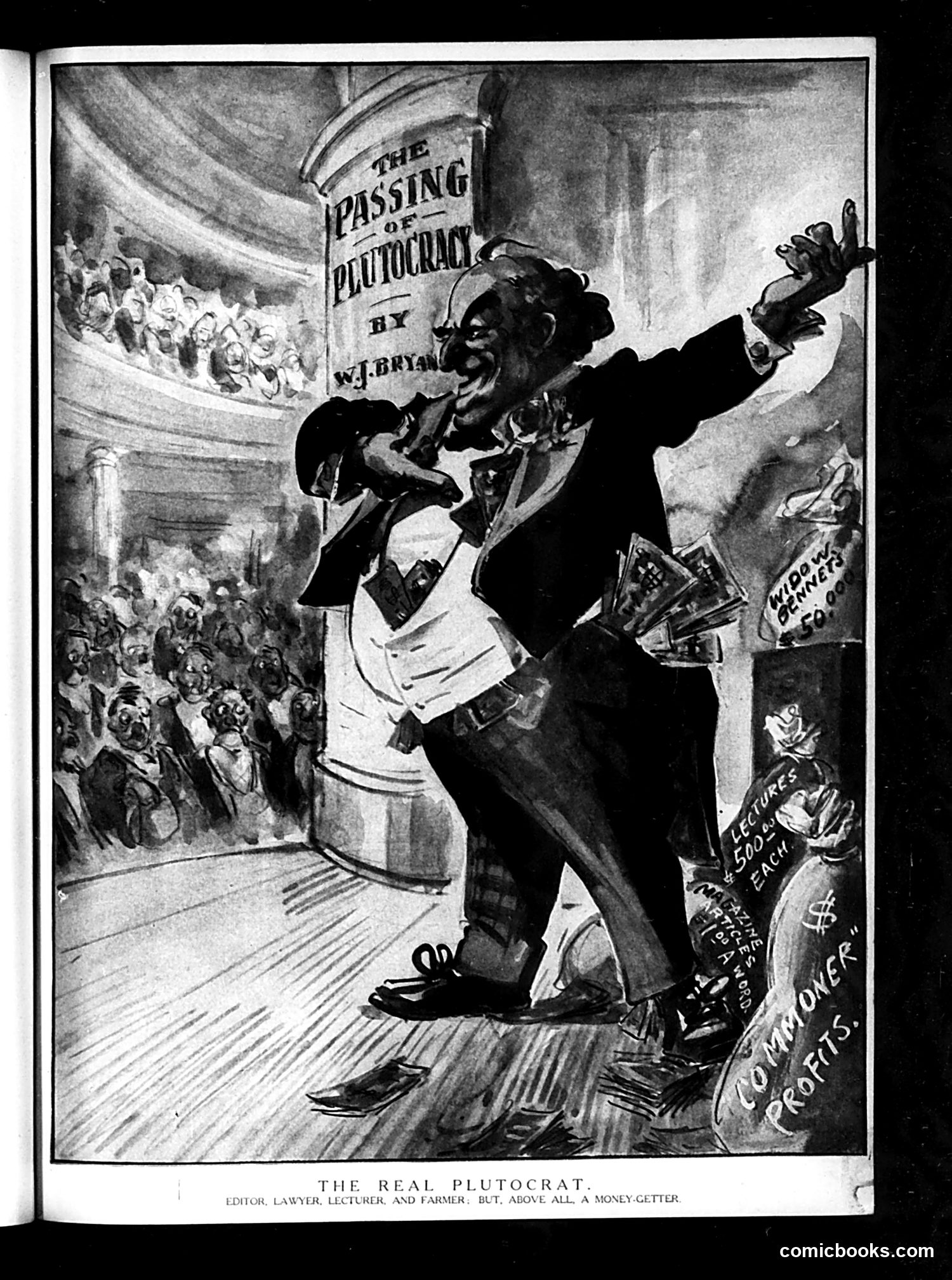
This political cartoon satirizes wealthy elites who accumulate power across multiple professions. The caricatured figure—depicted with exaggerated features typical of early 20th-century caricature—stands triumphantly before an audience, dressed formally and gesturing expansively. The title identifies him as "the real plutocrat": someone who functions as "editor, lawyer, lecturer, and farmer; but, above all, a money-getter." The satire targets how the wealthy concentrate influence across different sectors (media, law, agriculture, public discourse) while their primary motivation remains wealth accumulation. Books and money bags at his feet symbolize his financial power. The cheering crowd suggests his public influence despite (or because of) his mercenary motives. The work critiques plutocratic control of American institutions during the Progressive Era, when reformers attacked concentrated wealth and power.
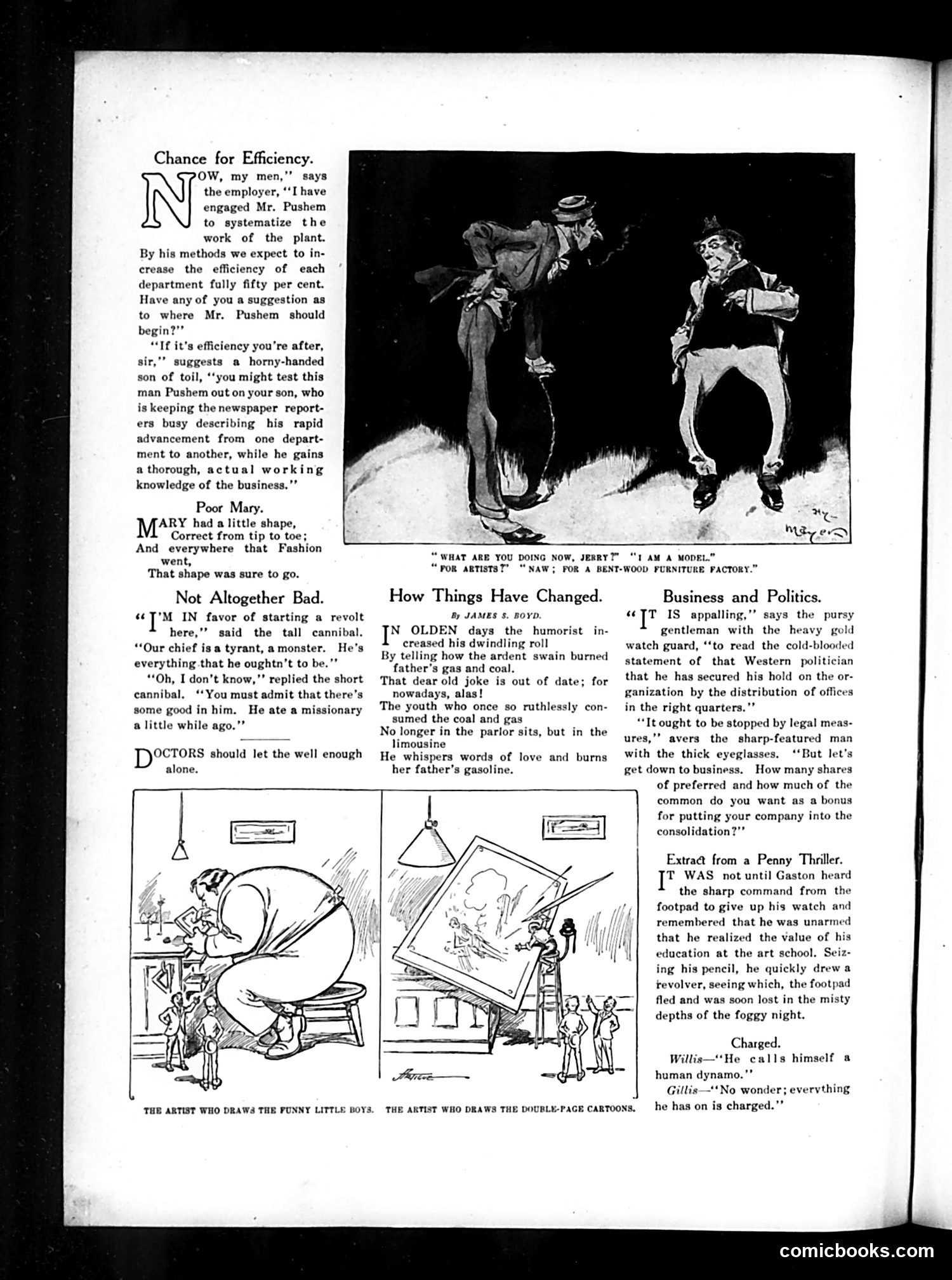
This page contains multiple satirical pieces reflecting early 20th-century American concerns: **"Chance for Efficiency"**: A worker sarcastically suggests testing the new efficiency expert (Mr. Pushem) on the employer's son, who appears to be advancing rapidly through newspaper departments through nepotism rather than merit. The satire targets both workplace inefficiency and preferential treatment for the wealthy. **"Poor Mary" and "Not Altogether Bad"**: Light verse and a cannibal joke typical of the era's casual humor. **"How Things Have Changed"**: A poem satirizing outdated romantic tropes—old jokes about young men burning coal/gas at their sweethearts' homes are now obsolete; they burn gasoline in automobiles instead. **"Business and Politics"**: Two businessmen discuss political corruption (distributing offices for support) while simultaneously engaging in equally corrupt stock manipulation for a corporate consolidation—highlighting hypocrisy about graft. **Bottom cartoons**: Visual gags about artists and charged ("electric") personality types. The page satirizes nepotism, hypocrisy in condemning corruption, and modern social change.
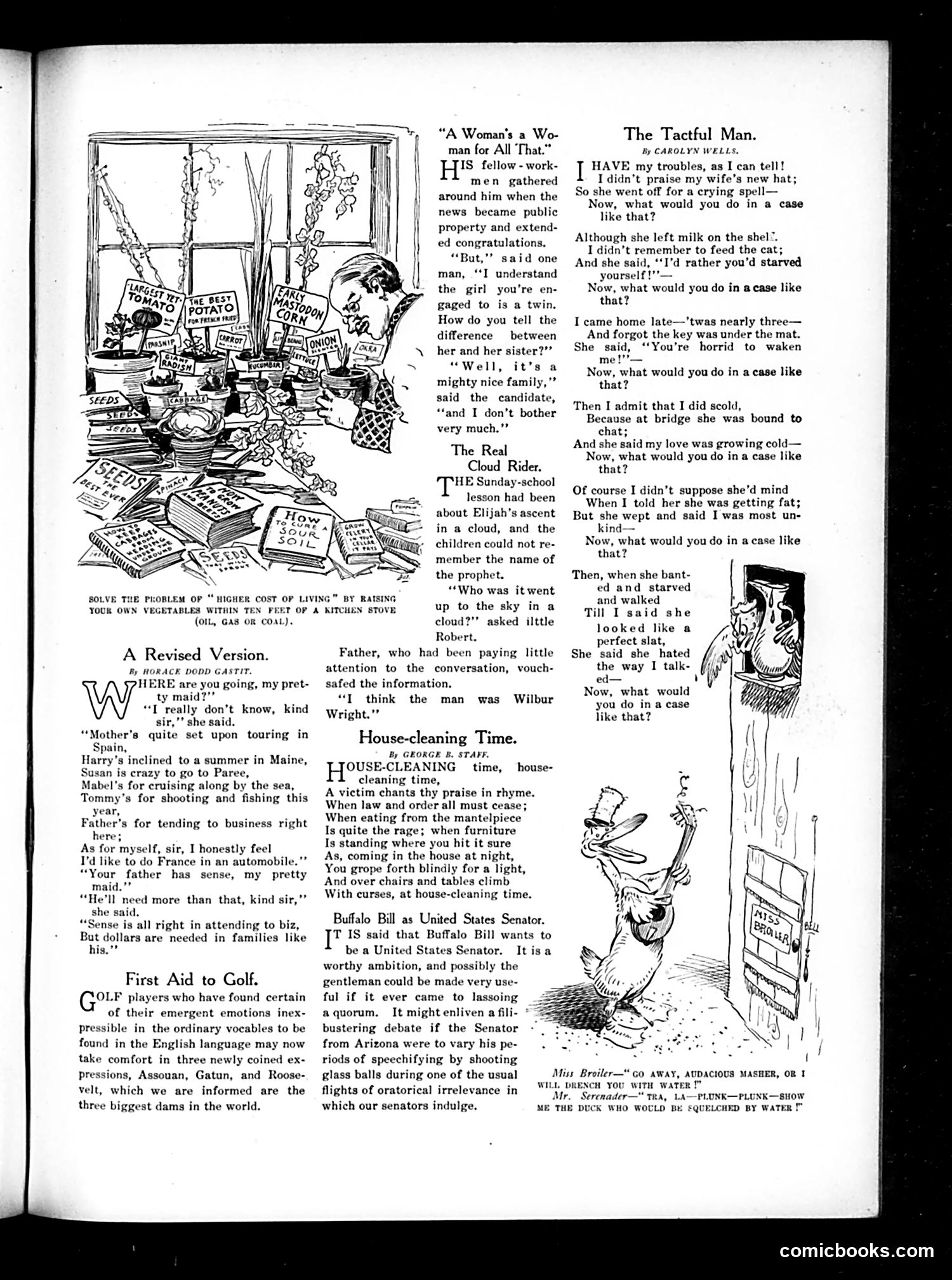
This page from Judge magazine (undated but early 20th century) contains several satirical pieces: **Main cartoon (top left):** Depicts solving "higher cost of living" by growing vegetables in a kitchen stove—visual satire on economic hardship and impractical domestic solutions. **"A Revised Version":** Mocks wealthy families' conflicting vacation desires (Spain, Maine, Paris, cruises) while the father sensibly wants to work. The joke: even "sense" won't help afford such frivolous spending. **"First Aid to Golf":** Golfers need new curse words; suggests "Assouan," "Gatun," and "Roosevelt"—the three biggest dams. This puns on damning language and Theodore Roosevelt's infrastructure projects. **"The Real Cloud Rider":** A child asks about the prophet ascending in clouds; father misunderstands, answering "Wilbur Wright"—conflating Biblical Elijah with the Wright brothers' aviation achievement. Light satire on modern technology replacing tradition. **"The Tactful Man":** A husband repeatedly fails at diplomacy with his wife (criticizing her hat, forgetting the cat, waking her, scolding her bridge-playing, calling her fat), asking readers what they'd do—humorous domestic conflict.
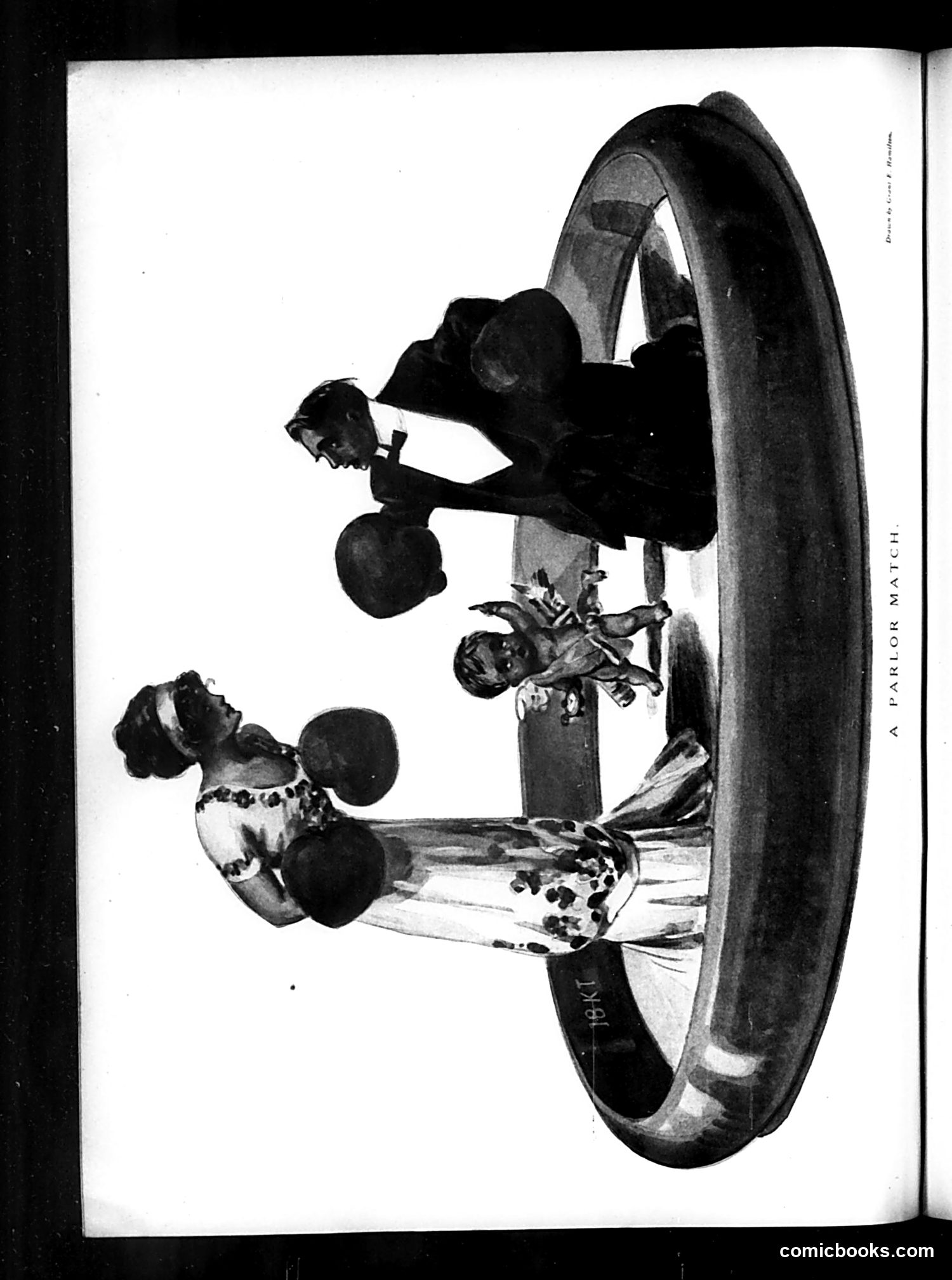
This appears to be a satirical illustration showing a domestic scene viewed through a large circular mirror or frame. The image depicts what seems to be a woman arranging flowers or conducting some household activity, with another figure observing. The title "A PARLOR MATCH" suggests wordplay—likely punning on "parlor" (a social room) and "match" (both a romantic pairing and the combustible object). The satire likely comments on courtship, marriage dynamics, or domestic relations common to Judge magazine's satirical subjects. However, without clearer context about the specific historical moment or additional text, the precise political or social critique remains unclear. The composition and formal dress suggest this addresses middle-class social conventions of the period when Judge was actively published.
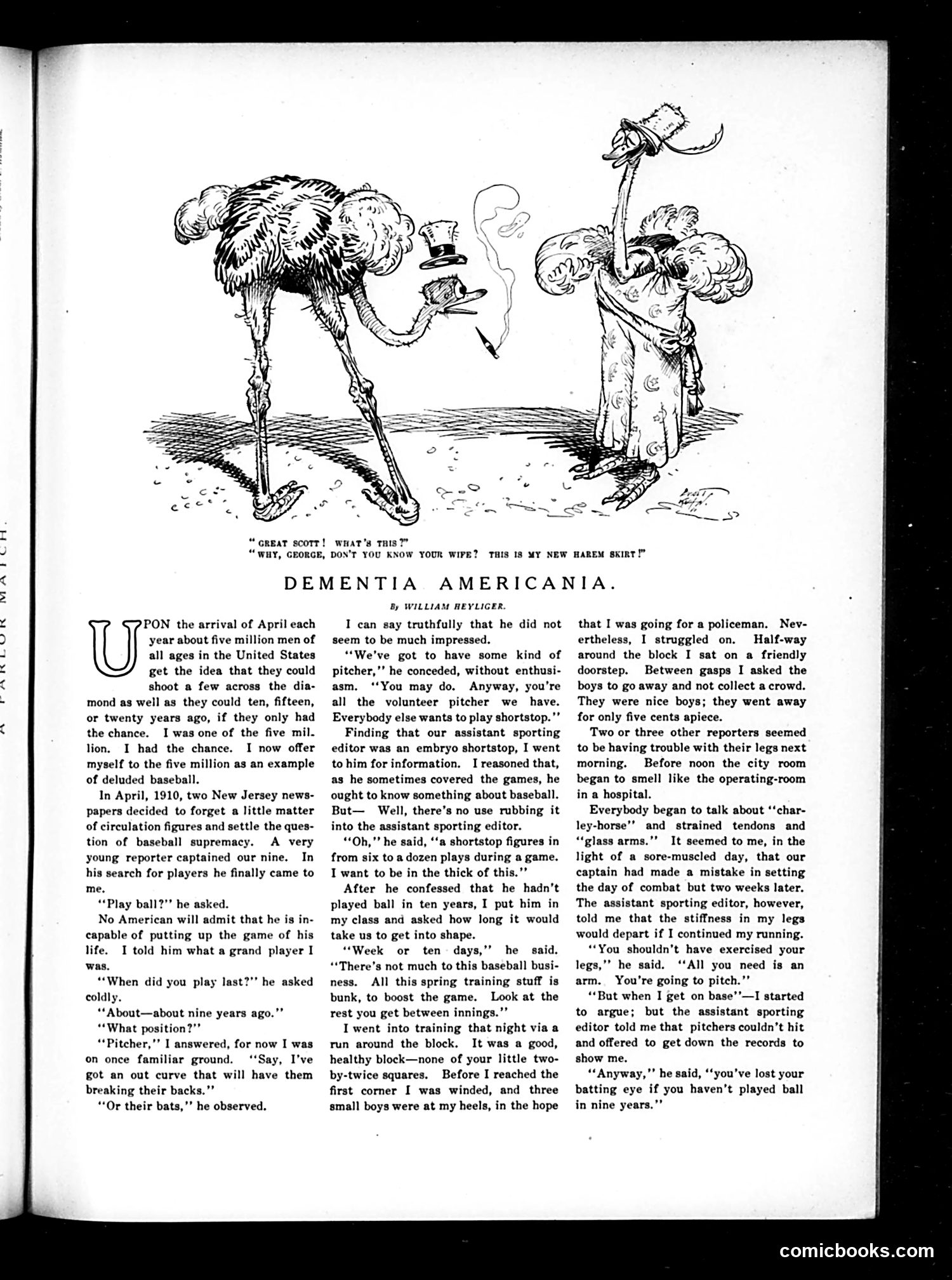
This 1910 article by William Heyliger satirizes the "April delusion" gripping American men—the recurring fantasy that they can still play baseball competitively despite years away from the sport. The cartoon caption jokes about a "harem skirt" (a fashionable women's garment of the era), with the husband's confused reaction providing visual comedy about changing women's fashion. The article's satire targets middle-aged men's overconfidence: a newspaper recruits the narrator as a pitcher despite his nine-year absence; he and an assistant sporting editor naively believe a week's training suffices. Their subsequent physical suffering—strained muscles, exhaustion—deflates their delusional confidence. The editor's dismissive commentary ("there's no use rubbing it in") underscores the gentle mockery of American male vanity and nostalgia for lost youth, a recurring theme in Judge's humor.
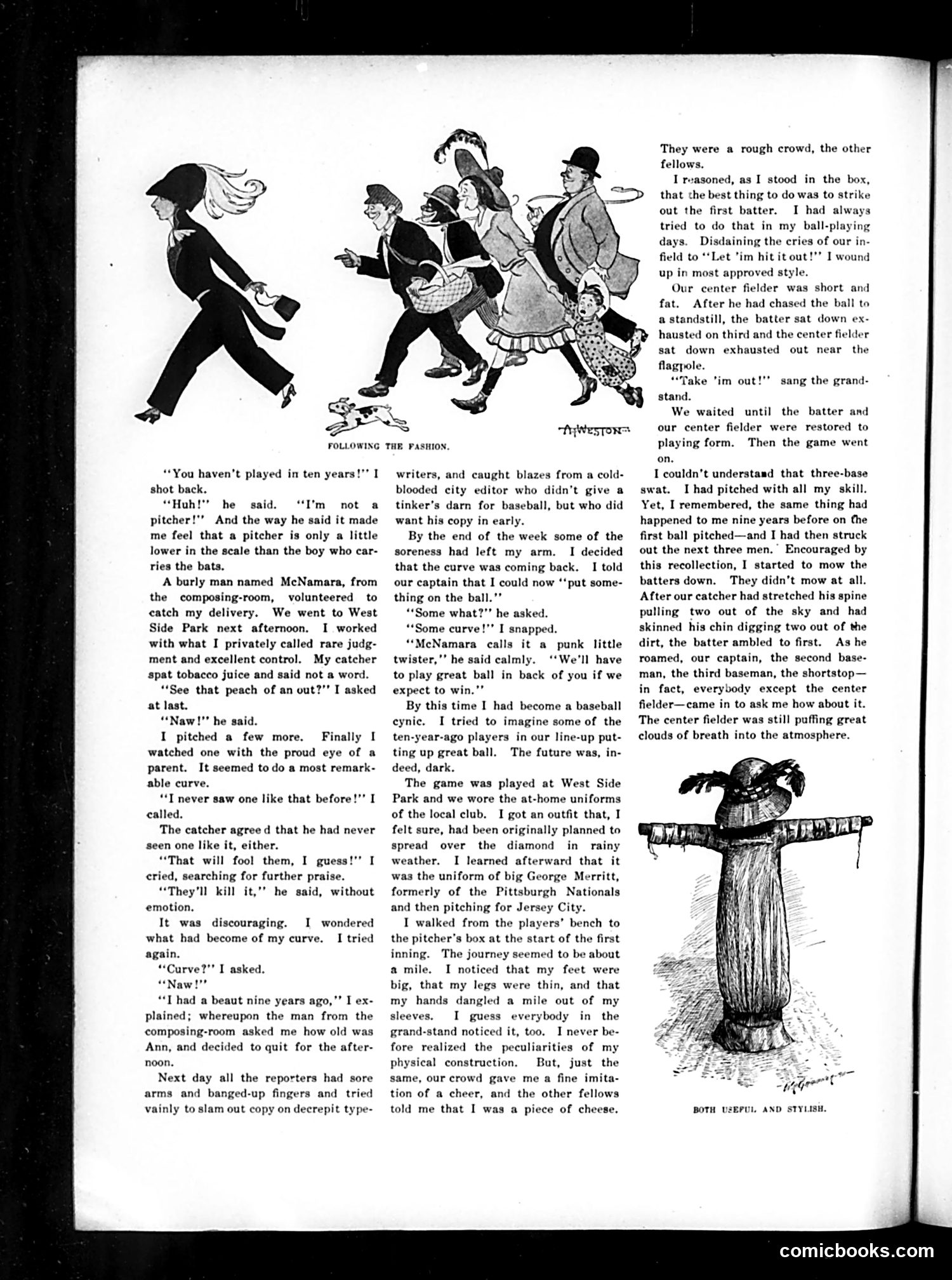
This page contains an illustrated humorous story about an office worker who attempts to return to baseball after nine years away. The cartoon titled "Following the Fashion" (top left) shows a woman in fashionable dress leading a group of men—likely satirizing how men follow women's fashion trends, hence the title. The main text is a first-person narrative about the narrator's failed baseball comeback. The humor derives from his physical inadequacy: he's awkwardly tall and thin in an ill-fitting uniform (apparently belonging to former player George Merritt), his pitching has deteriorated, and his teammates mock him relentlessly. The story documents his humiliation—exhausted players, dismissive catchers, and unsympathetic coworkers at *Judge* magazine who'd rather work than encourage his athletic aspirations. The satire targets both the narrator's delusional confidence in outdated skills and the callous, competitive workplace culture that prioritizes typeset deadlines over camaraderie.
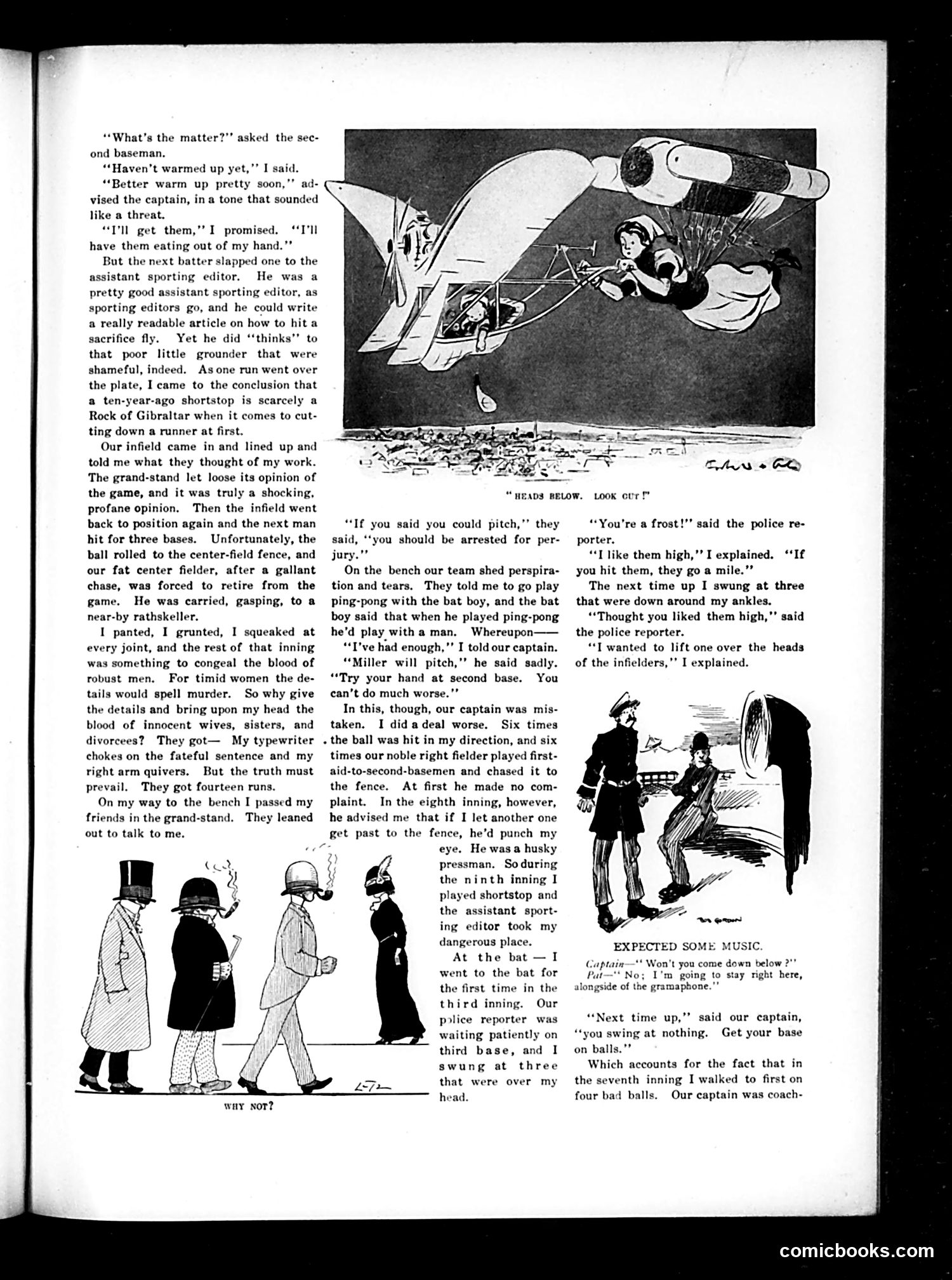
This page satirizes amateur baseball played by newspaper staff members—specifically at *Judge* magazine. The humor centers on the narrator's abysmal athletic performance: as pitcher, he gives up 14 runs in one inning; as shortstop, he repeatedly allows balls past him to the fence, prompting threats from an angry right fielder; and as batter, he swings wildly at pitches nowhere near the strike zone. The satire targets workplace incompetence masked by professional pretension. The "assistant sporting editor" can write eloquently about baseball technique but cannot execute a simple ground ball. The police reporter waits on base making sarcastic comments. The captain threatens and demotes the narrator repeatedly. The cartoons accompanying the text show the chaos: a wild pitch, uniformed figures (likely representing the varied newspaper staff positions), and a policeman with a gramophone, suggesting the absurdity of mixing sports with office culture. The joke: these white-collar professionals are hilariously unfit for athletics.
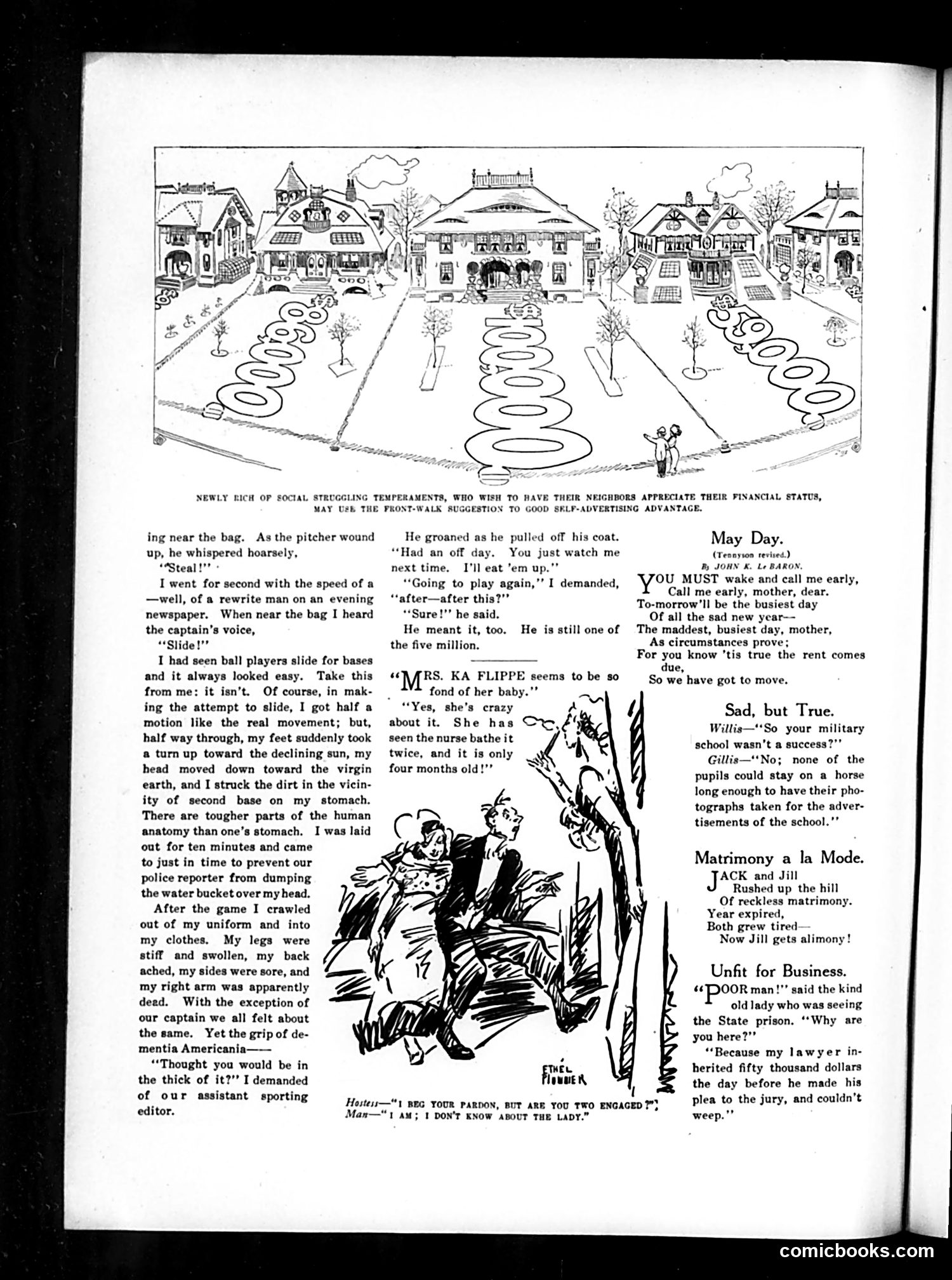
This page from *Judge* contains multiple satirical pieces reflecting early 20th-century American anxieties: **Top cartoon**: Mocks the newly wealthy's obsession with displaying financial status through front-yard ostentation—the spiraling designs likely represent decorative gardens or walkways meant to impress neighbors. **Main narrative**: A newspaper rewriter attempts to play baseball, humorously discovers sliding is painful, yet remains committed to playing again—satirizing the era's obsession with "dementia Americana" (baseball fever) affecting all social classes. **Sidebars**: Brief joke pieces mock: - Mrs. Ka Flippe's excessive baby care - A failed military school (students couldn't stay on horses for publicity photos) - A couple's quick descent into alimony - A prisoner whose lawyer abandoned his case after inheriting money The "May Day" poem parodies Tennyson, substituting rent concerns for romantic sentiment—reflecting working-class financial precarity beneath the era's consumer enthusiasm.
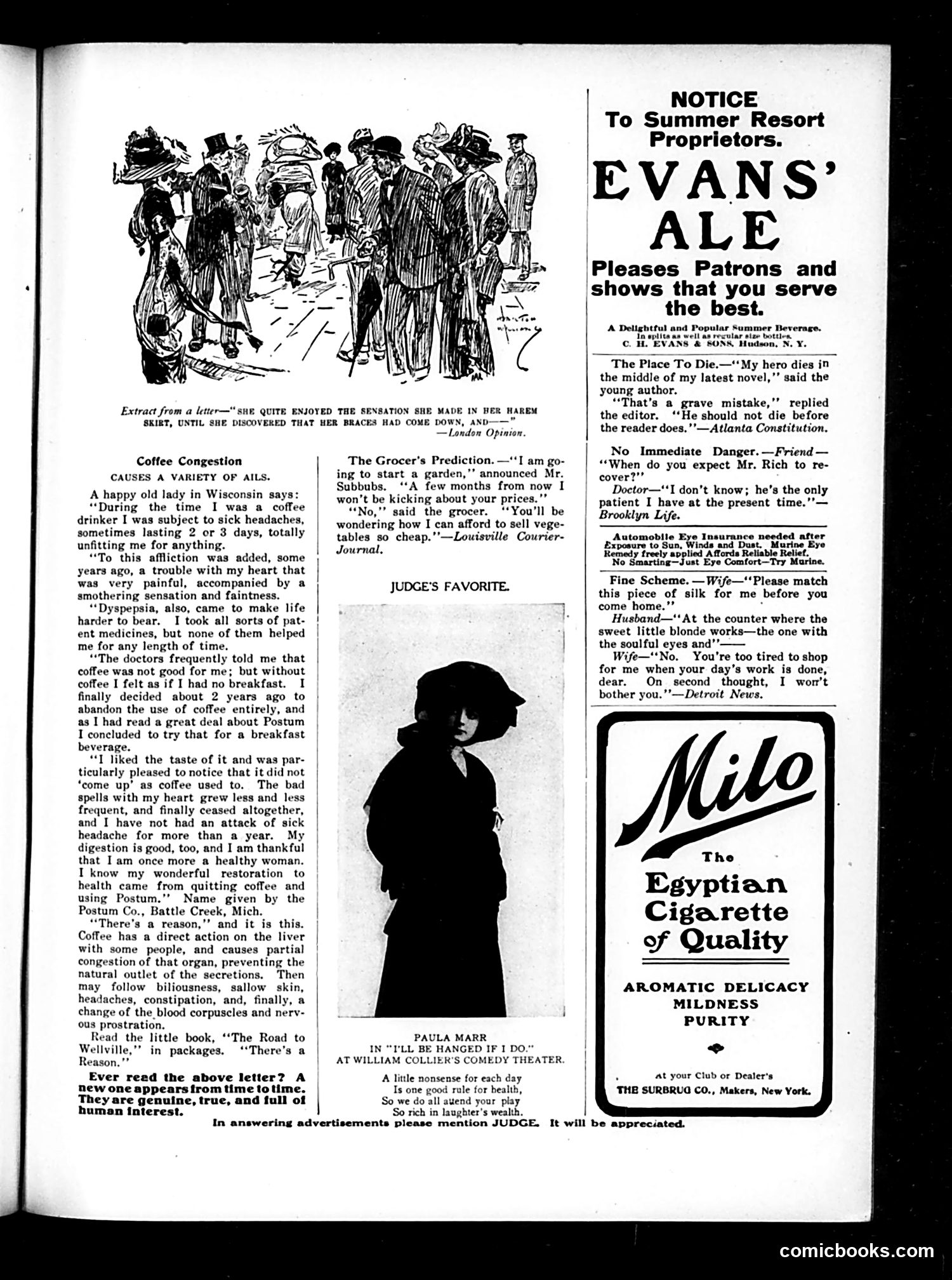
This page combines advertisements with satirical humor typical of early 20th-century Judge magazine. **Main Visual Content:** The top illustration depicts a woman in a "harem skirt" (a fashionable but controversial garment of the era) at what appears to be a social gathering. The caption jokes about her embarrassment when her "braces" (corset stays) came undone—satirizing both the garment's impracticality and the strict social conventions around women's undergarments being visible in public. **Satirical Content:** Several brief jokes mock everyday situations: a grocer predicts a customer's failed gardening attempt, a doctor's financial desperation, and a husband's transparent excuse to avoid shopping. These are gentle domestic humor. **Advertisements:** The page heavily features product ads—Evans' Ale (promoting it for resort proprietors), Postum (coffee substitute), Milo cigarettes, and Murine eye remedy. The Postum ad presents a testimonial from a Wisconsin woman crediting the product with curing her coffee-related ailments (headaches, heart trouble, dyspepsia). **Context:** This reflects early-1900s consumer culture, health anxieties about coffee, and fashion controversies around women's clothing.
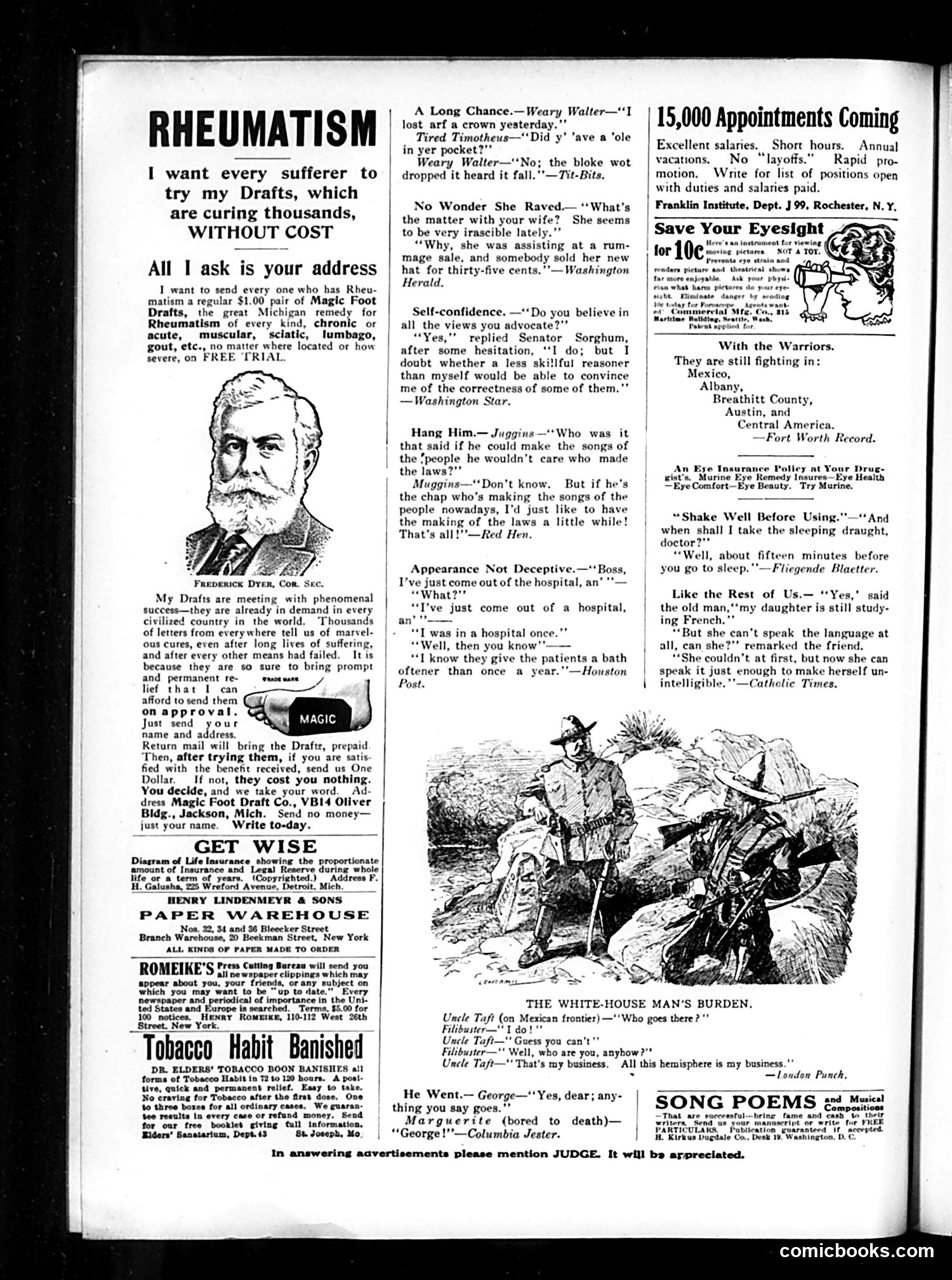
This is primarily an **advertising page** from an early 20th-century satirical magazine. The main content consists of patent medicine and business opportunity ads typical of the era. The notable element is a large **illustrated cartoon** titled "The White-House Man's Burden," showing a man struggling under a heavy load in a desert setting. The caption references Uncle Taft (President William Howard Taft) on the Mexican frontier, satirizing American military involvement in Mexico and Central America during this period. Below the cartoon are brief humorous jokes touching on politics and daily life—including one mocking Senator Sorghum's inconsistency in his own beliefs, and another criticizing popular songwriters' influence over laws. The page reflects the magazine's satirical approach while being dominated by dubious remedies (rheumatism "drafts," tobacco cessation products) and employment schemes—common advertising in publications from this era.
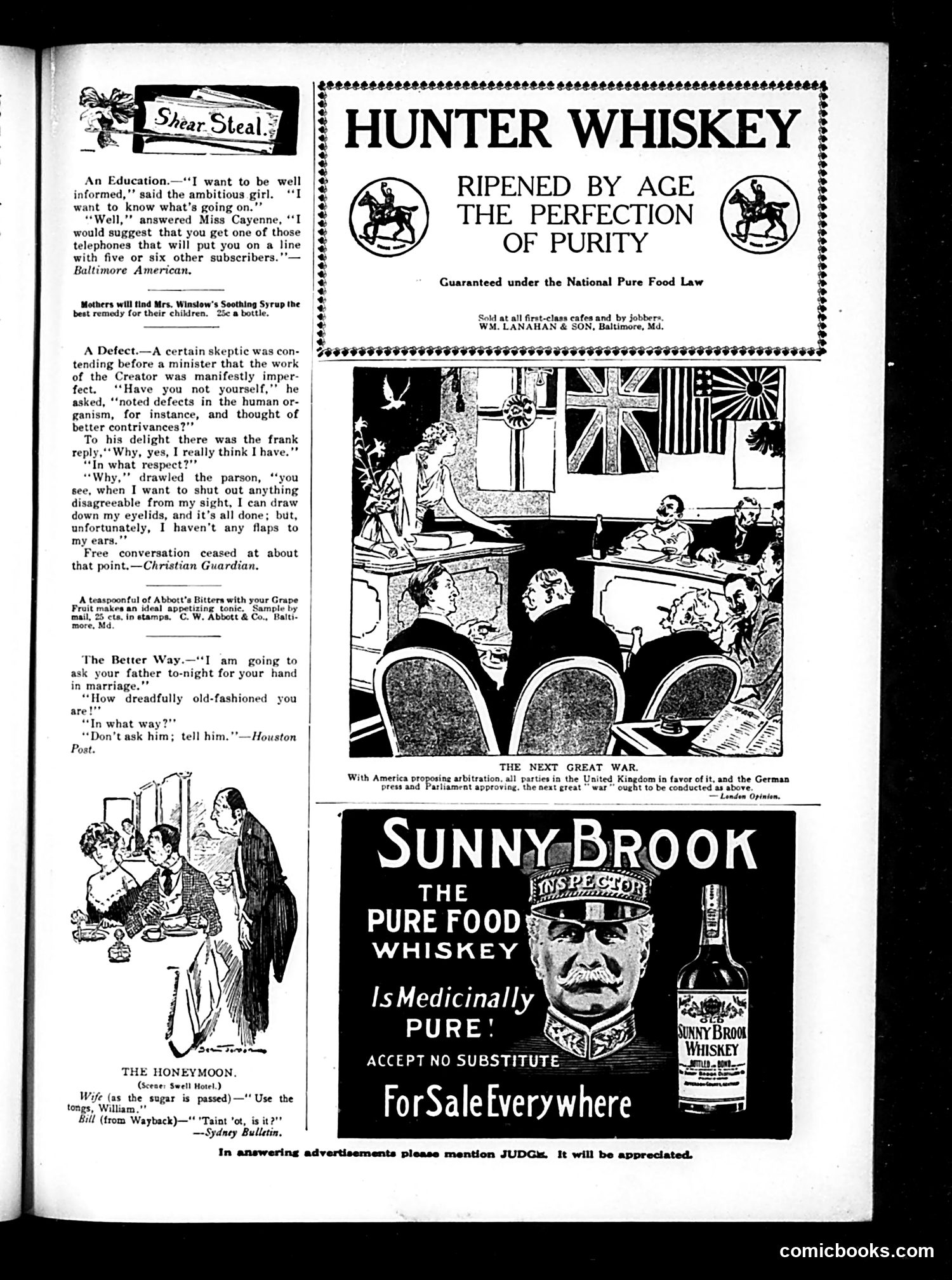
This page from *Judge* contains several satirical items mocking early 1900s social conventions: **"An Education"** jokes that the ambitious girl seeking information should get a party-line telephone, since sharing a line with five or six subscribers means she'll overhear everyone's conversations—a satirical comment on both women's intellectual ambitions and the gossip-enabling nature of shared telephone lines. **"A Defect"** presents a skeptic challenging a minister about God's imperfect design. The minister's reply—that ears lack "flaps" to shut out unpleasant sounds—is humorous because he's admitting design flaws, undercutting his own theological position. **"The Honeymoon"** depicts a rural groom ("Bill from Wayback") unfamiliar with proper etiquette, unable to use sugar tongs and complaining about hot beverages—mocking rural/working-class manners. **"The Next Great War"** cartoon's caption references arbitration and international cooperation, sarcastically suggesting future wars should follow polite formal procedures—likely commentary on early-1900s peace movements. The page is otherwise filled with period advertisements for whiskeys and patent medicines.
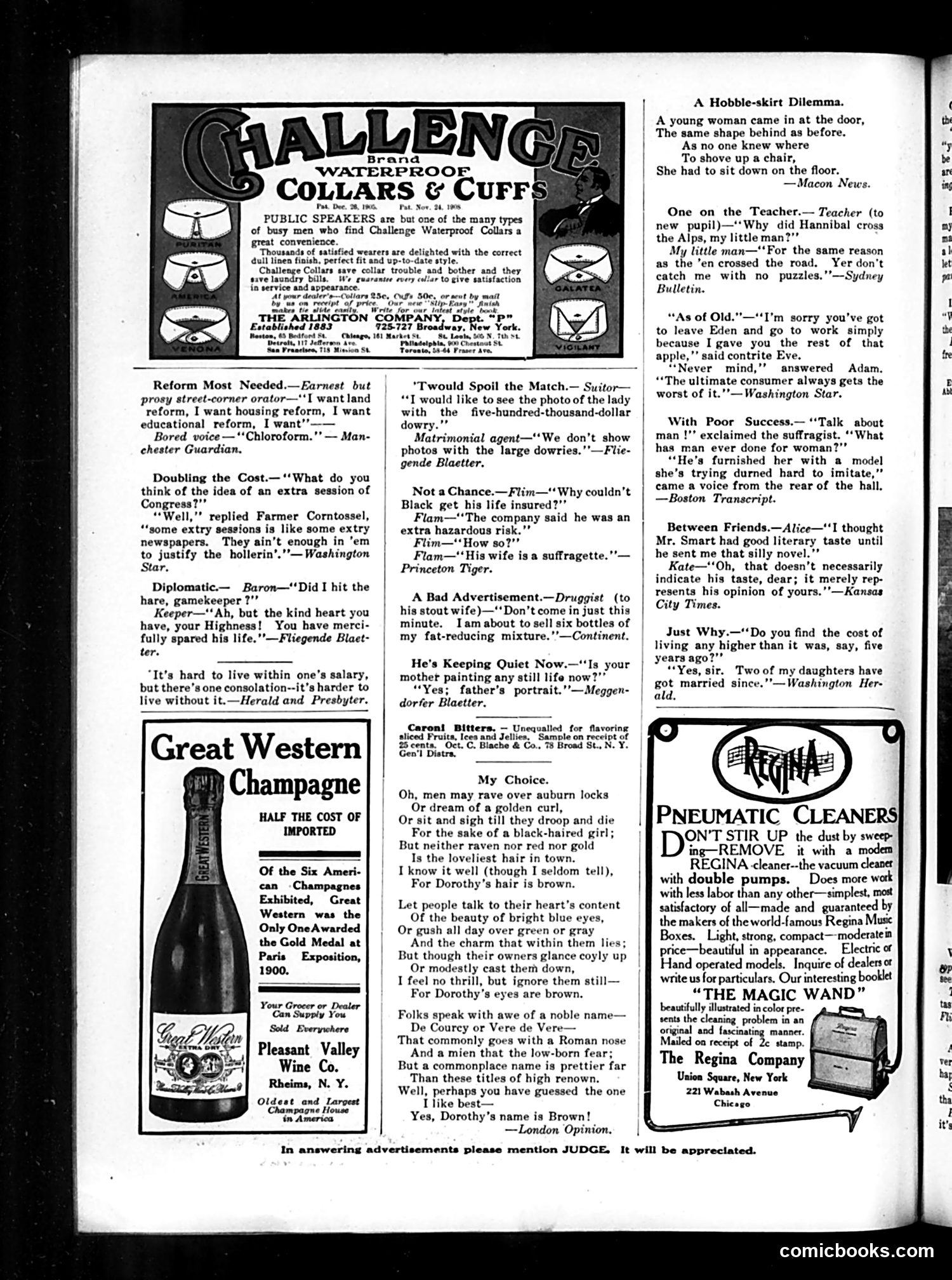
This page from Judge (American satirical magazine) is primarily **advertising with humorous filler content**—not political cartoons. ## Main Advertisement The top features **Challenge Waterproof Collars & Cuffs**, marketed to busy professionals as practical neckwear that survives laundry and provides "perfect fit and up-to-date style." ## Humor Section The bulk consists of short satirical jokes reprinted from various sources (Manchester Guardian, Washington Star, etc.): - **"Reform Most Needed"**: Mocks tedious street-corner orators demanding endless reforms - **"Suffragette" joke**: A wife's suffragette activism makes her a life insurance liability - **"Hobble-skirt" verse**: Pokes fun at the era's restrictive women's fashion (hobble skirts) preventing someone from sitting properly These are general social observations—poking at politicians, marriage, women's suffrage activism, and fashion trends—rather than targeting specific figures or events. ## Additional Advertisements Wine and champagne promotions fill the lower sections, typical of Judge's revenue model. The page reflects early 1900s humor styles and attitudes, particularly regarding gender and women's movements.
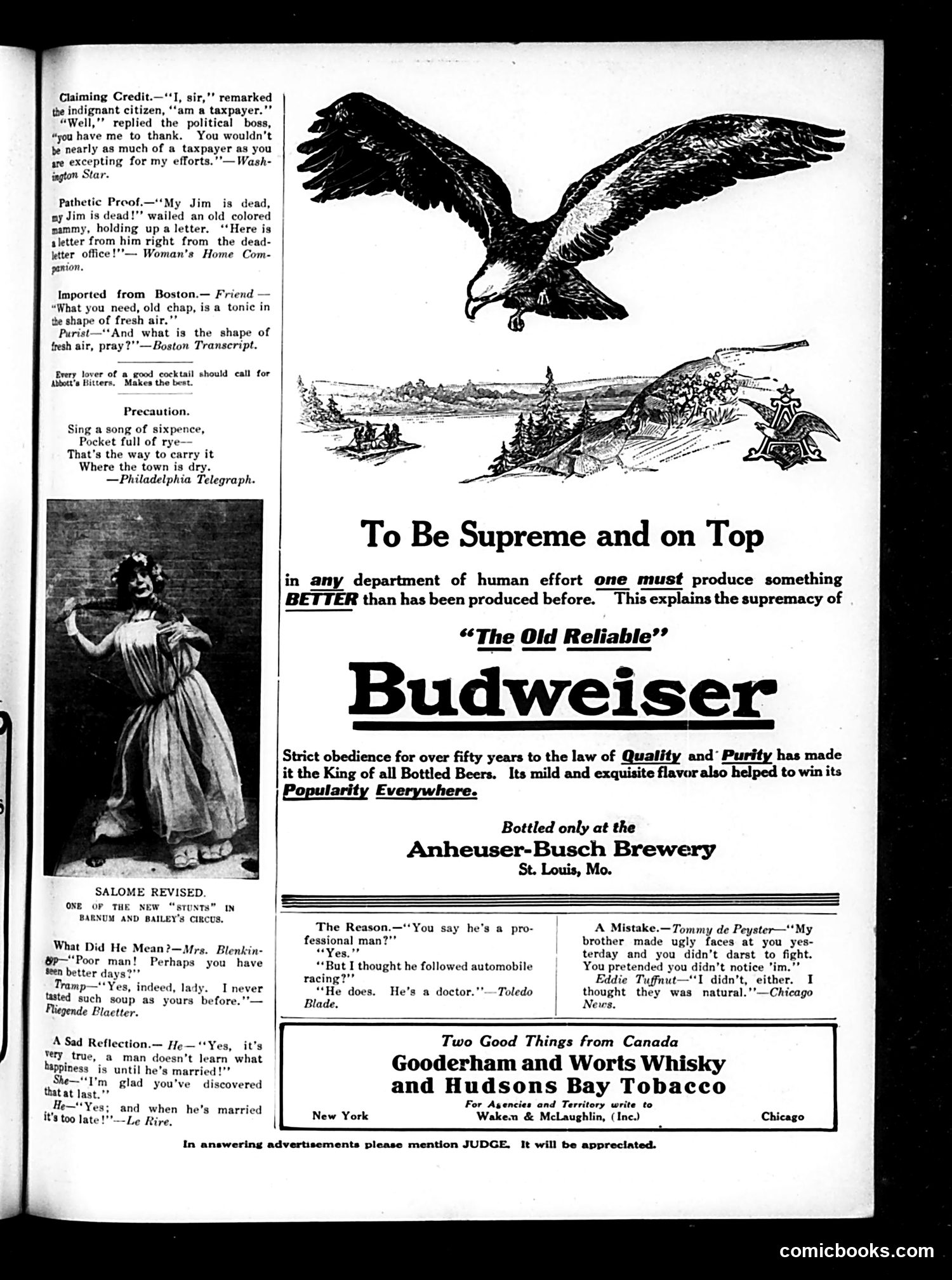
This page contains short humorous anecdotes rather than political cartoons. The jokes satirize various social situations of the era: **Main Content:** - "Claiming Credit" mocks a politician taking credit for taxpayers' prosperity - "Pathetic Proof" plays on a morbid misunderstanding (a letter from the "dead letter office," not the deceased) - "Precaution" references Prohibition ("where the town is dry"), suggesting alcohol smuggling by hiding bottles in song lyrics - Various other brief jokes about marriage, professions, and miscommunication **Notable Image:** The "Salome Revised" photograph shows a circus performer recreating the biblical/theatrical dance of Salome, noted as a "stunt" in Barnum and Bailey's Circus—reflecting early 20th-century vaudeville entertainment. **Advertisements:** The page is dominated by ads for Budweiser beer and Canadian whisky/tobacco, emphasizing quality and purity claims typical of pre-Prohibition advertising. The satire is mild and domestic, targeting everyday social pretenses rather than major political figures.
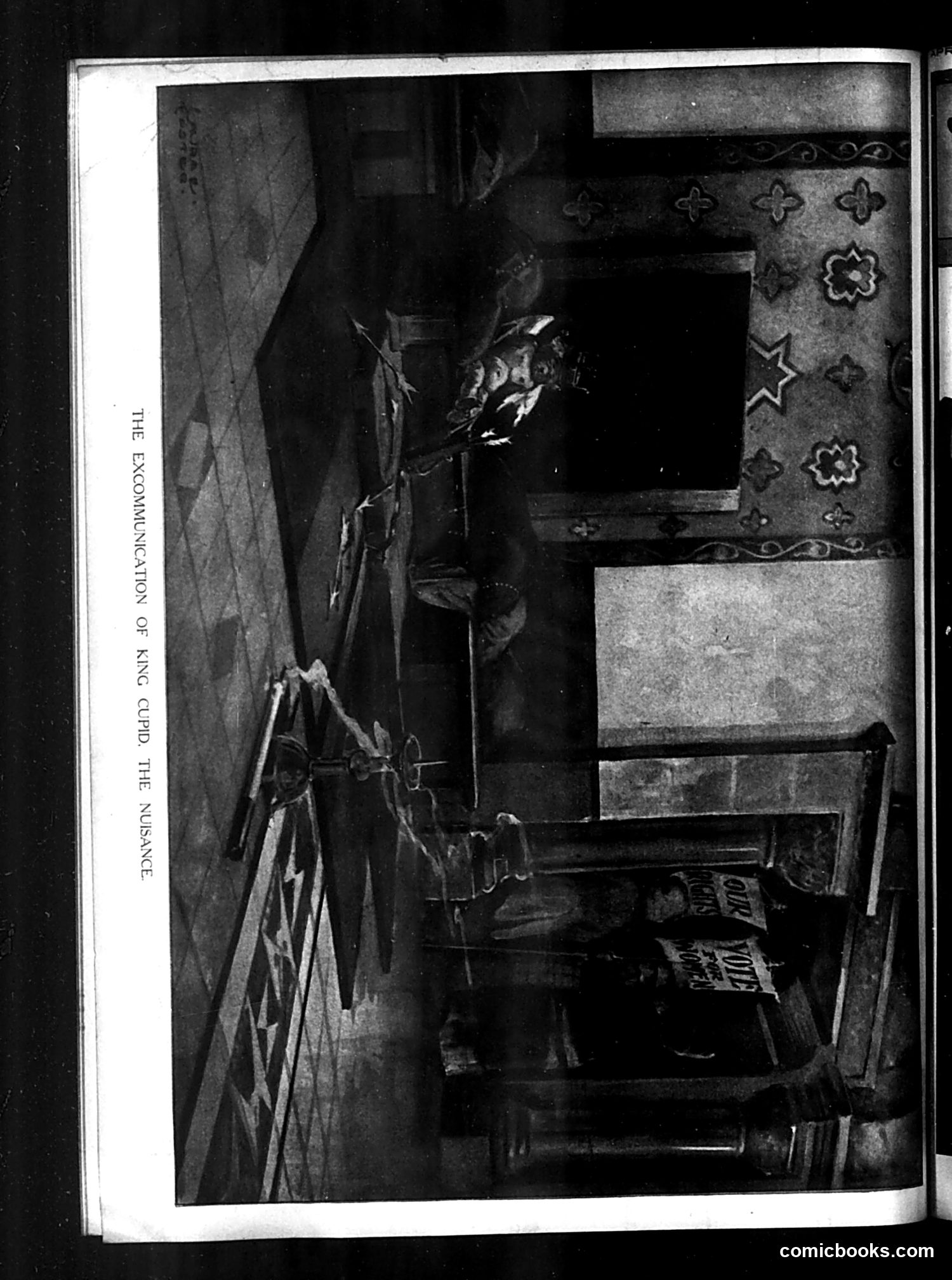
This appears to be a dramatic illustration (rather than a comic) depicting a formal religious or institutional proceeding. The caption suggests it concerns a child being formally expelled or condemned—"excommunication" typically refers to religious banishment, though "nuisance" suggests the child committed disruptive acts. The scene shows figures in formal dress in what appears to be an interior space with ornate decorative elements. Without the full text or additional context, the specific satire is unclear, but the caption's tone suggests the cartoon mocks either overly severe punishment of children or the pompous formality applied to minor infractions. The satirical point likely critiques exaggerated institutional responses to juvenile misbehavior.