
Judge, 1911-04-22 · page 12 of 24
Judge — April 22, 1911 — page 12: what you’re looking at
What you’re looking at
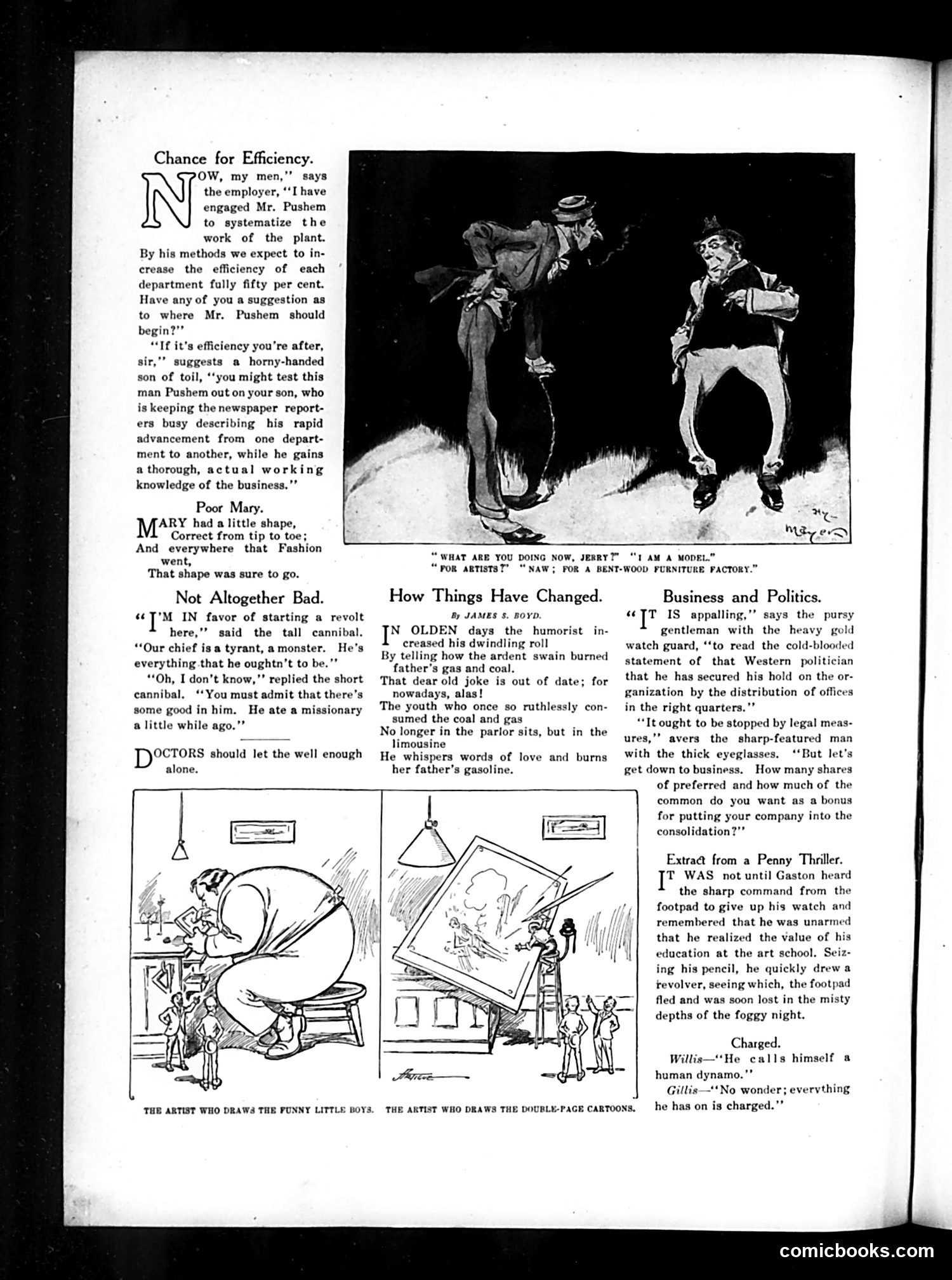
This page contains multiple satirical pieces reflecting early 20th-century American concerns: **"Chance for Efficiency"**: A worker sarcastically suggests testing the new efficiency expert (Mr. Pushem) on the employer's son, who appears to be advancing rapidly through newspaper departments through nepotism rather than merit. The satire targets both workplace inefficiency and preferential treatment for the wealthy. **"Poor Mary" and "Not Altogether Bad"**: Light verse and a cannibal joke typical of the era's casual humor. **"How Things Have Changed"**: A poem satirizing outdated romantic tropes—old jokes about young men burning coal/gas at their sweethearts' homes are now obsolete; they burn gasoline in automobiles instead. **"Business and Politics"**: Two businessmen discuss political corruption (distributing offices for support) while simultaneously engaging in equally corrupt stock manipulation for a corporate consolidation—highlighting hypocrisy about graft. **Bottom cartoons**: Visual gags about artists and charged ("electric") personality types. The page satirizes nepotism, hypocrisy in condemning corruption, and modern social change.
📄 Transcribed text from this page (OCR, searchable)
Machine-transcribed from the original scan — historical spelling and the odd misread are preserved.
Chance for Efficiency. OW, my men,’ says the employer, “I have engaged Mr. Pushem to systematize the work of the plant. By his methods we expect to in- crease the efficiency of each department fully fifty per cent. Have any of you a suggestion as to where Mr. Pushem should begin?” “If it’s efficiency you're after, sir,’’ suggests a horny-handed son of toil, ‘you might test this man Pushem out on your son, who is keeping the newspaper report- ers busy describing his rapid advancement from one depart- ment to another, while he gains a thorough, actual working knowledge of the business.’’ Poor Mary. MA8Y had a little shape, Correct from tip to toe And everywhere that Fashion went, ‘That shape was sure to go. Not Altogether Bad. “ 1 IN favor of starting a revolt here,” said the tall cannibal. “Our chief isa tyrant, a monster. He's everything that he oughtn’t to be. “Oh, I don’t know,”’ replied the short cannibal. ‘‘You must admit that there's some good in him. He ate a missionary a little while ago. OCTORS should let the well enough alone. RY MSy em “WHAT ARE YOU DOING NOW, JERRY?” “poR agtists 7” How Things Have Changed. By JAMES 8. BOYD. N OLDEN days the humorist creased his dwindling roll By telling how the ardent swain burned father’s gas and coal. That dear old joke is out of date; for nowadays, alas! The youth who once so ruthlessly con- sumed the coal and gas No longer in the parlor sits, but in the limousine He whispers words of love and burns her father’s gasoline. in- “TAM A MODEL.” “NAW; POR A BENT-WOOD FURNITURE PACTORY.” Business and Politics. «JT IS appalling,’”? says the pursy gentleman with the heavy watch guard, ‘‘to read the cold-blood statement of that Western politician that he has secured his hold on the or- ganization by the distribution of offices in the right quarters.”’ “It ought to be stopped by legal meas- avers the sharp-featured man with the thick eyeglasses, ‘‘But let's get down to business. How many shares of preferred and how much of the common do you want as a bonus for putting your company into the consolidation?” Extra@ from a Penny Thriller. T WAS not until Gaston heard the sharp command from the footpad to give up his watch and remembered that he was unarmed that he realized the value of his education at the art school, Seiz- ing his pencil, he quickly drew a revolver, seeing which, the footpad fled and was soon lost in the misty depths of the foggy night. Charged. Willis—“He calls himself a human dynamo.”* Gillis—No wonder; everything he has on is charged.”” THE ARTIST WHO DRAWS THE PUNNY LITTLE BOYS. THE ARTIST WHO DRAWS THE DOUBLE-PAGE CARTOONS, comicbooks.com