
Judge, 1911-04-22 · page 10 of 24
Judge — April 22, 1911 — page 10: what you’re looking at
What you’re looking at
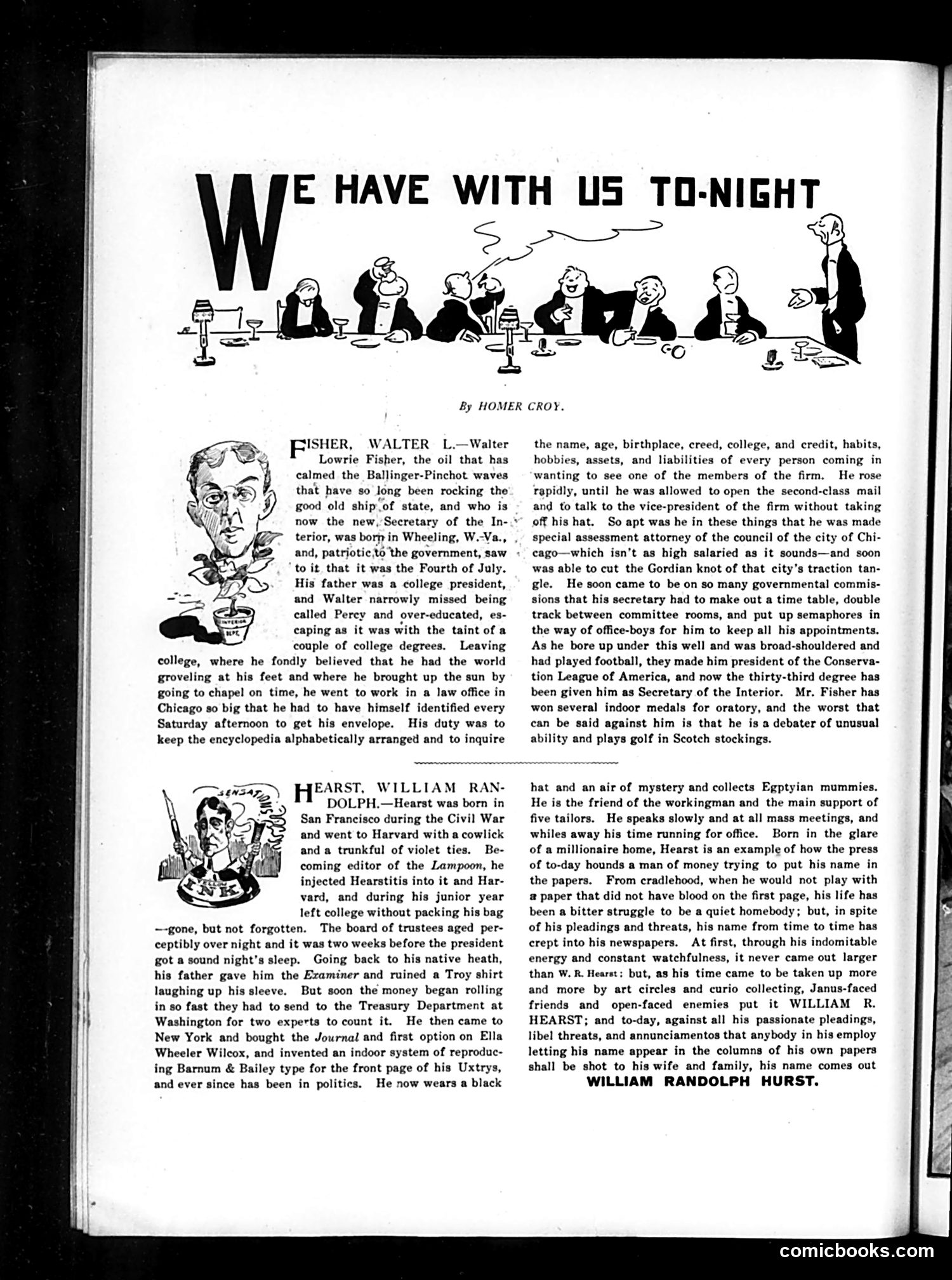
This page from Judge magazine presents satirical biographical sketches of two prominent figures: **Walter L. Fisher**, the new Secretary of the Interior (appointed to resolve the contentious Ballinger-Pinchot conservation scandal), and **William Randolph Hearst**, the newspaper magnate. The humor works through exaggeration and irony. Fisher is portrayed as a bureaucratic functionary who rose through tedious competence—keeping encyclopedias alphabetized, identifying himself for paychecks—yet somehow ended up running major governmental commissions. The satire mocks his relentless overinvolvement in committees. Hearst's sketch ridicules his sensationalism and political ambitions. Starting as a Harvard troublemaker who abandoned his education, he inherited newspapers and allegedly invented yellow journalism ("indoor system of reproducing Barnum & Bailey"), now desperately seeking respectability while collecting mummies and supporting tailors. Both sketches employ Judge's characteristic tone: mock-serious biographical treatment that reveals subjects' absurdities through deadpan narration and exaggerated detail.
📄 Transcribed text from this page (OCR, searchable)
Machine-transcribed from the original scan — historical spelling and the odd misread are preserved.
By HOMER CROY. ISHER, WALTER L.—Walter Lowrie Fisher, the oil that has calmed the Ballinger-Pinchot waves that have so long been rocking the good old ship‘of state, and who is now the new, Secretary of the In- terior, was born in Wheeling, W.-Va., and, patriotic,to ‘the government, saw to it that it was the Fourth of July. His father was a college president, and Walter narrowly missed being called Percy and over-educated, es- caping as it was with the taint of a couple of college degrees. Leaving college, where he fondly believed that he had the world groveling at his feet and where he brought up the sun by going to chapel on time, he went to work in a law office in Chicago so big that he had to have himself identified every Saturday afternoon to get his envelope. His duty was to keep the encyclopedia alphabetically arranged and to inquire WILLIAM RAN- DOLPH.—Hearst was born in San Francisco during the Civil War and went to Harvard with a cowlick s4nsaz EARST, ee), A m and a trunkful of violet ties. Be- coming editor of the Lampoon, he injected Hearstitis into it and Har- vard, and during his junior year left college without packing his bag —-gone, but not forgotten. The board of trustees aged per- ceptibly over night and it was two weeks before the president got a sound night's sleep. Going back to his native heath, his father gave him the Examiner and ruined a Troy shirt laughing up his sleeve. But soon the money began rolling in so fast they had to send to the Treasury Department at Washington for two experts to count it. He then came to New York and bought the Journal and first option on Ella Wheeler Wilcox, and invented an indoor system of reproduc- ing Barnum & Bailey type for the front page of his Uxtrys, and ever since has been in politics. He now wears a black the name, age, birthplace, creed, college, and credit, habits, hobbies, assets, and liabilities of every person coming in wanting to see one of the members of the firm. He rose rapidly, until he was allowed to open the second-class mail and to talk to the vice-president of the firm without taking off his hat. So apt was he in these things that he was made special assessment attorney of the council of the city of Chi- cago—which isn’t as high salaried as it sounds—and soon was able to cut the Gordian knot of that city’s traction tan- gle. He soon came to be on so many governmental commis- sions that his secretary had to make out a time table, double track between committee rooms, and put up semaphores in the way of office-boys for him to keep all his appointments. As he bore up under this well and was broad-shouldered and had played football, they made him president of the Conserva- tion League of America, and now the thirty-third degree has been given him as Secretary of the Interior. Mr. Fisher has won several indoor medals for oratory, and the worst that can be said against him is that he is a debater of unusual ability and plays golf in Scotch stockings. hat and an air of mystery and collects Egptyian mummies. He is the friend of the workingman and the main support of five tailors. He speaks slowly and at all mass meetings, and whiles away his time running for office. Born in the glare of a millionaire home, Hearst is an example of how the press of to-day hounds a man of money trying to put his name in the papers. From cradlehood, when he would not play with @ paper that did not have blood on the first page, his life has been a bitter struggle to be a quiet homebody; but, in spite of his pleadings and threats, his name from time to time has crept into his newspapers. At first, through his indomitable energy and constant watchfulness, it never came out larger than W. R. Hearst; but, as his time came to be taken up more and more by art circles and curio collecting, Janus-faced friends and open-faced enemies put it WILLIAM R. HEARST; and to-day, against all his passionate pleadings, libel threats, and annunciamentos that anybody in his employ letting his name appear in the columns of his own papers shall be shot to his wife and family, his name comes out WILLIAM RANDOLPH HURST. comicbooks.com