
Judge, 1911-04-22 · page 15 of 24
Judge — April 22, 1911 — page 15: what you’re looking at
What you’re looking at
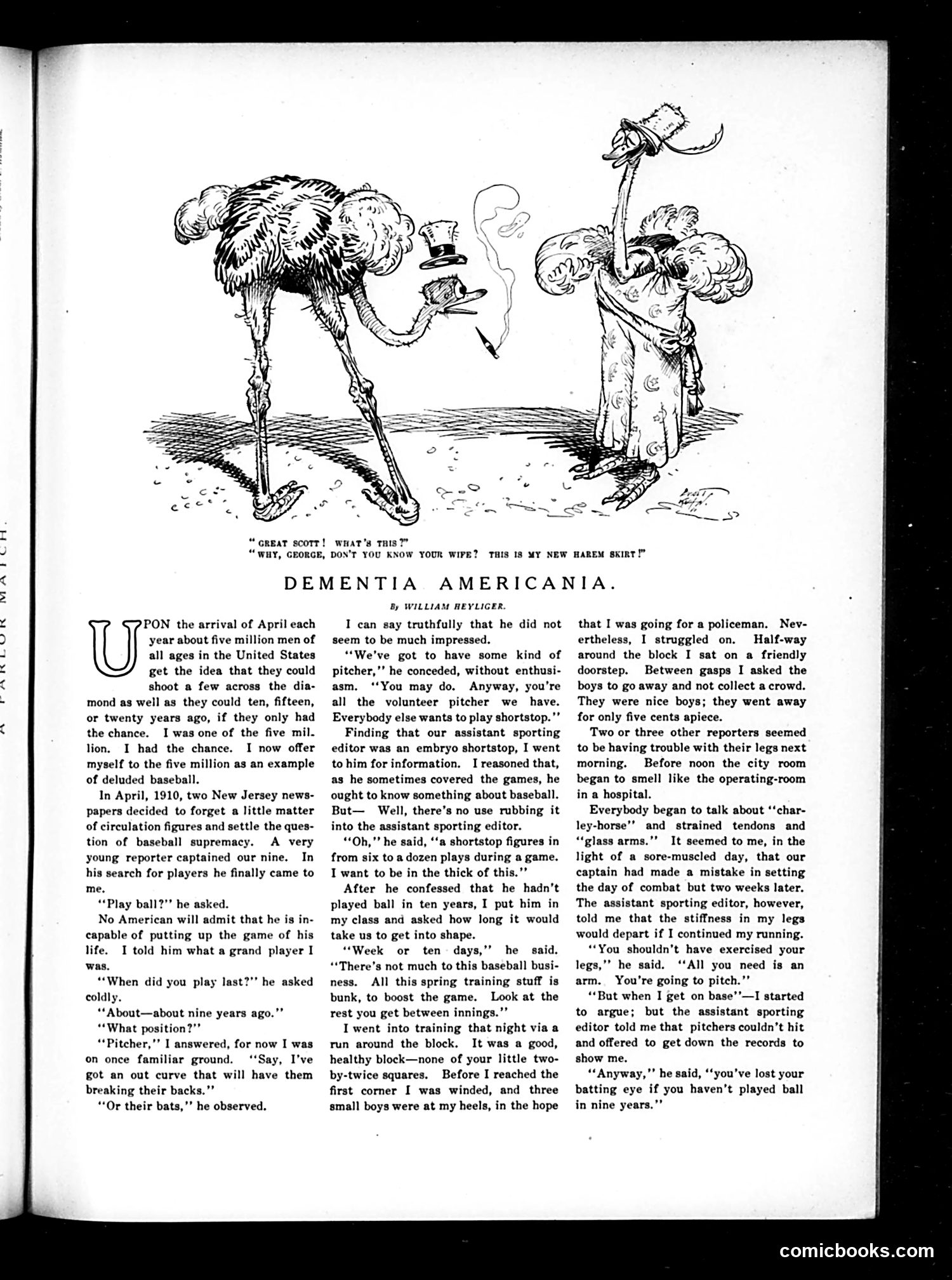
This 1910 article by William Heyliger satirizes the "April delusion" gripping American men—the recurring fantasy that they can still play baseball competitively despite years away from the sport. The cartoon caption jokes about a "harem skirt" (a fashionable women's garment of the era), with the husband's confused reaction providing visual comedy about changing women's fashion. The article's satire targets middle-aged men's overconfidence: a newspaper recruits the narrator as a pitcher despite his nine-year absence; he and an assistant sporting editor naively believe a week's training suffices. Their subsequent physical suffering—strained muscles, exhaustion—deflates their delusional confidence. The editor's dismissive commentary ("there's no use rubbing it in") underscores the gentle mockery of American male vanity and nostalgia for lost youth, a recurring theme in Judge's humor.
📄 Transcribed text from this page (OCR, searchable)
Machine-transcribed from the original scan — historical spelling and the odd misread are preserved.
FOU SS, Saw Nr SS OVE ON Ss ES oe “GREAT scoTT! WHAT'S THIS?” “WHY, GEORGE, DON’T YOU KNOW YOUR WIPE? THIS 18 MY NEW HAREM SKIRT!” DEMENTIA AMERICANIA. PON the arrival of April each year about five million men of all ages in the United States get the idea that they could shoot a few across the dia- mond as well as they could ten, fifteen, or twenty years ago, if they only had the chance. I was one of the five mil- lion. I had the chance. I now offer myself to the five million as an example of deluded baseball. In April, 1910, two New Jersey news- papers decided to forget a little matter of circulation figures and settle the ques- tion of baseball supremacy. A very young reporter captained our nine. In his search for players he finally came to me. “Play ball?’’ he asked. No American will admit that he is in- capable of putting up the game of his life. I told him what a grand player I was. “When did you play last?” he asked coldly. “*About—about nine years ago.’” ‘What position?’”’ “Pitcher,’’ I answered, for now I was on once familiar ground. ‘‘Say, I’ve got an out curve that will have them breaking their backs.’’ “Or their bats,’’ he observed. By WILLIAM HEYLIGER. I can say truthfully that he did not seem to be much impressed. “‘We've got to have some kind of pitcher,’’ he conceded, without enthusi- asm, ‘‘You may do. Anyway, you're all the volunteer pitcher we have. Everybody else wants to play shortstop.’’ Finding that our assistant sporting editor was an embryo shortstop, I went to him for information. I reasoned that, as he sometimes covered the games, he ought to know something about baseball. But— Well, there’s no use rubbing it into the assistant sporting editor. “‘Oh,’’ he said, ‘‘a shortstop figures in from six to a dozen plays during a game. I want to be in the thick of this.’’ After he confessed that he hadn't played ball in ten years, I put him in my class and asked how long it would take us to get into shape. “Week or ten days,” he said. ‘‘There’s not much to this baseball busi- ness. All this spring training stuff is bunk, to boost the game. Look at the rest you get between innings.’’ I went into training that night via a run around the block. It was a good, healthy block—none of your little two- by-twice squares. Before I reached the first corner I was winded, and three small boys were at my heels, in the hope that I was going for a policeman. Nev- ertheless, I struggled on. Half-way around the block I sat on a friendly doorstep. Between gasps I asked the boys to go away and not collect a crowd. They were nice boys; they went away for only five cents apiece. Two or three other reporters seemed to be having trouble with their legs next morning. Before noon the city room began to smell like the operating-room in a hospital. Everybody began to talk about ‘‘char- ley-horse’’ and strained tendons and “glass arms.’’ It seemed to me, in the light of a sore-muscled day, that our captain had made a mistake in setting the day of combat but two weeks later. The assistant sporting editor, however, told me that the stiffness in my legs would depart if I continued my running. “You shouldn't have exercised your legs,’”” he said. ‘‘All you need is an arm. You're going to pitch.’” “‘But when I get on base’’—I started to argue; but the assistant sporting editor told me that pitchers couldn’t hit and offered to get down the records to show me. “Anyway,” he said, ‘you've lost your batting eye if you haven’t played ball in nine years."’ comicbooks.com