
Judge, 1911-04-22 · page 16 of 24
Judge — April 22, 1911 — page 16: what you’re looking at
What you’re looking at
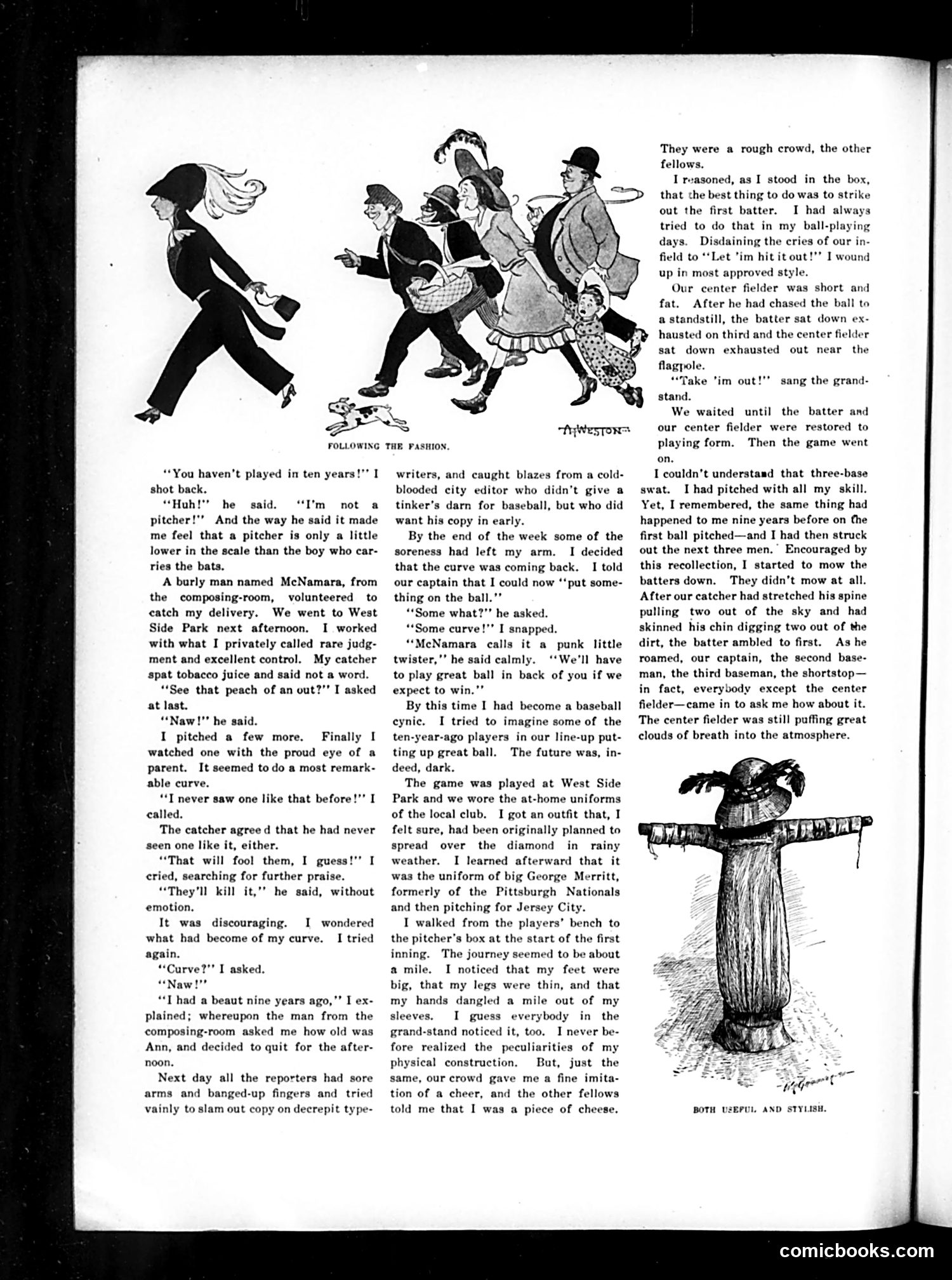
This page contains an illustrated humorous story about an office worker who attempts to return to baseball after nine years away. The cartoon titled "Following the Fashion" (top left) shows a woman in fashionable dress leading a group of men—likely satirizing how men follow women's fashion trends, hence the title. The main text is a first-person narrative about the narrator's failed baseball comeback. The humor derives from his physical inadequacy: he's awkwardly tall and thin in an ill-fitting uniform (apparently belonging to former player George Merritt), his pitching has deteriorated, and his teammates mock him relentlessly. The story documents his humiliation—exhausted players, dismissive catchers, and unsympathetic coworkers at *Judge* magazine who'd rather work than encourage his athletic aspirations. The satire targets both the narrator's delusional confidence in outdated skills and the callous, competitive workplace culture that prioritizes typeset deadlines over camaraderie.
📄 Transcribed text from this page (OCR, searchable)
Machine-transcribed from the original scan — historical spelling and the odd misread are preserved.
a Ba FOLLOWING THE PASHION. “You haven’t played in ten years!"" I shot back. “Huh he said. ‘I'm not a pitcher!’ And the way he said it made me feel that a pitcher is only a little lower in the scale than the boy who car- ries the bats. A burly man named McNamara, from the composing-room, volunteered to catch my delivery. We went to West Side Park next afternoon. I worked with what I privately called rare judg- ment and excellent control. My catcher Spat tobacco juice and said not a word. “See that peach of an out?’ I asked at last. “Naw!"’ he said. I pitched a few more. Finally I watched one with the proud eye of a parent. It seemed todo a most remark- able curve. “T never saw one like that before!’ I called. The catcher agree d that he had never seen one like it, either. “That will fool them, I guess!"’ I cried, searching for further praise. “They'll kill it,’’ he said, without emotion, It was discouraging. what had become of my curve. again. “Curve “Naw!"" “T had a beaut nine years ago,"’ I ex- plained; whereupon the man from the composing-room asked me how old was Ann, and decided to quit for the after- noon. Next day all the repor arms and banged-up fingers and tried vainly to slam out copy on decrepit type- I wondered I tried I asked. rs had sore writers, and caught blazes from a cold- blooded city editor who didn't give a tinker’s darn for baseball, but who did want his copy in early. By the end of the week some of the soreness had left my arm. I decided that the curve was coming back. I told our captain that I could now ‘‘put some- thing on the ball.” “Some what?"’ he asked. “Some curve !’" I snapped. “McNamara calls it a punk little twister,’’ he said calmly. ‘*We’ll have to play great ball in back of you if we expect to win.”” By this time I had become a baseball cynic. I tried to imagine some of the ten-year-ago players in our line-up put- ting up great ball. The future was, in- deed, dark. The game was played at West Side Park and we wore the at-home uniforms of the local club, I got an outfit that, I felt sure, had been originally planned to spread over the diamond in rainy weather. I learned afterward that it was the uniform of big George Merritt, formerly of the Pittsburgh Nationals and then pitching for Jersey City. I walked from the players’ bench to the pitcher's box at the start of the first inning. The journey seemed to be about a mile. I noticed that my feet were big, that my legs were thin, and that my hands dangled a mile out of my sleeves. I guess everybody in the grand-stand noticed it, too. I never be- fore realized the peculiarities of my physical construction. But, just the same, our crowd gave me a fine imita- tion of a cheer, and the other fellows told me that I was a piece of cheese. They were a rough crowd, the other fellows, I reasoned, as I stood in the box, that the best thing to do was to strike out the first batter. I had always tried to do that in my ball-playing Disdaining the cries of our in- !"" T wound days. field to ‘‘Let ’im hit it ou' up in most approved style. Our center fielder was short and fat. After he had chased the ball to a standstill, the batter sat down ex- hausted on third and the center fielder sat out near the flagpole. “Take ‘im out!"" stand. We waited until the batter and our center fielder were restored to Then the game went down exhausted sang the grand- playing form. on. I couldn't understand that three-base sw I had pitched with all my skill. Yet, I remembered, the same thing had happened to me nine years before on the first ball pitched—and I had then struck out the next three men.’ Encouraged by this recollection, I started to mow the batters down. They didn’t mow at all. After our catcher had stretched his spine pulling two out of the sky and had skinned his chin digging two out of the dirt, the batter ambled to first. As he roamed, our captain, the second base- man, the third baseman, the shortstop— in fact, everybody except the center fielder—came in to ask me how about it. The center fielder was still puffing great clouds of breath into the atmosphere. i Poel wey BOTH USEFUL, AND STYLISH. comicbooks.com