
A complete issue · 24 pages · 1911
Judge — April 8, 1911
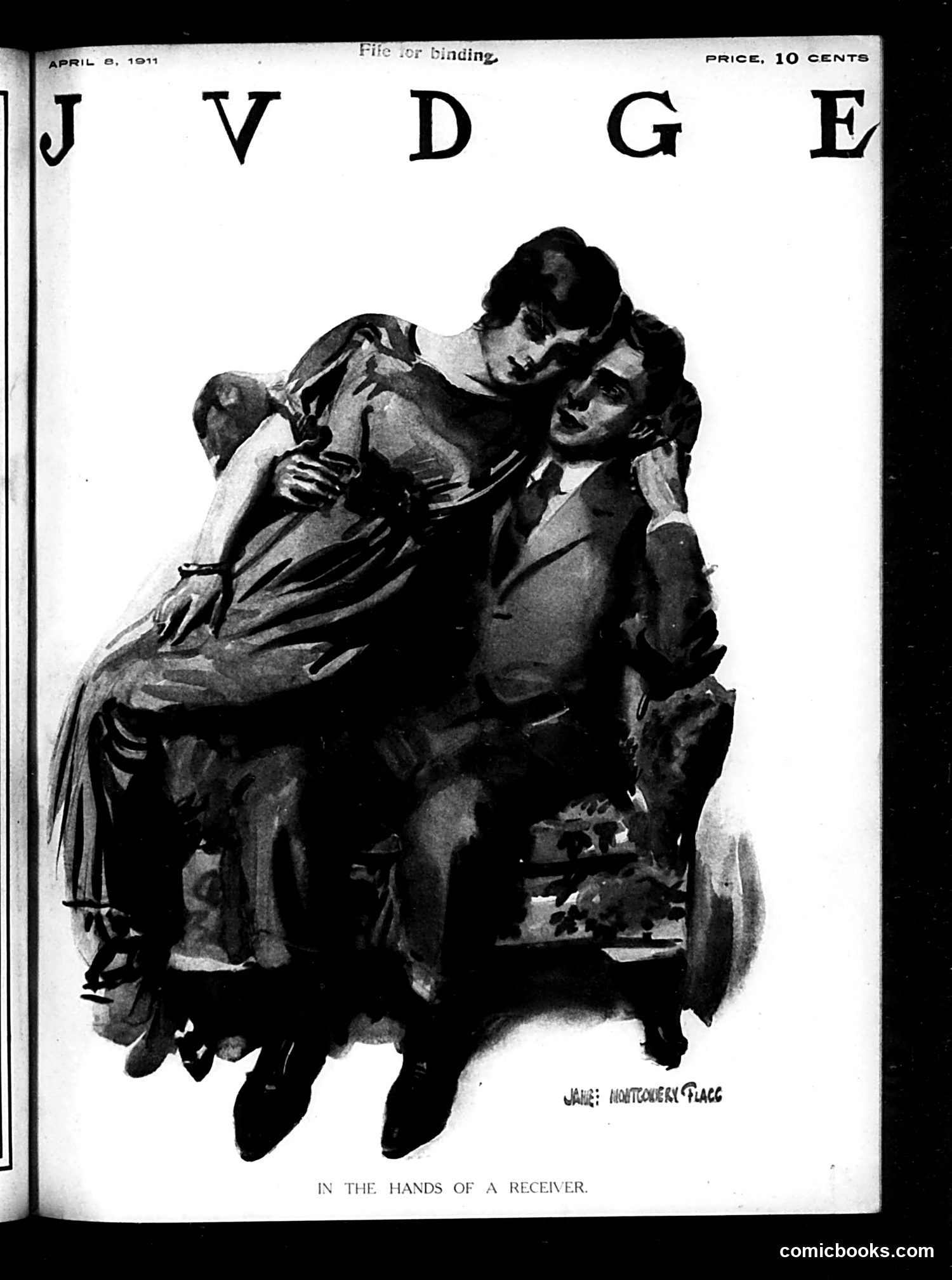
This Judge magazine cover from April 8, 1911 appears to be political satire about financial receivership—a legal process where a court-appointed receiver takes control of a failing business or organization. The illustration shows what appears to be a woman (possibly representing a corporation, business, or government entity) being physically handled/passed between multiple men in suits. The caption "In the Hands of a Receiver" suggests the subject is being transferred through legal/financial proceedings. The satire likely criticizes how receiverships left entities vulnerable to mismanagement or exploitation by court-appointed officials, or comments on a specific high-profile receivership case from 1911. Without additional context about which specific company or institution is referenced, the exact target remains unclear.
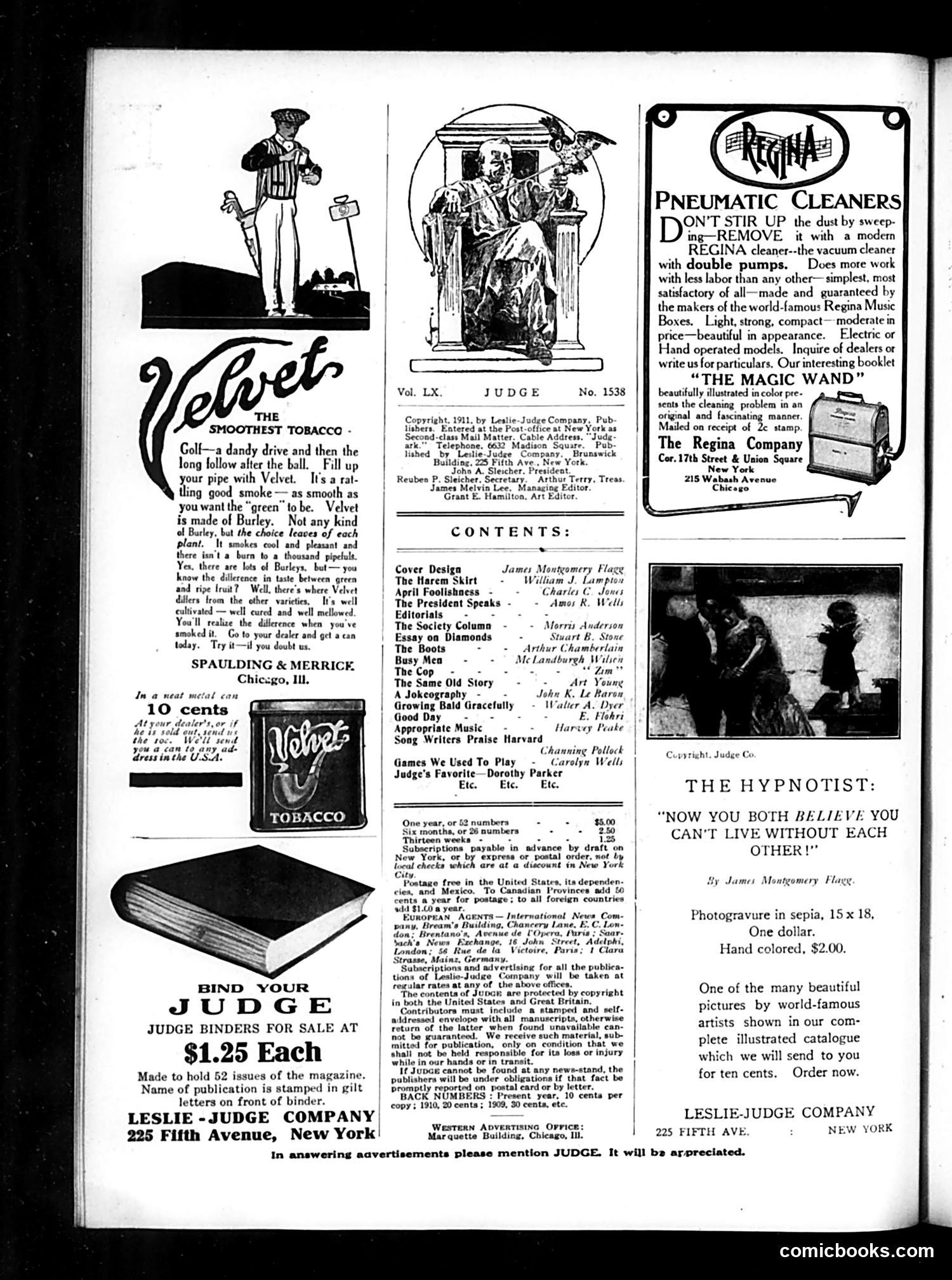
This page is primarily **advertisements and magazine business content** rather than political satire. The visible elements include: - A **Velvet tobacco ad** (left) featuring a golfer, promoting smooth smoking - A **Judge magazine cover** (center) showing an elderly man in classical dress, labeled "Vol. LIX, No. 1538" - A **Regina Pneumatic Cleaners ad** (right) promoting vacuum cleaners with "double pumps" - **Magazine subscription and binding information** (bottom) - A photograph captioned "**The Hypnotist**" with text "NOW YOU BOTH BELIEVE YOU CAN'T LIVE WITHOUT EACH OTHER!" by James Montgomery Flagg The hypnotist image appears to be satirizing romantic delusion or manipulation, but without additional context about contemporary events, the specific satirical target remains unclear. The page's primary purpose is commercial rather than political commentary.
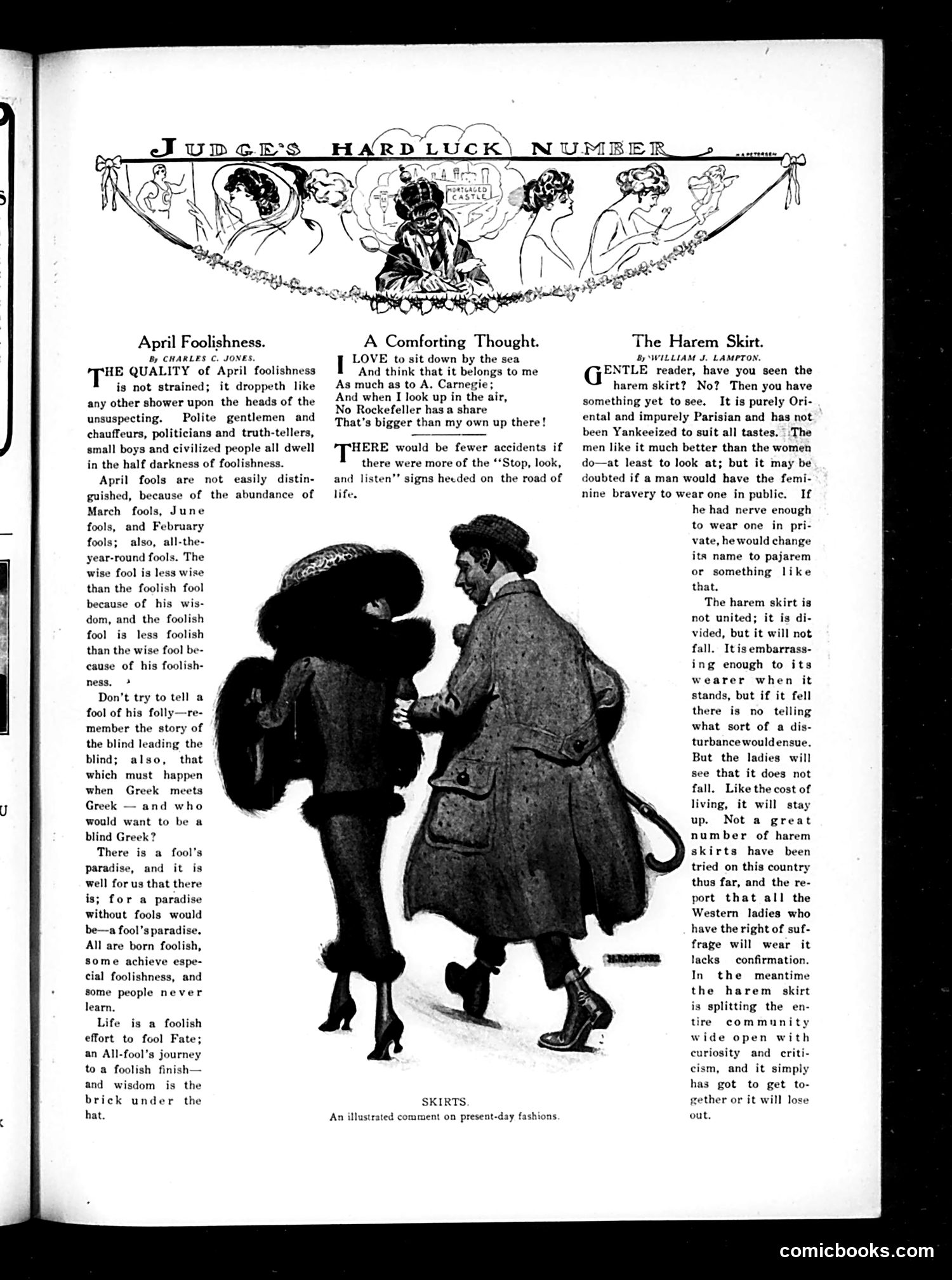
This page satirizes early 20th-century fashion and social customs through three separate pieces. **"April Foolishness"** mocks the tradition of April pranks with philosophical commentary on foolishness itself. **"A Comforting Thought"** presents a brief humorous poem about wealth disparity—a poor person finds comfort knowing the wealthy have anxieties too. **"The Harem Skirt"** is the main satire. The illustration shows a woman in a divided skirt with a man, captioned as commentary on "present-day fashions." The text criticizes the harem skirt (a controversial fashion allowing visible leg division) as unwomanly and impractical. The author suggests Western women lack "suffrage" to wear it confidently—likely a satirical reference to women's suffrage debates of the era, equating fashion controversy with political rights.
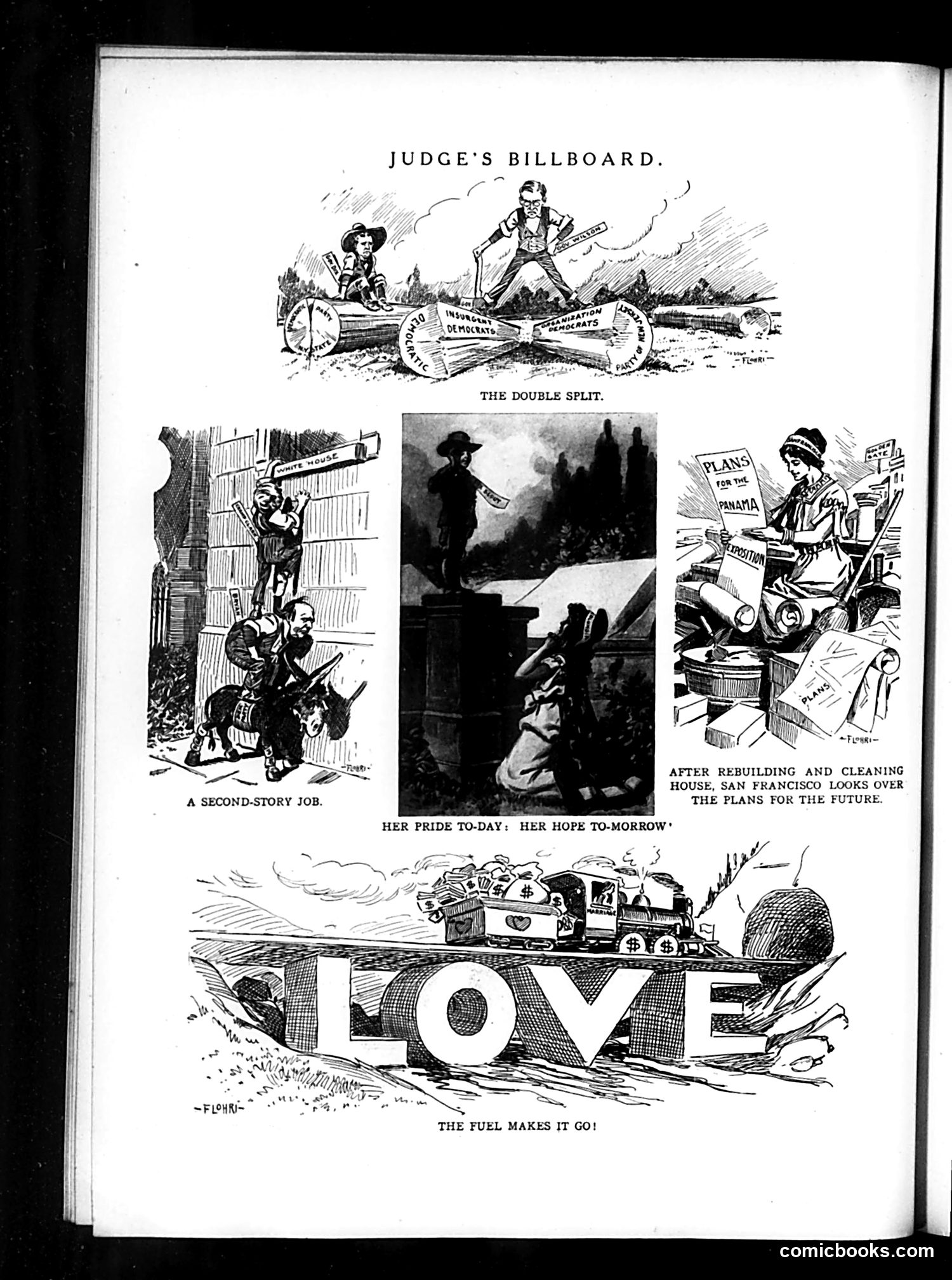
This page contains four satirical cartoons responding to San Francisco's 1906 earthquake and reconstruction: **"The Double Split"** (top) depicts competing political factions—labeled "Insurance Democrats" and "Separation Democrats"—literally splitting apart the city's recovery efforts. **"A Second-Story Job"** satirizes corruption or opportunistic looting amid disaster. **"Her Pride To-day; Her Hope To-morrow"** shows San Francisco surveying reconstruction plans with optimism despite devastation. **"The Fuel Makes It Go!"** (bottom) uses "LOVE" as a vehicle carrying San Francisco forward, suggesting civic unity and emotional resilience will power recovery. The cartoons balance criticism of political divisions with encouragement for the city's rebuilding spirit.
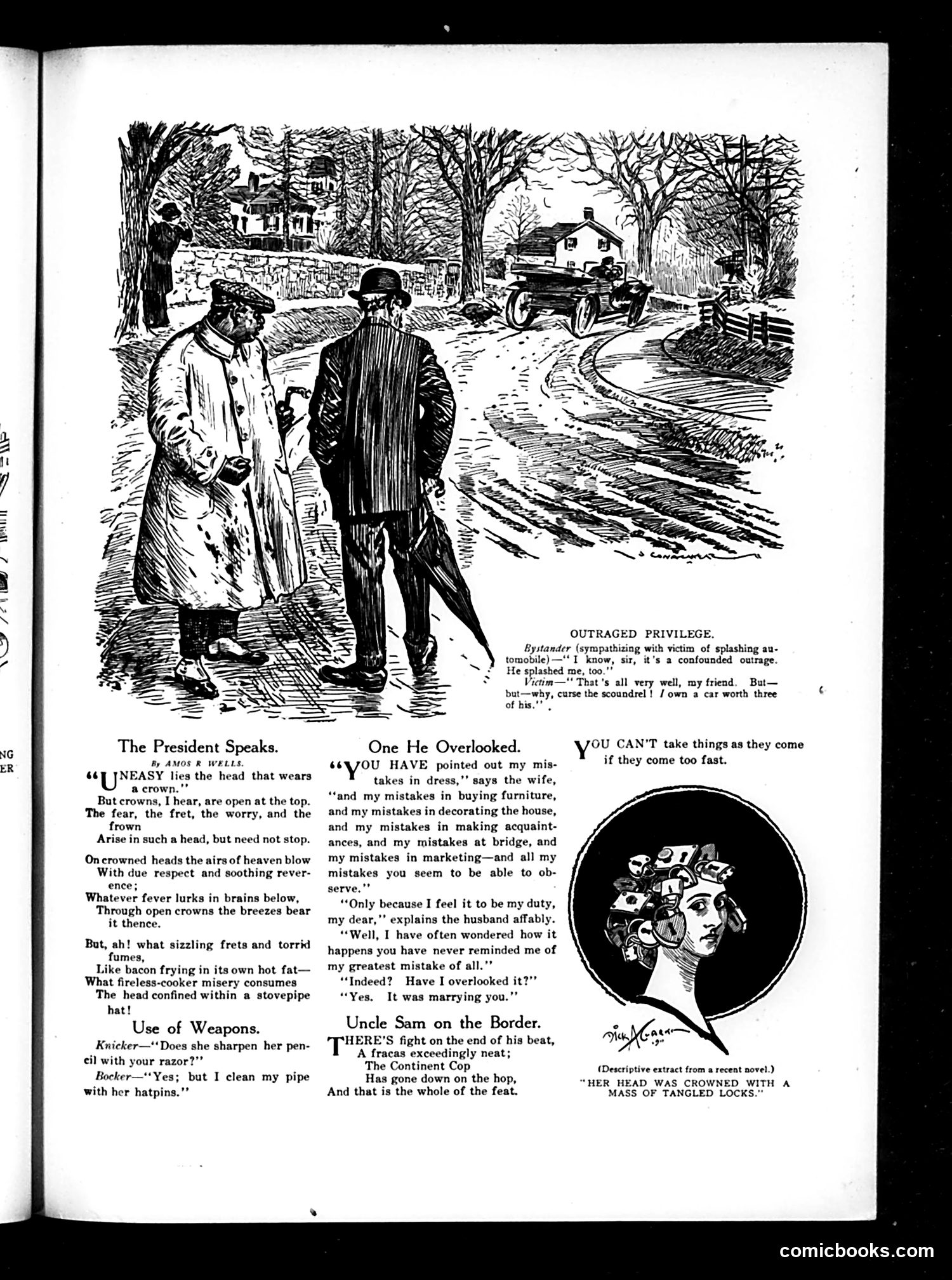
This page contains several satirical pieces reflecting early 20th-century American concerns: **"Outraged Privilege"** depicts a wealthy automobile owner complaining to a sympathizer about "splashing an automobile"—apparently upset that his expensive car was damaged. The satire critiques the entitlement of the wealthy, who obsess over minor property damage while dismissing workers' concerns. **"The President Speaks"** and **"One He Overlooked"** present a husband-wife dialogue where she catalogs his numerous mistakes in life decisions (furniture, decorating, financial choices, marriage itself), while he seems oblivious. The satire mocks male privilege and lack of self-awareness. **"Uncle Sam on the Border"** references military/political conflict, likely related to early 20th-century border tensions. The overall theme emphasizes class privilege and male blindness to personal failings.
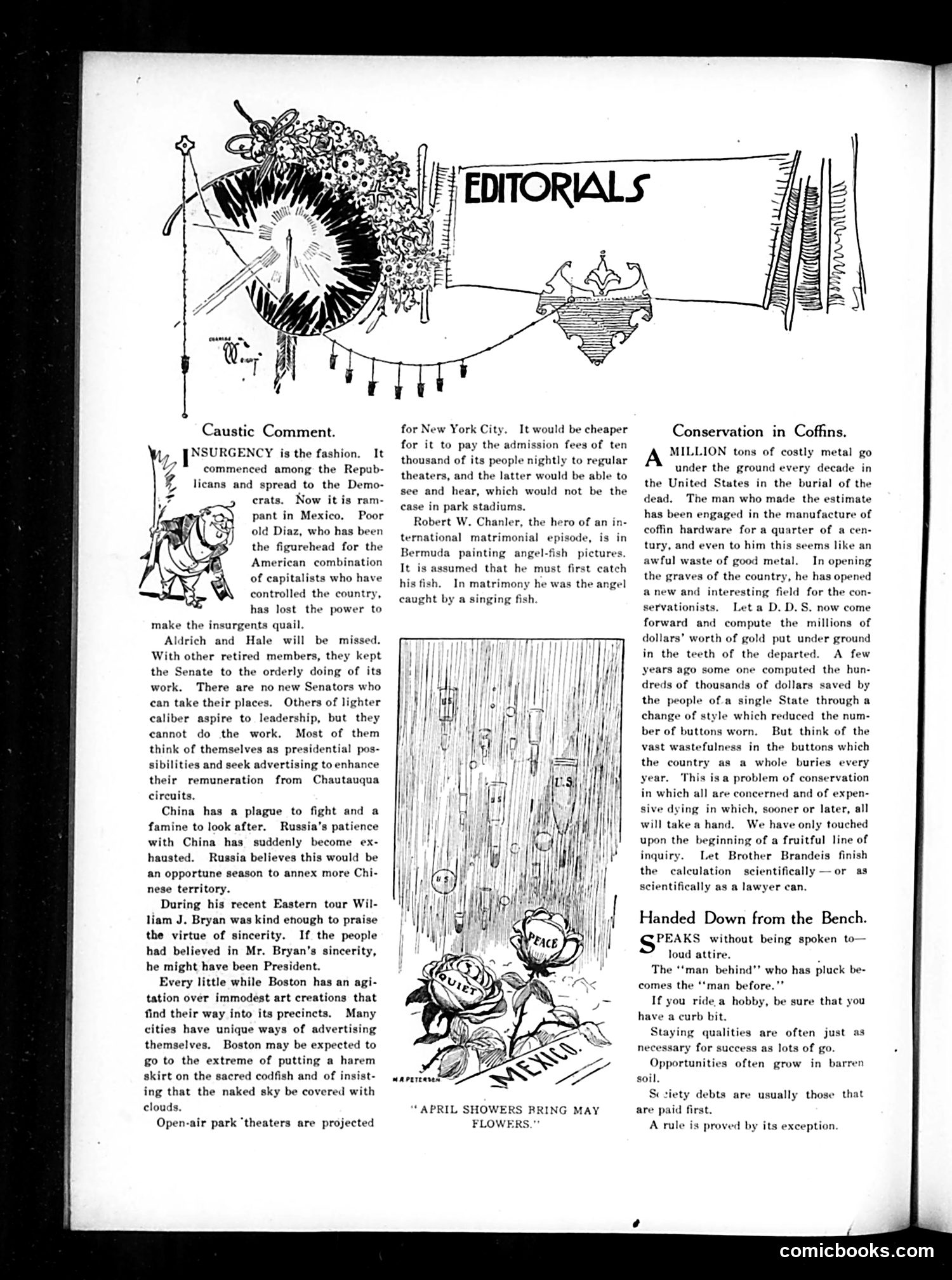
This editorial page satirizes American political and social issues circa early 1900s: **"Caustic Comment"** critiques: - **Insurgency movements** spreading from Republicans to Democrats to Mexico, where Porfirio Díaz has lost control of insurgents - **Senate mediocrity**: Aldrich and Hale's retirement leaves only "lighter caliber" replacements seeking Chautauqua lecture fees rather than serious governance - **Bryan's hypocrisy**: William Jennings Bryan praised sincerity during his Eastern tour, yet the public never believed in his sincerity enough to elect him president - **Boston's prudishness**: Regular moral panics over "immodest art" while proposing ridiculous outdoor theaters **Other targets include Russian imperial ambitions toward China and Robert W. Chanler's scandalous international marriage.** The "Conservation in Coffins" editorial humorously applies Progressive-era conservation rhetoric to burial waste—millions in metal buried annually—suggesting even death deserves efficiency reform.
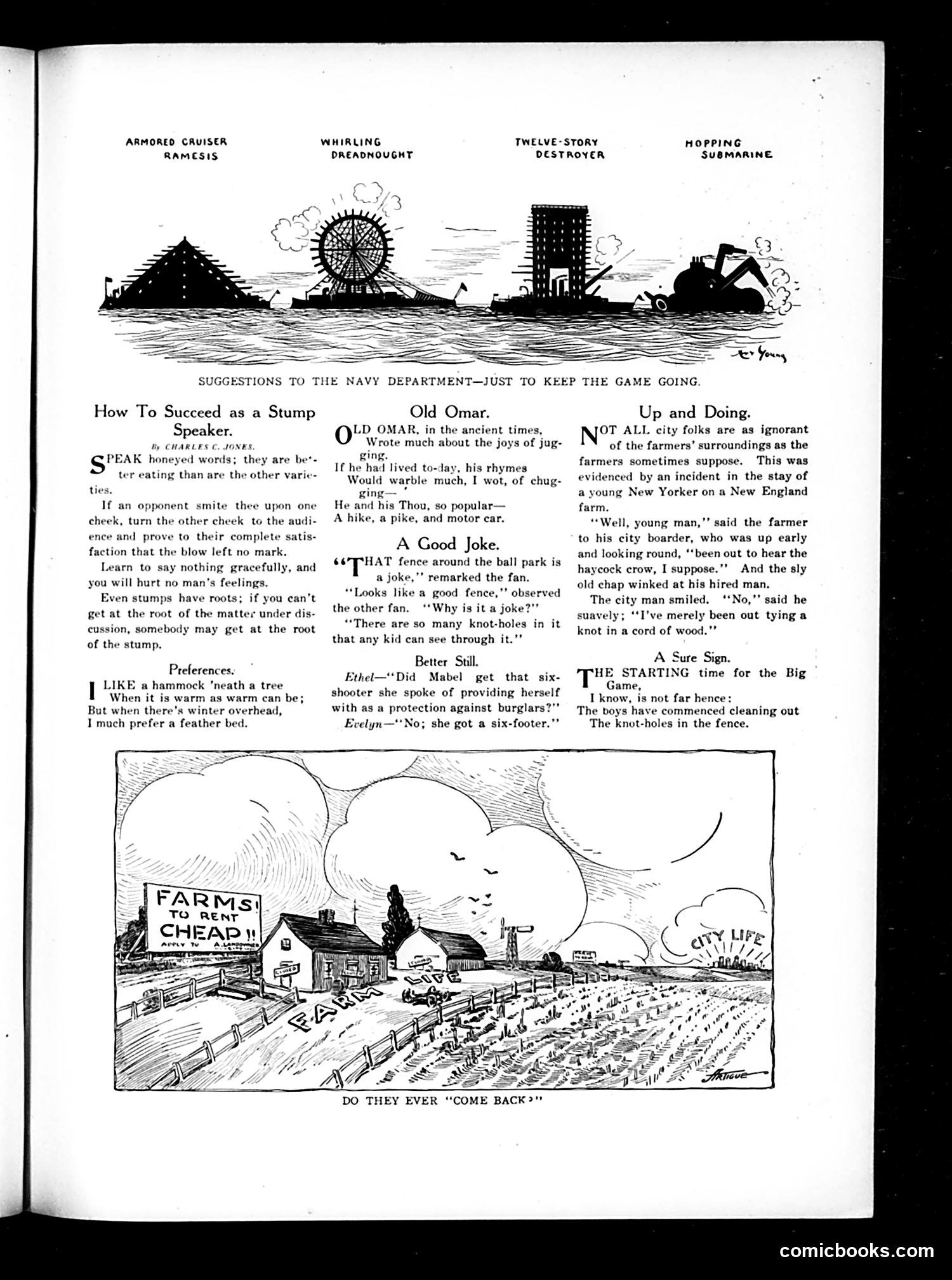
**Top Section:** The "Suggestions to the Navy Department" cartoon mocks naval innovation by depicting absurd warship designs—an armored cruiser shaped like a pyramid, a "whirling dreadnought" with a giant spinning wheel, a twelve-story destroyer (like an office building), and a "hopping submarine." This satirizes the era's arms race and rapid, sometimes impractical military technological developments. **Articles Below:** Mixed humor pieces including advice on being a "stump speaker" (political campaigner), verses parodying Omar Khayyam updated to modern times (with references to hiking and motor cars), and jokes about baseball parks and farm life. **Large Cartoon:** "Farms to Rent Cheap" contrasts rural simplicity with city life, suggesting city dwellers abandon farms. The caption "Do They Ever 'Come Back'?" questions whether urban migrants return to rural life—reflecting early 20th-century migration anxieties as Americans moved cityward. The page reflects Progressive Era concerns: military spending, changing American society, and rural-urban tensions.
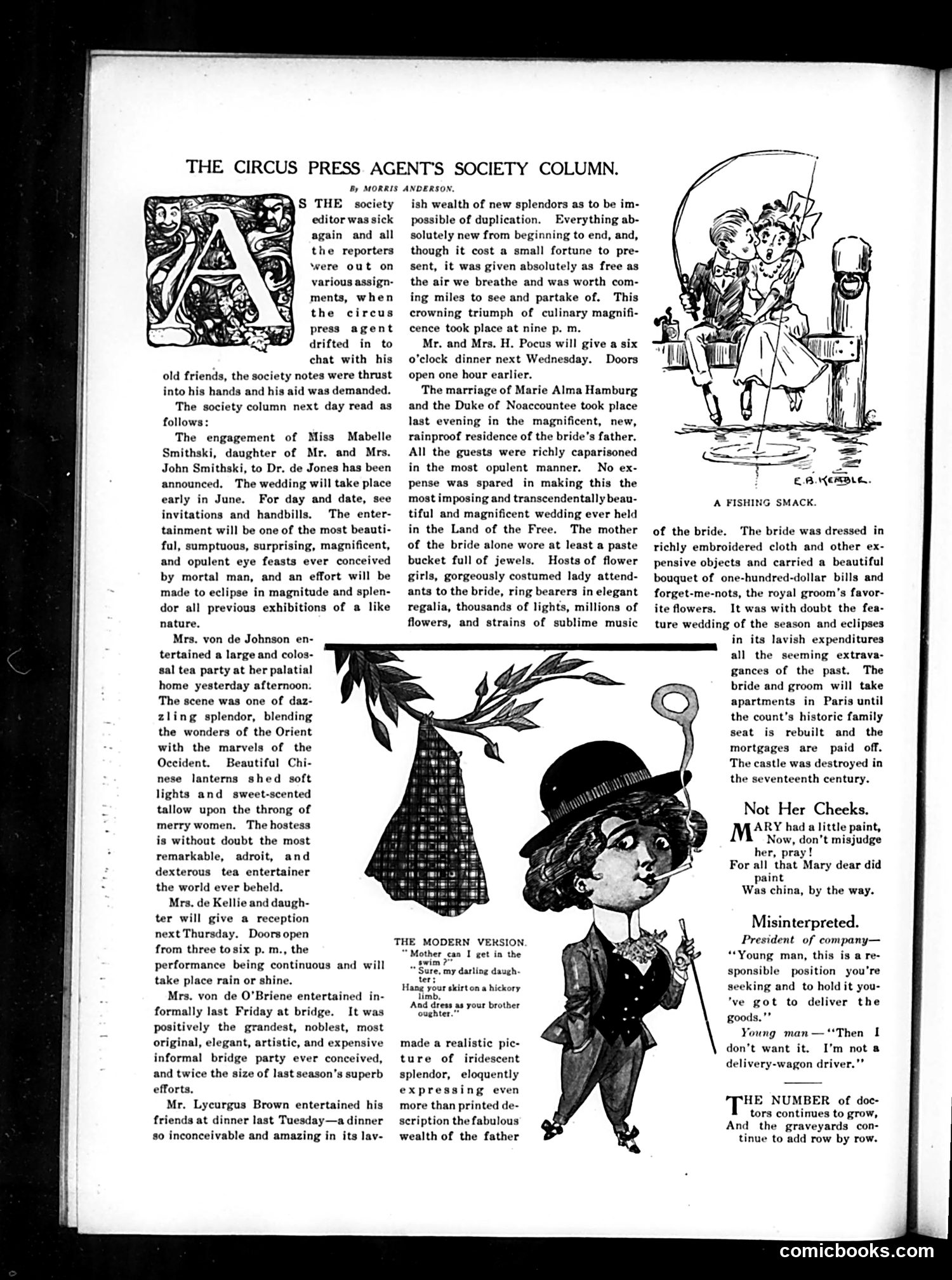
This satirical piece mocks society page journalism by having a circus press agent write the society column. The joke: he applies inflated carnival advertising language to mundane social events—describing a simple tea party as "dazzling splendor" blending "wonders of the Orient with marvels of the Occident," and a bridge game as "the grandest, noblest...expense informal bridge party ever conceived." The satire targets two things: the absurd hyperbole of circus promoters and the pretentiousness of high-society reporting. By using exaggerated language for ordinary events (weddings, dinners, receptions), the piece exposes how ridiculous both circus hype and society journalism sound. The accompanying cartoons show the "Modern Version" with simpler language, emphasizing the contrast between inflated rhetoric and reality—mocking both carnival showmanship and upper-class vanity.
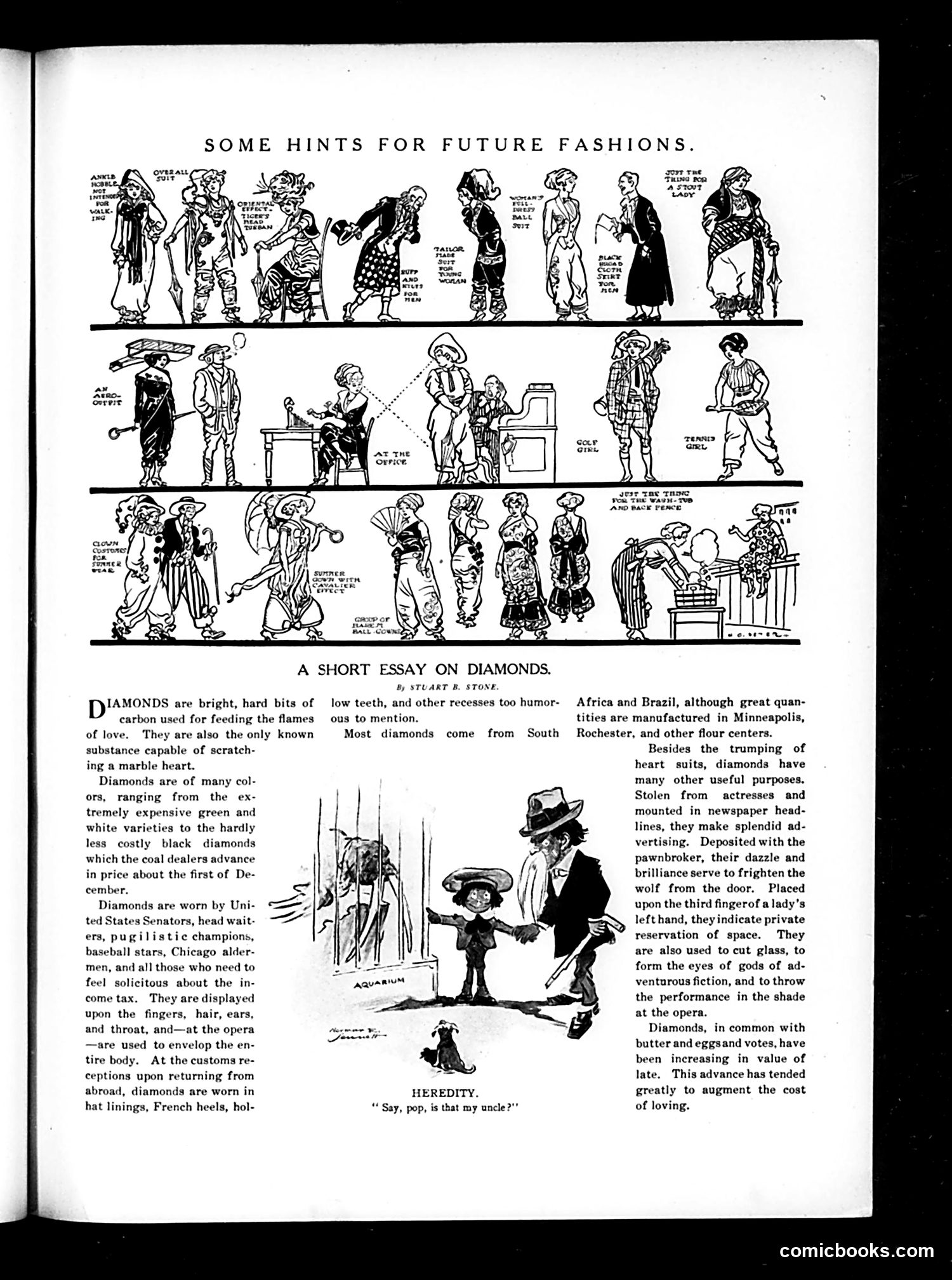
The top section satirizes evolving women's fashion through exaggerated costume sketches labeled with humorous predictions—suggesting increasingly practical or absurd garments (golf attire, tennis wear, etc.). The essay below mocks diamond culture through deadpan irony. It presents diamonds as status symbols worn by unlikely figures: senators, waiters, boxers, and corrupt aldermen—suggesting diamonds signify both wealth and moral questionability. The humor lies in treating diamonds' inflated value as absurd while simultaneously noting their genuine use as pawn collateral ("frighten the wolf from the door"). The final joke, "Heredity," shows a small figure asking an older man if that's his uncle—implying either inheritance of diamonds or commentary on family resemblance through material possessions rather than genetics. The essay's closing line—that diamonds' rising value has "augment[ed] the cost of loving"—cynically suggests marriage itself has become commodified, with diamond engagement rings representing love's commercialization.
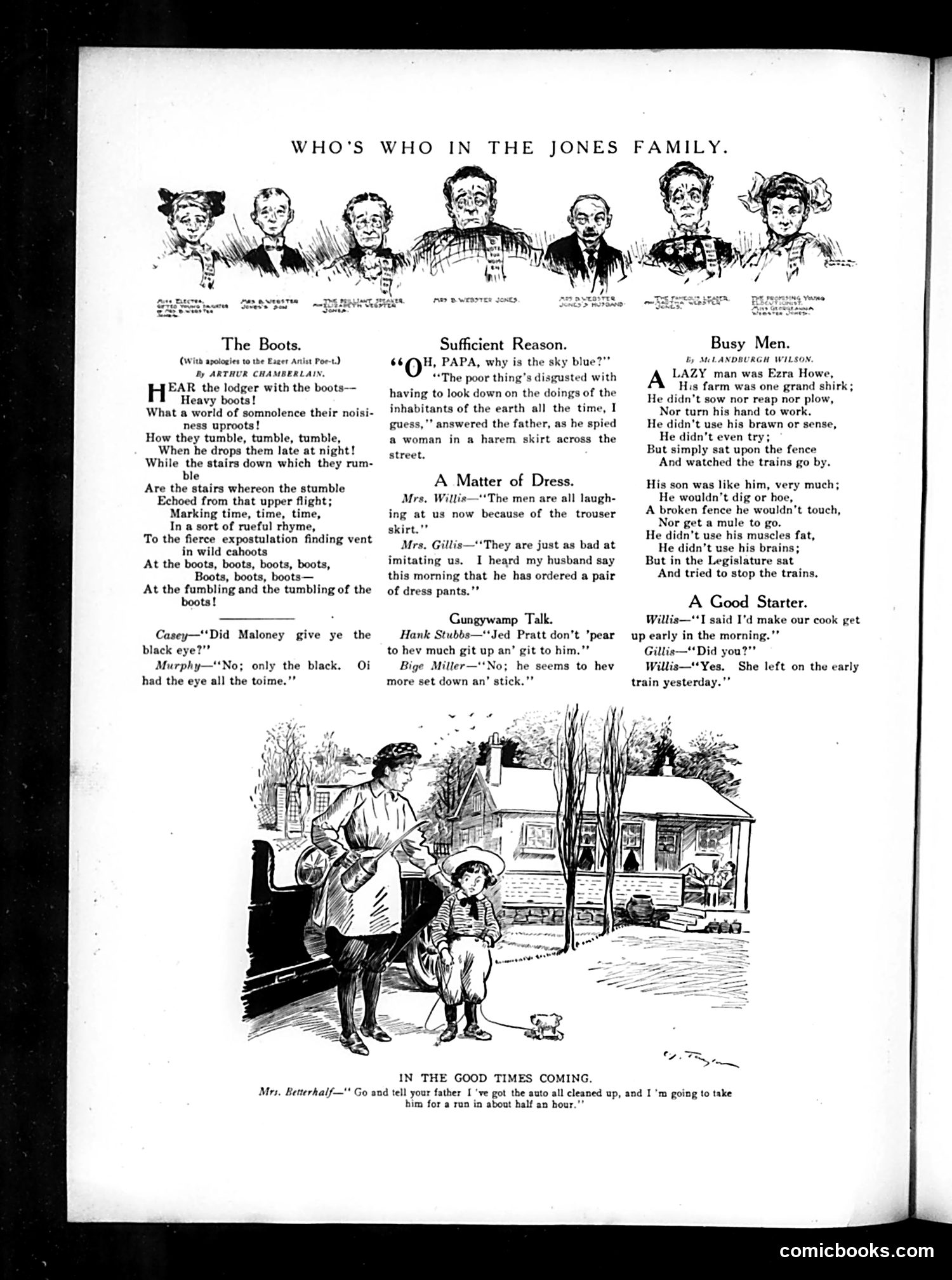
This page from *Judge* magazine presents six domestic humor pieces targeting early-20th-century American family life and social changes. **"The Boots"** parodies Poe's "The Bells," mocking noisy lodgers who disturb neighbors by dropping heavy boots at night—a relatable complaint in tenement living. **"Sufficient Reason"** satirizes women's fashion (the "harem skirt"), showing a father dismissing his daughter's complaint about having to observe earthly "doings" with condescension. **"A Matter of Dress"** captures the gender role anxiety of the era: men mock women's new trouser skirts while ordering "dress pants" themselves—suggesting confusion about changing gender norms. **"Busy Men"** presents a cautionary tale: Ezra Howe's laziness passes to his son, who paradoxically becomes a legislator trying to "stop the trains"—satirizing ineffectual politicians. **"A Good Starter"** uses the new automobile as a punchline: the cook escapes rather than wake early. Overall, these pieces reflect anxieties about modern life, changing social roles, and technological disruption during the Progressive Era.
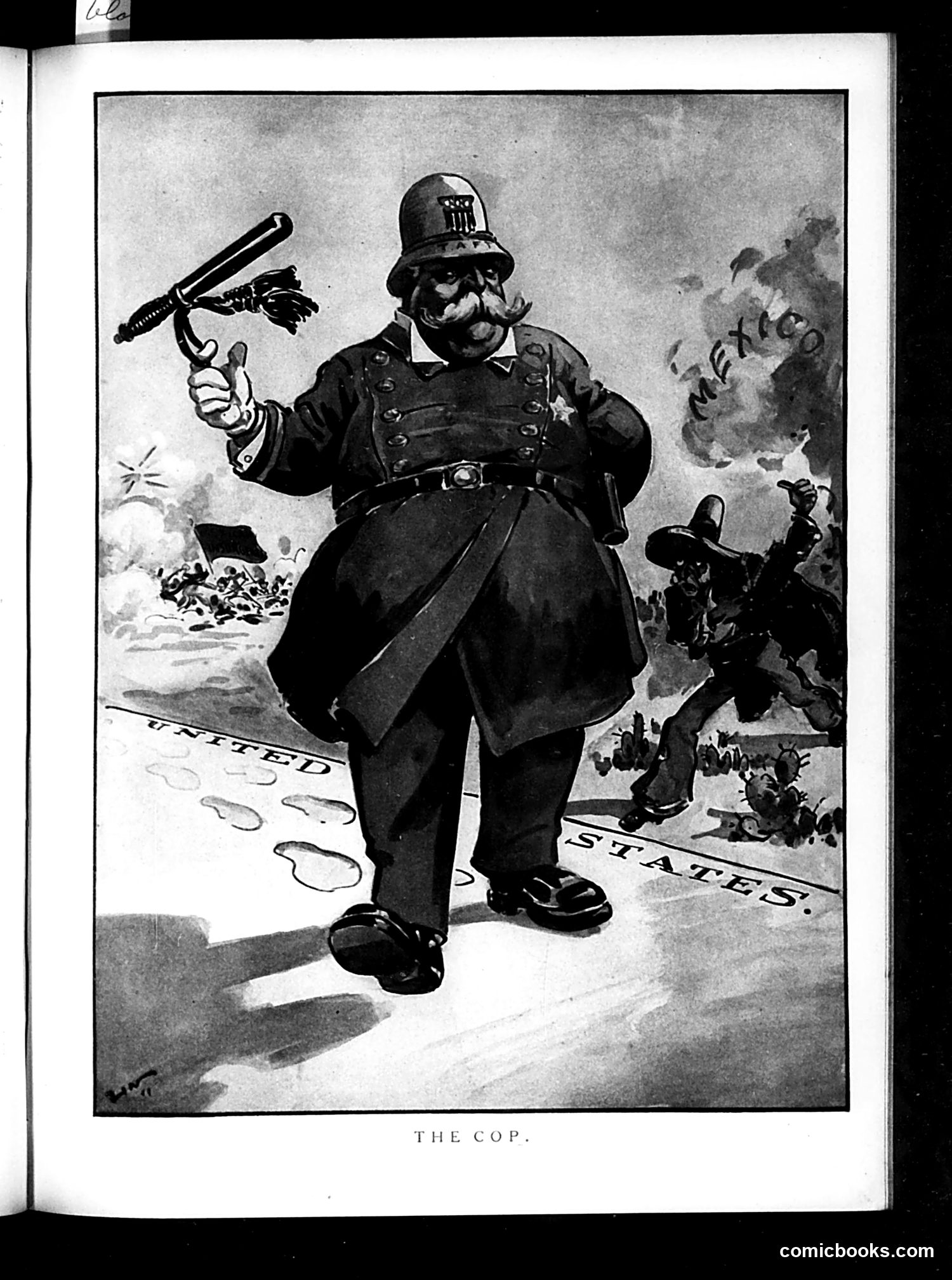
This satirical cartoon depicts a militaristic police officer standing astride the boundary between "United States" (left) and "States" (right). The figure wields a large club/baton menacingly while wearing a spiked German-style military helmet, suggesting authoritarian aggression. The cartoon critiques police overreach and militarism, likely referencing early 20th-century labor unrest or civil conflict. The German military imagery implies the police are adopting oppressive, foreign authoritarian tactics rather than protecting citizens democratically. The divided nation beneath his feet suggests he's imposing control by force rather than law. Without the publication date visible, the precise historical context remains unclear, but the satire targets the militarization of American police and their threat to constitutional order.
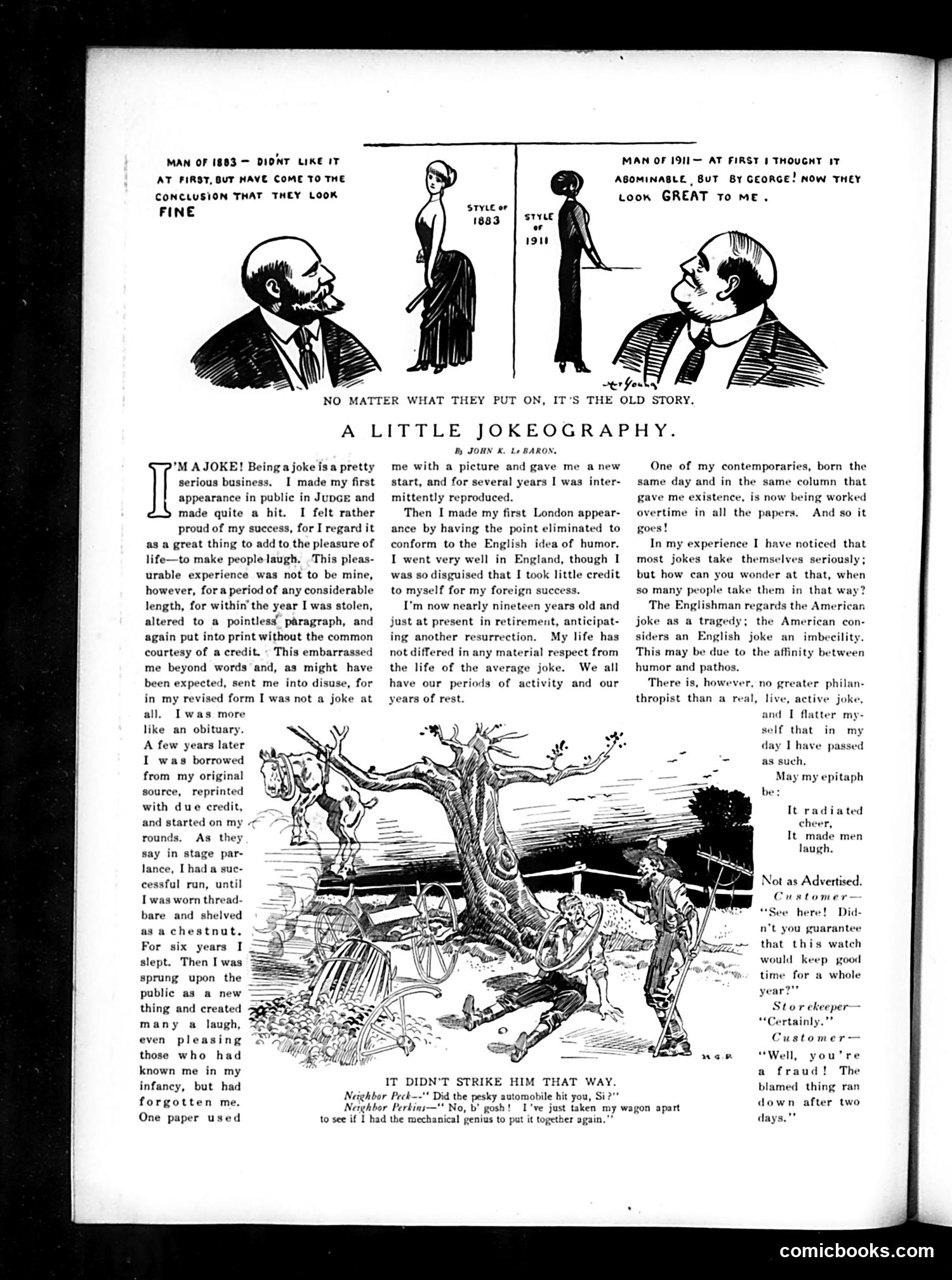
This page presents a humorous autobiographical essay by John K. Le Baron, personifying a joke as if it were a living entity with a career history. **The Main Cartoon (top):** Contrasts fashion between 1883 and 1911. A man initially disliked women's 1883 styles but came to appreciate them; by 1911, he initially found the new fashions "abominable" but now considers them "great." The joke's point: fashion taste is relative and changes over time—what seems outrageous eventually becomes acceptable. **The Essay:** Le Baron describes how his joke was stolen, reprinted without credit, fell into obscurity (became a "chestnut"—old/tired), then experienced periodic revivals. He reflects that jokes have "periods of activity and rest" like human lives. **The Secondary Cartoon (bottom):** Shows a man who disassembled his automobile to understand it, suggesting mechanical incompetence masquerading as curiosity. **The Vignette (right):** A brief dialogue about a defective watch—satirizing false advertising claims. The page humorously explores how jokes, fashions, and consumer products have unpredictable lifespans and reputations.
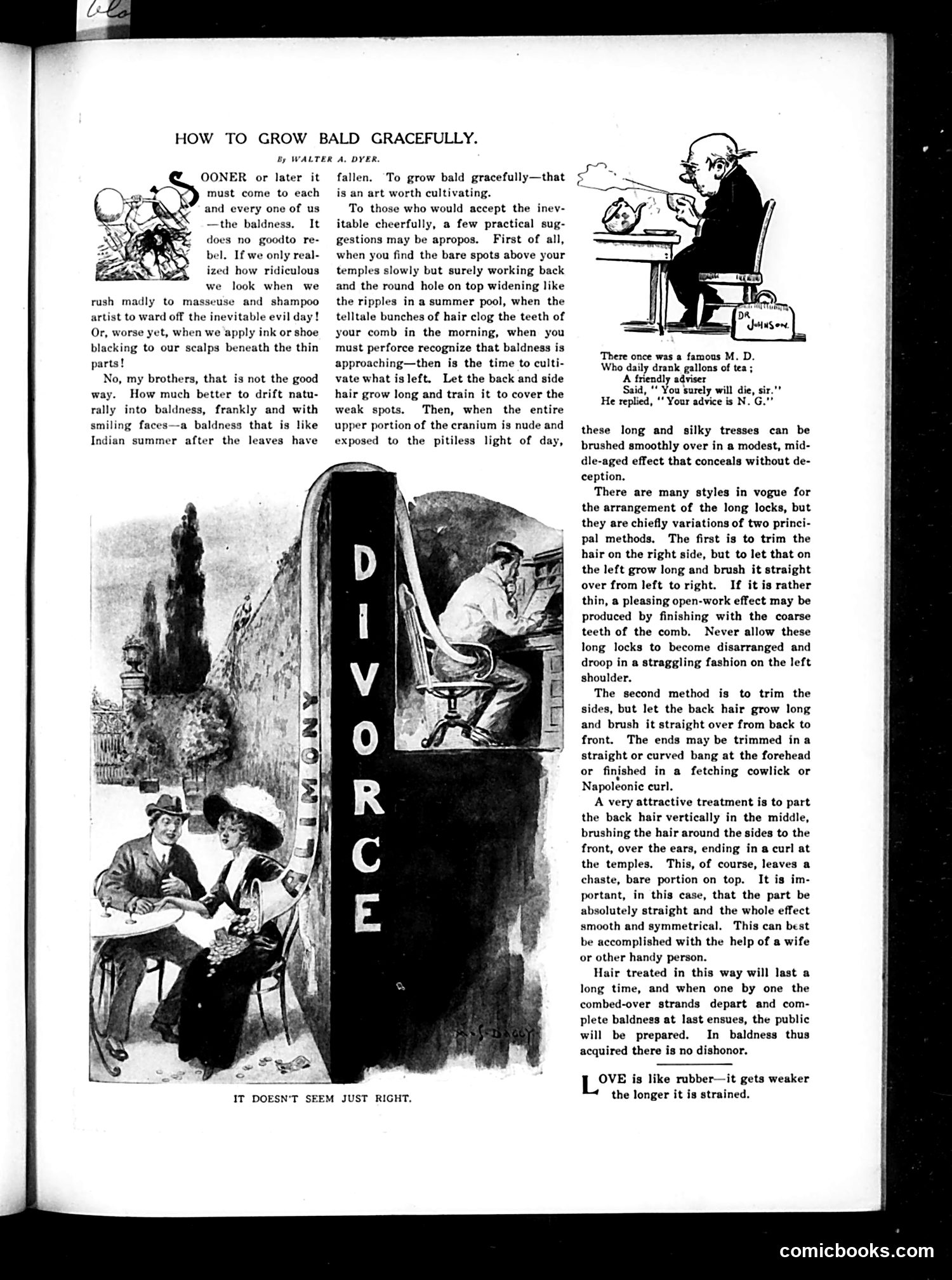
This humorous article by Walter A. Dyer satirizes male vanity and the desperate measures men take to hide baldness. The piece mocks the shame surrounding hair loss while offering tongue-in-cheek "advice" on accepting it gracefully. The satire targets several behaviors: rushing to barbers and shampoo specialists, and worse, applying shoe blacking or ink to the scalp—desperate cosmetic tricks that were apparently common practices. Rather than fight the inevitable, Dyer ironically suggests men should cultivate remaining hair by growing it long on the sides and back, then combing it over the bald spots in various elaborate arrangements (side-to-side, back-to-front, or parted vertically). The accompanying illustrations show a "Divorce" sign (suggesting baldness causes marital discord) and a man seeking hair advice, emphasizing how seriously some took the problem. The closing aphorism about love and rubber is a cynical aside, unrelated to the main humor. The piece reflects early 20th-century attitudes toward male aging and appearance anxiety.
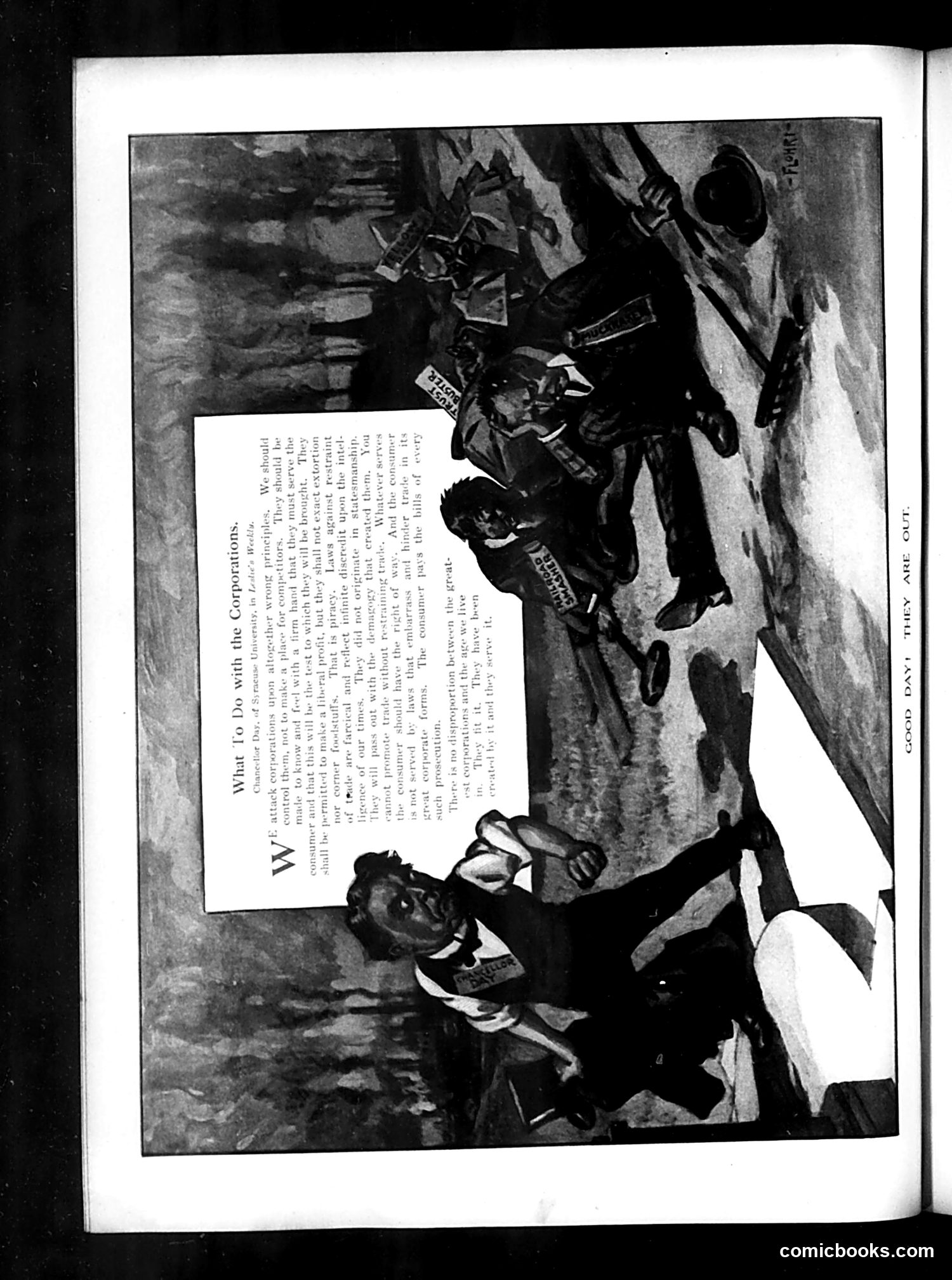
This page from *Judge* magazine shows what appears to be a political cartoon (rotated 90 degrees) depicting figures in formal/military dress in what seems to be a confrontational scene. The headline reads "What To Do with the Corporations," suggesting commentary on corporate regulation or control—a major political issue of the Progressive Era. The cartoon likely satirizes debates over government's proper relationship to big business. However, the image quality and rotation make specific identification of the caricatured figures difficult. The formal attire and apparent conflict suggest high-level political or corporate figures engaged in a dispute over corporate power or reform. Without clearer visibility of facial features or additional context clues, I cannot definitively identify which specific corporations or politicians are being mocked.
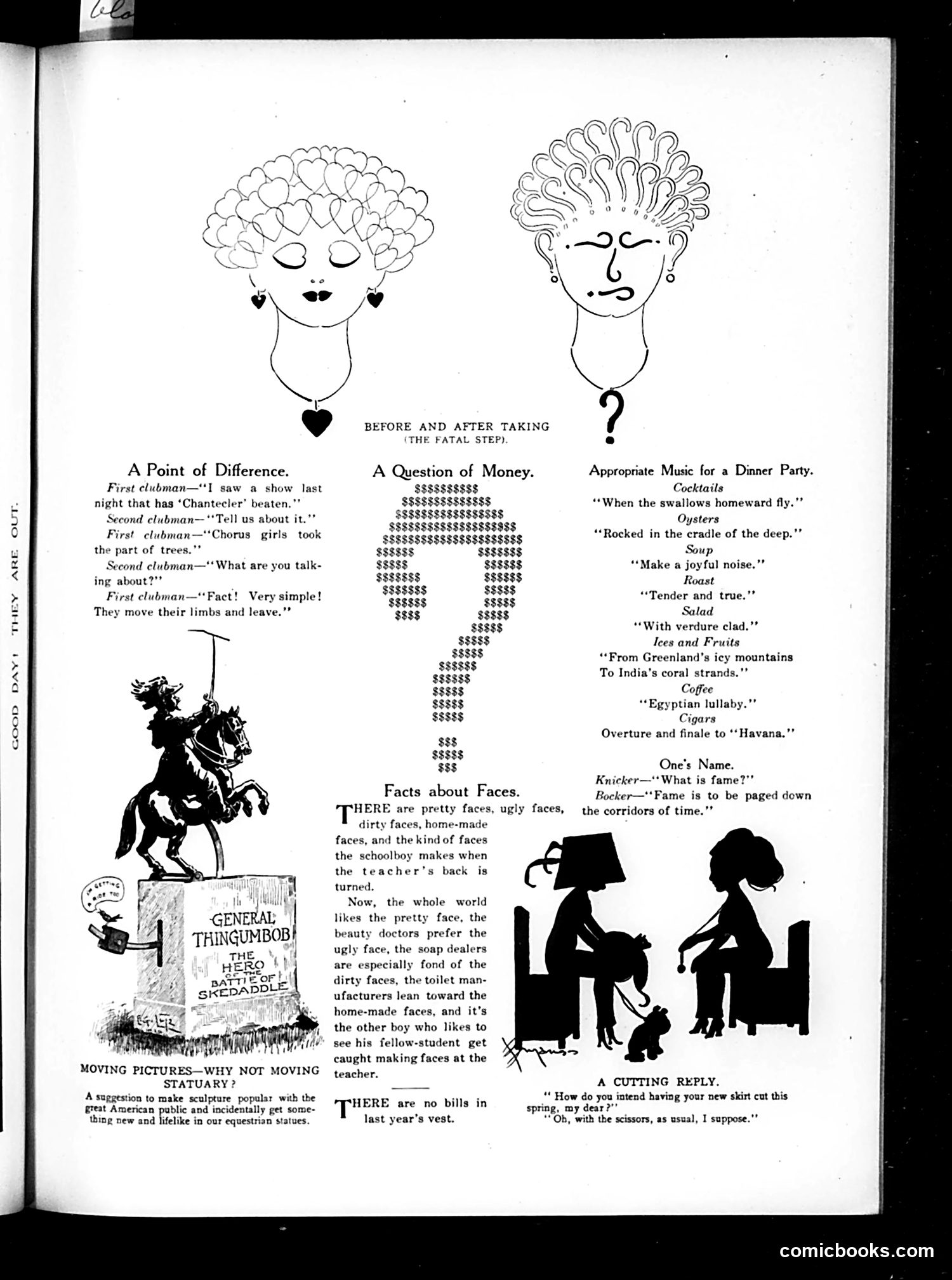
This page contains multiple satirical pieces typical of early 20th-century American humor: **"A Point of Difference"**: Two clubmen discuss a show where chorus girls portrayed trees—the joke being that chorus girls literally "move their limbs and leave," a pun on their dancing and employment instability. **"Moving Pictures—Why Not Moving Statuary?"**: Satirizes the then-new film industry by suggesting equestrian statues should move too, mocking both cinema novelty and America's unchanging public monuments. **"Before and After Taking (The Fatal Step)"**: The illustration shows a woman's transformation after marriage—her hair deflates and expression sours—commenting on marriage's supposed dampening effect on women's appearance and spirit. **"A Question of Money"**: A visual joke showing dollar signs forming a human silhouette, representing materialism or the reduction of human identity to money. **Other pieces** include light social humor about faces, dinner-party music selections, and a sarcastic response about cutting a skirt "with scissors, as usual"—gentle domestic satire. The overall tone is genteel mockery of contemporary manners and modern anxieties.
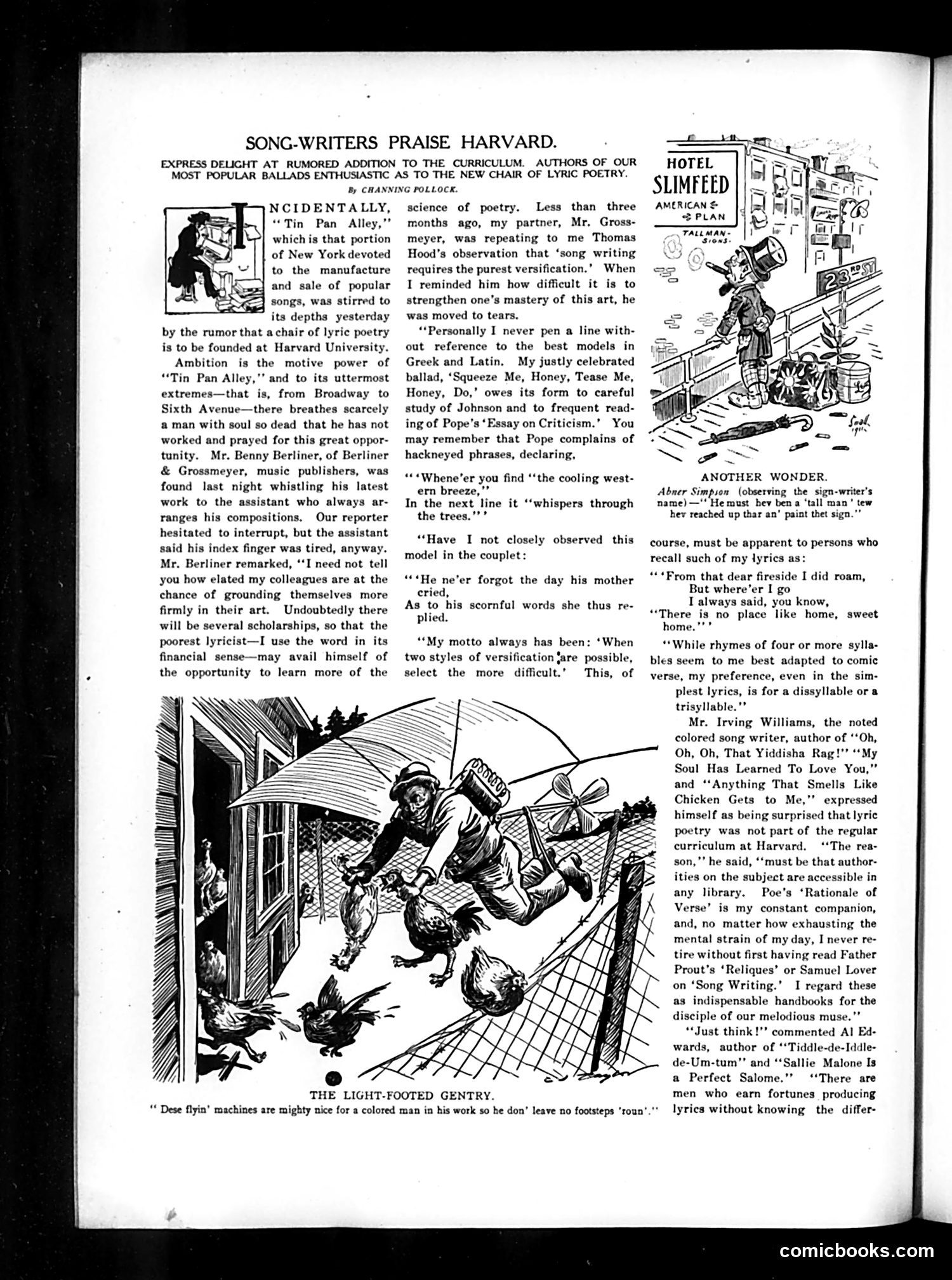
This satirical article mocks "Tin Pan Alley"—New York's popular music industry—by depicting songwriters as pretentious frauds. The joke is that these writers of cheap, formulaic pop songs (like "Squeeze Me, Honey, Tease Me, Honey, Do") absurdly claim scholarly credentials rooted in classical poetry and Greek/Latin models. The satire works through contrast: the songwriters pompously reference Pope's *Essay on Criticism* and claim careful study while writing obvious doggerel. Mr. Berliner's admission that his motto is "when two styles are possible, select the more difficult"—yet he produces vapid rhymes—exposes the pretension. The accompanying cartoons lampoon working-class figures: one shows a laborer with umbrella and chickens (titled "The Light-Footed Gentry"), and another depicts a Black sign-painter, using racial stereotypes typical of the era. The piece ridicules both commercial songwriters' false erudition and, implicitly, Harvard's consideration of legitimizing such "art."
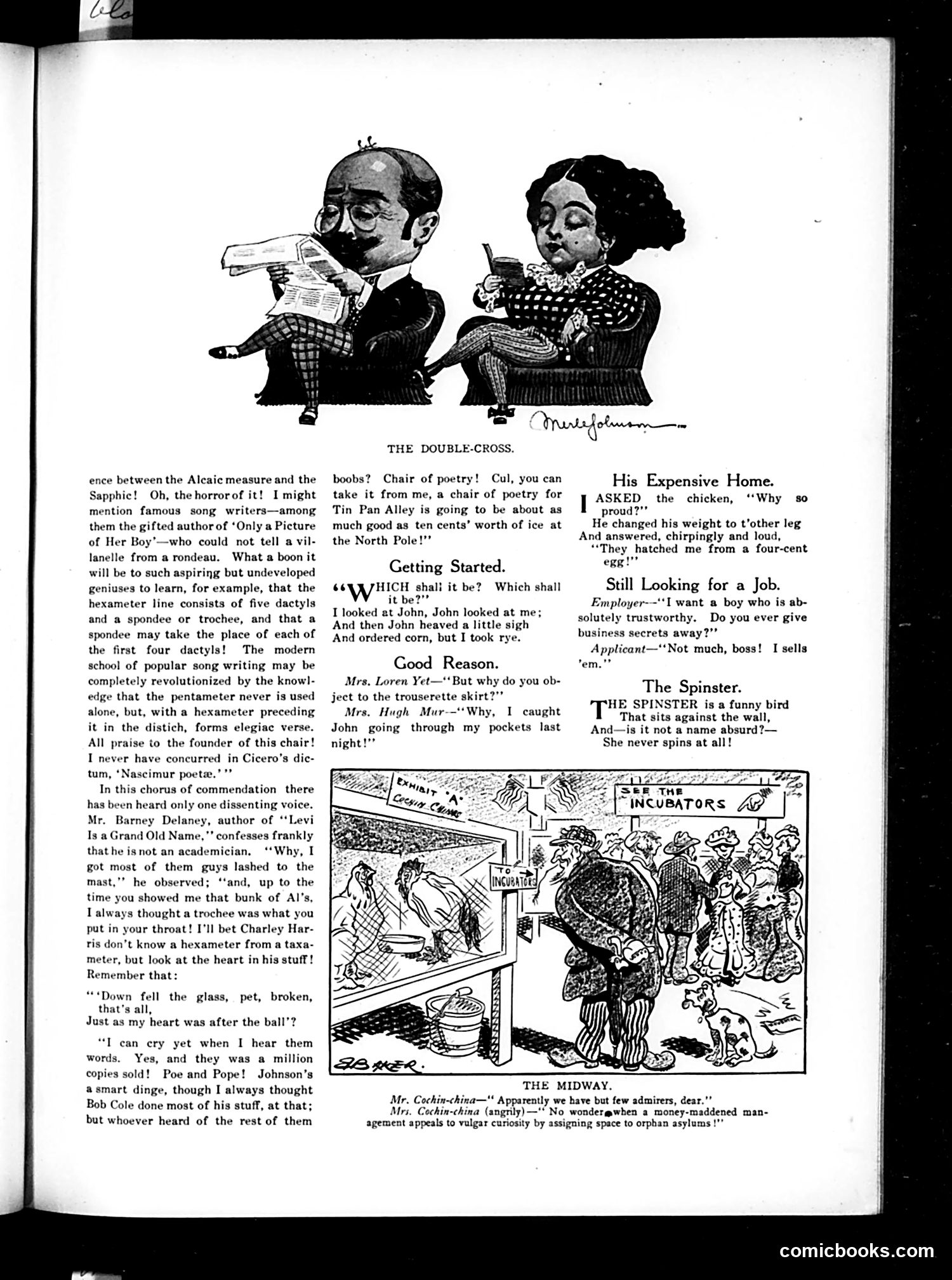
**"The Double-Cross"** (top cartoon) depicts two figures in exaggerated caricature style, likely representing songwriters or Tin Pan Alley figures. The accompanying text satirizes a debate over whether popular songwriting needs formal poetic training. Mr. Barney Delaney argues passionately against academic pretension, defending emotionally effective but technically "uneducated" songs like "After the Ball"—suggesting that commercial success matters more than classical meter or prosody. **Other humor pieces** include brief jokes about relationships, job interviews, and animal wordplay ("The Spinster" puns on the word's dual meaning). **"The Midway"** cartoon (bottom) shows what appears to be a traveling carnival or exhibition. The dialogue critiques how orphan asylums are relegated to less desirable carnival space compared to more profitable attractions, satirizing the era's commercialism and treatment of charitable institutions. The page reflects early 1900s concerns: artistic gatekeeping, Tin Pan Alley's cultural dominance, and social welfare issues in an increasingly commercialized society.
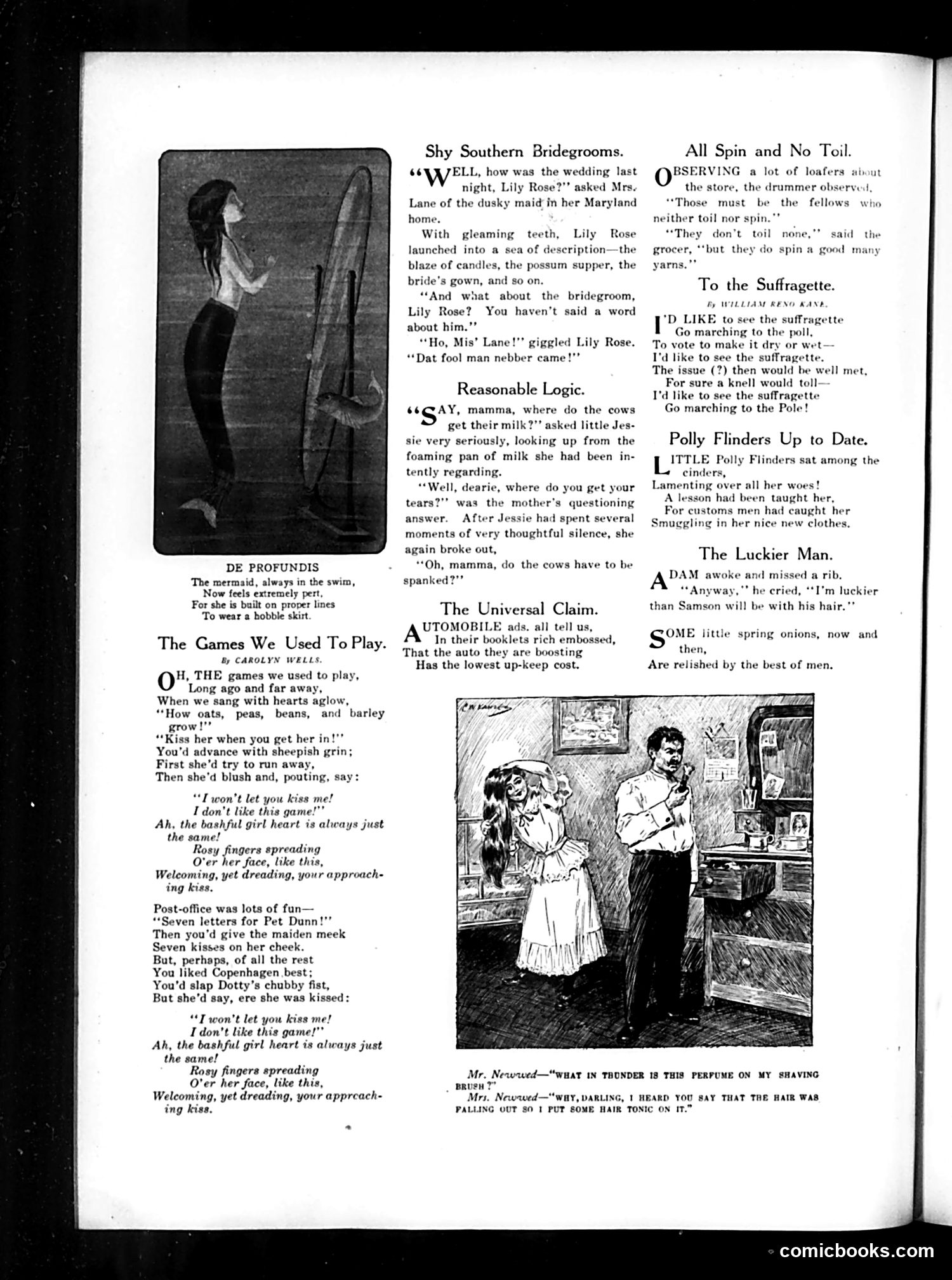
This page from the satirical magazine *Judge* contains multiple short humorous pieces targeting early 20th-century social topics: **"The Games We Used To Play"** nostalgically describes children's kissing games, with the repeated refrain about bashful girls resisting advances—likely poking fun at Victorian courtship conventions and gender dynamics. **"Shy Southern Bridegrooms"** features a Black maid's dialect humor, recounting that the bridegroom "nebber came"—a stereotype-based joke playing on regional and racial caricatures. **"Reasonable Logic"** shows a child's innocent logic about cow-spanking, typical humor of the era. **"The Universal Claim"** satirizes automobile advertisements' competing claims about lowest maintenance costs. **"To the Suffragette"** presents skeptical verse about women's suffrage and Prohibition ("dry or wet"), suggesting political opposition to both movements. **"Polly Flinders Up to Date"** modernizes the nursery rhyme by having customs officials catch the character smuggling clothes—commenting on tariffs or import regulations. The page reflects period attitudes toward women, minorities, automobiles, and progressive social movements.
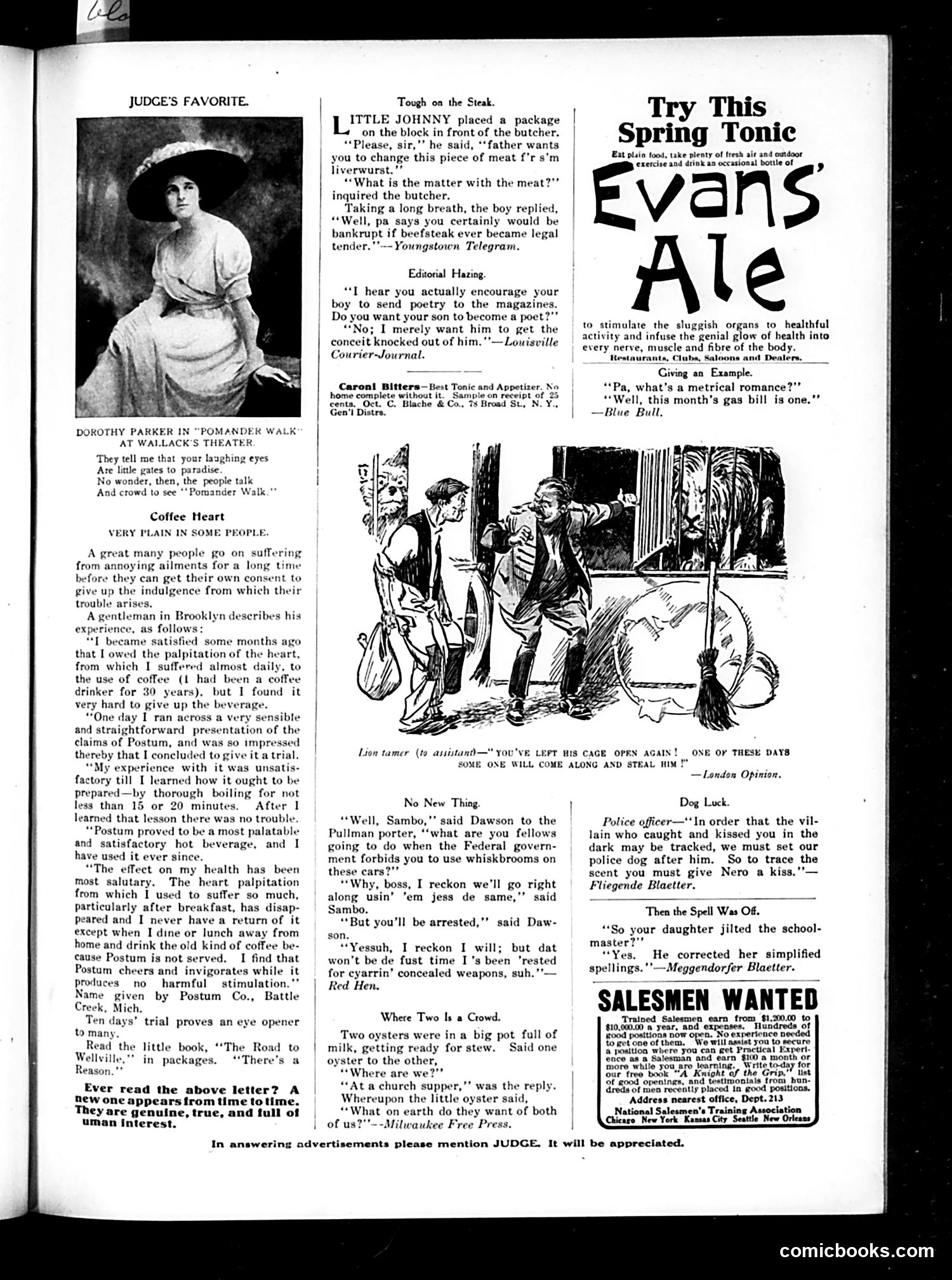
This page from *Judge* magazine contains mostly advertisements and light humor pieces typical of early 20th-century American satire. **Notable content:** The **"Tough on the Steak"** joke mocks a butcher through a child's innocent insult—the father suggests the butcher's meat is so poor that if beefsteak became legal tender, he'd go bankrupt. It's straightforward wordplay. **"Editorial Hazing"** satirizes literary magazines' role in crushing young poets' egos by encouraging submissions—the editor wants aspiring poets rejected to humble their pretensions. **"No New Thing"** uses racist dialect humor about a Pullman porter, playing on stereotypes about African American railroad workers and casual law-breaking—offensive by modern standards but apparently acceptable contemporary comedy. The page is primarily filled with **Postum cereal advertisements** claiming coffee causes heart problems, and **Evans Ale spring tonic ads**—period medical marketing making dubious health claims now recognized as quackery. The **Dorothy Parker theater reference** promotes a contemporary stage production.
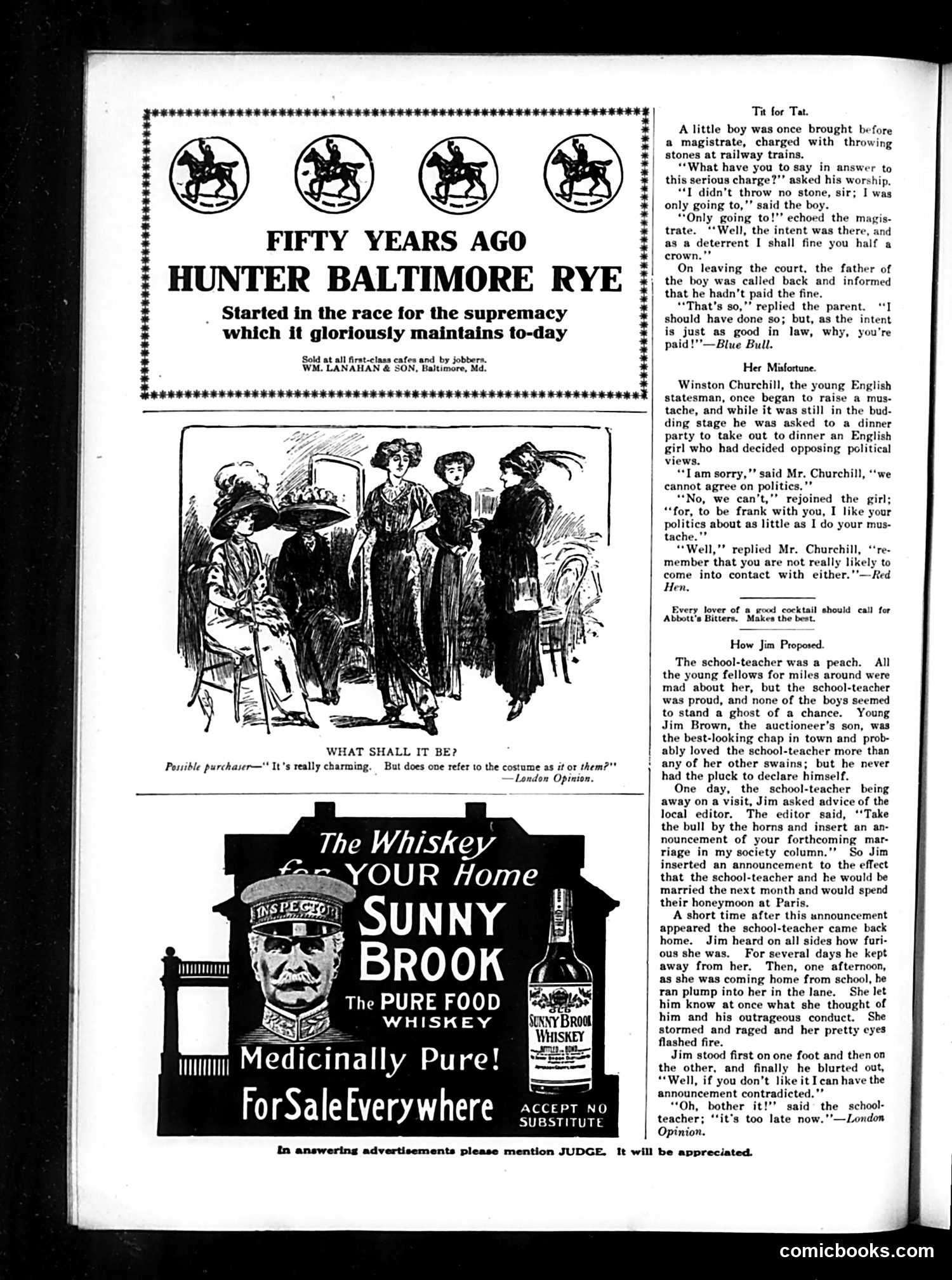
This page contains three brief humorous anecdotes typical of Judge's satirical style: **"Tit for Tat"** presents legal irony: a boy fined for *intent* to throw stones at trains uses the same logic to avoid paying the fine—claiming intent to pay is legally equivalent to paying. **"Her Misfortune"** mocks young Winston Churchill's nascent mustache. A dinner partner insults both his politics and facial hair; Churchill retorts she needn't worry about further contact with either—a cutting comeback suggesting she's unworthy of association with him. **"How Jim Proposed"** satirizes masculine audacity and desperation. A timid suitor publishes a fake engagement announcement to force the schoolteacher's hand. Rather than being charmed, she's furious; Jim offers to retract it, but she reveals it's too late—implying she's actually accepted the publicity as binding. The page also includes period advertisements (Hunter Baltimore Rye whiskey, Sunny Brook whiskey) typical of Judge's revenue model. These humorous vignettes mock social pretension, legal absurdity, and courtship conventions of the era.
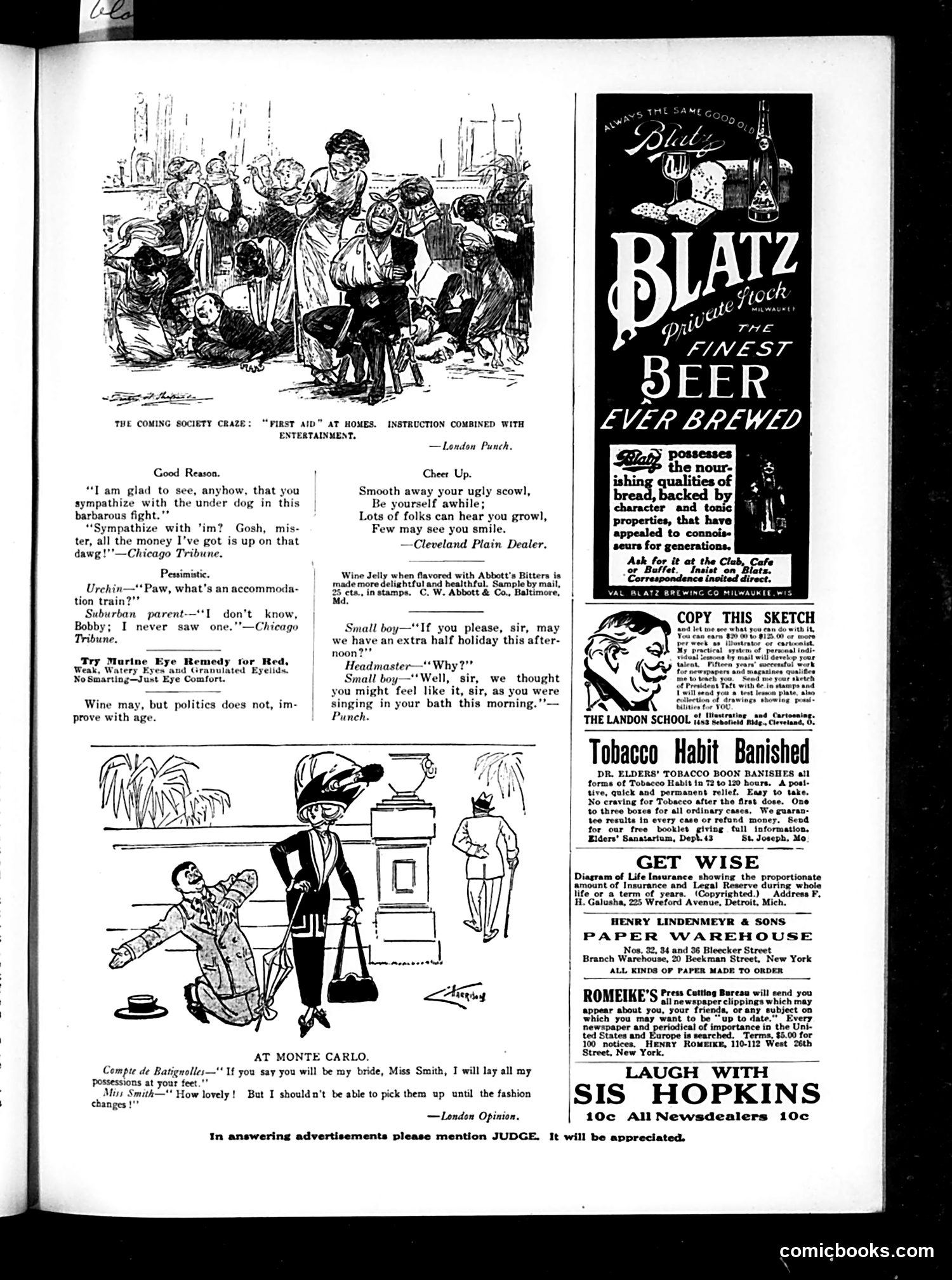
This page contains several short satirical pieces typical of early 20th-century American humor magazines: **Top cartoon** depicts "The Coming Society Craze: 'First Aid' at Homes"—mocking the fashionable trend of wealthy society women hosting instruction classes combined with entertainment, implying they trivialize serious subjects for amusement. **Comic vignettes** below satirize various social types: the working-class man betting on dogfights (not from sympathy but financial interest); suburban parents' ignorance; and a schoolboy's cheeky observation about his headmaster singing in the bath. **"At Monte Carlo"** jokes about a French nobleman's romantic proposal—he offers all possessions at her feet, but she notes fashion changes so frequently she couldn't pick them up in time. The page is primarily **advertisements** for commercial products (Blatz beer, tobacco remedies, insurance, paper warehouses, press clipping services) interspersed with these humor pieces—typical of Judge's revenue model.
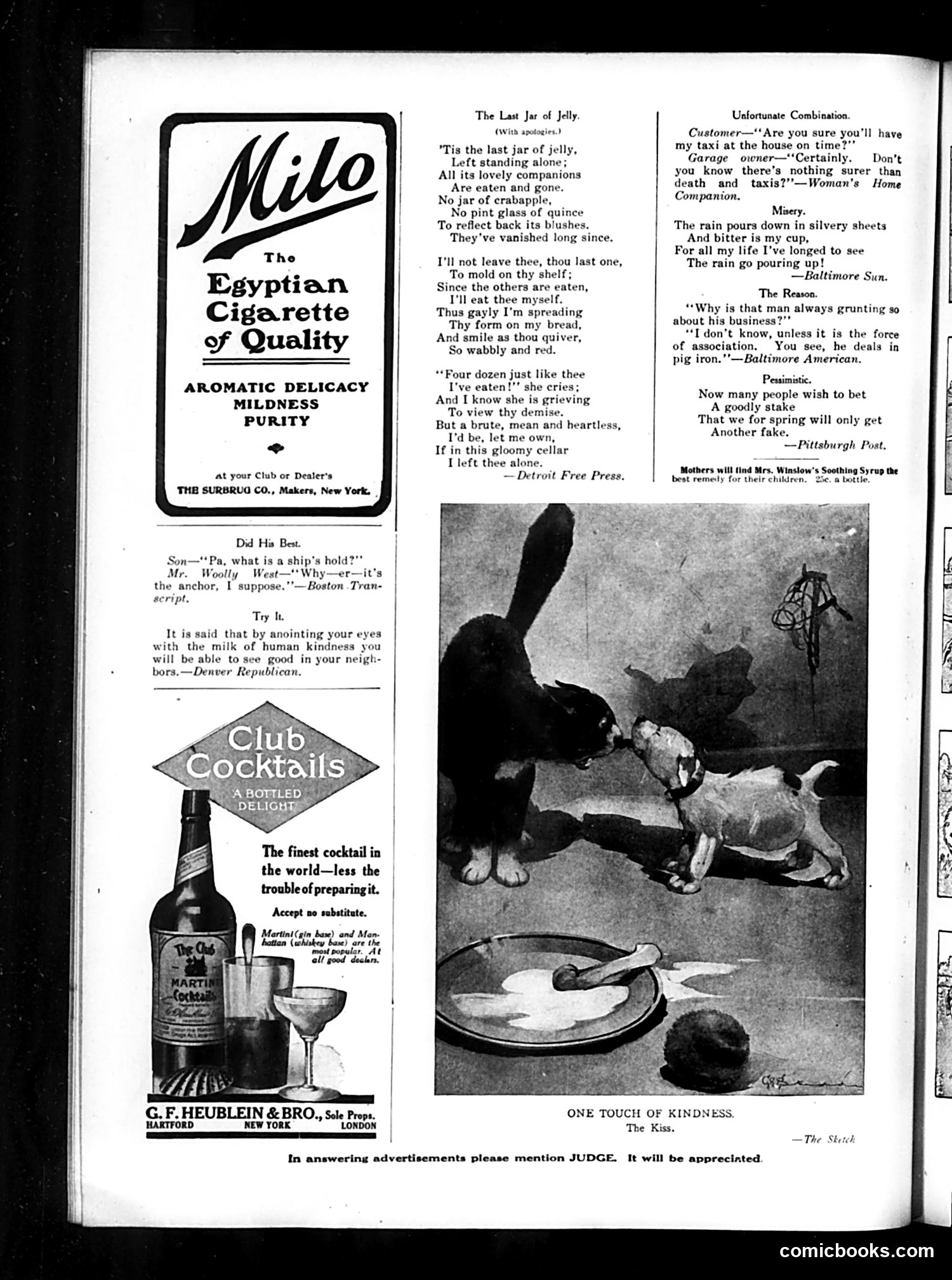
This page is primarily **advertisements and humorous short items**, not political cartoons. The main content includes: **Advertisements:** Milo Egyptian cigarettes, Club Cocktails (pre-mixed drinks), and Mrs. Winslow's Soothing Syrup dominate the layout. **Humor pieces:** Brief jokes and quips from various newspapers, including: - A dad joke about a ship's "hold" (the anchor) - Sentimentality about eating the last jar of jelly - Office humor about taxi reliability and death - Wordplay about rain and a businessman dealing in "pig iron" **Cartoon:** "One Touch of Kindness—The Kiss" shows a woman kissing a small dog while it eats from a plate. The Sketch credits this as gentle domestic humor. **Context for modern readers:** The page reflects early-20th-century American humor—puns, sentimental verse, and gentle domestic comedy. The advertisements for cocktails and cigarettes indicate pre-Prohibition or early Prohibition-era publishing. The overall tone is lighthearted rather than satirical.
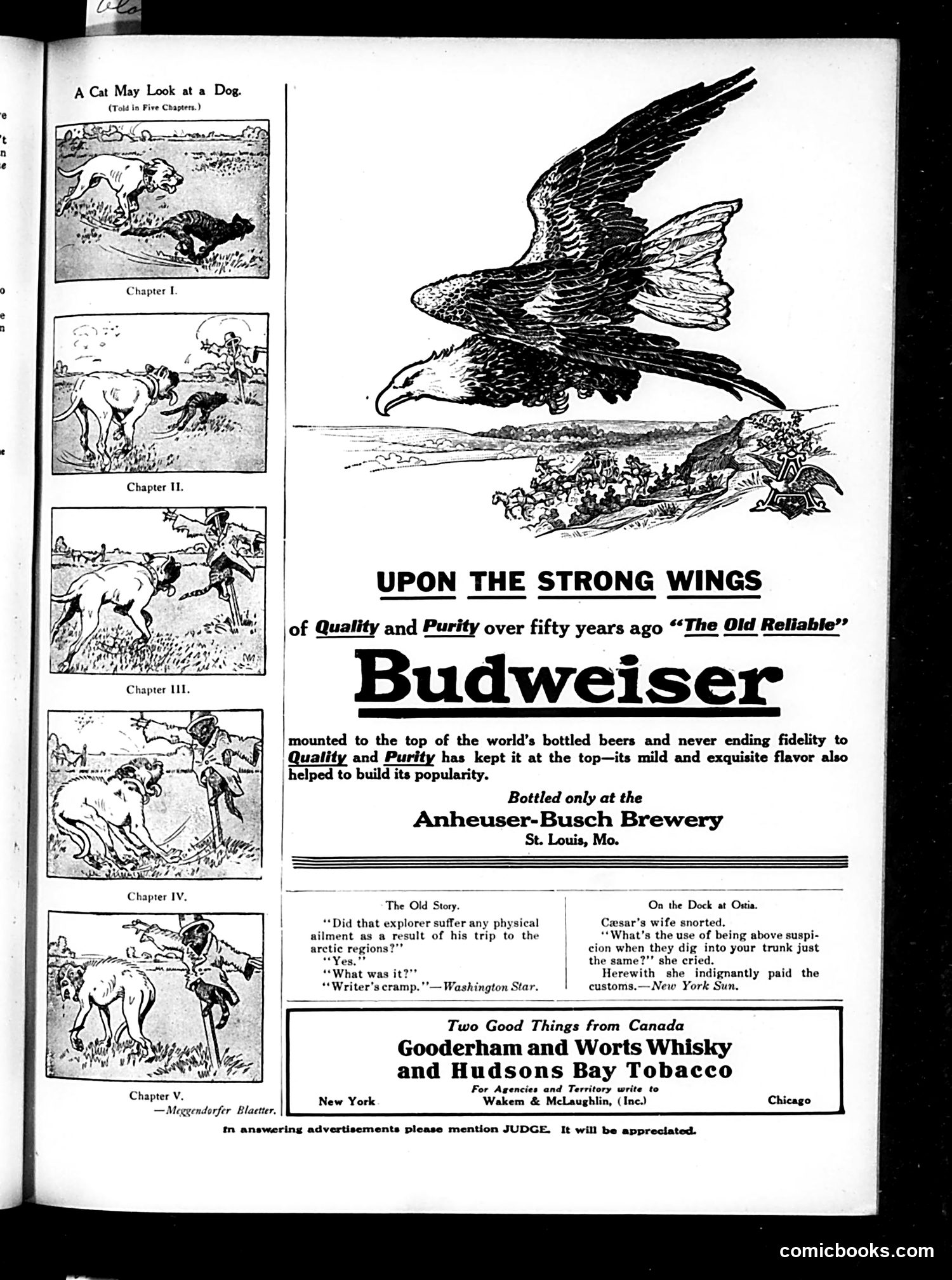
This page is primarily **advertising**, not editorial satire. The left column shows chapter illustrations from "A Cat May Look at a Dog"—a serialized story told in five chapters—but the dominant content is commercial. The main advertisement promotes **Budweiser beer**, claiming it has maintained its position as the world's leading bottled beer for fifty years through "Quality and Purity." This appears designed to reassure consumers during an era when beer quality and safety were concerns. Below are two brief humorous anecdotes (reprinted from *Washington Star* and *New York Sun*): one jokes about an explorer getting "writer's cramp" from arctic travel, the other about Caesar's wife ironically being suspected despite her position. These are filler content typical of Judge magazine. The bottom advertises Canadian whisky and tobacco. The page reflects early-20th-century advertising strategies emphasizing product reliability and longevity to build consumer trust.
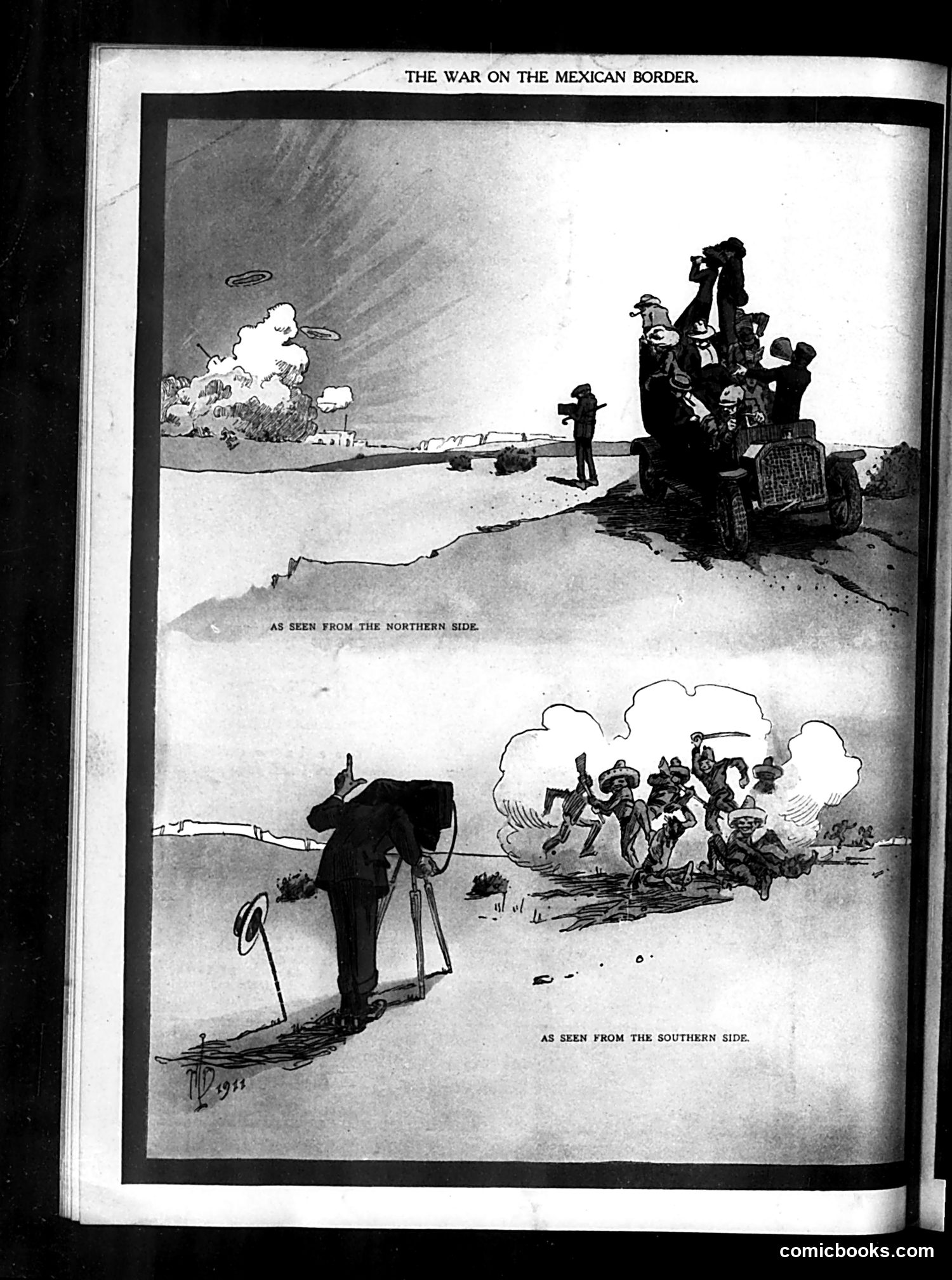
This Judge cartoon presents two contrasting perspectives on border conflict, likely from the Mexican-American tensions of the early 1910s (possibly related to the Mexican Revolution). The **top panel** ("As Seen from the Northern Side") shows American military observers watching distant explosions—depicting the conflict as remote and safely contained. The **bottom panel** ("As Seen from the Southern Side") presents the opposite view: a lone figure (appearing to represent Mexico or Mexican forces) observes armed American troops advancing aggressively across the border with weapons and explosions. The satire critiques American perspective bias—Americans view the situation as safely distant, while from Mexico's viewpoint, American military intervention appears threatening and immediate. The cartoon uses opposing viewpoints to highlight how each nation perceives the same conflict very differently.