
Judge, 1911-04-08 · page 16 of 24
Judge — April 8, 1911 — page 16: what you’re looking at
What you’re looking at
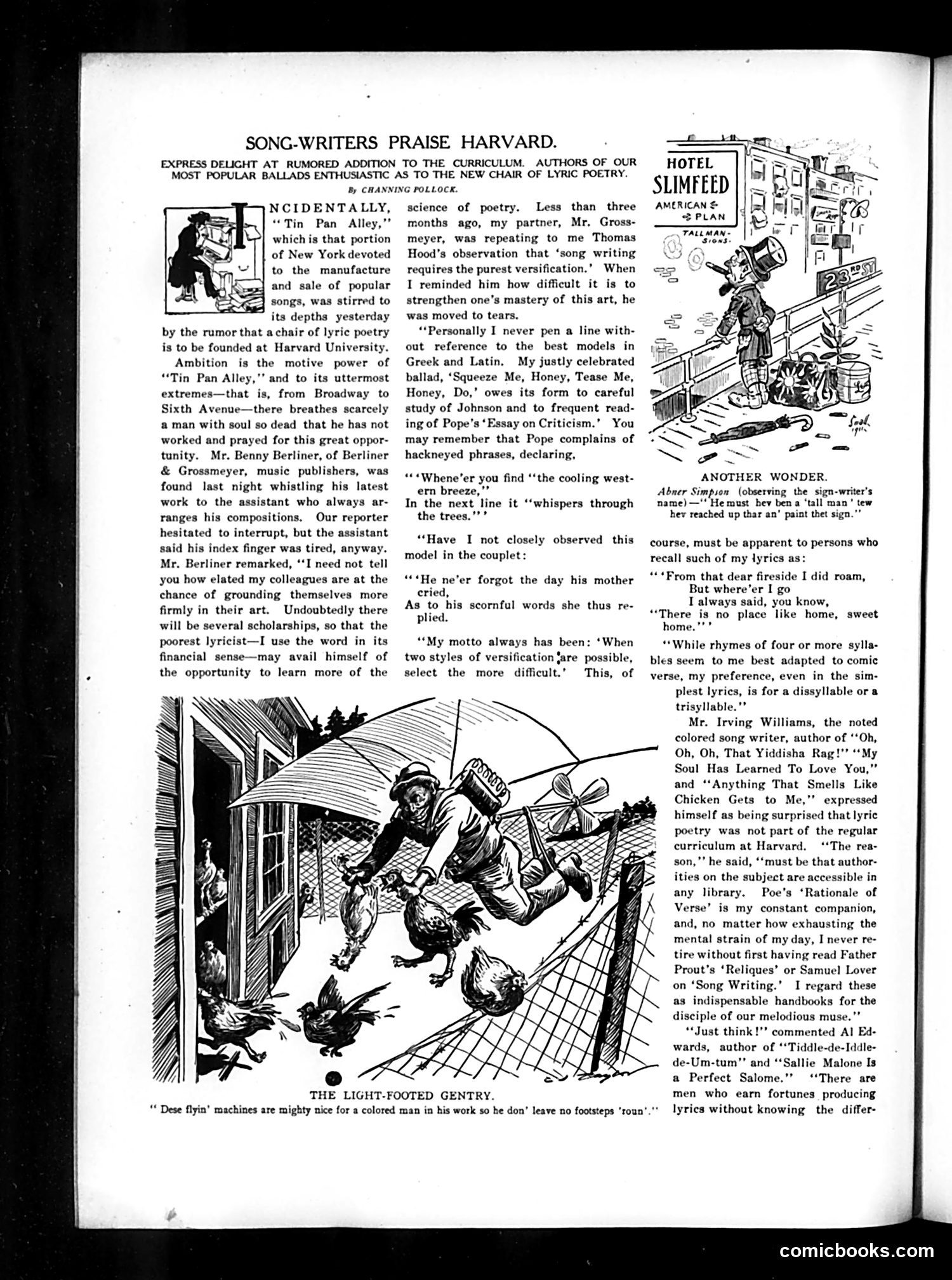
This satirical article mocks "Tin Pan Alley"—New York's popular music industry—by depicting songwriters as pretentious frauds. The joke is that these writers of cheap, formulaic pop songs (like "Squeeze Me, Honey, Tease Me, Honey, Do") absurdly claim scholarly credentials rooted in classical poetry and Greek/Latin models. The satire works through contrast: the songwriters pompously reference Pope's *Essay on Criticism* and claim careful study while writing obvious doggerel. Mr. Berliner's admission that his motto is "when two styles are possible, select the more difficult"—yet he produces vapid rhymes—exposes the pretension. The accompanying cartoons lampoon working-class figures: one shows a laborer with umbrella and chickens (titled "The Light-Footed Gentry"), and another depicts a Black sign-painter, using racial stereotypes typical of the era. The piece ridicules both commercial songwriters' false erudition and, implicitly, Harvard's consideration of legitimizing such "art."
📄 Transcribed text from this page (OCR, searchable)
Machine-transcribed from the original scan — historical spelling and the odd misread are preserved.
SONG-WRITERS PRAISE HARVARD. EXPRESS DELIGHT AT RUMORED ADDITION TO THE CURRICULUM. AUTHORS OF OUR MOST POPULAR BALLADS ENTHUSIASTIC AS TO THE NEW CHAIR OF LYRIC POETRY. By CHANNING POLLOCK. NCIDENTALLY, “Tin Pan Alley,"’ which is that portion of New York devoted to the manufacture and sale of popular songs, was stirred to its depths yesterday by the rumor that achair of lyric poetry is to be founded at Harvard University. Ambition is the motive power of “Tin Pan Alley,’’ and to its uttermost extremes—that is, from Broadway to Sixth Avenue—there breathes scarcely a man with soul so dead that he has not worked and prayed for this great oppor- tunity. Mr. Benny Berliner, of Berliner & Grossmeyer, music publishers, was found last night whistling his latest work to the assistant who always ar- ranges his compositions. Our reporter hesitated to interrupt, but the assistant said his index finger was tired, anyway. Mr. Berliner remarked, ‘‘I need not tell you how elated my colleagues are at the chance of grounding themselves more firmly in their art. Undoubtedly there will be several scholarships, so that the poorest lyricist—I use the word in its financial sense—may avail himself of the opportunity to learn more of the science of poetry. Less than three months ago, my partner, Mr. Gross- meyer, was repeating to me Thomas Hood’s observation that ‘song writing requires the purest versification.’- When I reminded him how difficult it is to strengthen one’s mastery of this art, he was moved to tears. “Personally I never pen a line with- out reference to the best models in Greek and Latin. My justly celebrated ballad, ‘Squeeze Me, Honey, Tease Me, Honey, Do,’ owes its form to careful study of Johnson and to frequent read- ing of Pope’s ‘Essay on Criticism.’ You may remember that Pope complains of hackneyed phrases, declaring, “«*Whene’er you find ‘‘the cooling west- ern breeze,” In the next line it “whispers through the trees.” “Have I not closely observed this model in the couplet: “*He ne'er forgot the day his mother cried, As to his scornful words she thus re- plied. “*My motto always has been: ‘When two styles of versification ‘are possible, select the more difficult." This, of THE LIGHT-FOOTED GENTRY. SLIMFEED AMERICAN & ANOTHER WONDER. Abner Simpson (observing the sign-writer's name)—"' He must hev bena ‘tall man’ tew hev reached up thar an’ paint thet sign."” course, must be apparent to persons who recall such of my lyrics as: “**From that dear fireside I did roam, But where’er I go I always said, you know, “There is no place like home, sweet home."’’ “While rhymes of four or more sylla- bles seem to me best adapted to comic verse, my preference, even in the sim- plest lyrics, is for a dissyllable or a trisyllable.”” Mr. Irving Williams, the noted colored song writer, author of ‘‘Oh, Oh, Oh, That Yiddisha Rag!"’ ‘‘My Soul Has Learned To Love You,"’ and ‘Anything That Smells Like Chicken Gets to Me,” expressed himself as being surprised that lyric poetry was not part of the regular curriculum at Harvard. ‘‘The rea- son,’’ he said, ‘must be that author- ities on the subject are accessible in any library. Poe’s ‘Rationale of Verse’ is my constant companion, and, no matter how exhausting the mental strain of my day, I never re- tire without first having read Father Prout's ‘Reliques’ or Samuel Lover on ‘Song Writing.’ I regard these as indispensable handbooks for the disciple of our melodious muse.” “‘Just think!’’ commented Al Ed- wards, author of ‘‘Tiddle-de-Iddle- de-Um-tum”’ and ‘‘Sallie Malone Is a Perfect Salome." ‘‘There are men who earn fortunes producing “ Dese flyin’ machines are mighty nice for a colored man in his work so he don’ leave no footsteps 'roun’.’ lyrics without knowing the differ- comicbooks.com