
Judge, 1911-04-08 · page 10 of 24
Judge — April 8, 1911 — page 10: what you’re looking at
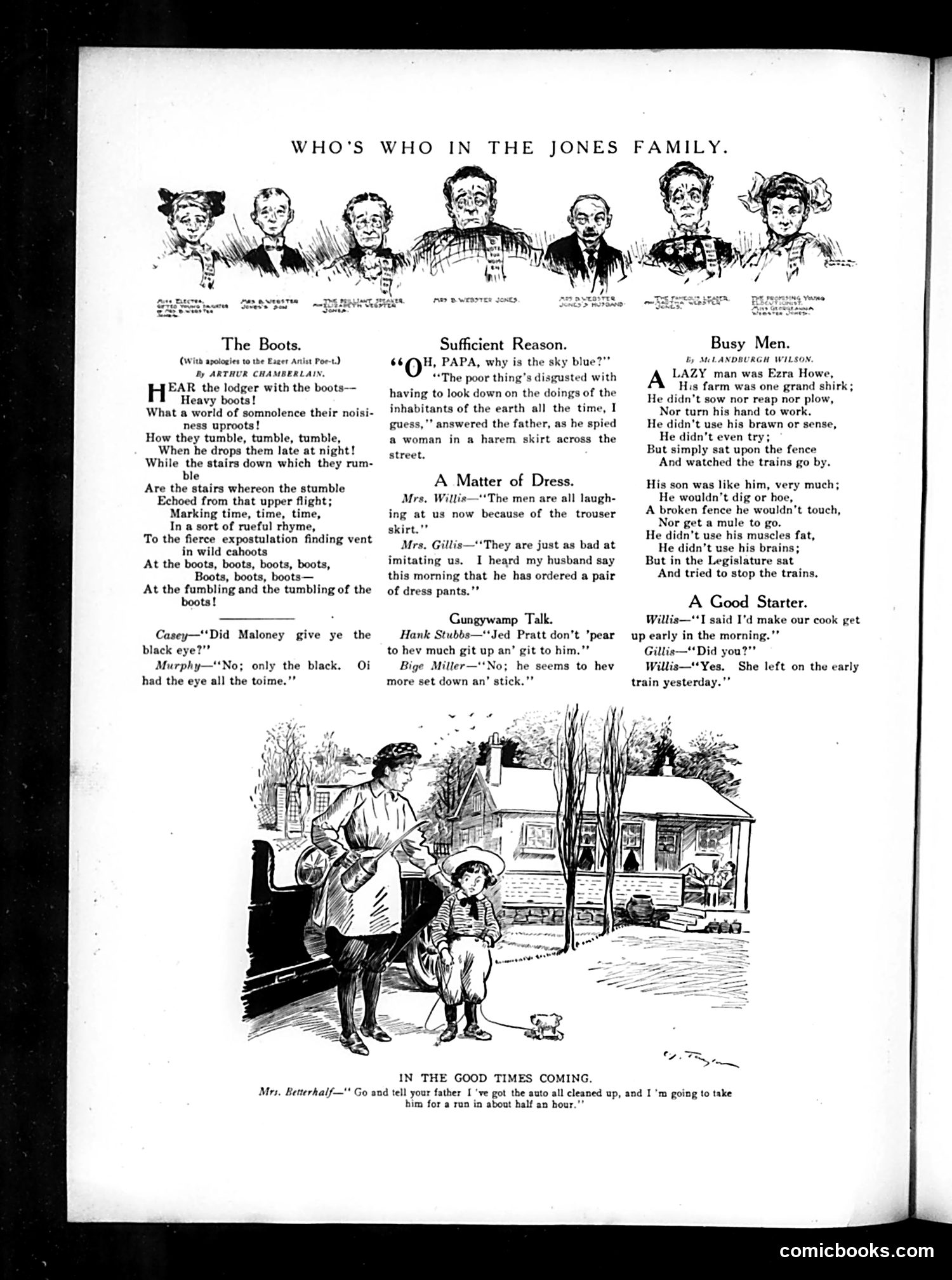
What you’re looking at
This page from *Judge* magazine presents six domestic humor pieces targeting early-20th-century American family life and social changes. **"The Boots"** parodies Poe's "The Bells," mocking noisy lodgers who disturb neighbors by dropping heavy boots at night—a relatable complaint in tenement living. **"Sufficient Reason"** satirizes women's fashion (the "harem skirt"), showing a father dismissing his daughter's complaint about having to observe earthly "doings" with condescension. **"A Matter of Dress"** captures the gender role anxiety of the era: men mock women's new trouser skirts while ordering "dress pants" themselves—suggesting confusion about changing gender norms. **"Busy Men"** presents a cautionary tale: Ezra Howe's laziness passes to his son, who paradoxically becomes a legislator trying to "stop the trains"—satirizing ineffectual politicians. **"A Good Starter"** uses the new automobile as a punchline: the cook escapes rather than wake early. Overall, these pieces reflect anxieties about modern life, changing social roles, and technological disruption during the Progressive Era.
📄 Transcribed text from this page (OCR, searchable)
Machine-transcribed from the original scan — historical spelling and the odd misread are preserved.
WHO'S WHO ap qweestes See Sa The Boots. (With apologies to the Eager Anist Poe-t.) By ARTHUR CHAMBERLAIN. EAR the lodger with the boots— Heavy boots! What a world of somnolence their noisi- ness uproots! How they tumble, tumble, tumble, When he drops them late at night! While the stairs down which they rum- ble Are the stairs whereon the stumble Echoed from that upper flight; Marking time, time, time, In a sort of rueful rhyme, To the fierce expostulation finding vent in wild cahoots At the boots, boots, boots, boots, Boots, boots, boots— At the fumbling and the tumbling of the boots! Casey—“‘Did Maloney give ye the black eye?”” Murphy—"No; only the black. Oi had the eye all the toime.”” IN THE JONES Sufficient Reason. 66()H, PAPA, why “The poor thing’s disgusted with having to look down on the doings of the inhabitants of the earth all the time, I guess,"’ answered the father, as he spied a woman in a harem skirt across the is the sky blue? street. A Matter of Dress. Mrs. Willis—'‘The men are all laugh- ing at us now because of the trouser skirt."” Mrs. Gillis—‘‘They are just as bad at imitating us. I heard my husband say this morning that he has ordered a pair of dress pants.”” Gungywamp Talk. Hank Stubbs—‘‘Jed Pratt don’t ‘pear to hev much git up an’ git to him.’” Bige Miller—'*No; he seems to hev more set down an’ stick.’” IN THE GOOD TIMES COMING. FAMILY. Busy Men. by MeLANDBURGH WILSON. LAZY man was Ezra Howe, His farm was one grand shir! He didn’t sow nor reap nor plow, Nor turn his hand to work. He didn't use his brawn or sense, He didn't even try; But simply sat upon the fence And watched the trains go by. His son was like him, very much; He wouldn’t dig or hoe, A broken fence he wouldn't touch, Nor get a mule to go. He didn’t use his muscles fat, He didn’t use his brain: But in the Legislature sat And tried to stop the trains. A Good Starter. Willis—‘‘I said I'd make our cook get up early in the morning.” Gillis—** Did you?"’ Willis—"‘Yes. She left on the early train yesterday.”’ oS Mrs. Betterhalf—" Go and tell your father I ‘ve got the auto all cleaned up, and I 'm going to take him for a run in about half an hour."’ comicbooks.com