
Judge, 1911-04-08 · page 12 of 24
Judge — April 8, 1911 — page 12: what you’re looking at
What you’re looking at
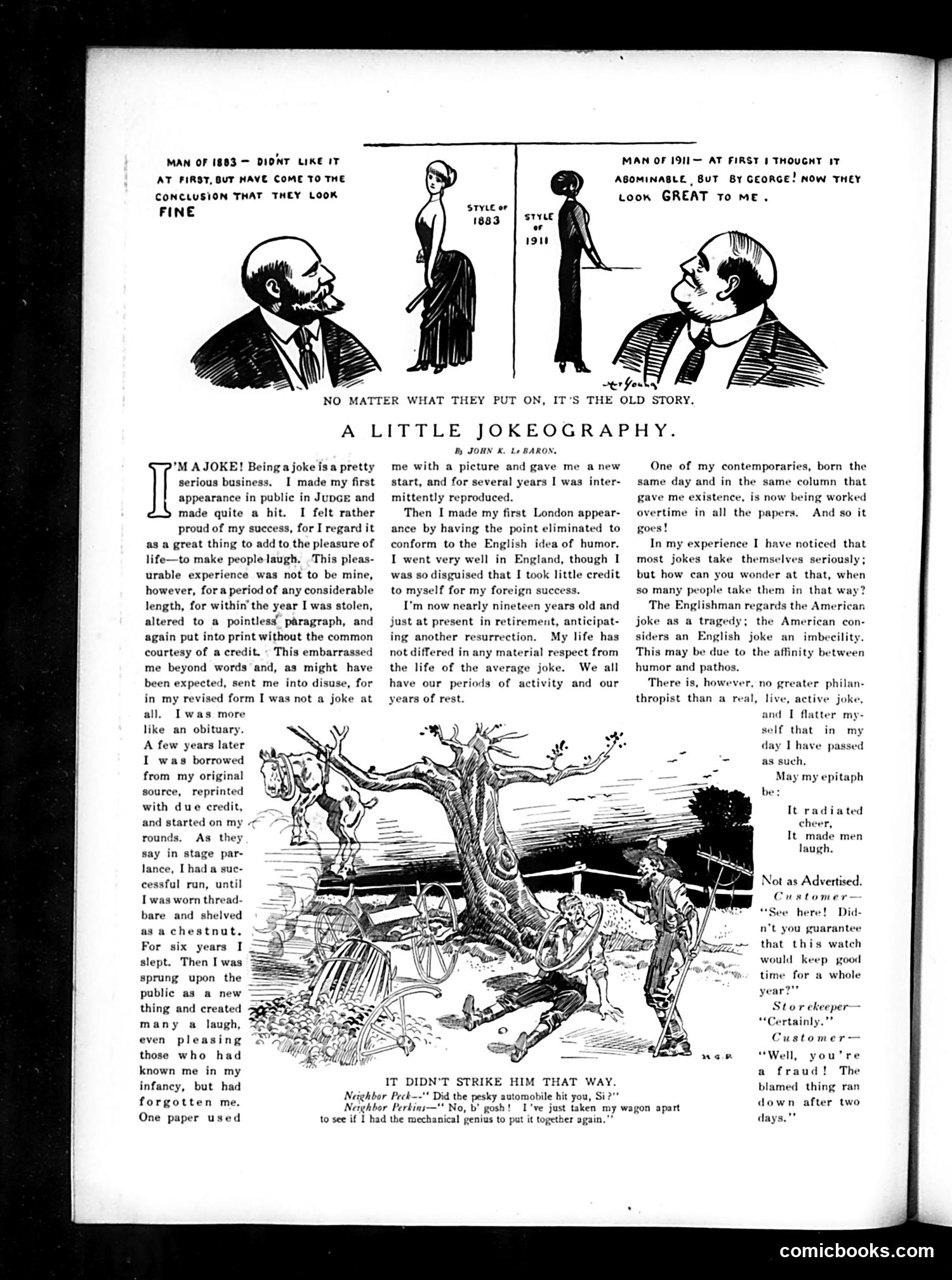
This page presents a humorous autobiographical essay by John K. Le Baron, personifying a joke as if it were a living entity with a career history. **The Main Cartoon (top):** Contrasts fashion between 1883 and 1911. A man initially disliked women's 1883 styles but came to appreciate them; by 1911, he initially found the new fashions "abominable" but now considers them "great." The joke's point: fashion taste is relative and changes over time—what seems outrageous eventually becomes acceptable. **The Essay:** Le Baron describes how his joke was stolen, reprinted without credit, fell into obscurity (became a "chestnut"—old/tired), then experienced periodic revivals. He reflects that jokes have "periods of activity and rest" like human lives. **The Secondary Cartoon (bottom):** Shows a man who disassembled his automobile to understand it, suggesting mechanical incompetence masquerading as curiosity. **The Vignette (right):** A brief dialogue about a defective watch—satirizing false advertising claims. The page humorously explores how jokes, fashions, and consumer products have unpredictable lifespans and reputations.
📄 Transcribed text from this page (OCR, searchable)
Machine-transcribed from the original scan — historical spelling and the odd misread are preserved.
MAN OF 1883 — DIONT LIKE IT AT FIRST, BUT HAVE COME TO THE CONCLUSION THAT THEY LOOK FINE MAN OF I9I1— AT FIRST | THOUGHT IT ABOMINABLE BUT BY GEORGE! NOW THEY toon GREAT to me. STYLE oF 1883 A LITTLE JOKEOGRAPHY. 'M A JOKE! Being a joke isa pretty serious business. I made my first appearance in public in Jupce and made quite a hit. I felt rather proud of my success, for I regard it as a great thing to add to the pleasure of life—to make people laugh. This pleas- urable experience was not to be mine, however, fora period of any considerable length, for within’ the year I was stolen, altered to a pointless’ paragraph, and again put into print without the common courtesy of a credit. » This embarrassed me beyond words and, as might have been expected, sent me into disuse, for in my revised form I was not a jok all. Iwas more like an obituary. A few years later I was borrowed from my original source, reprinted with due credit, and started on my « rounds. As they say in stage par- lance, I had a suc- cessful run, until I was worn thread- bare and shelved as achestnut,. For six years I slept. Then I was sprung upon the public as a new thing and created many a laugh, even pleasing those who had known me in my infancy, but had forgotten me. One paper used By JOHN K. Le BARON, me with a picture and gave me anew start, and for several years I was inter- mittently reproduced. Then I made my first London appear- ance by having the point eliminated to conform to the English idea of humor. I went very well in England, though I was so disguised that I took little credit to myself for my foreign success, I'm now nearly nineteen years old and just at present in retirement, anticipat- ing another resurrection. My life has not differed in any material respect from the life of the average joke. We all have our periods of activity and our years of rest. IT DIDN'T STRIKE HIM THAT WAY. Neighbor Peck" Did the pesky automobile hit you, Si?” Netghbor Perkins—" No, b' gosh! to see if I had the mechanical genius to put it together again.” I've just taken my wagon apart One of my contemporaries, born the same day and in the same column that gave me existence, is now being worked overtime in all the papers, And so it goes! In my experience I have noticed that most jokes take themselves seriousl. but how can you wonder at that, when so many people take them in that way? American The Englishman regards th joke as a tra ; the American con- siders an English joke an imbecilit This may be due to the affinity between humor and pathos. There is, how thropist than a r philan- active joke, and I flatter my- self that in’ my day I have passed as such, May my epitaph laugh. Not as Advertised. Customer- e here! Did- n't you guarantee that this watch would keep good time for a whole “Certainly Customer— “Well, you're a fraud! The blamed thing ran down after two days." comicbooks.com