
A complete issue · 24 pages · 1911
Judge — February 4, 1911
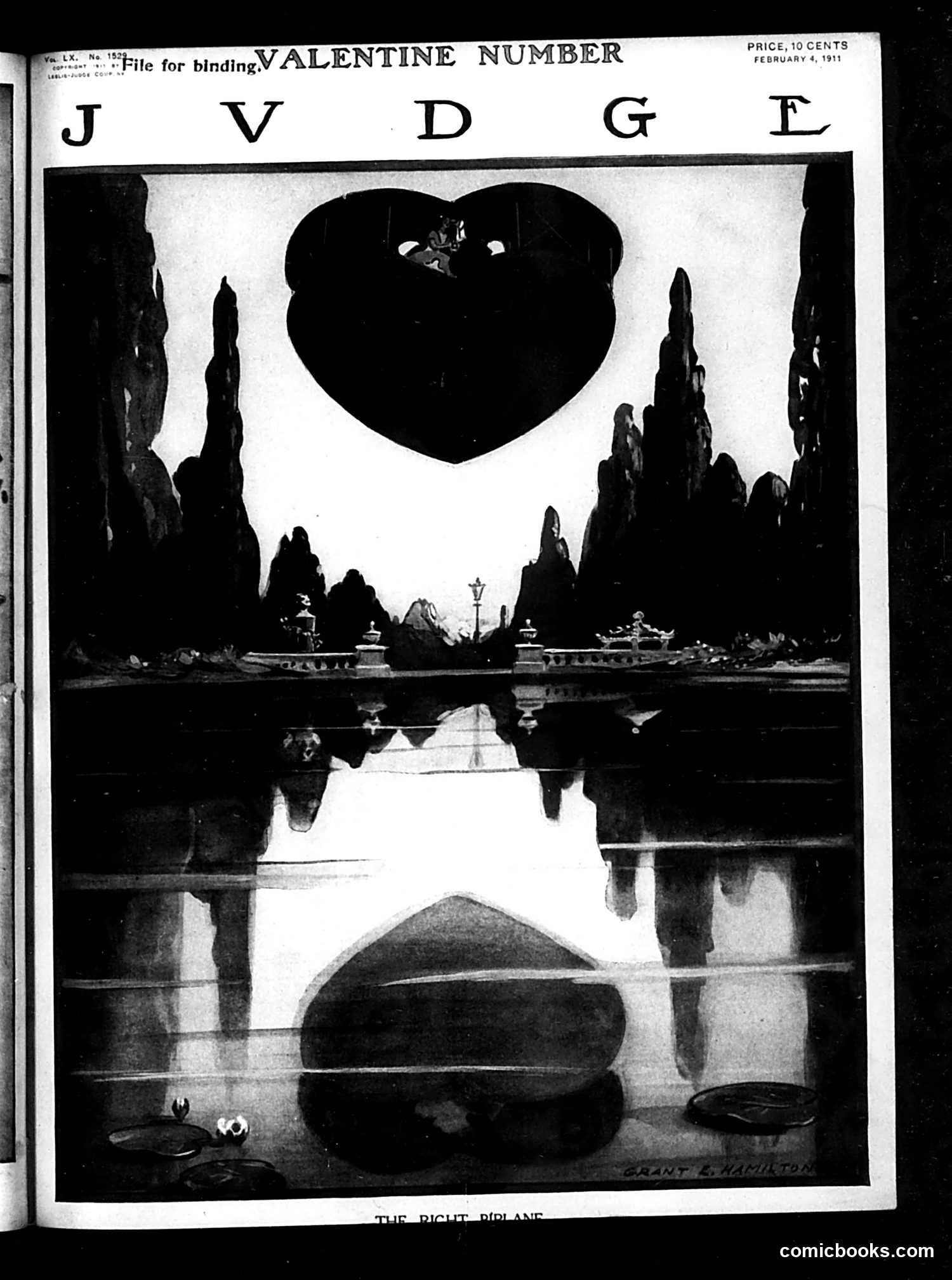
This surreal illustration appears to satirize early 20th-century industrial or political ambitions. The composition shows a dreamlike or nightmarish landscape: towering dark spires frame a pastoral garden scene with a heart floating above—suggesting romantic ideals. In the foreground, a large pipe or conduit dominates, with what appears to be industrial or mechanical elements below. The title "The Right Pipeline" likely references a contemporary infrastructure project or political proposal. The contrast between the delicate heart and romantic garden above versus the crude industrial pipe below suggests satire of how practical/corrupt implementation undermines idealistic goals. Without additional context about 1911 politics or infrastructure debates, the specific target remains unclear, though the imagery evokes tension between aspiration and reality.
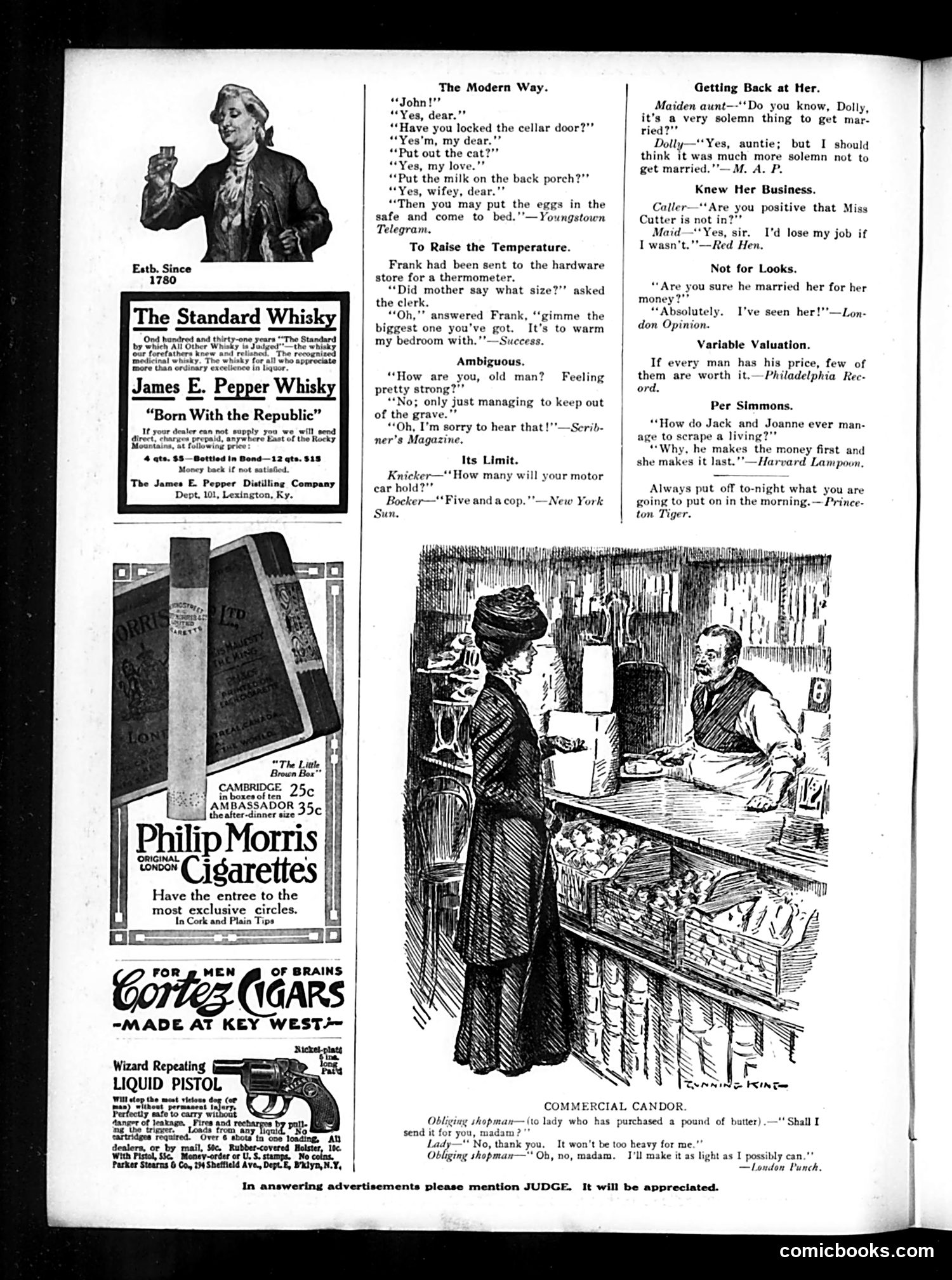
This page is primarily **advertisements and humor snippets** rather than political cartoons. The main cartoon, "Commercial Candor," depicts a butcher shop scene where a woman asks to send butter to a customer, and the butcher responds he'll make it "as light as I possibly can"—a joke about adulterating butter with cheaper fillers to increase profit margin. The scattered one-liners mock contemporary social situations: marriage hesitation, poor business practices, and household management. The advertisements (whisky, cigarettes, cigars, gun powder) dominate the layout. The humor reflects early 20th-century concerns about **food adulteration and commercial dishonesty**—issues that would eventually spur food safety legislation. The "Commercial Candor" title ironically suggests honest business practice while depicting precisely the opposite.
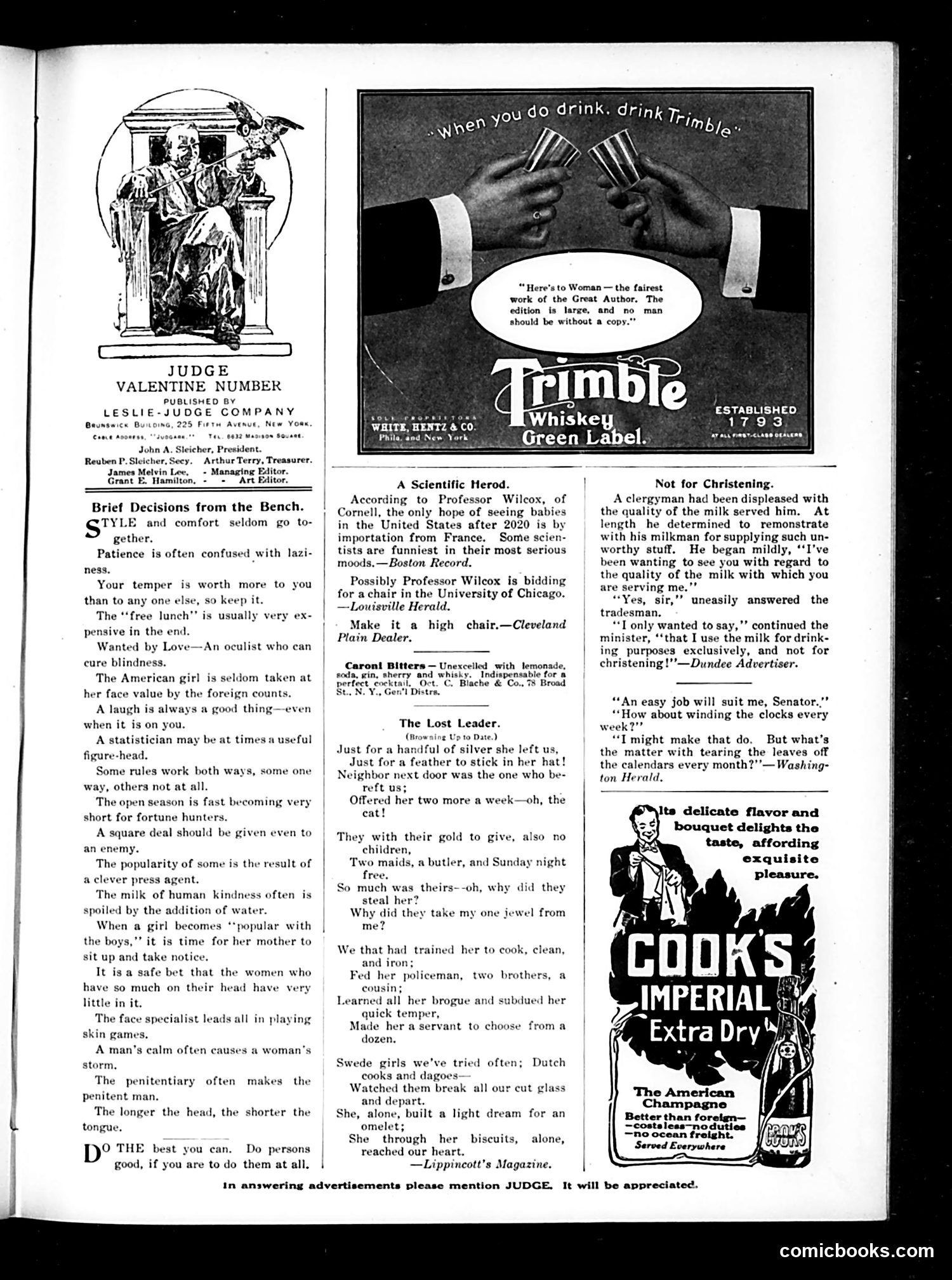
This page is primarily **advertising and humor columns** rather than political cartoons. The left side features "Brief Decisions from the Bench"—short jokes about social behavior, gender relations, and courtroom observations typical of Judge's satirical style. Topics include patience, the "free lunch," blindness, and fortune-telling. The right side contains two advertisements (Trimble Whiskey and Cook's Imperial champagne) and short humorous pieces like "A Scientific Herod" (mocking Professor Wilcox's pessimism about babies post-1920) and "Not for Christening" (a minister's complaint about milk quality). The content reflects early 20th-century attitudes toward women, relationships, and domesticity without targeting specific political figures or events.
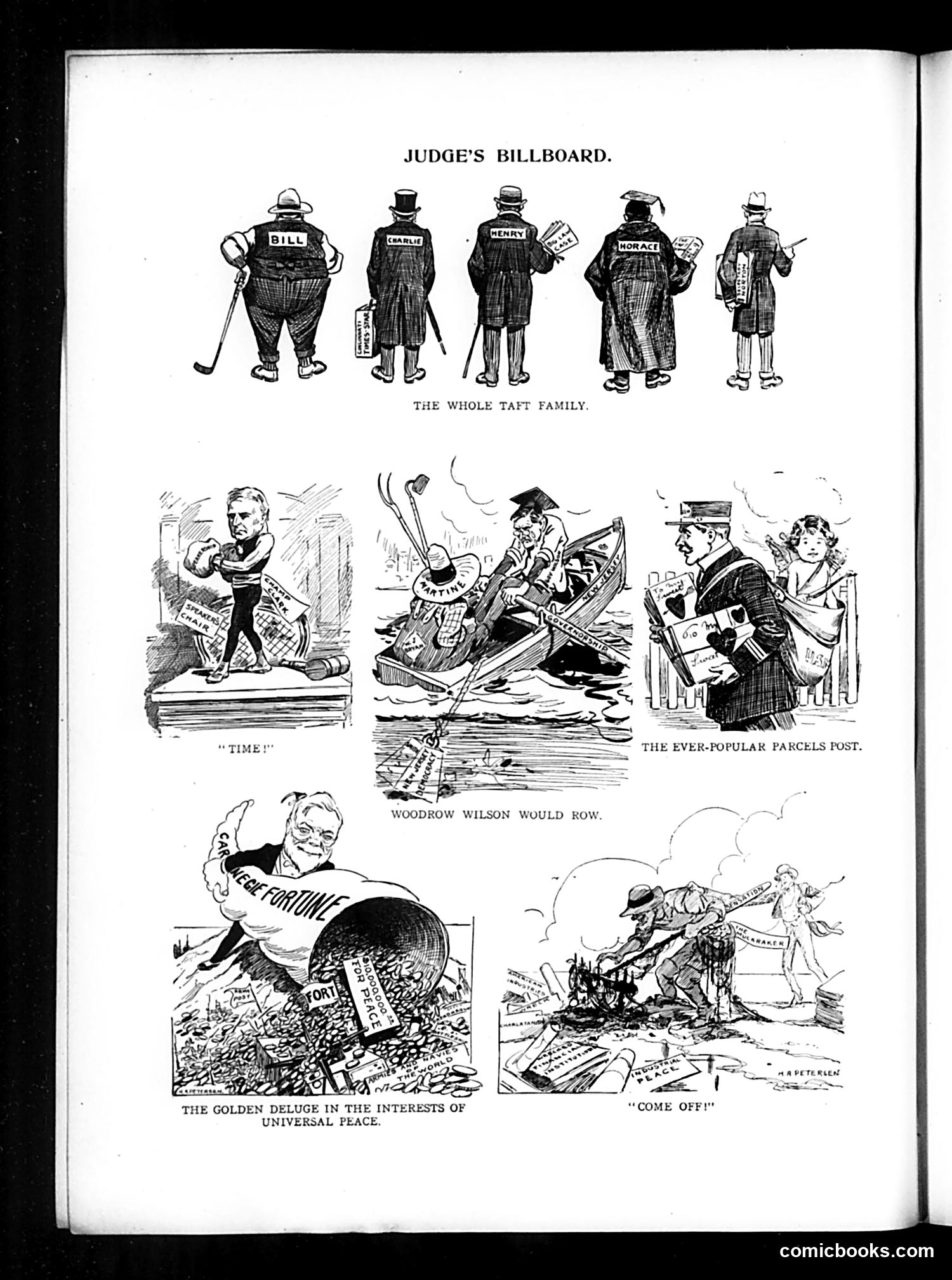
This page satirizes President William Howard Taft and his administration through caricature. The top section shows "The Whole Taft Family" as golf players—Taft was famously devoted to golf, a leisure activity critics attacked as unbecoming of a president during serious times. The lower cartoons mock Taft's policies and decisions. "Woodrow Wilson Would Row" appears to contrast Wilson's activism with Taft's inaction. "The Golden Deluge in the Interests of Universal Peace" depicts fortune/wealth being distributed, likely criticizing Taft's handling of economic or diplomatic issues. "Come Off!" and other panels seem to demand action from the administration. The overall theme ridicules Taft as passive, golf-obsessed, and ineffectual—common criticisms from his political opponents.
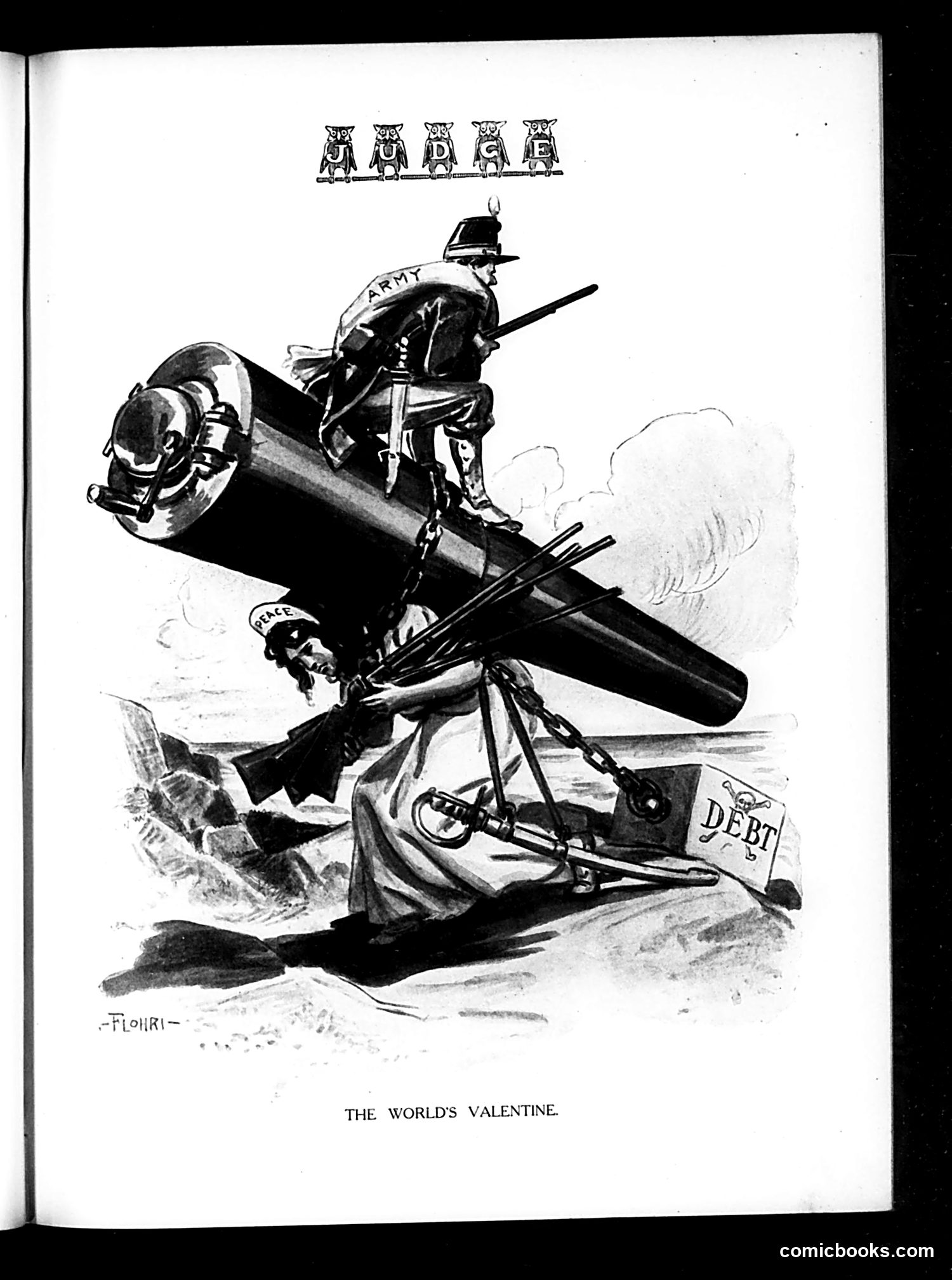
This Judge magazine cartoon satirizes post-World War I geopolitics. An armed German soldier (labeled "Army") rides atop a large bomb or artillery shell, wielding a bayoneted rifle. Below him, a fallen figure representing "Debt" lies crushed beneath the weapon's weight. The satire critiques Germany's militarism and war reparations obligations following WWI. The "World's Valentine" title sarcastically presents Germany's military aggression as an unwanted "gift" to the world. The soldier's aggressive posture and the crushed "Debt" figure suggest the cartoon mocks Germany's attempts to avoid or minimize war debt payments while maintaining military strength—a central tension in 1920s European politics. The "Judge" masthead indicates this reflects American satirical commentary on post-war international relations.
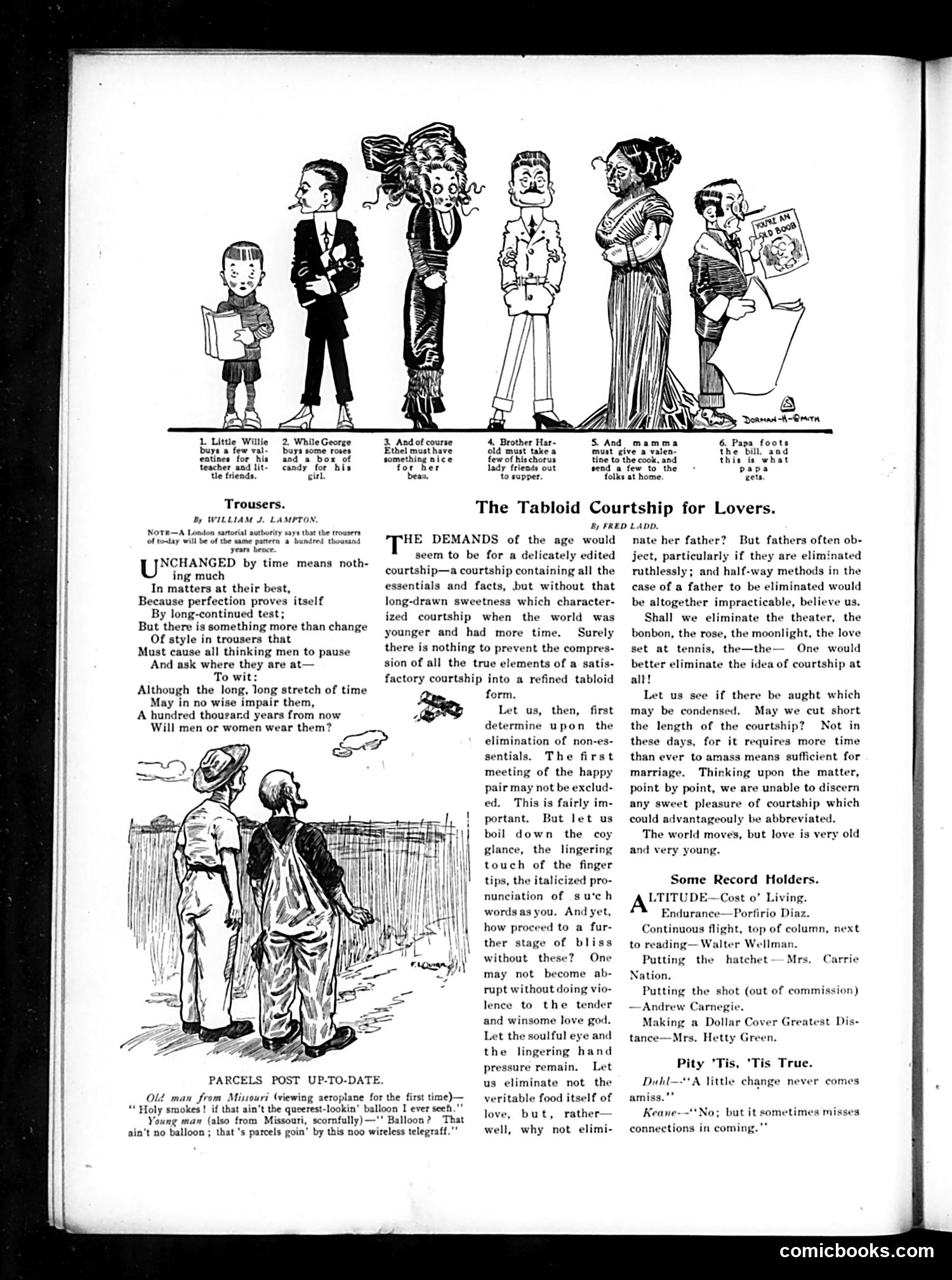
This page contains three satirical pieces reflecting early 1900s American concerns: **"The Tabloid Courtship for Lovers"** mocks the modern demand for efficiency even in romance. The author humorously argues that courtship cannot be condensed like newspaper articles—eliminate the theater, flowers, moonlight, or a bothersome father, and you've eliminated courtship itself. The satire targets the era's obsession with speed and compression applied inappropriately to human emotion. **"Parcels Post Up-To-Date"** jokes about the newly-established parcel post system (launched 1913) through two Missourians mistaking an airplane for mail delivery via "wireless telegraff"—poking fun at rural Americans' unfamiliarity with modern technology. **"Trousers"** references a London fashion prediction that trouser styles won't change in a hundred thousand years, prompting existential questioning: will humans even wear trousers then? The Valentine's Day comic strip shows escalating gift-giving expectations across social classes, culminating with father footing an expensive bill while receiving nothing in return—satirizing commercialized holidays and gender economics.
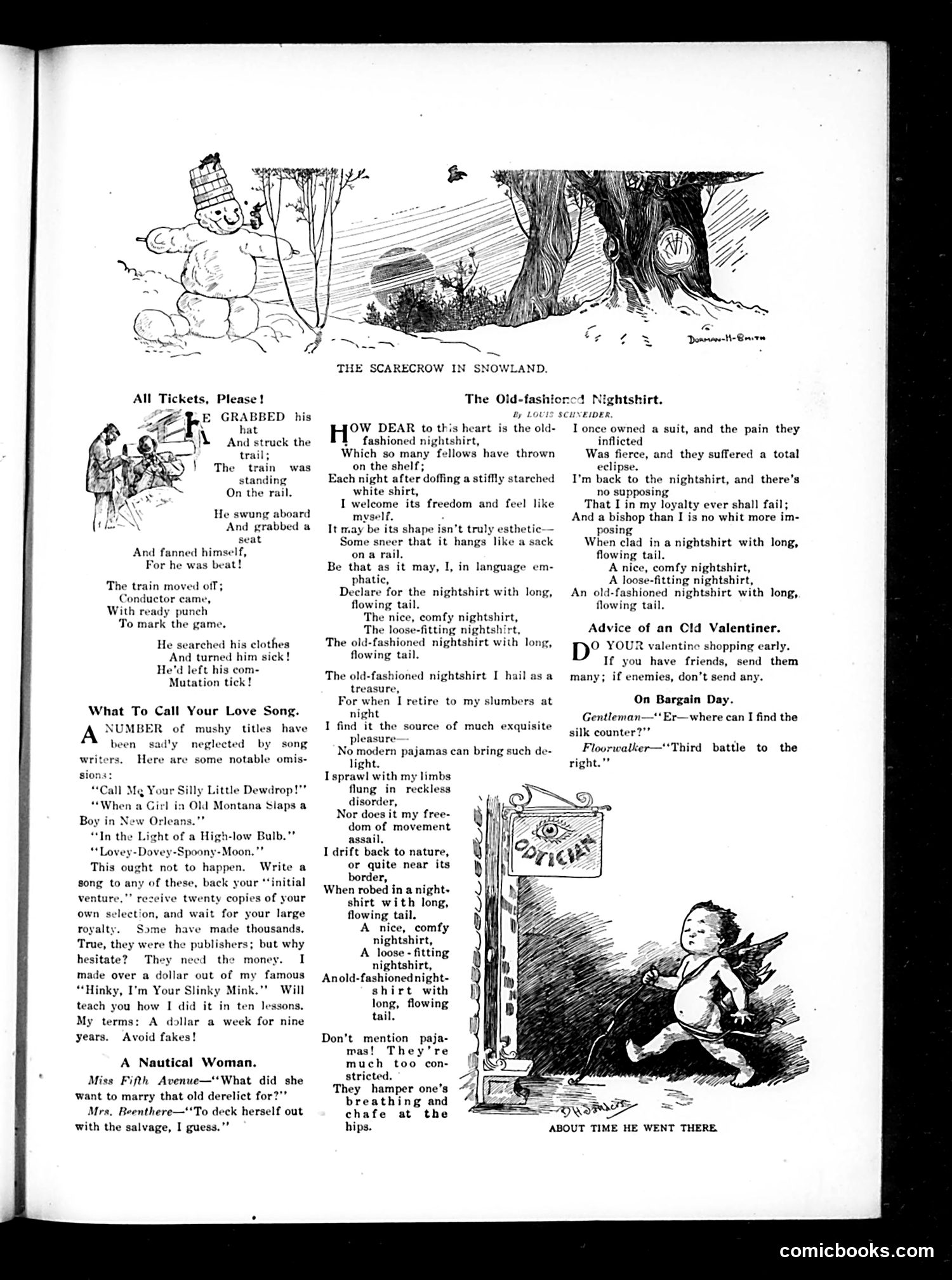
This page from *Judge* contains mostly humorous short pieces and light verse rather than political cartoons. The content reflects turn-of-the-century American humor: **"All Tickets, Please!"** depicts a common travel mishap—a passenger boards a train, realizes he's forgotten his ticket ("commutation tick"), and gets caught by the conductor. It's gentle comedy about everyday embarrassment. **"The Old-fashioned Nightshirt"** is nostalgic verse celebrating traditional nightwear over modern pajamas, treating the garment almost affectionately. This reflects a real early-20th-century debate about changing fashion and comfort. The remaining items—pun-based jokes about song titles, a play on words about a woman marrying a "derelict," and Valentine's Day advice—are generic humor with no evident political content. The small cartoon "About Time He Went There" appears to show a child, but its meaning is unclear without additional context. Overall, this page represents *Judge*'s lighter, lifestyle-focused content rather than satirical commentary.
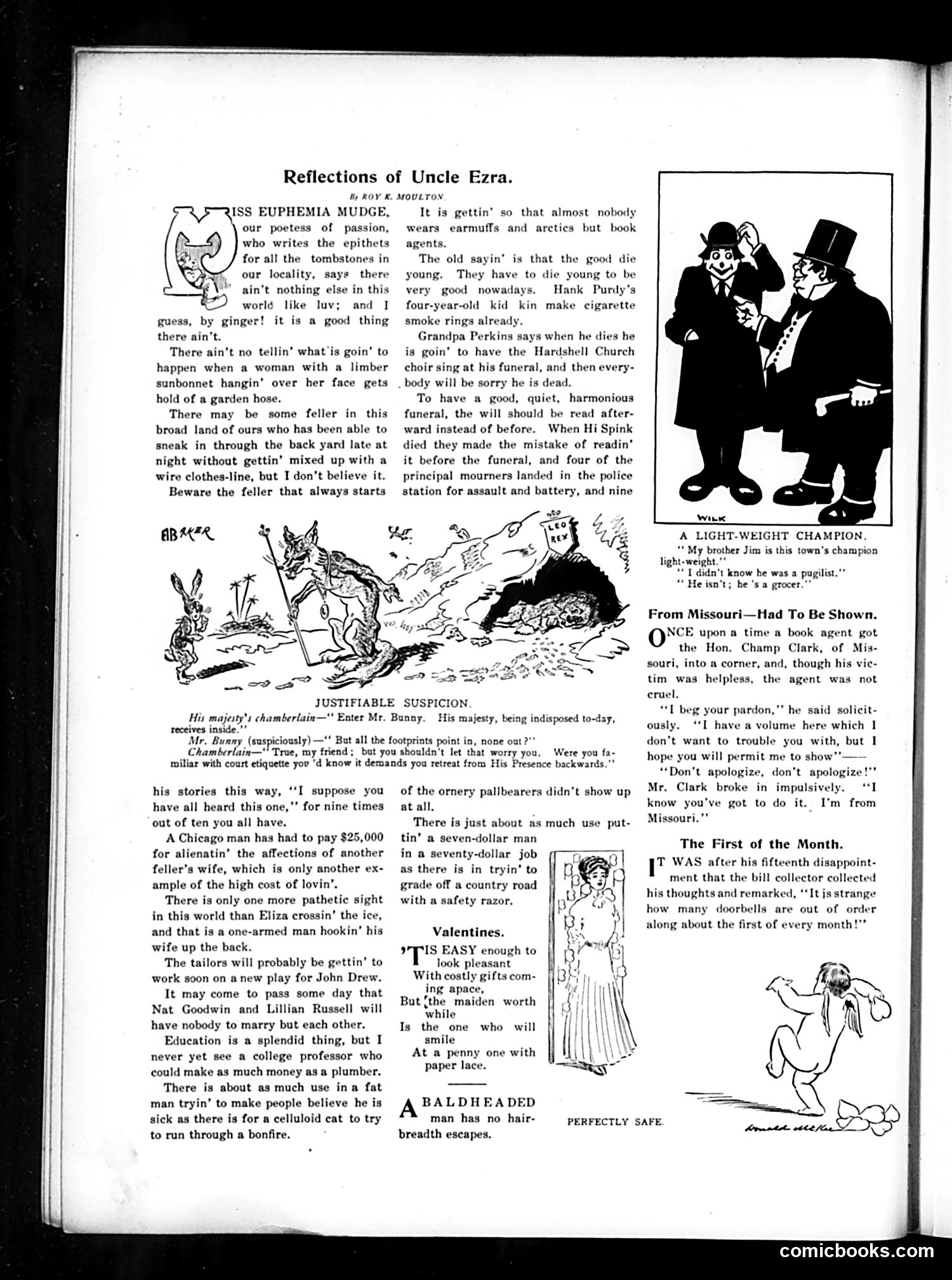
This page features rural American humor attributed to "Uncle Ezra," a folksy character offering observations about small-town life. The cartoons satirize various American types and situations: **"Justifiable Suspicion"** depicts a chamberlain explaining court protocol to Mr. Bunny—the joke being that all footprints lead *into* the royal chamber, suggesting suspicious activity, but the chamberlain excuses it by noting etiquette requires backing out of the king's presence. **"A Light-Weight Champion"** plays on the term "light-weight": the brother is a champion in the grocery business (a light-weight in boxing), not an actual pugilist. **"From Missouri"** references Champ Clark (a real Missouri congressman), playing on the state's reputation for skepticism—the agent's pushy sales pitch forces Clark to politely accept a book demonstration rather than lose face. The Uncle Ezra text contains period-typical rural observations about love, funerals, and social pretension, reflecting early 20th-century small-town American culture.
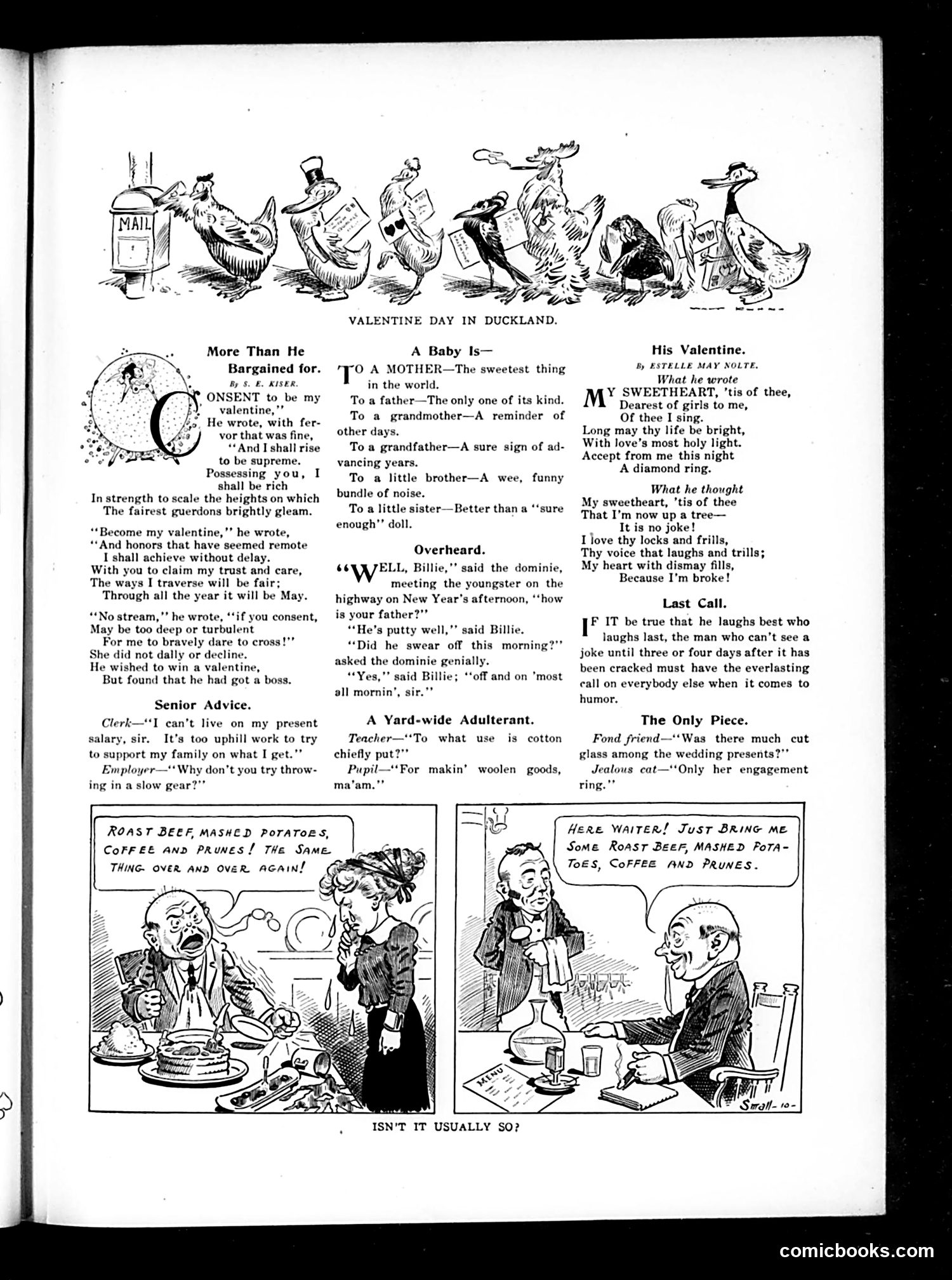
This page from Judge presents several humorous takes on romance and marriage, reflecting early-20th-century social attitudes. **Top illustration**: "Valentine Day in Duckland" depicts anthropomorphic ducks exchanging valentines—a whimsical framing device for the issue's romantic content. **Main content**: Multiple short pieces mock romantic idealization: - "More Than He Bargained For" satirizes a man's flowery marriage proposal; the punchline—he expected a devoted wife but "got a boss"—reflects anxieties about female independence and changing gender dynamics. - "His Valentine" contrasts what he *writes* (flowery devotion, diamond ring) versus what he *thinks* (he's financially ruined), mocking both romantic pretense and marital financial strain. - Bottom cartoons humorously depict marital dissatisfaction and domestic routine ("Roast beef, mashed potatoes... the same thing over and over"). The overall theme: marriage transforms romantic fantasy into mundane, sometimes burdensome reality. The humor targets both male naïveté and female assertiveness—typical satirical concerns of the era.
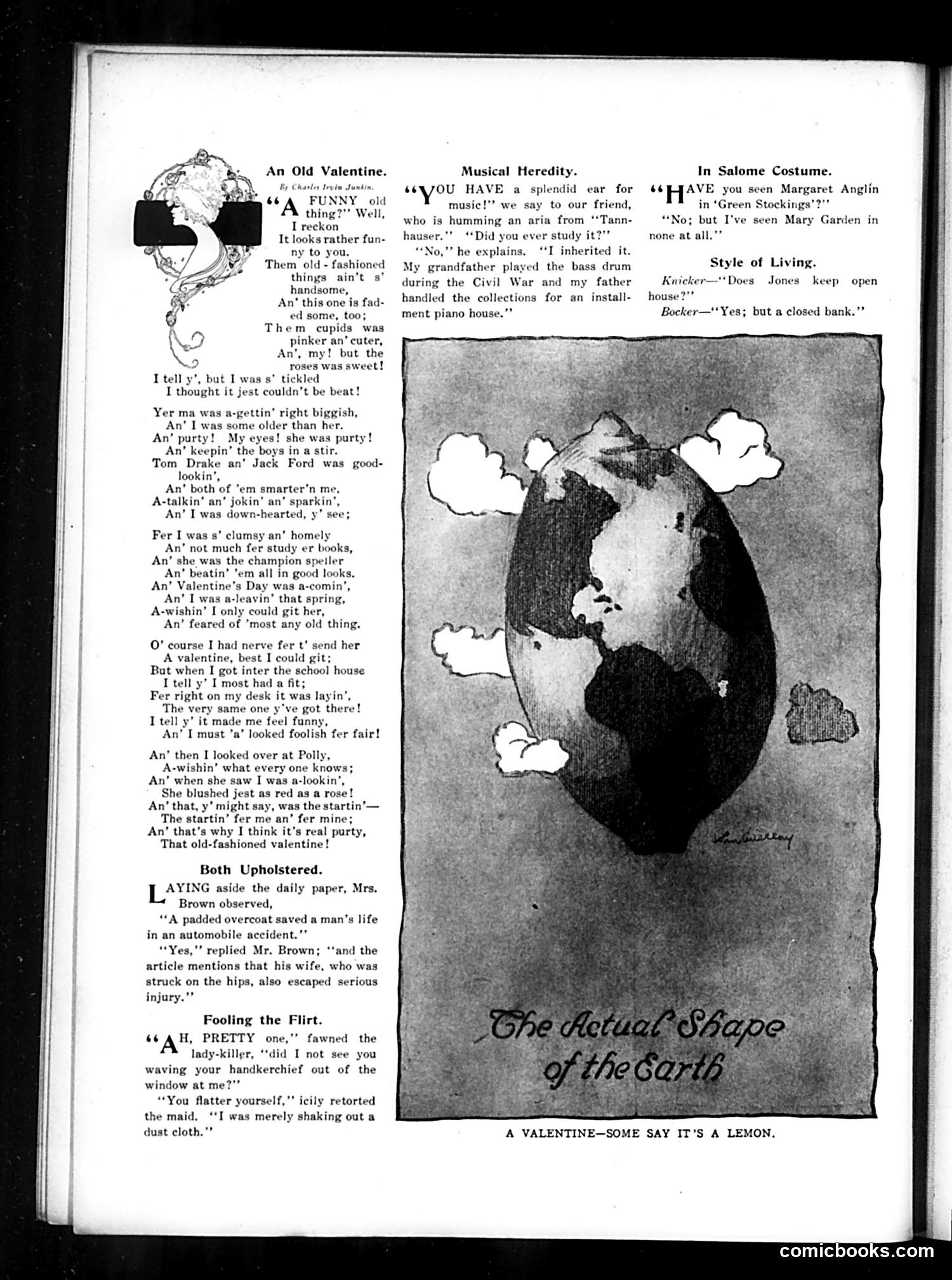
This page contains several short humor pieces typical of early 20th-century Judge magazine. **"An Old Valentine"** is the main feature—a nostalgic poem about a rural man recalling how he sent a valentine to a girl he admired, only to discover she'd sent him an identical one, leading to their eventual marriage. The dialect verse celebrates old-fashioned romance and courtship. **The other brief jokes** mock contemporary social types: - "Both Upholstered" plays on wives' padding (literal and figurative) - "Musical Heredity" satirizes pretension—a man claims to have inherited musical talent through his grandfather's bass drumming and his father's work collecting installment piano payments (suggesting unearned claims to refinement) - "Fooling the Flirt" depicts a maid rejecting a lady-killer's advances - "In Salome Costume" compares theatrical performances The illustrated cartoon on the right shows "The Actual Shape of the Garth" (likely "garth" meaning enclosed courtyard or body)—appears to be fashion or body-shaming satire, though the specific reference is unclear.
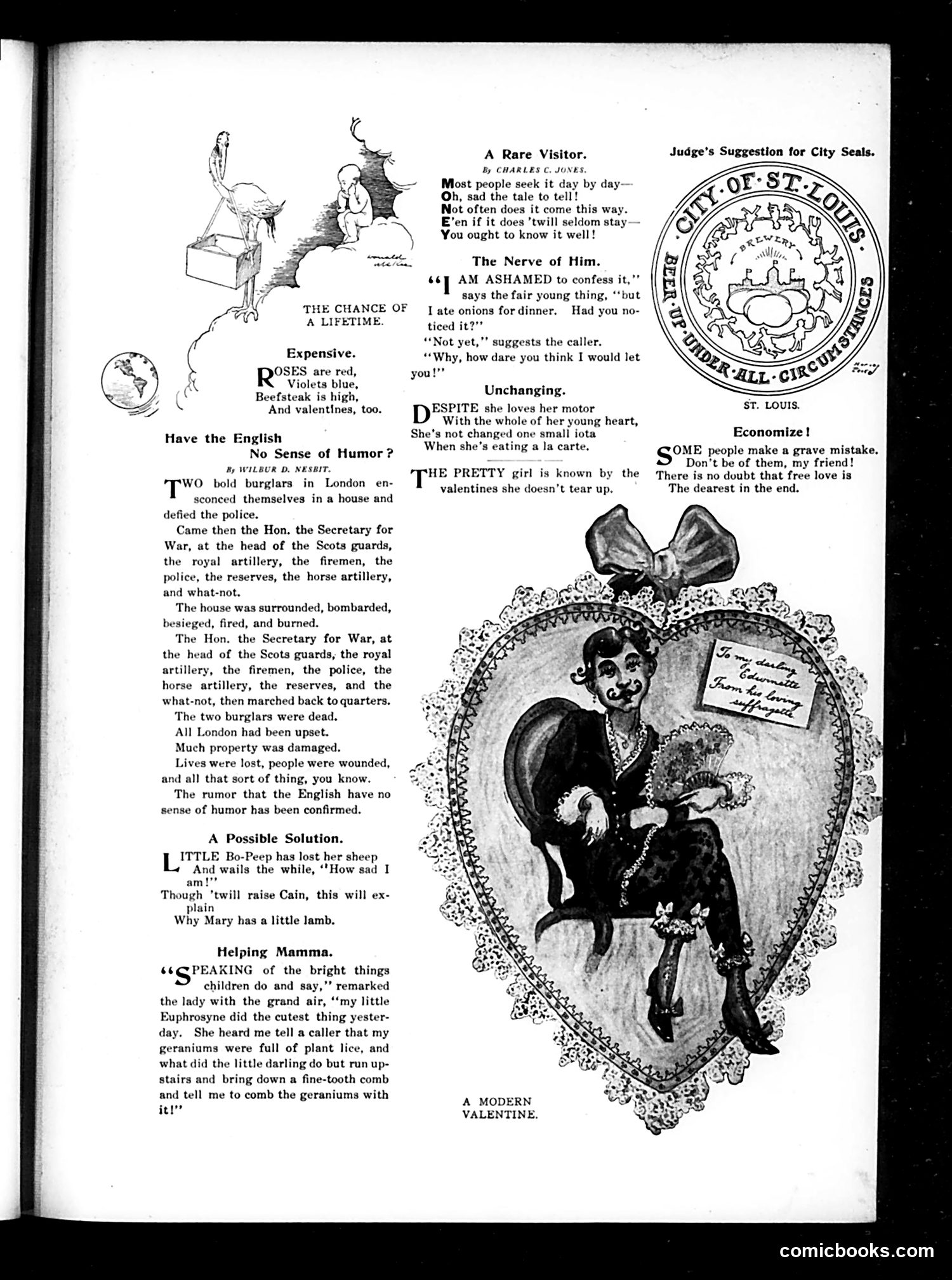
This satirical page contains multiple short humorous pieces typical of early 20th-century American humor magazines. **"Have the English No Sense of Humor?"** mocks British military overkill: two burglars in London are responded to with massive force—the Secretary for War, Scots guards, royal artillery, firemen, and police surround, bombard, and burn the house, killing the burglars and causing widespread damage. The joke's point: such an absurdly disproportionate response to a minor crime demonstrates the English *lack* humor—they take themselves too seriously. **Other pieces** are lighter: poems about roses/Valentine's Day prices, a child combing geraniums for plant lice (misunderstanding mother's complaint), jokes about a woman eating onions, and a pun on "free love" being expensive. **"Judge's Suggestion for City Seals"** shows St. Louis's city seal with a caption—likely gentle mockery of municipal pretension, though specifics are unclear. The **"Modern Valentine"** illustration depicts a woman in an ornate heart-shaped frame—satirizing contemporary romantic sentiment or social conventions around courtship.
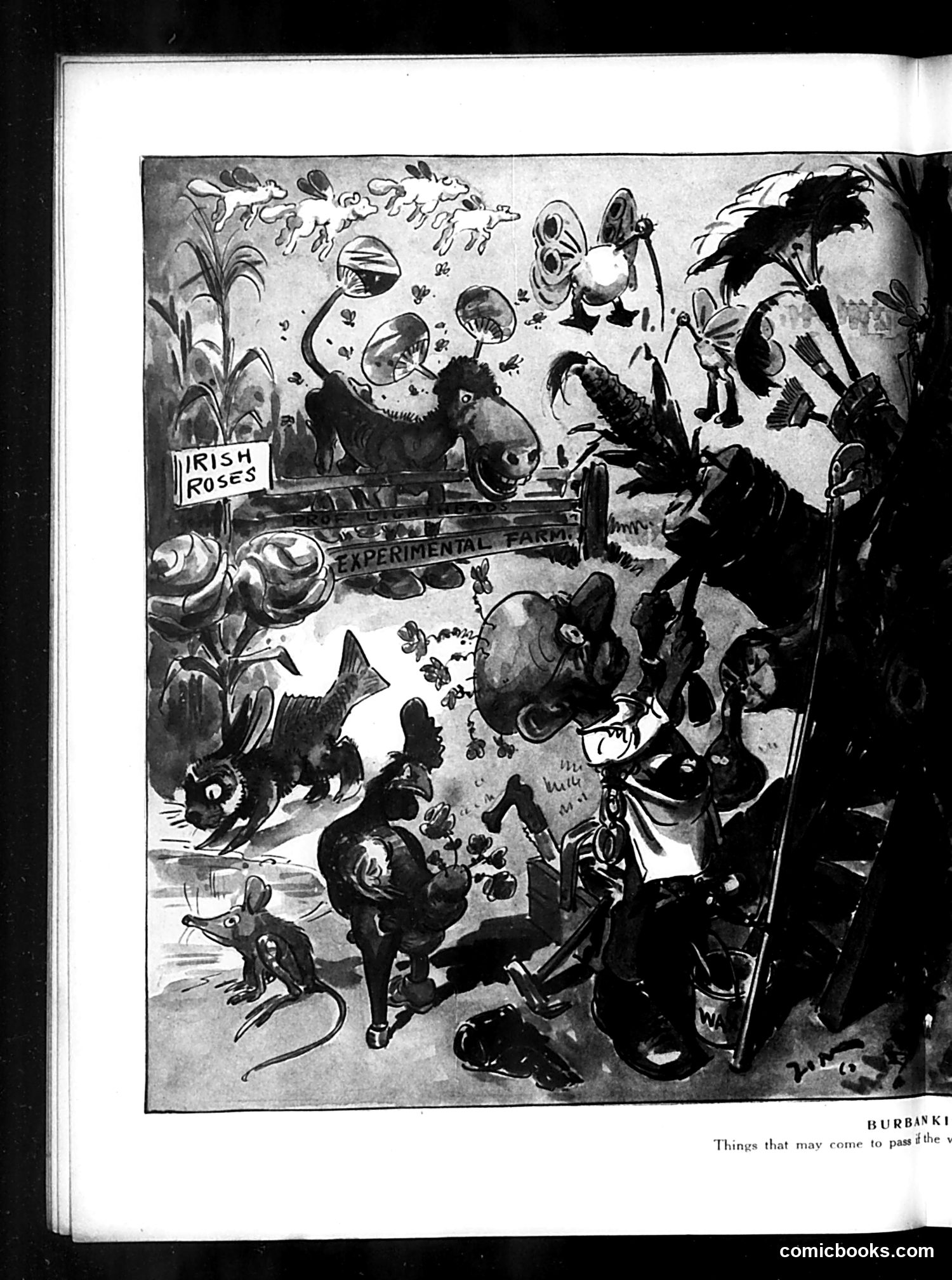
This appears to be a satirical cartoon by Burbank depicting an "Experimental Farm" scene. The visible sign reads "IRISH ROSES" and another label indicates "EXPERIMENTAL FARM." The cartoon shows anthropomorphized animals (appearing to be rabbits or similar creatures) in chaotic activity around potted plants and flowers. Small flying creatures scatter overhead. The style suggests early 20th-century social satire, likely mocking agricultural experimentation or horticulture trends of that era. The title fragment "Things that may come to pass" suggests speculation about future consequences, possibly satirizing scientific breeding experiments or agricultural innovations popular in the period. Without more context or complete text, the specific political/social target remains unclear, though the crowded, anarchic composition implies criticism of whatever experimental practice is depicted.
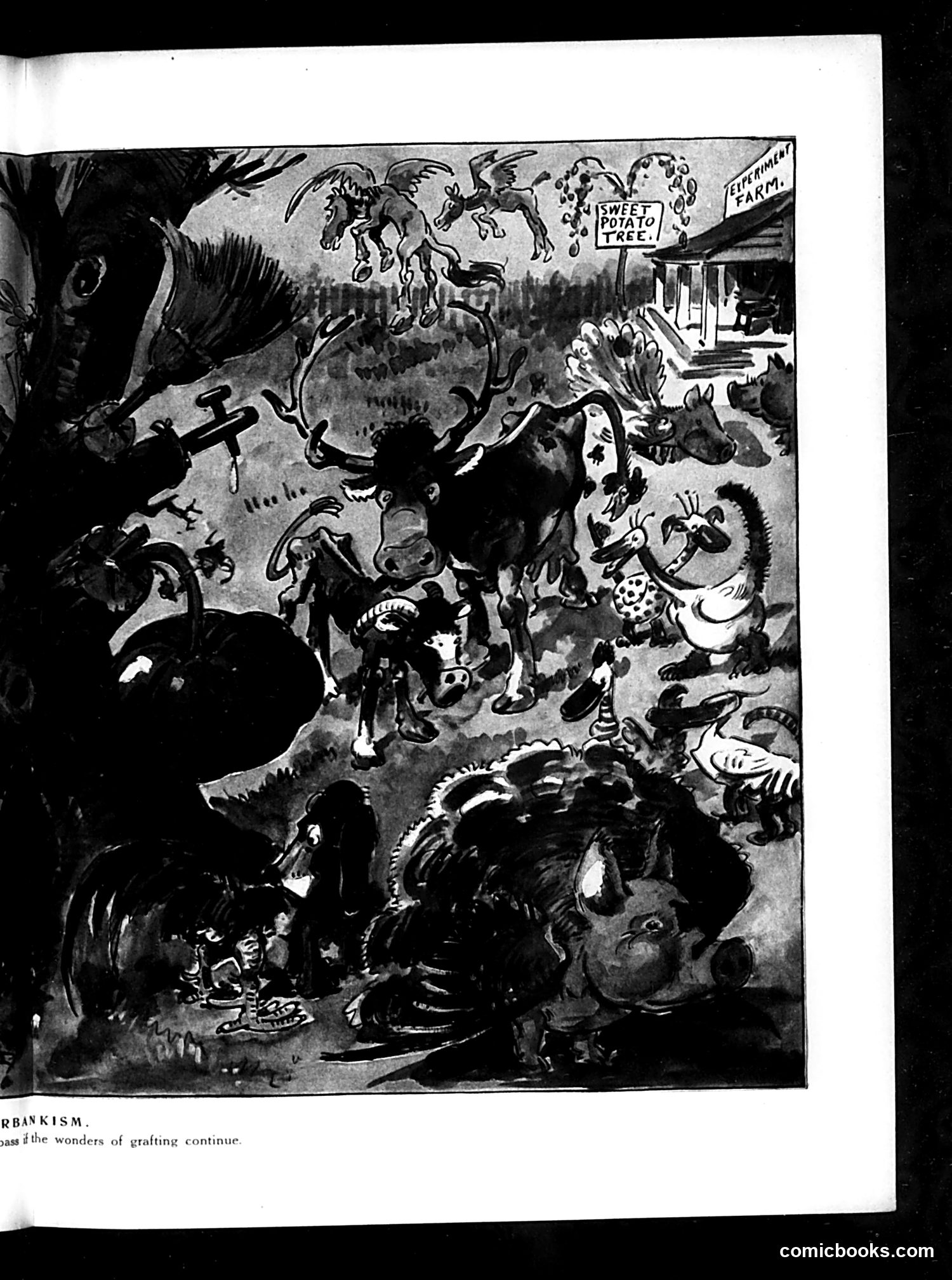
This satirical cartoon critiques "Bankism"—apparently a political or economic system involving corruption and "grafting" (illegally obtaining money through abuse of office). The chaotic farm scene depicts various animals engaging in wild, disorderly behavior around a "Sweet Potato Tree" and farmhouse, likely representing the chaos and moral disorder caused by such corrupt practices. The grotesque, exaggerated animal caricatures suggest that those engaged in grafting are depicted as less than human—crude, base, or animalistic. The overflowing abundance of activity conveys how pervasive and systemic the corruption has become. Without knowing the specific publication date or political context, the exact targets remain unclear, but the cartoon attacks institutional corruption and its destructive social effects through agricultural metaphor and animal caricature—common Judge magazine techniques.
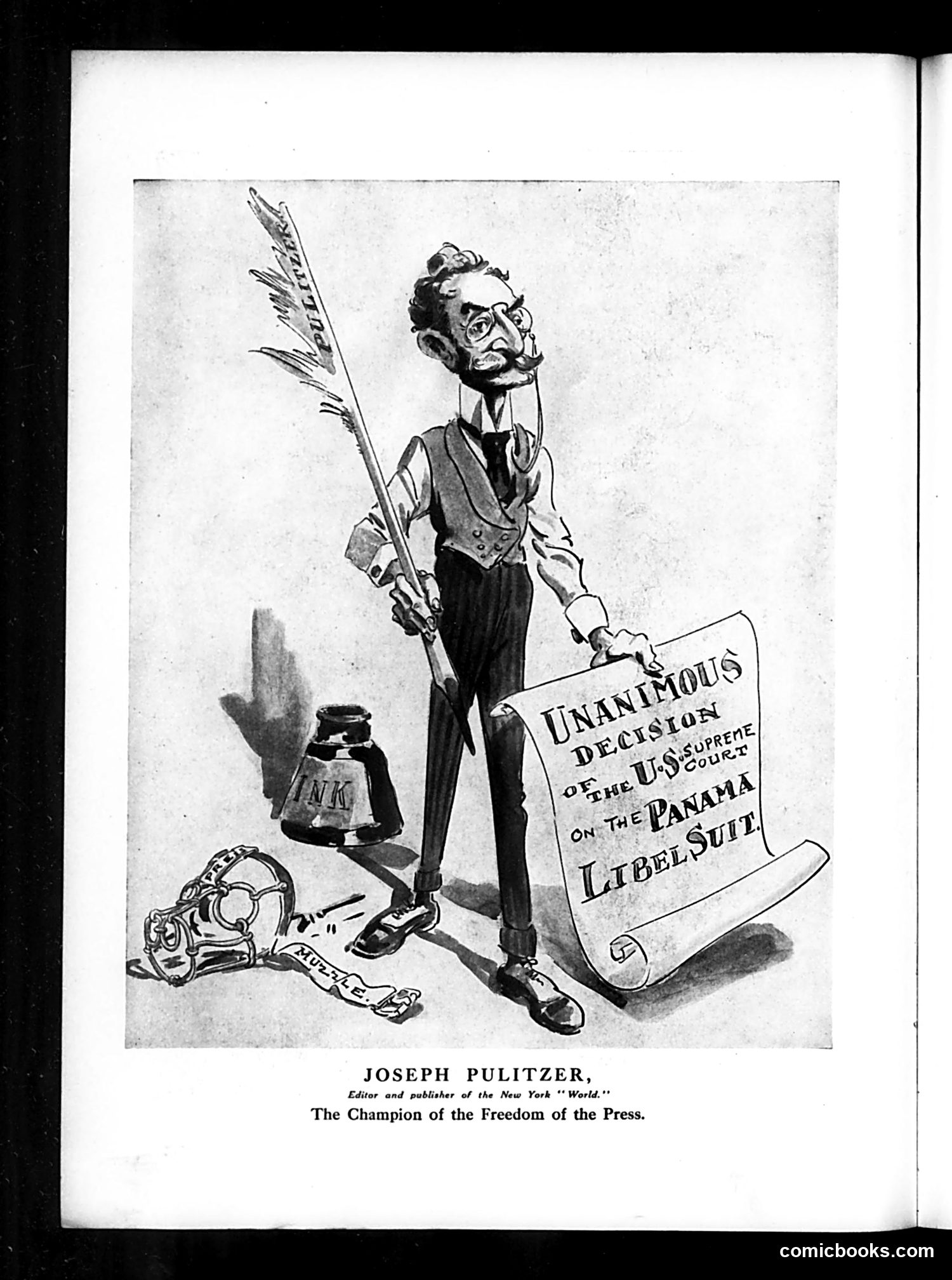
This is a caricature of Joseph Pulitzer, editor of the New York *World* newspaper. The cartoon depicts him as a tall, thin figure holding a quill pen and an ink bottle, standing triumphantly over legal documents. The scroll reads "Unanimous Decision of the U.S. Supreme Court on the Panama Libel Suit." The satire praises Pulitzer as a champion of press freedom, likely referring to a specific Supreme Court victory regarding libel laws and the *World*'s reporting on the Panama Canal scandal. The visual emphasizes his role defending journalistic rights to publish controversial stories without fear of legal censorship. The exaggerated caricature—with prominent features and theatrical pose—is typical of Judge magazine's satirical style, celebrating (or possibly mocking) Pulitzer's aggressive stance on press liberty during the Progressive Era.
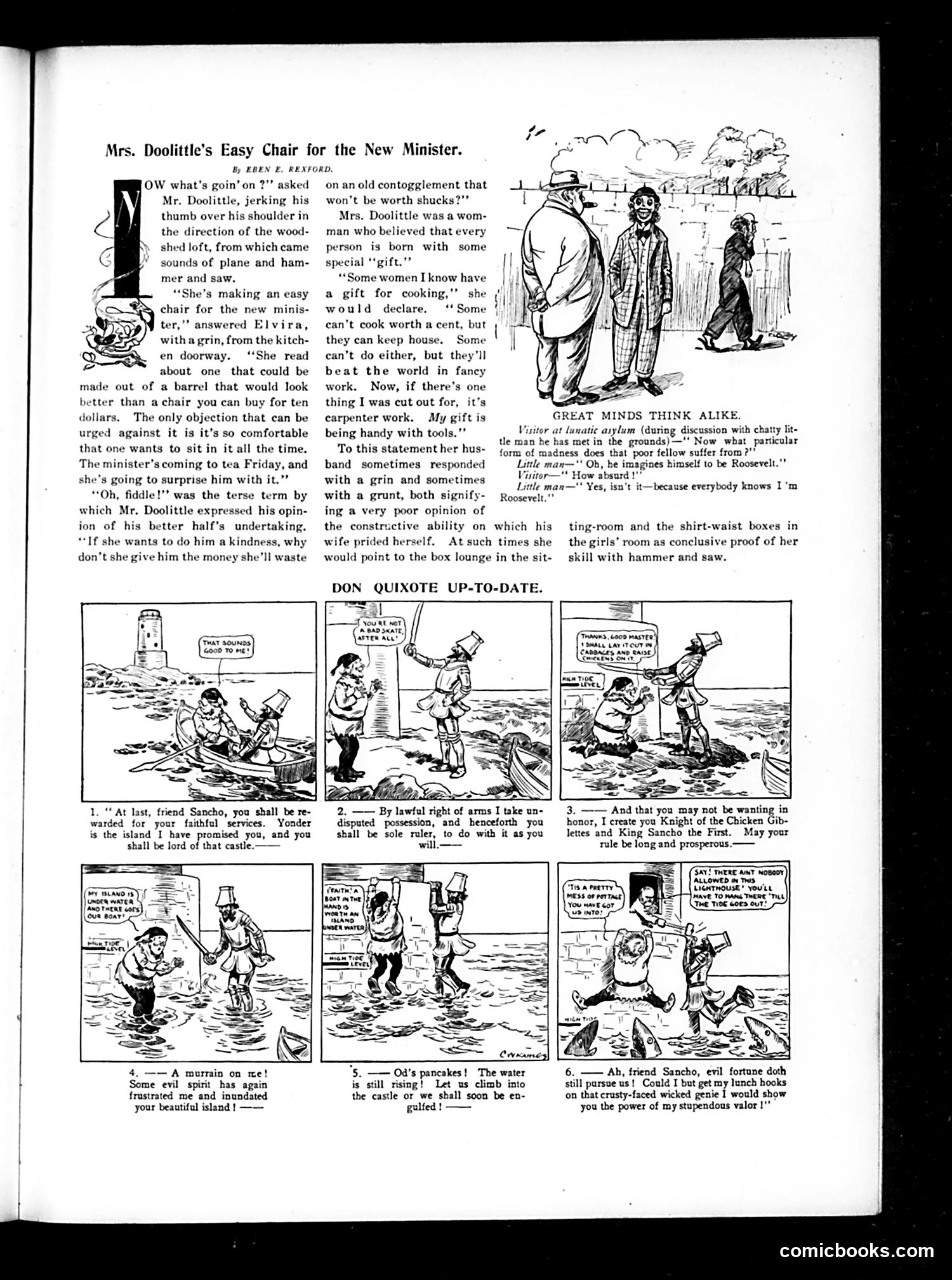
**Upper Section:** "Mrs. Doolittle's Easy Chair for the New Minister" is a humorous domestic story. Mr. Doolittle dismisses his wife's carpentry skills and her plan to build a homemade barrel chair as a gift for their new minister, considering it a waste of money. Mrs. Doolittle believes everyone has special "gifts"—hers being carpentry—and points to previous successful projects as proof. **Lower Left:** A "Don Quixote Up-to-Date" comic strip modernizes Cervantes' classic, with Don Quixote and Sancho Panza encountering an island that mysteriously floods and disappears, thwarting their plans. **Lower Right:** A satirical joke about a mental asylum visitor meeting a patient who claims to be Theodore Roosevelt. The punchline: the visitor himself also believes he is Roosevelt, suggesting both are delusional—likely mocking Roosevelt's outsized personality or political prominence during this era.
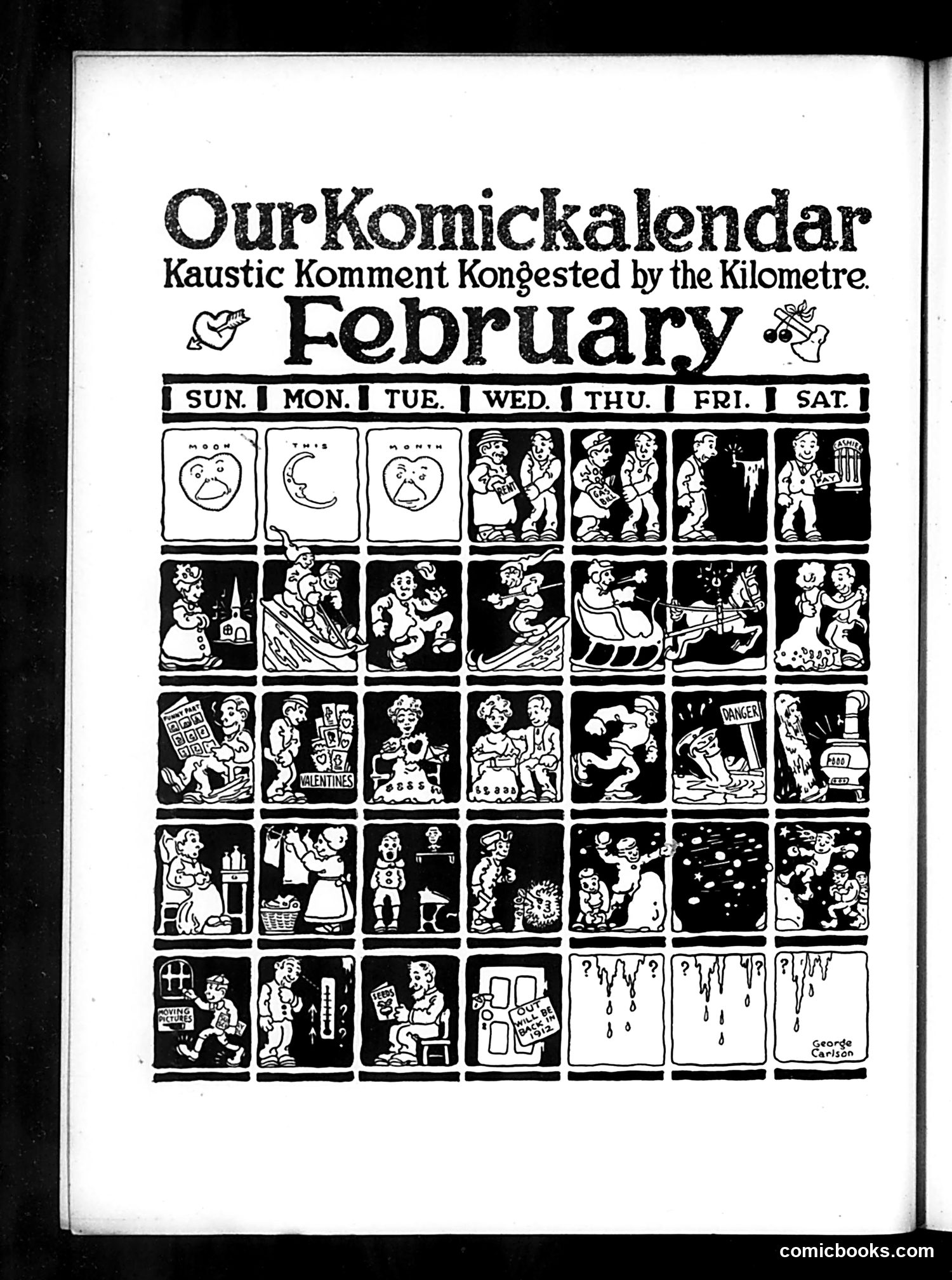
This is a comic calendar page from *Judge* magazine featuring daily panels for February. The title's deliberate misspellings ("Komical," "Kaustic Komment," "Konégested") suggest playful satire. The panels depict everyday domestic and social scenarios: unhappy faces (suggesting dreary winter), domestic disputes, Valentine's Day activities, winter hardships (snow, cold), children's misbehavior, and general household chaos. The cartoons use visual gags and exaggerated expressions typical of early 20th-century American comic strips. The style is vaudeville-influenced slapstick humor targeting middle-class experiences. Without visible caricatures of specific public figures, these appear to be generic satirical observations about February's bleakness, romantic complications, and winter's domestic challenges—resonating with readers through relatable rather than topical humor.
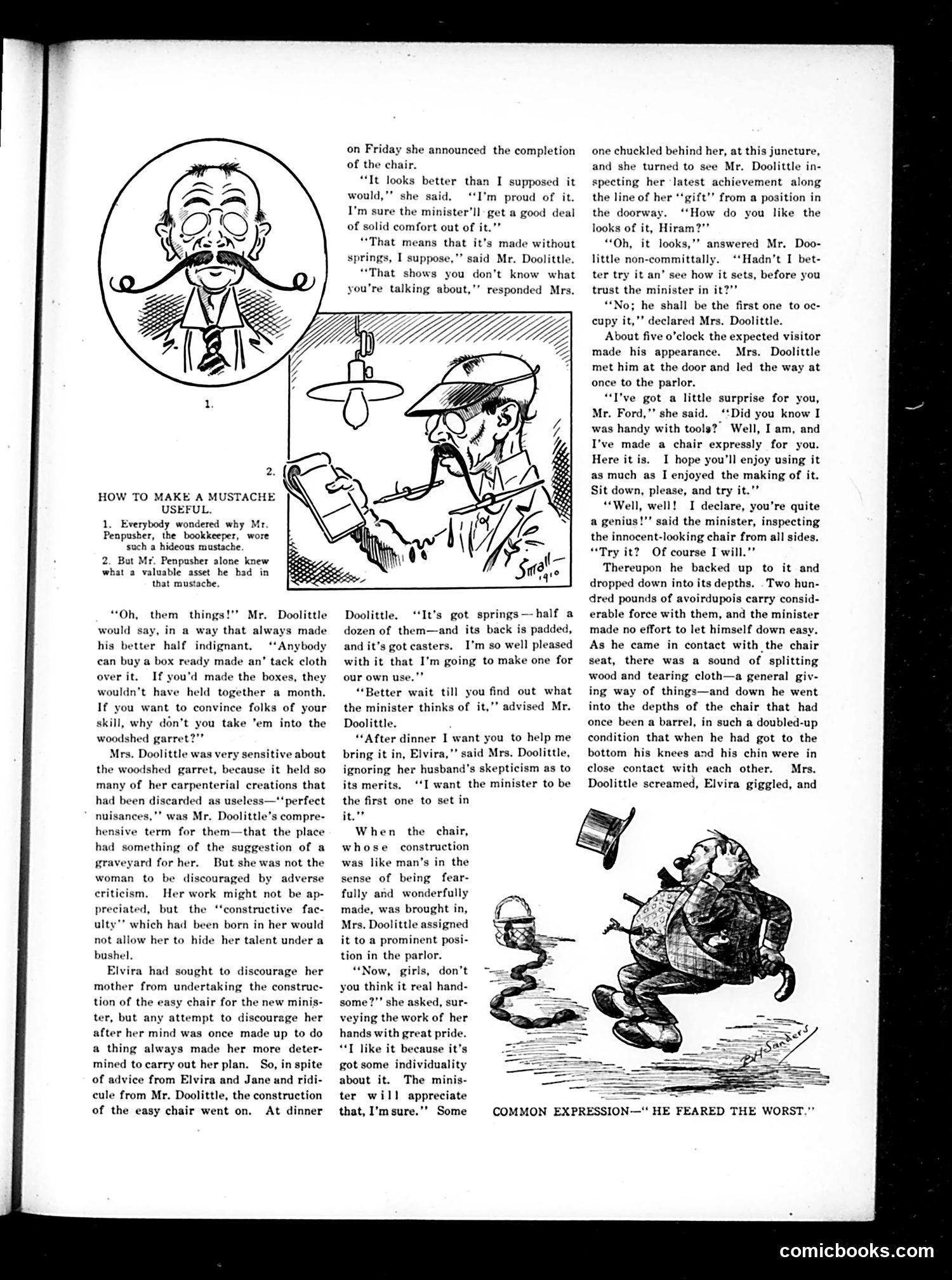
This page presents a humorous domestic story about Mrs. Doolittle's homemade furniture project. The top illustration labeled "How to Make a Mustache Useful" shows a bookkeeper (Mr. Penpusher) whose prominent mustache becomes a practical tool—he uses it to hold things. The main story satirizes well-intentioned but poorly-executed craftsmanship. Mrs. Doolittle, despite her husband's skepticism, builds an "easy chair" for the new minister using springs, padding, and casters. The humor centers on the gap between her pride in the work and Mr. Doolittle's doubts about its safety and construction quality. He warns her to test it first, but she insists the minister use it untested—setting up an expectation of comedic disaster. The satire targets both amateur carpentry and domestic friction: the husband's resigned tolerance of his wife's "constructive faculty" (which fills their woodshed with failed projects), and her stubborn determination despite criticism. The bottom illustration shows the chair apparently collapsing or malfunctioning catastrophically—the joke's punchline delivered visually.
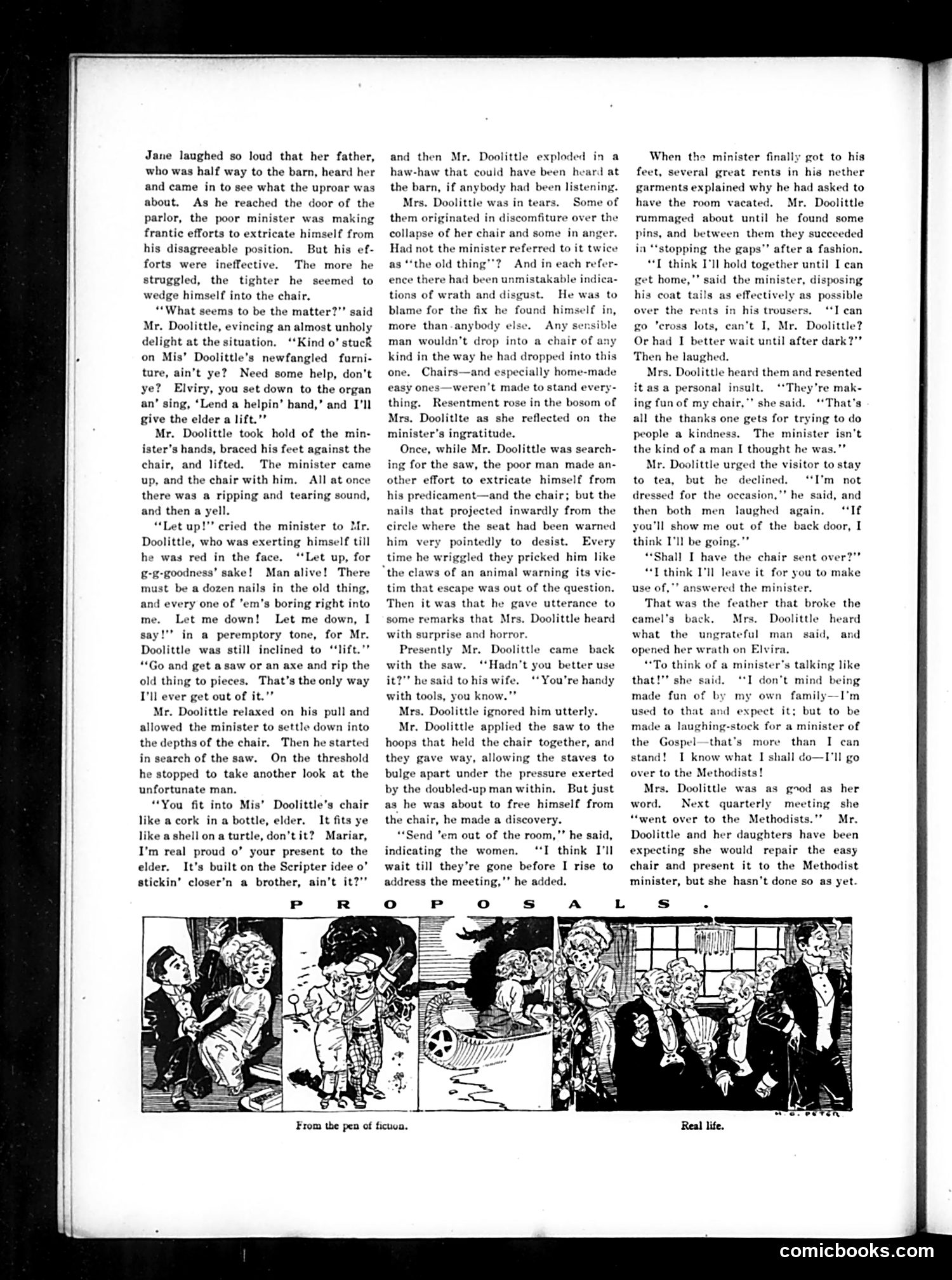
This page depicts a humorous domestic scene from what appears to be a serialized story. A visiting minister becomes trapped in Mrs. Doolittle's new chair—an awkwardly constructed piece of furniture with protruding nails. The satire targets both rural life and domestic pretension: Mr. Doolittle takes comedic delight in the minister's predicament, while Mrs. Doolittle grows offended when the trapped clergyman, in pain, utters profanities she overhears—despite his distress being caused by *her* gift to him. The joke relies on early 20th-century contrasts between rustic practicality (Mr. Doolittle's crude humor) and middle-class respectability (Mrs. Doolittle's wounded pride over the "ungrateful" minister's language). The accompanying comic panels below labeled "From the pen of fiction" and "Real life" suggest the story illustrates how fiction mirrors actual domestic absurdities.
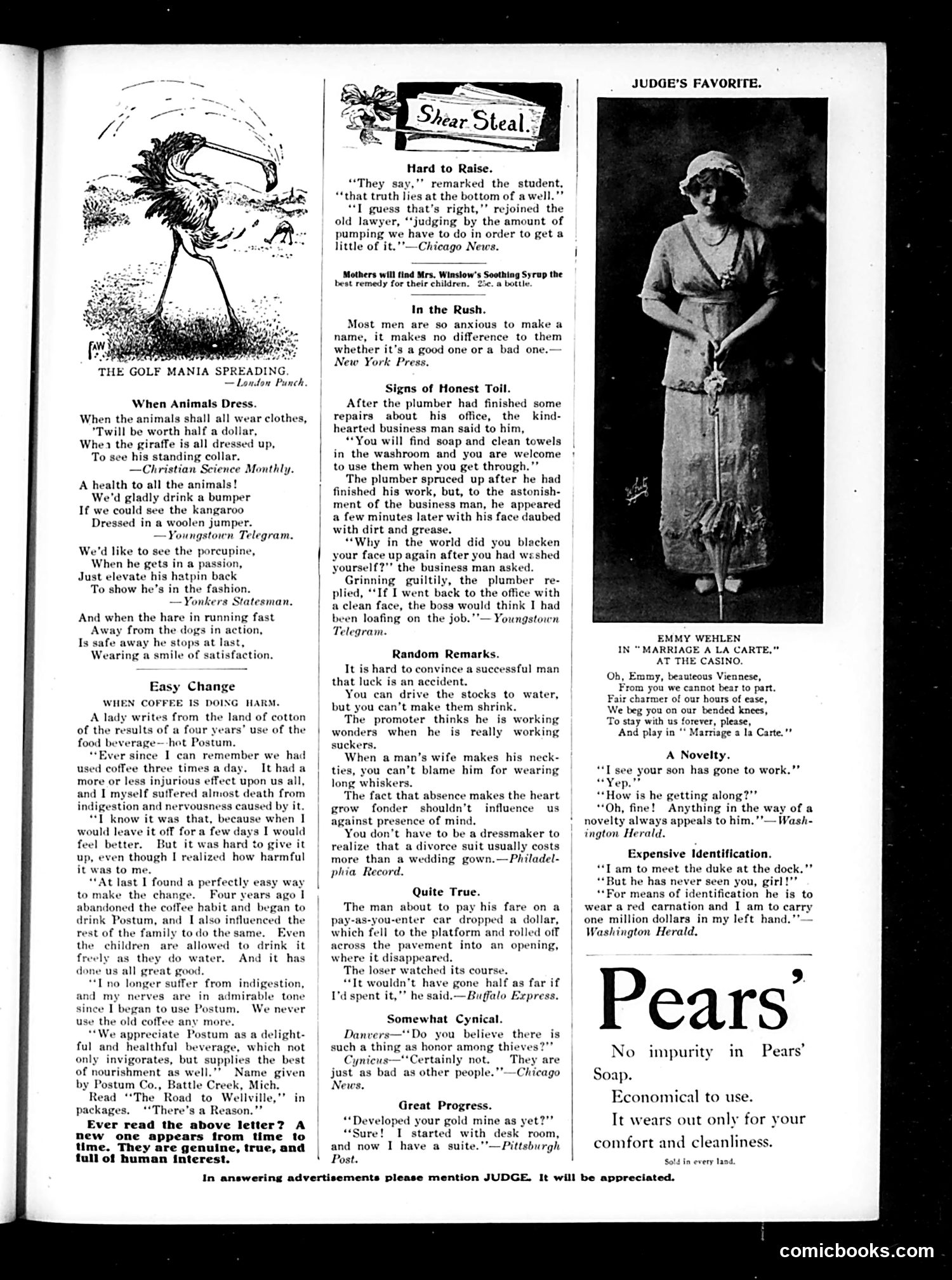
This Judge magazine page from the early 1900s contains several humor pieces satirizing contemporary American life. **The main cartoon** depicts a thin, wild-haired figure in exaggerated mid-swing during golf, captioned "The Golf Mania Spreading" (crediting London Punch). The satire mocks golf's explosive popularity among the middle and upper classes—the sport had become fashionable in America only recently, and the cartoon ridicules both the obsessive enthusiasm it inspired and golfers' comically undignified appearance while playing. **Supporting verses** humorously imagine animals wearing human clothes and fashion accessories, continuing this theme of absurd social pretension. **"Signs of Honest Toil"** satirizes working-class anxieties: a plumber deliberately dirties his face after cleaning up so his boss won't think he's been loafing—mocking both workplace suspicion of workers and the irony that honest labor requires visible grime as proof. Other brief jokes target divorce costs, ambitious social-climbers, and coffee health claims (via advertisement). The page reflects early-1900s concerns: class anxieties, new leisure activities, and labor tensions.
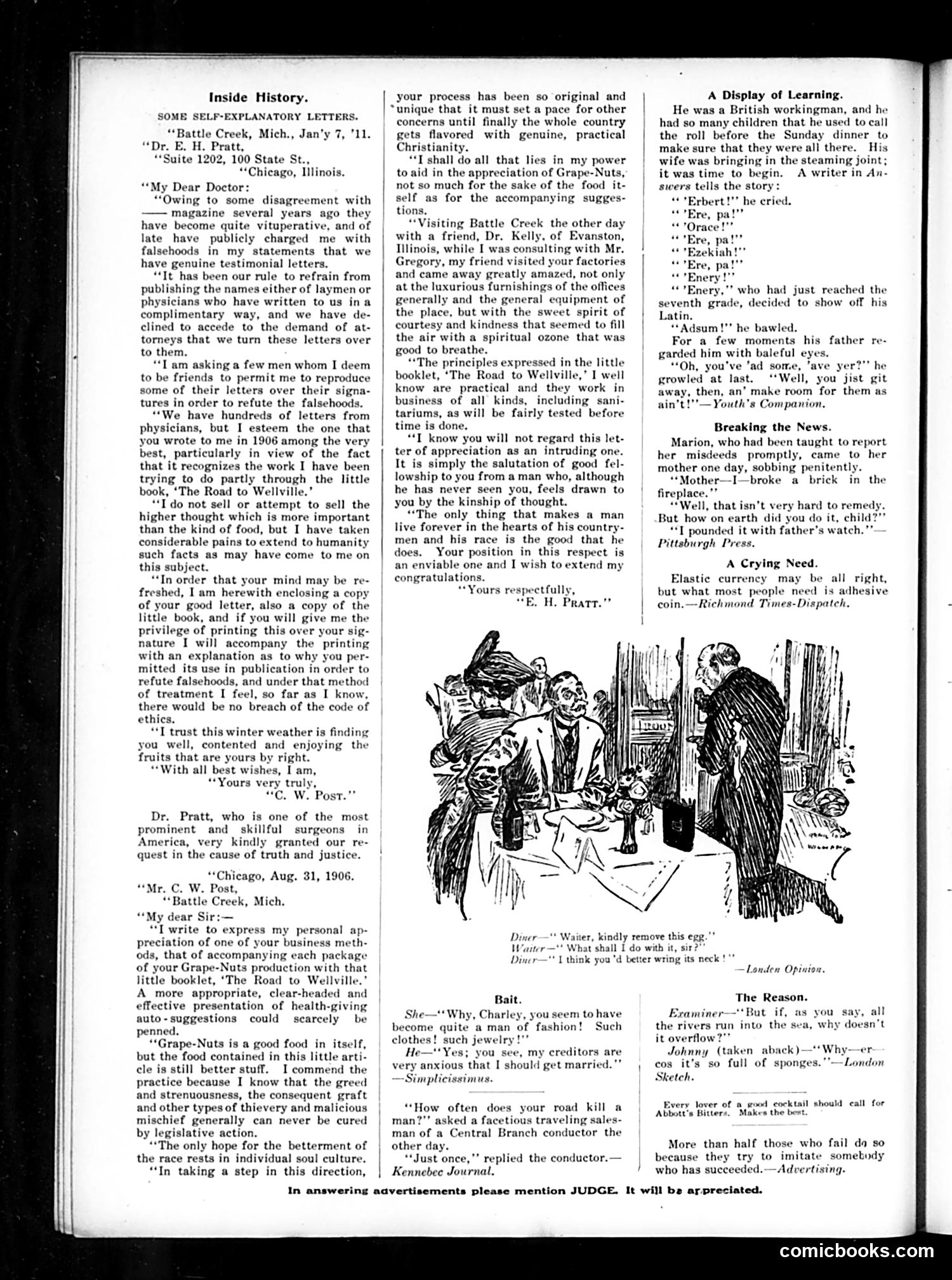
This page features correspondence between C.W. Post (the Grape-Nuts cereal founder) and Dr. E.H. Pratt, a prominent surgeon. Post is publishing the doctor's 1906 testimonial letter to defend against magazine accusations that his health claims and customer testimonials are fabricated. The satire targets Post's marketing practices: he solicits endorsements from respected professionals (like surgeons) and packages them with promotional booklets ("The Road to Wellville") that make quasi-spiritual health claims. Post frames this as promoting "individual soul culture" rather than mere commerce. The cartoon below shows a dining scene, likely mocking the pretentious pseudo-scientific health messaging accompanying food products—a common target of Judge's satire on dubious health claims and manipulative advertising. The irony: Post uses a published letter *defending* against charges of using fake testimonials as *proof* the testimonials are genuine.
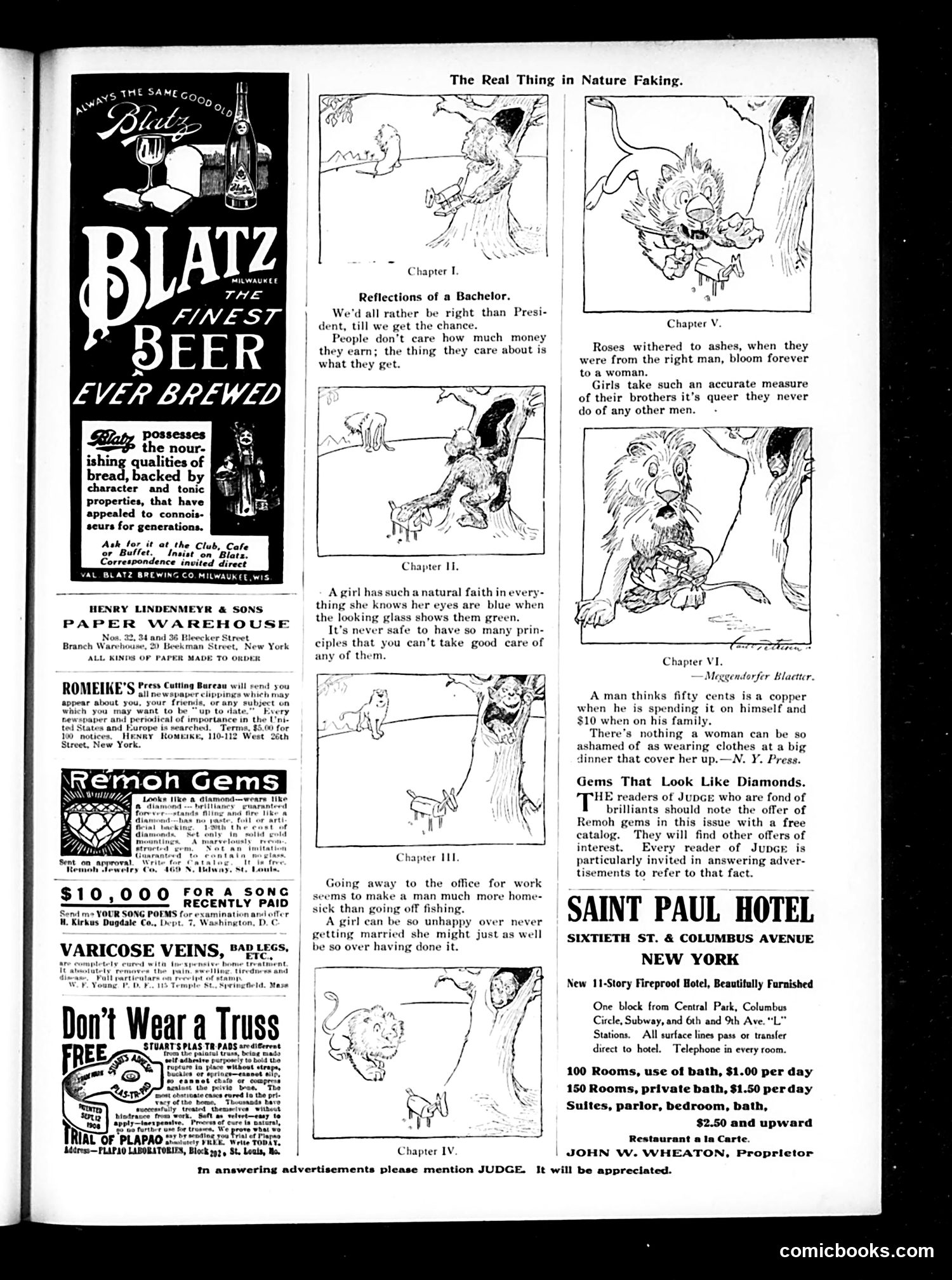
This page features a serialized humor series titled "Reflections of a Bachelor," comprising six illustrated chapters with witty aphorisms about relationships and human nature. The cartoons depict domestic scenes—couples, romantic moments, and everyday life—rendered in simple line drawings. The accompanying text offers satirical observations: women's self-deception about their appearance, the impracticality of excessive principles, men's financial hypocrisy, and women's dating preferences. The title "Nature Faking" likely references early-1900s debates about authenticity in literature and illustration versus sentimentalized portrayals. Here, the cartoons humorously expose the gap between how people *think* they behave versus reality—particularly gender dynamics and self-awareness. The page is otherwise filled with period advertisements (beer, hotels, medical services), typical of Judge magazine's format.
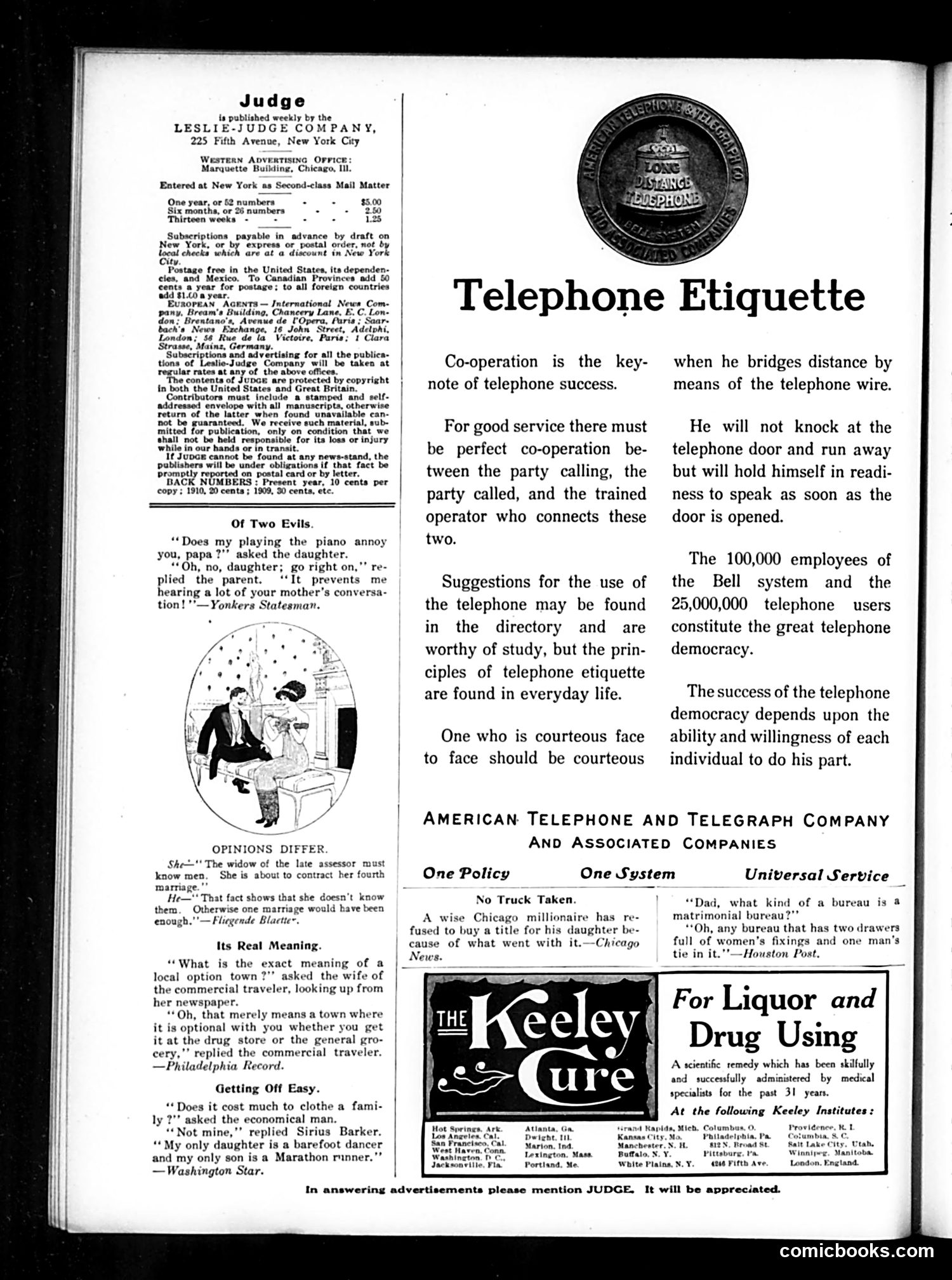
This page is primarily a magazine table of contents and advertising, not a political cartoon. The main content is: **"Telephone Etiquette"** — A sponsored article by American Telephone & Telegraph promoting proper telephone manners as civic duty. It frames telephone use as a "telephone democracy" requiring mutual cooperation between callers, recipients, and operators. **Small humor pieces** fill the left column (jokes about piano-playing, remarriage, "local option" towns, and family budgeting) — these are standard period comedy filler, not satire. **The cartoon** — A small illustration accompanies "Of Two Evils," showing a domestic scene where a father welcomes his daughter's piano-playing because it drowns out his wife's conversation. This reflects common early-20th-century humor about marriage and domestic annoyance. The page reflects *Judge* magazine's mix of lighthearted jokes, advertising, and genteel humor for middle-class readers. There is no significant political content or social commentary visible here.
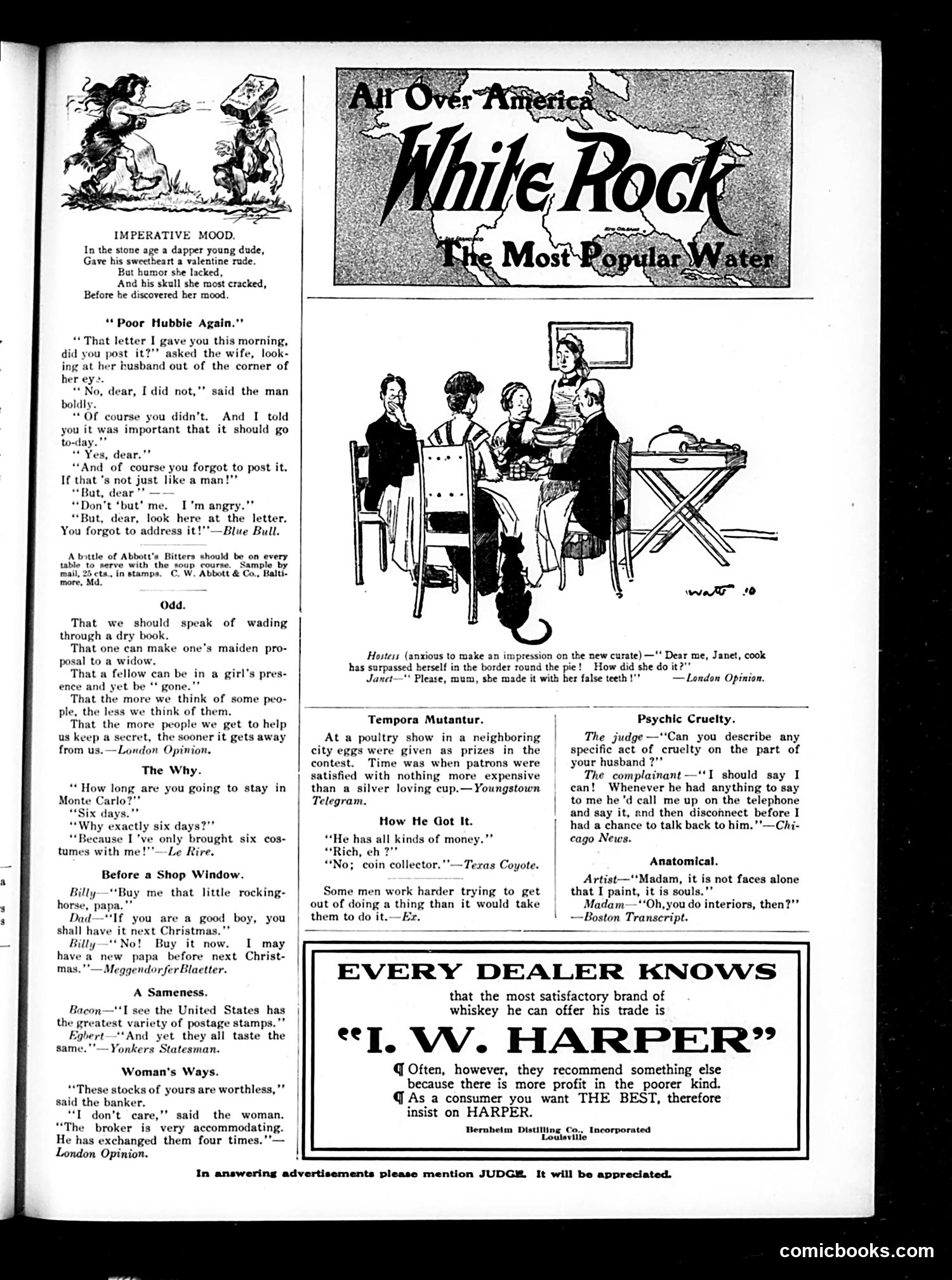
This page from Judge contains several short humorous pieces typical of early 20th-century American satire: **"Poor Hubbie Again"** mocks married life—a wife accuses her husband of forgetting to post an important letter, but he points out she forgot to address it, reversing her complaint. **"Imperative Mood"** offers philosophical observations (e.g., "That the more we think of some people, the less we think of them"), a common format for the era's humor. **"Psychic Cruelty"** satirizes emerging divorce proceedings, where a wife complains her husband hangs up the telephone before she can respond—a modern form of marital rudeness. The page also includes lighter jokes about Monte Carlo vacations, postage stamps, and a curate's dinner party mishap. The large **I.W. Harper whiskey advertisement** dominates the lower half, claiming dealers know it's the best but recommend cheaper brands for profit—a cynical commentary on business ethics. The overall tone reflects Belle Époque-era concerns: marriage frustrations, social climbing, and commercial dishonesty.
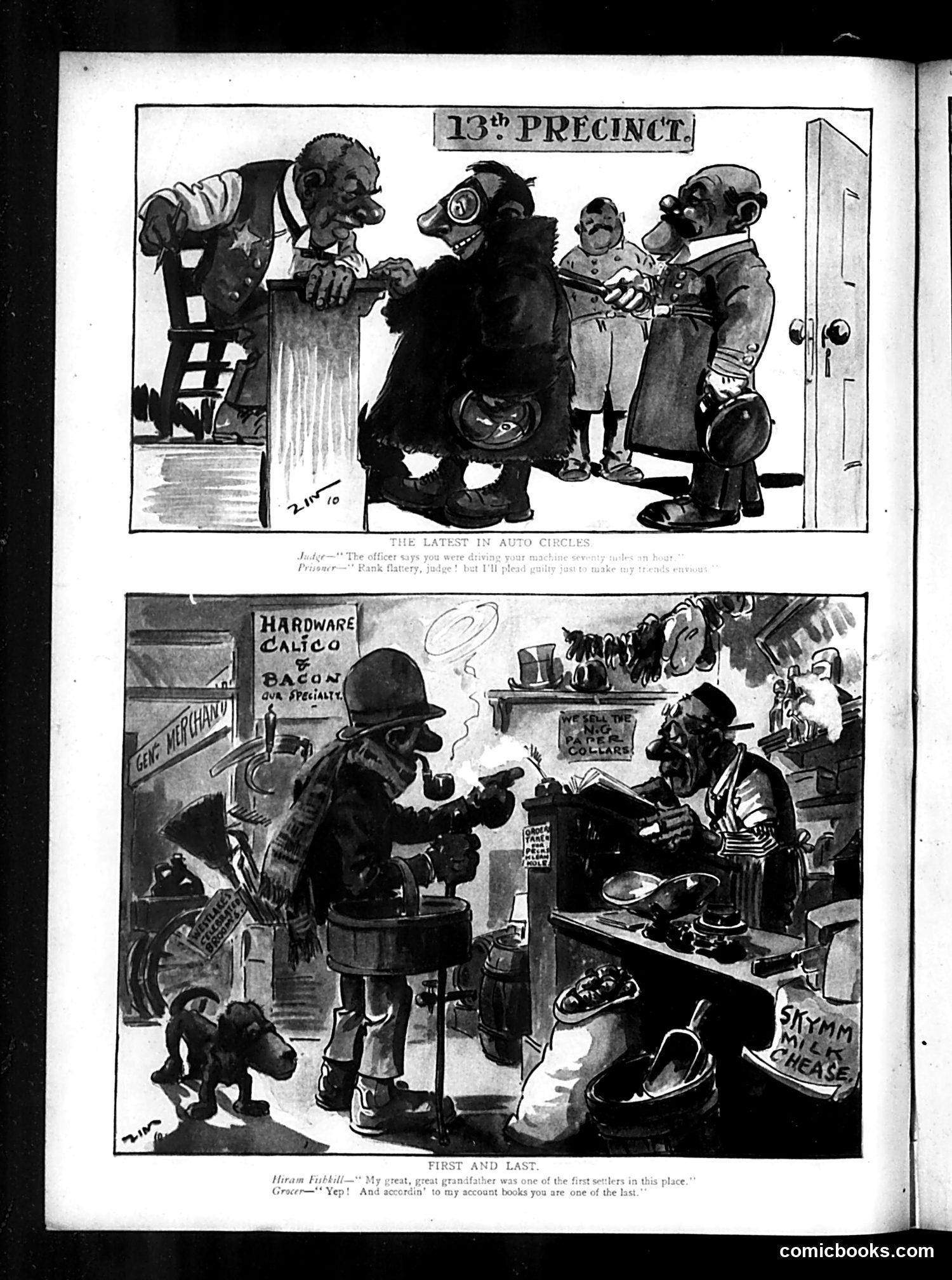
This page contains two satirical cartoons using racist caricatures typical of early 20th-century American humor. **Top cartoon ("The Latest in Auto Circles"):** Depicts what appear to be caricatured Black figures around a police station, mocking automobile-related crime or traffic violations in urban precincts. **Bottom cartoon ("First and Last"):** Shows a hardware store scene where an older figure claims his grandfather was "one of the first settlers in this place," while a younger character responds that the older man is "one of the last"—likely satirizing changing urban demographics or displacement. Both rely on dehumanizing visual stereotypes standard to Judge's era. The humor targets immigrants, working-class communities, and racial minorities through exaggerated features and implied criminal or social incompetence. These cartoons reflect deeply prejudiced attitudes normalized in early American satirical publishing.