
Judge, 1911-02-04 · page 9 of 24
Judge — February 4, 1911 — page 9: what you’re looking at
What you’re looking at
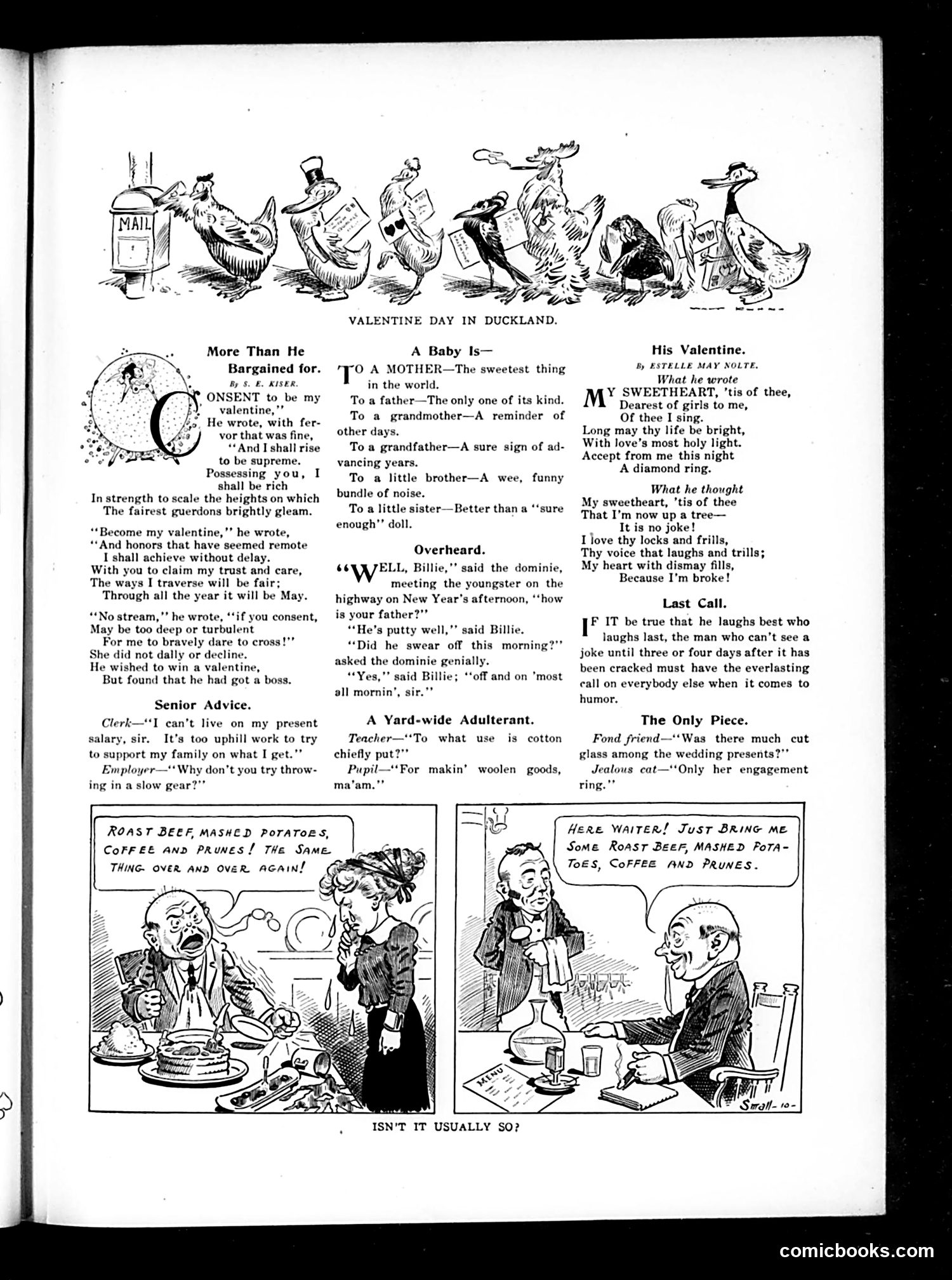
This page from Judge presents several humorous takes on romance and marriage, reflecting early-20th-century social attitudes. **Top illustration**: "Valentine Day in Duckland" depicts anthropomorphic ducks exchanging valentines—a whimsical framing device for the issue's romantic content. **Main content**: Multiple short pieces mock romantic idealization: - "More Than He Bargained For" satirizes a man's flowery marriage proposal; the punchline—he expected a devoted wife but "got a boss"—reflects anxieties about female independence and changing gender dynamics. - "His Valentine" contrasts what he *writes* (flowery devotion, diamond ring) versus what he *thinks* (he's financially ruined), mocking both romantic pretense and marital financial strain. - Bottom cartoons humorously depict marital dissatisfaction and domestic routine ("Roast beef, mashed potatoes... the same thing over and over"). The overall theme: marriage transforms romantic fantasy into mundane, sometimes burdensome reality. The humor targets both male naïveté and female assertiveness—typical satirical concerns of the era.
📄 Transcribed text from this page (OCR, searchable)
Machine-transcribed from the original scan — historical spelling and the odd misread are preserved.
More Than He Bargained for. By S. B. KISER, ONSENT to be my ’ valentine,’” He wrote, with fer- vor that was fine, “And I shall rise to be supreme. Possessing you, I shall be rich In strength to scale the heights on which The fairest guerdons brightly gleam. “Become my valentine,’ he wrote, “‘And honors that have seemed remote I shall achieve without delay. With you to claim my trust and care, The ways I traverse will be fair; Through all the year it will be May. “No stream,’’ he wrote, ‘‘if you consent, May be too deep or turbulent For me to bravely dare to cross!’" She did not dally or decline. He wished to win a valentine, But found that he had got a boss. Senior Advice. Clerk—“I can't live on my present salary, sir. It’s too uphill work to try to support my family on what I get."" Employer—‘* Why don't you try throw- ing in a slow gear?” ROAST BEEF, MASHED POrAToes, VALENTINE DAY IN DUCKLAND. A Baby Is— ‘yO A MOTHER—The sweetest thing in the world. To a father—The only one of its kind. To a grandmother—A reminder of other days. To a grandfather—A sure sign of ad- vancing years. To a little brother—A wee, bundle of noise. To a little sister—Better than a ‘‘sure enough”’ doll. funny Overheard. SOWELL, Billie,’’ said the dominie, meeting the youngster on the highway on New Year's afternoon, ‘“‘how is your father?’ “He's putty well,”’ said Billie. “Did he swear off thi: ly. off and on 'most morning? asked the dominie ge “Yes,” said Billie; all mornin’, sir.” A Yard-wide Adulterant. Teacher—'‘To what use is cotton chiefly put? Pupil—For makin’ ma‘am.”" woolen goods, His Valentine. by ESTELLE MAY NOLTE. What he wrote Y SWEETHEART, ’tis of thee, Dearest of girls to me, Of thee I sing. Long may thy life be bright, With love’s most holy light. Accept from me this night A diamond ring. What he thought My sweetheart, ’tis of thee That I’m now up a tree— It is no joke! I love thy locks and frills, Thy voice that laughs and trills; My heart with dismay fills, Because I'm broke! Last Call. FF IT be true that he laughs best who laughs last, the man who can’t see a joke until three or four days after it has been cracked must have the everlasting call on everybody else when it comes to humor. The Only Piece. Fond friend—Was there much cut glass among the wedding presents?” Jealous cat—‘Only her engagement ring.”’ ISN'T IT USUALLY SO? Here WAITER! Just BRING ME Some Roasr BEEF, MASHED FoTAa- ToES, CoFFEE AND PRUNES. comicbooks.com